The silver porgy (Diplodus argenteus) of the Sparidae is an occasional cleaner of two species of fish in the south-west Atlantic (Sazima, Reference Sazima1986; Krajewski, Reference Krajewski2007). In a recent overview of fish that clean sea turtles (Sazima et al., Reference Sazima, Grossman and Sazima2010), 18 reef fish species in seven families are recorded as cleaners/grazers of epibionts of three turtle species of the Cheloniidae. Nine of these fish species (50%) are recorded for the south-west Atlantic (Sazima et al., Reference Sazima, Grossman and Sazima2010). The only sparid recorded associated with sea turtles is the sheepshead bream (Diplodus puntazzo), cleaning the loggerhead turtle (Caretta caretta) in the Mediterranean Sea off Greece (Schofield et al., Reference Schofield, Katselidis, Dimopoulos, Pantis and Hays2006). We record herein for the first time a sparid (Diplodus argenteus) associating with green turtles (Chelonia mydas) and cleaning their carapaces in the south-west Atlantic.
Field work was conducted at the rocky shores of Arvoredo Island (about 27°17′S 48°18′W), off Santa Catarina, southern Brazil. From 2004 to 2008, 334 SCUBA and snorkelling dives (227 hours) at depths 0.5–17 m were conducted in bays of Arvoredo Island, totaling 23 hours of direct underwater observation of turtle behaviour. Ad libitum and ‘behaviour’ samplings (Martin & Bateson, Reference Martin and Bateson1986) of general behaviours of focal animals were recorded in sessions that lasted 1–30 minutes. When a cleaning behaviour was sighted, both the turtle and the fish had their sizes estimated (curved carapace length (CCL) and total length (TL), respectively). One cleaned turtle was caught after a cleaning session to collect a sample of epibionts from the spot where the fish were feeding. Only immature individuals of the green turtle were recorded at the shores of Arvoredo Island, which seem to present a degree of residency at this protected area (Reisser et al., Reference Reisser, Proietti, Kinas and Sazima2008).
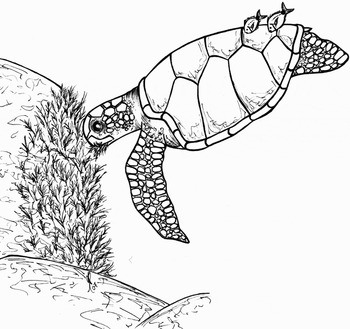
Silver porgy (Diplodus argenteus) juveniles 3–4 cm TL were observed repeatedly biting at the carapaces of green turtles (Chelonia mydas) 30–60 cm CCL on five occasions. One to two juvenile fish individuals feeding on the same turtle were recorded (Figure 1). The cleaned turtle was either swimming slowly in the water column (N = 2) or hovering while feeding on red algae (Pterocladiella capillacea) belts on rocky reefs (N = 3).
Two juvenile silver porgies (Diplodus argenteus) grazing on epibionts on the carapace of an algae-foraging green turtle (Chelonia mydas) at Arvoredo Island, off southern Brazil. Drawing by Maíra Proietti.

The epibionts scraped from the green turtle were mostly Cyanobacteria (blue green ‘algae’) of the Chroococalles, both colonial (63.1%) and unicellular (27.6%), and Oscillatoriales including Lyngbya sp. (4.6%). Chlorophyta (green algae) comprised 3.7%, and the remaining microorganisms found on the carapace were Bacillariophyta (diatoms, 0.7%), and Ciliophora, Vorticellidae (ciliates, 0.2%). Juvenile porgies are omnivores that feed on benthic invertebrates, seaweeds, and zooplankton (Sazima, Reference Sazima1986; Carvalho-Filho, Reference Carvalho-Filho1999), and most likely benthic microorganisms and epibionts such as those listed above are part of the diet of the small juveniles we recorded cleaning green turtles. Our findings are consistent with a study of the diet of the silver porgy in the same general area we conducted our observations (Dubiaski-Silva & Masunari, Reference Dubiaski-Silva and Masunari2004).
Juvenile silver porgies are able to change their cleaning stations while servicing fish (Krajewski, Reference Krajewski2007), which is consistent with our observations of sea turtle cleaning. Our records, although admittedly few (N = 5) demonstrate that juvenile porgies are able to move along with slowly swimming turtles, and that they join green turtles at their feeding grounds. Reef fish cleaning sea turtles has been claimed to be a localized phenomenon, restricted to particular populations and/or individuals (Losey et al., Reference Losey, Balazs and Privitera1994). However, data from literature and the present study indicate that reef fish that graze on, clean, or use sea turtles as feeding grounds otherwise, are more common than the available records would indicate (Sazima et al., Reference Sazima, Grossman and Sazima2010).
ACKNOWLEDGEMENTS
We thank Patadacobra Diving and the Brazilian Navy for logistic support, and all the personnel involved in data collection. We also thank Clarisse Odebrecht for identification of the epibionts. Three anonymous referees helped to improve the paper. M.P. and J.R. received scholarships from the CNPq (National Council for Technological and Scientific Development—Brazil), and I.S. had a grant from the CNPq at the period of this study.