Studies of morphological development are gradually assembling a picture of how and when children become sensitive to affixes in spoken and written language. However, to date, relatively few studies have compared the course of development of derivational skills in different languages. Therefore, in this article, we present some observations about the issues inherent in comparing knowledge about derivational morphology in two European languages, French and English, together with a cross-linguistic study of growth in awareness of derivational suffixes.
THE SYSTEMS OF DERIVATIONAL MORPHOLOGY IN FRENCH AND ENGLISH
Derivational morphology refers to a linguistic system for forming a new word from an existing word or word root. The major mechanism in the derivational process is the addition of an affix to the existing word, either through prefixation or suffixation, with the result that languages can contain sets of related word forms that have been derived from the same base (English [grace]: gracious, disgrace; French [grâce]: gracieux, disgrâce). Word formation can also be accomplished via the process of compounding whereby two or more lexemes are joined together (e.g., English: windscreen; French: pare-brise), although this process is more typical of Germanic than Romance languages (Bauer, Reference Bauer2003).
With over 80% of the French vocabulary originating from Latin, word forms obtained by derivation are far more numerous than those obtained by compounding. Approximately 170 suffixes exist in French, although there is a wide variation in their productivity with many being confined to scientific or technical terminology. Derivation is less prevalent and less productive in English because of the language's Germanic roots. Nevertheless, English has also been greatly influenced by French and LatinFootnote 1 and, as a result, has acquired a large number of affixes. However, no more than 50 suffixes could be said to be in common use because many suffixes of Latin or Greek origin are characteristic only of the literate lexicon (Crystal, Reference Crystal2003).
Lexical stress further differentiates the word formation systems in the two languages. Syllables that are stressed are thought to have a greater perceptual salience, which may be exploited during spoken word recognition (Cutler & Clifton, Reference Cutler, Clifton, Bouma and Bouwhuis1984; Pitt & Samuel, Reference Pitt and Samuel1990; Vihman, Nakai, DePaolis, & Halle, Reference Vihman, Nakai, DePaolis and Halle2004). Therefore, the fixed pattern of final stress in French words may serve to enhance the salience of derivational suffixes, whereas the stress pattern of English may act to deemphasize suffixes because final stress is comparatively rare in English (Delattre, Reference Delattre1965). In addition, many common English suffixes that have been imported from French or Latin, impose a phonological change in the lexical stress of the base word that renders the derivation phonologically “opaque” (e.g., captive vs. captivity). The vowel reduction that occurs in unstressed syllables in English (but not in French) heightens the opacity of such pairs (Dauer, Reference Dauer1983).
Thus, the French and English derivational systems differ on some of the key aspects that have been identified as guiding the development of knowledge about derivational morphology across languages, namely, phonological transparency and productivity (Carlisle, Stone & Katz, Reference Carlisle, Stone and Katz2001; Casalis, Colé, & Sopo, Reference Casalis, Colé and Sopo2004; Clark, Reference Clark1993). However, despite these differences, studies of adult processing document sensitivity to morphemes in both languages. For example, evidence from studies using the word order competition technique, which induces speech errors by requiring intermittent reordering during reading aloud, supports a morphological account of the treatment of affixes as units in this task rather than competing explanations framed in terms of semantic or phonological overlap (Melinger, Reference Melinger2003; Pillon, Reference Pillon1998). Other evidence from visual masked priming in lexical decision appears consistent with a morphological decomposition process that occurs early in visual word recognition and that is independent of semantic factors (Longtin, Seguí, & Halle, Reference Longtin, Seguí and Halle2003; Rastle, Davis, & New, Reference Rastle, Davis and New2004). Although a full review of the debate concerning the involvement of morphemes in adult speech production and visual word recognition is beyond the scope of the present study, this work at least, which has been conducted in parallel in English and French, is consistent with models in which a morphological level of structure has developed in the representation of complex words (e.g., Dell, Reference Dell1986; Taft, Reference Taft1994).
THE DEVELOPMENT OF METALINGUISTIC KNOWLEDGE
In developmental work, the acquisition of knowledge about derivational morphology has been investigated through observational studies of early language use and empirical investigations of morphological knowledge in oral language and reading tasks. This body of evidence, which is more extensive in English than in French, suggests that morphological knowledge develops over a lengthy time span, showing a marked growth between Grades 1 and 6 but continuing to improve throughout adolescence and into adulthood (Anglin, Reference Anglin1993; Derwing & Baker, Reference Derwing, Baker, Fletcher and Garman1979; Mahony, Singson, & Mann, Reference Mahony, Singson and Mann2000; Singson, Mahony, & Mann, Reference Singson, Mahony and Mann2000). A developmental trend for greater explicitness in knowledge about derivations was also noted by Anglin (Reference Anglin1993, p. 144), which ties in with the increasing element of metacognitive “awareness” that has been observed more generally in relation to language development (Clark, Reference Clark, Sinclair, Jarvella and Levelt1978; Gombert, Reference Gombert1992; Karmiloff-Smith, Reference Karmiloff-Smith1986, Reference Karmiloff-Smith1992; Valtin, Reference Valtin, Downing and Valtin1984).
A limiting aspect of implicit knowledge about language according to the representational redescription model proposed by Karmiloff-Smith (Reference Karmiloff-Smith1986, Reference Karmiloff-Smith1992) is that it consists of independently stored representations of particular forms that are sufficient to produce accurate behavioral performance within the sphere in which they have been acquired, but that lack the flexibility to generalize to other situations because the relationships embedded within this implicit system are not themselves represented. A four-phase process of redescription is thus envisaged by Karmiloff-Smith to capture such relationships and to gradually make the information available both for generalization and ultimately for conscious manipulation and report. Broadly, the beginning and end points in this process appear akin to the procedural–declarative distinction referred to in other spheres (Browne, Reference Browne1997; Karmiloff-Smith, Reference Karmiloff-Smith1997), with the idea that by producing knowledge in a declarative or explicit format this knowledge will become more accessible to higher level cognitive processes. This would tie in with Anglin's (Reference Anglin1993) observations about the contribution that morphological problem-solving strategies make to vocabulary growth in later childhood.
Although Karmiloff-Smith (Reference Karmiloff-Smith1992) proposes that metalinguistic development is primarily endogenously driven, Gombert (Reference Gombert1992), in his reworking of the representational redescription model, has argued for a stronger influence of exogenous factors in determining change. Gombert regards the implicit phases as obligatory in normal language development but sees transition to the next phase of metalinguistic control as optional, and critically dependent upon the presence of a demand for this type of conscious control in the external environment. Learning to read is thought to be the likely catalyst for the emergence of metalinguistic knowledge about many different aspects of language. This feature of Gombert's (Reference Gombert1992) model has proved to be explanatory in relation to phonological awareness, as clear dissociations in the level of explicit awareness of rhyming and phonemic sounds have been observed during the first year of schooling according to whether children were exposed to reading instruction that emphasized phonemes or rhyme (Duncan, Seymour & Hill, Reference Duncan, Seymour and Hill1997, Reference Duncan, Seymour and Hill2000; Goswami & East, Reference Goswami and East2000).
Although the theories of Karmiloff-Smith and Gombert both draw upon ideas originally put forward by Piaget, the changes that take place during metalinguistic development are not stagelike alterations across domains but rather recurrent phase changes that are thought to work on different aspects (e.g., semantic, phonological, morphological) of the system independently. Consequently, a child may be at an implicit level of knowledge with respect to one component of language but at an explicit level of knowledge for another. Anglin's (Reference Anglin1993) observations from English suggest that explicit knowledge about derivational morphology might emerge between Grades 3 and 5, rather later than explicit knowledge about phonology, which has been observed as early as Grade 1 (Duncan et al., Reference Duncan, Seymour and Hill1997). However, the evidence is restricted to a slightly increased incidence of explicit strategies in defining derived words among older children. In the next section, work that has addressed the question of metamorphological development experimentally will be reviewed and related to other evidence about the development of sensitivity to derivational suffixes in English and French. Of particular interest is the question of whether metamorphological development might progress at different rates in French and English because of the differences in the systems of derivational morphology reviewed earlier.
DEVELOPMENTAL STUDIES OF METALINGUISTIC KNOWLEDGE ABOUT DERIVATIONAL MORPHOLOGY
Carlisle (Reference Carlisle and Feldman1995; Carlisle & Nomanbhoy, Reference Carlisle and Nomanbhoy1993) is one of the few authors to have considered morphological awareness within the framework of metalinguistic development provided by Karmiloff-Smith (Reference Karmiloff-Smith1986, Reference Karmiloff-Smith1992) and Gombert (Reference Gombert1992). Drawing upon these models, Carlisle constructed experimental tasks to distinguish different levels of metalinguistic knowledge about derivational morphology. She used a judgment task to assess more implicit (epilinguistic) skills because the minimal demand in judging the relatedness of spoken words appears close to a functional knowledge of language (e.g., “Are these words related: . . . teach–teacher?). Carlisle suggested that such tasks can be contrasted with tasks that contain a requirement for more explicit (metalinguistic) manipulation, and hence, the crucial element of conscious control over the derivational process, claiming that experimental production tasks (e.g., “Teach. My uncle is a _____ [teacher]”) fulfill this more explicit criterion. Her view is that the requirement to produce a derivation “to order” differs qualitatively from the spontaneous productions that have been observed in preschool language. As a result of administering contrasting tests of this kind, Carlisle (Reference Carlisle and Feldman1995) proposed that the transition from implicit to explicit awareness of derivational morphology takes place during the kindergarten and first-grade years because her findings indicated that children already had excellent implicit skills at this point and were demonstrating a growing ability to perform explicit tasks.
In reviewing the experimental findings, the work of Carlisle and colleagues will be discussed in conjunction with similar studies in the literature for comparative purposes. Several of these studies have examined morphological awareness solely in relation to the English suffix -er, and those using the more implicit judgment task have reported high accuracy rates (88%) among 6-year-olds (Carlisle, Reference Carlisle and Feldman1995; Carlisle & Nomanbhoy, Reference Carlisle and Nomanbhoy1993). Accuracy in the more explicit production task have also been found to be very good (agentive = 91%, instrumental = 72%) in this age group (Clark & Hecht, Reference Clark and Hecht1982), although lower accuracy (agentive = 63%, instrumental = 35%) has been observed with nonlexical stimuli (Derwing & Baker, Reference Derwing, Baker, Fletcher and Garman1979). Nevertheless, other studies that have tested a wider range of suffixes imply that metamorphological development may be a more lengthy process. This work, which has tended to focus on older children, indicates that accuracy at oral relatedness judgments is still comparatively high at around 70% among 8-year-olds (Mahony et al., Reference Mahony, Singson and Mann2000). However, production accuracy rates show a marked decrease as a result of widening the stimulus base, with accuracy around only 40% for 6-year-olds (Carlisle, Reference Carlisle and Feldman1995) and lower if nonlexical stimuli are used: approximately 4% for preschool children and 30% for 6- to 8-year-olds (Derwing & Baker, Reference Derwing, Baker, Fletcher and Garman1979).
Although few published experimental studies exist in the French language, those that have appeared have assessed a wide range of derivational suffixes. In a relatedness judgment task, Colé, Royer, Leuwers, and Casalis (Reference Colé, Royer, Leuwers and Casalis2004) found near ceiling performance (83%) among their group of 6-year-olds. Casalis and Louis-Alexandre (Reference Casalis and Louis-Alexandre2000) administered a production task, similar to that used by Carlisle (Reference Carlisle and Feldman1995), to the same age group and showed that performance levels were lower and better with words (51%) than with nonwords (33%). However, these two studies are difficult to compare because Casalis and Louis-Alexandre used prefixes as well as suffixes, and evidence suggests that the two types of affix differ in nature in French (Giraudo & Grainger, Reference Giraudo, Grainger, Assink and Sandra2003). Later studies focused only on suffixes in the same type of production task and found a production accuracy rate for words of 76% for 7-year-olds (Casalis et al., Reference Casalis, Colé and Sopo2004) and a rate of approximately 50% for mixed word and nonword stimuli among 5-year-olds (Casalis & Colé, Reference Casalis and Colé2009).
The picture that emerges from this short overview of the literature is that production performance tends to lag behind judgment performance in early schooling in both French and English. This is consistent with the suggestion that the retrieval element of production requires a greater degree of metalinguistic skill than recognition or comprehension (Carlisle, Reference Carlisle and Feldman1995; Windsor, Reference Windsor1994). Production accuracy rates also appear to fall, especially in English, with the introduction of a range of suffixes, making it appear that the transition to metalinguistic awareness may be a more gradual and suffix-specific process than previously proposed.
In her seminal study, Berko (Reference Berko1958) maintained that the explicitness of any awareness task can be manipulated through the use of nonlexical stimuli, as this increases the demand for conscious control by testing knowledge of generalizable rules about morphology. She used oral descriptions of pictures to elicit suffix use. Thus, to elicit a diminutive suffix, the following example was used: “This is a wug . . . This is a very tiny wug . . . What would you call a very tiny wug?” This technique was later adopted by Derwing (Reference Derwing1976), who proposed that it was the learning of morphological rules that enabled a child to use suffixes “productively in the creation of new derived words of the same type (including overgeneralizations . . .)” (p. 40). It was noted in the review presented above that production accuracy decreased when nonlexical stimuli were introduced, which would be consistent with the presence of an increased explicit demand through this manipulation. Therefore, it appears possible that this technique could be a useful tool in assessing knowledge about derivational morphology, as it may offer the possibility of distinguishing the learning of specific instances of derived words from more sophisticated rule-based knowledge.Footnote 2
CROSS-LINGUISTIC COMPARISON OF AWARENESS OF DERIVATIONAL MORPHOLOGY
Although judgment and production skills are clearly emerging in both French- and English-speaking children during early schooling, cross-linguistic comparison of the rate of progress is difficult because of methodological differences between the English and French studies. For example, it is only in studies of older children (Grade 3 onward) that a broad range of suffixes tends to be examined in English, whereas in French a wide range of suffixes is typical, even in studies of preschool children. One question to be resolved is whether these methodological differences are simply coincidental or whether instead these differences reflect a response to differing rates of development for awareness of derivational morphology in the French and English languages.
Our attempt to gather evidence about this issue has been hampered by the lack of cross-linguistic data in the field. Comparison of metalinguistic development across languages provides an excellent opportunity to investigate the influence of native language on development, but although this technique has been used in studies of metaphonological development (e.g., Duncan, Colé, Seymour, & Magnan, Reference Duncan, Colé, Seymour and Magnan2006), it has never to our knowledge been applied to the study of derivational morphology. The nearest approximation that we can find to cross-linguistic experimental work is to compare two separate single-language studies that investigated awareness of equivalent suffixes in French and English using the same type of production task. The first study, by Clark and Hecht (Reference Clark and Hecht1982), examined the production of the -er suffix in English (e.g., “I've got a picture here of someone who burns things. What could we call someone who burns things? Someone who burns things is a _____?” [burner]); and the second, by Seidler (Reference Seidler1988Footnote 3), investigated the -eur suffix in French (e.g., “Comment pourrait-on appeler un homme qui cache de l'argent?” [cacheur], which can be translated as “What could you call a man who hides money?” [hider]). Each suffix performs a similar function in derivation, takes both agentive and instrumental forms, and is highly productive relative to other suffixes in the language. Clark and Hecht (Reference Clark and Hecht1982) reported English production rates for two age ranges 4 years, 6 months (4;6) to 5;2 and 5;3 to 6;0, which, when averaged, give an 84% accuracy rate for novel agentive nouns and 71% for novel instrumental nouns.Footnote 4 The accuracy rates among a comparable French group aged 4;7 to 5;11 in Seidler's study were slightly higher at 90% and 84%, respectively, despite the lack of picture support. Furthermore, the proportion of English speakers who showed consistent use of -er for both agents and instruments (58%) was smaller than the proportion of French children showing consistent use of -eur (75%).
Although the results show evidence of explicit morphological processing by both groups, a slight cross-linguistic difference in favor of the French-speaking children is also apparent. Nevertheless, the differences are small in magnitude making it difficult to draw any strong conclusions from these data. Another reason for caution is that both studies restricted their focus to just one, extremely productive suffix, which may be acquired atypically early in English (Clark, Reference Clark1993; Derwing, Reference Derwing1976).
THE PRESENT STUDY
Our aim in this cross-linguistic study is to begin to relate data on the development of morphological awareness to native language context, and by so doing to gain insight into the linguistic factors that drive the acquisition of derivational knowledge in English and French.
The first objective is to explore the evidence that a transition from implicit to explicit knowledge about derivational morphology takes place during the first year of schooling. Carlisle (Reference Carlisle and Feldman1995) provided evidence in support of this position, but our review of the literature suggests that this may be a more limited effect than first thought. One point of interest is whether the transition in morphological awareness may be largely restricted to the highly productive suffix that is most often studied in English, namely, -er. In the experimental work to follow, we widen the range of derivational suffixes examined in tasks based on those originally used by Carlisle, and we also explore the effect of heightening the explicit demands of the production task through the inclusion of nonlexical stimuli. The expectation is that the development of explicit morphological knowledge may be more advanced for the highly productive -er suffix (and for the equivalent -eur suffix in French) than for other derivational suffixes, for which metamorphological development may extend throughout the school years and may be partly dependent on reading acquisition (Mahony et al., Reference Mahony, Singson and Mann2000).
Although differing methodologies confuse the picture, existing single language studies suggest that French children may be slightly more advanced than their English-speaking peers in their knowledge about derivational suffixes, which would tie in with the greater productivity of derivation in French word formation. Therefore, our second objective is to begin to examine cross-linguistic differences in school-aged children's knowledge about derivational morphology through relating performance rates and error pattern in matched judgment and production tasks to native language. A difference in the educational system between France and the United Kingdom complicates this endeavor, as children begin school a year later in France (age 6 years) than in the United Kingdom (age 5 years). Therefore, we will make the cross-linguistic comparison in two ways by investigating metamorphological development in relation to (a) educational level in Experiment 1 (where chronological age necessarily differs between language groups), and (b) maturational level in Experiment 2 (where year of schooling necessarily differs between language groups).
EXPERIMENT 1
In this exploration of morphological development in relation to educational level, a cross-sectional analysis will be conducted in the first and third year of schooling in the United Kingdom and France. The introductory review identifies this period of early schooling as one of considerable interest in relation to the emergence of knowledge about derivational morphology (Anglin, Reference Anglin1993; Carlisle, Reference Carlisle and Feldman1995; Casalis & Louis-Alexandre, Reference Casalis and Louis-Alexandre2000). By assessing children in their first year of schooling, it is hoped to gain insight into the morphological skills that have developed largely during language acquisition in the preschool period and that are available to children early in their school careers. Examination of the older group of Grade 3 children is designed to explore the additional effects of longer term exposure to school-based language and reading instruction.
A recent meta-analysis of data from 827 children reported that morphological awareness shows a moderate correlation with vocabulary and reading between kindergarten and Grade 9 for alphabetic orthographies, including both French and English (Sénéchal & Kearnan, Reference Sénéchal and Kearnan2007). Such associations emphasize the need to match the language groups on vocabulary and reading progress and also point to the importance of considering the nature of the French and English derivational systems not only with respect to oral language but also in relation to the written form of each language. Although the French and English orthographies both have a morphophonological structure, there is a higher degree of opacity in the grapheme–phoneme correspondences underlying derivational relations in English (e.g., heal–health). Although some evidence suggests that morphological awareness can predict early reading skills in English (Carlisle, Reference Carlisle and Feldman1995; Carlisle & Nomanbhoy, Reference Carlisle and Nomanbhoy1993), these findings may have been mediated by vocabulary skills because other studies that have controlled for vocabulary and phonological awareness imply that awareness of derivational morphology makes a much later contribution to word decoding from Grade 5 onward (Carlisle, Reference Carlisle2000; Mahony et al., Reference Mahony, Singson and Mann2000; Nagy, Berninger & Abbott, Reference Nagy, Berninger and Abbott2006; Singson et al., Reference Singson, Mahony and Mann2000). Extension of this work led Mann and Singson (Reference Mann, Singson, Assink and Sandra2003) to propose that children in this older age range parse morphologically complex words into base and suffix to apply morphophonological rules to increase decoding accuracy in the irregular English orthography (see also Nagy et al., Reference Nagy, Berninger and Abbott2006).
In the more transparent French orthography, a rich set of connections between early morphological knowledge and early reading has been found. Kindergarten derivational skills have been shown to predict text reading and vocabulary skills in Grade 1 (Colé et al., Reference Colé, Royer, Leuwers and Casalis2004). These links have been shown to survive controls for vocabulary skill in a study by Casalis and Louis-Alexandre (Reference Casalis and Louis-Alexandre2000), in which kindergarten derivational skills predicted word decoding in Grade 2 and Grade 2 derivational knowledge was a concurrent predictor of both word decoding and reading comprehension.
Thus, in the experimental work to follow, the available evidence suggests that metalinguistic awareness of derivational morphology is likely to develop earlier and to be more influenced by early schooling in French than in English.
Method
Participants. The participants were drawn from schools in Scotland and France with a similar middle-income socioeconomic intake. Informed consent was obtained for children in the first (Grade 1) and third (Grade 3) year of schooling in each country and after testing on standardized tests of word recognition and receptive vocabulary (see Materials and Procedure subsection for details), language groups were formed that were well matched on these background measures. There were only 15 children in each group, and the small-sample size needs to be borne in mind in interpreting our later analyses because of low statistical power. The French children were native French speakers and the Scottish children were native English speakers. The average ages of the English-speaking groups were 6;1 in Grade 1 (range = 5;8–6;8) and 8 years in Grade 3 (range = 7;8–8;5). On average, the French language groups were aged 6;8 in Grade 1 (range = 6;5–7;3) and 8;8 in Grade 3 (range = 8;1–9;7). At each grade level, a t test showed that the French-speaking children were significantly older than the English-speaking children because of the different ages of formal schooling in each country: Grade 1, t (28) = 5.59, p < .001; Grade 3, t (28) = 4.59, p < .001.
Materials and procedure
BACKGROUND MEASURES. Receptive vocabulary was measured using the British Picture Vocabulary Scale in the United Kingdom (Dunn, Dunn, Whetton, & Pintillie, Reference Dunn, Dunn, Whetton and Pintillie1982) and the Échelle de Vocabulaire en Images Peabody in France (Dunn, Thériault-Whalen, & Dunn, Reference Dunn, Thériault-Whalen and Dunn1993). A receptive vocabulary test was used to obtain a base measure of the children's word knowledge without adding the extra dimension of explicit verbal analysis of the word's meaning that would be entailed in a test of expressive vocabulary. To assess word recognition, the British Abilities Scales word reading subtest (Elliot, Murray, & Pearson, Reference Elliot, Murray and Pearson1983) was used in the United Kingdom and the Alouette Test (Lefavrais, Reference Lefavrais1963) in France.Footnote 5 The background measures were always completed before the experimental tasks (lexical judgment, lexical production, nonlexical production), which were presented in a pseudorandomized order to ensure that the lexical version of the production task was always presented before the nonlexical version.
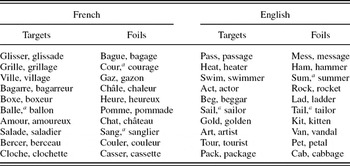
LEXICAL JUDGMENT TASK. This oral task (adapted from Mahony et al., Reference Mahony, Singson and Mann2000) asks children to decide whether two words do belong to the same morphological family (e.g., heat–heater) or do not (e.g., ham–hammer). In English, the children were told “In this game, I'm going to give you two words that are a little bit like each other. You have to tell me each time whether the words that I say are from the same family or not. Let's practice a little bit: kind and kindness, are they from the same family? Teach and teacher? Rob and robin?” The children were given corrective feedback about the answers for the practice items. At no point did the children see the words in written form. The format of the instructions and procedure was the same in French.
Words in both target and foil pairs were phonologically similar. The experimental items contained 10 target pairs and 10 foil pairs in each language and these were randomized for presentation to each child (see Table A.1 in Appendix A for stimuli).
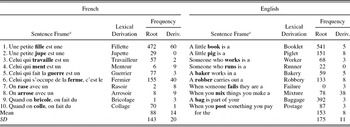
LEXICAL PRODUCTION TASK. In this oral task (adapted from Berko, Reference Berko1958) the children produce a derivation to close a sentence spoken by the experimenter. Both the root and the derivation were real words (e.g., Someone who runs is a . . . ? [runner]), and the phonological relationship between root and derivation was always transparent. The instructions given to the children were as follows: “You have to complete the sentences with a word from the same family as the one that I use. Someone who cleans is a . . . ? (cleaner). When you move you make a . . . ? (movement).” At no point did the children see the sentences in written form. Corrective feedback was given for the practice items and the instructions given to the children followed exactly the same format in each language.
The 10 sentence frames in each language were designed to elicit diminutive, agentive, instrumental, and collective/abstract derived forms in French and diminutive, agentive, locative, and collective/abstract forms in English (see Table A.2 in Appendix A for materials). These sentence frames were randomized for presentation to each child. Using the databases MANULEX (Lété, Sprenger-Charolles, & Colé, Reference Lété, Sprenger-Charolles and Colé2004) and CPWD (Stuart, Dixon, Masterson, & Gray, Reference Stuart, Dixon, Masterson and Gray2003), the mean frequency per million was calculated for all of the roots and derivations as they appear in the sentence frames (see Table A.2). There was no significant difference in the frequency of French and English roots, t (18) = 0.92, p > .05, or derivations, t (18) = 0.82, p > .05. In each language, roots were more frequent than derivations, significantly so in the case of English, t (9) = 2.61, p < .05, but not in French, t (9) = 1.87, p > .05.Footnote 6
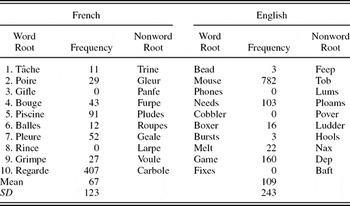
NONLEXICAL PRODUCTION TASK. This nonlexical version of the oral production task was designed to assess more explicit knowledge of derivational morphology by asking children to derive novel forms to order. The children were asked to construct novel (nonlexical) derivations from either a word root (e.g., Someone who needs is a . . .? [needer]) or a nonword root (e.g., Someone who lums is a . . . ? [lummer]). All of the items were designed to elicit nonexistent but plausible derivatives. Although the same sentence frames were used in both the lexical and nonlexical version of the production task, responses were not so highly constrained in the nonlexical version because the children could select any appropriate suffix in producing the derivation. For example, with a diminutive sentence frame like “A little feep is a . . . ?,” any of the diminutive suffixes (-y/-ie, -let) could have been used to form the nonlexical derivation (e.g., feepie, feeplet).
The nonlexical version of the production task was always administered after the lexical version, and the order of the word and nonword root conditions was counterbalanced. Within each condition the 10 sentence frames were randomized for presentation to each child. The instructions given to the children in the word root condition were the following: “You are going to do the same thing with the sentences that I give you but this time you have to make up new words which are like real ones. For example, if you had to make up a new word what would you call someone who wants something? Someone who wants something is a . . . ? When you park you make a . . . ?” For the nonword root condition the instructions were the following: “We're going to do the same thing but this time with made-up words. Even though the words aren't real you can still try to give them the right ending. Someone who groons is a . . . ? When you laip you make a . . .?” At no point did the children see the sentences in written form. Corrective feedback was given using the nonsense derivations “wanter,” “parkment,” “grooner,” and “laipment,” but any morphologically appropriate derivation made up by the child would be accepted as correct. The format of the instructions and procedure was the same in French.
The word and nonword roots used in this task are listed in Table A.3 in Appendix A. The word roots were matched for frequency per million between the languages, t (18) = 0.49, p > .05, and did not differ significantly in frequency from the roots used in the lexical production task in either French, t (9) = 0.33, p > .05, or English, t (9) = 0.48, p > .05.
CODING OF RESPONSES. A correct response in the lexical production task corresponded to a specific vocabulary item. Responses in the nonlexical production task, however, were less constrained because a child could generate an appropriate novel derivation using any one of a number of suffixes, all of which perform the same function in word formation. This potential for variation was incorporated into the scoring scheme by marking as correct any novel derivation that respected the semantic and syntactic constraints of the sentence frame. In practice, the variation in response turned out to be small in both French and English, and any alternative suffix usage was verified using guidance from the Oxford English Dictionary or the Trésor de la Langue Française in French.
The remaining responses in the production task were considered to be errors and were assigned to one of the categories in the following classification scheme. Actual error responses to the English item “A little mouse is a. . .?” (correct response: mouselet or mousie) are used to illustrate the scheme: (a) real word—a nonderived word that is semantically and syntactically appropriate (e.g., “vole”); (b) wrong suffix—derivation of the root using a suffix that is inappropriate in the context (e.g., “mouser”); (c) wrong root—derivation that uses an inappropriate root with either a correct or incorrect suffix (e.g., “tinser”); (d) compound—a compound form that involves the root from the sentence frame (e.g., “mini-mouse”); (e) repeat root (e.g., “mouse”); and (f) refusal. All of the remaining errors that were not classifiable according to this scheme were categorized as (g) other. This category consisted mainly of one-off error responses (e.g., “little”) and a small but noticeable number of phonological substitutions (e.g., “touse”).
The reliability of the coding schemes was obtained from two coders (native speakers) in each country who independently coded 20% of the data from their own language group. Interrater agreement rates were 94% in French and 96% in English. The remaining discrepancies were resolved by consensus.
Results
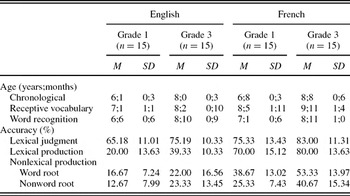
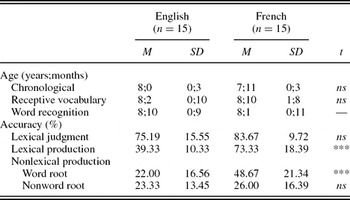
Means and standard deviations for the background measures and experimental tasks can be inspected in Table 1.Footnote 7
Experiment 1 means and standard deviations for performance ages on background measures and accuracy in the judgment and production tasks for each language group according to year of schooling

Background measures. Average performance in the word recognition and receptive vocabulary tests was found to be average or slightly above average for chronological age at each grade level in each country according to the age-normed scores (see Table 1). As the French children were older than the United Kingdom children at each grade level, the important language group comparison is not between absolute test ages but between test ages relative to chronological age. At Grade 1, analyses showed that reading and receptive vocabulary were ahead of age by a similar amount in each language group (reading, Mann–Whitney U = 107, p > .05; receptive vocabulary, Mann–Whitney U = 86.5, p > .05). Receptive vocabulary and reading age tended to be above chronological age in both language groups at Grade 3. However, the English speakers appeared to have better reading skills for chronological age then the French speakers (Mann–Whitney U = 62.5, p < .05), whereas the French children appeared to have a more advanced receptive vocabulary for age than the English speakers (Mann–Whitney U = 63, p < .05).
LEXICAL JUDGMENT TASK. Means and standard deviations are provided in Table 1. One-sample t tests indicated that the performance of each group was significantly above chance: English Grade 1, t (14) = 5.34, p < .001; English Grade 3, t (14) = 6.27, p < .001; French Grade 1, t (14) = 7.31, p < .001; French Grade 3, t (14) = 11.30, p < .001. A two-way between-participants analysis of variance (ANOVA) with Language (English, French) and School Year (Grade 1, Grade 3) factors showed significant main effects of Language, F (1, 56) = 7.21, p < .05, η2p = .11, and School Year, F (1, 56) = 6.98, p < .05, η2p = .11. The interaction of these factors was not significant (F < 1). The French children, who were a year older than their United Kingdom counterparts in each grade, consistently performed at a higher level but, importantly, both groups showed a similar degree of improvement with schooling.
LEXICAL PRODUCTION TASK. Table 1 contains means and standard deviations for each group. A two-way between-participants ANOVA with Language (English, French) and School Year (Grade 1, Grade 3) factors revealed significant main effects of Language, F (1, 56) = 174.49, p < .001, η2p = .76, and School Year, F (1, 56) = 18.26, p < .001, η2p = .25, but no interaction, Language × School Year, F (1, 56) = 1.85, p > .05. The French children performed most accurately and each language group showed a similar improvement between the first and third year of schooling.Footnote 8
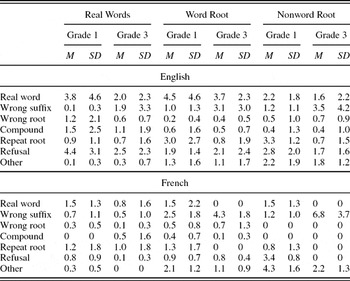
Error analysis. For the two school years in each country, the mean number of error responses for each error category was calculated by items in all three conditions of the production task (see Table 2). Inspection of the results reveals considerable variation between error categories in both groups and zero cells within the French data set. The zero cells may reflect the greater accuracy of the French group, resulting in a narrower range of errors. Strategic factors may also be at play as the older French children, for example, made no real word responses in either of the nonlexical conditions.
Experiment 1 mean number of error responses (/10) in the production task classified by grade level and error category for English and French items
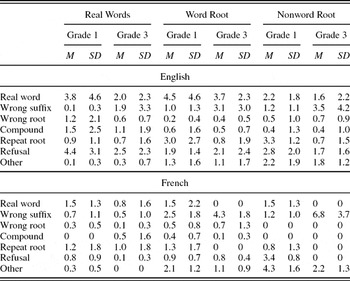
To be able to analyze the French data, separate analyses were conducted for each condition using only those error categories without zero cells. For lexical production, a two-way ANOVA with within-items factors School Year (Grade 1, Grade 3) and Error Type (real words, wrong suffix, wrong root, repeat root, refusals) found no significant effects, School Year, F (1, 9) = 4.00, p > .05; Error Type, F (4, 36) = 1.72, p > .05; School Year × Error Type (F < 1).
It was possible to include all error categories in the English error analysis for the lexical production task. The two-way ANOVA showed a significant main effect of school year, indicating that more errors were produced in Grade 1 than in Grade 3, F (1, 9) = 10.68, p = .01, η2p = .54. The Greenhouse–Geisser correction was necessary for the other effects: error type: F (3, 27) = 4.12, p < .05, η2p = .31; School Year × Error Type: F (2, 20) = 2.08, p > .05. A post hoc Tukey test (α = .05 throughout) was used to examine the significant effect of error type, but variation appeared to prevent any differentiation between the error categories.
NONLEXICAL PRODUCTION TASK. Performance levels were lower in this version of the production task, although the French children's scores still appeared higher than those of the English speakers (see Table 1). A three-way mixed ANOVA was conducted on the data with between-participants factors, Language (English, French) and School Year (Grade 1, Grade 3), and within-participants factor, Condition (word root, nonword root). There were significant main effects of Condition, F (1, 56) = 20.16, p < .001, η2p = .27, Language, F (1, 56) = 56.55, p < .001, η2p = .50, and School Year, F (1, 56) = 17.23, p < .001, η2p = .24. The interactions Condition × School Year, Language × School Year, and Condition × Language × School Year were not significant, F < 1, F (1, 56) = 1.60, p > .05, and F < 1, respectively, indicating that the language groups showed a similar improvement in production with schooling. However, the interaction Condition × Language, F (1, 56) = 13.36, p < .005, η2p = .19, was significant with simple effects revealing no difference between the word and nonword root conditions for the English-speaking children (F < 1) but a significant advantage for word over nonword roots, F (1, 56) = 33.18, p < .001, among the French children.
Error analysis. A two-way ANOVA was conducted on the French data from the word root condition of the nonlexical production task by restricting the error types to wrong suffix, wrong root, compound, refusals, and other. There was no effect of school year (F < 1), and use of the Greenhouse–Geisser correction was necessary for the other two effects: error type, F (3, 23) = 26.28, p < .001, η2p = .75; School Year × Error Type, F (2, 17) = 5.38, p < .05, η2p = .37. Simple effects indicated a significant differentiation between errors in each grade: Grade 1, F (2, 17) = 7.48, p < .01; Grade 3, F (2, 17) = 23.60, p < .001, which was followed up using Tukey tests. The pattern was one of increasing prominence of wrong suffix errors. In Grade 1, wrong suffix errors were equally as common as refusals and other errors, but could be differentiated from the least common categories wrong root and compound errors, whereas by Grade 3, wrong suffix errors were more frequent than any other error type. In the nonword root condition, only wrong suffix and other errors occurred at Grade 3, so the analysis was restricted to these types. The two-way ANOVA showed significant effects of school year, F (1, 9) = 6.62, p < .05, η2p = .42, and School Year × Error Type, F (1, 9) = 43.00, p < .001, η2p = .83, but no main effect of error type (F < 1). Simple effects revealed that other errors were more common than wrong suffix errors at Grade 1, F (1, 9) = 13.94, p < .01, but this pattern was reversed at Grade 3, F (1, 9) = 30.69, p < .001.
English errors (all categories) in the nonlexical production task were analyzed using a three-way mixed ANOVA with between-items factor Condition (word root, nonword root) and within-items conditions (school year, error type). The effect of Condition did not feature in any significant effects, showing that error responses were similar for both word and nonword roots. Once again, more errors were made in Grade 1 than in Grade 3, F (1, 18) = 16.46, p < .01, η2p = .48. The Greenhouse–Geisser correction was necessary for the effects of error type, F (3, 57) = 6.18, p < .01, η2p = .26, and School Year × Error Type, F (4, 64) = 7.62, p < .001, η2p = .30. According to simple effects, the errors were differentiated in Grade 1, F (3, 64) = 15.55, p < .001, and in Grade 3, F (3, 64) = 12.62, p < .001. Tukey tests indicated that in Grade 1, the real word and repeat root errors were more common than wrong suffix, wrong root, and compound errors, and refusals were more common than wrong root errors. By Grade 3, the prominence of wrong suffix errors had increased to the level of real word errors and the incidence of repeat root errors had decreased markedly.
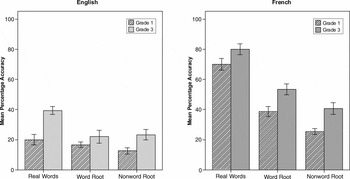
Overview of production performance. Despite the differences in the nature of the lexical and nonlexical versions of the production task, an exploratory three-way mixed ANOVA was conducted to compare performance across the lexical and nonlexical conditions of the production task (see Figure 1). This analysis revealed a significant Condition × Language × School Year interaction, F (2, 112) = 3.50, p < .05, η2p = .06. Investigation of simple effects for the French groups showed that condition was significant, F (2, 112) = 137.06, p < .001, but the interaction, Condition × School Year, was not (F < 1). The French children exhibited a consistent pattern of response in each school grade: real words > word root > nonword root (shown using Tukey tests). Among the English-speaking group, Condition × School Year was significant in an analysis of simple effects, F (2, 112) = 3.70, p < .05, showing that the pattern of performance changed between Grade 1 and Grade 3 in English. The effect of condition was not significant in Grade 1, F (2, 112) = 2.00, p > .05, indicating that performance was equally poor in all three conditions. Nonetheless, performance was clearly above floor level. No child scored zero in all three conditions because the two items in each condition containing the suffix -er tended to elicit at least one correct response. In contrast, the Grade 3 children showed a significant distinction between the conditions, F (2, 112) = 13.79, p < .001, and a post hoc Tukey test revealed the following pattern of response: real words > word root = nonword root.
The mean percentage accuracy in each condition of the production task in Experiment 1 for English- and French-speaking first and third graders. Error bars represent ±1 SEM.

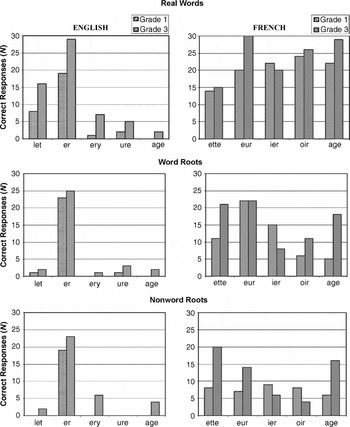
To provide a qualitative insight into the cross-linguistic differences revealed in the statistical analysis, graphs were drawn to illustrate the spread of correct responses across the range of suffixes tested in each language (see Figure 2). Although French accuracy can be seen to decline as the task becomes increasingly nonlexical, the French children's ability to manipulate suffixes does not appear to narrow substantially in range. By Grade 3, the French group demonstrate a good capacity to perform even the most explicit level of manipulation with three different suffixes (-ette, -eur, and -age), whereas this level of performance was only observed for the -er suffix in English.
The number of correct responses for each suffix tested in each condition of the production task in Experiment 1 for English- and French-speaking first and third graders. The maximum possible score is 30.

Discussion
The results indicate that the ability to perform the lexical judgment task is well advanced by the outset of schooling, and this ability shows a consistent growth with grade level in each language. In contrast, the pattern of performance in the production task is suggestive of qualitative differences between the language groups, especially in relation to derivations based on word roots. Production skills were generally poor among the Grade 1 English speakers except for responses to stimuli using the -er suffix, which were generally extremely good. Of the three production conditions, lexical production showed the most improvement between Grades 1 and 3 in English. Nonlexical skills, however, did not improve significantly during this period and appeared available only for the -er suffix. French children, by contrast, seem to begin schooling with a well-developed production capacity, which is broader in scope. Steady progress was also observed in each condition between the first and third grades in France and, at each grade level, production accuracy fell systematically as the task became increasingly nonlexical in nature.
Errors in the production task were less numerous among the French groups, and fell within a narrower range of error categories. Neither language group showed much differentiation between error categories in the lexical production task, although the French children made no compound errors in Grade 1 and no unclassifiable (other) errors in Grade 3. With nonlexical production, wrong suffix errors were among the most frequent errors made by the French children from Grade 1 onward, and real word and repeat root errors had completely disappeared from their responses by Grade 3. The English speakers were much more prone to give real word or repeat root responses and these, together with refusals, were the most common error categories in Grade 1. By Grade 3, however, real word and wrong suffix errors were most common.
EXPERIMENT 2
Accuracy was higher in French than in English in each task and at each grade level in Experiment 1. This was a likely outcome given the age differences in school entry that existed between the language groups. Thus, to complete our cross-linguistic comparison, it was important to conduct a second experiment to match the United Kingdom and French groups on chronological age and receptive vocabulary to compare awareness of derivational morphology at a similar phase of maturation and language development in each country. The children who took part in Experiment 2 were aged 8 years, and because of the differences in the educational systems, the English speakers may have had an advantage as they had received 1 more year of schooling than the French children. The expectation is that the age match will reduce the quantitative differences between the language groups that were observed in Experiment 1, but that the qualitative differences between the groups may prove more resistant if these are linked to cross-linguistic differences between the English and French languages.
Method
Participants. Participants were selected in the same manner and from the same schools that were used in Experiment 1. The 15 children in each language group were similar in mean chronological age (English, 8 years, range = 7;8–8;5; French, 7;11, range = 7;6–8;3), t (28) = 1.65, p > .05.
Materials and procedure. These were identical to Experiment 1.
Results
Background measures. The English-speaking children had received 1 more year of schooling than the French children. As can be seen from the age-normed scores in Table 3, reading progress was normal for chronological age in each group (English, 8;10, SD = 0;9; French, 8;1, SD = 0;11), but in real terms this meant that the UK group had received 1 year more of reading instruction than the French group. It can also be seen that there was a tendency for the English speakers to have stronger reading than receptive vocabulary skills for age, whereas the converse pattern was observed among the French speakers. Nevertheless, the important point for the present analysis is that receptive vocabulary age did not differ significantly between the groups (English, 8;2, SD = 0;10; French, 8;10, SD = 1;8; Mann–Whitney U = 91.50, p > .05).
Experiment 2 means and standard deviations for performance ages on background measures and accuracy in the judgment and production tasks for each language group

***p < .001.
LEXICAL JUDGMENT TASK. The mean percentage accuracy scores for the English and French language groups were 75.19% and 83.67%, respectively (see Table 3). Examination of the data using one-sample t tests indicated that both groups performed significantly above chance in this lexical judgment task: French, t (14) = 13.41, p < .001; English, t (14) = 6.27, p < .001. Although the French children tended to outperform the English-speaking children, an independent-samples t test showed this difference to be nonsignificant, t (28) = 1.79, p = .08.
LEXICAL PRODUCTION TASK. Inspection of Table 3 indicates that mean performance levels for producing real derivations were noticeably higher in French (73.33%) than in English (39.33%) and this difference was significant in an independent-samples t test, t (28) = 6.24, p < .001.
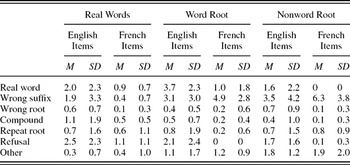
Error analysis. For each language, the mean number of error responses made for each error category was calculated by items in each condition of the production task (see Table 4). A two-way mixed ANOVA was conducted on the errors from the lexical production task with between-items factor, Language (English, French), and within-items factor, Error Type (real word, wrong suffix, wrong root, compound, repeat root, refusal, other). It was necessary to use the Greenhouse–Geisser correction for the effect of Error Type, F (3, 54) = 2.73, p = .05, η2p = .13. A Tukey test failed to differentiate the error types possibly because of the marginal nature of the result. The main effect of Language was also significant with more errors being made in English, F (1, 18) = 5.96, p < .05, η2p = .25, but there was no interaction between Error Type and Language (F < 1).
Experiment 2 mean number of error responses (/10) in the production task classified by error category for English and French items

NONLEXICAL PRODUCTION TASK. A two-way mixed ANOVA was conducted with between-participants factor Language (English, French) and within-participants factor Condition (word root, nonword root). Both main effects were significant: Language, F (1, 28) = 7.74, p < .05, η2p = .22; Condition, F (1, 28) = 9.89, p < .01, η2p = .26, as was the interaction Condition × Language, F (1, 28) = 12.51, p < .01, η2p = .31. Simple effects showed that the French children performed at a higher level than the English speakers on word root items, F (1, 28) = 30.90, p < .001; however, the groups performed at a similar level on nonword root items (F < 1).
Error analysis. Because the French children made no refusals in the word root condition and no real word errors in the nonword root condition (see Table 4), these error types were omitted from the analysis of the nonlexical production errors. A three-way mixed ANOVA was conducted with between-items factors Language (English, French) and Condition (word root, nonword root) and within-items factor Error Type (wrong suffix, wrong root, compound, repeat root, other). Greenhouse–Geisser correction was used for the effect of Error Type. The only significant effects were Error Type, F (2, 58) = 34.22, p < .001, η2p = .49, and Error Type × Language, F (2, 58) = 3.64, p < .05, η2p = .09. An analysis of simple effects revealed that the French data contained significantly more errors involving the use of the wrong suffix than the English data set, F (1, 58) = 6.01, p < .05, but no other differences achieved significance (Fs < 1).
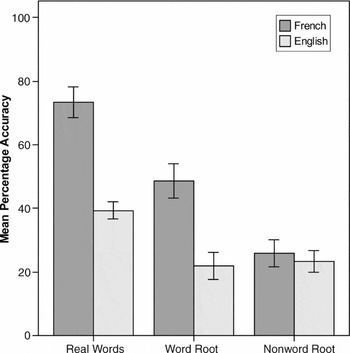
Overview of production performance. As in Experiment 1, an exploratory two-way mixed ANOVA was conducted to compare performance across the three conditions (see Figure 3). This analysis revealed a significant Condition × Language interaction, F (2, 56) = 13.12, p < .001, η2p = .32. Both language groups showed significant simple effects of condition: English, F (2, 56) = 9.09, p < .001; French, F (2, 56) = 54.77, p < .001, which were followed up using Tukey tests. These indicated different relationships among the three conditions in the two language groups (English: real words > word root = nonword root; French: real words > word root > nonword root).
The mean percentage accuracy in each condition of the production task in Experiment 2 for English- and French-speaking 8-year-olds. Error bars represent ±1 SEM.

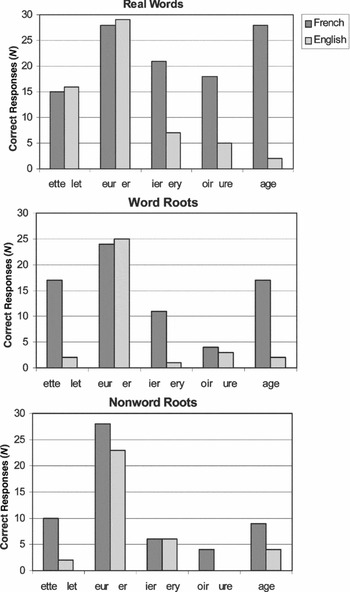
The distribution of correct responses across suffixes for each language in each condition is displayed in Figure 4. Examination of the French pattern shows that accurate productions spread across a wider range of suffixes than in English. Although French knowledge is observably more extensive in the real word and word root conditions, French and English performance is more similar in the nonword root condition where both groups appear most secure in the explicit manipulation of the -er/-eur suffix.
The number of correct responses for each suffix tested in each condition of the production task in Experiment 2 for English- and French-speaking 8-year-olds. The maximum possible score is 30.

Discussion
Only marginal cross-linguistic differences emerged in the lexical judgment task as performance levels in both groups were high (>70%) and well above chance. This contrasted with results of the lexical production task where a clear advantage for the French children was observed. Although links have been drawn between derivational knowledge and vocabulary development (Anglin Reference Anglin1993; Freyd & Baron, Reference Freyd and Baron1982), production of real derivations was worse in English than in French despite equivalent receptive vocabulary skills for age in both groups, and despite both roots and derivations being matched in frequency between languages.
Production accuracy fell in both groups as the task became more nonlexical, suggesting that the demands for morphological processing became more explicit. The English speakers appeared most affected by this manipulation and showed lower production accuracy than the French children in the word root conditions, although both groups were equally poor at producing derivations based on nonword roots. For the United Kingdom children, the production of nonlexical derivations was largely restricted to the -er suffix, whereas the French children were able to manipulate a greater range of suffixes in the context of a real word root but their performance range also narrowed in the nonword root condition to the -eur suffix (the French equivalent of the English suffix -er). The errors made by the two language groups were similar in the lexical production task but the French children differed from the English speakers in nonlexical production in that they made no real word errors and significantly more wrong suffix errors.
To summarize, a high degree of similarity was evident between languages in the 8-year-olds' ability to make judgments about morphological relations. However, differences emerged in production ability and, despite having received 1 year less of schooling than their UK peers, the French children displayed superior morphological knowledge in this task and a greater ability to generalize that knowledge to novel contexts.
GENERAL DISCUSSION
In Experiment 1, the two language groups were matched on exposure to formal schooling, and as a result, differed in age, whereas, in Experiment 2, a chronological age match was used to equate the groups on their level of cognitive and linguistic maturation. Each manipulation produced a contrasting pattern of cross-linguistic performance on judgment and production measures of morphological awareness which will be explored below.
Lexical judgment task
The 8-year-olds in each country exhibited comparable sensitivity to morphological relatedness. The children scored well above chance with the language groups differing only marginally in their accuracy at distinguishing word roots and their derivations (e.g., heat–heater) from other word pairs related only phonologically (e.g., ham–hammer). Furthermore, development between the first and third years of schooling appeared to progress at a similar rate in the French and English samples.
Tyler and Nagy (Reference Tyler and Nagy1989) referred to the ability to “see morphological relations between two words that share a common base morpheme” (p. 649) as relational knowledge, and proposed that this constituted the basis for developing an understanding of both the syntactic properties of suffixes and the distributional constraints on their use. Relational knowledge may, in addition, contribute to vocabulary development as the drawing of semantic inferences between root morphemes and the whole form is held to be central to deciphering the meaning of derived words (Anglin, Reference Anglin1993; Freyd & Baron, Reference Freyd and Baron1982). Our results suggest that French and UK children have similar relational capabilities by the age of 8 years. It is around this age that there is known to be a sharp rise in the number of derivations in English-speaking children's vocabulary (Anglin, Reference Anglin1993), and it is of interest to know whether French children undergo a similar pattern of vocabulary acquisition or whether derivations begin to be assimilated into vocabulary at an earlier point in French.
Carlisle and Nomanbhoy (Reference Carlisle and Nomanbhoy1993) were careful to highlight the dependence of morphological learning on phonological, semantic, and syntactic knowledge during language acquisition (for a review, see Clark, Reference Clark1993). Testing the relative contributions of these factors to morphological awareness remains a challenge, not least because one view is that morphological knowledge is the result of a synergistic convergence of the phonological, orthographic and semantic aspects of words (e.g., Gonnerman, Seidenberg, & Andersen, Reference Gonnerman, Seidenberg and Andersen2007; Seidenberg & Gonnerman, Reference Seidenberg and Gonnerman2000). However, when Carlisle and Nomanbhoy examined the contribution of phonological awareness to performance in their morphological judgment test they found no significant association. This null effect seems likely to have been because of the control for phonological similarity that is embedded within their task, which, as in the present study, compared items that were equally phonologically similar but differed in terms of morphological relatedness (e.g., heat–heater vs. ham–hammer). An interesting question for future research is whether the judgment task requires any specifically morphological knowledge about the relation between the “morphologically related” pairs (e.g., heat–heater) or simply sensitivity to the greater semantic relatedness of these items.
Production task
Comparison of levels of performance in the lexical judgment and production tasks is complicated by format differences (yes–no decision vs. response production); however, the evidence is consistent with judgments about morphological relatedness being somewhat easier than the production of derivations. The advantage for judgment over production was only about 3–10% for the French groups, whereas in English, the advantage was larger at 35–45%. There did not appear to be a necessary relationship between judgment and production skill, as was evident in Experiment 2 where the two language groups had very similar levels of judgment (approximately 80%) but discrepant levels of production. One possible explanation for this pattern of results is that the production task is tapping a more explicit level of awareness than is required in the judgment task. According to Gombert (Reference Gombert1992), more implicit forms of awareness are considered necessary for further metalinguistic development but are not regarded as a sufficient condition for meta-awareness to emerge. Thus, it would be possible for two groups to have similar implicit skills but for only one of those groups to have moved beyond this point toward more explicit processing.
Nevertheless, another possible contributing factor to the differing levels of judgment and production performance is that a purely semantic strategy can be used to successfully discriminate examples like “heat–heater” from “ham–hammer” in the lexical judgment task, whereas in lexical production, such a strategy is likely to increase the incidence of semantically based real word errors (e.g., “A little mouse is a . . . vole”), as was observed particularly among the (younger) English groups. Therefore, it is difficult to say with any certainty that the difference between task performance levels is best described as a difference solely in terms of the metalinguistic demands of the lexical judgment and production tasks, as concluded by Carlisle (Reference Carlisle and Feldman1995), rather than as a difference in the morphological specificity of the task requirements. This is an important empirical question that will require further research. For the present, our study attempted to strengthen the explicit demands of the production task itself by adding two nonlexical conditions involving the construction of a novel derivation from a word or nonword root. This type of nonlexical production was observed to be significantly more difficult than lexical production in both our experiments, suggesting that this manipulation increases the demand for explicit control over morphological knowledge (Berko, Reference Berko1958; Manza & Reber, Reference Manza, Reber and Berry1997). Interestingly, however, the most explicit version of the production task, in which both root and derivation are nonsense words, proved to be equally challenging for the 8-year-olds in each country. Therefore, it seems that although the French children were advancing more quickly along the path of metamorphological development than the English speakers, they still have some way to develop before full explicit control over the use of derivational suffixes is achieved.
Error patterns were consistent with the differing pace of metamorphological development in each country. The UK children made many real word substitutions that were plausible according to the semantic and syntactic constraints of the task. This error was not typical of the French groups who, as early as Grade 1, made a large proportion of errors that indicated an attempt to form a derivation but that were unsuccessful because of the use of the wrong suffix. By Grade 3 this category dominated the French error responses but was only beginning to emerge as an important error category among the English-speaking group.
The transition from implicit to explicit knowledge about derivational morphology
Carlisle's (Reference Carlisle and Feldman1995) proposal that the transition to explicit morphological awareness takes place during the first year at school receives most support from the French data set. As early as Grade 1, the French children displayed a good knowledge of real-word derivations and could generalize this knowledge to produce novel derivations from word roots. This contrasted markedly with the performance of the English speakers, whose knowledge of derivational suffixes was poor in Grade 1 and whose ability to generate novel derivations improved only slowly during the first 3 years of schooling. Our findings for English, therefore, argue against the proposal that a general transition to explicit processing of derivational morphology occurs before the end of Grade 1.
The reason for the inconsistency with some of the earlier findings for English seems likely to lie in our use of a larger set of derivational suffixes and our heightening of the explicit demands of the production task. Both of these manipulations appear to have exposed limitations in the explicit skills of the English speakers. When we restrict the focus to the -er suffix, a precocious ability to manipulate this particular suffix is evident from Grade 1. Therefore, it is not that young English speakers lack the capacity to explicitly manipulate derivational suffixes, but instead that their ability to do so is very restricted in range relative to their French peers (see Figures 2 and 4).
In studies of phonology, those phonological units that children are explicitly aware of appear to be favored as decoding units (Duncan et al., Reference Duncan, Seymour and Hill1997, Reference Duncan, Seymour and Hill2000). If this is also true of morphology, French children may be in a position to use a greater range of derivational suffixes than English speakers in their early reading, and also in writing, which is more opaque than reading in French. Published evidence from studies of spelling is supportive of a relationship with literacy. Pacton, Fayol, and Perruchet (Reference Pacton, Fayol and Perruchet2005) observed that French children use morphological regularities in spelling as early as Grade 2 for the suffix -ette and Grade 3 for -eau, which is consistent with the early explicit sensitivity to derivational morphology shown by French children in the present study. Similarly, Deacon and Bryant's (Reference Deacon and Bryant2005) finding that 6- to 8-year-old English speakers did not use morphological knowledge in spelling is in keeping with our observations of poor explicit manipulation of suffixes by this age group.
In a recent comparison of different orthographies, Jaffré (Reference Jaffré2006) argued that orthographies encompass two basic principles: the first is phonographic, and refers to the correspondence between the written form and the sounds of the spoken language; the second is semiographic, and concerns the encoding of meaning in the orthography. According to Jaffré, one characteristic feature of the French orthography is that morphology is systematically encoded in French spelling even though it is frequently not heard in speech. This is especially true of inflectional morphology, but it also applies to derivational morphology, where silent letters often establish a visual link between words from the same morphological family. For example, the “t” morphogram at the end of the French word “lait” (milk) is not pronounced in spoken French but it is also to be found (and heard) in the derived words “laitier” (milkman), “laitage” (dairy product), “laiteux” (milky), and so forth. Therefore, although such morphograms may introduce graphophonological inconsistencies, at a graphosemantic or morphological level, they represent consistencies that may prove useful for young readers and spellers.
Although English is the deeper orthography with high levels of inconsistency in the correspondence between spelling and sound in both the reading and writing directions, English is also characterized by a significant degree of morphographic regularity. In contrast to French, however, most morphemic elements are pronounced rather than silent, and so the separation between phonographic and semiographic correspondences in the orthography may not be so marked. Several authors have claimed that the capacity for morphological analysis is likely also to prove beneficial for literacy development in English. Mann and Singson (Reference Mann, Singson, Assink and Sandra2003) proposed that older children parse morphologically complex words into base and suffix to apply morphophonological rules to increase decoding accuracy (see also Nagy et al., Reference Nagy, Berninger and Abbott2006). Furthermore, Rastle and Coltheart (Reference Rastle and Coltheart2000) have argued that derivational affixes could provide important cues about lexical stress assignment and vowel reduction, issues relevant for learning to read English but not French, and an algorithm developed by these authors that incorporated morphological regularities did indeed show a good correspondence with skilled decoding in English.
What factors govern the emergence of explicit knowledge about derivational morphology?
In this final section, we examine factors that might constrain the process of metamorphological development to gain insight into why this acquisition process seems to be accelerated in French relative to English.
Clark (Reference Clark1993) has argued that derivations take time to assimilate. Derivations are complex in form, and the meaning of the bound morphemes that they contain is difficult to capture, with the result that knowledge about particular affixes is acquired gradually in a sequence determined by type frequency and productivity (Clark, Reference Clark1993; Clark & Cohen, Reference Clark and Cohen1984; Derwing & Baker, Reference Derwing, Baker, Fletcher and Garman1979; Lewis & Windsor, Reference Lewis and Windsor1996; Windsor, Reference Windsor1994). Invoking a process reminiscent of Karmiloff-Smith's (Reference Karmiloff-Smith1986) concept of representational redescription, Clark (Reference Clark1993) went on to suggest that, as individual suffixes are acquired, levels of organization emerge within the lexicon containing groups of derivations that are related in form and meaning. Gombert (Reference Gombert1992) has argued that progression to the explicit phase requires the presence of an external demand for metalinguistic control, and our findings in relation to Grade 1 performance in French and to the processing of the -er suffix in English suggest that certain aspects of metamorphological development may be subject to demands present in the preschool phase (for a similar finding in relation to explicit awareness of syllables, see Duncan et al., Reference Duncan, Colé, Seymour and Magnan2006).
One question for future research is whether learning about derivational morphology reflects the gradual setting up of statistical regularities within the language system as demonstrated in connectionist models (Gonnerman et al., Reference Gonnerman, Seidenberg and Andersen2007; Seidenberg & Gonnerman, Reference Seidenberg and Gonnerman2000) such that knowledge about derivational morphology is graded and is computed from phonological, semantic, and orthographic information. A slightly different view is encapsulated within the declarative/procedural model (Ullman, Reference Ullman2001, Reference Ullman2004), where a mental lexicon of words and a mental grammar of rules are ascribed to the separate memory systems referred to in the name of the model. The model proposes that although both systems can underlie morphological pattern learning, the declarative system specializes in associative mapping, whereas the procedural system is dedicated to the learning and use of rules; more specifically, those rules that are global in nature. Interestingly, Ullman (Reference Ullman2004) advocates an interaction between these systems during learning, arguing that “in some cases explicit knowledge of the rules themselves may help guide processing, perhaps enhancing the procedural rule acquisition” (p. 247).
The variation in response to the suffixes tested in our study deserves comment here. The English speakers show a narrow range of performance especially in the nonlexical conditions. Nevertheless, their level of response to the one suffix that they appear to know (-er) was observed to be quite constant across production conditions. Although the absence of a performance decrement in transfer to novel contexts is consistent with rule-based knowledge (e.g., Manza & Reber, Reference Manza, Reber and Berry1997; Pacton et al., Reference Pacton, Fayol and Perruchet2005), it is also possible that statistical learning in a context where few constraints exist on the use of the -er suffix may produce a similar effect. Nevertheless, in the French data, only the 8-year-olds exhibited anything resembling this type of pattern (see French performance on the -eur suffix in Figure 4). Instead, the French groups tended to show a breadth of knowledge about suffixes that decreased gradually and generally as the task became more nonlexical (see Figure 2). This type of pattern appears more consistent with statistical learning of the regularities underlying derivational morphology (Pacton et al., Reference Pacton, Fayol and Perruchet2005) or with incomplete rule-based learning (for a critique of this latter view, see Pacton, Perruchet, Fayol, & Cleeremans, Reference Pacton, Perruchet, Fayol and Cleeremans2001). Further research is necessary to determine the correct interpretation of these differing response patterns.
In general, cross-linguistic variation in the acquisition sequence appears most likely to emanate from the preschool language environment and/or from the system of formal education adopted by each country. On the basis of our findings, preschool language is implicated because explicit morphological skills were already divergent between the language groups in the first year of schooling, and formal education may also be involved because the pattern of development between the first and third year of schooling was different in each country. Each of these factors will be considered in turn.
Preschool language. As noted in the introductory section, derivation is more productive in French than in English and evidence from diary studies suggests that preschool spontaneous speech in French correspondingly contains a wider range of derivational suffixes than is observed in English (Clark, Reference Clark1993). Conversely, compounding is more prevalent and more productive in English than in French (Bauer, Reference Bauer2003), and cross-linguistic disparities in the early use of compounding for lexical innovation have previously been attributed to this difference (Clark, Reference Clark1993). The findings from the present study suggest that the complementary incidence of compounding and derivation in English and French may also be traceable in awareness of derivational morphology, confirming previous indications from diary studies (Clark, Reference Clark1993).
Recent cross-linguistic evidence from Zhang, Anderson, Packard, Wu, and Tang (Reference Zhang, Anderson, Packard, Wu and Tang2009) lends support to this type of relationship between the productivity of a word formation system and metalinguistic development among native speakers. Their comparison of English and Chinese is of considerable relevance to the present study because derivational morphology is more common and compounding less common in English than in Chinese. In other words, English stands in a similar relationship to Chinese as French does to English in terms of the relative prevalence of compounding versus derivation in word formation. The authors observed that English speakers tended to be less sensitive to compound structures than Chinese children, although it should be emphasized that the assessment task used differed from the oral tasks used in the present study because it contained a substantial reading component.
Returning to the present study, a lower prevalence of derivations in English relative to French is consistent with the slower rate of metamorphological development that we observed among our English speakers. Establishing the spoken frequencies of individual derivational suffixes in the preschool and early school years will be an important focus for future research. An interrelated issue concerns the productivity of individual derivational suffixes as Clark (Reference Clark1993) identifies this as an important principle in the process of coining new words to fill lexical gaps, a process that may prove relevant to the early development of morphological awareness.
The reinforcement of derivational relationships may be further complicated in English by lexical stress, which is contrastive and hence important for successful word identification. Lexical stress is not contrastive in French, and so would not be expected to influence suffix learning to the same extent. In contrast, the predominant patterns of English lexical stress are likely to deemphasize suffixes because final syllable stress is rare, and thus the perceptual salience of the suffix would be expected to be low (Cutler & Clifton, Reference Cutler, Clifton, Bouma and Bouwhuis1984; Pitt & Samuel, Reference Pitt and Samuel1990). Furthermore, the similarity between roots and their derivations is rendered opaque for a whole class of English suffixes that alter the stress pattern of the root in the formation of the derivation (e.g., ˈdedicate → dediˈ cation). Studies confirm that English-speaking children take longer to acquire these stress-shifting suffixes compared to suffixes that are stress neutral (Carlisle, Reference Carlisle and Feldman1995, Reference Carlisle2000; Jarmulowicz, Reference Jarmulowicz2006; Mahony et al., Reference Mahony, Singson and Mann2000).
Formal education. Another factor in the explanation of the French advantage in explicit morphological skills may be that the pace of introduction of information about derivational morphology in the school curriculum is simply faster in France than in the United Kingdom, and a preliminary review does indeed point to some differences in instructional approach. The recommendations from the French Ministry of Education make express mention of derivational morphology from the first year of schooling in relation to the development of oral vocabulary and the building of a sight vocabulary. Teachers highlight derivational relations (e.g., “sable, sableux, sablonneux, sablière, sablage,” which can be translated as “sand, sandy, sand-covered, sand quarry, sanding”), and also employ a process in which derivations are produced and then checked for lexicality (e.g., “coiffure” vs. “peignure,” which can be translated as “hairdressing” vs. “haircombing”). In the United Kingdom, information about derivational morphology is introduced more gradually, but teachers begin informally to highlight frequent suffixes like -er from the end of Grade 1 onward. However, it is interesting to note that in the present study, the UK children already possessed an advanced ability to manipulate this suffix before this point. More intensive teaching about derivational morphology is introduced later in Grade 3 or 4 in the context of spelling instruction when children explore how words change with the addition of affixes. By the sixth or seventh year of schooling, children should know the rules governing the relations between a range of roots and derivations as well as the terms “prefix” and “suffix” (Learning and Teaching Scotland, personal communication, July 31, 2006).
A further aspect of children's exposure to derivational suffixes in the education system concerns the influence of reading acquisition. Seeing words in print can help to consolidate understanding of the relationship between meaning and the morphemic units within words (Moats, Reference Moats2000). Less productive and technical suffixes, as well as those suffixes that produce a phonological change to the base, may need to be reinforced by orthographic cues and, at least in English, the written frequency of derivational suffixes appears predictive of progress in this respect (Jarmulowicz, Reference Jarmulowicz2002). To explore this matter further, we have undertaken a preliminary inspection of two databases that survey wordforms from children's early reading materials in English (CPWD; Stuart et al., Reference Stuart, Dixon, Masterson and Gray2003), and in French (MANULEX; Lété et al., Reference Lété, Sprenger-Charolles and Colé2004). This has allowed us to compare the incidence of individual suffixes in Grade 1 reading materials in each language. The results confirm that French children encounter a much larger variety of suffixes often with high-type frequencies from the outset of schooling. In France, 32 suffixes with type frequencies of 2 or above occurred in Grade 1 reading materials, whereas only 5 suffixes occurred with this level of written frequency in English: -y (adjective), -er (noun, agentive), -y (noun, diminutive), -er (noun, instrumental), and -ly (adverb) (see also Derwing, Reference Derwing1976). Thus, suffix frequency appears at least to be consistent with production performance because English production ability is largely restricted to the -er suffix, whereas French children show a facility with the wider range of suffixes that recur in their early reading materials. The extent to which such written frequencies overlap with or are subsumed by underlying oral language frequencies of derivations or their components is a topic for future study.Footnote 9
A final consideration relates to issues raised by Jaffré (Reference Jaffré2006) in relation to the French orthography. He proposes that the need to distinguish between many similarly pronounced but morphologically distinct pairs such as “chanter” (“to sing”) and “chanté” (“sung”) promotes a greater understanding of the internal functioning of the French language. Thus, mastery of the morphological structure of the French orthography may require a greater degree of metalinguistic control than is entailed in English. Although it remains unclear whether this argument, which is largely based upon the nature of the system of inflectional morphology in French, also extends to the acquisition of derivational knowledge, the more advanced ability of the French children to explicitly manipulate derivational suffixes in the present study is at least consistent with this interpretation.
CONCLUSIONS
This is the first study to directly compare children's awareness of derivational morphology in French and English. The aim was to establish whether the course of acquisition of derivational knowledge might vary in these languages of differing (Romance vs. Germanic) origin. The central finding is that the rate of growth in metamorphological development appears to be slightly accelerated in French relative to English, which parallels the differences in the productivity of the derivational process in the two languages, and hence, appears to support the importance of this factor in the early acquisition of morphological knowledge The emphasis placed on morphology in the oral and written language curricula of the two educational systems also proved to be consistent with the French advantage in manipulating derivational suffixes. The disentanglement of these sources of influence is a challenge for future research.
APPENDIX A
Stimuli for the lexical judgment task

aThese words are homophones (court, bal, cent, some, sale, tale).
Stimuli for the lexical production task

aThe sentence frame containing the lexical root, which is in bold.
Stimuli for the nonlexical production task

Note: The sentence frames (1–10) from the lexical production task were used in this task with occasional minor adjustments that did not alter the syntax.
ACKNOWLEDGMENTS
The authors express their gratitude to the pupils and staff in the participating schools. We also thank Sheila Baillie and Hannah Bownass for their assistance with data collection. This research was supported by funds from The British Council's Alliance Franco-British Partnership Programme (PN 03.014) in the United Kingdom and the Programme d'Actions Intégrées Franco–Britannique Alliance (05682 XG) administered by the Ministères des Affaires Etrangères et de l'Education Nationale in France.