1. Introduction
The Agreement on Agriculture (AoA), concluded as part of the Uruguay Round negotiations represents a milestone in the development of international rules on agricultural trade.Footnote 1 The General Agreement on Tariffs and Trade 1947 (GATT) did not distinguish between manufactured goods and agricultural products other than to carve out some specific exceptions to the prohibition on quantitative restrictions and export subsidies.Footnote 2 The GATT was particularly deficient in addressing the massive distortions in the world agricultural markets and in integrating agriculture specific non-trade concerns, including sanitary and phytosanitary issues. The AoA strengthened the existing disciplines of the GATT and established rules to improve competition in the field of international agricultural trade.Footnote 3
The rules contained in the AoA rest on the triad of ‘market access’, ‘domestic support’, and ‘export competition’.Footnote 4 Amongst the three, the domestic support pillar has been the most contentious and the least understood. On domestic support, the AoA established rules outlining different categories of support based on their perceived trade-distortive effects, provided methodologies to calculate the extent of distortion, and introduced disciplines to implement such support measures.Footnote 5 In addition, the AoA laid down the requirement of reporting such measures to the Committee on Agriculture at the WTO.
The AoA has categorized domestic support measures under different boxes which include:Footnote 6
(i) support with no or minimal distortive effect on trade (Green Box);Footnote 7
(ii) trade-distorting support (Amber Box);Footnote 8
(iii) support which may have some trade distortive effects, but which are subject to certain limitations on production (Blue Box)Footnote 9; and
(iv) certain developmental support measures for developing Members (Development Box).Footnote 10
A Member country is bound by a specific domestic support reduction commitment expressed in terms of an ‘Aggregate Measurement of Support’ (AMS). AMS is a single figure meant to capture all product-specific and non-product-specific domestic support provided by the government, subject to certain exemptions.Footnote 11 Amongst these categories, Amber Box support is subject to calculation in the AMS and to reduction commitments, while support under Green Box, Blue Box, and the Development Box are exempt from such calculation and reduction commitments.Footnote 12
The measures covered under the Green Box include minimal, or non-trade-distorting domestic support that is generally required to be decoupled from production and price of the agricultural products. It includes government service programmes and several types of direct payments to producers,Footnote 13 and provides some policy space for Members to extend support to agricultural producers as it exempts several types of domestic support measures from AMS calculation.Footnote 14
The Amber Box permits both product-specific as well as non-product-specific domestic support measures. It includes market price support (MPS), non-exempt direct payments and other non-exempt support measures. However, the margin for providing Amber Box measures is limited for Members – either up to Bound Total AMS or de minimis levels.Footnote 15 In fact, a majority of WTO Members lack a positive Bound Total AMS, which implies that any support in excess of its de minimis limits results in a violation of the Member's AoA obligation.Footnote 16
This is further complicated and rendered contentious by the present methodology (outlined in Section 3 of this article) of calculating AMS. Its failure to account for inflation and exchange rate movements is a key deficiency that inevitably results in inaccurate, and sometimes overestimation of, trade distortion levels.Footnote 17 Members with de minimis allowances are put at a particular disadvantage, as AMS calculations based on fixed/historical indicators without inflation adjustments offer little room to provide Amber Box support.
This leaves Members, looking to provide domestic support on a product-specific basis, with the option of utilizing the Blue Box category. This category includes domestic support measures that are in the nature of direct payments under production-limiting programmes in Article 6.5 of the AoA.Footnote 18 Considering that Blue Box measures are exempt from AMS calculations, it provides certain policy flexibility for Members to extend WTO consistent domestic support.
In view of the scarce and infrequent use of Blue Box support measures, the aim of this article is to explore the legal principles in Article 6.5. It also examines the congruence between Blue Box and the Amber Box categories of support. Section 2 of the article explores the legal understanding and characterization of measures under the Blue Box. Section 3 examines the nature and design of MPS and non-exempt direct payments under the Amber Box. Subsequently, Section 4 compares and contrasts MPS measures and non-exempt direct payment measures under the Amber Box with direct payment measures under the Blue Box. Section 5 concludes.
2. Legal Interpretation of Blue Box Domestic Support Measures
2.1 Background: Current Use and Evolution
Blue Box presents certain latitude to WTO Members in providing domestic support that is exempt from calculation in the AMS.Footnote 19 Interestingly, it has received little attention in academic literature despite being conceived as a category of domestic support where payments are permitted without any budgetary ceiling. Only a handful of WTO Members have implemented Blue Box measures.Footnote 20 The European Union, Norway, Japan, and Iceland have notified Blue Box programmes in their latest Domestic Support notifications.Footnote 21 This category of support has remained particularly underexplored among developing Members. China is the only developing Member that has introduced Blue Box support, notably for corn and cotton.Footnote 22
Domestic support provided under Article 6.5 of the AoA is not subject to reduction commitments, provided that such measures adhere to the requirements set out therein.Footnote 23 According to Article 6.5, Blue Box measures are direct payments made under production-limiting programmes. Direct Payments, although not specifically defined, are generally understood to mean domestic support which are in the nature of cash payments or grants that may be linked to production or sales.Footnote 24 The direct payments under Article 6.5 are delinked from current production, and are required to be based on fixed parameters.
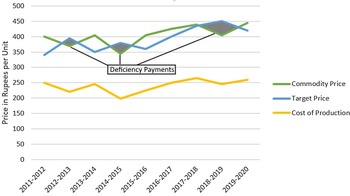
Blue Box measures have traditionally been in the nature of deficiency-payments or counter-cyclical payments.Footnote 25 A deficiency payment is a type of agricultural domestic support, paid by governments to producers of certain commodities, and based on the difference between a target price and the domestic market price. Such a measure would require the government to provide a ‘market signal’ (target price) which may be an indicative price for the concerned crop. When the actual market price falls below the signal or target price, the government usually intervenes to provide the difference by way of direct payments to the producers. Such measures may be operationalized in various ways. For instance, the payment may be based on a guaranteed gross margin in relation to cost of production or the difference between the commodity and target price. A basic representation of a counter-cyclical payment is provided in Figure 1.
Graphical Representation of deficiency payments.
Source: Author's Illustration

During the Uruguay Round negotiations, the main proponents of the Blue Box category of support were the European Communities and the United States. The emergence of Blue Box is rooted in the Oilseeds dispute between the United States and the European Communities that impacted their economic relations in the late 1980s and early 1990s.Footnote 26 In 1990, the United States secured a favourable finding in a GATT Panel proceeding in which the European Communities’ subsidies, provided to seed processors, conditional on the purchase of oilseeds originating in the Community, were held to be inconsistent with Article III:4 of the GATT.Footnote 27 In a follow-up report in 1991, the GATT Panel found that European Communities’ subsequent reforms had failed to comply with the Panel's recommendations.Footnote 28 The tension between the trading powers escalated further when the United States announced its intention to retaliate against European Communities after the latter refused to fully comply with the Panel's recommendations.Footnote 29 These differences also spilled over to the discussions on agricultural issues during the Uruguay Round and resulted in a near breakdown of the negotiations. Subsequently, in the bilateral pact known as the ‘Blair House Agreement’,Footnote 30 the two parties arrived at an agreement on a number of outstanding agricultural issues, including reduction of domestic support and export subsidy, based on volume and budgetary outlays, as well as a mechanism to resolve the oilseeds dispute.Footnote 31
The Blair House Agreement also introduced a new category of domestic support to accommodate the European Communities’ MacSharry compensations and the United States’ deficiency payments. In the 1990s, the United States maintained income support programmes involving deficiency payments to producers participating in Acreage Reduction Programme wherein the payments were based on fixed crop base area and programme yield.Footnote 32 Similarly, European Communities’ Common Agricultural Policy reforms of 1992, popularly known as the MacSharry reform package, initiated a shift from price support policies to a direct compensation programme financed by the Community's budget.Footnote 33 The payments were aimed at compensating the producers for any loss in income suffered on account of the dismantling of price support policies. The Agreement placed these direct payment programmes in a separate category of domestic support which would not be subject to reduction commitments and introduced a peace clause to insulate such support from challenge under the GATT and subsidy disciplines.Footnote 34 Therefore, the concept of a separate ‘Blue Box’ emerged from the Blair House Agreement between the United States and the European Communities. This provision was later introduced in the AoA as Article 6.5.Footnote 35
Blue Box as a category of domestic support, therefore, had successfully emerged from the Uruguay Round negotiations without attracting much attention from the Members. Consequently, the dearth of discussions and limited Member practices have inhibited its use and popularity. This article seeks to contribute to an improved understanding of Blue Box policies with the help of tools of treaty interpretation, and begins this exercise with the plain language of the provision at issue. The text of Article 6.5 reads as follows:
Article 6
Domestic Support Commitments
5. (a) Direct payments under production-limiting programmes shall not be subject to the commitment to reduce domestic support if:
(i) such payments are based on fixed area and yields; or
(ii) such payments are made on 85 percent or less of the base level of production; or
(iii) livestock payments are made on a fixed number of head.
(b) The exemption from the reduction commitment for direct payments meeting the above criteria shall be reflected by the exclusion of the value of those direct payments in a Member's calculation of its Current Total AMS.
From the language of Article 6.5(a) of the AoA, there appears to be two fundamental elements of a Blue Box support: (i) direct payments; and (ii) production-limiting programmes. These payments are thereafter limited to fixed parameters, i.e. (i) fixed area and yields; or (ii) 85% or less of the base level of production; or (iii) fixed number of livestock head. The meaning and understanding of these two elements are further explored in this part of the article, in an attempt to delineate the contours of a Blue Box measure.
2.2 Interpreting the Nature of Direct Payments
The first and the foremost challenge in understanding the scope of Blue Box support lies in the interpretation of the terms ‘direct payments’. The understanding of the rules on direct payments is distinct under the Agreement on Subsidies and Countervailing Measures (SCM Agreement) and the AoA. For instance, the definition of subsidy under the SCM Agreement, i.e. a ‘financial contribution’ or an ‘income or price support’ that confers a ‘benefit’ is broad enough to capture most subsidy programmes, whether provided directly or indirectly by the government.Footnote 36 In this regard, the AoA presents several ambiguities.
While there are several references to ‘direct payments’ in the Annexes to the AoA, the term has not been defined.Footnote 37 In order to interpret this term, reference may be made to general rules of treaty interpretation enshrined in Articles 31 and 32 of the Vienna Convention on the Law of Treaties.Footnote 38
The concept of a direct payment under a Blue Box measure has not been examined by a WTO Panel or the Appellate Body. According to the general rules of treaty interpretation, a treaty provision must be interpreted by giving effect to the ordinary meaning of the words used, in its context, in good faith, and in light of the treaty's object and purpose.Footnote 39 These principles are not to be applied in any hierarchical or sequential order, but simultaneously.Footnote 40
Interpretation of terms used must be based, above all, on the text of the treaty.Footnote 41 The term ‘direct’, in ordinary parlance, as an adjective, means ‘existing or occurring without intermediaries or intervention; uninterrupted’.Footnote 42 The term ‘payment’, in ordinary parlance, as a noun, means ‘an act, or the action or process, of paying’ or ‘a sum of money paid’.Footnote 43 Taken together, the term ‘direct payment’ means ‘the act, or the action or process, of paying without intervening factors or intermediaries’. However, does it mean that, ‘direct payment’ necessarily entails a direct transfer of funds from the government to the beneficiary?
The ordinary meaning of a treaty term cannot be established without examining its immediate as well as broader context in the treaty.Footnote 44 Therefore, the structure of a treaty is of equal importance as the ordinary meaning of a treaty term used, as its meaning is informed by the context in which it is used.Footnote 45 To understand the meaning of the term ‘direct payments’, relevant context may be derived from Annex 2 and Annex 3 to the AoA.
Annex 2 (Green Box) of the AoA provides a detailed, but non-exhaustive list of practices for which Members may claim exemption from calculation in the AMS. Annex 2 refers to ‘direct payments’ at various places.Footnote 46 The heading of paragraph 5 of Annex 2 is titled ‘Direct Payments to producers’ and includes ‘support provided through direct payments (or revenue forgone, including payments in kind)’. The terms ‘revenue forgone’ and ‘payments in kinds’, which are included alongside ‘direct payments’ in paragraph 5 could be somewhat instructive.Footnote 47 As the Appellate Body noted in US–FSC, ‘revenue foregone’ involves a transfer of resources.Footnote 48 This provision, however, does not in itself clarify whether direct payments should entail transfer of economic resources from the government. The Appellate Body noted in US–FSC that in disputes brought under the AoA, just as in cases under Article 1.1(a)(1)(ii) of the SCM Agreement, ‘it is only where a government foregoes revenues that are “otherwise due” that a “subsidy” may arise’.Footnote 49 This would further imply that only the government can forego revenue since only a government can claim revenue in the first place.
However, the contextual relevance of ‘direct payment’ under Annex 2 is not helpful beyond a point, as Green Box measures envisage no, or minimal, trade-distorting support. It is also a hallmark of Green Box that the support provided under this category should be maintained through a publicly funded government programme not involving transfers from consumers. ‘Direct payments’ under paragraph 5 may qualify as Green Box support, if it conforms to the basic criteria set out in paragraph 1 and the (i) specific criteria applying to individual direct payments in paragraphs 6 through 13; or (ii) criteria (b) through (e) in paragraph 6. An underlying principle across Annex 2 is that such direct payments should not be related to, or based on, the type or volume of production, or on the price of the agricultural product.Footnote 50 To recap, the unique nature of Green Box measures does not provide insights on whether private payments, facilitated by regulatory or administrative measures can satisfy the elements of ‘direct payment’ under Article 6.5.
An additional context for interpretation of ‘direct payments’ under Article 6.5 is Annex 3 of the AoA. Paragraph 1 of Annex 3 recognizes three categories of support, namely MPS, non-exempt direct payments and other non-exempt policies. Annex 3 provides the formula for calculating the quantum of support for the purpose of AMS calculations. These measures are not clearly defined in the Annex.
In addition, paragraph 2 of Annex 3 clearly states that subsidies under paragraph 1, namely MPS, non-exempt direct payments and other non-exempt policies, shall include both budgetary outlays and revenue foregone by governments or their agents, indicating that direct payments are expected to flow from governmental entities.Footnote 51 Importantly, however, this formulation does not appear to preclude subsidies other than those provided through budgetary outlays and revenue forgone. For instance, certain price support measures may be implemented through administered prices that involve transfers from consumers without any governmental outlay.Footnote 52
Therefore, application of the principles of treaty interpretation to ‘direct payments’, as envisaged in the AoA, does not completely rule out private payments, but it gives an overwhelming indication that such payments must be made by governmental entities and should not be achieved through transfer of economic resources from consumers to agricultural producers.Footnote 53
2.3 Achieving the ‘Production-Limitation’ Aspect
The second important element of a Blue Box support measure is that the payments are required to be made under ‘production-limiting’ programmes.Footnote 54 The AoA does not elaborate on how this criterion of production limitation may be achieved. It is left to individual Members to devise appropriate mechanisms to ensure that the programme under which such payments are made contain requirements aimed at limiting the production at certain levels. This condition is generally complied with by tying the payments to acreage control and supply control programmes to limit the production surplus.Footnote 55
In the United States, deficiency payments were made to agricultural producers that participated in the Acreage Reduction Program (ARP).Footnote 56 The ARP limited the acreage on which participating producers were permitted to plant the programme crop.Footnote 57 Under the United States’ deficiency payment programme, the eligible acreage was based on the triple base provision introduced under the Food, Agriculture, Conservation and Trade Act of 1990.Footnote 58 The payment acreage was set to a maximum of 85% of the crop acreage base less any reduced acreage. Crops planted on 15% of the crop's acreage base, referred to as the normal flex acreage, were ineligible to receive the deficiency payments.Footnote 59 Crops other than fruits, vegetables, and prohibited crops were permitted on this acreage. Likewise, European Union's arable crop support (under the 1992 Common Agricultural Policy) had introduced compensatory payments to farmers and supply management through set-aside arrangements.Footnote 60
Under Norway's 2019 notification of its Blue Box programme on milk, the payments are made per milk cow and reduced once the legislatively pre-determined threshold for the number of cows is reached.Footnote 61 This may be considered to be the production-limiting aspect of the measure. Interestingly, Norway has utilized a parameter under Article 6.5(a)(ii) viz., 85% or less of the base level of production to set its subsidy entitlements for milk producers, even though the conditions of the programme do not directly relate to a percentage of the base level of production. Since the payment is made per milk cow in a dairy farm, the parameter under Article 6.5(a)(iii), which relates to the number of livestock head, may have been better suited for the Norwegian Blue Box programme.Footnote 62
A question that arises is whether the production limitation may be achieved through the parameters listed in sub-paragraphs (i)–(iii) in Article 6.5(a). Together with the absence of any jurisprudence, the inconsistent practices of Members contribute to the lack of clarity in explaining how production limitation can be achieved.Footnote 63 However, it is generally understood that Blue Box covers ‘payments directly linked to acreage or animal numbers, but under schemes which also limit production by imposing production quotas or requiring farmers to set aside part of their land’.Footnote 64 Therefore, the ‘production-limiting’ aspect of Article 6.5 may be understood to mean a standalone requirement fulfilled through conditions other than those embodied in Article 6.5(a)(i)–(iii).Footnote 65 The primary objective of a Blue Box programme is to address surplus production by removing the incentive that leads to production, although it is not known whether the evidence of an actual decrease in production is necessary to continue a Blue Box programme.Footnote 66
In any case, Members have the discretion to select the base area, yield, or the level of production, which may be strategically chosen to provide large amounts of support under the Blue Box programme. Article 6.5 also does not limit the amount of subsidy that may be disbursed; the amount of payment per unit is left to the implementing Member's judgment. As a result, Article 6.5 does not appear to limit the amount of subsidy that may be disbursed under the production-limiting programme.
Having sketched the key elements of the Blue Box and its scope, we proceed to examine the nature of the Amber Box measures, which are subject to reduction commitments under the AoA. In the following analysis, we will also examine the nature and extent of overlap between the Blue Box and the Amber Box.
3. Analysing Amber Box Domestic Support Measures: Market Price Support and Non-Exempt Direct Payments
Domestic support measures that are considered to distort production and trade fall into the Amber Box category.Footnote 67 Article 6.3 of the AoA establishes a quantitative limitation on the amount of domestic support that a WTO Member can provide in a given year. Annex 3 to the AoA recognizes three types of support provided on a product-specific basis as Amber Box domestic support. These include: (a) MPS; (b) non-exempt direct payments; and (c) other non-exempt policies.Footnote 68 Included in these subsidies are both budgetary outlays and revenue forgone by government or their agents.Footnote 69
The concepts of MPS and non-exempt direct payment measures are not defined in the AoA. Annex 3 prescribes the method for computing the amount of such types of support for the purpose of AMS calculation. Consequently, reliance would have to be placed on the language of the relevant provisions in Annex 3, and the WTO jurisprudence on the interpretation of the various elements used for the purpose of calculation of the AMS for a better appreciation of these two types of measures.
3.1 Market Price Support Measure: Concept
As a policy measure which nearly excludes the operation of market forces, economically, an MPS ‘involves the establishment of a differential between the price received by domestic producers and the price which prevails in international trade’.Footnote 70 In the WTO context, an MPS can be provided either through administered prices (which could also involve transfer from consumers as well as purchases by the government) or through certain types of government funding.Footnote 71 The formula for calculation is provided in paragraph 8 of Annex 3 to the AoA:
Market Price Support: market price support shall be calculated using the gap between a fixed external reference price and the applied administered price multiplied by the quantity of production eligible to receive the applied administered price. Budgetary payments made to maintain this gap, such as buying-in or storage costs, shall not be included in the AMS. (Emphasis added)
The measurement of MPS under the AoA often may not represent the actual amount of support.Footnote 72 As evidenced by the formula above, the MPS component of the AMS is not based on actual expenditures or current price gap information.Footnote 73 Further, the concept of ‘fixed external reference price’ was introduced in the AoA since the negotiators felt that governments could not legally commit to disciplines whose quantitative parameters they could not control, for example, the volatile world market prices.Footnote 74
The notion of ‘price support’ finds a place in other WTO covered agreements including the SCM Agreement. According to the WTO Panel in China–GOES, the concept of ‘price support’ in Article 1.1(a)(2) of the SCM Agreement has a narrower meaning, and is limited to the direct government intervention in the market with the design to fix the price of a good at a particular level; for example, through purchase of surplus production when price is set above equilibrium.Footnote 75 The Panel used the following understanding of the concept of MPS, in arriving at its observations:
This indicates, at least for the type of price support contemplated in Annex 3 of the Agreement on Agriculture, that a direct form of government control over domestic prices is required, in the form of a fixed, administered price, rather than a movement in prices being an indirect effect of another form of government intervention. Footnote 76
Therefore, MPS in the AoA is understood to mean direct government intervention to fix domestic prices through price operations, such as procurement of the production of the basic agricultural product and the use of an administered price. Although the government exercises control over the price of the product, the actual payments to the producers may be made directly by the government or through transfers from consumers, by way of administered prices.
3.2 Non-Exempt Direct Payment Measure: Concept
Domestic support in the nature of non-exempt direct payments may take the form of either (a) non-exempt direct payment based on factors other than price or; (b) non-exempt direct payment based on price.Footnote 77 In a way, although Annex 3 does not define what constitutes ‘direct payments’, there is substantial overlap in the understanding of this concept under both the Amber and Blue categories of support.
Paragraph 10 of Annex 3 provides for the calculation of non-exempt direct payments:
Non-exempt direct payments: non-exempt direct payments which are dependent on a price gap shall be calculated either using the gap between the fixed reference price and the applied administered price multiplied by the quantity of production eligible to receive the administered price, or using budgetary outlays. (Emphasis added)
A text-based interpretation of these terms is very difficult. Non-exempt direct payments based on factors other than price may include payments by the government based on the volume of production or the area of cultivation.Footnote 78 Such measures are to be included in the calculation of AMS by using budgetary outlays.Footnote 79 In the case of non-exempt direct payments dependent on a price-gap, paragraph 10 does not offer any insight into the nature and design of the price-based payment.
Practice of Members suggest that such measures usually entail a target price and a market price, much like the deficiency payments or counter-cyclical payments by Members under Blue Box programmes discussed in Section 2 above.Footnote 80 For instance, the Price Loss Coverage program of the United States provides payments when the effective price of a covered commodity is less than the respective reference price for that commodity.Footnote 81 Such measures are to be included in the calculation of AMS by either using the formula provided for in paragraph 10 of Annex 3 or using budgetary outlays.
In short, the methodologies for the calculation of MPS and non-exempt direct payment present an unmistakable similarity at least in terms of their structural elements. The calculation methodologies need to be further explored, as we attempt below.
3.3 Dissecting the Elements in the Formula for MPS and Non-Exempt Direct Payments Calculation
In the absence of clear definitions in the AoA, the nature and scope of Amber Box measures must be gleaned from the provisions of Annex 3. The language of paragraph 1 of Annex 3 which identifies MPS and non-exempt direct payments separately appears to suggest that these two types of measures are distinct categories of support.
However, there are certain similarities in their methods of calculation provided in paragraphs 8 and 10 of Annex 3. This necessitates a closer examination of the elements in the formulae for calculation of MPS and non-exempt direct payments. This exercise while building on the understanding of the Amber Box measures, would also aid in understanding the areas of convergence and differences between Amber Box and Blue Box measures.
3.3.1 Fixed External Reference Price v. Fixed Reference Price
Paragraph 8 of Annex 3 uses the terms ‘fixed external reference price’ (FERP), whereas paragraph 10 uses the terms ‘fixed reference price’ (FRP). Paragraphs 9 and 11 provide guidance on what constitutes the FERP and the FRP respectively. This component of the method of calculation is a constant price.
The term FERP has been clearly described in paragraph 9 of Annex 3 as being based on the years 1986–1988, which is termed the base year, and is generally the export or import price during the base period, depending on whether a country was a net exporter or importer.Footnote 82
In China–Agricultural Producers, China's compliance with its domestic support commitments under the AoA was challenged. The time period to be used for the calculation of FERP was one of the contentions in the dispute. The United States argued that the FERP should be based on the years 1986 to 1988, in the light of the ordinary meaning of the terms in paragraph 9 of Annex 3.Footnote 83 China argued that the FERP must be determined using the 1996–1998 period, based on its table of supporting material, and consistent with the Technical Note by the WTO Secretariat for acceding Members.Footnote 84 The Panel provided certain clarifications on the following set of issues.
(i) On the difference between the base period and the FERP itself, the Panel noted: ‘The base period of the FERP is nothing more than the time period for measuring the prices of a given product and is one of the characteristics of the FERP used in the calculation of MPS’.Footnote 85
(ii) On the usage of the terms ‘external reference price’ in China's table of supporting material, the Panel opined: ‘where the data reflects external reference prices that are fixed or anchored in a particular time-frame and are used for the calculation of market price support, it is immaterial whether the label ‘reference price’ or ‘external reference price’ or ‘fixed external reference price’ is used to describe the element of the AMS calculation for market price support that Paragraphs 8 and 9 of Annex 3 identify as the ‘fixed external reference price’.Footnote 86
Based on the above, the Panel held that the FERP to be used in this case is the one based on the same years used to calculate China's Base Total AMS, i.e., 1996–1998.Footnote 87
In the case of non-exempt direct payments, for the original Members of the WTO, the ‘fixed reference price’ is to be based on the years 1986–1988 and in general be the actual price used for determining payment rates.Footnote 88 Since the market is left to function on its own, and it is only the income of the producer that is guaranteed through direct payments, the use of domestic prices as a benchmark for calculation of AMS has been provided.Footnote 89 Consequently, this may be understood to refer to the actual prices that were used for determining payment rates during the base period, i.e., 1986–1988.
A combined reading of paragraphs 8 and 10 and the observations of the Panel in China–Agricultural Producers, in effect, indicate that the terminology of FERP and FRP, in themselves, are only labels used to describe the elements of the AMS calculation. Both the terms serve to indicate a historical price for the purpose of AMS calculation. However, they reflect two different types of prices. This means that the factors which decisively affect calculation of these components are distinct. On the one hand, FERP in paragraph 9 is premised on the prices of basic agricultural product at the point of import or export, effectively drawing a link to the international price of a product. On the other hand, FRP in paragraph 11 is premised on the prices of the agricultural product, which are actually used for determining payment rates, seemingly indicating the domestic price of the product. This difference may be considered to highlight the difference in the underlying measures, i.e. between an MPS and a non-exempt direct payment.
3.3.2 Applied Administered Price
The terms ‘applied administered price’ (AAP) finds mention in both paragraphs 8 and 10 of Annex 3. The WTO jurisprudence on MPS in Korea–Beef and China–Agricultural Producers has resulted in a refined understanding of the concept of AAP.
The Korea–Beef dispute concerned measures maintained by Korea on imports of fresh, chilled, and frozen beef. The complainants argued that Korea's domestic support to its beef sector exceeded the de minimis level and was therefore required to be included in the calculation of the Current Total AMS.Footnote 90 Korea argued that the term ‘applied administered price’ indicates that it refers to money actually spent and prices actually applied.Footnote 91
Neither the Panel nor the Appellate Body specifically delved into the definition of AAP. The analysis instead focused on the interpretation of ‘quantity of production eligible to receive the applied administered price’. While examining this issue, the Panel also made certain general observations on the concept of MPS. According to the Panel:Footnote 92
Market price support gauges the effect of a government policy measure on agricultural producers of a basic product rather than the budgetary cost of that measure borne by government. In general, with market price support programmes, all producers of the products which are subject to the market price support mechanism enjoy the benefit of an assurance that their products can be marketed at least at the support price. (Emphasis added)
The observations of the Panel indicate that the support price, i.e., the floor price at which the products can be marketed, is the AAP. In this regard, the Panel further noted that the minimum price support would be available to all marketable production of the type and quality to which the administered price support programme relates.Footnote 93
In China–Agricultural Producers, the United States alleged that China had exceeded its de minimis for Indica rice, Japonica rice, wheat, and corn for the years 2012–2015.Footnote 94 While interpreting the various elements in the calculation of MPS, the Panel examined the concept of AAP in detail. The United States had claimed that the AAP is the price a Member dispenses or furnishes to support a particular basic agricultural product and is distinguishable from a prevailing domestic market price.Footnote 95 China argued that the AoA neither defines nor includes any specific guidance concerning the AAP. Consequently, in its view the dictionary meaning of the terms coupled with the constituent data and methodology must be relied on.Footnote 96
Under the Chinese measures, the AAP was referred to as the ‘minimum purchase price’, identified in the annual wheat and rice MPS notices. This was the price at which designated state-owned enterprises would purchase wheat and rice from the market. The Panel made the following observations on the definition of AAP:
The Panel agrees with the parties that it would be valuable to determine the ordinary meaning of the term ‘applied administered price’. ‘Applied’ is defined as ‘put to practical use’ while ‘apply’ means ‘put to use; employ’ which, as the United States suggests, points to an actual, demonstrable action. The Panel concurs with China's characterization of ‘administered’ when referring to a price as being defined as ‘determined not by market forces but by administrative action (as of a large company or a government).’ The AAP, therefore, is the price set by the government at which specified entities will purchase certain basic agricultural products.Footnote 97
(Emphasis added)
The price set by the government at which specified entities are required to purchase certain basic agricultural products constitutes the AAP. This understanding of AAP, under paragraph 8 of Annex 3 for the calculation of MPS, would provide interpretative context for understanding the meaning of AAP in paragraph 10 relating to non-exempt direct payments based on price gap.
A Member looking to implement both an MPS and non-exempt direct payment on a single product may face difficulties in ascertaining what the AAP for the purposes of paragraph 10 should be. A direct payment based on a ‘price gap’ under paragraph 10, implemented through a deficiency-type measure presupposes the operation of two (target and market) prices on a product. However, the formula provided in paragraph 10 also refers to an AAP, which according to China–Agricultural Producers, is the price set by the government at which specified entities are required to purchase the basic agricultural product. This understanding would make it difficult for the AAP to operate as a ‘target price’, which is only indicative in nature. In fact, any price fixed for the product (AAP) through governmental action would fundamentally remove any secondary indicative price in the market which is otherwise required for the existence of dual prices or a price gap under paragraph 10.
This may result in an incongruity in the understanding and interpretation of AAP for the purposes of paragraphs 8 and 10, potentially blurring the distinction between the two measures. At a minimum, it has, and may continue to discourage Members from adopting the price-gap formula contained in paragraph 10 of Annex 3. However, the ostensible similarities between the two measures on account of the interpretation of AAP may be difficult to reconcile with the differences highlighted by FRP and FERP as noted previously. The following Section elaborates the distinction between an MPS and a direct payment measure under AoA.
4. Connecting the Dots between the Amber Box and Blue Box
Analysing the structural elements of an MPS and a direct payment measure in Annex 3 reveals certain similarities. As noted above, the presence of an administered price or AAP in the formulae contained in paragraphs 8 and 10 appears to blur the distinction between the two measures. However, a closer examination of the elements of FRP and FERP indicates that there may be differences between the two measures, given that they reflect two different types of prices. The discussion in Section 3 also suggests that the method of operation and the underlying design of an MPS measure and a non-exempt direct payment measure may be different.
In this Section, we examine the policy objectives, design, and operation of an MPS and a direct payment measure more generally, to discern the extent of overlap between the Amber Box and the Blue Box.
The essential objective of an MPS policy is to keep the domestic price of agricultural products above a certain level, and invariably above the world prices.Footnote 98 The essence of this policy instrument, which was mainly utilized by the European Union, was summarized by Barents as follows:
Under the common market organizations the main form of intervention related to price support, the essential objective of which is to keep the market prices at or above a certain minimum level. To this end, the Council annually fixes a number of common prices which indicates the level at which the market price should be situated and at which the various supporting mechanisms (intervention buying, private stocking arrangements, and a variety of other financial instruments) are or become operative.Footnote 99
The OECD PSE Manual defines MPS as ‘the annual monetary value of gross transfers from consumers and taxpayers to agricultural producers, measured at the farm gate level, arising from policy measures that support agriculture by creating a gap between domestic market prices and border prices of specific agricultural commodities’.Footnote 100 MPS measures therefore mean the maintenance of a differential in the domestic and the international price of a given product. While its method of calculation in the OECD is different from that under the AoA, the essence of the measure appears to be the same.
The understanding of MPS under the AoA in Korea–Beef and China–Agricultural Producers is based on the effect of a measure on the price of the product in the market. In other words, an MPS policy is one in which the effect of a policy results in the assurance of a guaranteed price of the product for the producer. Further, an MPS measure is supported through mechanisms like procurement of the agricultural product at the administered price.
Direct payment measures, however, are designed to operate through certain types of government funding and do not involve setting a price for the product in the market. As explained in Section 2, the legal interpretation of ‘direct payments’ hinges on the involvement and the ability of the government in making such payments directly to the producer of the agricultural product. They are usually administered through deficiency payment measures, which do not involve price support operations like procurement of the agricultural product.Footnote 101
The use of direct payments, through policies such as deficiency-type payments, is less trade-distorting than MPS measures in that ‘(i) it allows the market forces to play a primary role in the determination of the initial income of the producer, (ii) it need not be followed by restrictive border measures,Footnote 102 and (iii) it is a much more overt and transparent form of support’.Footnote 103 It is, however, considered to be somewhat trade-distorting as the amount transferred to each producer ultimately depends on the quantity of produce that is brought to the market.Footnote 104
Therefore, the convergence between the Amber Box and the Blue Box is only limited to the presence of direct payment measures. Though they are of the same nature in terms of their trade-distorting nature, direct payments under Article 6.5 are required to fulfil additional conditions to qualify as Blue Box. By contrast, the predominantly used Amber Box measure, i.e., the MPS is fundamentally different from a direct payment, contributing to the dissonance between the two boxes. As a result, reformulating such measures as Blue Box may be more difficult than the superficial similarities between the measures otherwise suggest.
5. Conclusion
The outmoded AoA disciplines badly need a recast. In its existing form, the AoA provides limited scope to extend domestic support on a product-specific basis under the Amber Box category. Exempt categories of support, namely, Green Box, with its decoupled type support measures, and Development Box with generally available investment and input subsidies are expensive alternatives. In this context, the Blue Box appears to present a greater flexibility to WTO Members to extend product-specific support that is also exempt from AMS calculations.
As a category of domestic support, the Blue Box entails direct payments made under certain production-limiting programmes, based on fixed historical indicators by governmental entities, not involving transfers from consumers. The Amber Box, however, predominantly consists of two specific types of measures – MPS and non-exempt direct payments. The MPS is a measure that provides an assurance of a price to the agricultural producers, thereby, creating a differential between the domestic and world price of a product. A non-exempt direct payment, although not specifically defined in Annex 3 of AoA, displays characteristics similar to that of the direct payments under the Green and the Blue Box. That is to say, it entails payments made by the government to agricultural producers without any intermediaries.
In view of the limited guidance on the nature of Blue Box under the AoA, this article examined the concept of non-exempt direct payments, which are somewhat dealt with in Annex 3 of the AoA. While certain elements of calculation methodologies such as price gaps and comparators – for example, fixed external reference price and fixed reference price (both anchored in time) as well as applied administered prices – are common to both non-exempt direct payments and MPS, we conclude that MPS and direct payments are fundamentally different concepts. These underlying differences contribute to a better understanding of the Blue Box as well as the Amber Box.
In its current form, Article 6.5 does not limit government expenditure on Blue Box programmes, and exempts such support from any reduction commitments. Yet, it has not gained popular acceptance of the Members. Only a handful of Members have notified Blue Box programmes in their latest notifications on domestic support, including the European Union, China, Norway, and Japan. Developing Members, in particular, may be finding making such direct payments to producers out of the state exchequer too expensive.
Blue Box had in fact featured heavily in the Doha Round of negotiations on agriculture support. The discussion on this category of support was primarily focused on garnering consensus to eliminate or put a cap on this alleged trade-distorting support. However, the failure of the Doha Round has allowed government spending on Blue Box to remain unimpeded. In view of the trade-distorting nature of such payments, multilateral discussions on Article 6.5 may be necessary in future negotiations relating to reform of the AoA.