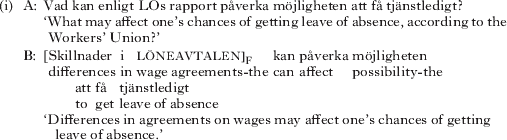
1 Introduction
This article discusses the relation between prosodic phrasing and syntactic structure, making use of empirical evidence from Stockholm Swedish. A number of previous researchers have argued that prosodic structure is not isomorphic to syntactic structure, and that a prosodic structure must therefore be postulated which is distinct from the syntactic one. Among these researchers, there has been agreement that prosodic structure is in some sense ‘flatter’ than syntactic structure. The idea of prosodic flatness has played a major role in several influential accounts of the relation between syntactic and prosodic structure (e.g. Selkirk Reference Selkirk1984, Reference Selkirk1986, Reference Selkirk, Morgan and Demuth1996, Nespor & Vogel Reference Nespor and Vogel1986, Ladd Reference Ladd1992, Reference Ladd1996, Reference Ladd2008, Truckenbrodt Reference Truckenbrodt1999). In these models, syntax–prosody non-isomorphisms arise when the complex syntactic branching is translated into a more limited prosodic branching.
However, no general agreement has been reached as to the exact nature of the flatness of prosodic structure. In early accounts, the flatness of prosodic structure was hypothesised to be due to the Strict Layer Hypothesis (Selkirk Reference Selkirk1984, Nespor & Vogel Reference Nespor and Vogel1986), according to which neither recursion nor skipping of prosodic categories was allowed in prosodic structure representations. The evidence favouring recursion in prosodic structure has, however, been accumulating (Ladd Reference Ladd1986, Reference Ladd1992, Reference Ladd1996, Reference Ladd2008, McCarthy & Prince Reference McCarthy and Prince1993, Wagner Reference Wagner2005, Kabak & Revithiadou Reference Kabak, Revithiadou, Grijzenhout and Kabak2009, Schreuder et al. Reference Schreuder, Gilbers and Quené2009, Féry Reference Féry, Erteschik-Shir and Rochman2010, Ito & Mester Reference Ito, Mester, Borowsky, Kawahara, Shinya and Sugahara2012), and most researchers now seem to accept that at least some prosodic recursion must be assumed.
The evidence from Stockholm Swedish that will be presented here provides further support for the claims that prosodic structure is not identical to syntactic structure, and that prosodic structure does not conform to the Strict Layer Hypothesis. Rather, this evidence provides support for a relatively liberal view on recursion in prosodic structure.
The topic under discussion in the present article is the consequence for the model of the syntax–prosody interface of allowing this liberal view on recursion. Prosodic representations which are liberal in this respect impose partly different requirements on the syntax–prosody interface model, as compared to models that are more conservative with regard to recursion and more closely follow the original ideas of the Strict Layer Hypothesis.
This article will propose that, under the assumption that recursion is allowed in prosodic structure, the pressure for ‘flatness’ in prosody should be expressed as a requirement that sister nodes in prosodic structure be equal, in the sense of belonging to the same prosodic category.
This argument builds on evidence for two types of recursive prosodic structures in Stockholm Swedish, shown in (1). Stockholm Swedish has the typologically rather uncommon feature that there are phonological tonal markers at both the right and left edges of intonation phrases (IPs). The distribution of these boundary markers allows phonological structure to be diagnosed in greater detail in Stockholm Swedish than in many other languages, thus providing empirical support for the distinction in (1).
(1)

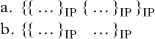
The prosodic structures in (1) correlate with embedding vs. coordination of clauses in syntactic structure, so that (1a) correlates with (2a), and (1b) with (2b).Footnote 1 This fact lends support to a claim which has been made in much previous literature, that syntactic structure is one major source of recursion in prosody (e.g. Ladd Reference Ladd1986, Reference Ladd1992, Selkirk Reference Selkirk, Morgan and Demuth1996, Wagner Reference Wagner2005).
(2)

However, the crucial observation can also be made that whereas (1a) is the exclusive prosodic correlate to the syntactic structure in (2a), two other, flatter, prosodic structures occur as prosodic correlates to (2b). The two structures competing with (1b) are given in (3) (note that (3a) is identical to (1a)).
(3)
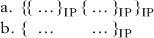
Two important conclusions can be drawn from the fact that the structures in (3) compete with that in (1b).
First, there is no general isomorphism between syntactic and prosodic structure, even though prosodic structure may often correlate with syntactic structure. This standpoint differs from that of researchers who assume that prosodic structure can be derived directly from syntactic structure (e.g. Wagner Reference Wagner2005). Instead of deriving the prosodic structure directly from the syntax, the present account assumes that it is generated in accordance with a set of ranked constraints that impose requirements both on well-formed prosodic structure and on the relation between syntactic and prosodic branching. The present account thus builds on work which has used Optimality Theory (OT; Prince & Smolensky Reference Prince and Smolensky1993) to model the relation between syntax (and to some extent information structure) and prosody (Selkirk Reference Selkirk, Morgan and Demuth1996, Reference Selkirk and Horne2000, Truckenbrodt Reference Truckenbrodt1999, Féry & Samek-Lodovici Reference Féry and Samek-Lodovici2006, Elordieta Reference Elordieta, Riad and Gussenhoven2007, Cheng & Downing Reference Cheng and Downing2009, Feldhausen Reference Feldhausen2010, Elfner Reference Elfner2012, among many others).
Second, the existence of options competing with (1b) (whereas there appear to be no such competing structures for (1a)), reveals that (1b) is phonologically marked in relation to (1a). Thus something in the phonology disprefers (1b), allowing the alternative structures in (3) to surface in spite of the fact that (1b) exhibits a better correspondence to the syntactic structure in (2b) than the structures in (3).
The main claim of this article will be that (1b) is dispreferred due to a constraint which will be referred to as EqualSisters, given in (4). It will be shown that previous accounts of the syntax–prosody interface incorporating constraints such as Non-recursivity and Exhaustivity (Selkirk Reference Selkirk, Morgan and Demuth1996) cannot account for (1b) being dispreferred.
(4)

EqualSisters disprefers (1b) because the material to the right of the embedded IP belongs to some prosodic category lower than the IP. In the Swedish case to be illustrated below, this material will be argued to constitute a phonological phrase (PP), as illustrated in (5).
(5)

EqualSisters is a markedness constraint, which imposes a restriction on well-formed prosodic structure. The restriction on prosodic structure imposed by EqualSisters is independent of whether prosodic structure reflects syntactic structure. Therefore, EqualSisters is sometimes in conflict with the class of constraints that defines the relation between syntactic and prosodic branching. A number of constraint types can be distinguished within this class. Alignment constraints have been widely assumed to align left and right edges in prosody with left and right edges in syntax (Selkirk Reference Selkirk1986, Reference Selkirk, Morgan and Demuth1996, McCarthy & Prince Reference McCarthy and Prince1993). Alignment constraints were argued by Truckenbrodt (Reference Truckenbrodt1999) to interact with a constraint WrapXP, which states that a single syntactic constituent must be contained within a single prosodic constituent. More recently, Selkirk (Reference Selkirk2009, Reference Selkirk, Goldsmith, Riggle and Yu2011) has proposed that the alignment constraints together with WrapXP be supplanted by match constraints, which demand a one-to-one relation between constituents in syntactic and prosodic structure, thus requiring correspondence of both the left and the right edges of prosodic and syntactic constituents.
In the account given here, the match constraints are assumed to interact with EqualSisters, as these make better predictions than alignment constraints with respect to the prosodic pattern observed with coordinated IPs subsumed under a higher IP node, as in (1a). However, alignment constraints can interact with EqualSisters in a similar way to match constraints, and it should be noted that there is as yet no consensus as to which approach is the better from a typological perspective.
Through its interaction with the match constraints, EqualSisters provides an answer to the question why embedding in the syntactic structure is not always reflected in the prosodic structure. EqualSisters causes syntax–prosody non-isomorphisms when it is ranked higher than match constraints, by imposing restrictions on the possibilities for prosodic structure to reflect syntactic embedding.
The general idea behind EqualSisters is to weaken the Strict Layer Hypothesis in such a way that the ‘flatness’ of prosodic structure in relation to syntactic structure is predicted, while at the same time allowing sufficient complexity in prosodic representations.
EqualSisters is, however, not the only attempt to this end within OT. A proposal with a similar aim was presented by Selkirk (Reference Selkirk, Morgan and Demuth1996), in response to evidence that violations of the Strict Layer Hypothesis are found in many of the world's languages. Under the original Strict Layer Hypothesis, prosodic structure was hypothesised to exhibit a fixed depth of structure, where neither recursion nor skipping of categories was possible. The original formulation of the Strict Layer Hypothesis, from Selkirk (Reference Selkirk1984: 26), is given in (6).
(6)

Another version of the Strict Layer Hypothesis, given in (7), is presented by Nespor & Vogel (Reference Nespor and Vogel1986: 7) as the first two (of four) principles governing the geometry of prosodic tree structures.
(7)

Ladd (Reference Ladd1992, see also 1996, 2008) summarises the Strict Layer Hypothesis as in (8).
(8)

Selkirk (Reference Selkirk, Morgan and Demuth1996) divides the original Strict Layer Hypothesis into the four separate constraints in (9). In line with the general principles of OT, she proposes that two of the constraints, Exhaustivity and Non-recursivity, are violable, thus expressing the fact that both level skipping and recursion can appear in phonological structure whenever higher-ranked constraints call for them. Layeredness and Headedness are assumed to be inviolable in all languages (they will also not be violated in the present account).
(9)
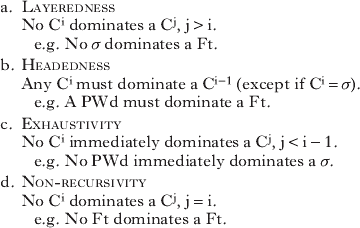
However, neither of the two violable constraints proposed by Selkirk (Reference Selkirk, Morgan and Demuth1996) prefers (1a) to (1b) (although it should be mentioned here that these constraints have been successful in accounting for non-isomorphisms between syntactic and prosodic branching in a number of other languages). Non-recursivity is violated by both (1a) and (1b), whereas Exhaustivity is violated by neither. Consequently, these constraints fail to account for the data from Stockholm Swedish.
The way in which EqualSisters amounts to a weakening of the Strict Layer Hypothesis is more closely related to a proposal by Ladd (Reference Ladd1992; see also 1996 and 2008) than to that of Selkirk (Reference Selkirk, Morgan and Demuth1996). Arguing that the Strict Layer Hypothesis assumed by Selkirk (Reference Selkirk1984) and Nespor & Vogel (Reference Nespor and Vogel1986) is too strongly formulated, Ladd replaces the Strict Layer Hypothesis with the Ranking Condition in (10a) and the Uniformity Condition in (10b).
(10)

Both conditions rely on the definition of prosodic rank in (11).
(11)
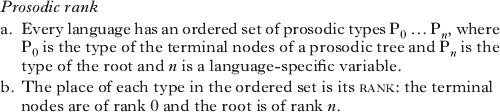
Ladd's Uniformity Condition imposes no ban on structures where a mother node dominates two (or more) daughter nodes which belong to the same prosodic category as the mother node, in spite of such structures being recursive. However, any structure in which a mother node dominates two daughter nodes of different prosodic categories is banned, independently of whether there is recursion or not. Structures which are recursive in a way that is in agreement with the Uniformity Condition are termed Compound Prosodic Domains, in parallel with the compounding structures frequently found in morphosyntax.
The type of structure that Ladd refers to as Compound Prosodic Domains is precisely the type of structure that is called for by the EqualSisters constraint. EqualSisters is thus a violable version of Ladd's Uniformity Condition, incorporated into an OT account of the syntax–prosody interface.
The distinction between the structures that are allowed by EqualSisters and structures that are not is also closely related to the distinction between what van der Hulst (Reference Hulst and Hulst2010) refers to as balanced recursion, corresponding to (1a), and unbalanced recursion, corresponding to (1b). Van der Hulst also argues that unbalanced recursion is sometimes ‘flattened’ into balanced recursion. The Swedish data in the present account will provide additional evidence that these two types of recursion need to be distinguished by the grammar, and that the balanced type is preferred to the unbalanced one.
The article is structured as follows. §2 and §3 will provide information on the Swedish prosodic system which will be crucial for empirically establishing the distinction between (1a) and (1b). Specifically, §2 describes the different phenomena in the Stockholm Swedish intonation system which will be used to define the categories of the prosodic hierarchy, and §3 discusses the definition of the prosodic categories.
§4 provides the empirical evidence for the distinction between (1a) and (1b), and also establishes the correlation between these structures and the syntactic structures from (2a) and (2b). This section also provides empirical evidence for the alternation between (1b) and the structures in (3). §5 shows how the interaction of match constraints and EqualSisters predicts the various prosodic patterns from §4.
§6, finally, discusses the present proposal in relation to proposals in the previous literature, showing that the interaction of EqualSisters with alignment constraints is similar to its interaction with match constraints, and that EqualSisters is needed in the syntax–prosody interface independently of the choice between match and alignment constraints. It is also shown, however, that alignment constraints fail to predict the recursive structure in (1a), and that WrapXP appears to play no role in the account of Swedish data, even if alignment constraints are employed. In addition, §6 contains a comparison between EqualSisters and the previously proposed Non-recursivity and Exhaustivity. §7 summarises the article.
2 The Stockholm Swedish tonal system
This section first gives a general overview of the lexical accents (accent 1 and accent 2) and the prominence tones (focal accents and word accents) in Stockholm Swedish. Thereafter, the focal accent (the strongest type of prominence) is described in §2.1 and the initiality accent (an edge phenomenon) in §2.2. Both the focal accent and the initiality accent are important for defining prosodic phrasing in Swedish. Focal accents will be taken as evidence for the presence of a phrasal head, which is aligned with the right edge of the phrase in the default case, whereas initiality accents will be taken as evidence for the presence of a left edge in prosodic structure.
2.1 The lexical accents (accent 1 and accent 2)
Like most other Swedish and Norwegian dialects, Stockholm Swedish has a distinction between two lexical accents, usually referred to as accent 1 and accent 2. Individual morphemes are lexically specified for accent.Footnote 2 A word (potentially containing morphemes with conflicting accent specification) is assigned either accent 1 or accent 2, based both on its morphological structure and on phonological properties of the word. For example, some plural suffixes assign accent 2 to a word (1ˈbil ‘car’ vs. 2ˈbil-ar ‘cars’), whereas the unstressed prefixes för- and be- tend to change accent 2 roots into accent 1 words (2ˈhöra ‘hear’ vs. för- 1ˈhöra ‘interrogate’; 2ˈskriva ‘write’ vs. be- 1ˈskriva ‘describe’). See Riad (Reference Riad, Vainio, Aulanko and Aaltonen2009, Reference Riad2012, forthcoming) for discussion of how the combination of morphological and phonological properties of a word affects the assignment of lexical accent in Swedish.
The phonological realisation of the lexical accents is context-dependent, varying with two categorically different degrees of prominence, referred to as word accent and focal accent.Footnote 3 The term word accent is due to Bruce, whose 1977 thesis lay the foundation for later descriptions of the Stockholm Swedish tonal system. The focal accent was referred to as the ‘sentence accent rise’ in Bruce (Reference Bruce1977), but was later renamed focal accent by Bruce and other researchers. The term focal accent has been widely used in the literature (e.g. Bruce Reference Bruce1998, Heldner Reference Heldner2001, Hansson Reference Hansson2003, Gussenhoven Reference Gussenhoven2004).
The function of the focal accent has been more widely studied than that of the word accent. Focal accents generally have a similar distribution to pitch accents in other Germanic languages, like English and German. They are found on focused constituents, whereas they consistently fail to appear in postfocal areas that contain information structurally given material. Focal accents also appear as nuclear and prenuclear accents in all-new sentences.
The function of the word accent in the tonal system has remained elusive. It is still unclear whether and to what extent word-accent distribution is determined by information structural and/or rhythmical concerns. Most words receive a word accent, independent of their position in the sentence. Exceptions to this general rule are unstressed function words such as articles and (some) pronouns, verbs in some types of verb phrases, and all but the last word in most lexicalised phrases. In addition to these cases, there is a small group of words which often fails to receive a word accent, for reasons which remain unexplained. This group of words includes gammal ‘old’, liten ‘small’ and inflectional forms of these words. Words in a sentence which fail to receive word accents are tonally unspecified, and there is tonal interpolation across these words.
As for the tonal realisation of the word accent vs. the focal accent, the basic generalisation is that the word accent is a tonal fall, whereas the focal accent contains a tonal rise. Table I illustrates the word accent vs. focal accent realisations of the two lexical accents.
Word accents are realised with a simple tonal fall, which begins on the stressed syllable in accent 2 (represented as H*L), and which ends on the stressed syllable in accent 1 (represented as HL*).
The focal accent contains (at least) a tonal rise. The tonal composition of the focal accent in relation to the HL tones contributed by the word accent has been a matter of discussion in the literature. We need not linger on this, but for the sake of completeness it should be mentioned that there is consensus that in accent 2 words the focal accent rise combines with the word-accent fall, thus resulting in the two peak contour represented as H*LH in Table I. As for accent 1, however, there has been some discussion of whether the word-accent fall is or is not present before the tonal rise. Bruce (Reference Bruce1977, Reference Bruce1998, Reference Bruce and Jun2005, Reference Bruce, Riad and Gussenhoven2007) assumes that it is, and thus arrives at a HL*H contour for accent 1 focal accents. In contrast, Engstrand (Reference Engstrand1995, Reference Engstrand1997) and Riad (Reference Riad, Kehrein and Wiese1998, Reference Riad2006, Reference Riad, Vainio, Aulanko and Aaltonen2009) assume that there is no H before the L*H sequence in accent 1. Here I follow the latter researchers in assuming that such a fall is not present, as this assumption is more in line with the data that will be presented here. Thus, the accent 1 focal accent is assumed here to be a single peak contour, represented as L*H in Table I.
The realisation of the lexical accents in Stockholm Swedish.

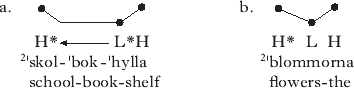
Before we move on, a comment on the tonal realisation of focal accents in compound words is warranted. Though the details of Swedish compound prosody are not immediately crucial to the main argument of this article, compounds appear in the example sentences below. A short introduction to their prosodic structure is therefore appropriate here. In Stockholm Swedish, all compounds receive accent 2, and thus have a two-peak contour when focally accented.Footnote 4 In compound structures, there is always more than one morpheme which is lexically specified for stress. As illustrated in (12a), the two tonal peaks in the accent 2 focal accent contour are sensitive to the presence of multiple stresses in the word, in the sense that the first peak associates with the leftmost stressed syllable (primary stress), whereas the second peak associates with the rightmost stressed syllable (secondary stress). This can cause the two tonal peaks to be one or several syllables apart in focally accented compounds, as in (12a), where the first peak associates with the initial morpheme skol and the second peak associates with the last morpheme hylla, while the syllable bok is tonally low. This contrasts with the realisation of focal accents in words with only one lexically stressed morpheme, where the second tonal peak generally appears directly after the first one, as illustrated in (12b). I follow Riad (Reference Riad, Kehrein and Wiese1998) in assuming that the tonal contour observed in compounds arises because the L tone associates with the secondary stress (marked as L* in (12a)), and spreads leftwards in the compound so as to create a tonal floor between the two H tones (indicated with the arrow in (12a)). Henceforth, all focal accents on compounds (and some derivatives which behave prosodically as compounds) will be represented with the contour H*L*H.
(12)
2.2 Focal accents
This section presents in some more detail the function and distribution of focal accents, which will play an important role in defining and diagnosing the phrasal patterns found in Swedish. I will assume that the focal accent is the head of a phonological phrase, the phonological category below the intonation phrase. This assumption allows focal accent placement to be seen as the result of default PP-phrasing in ‘out-of-the-blue’ sentences. It also allows the prediction that information structural focus is marked by focal accents, via the requirement that a focused constituent must correspond to a PP head.Footnote 5
The basic patterns of focal accent placement can be illustrated with a set of simple sentences. In all-new sentences, focal accents appear in similar positions to nuclear pitch accents in other Germanic languages, such as English and German (cf. Gussenhoven Reference Gussenhoven and Roca1992, Féry Reference Féry1993, Selkirk Reference Selkirk and Goldsmith1995). Accordingly, the focal accent appears on the last word of the direct object in a transitive sentence (13a). There may, however, also be prenuclear focal accents in all-new sentences. For example, the subject can have a focal accent, in addition to the one that appears on the object, as in (13b). This means that the focal accent does not correspond in any simple way to the nuclear accent in English.Footnote 6
(13)
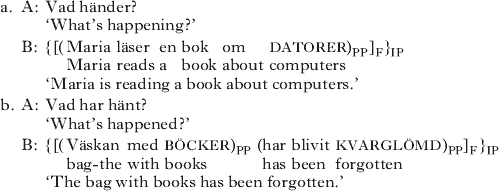
An important conclusion to be drawn from the placement of focal accents in all-new sentences is that focal accents are placed on the rightmost word of the phrase that they appear in. Because the focal accent appears rightmost in the phrase (in the absence of narrow focus), it will be assumed here that the presence of a focal accent on a word in an all-new sentence indicates a phonological phrase edge after that word.
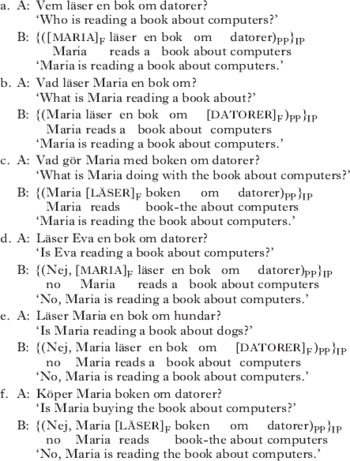
In sentences with a narrow focus (14a–c) or contrastive focus (14d–f), the focused constituent is invariably marked with a focal accent. Thus, as is illustrated in (14a, c, d, f), the PP head is forced leftward to a non-final position, in order to coincide with the focus.Footnote 7 Constituents which are ‘given’ in the sense of information structure and which follow a focus have word accents (14a–f). In (14) and henceforth, words with focal accents are given in small capitals. Words in lower case either receive word accents or remain tonally unspecified.
(14)
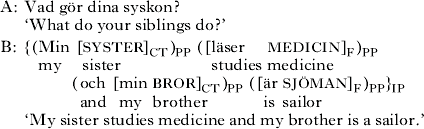
Sentences with a contrastive topic (CT) and a focus have (at least) two focal accents; one on the contrastive topic and one on the focus, as illustrated in (15), an example slightly adapted from Krifka (Reference Krifka, Féry, Fanselow and Krifka2007).Footnote 8
(15)
2.3 Initiality accent: tonal marking of left edges
I now proceed to another cue which will be important for diagnosing phrasal patterns in Swedish, the initiality accent. As the name implies, initiality accents are phrase-initial, more specifically IP-initial. The term initiality accent is due to Myrberg (Reference Myrberg2010), but the phenomenon has been previously described by Horne (Reference Horne1994), Horne et al. (Reference Horne, Hansson, Bruce and Frid2001), Roll (Reference Roll, Bruce and Horne2006) and Roll et al. (Reference Roll, Horne and Lindgren2009).
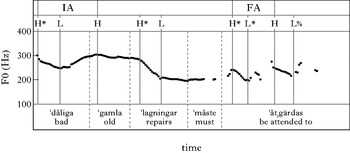
Initiality accents are marked with a tonal contour which is phonologically very similar to that of the focal accent, i.e. a H*LH contour on an accent 2 word and a L*H contour on an accent 1 word. On a compound with an initiality accent, the contour is H*L*H, in parallel with the tonal contour observed on compounds with focal accents (cf. (12a)). An initiality accent appears in Fig. 1 on the initial accent 2 word dåliga, which has a H*LH contour. The sentence in Fig. 1 was read by a female Stockholm Swedish speaker and was pronounced as an answer to the question Vad ska man göra med dåliga gamla lagningar? ‘What has to be done with bad old repairs?’.
Tonal contour for the sentence Dåliga gamla lagningar måste åtgärdas ‘bad old repairs must be attended to’, showing an initiality accent on the accent 2 word dåliga ‘bad’. The y axis in this and other figures shows the fundamental frequency in Hz. In the tonal transcription, tonal targets are transcribed in accordance with Table I, and L% is a low boundary tone. IA=initiality accent and FA=focal accent.

Despite the phonological similarity of initiality accents to focal accents, there is reason to make a strict separation between these two phenomena. Upon closer inspection, there are differences between focal accents and initiality accents, both in terms of their distribution and their phonetic realisation.
For the distribution of initiality accents, the basic generalisation is that they appear on the leftmost stressed word in an intonation phrase (and very often an intonation phrase in prosodic structure corresponds to a clause in syntactic structure), as in Fig. 1. The H*LH contour on dåliga cannot be analysed as a focal accent, for two reasons. First, the subject noun phrase dåliga gamla lagningar is given in this context. This ensures that the H*LH contour on the word dåliga is not due to narrow focus on this word. The H*LH contour on dåliga can also not be analysed as a focal accent marking a topic in this sentence. This is because topic-marking accents appear on the final word of topic phrases, whereas the initiality accent appears initially in the syntactic phrase. Thus, a topic-marking accent in this sentence would have appeared on the word lagningar. We can conclude that, in contrast to the focal accent, the initiality accent does not correlate with any information-structural category.
As for the realisation of the tonal contour, there is a difference between initiality accents and focal accents, in that the last H in an initiality accent H*LH/L*H contour is realised much later than the same H in a focal accent (Horne et al. Reference Horne, Hansson, Bruce and Frid2001, Roll et al. Reference Roll, Horne and Lindgren2009, Kügler & Myrberg Reference Kügler and Myrberg2012). The late alignment of H is observed in Fig. 1. In the absence of tonal specification on gamla, the last H tone of the initiality accent floats rightwards, and is not realised until the first syllable of this word. There appears to be no strict rule for how far the initiality accent H can float. It is not uncommon for it to float far enough to merge with a H*L accent several syllables away from the initiality accented syllable. However, there are also cases where the initiality accent H does not float as far. Nonetheless, it appears to be a stable generalisation that the last H of an initiality accent is later than that last H of a focal accent.
There is a small set of well-defined cases where initiality accents do not appear in an intonation phrase (Myrberg Reference Myrberg2010).Footnote 9 Except for these cases, it can be assumed that intonation phrases obligatorily have initiality accents. The exceptions are controlled for in the dataset below, and in the remainder of the article it is therefore assumed that initiality accents are obligatory cues to the left edges of intonation phrases.
In summary, the initiality accent is tonally similar to the focal accent. However, the two phenomena can and should be distinguished. First, their distribution differs, since initiality accents appear initially in a phrase, whereas focal accents appear either on a focus or on the last word in a phrase. Secondly, the realisation of the tonal contours differ between initiality accents and focal accents, in that the last H tone of an initiality accent is regularly realised much later than that of a focal accent.
3 The Stockholm Swedish prosodic hierarchy
This section describes how the tonal phenomena from the previous section relate to the three categories which will be assumed in the prosodic hierarchy of Swedish: the intonation phrase (IP), the phonological phrase (PP) and the prosodic word (PW).
The model outlined here for Swedish is based on the model of the prosodic hierarchy of Ito & Mester (Reference Ito, Mester, Borowsky, Kawahara, Shinya and Sugahara2012), according to which the IP, the PP and the PW are universally the only three categories in the prosodic hierarchy. Ito & Mester argue that extensive recursion should be allowed in prosodic structure. They argue that recursion in prosodic structure can replace prosodic categories which have been assumed to account for language-specific phonological phenomena, but which lack typological evidence. The elimination of such language-specific categories from the prosodic hierarchy would allow a universal theory of the prosodic hierarchy.
One of the prosodic categories which Ito & Mester do not include in their universal prosodic hierarchy is the Utterance, which was postulated as a separate category above the IP in some earlier models (e.g. Nespor & Vogel Reference Nespor and Vogel1986). According to Ito & Mester, however, the Utterance is not a category in the prosodic hierarchy, but can be translated as the highest (in their terminology ‘maximal’) IP node. It will be argued in §5.3 that this is a plausible hypothesis for Swedish, and that recursion of the category IP provides a more straightforward account of Stockholm Swedish data than a separate Utterance category. It should be noted that other authors have also argued that the Utterance is not part of the universal prosodic hierarchy. Selkirk (Reference Selkirk2009, Reference Selkirk, Goldsmith, Riggle and Yu2011) argues that the Utterance should not be part of the prosodic hierarchy since this category has no apparent correspondent in the syntax, whereas the PW, PP and IP do. The PW basically corresponds to a word in the morphosyntax, the PP to a syntactic phrase and the IP to a syntactic clause.
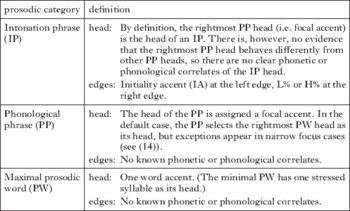
The tonal phenomena which are relevant for the definition of the three tonal domains in Swedish are word accents, focal accents, initiality accents and right-edge boundary tones, which can be H% or L%.Footnote 10Table II summarises the three categories of the Swedish prosodic hierarchy and the phonological correlates of their heads and edges. (The terms maximal and minimal refer to the highest and lowest projections of a prosodic category (Ito & Mester Reference Ito, Mester, Borowsky, Kawahara, Shinya and Sugahara2012). The use of these terms here is explained in §3.2.)
The tonal domains in the Stockholm Swedish prosodic hierarchy.

3.1 The intonation phrase and the phonological phrase
The IP is the highest category of the prosodic hierarchy. Its defining characteristics are tonal edge markers. At the left edge of an IP there is an initiality accent. The initiality accent is obligatory, with the exception of the cases mentioned in note 9. Right edges of IPs are obligatorily marked with high (H%) or low (L%) boundary tones. A neutral declarative sentence generally has a L% boundary tone.Footnote 11 Below the IP is the phonological phrase, PP. The head of the PP is obligatorily assigned a focal accent. The PP has no phonological edge markers.
There is a clear division of labour between the IP and the PP in the prosodic model outlined here. The IP has phonological cues at both edges, whereas only the head of the PP has a phonological marker. There are no categorical phonological cues for IP heads, nor any categorical phonological cues for PP boundaries (whether left or right).Footnote 12
IP and PP edges always coincide in the data on which the argument for EqualSisters is based. This fact raises two issues which will be addressed before I move on to discuss the properties of the prosodic word in Swedish. First, the relation between the focal accent and the L% boundary tone will be addressed. Second, it will be pointed out that it is not crucial for the present account whether the focal accent is analysed as the head of IP or as the head of PP. In fact, it is not crucial that the distinction between the categories IP and PP is maintained at all. This means that the account outlined here is in principle compatible with an analysis of Swedish prosody where there is only one prosodic category above the prosodic word.
I begin with the relation between the focal accent and the L%. A consequence of the fact that IP and PP edges coincide in the material considered here is that the L% always directly follows the focal accent. Thus phrase-finally we observe the tonal sequence L*HL% when the phrase-final word has accent 1, and H*LHL% when the phrase-final word has accent 2 (as seen in Fig. 1, where the accent 2 word åtgärdas has a H*L*HL% contour). The fact that the L% always directly follows a focal accent in the material might raise the suspicion that the L% is actually part of the focal accent. However, it is clear that this is not the case. Instead, the L% is a separate tonal object, which serves as a boundary cue. The evidence for this comes from the fact that the L% is not obligatory after a focal accent. Whenever there is no L% after a focal accent, there is a ‘high plateau’ (e.g. Bruce Reference Bruce1977, Reference Bruce, Gregersen and Basbøll1987). Plateaus result from interpolation between the rightmost H of a focal accent and the leftmost H of a word accent (i.e. plateaus are formed between two high tones in tonal sequences like L*H→H*L/HL* or H*LH→H*L/HL*). This also means that the focal accent itself is not a boundary cue. Studies have shown that there is no correlation between the presence of a focal accent and a perceived boundary (e.g. Strangert & Heldner Reference Strangert and Heldner1995, Hansson Reference Hansson2003). A tonal fall (presumably due to an L% boundary tone), however, has been shown to be interpreted by listeners as a boundary cue (e.g. House Reference House1990, Bruce et al. Reference Bruce, Granström, Gustafson, House, Granström and Nord1993; see also Hansson Reference Hansson2003: 126–127, 133). That a tonal fall is a boundary signal which is separate from the focal accent in Swedish is thus a rather uncontroversial assumption, with a long line of predecessors in the literature, both researchers working within the Lund model and others (e.g. Bruce Reference Bruce1977, Reference Bruce1982, Reference Bruce1998, Riad Reference Riad, Kehrein and Wiese1998, Gussenhoven & Bruce Reference Gussenhoven, Bruce and Hulst1999, Heldner Reference Heldner2001, Hansson Reference Hansson2003, Gussenhoven Reference Gussenhoven2004, Ambrazaitis Reference Ambrazaitis2009).
We can now move on to the second issue which needs to be addressed in relation to the coincidence between IP and PP edges in the material, namely that it is not crucial for the argument for EqualSisters whether the focal accent is analysed as the head of IP or as the head of PP, or whether the IP and the PP are collapsed into a single prosodic category. This follows directly from the fact that in the material at hand, the IP and PP edges always coincide.
The distinction which is made between IP and PP edges here is due to Myrberg (Reference Myrberg2010). However, other researchers have made different assumptions about the prosodic structure above the prosodic word in Swedish. For example, Hansson (Reference Hansson2003) assumes only one category, which covers both the IP and the PP in the present account.Footnote 13 It is, however, important to note that, under an account of Swedish prosody along the lines of Hansson, the general argument for EqualSisters proposed in this article also holds.
Though it is not crucial to the argumentation whether the IP and the PP are kept separate or are collapsed into a single category, some motivation for the definition of the IP vs. PP distinction that is made here will nonetheless be given.
At first glance, the account offered here might appear unsatisfactory, in the sense that two phrasal domains have complementary functions (the IP being only boundary marking and the PP only head marking). It might appear that assuming only one level of prosodic phrasing in Swedish, with a focal accent as its head, an initiality accent as a left-edge signal and a L% or H% as its right-edge signal, would be a theoretically more satisfactory solution.
One advantage of the type of analysis provided here, however, is that it can easily account for the fact that there may be two or more focal accents between an initiality accent and a H% or L% boundary tone. Such structures are not uncommon. They are for instance found in all-new sentences where a clause-initial constituent (e.g. the subject of the sentence) has a focal accent, e.g. on account of being long or being a contrastive topic, as illustrated in (13b) and (15).
In these contexts a boundary tone is often inserted, but need not be. The non-obligatoriness of the boundary tone after a clause-internal focal accent contrasts with contexts where a boundary tone is obligatorily inserted, such as the end of a clause. The model assumed here, where the IP and the PP levels are kept separate, allows the structure with a boundary tone following a PP final focal accent to be represented as a PP plus an IP edge, whereas the focal accent without a following boundary tone can be represented as a single PP edge. A model in which the IP and the PP are collapsed into one category (or where the focal accent is head of IP) needs to assume the same prosodic representations for the focal accent with and without a following boundary tone. The result of this will be that boundary tones are optionally realised at the end of the prosodic constituent which licenses them.
One problem for an account which assumes such optional boundary tones is that the syntactic environment appears to be one factor in determining whether the boundary tone is optional or not. At the end of a clause it is obligatory, but clause-internally it is optional. This fact is difficult to account for in a model which assumes that the focal accent and the L% belong to the same prosodic categories, without violating the ‘hypothesis of indirect reference’ (Inkelas Reference Inkelas1989, Truckenbrodt Reference Truckenbrodt1999). This hypothesis says that the application of prosodic rules can refer to phonological domains, but can make no direct reference to syntactic ones, and it has been widely assumed within accounts of prosodic structure that assume a prosodic structure which is distinct from the morphosyntactic structure (Nespor & Vogel Reference Nespor and Vogel1986, Selkirk Reference Selkirk1986). An account of Swedish prosody which assumes optional L% boundary tones must violate the indirect reference hypothesis to explain why one and the same type of prosodic phrasal category behaves differently in different syntactic environments.
Separating the IP and PP levels, as is done here, is a straightforward way of avoiding non-obligatory tonal cues to prosodic categories, thereby also avoiding violations of the indirect reference hypothesis. Because there are no optional boundary tones in the model adopted here, it allows the assumption that tonal phenomena are obligatory cues to edges/heads of prosodic categories in Stockholm Swedish. Thus there is no variation with respect to whether an edge/head of some category is or is not reflected by a certain tonal cue. This assumption allows tonal phenomena to be taken as direct evidence for the presence or absence of prosodic edges and heads.
3.2 The prosodic word
The remainder of this section discusses the lowest category in the prosodic hierarchy, the PW. The exact definition of this category will not play any crucial role in this article, but for the sake of exposition and completeness, it is dealt with briefly here. I follow the view on prosodic words in Swedish developed by Riad (Reference Riad2012, forthcoming) and Myrberg & Riad (forthcoming), which is couched within Ito & Mester's (Reference Ito, Mester, Borowsky, Kawahara, Shinya and Sugahara2012) prosodic hierarchy framework.
The definition of the prosodic word in Swedish is slightly complicated by the fact that Swedish (along with Norwegian) has both stress (which is a non-tonal phenomenon) and word accent (which is tonal, and closely connected with the lexical accent of words; see Table I above). Arguably, both lexical stresses and word accents are assigned within the prosodic word, but there is not a one-to-one relation between those syllables which are stressed in the lexicon and those which are assigned word-accent tones in a sentence. Ito & Mester's model allows separation of stress and lexical accent, on the assumption that lexical stress is the head of the minimal (i.e. the lowest projection of a) prosodic word and word accent is the head of the maximal (i.e. the highest projection of a) prosodic word. Under the view of the prosodic word assumed here, then, the minimal prosodic word contains exactly one stressed syllable, and the maximal prosodic word contains exactly one word accent.
Morphologically simplex words have one stress and thus form minimal prosodic words (there is arguably no secondary stress in simplex words in Swedish). I follow Riad's view that word stress is largely morphologically determined. This view entails the assumption that morphemes carry lexical specifications relating to stress. Riad (Reference Riad2012) divides the lexical specifications that morphemes may have relating to stress into four groups: ‘unspecified’ (neutral with respect to stress), ‘tonic’ (containing one stressed syllable), ‘pretonic’ (required to follow a stressed syllable) and ‘posttonic’ (required to precede a stressed syllable). Stress patterns in Swedish words are determined by constraints requiring preservation of lexical specification on the one hand and calling for optimal prosodic word structures on the other.
Compounds are examples of structures which constitute one maximal prosodic word, while containing several minimal prosodic words. This is because the stresses of individual morphemes are retained in compounds, which can thus be divided into multiple minimal prosodic words. However, although they contain multiple stressed syllables, compounds can only be assigned one word accent.
Some morphological derivatives form one minimal PW, like simplex words, whereas others receive a prosodic structure similar to that of compounds. All compounds and derivatives which behave like compounds have accent 2 in Stockholm Swedish. When the compound is focused or initiality accented, it is assigned the tonal contour H*L*H, as illustrated in (12a).
In summary, three categories are assumed in the prosodic hierarchy of Swedish. These are the IP, the PP and the PW. The IP is defined by obligatory left and right edge cues. At the left of the IP, there is an initiality accent (which is obligatory except for the exceptions described in note 9). At the right of the IP there is an obligatory L% or H% boundary tone.
The PP is characterised by having a focal accent as its head. The PP is right-headed by default, and the focal accent can therefore be used as a right-edge signal in all-new contexts. However, the focal accent can also appear non-finally in the PP, in order to coincide with a narrow focus.
The lowest category is the PW, which is defined by a lexically stressed syllable (at the minimal level) and by a word accent (at the maximal level).
4 Data from Stockholm Swedish
This section presents an experiment on prosodic phrasing with three native Stockholm Swedish speakers. Syntactically, the stimulus sentences are of two different types; one with two coordinated clauses and the other with a main clause containing an embedded clause. The stimulus sentences, along with assumptions about their respective syntactic structures, are presented in §4.1.
§4.2 presents the results of the experiment. It will become clear in this section that, prosodically, the coordinated sentences behave differently from the sentences containing embedding. Specifically, the embedded sentences were realised with three different prosodic structures (cf. (1b) and (3a, b)), whereas the coordinated sentences were always realised with the same prosodic structure (cf. (1a)) by all speakers. The results from this experiment will be accounted for in §5 in terms of variable ranking of match constraints and EqualSisters.
4.1 Stimuli
Six target sentences were recorded, produced by three native speakers of Stockholm Swedish (two female and one male). Each target sentence was preceded by a few context sentences that triggered an all-new reading of the target sentence. Three of the six sentences had the syntactic structure illustrated in (16a), and the other three had the syntactic structure in (16b). Each of the three speakers read the full set of six sentences three times, so the data consisted of 54 sentences (2 conditions×3 items×3 speakers×3 repetitions), of which 27 had the syntactic structure in (16a) and 27 the structure in (16b).
(16)
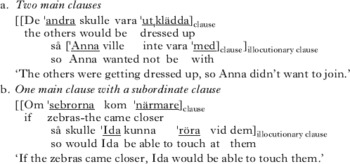
The crucial syntactic difference between (a) and (b) lies in the presence of coordination vs. embedding in the syntactic structure. Whereas (16a) consists of two main clauses coordinated with så, (16b) consists of one main clause with an embedded clause in the preverbal position.
We need to provide a comment with regard to the notion of ‘clause’ that will be assumed in the present account, as this definition is a relatively wide one, including the outermost syntactic node in (16a). It is clear from the literature on the correspondence between syntax and prosody that many languages impose some requirement that clauses in syntactic structure correspond to IPs in prosodic structure (e.g. Selkirk Reference Selkirk2009, Reference Selkirk, Goldsmith, Riggle and Yu2011 and references therein, and Ito & Mester Reference Ito, Mester, Borowsky, Kawahara, Shinya and Sugahara2012). It is, however, unclear exactly how the notion of clause which is relevant to the syntax–prosody correspondence can be defined in current syntactic theory.
We do not really need a very precise notion of the clause for the present account. What is crucial here is that in (16b) there are two clauses, one of which is embedded in the other. Second, it is crucial that in (16a) there are two coordinated clauses subsumed under a single syntactic projection. This larger projection must necessarily behave like a clause in terms of the syntax–prosody mapping. The assumption that there exists a syntactic projection around coordinated clauses, and that it behaves like a clause with respect to the syntax–prosody interface, has a precedent in Selkirk (Reference Selkirk2009, Reference Selkirk, Goldsmith, Riggle and Yu2011), who argues that the match constraints adopted in the present account apply both to individual clauses and to the syntactic node that subsumes coordinated clauses. There is also empirical support from English and German for assuming that coordinated clauses form IPs like individual clauses (Ladd Reference Ladd1986, Féry & Truckenbrodt Reference Féry and Truckenbrodt2005). This evidence will be presented in more detail in §5.3.
I therefore adopt Selkirk's (Reference Selkirk2009, Reference Selkirk, Goldsmith, Riggle and Yu2011) assumption that there are two notions of ‘clause’ which are relevant to the syntax–prosody interface. These two types correspond to two different functional projections in modern (generative) syntactic theory; Selkirk (Reference Selkirk, Goldsmith, Riggle and Yu2011) refers to them as the ‘standard clause’ and the ‘illocutionary clause’. Two coordinated clauses, as in (16a), together form one illocutionary clause, as the coordinated clauses cannot have different illocutionary force (cf. Selkirk Reference Selkirk2009). The two individual clauses which are coordinated each form one standard clause. In (16b), the embedded clause is a standard clause. The main clause and the embedded clause together have illocutionary force, and therefore form one illocutionary clause.
There is still work to be done with respect to determining which functional nodes in the syntactic projection of a clause correspond to the illocutionary and the standard clause respectively. Selkirk (Reference Selkirk2009, Reference Selkirk, Goldsmith, Riggle and Yu2011) proposes that the illocutionary clause corresponds to the Force projection of Rizzi (Reference Rizzi and Haegeman1997), whereas the standard clause is one of the lower functional projections (she points out, however, that more research is needed to determine which one). I will remain agnostic here as to precisely which projections are involved in the syntax–prosody interface, as this issue requires extensive theoretical discussion as well as empirical investigation.
Before moving on to the result section, a comment is also needed with regard to the status of the adjunct clause in (16b), which is assumed to be embedded in the main clause. Swedish is a V2 language, like most other Germanic languages. This means that there can be only one constituent preceding the finite verb in a (main) clause, and most types of declarative clauses require that some constituent occupy this preverbal position (but for systematic exceptions to this generalisation see Mörnsjö Reference Mörnsjö2002, for example). In much of the Swedish literature, the position before the verb has been referred to as the ‘fundament’ position, following Diderichsen (Reference Diderichsen1946). In work that adopts a generative syntactic framework, the fundament position has often been assumed to correspond to the SpecCP position, and in this work the finite verb in main clauses is assumed to move up to C0 (e.g. Platzack Reference Platzack1998: 89–92). I assume here that the adverbial clause in (16b) occupies the fundament position, or, in Platzack's (and others') terms, that it is in SpecCP, whereas the verb is in C0.Footnote 14
There is a great deal of variation with respect to which constituent in a clause appears in the fundament position. However, it has been shown that subjects are the most common constituent found in this position, and that the second most common constituent is an adverbial (Jörgensen Reference Jörgensen1973, Platzack Reference Platzack1998). This means that the sentence structure in (16b), where an adverbial is in the fundament position, is relatively common. For more extensive discussions on the restrictions with respect to movement to the SpecCP position in modern Swedish, see Platzack (Reference Platzack1998) and Teleman et al. (Reference Teleman, Hellberg and Andersson1999).
The så in the target sentences of (16b) is commonly found after adverbials and some other types of constituents in the fundament (cf. Teleman et al. Reference Teleman, Hellberg and Andersson1999, Nordström Reference Nordström2010). This så is present in the target sentences both to make them more natural and to increase the parallel with the coordinated clauses in (16b).
The target sentences are designed in a way which makes it easy to diagnose the prosodic structure. In every target sentence, four of the words are content words, which obligatorily receive a tonal prominence in Swedish. These words are underlined in (16), and the stressed syllables of these words are indicated. Except for the word med in (16a), all the underlined words are accent 2 words.Footnote 15 The underlined words obligatorily carry a word accent when they are phrase-internal, a focal accent when they are phrase-final and an initiality accent when they are phrase-initial. These words can therefore be used to diagnose the phrasing pattern in the sentences. The remaining words in the sentences do not require any tonal prominence, so tonal interpolation is expected across these words.
4.2 Results
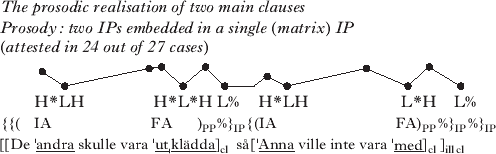
I now proceed to discuss the results of the experiment, i.e. the prosodic realisations of the target sentences. All three speakers read the sentence in (16a) in the same way, with the exception of three (slightly disfluent) readings which were hard to analyse. Thus (at least) 24 of the 27 readings had the prosodic structure shown in (17).
(17)
In contrast to the coordinated clauses, the sentence type in (16b), which contains embedding, was read in three different ways by the speakers. The three options are illustrated in (18).Footnote 16 Below, the prosodic structures in (17) and (18) are discussed in some detail, and example contours produced by the three speakers are shown. At the end of this section, a table is given which shows the distribution of the prosodic patterns between the speakers.
The curly brackets and parentheses in (17) and (18a–c) show the attested prosodic phrasings for the syntactic structures in (16a) and (b) respectively. Curly brackets represent IP edges and parentheses represent PP edges. IA stands for initiality accent and FA for focal accent. The tonal pattern expected for the prosodic structure in the example is given above each sentence, and a stylised contour is shown. The number of attestations for each prosodic structure is also given.
(18)

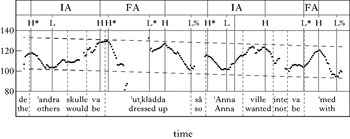
In the prosodic structure in (17), both clauses have an initiality accent on the first tonally prominent word (i.e. andra in the first clause and Anna in the second). Both clauses also have a focal accent on the last tonally prominent word (i.e. utklädda in the first clause and med in the second). Finally, both clauses end with a L% boundary tone, realised as a tonal fall on the last syllable of each clause. An example of the prosodic pattern in (17) is given in Fig. 2.
Tonal contour for the sentence in (17), containing two coordinated clauses. In the tonal transcription, prominences are transcribed in accordance with Table I, and L% is a low boundary tone. The two dashed lines indicate the downtrend pattern throughout the two clauses. Utklädda is the participle of the (lexicalised) verb+particle combination klä ut ‘dress up’. This word receives compound prosody, and therefore has an accent 2 contour with two association points, one for the primary and one for the secondary stress, i.e. H*L*H.

In addition to the two IPs that contain each of the two clauses, an outer IP projection is assumed in (17), which contains both the lower IPs. This IP is motivated by the fact that all instantiations of the prosodic pattern in (17) have a downdrifting pattern which continues throughout both clauses. The downdrift is marked with dashed lines in Fig. 2.Footnote 17 In §5.3 it will be argued at some length that downtrend patterns in these cases constitute evidence for recursion at the level of the IP. This type of recursion will be a crucial prerequisite to the argumentation for EqualSisters, because an account which does not assume it could make do with previously proposed constraints, such as Non-recursivity and WrapXP or WrapCP. In §5.3, however, it is argued that an account which does not take these downtrend patterns as a reflection of prosodic recursion is theoretically and empirically unsatisfactory, drawing on evidence from English, German and Swedish (Ladd Reference Ladd1986, Hansson Reference Hansson2003, Féry & Truckenbrodt Reference Féry and Truckenbrodt2005).Footnote 18
Moving on now to an illustration of the three patterns, the prosodic structures in (18) are exemplified in Fig. 3. In Fig. 3a, which illustrates the prosodic pattern in (18a), there is an initiality accent as well as a focal accent and a L% in the embedded clause, providing evidence that this clause forms an IP. In addition, there is an initiality accent, a focal accent and a L% in the matrix clause, meaning that there is another IP there. As in Fig. 2, there is also a clear downtrend pattern throughout the clause, which leads to the conclusion that the two IPs are included in a larger IP projection.

The prosodic structure in (18b) is exemplified in Fig. 3b. In (18b) there is only one initiality accent, located in the embedded clause, and one focal accent, located in the matrix clause. There is also one L% at the end of the matrix clause. Thus we can conclude that the entire main clause, including the embedded clause, forms one single IP.
There is a slightly rising contour after the sharp H*L fall in närmare, but this is not an H tone, as becomes clear when the H*L contour on närmare in Fig. 3b is contrasted with the H*L*H-contour on rumsrena in Fig. 3a. The H*L contour on Ida should be contrasted with the H*LH contour on ägare in Fig. 3a.
The prosodic pattern in (18c) is illustrated in Fig. 3c. It lacks the one-to-one correspondence between the number of initiality accents and focal accents observed in (17) and (18a, b). There is an initiality accent, a focal accent and a L% in the embedded clause, but the matrix clause has only a focal accent and a L%, but no initiality accent. The prosodic pattern in Fig. 3c is interpreted as embedding in the prosodic structure, which directly mirrors the syntactic embedding in the target sentence in (18).
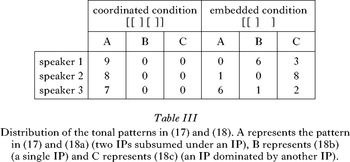
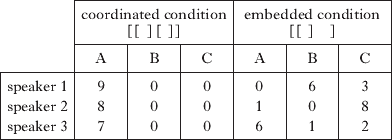
Table III shows the distribution of the different tonal patterns in (17) and (18). The lefthand side of the table shows the results for the coordinated condition in (17). The righthand side of the table show the results for the embedded condition in (18). The A, B and C in the row below each condition represent the observed tonal patterns. A represents the pattern in (17) and (18a) (two IPs subsumed under an IP), B represents (18b) (a single IP) and C represents (18c) (an IP dominated by another IP). As is evident from Table III, the three speakers show a clear individual preference for one of the three patterns.
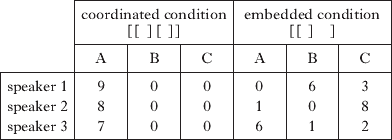
In summary, the two coordinated clauses from (16a) were always assigned the same prosodic structure, namely two IPs coordinated under a third IP, as in (17). The sentence from (16b), containing embedding, was given three different prosodic structures. One of the three patterns, the one in (18a), looks like the pattern for the coordinated sentence in (17). The second pattern, (18b), has a single IP corresponding to the whole main clause, and the third pattern, (18c), has one IP embedded into a higher IP, thus reflecting the embedding in the structure of the target sentence.
In the next section, the variation in prosodic branching illustrated in (18), as well as the lack of variation in (17), will be derived from the syntactic structure via variable ranking of a set of OT constraints.
5 Accounting for Stockholm Swedish with EqualSisters and match constraints
This section illustrates how the three alternative prosodic patterns in (18) result from the variable ranking of match constraints with EqualSisters, such that each of the structures in (18) is selected as optimal under at least one ranking. The single output structure in (17) incurs no violations of any of the constraints when it is the output to the coordinated syntactic structure in (16a), and is thus selected as the winning output candidate under any ranking.
‘Classic’ versions of OT cannot capture variation of the type described in (18), where three different output structures correspond to a single input structure. This is because constraint ranking does not change, i.e. constraints are strictly ranked. Hence the grammar can only match any one single input to a single output structure (McCarthy Reference McCarthy2002: 227). Some authors have, however, assumed variable ranking of OT constraints in order to predict variation in grammatical structure. There are different ways of modelling such variable rankings. An example is the ‘floating constraints’ approach of Nagy & Reynolds (Reference Nagy and Reynolds1997). A different approach is argued for by Anttila (Reference Anttila, Hinskens, van Hout and Wetzels1997). His model includes partial rankings, which entails that some constraints remain unranked in the grammar, whereas others are ranked. Yet another approach to modelling linguistic variation with OT is Stochastic OT (Boersma & Hayes Reference Boersma and Hayes2001). This approach models constraint rankings on a continuous scale, in a way which allows variable rankings between some constraints and strict ranking between others in the grammar. One of the differences between the approaches to modelling variation in OT lies in the predictions they make with regard to the frequency of occurrence of different patterns. However, for the purposes of the present work, it is not possible to select one of these models, as no statistical data for intonational variation is available. Suffice it to say that variation of phonological phrasing in relation to the syntactic structure can be modelled in OT in terms of some variable and some strict rankings in the grammar.
It should be noted that a distinction can be made between what in this account is called variable ranking and what might be referred to as ‘free’ ranking. Free ranking means that the constraint ranking plays no role, because the same candidate will be selected as the winner independently of the ranking. Put differently, there is no means of determining the ranking of two or more constraints. The variable ranking used here is essentially different. The ranking is crucial, because changing the ranking of constraints also changes the output structure. The variable ranking used here thus means that a single syntactic structure can be given different prosodic realisations in the same information-structural context, both for individual speakers and between speakers.Footnote 19
No strict rankings will be assumed in the account developed here. It is important to note that all logically possible rankings of the constraint set will result in an output structure which is grammatical in the language, i.e. one of the observed patterns in (17) and (18). Thus the constraint set to be proposed inherently excludes all ungrammatical structures.
§5.1 describes how two match constraints can decide between two of the three structures in (18). §5.2 describes how free ranking of EqualSisters with the two match constraints can decide between all three structures in (18). This section also shows why only one structure can be selected for the sentence with coordinated clauses from (17). §5.3 discusses why recursion must be assumed at the level of the IP, in (17) and (18a), and discusses how such recursion is predicted by the match constraints.
5.1 Match constraints
Match constraints require a strong correspondence between syntactic and prosodic bracketing. That edges of syntactic and prosodic constituents coincide in a principled way is argued by Selkirk (Reference Selkirk1986), who develops the edge-based theory of the syntax–prosody interface. In a later article, Selkirk (Reference Selkirk, Morgan and Demuth1996) uses the theory of Generalised Alignment (McCarthy & Prince Reference McCarthy and Prince1993) to formulate the edge-based theory of the syntax–prosody interface in OT terms. Generalised Alignment amounts to a general formulation of the idea that edges of phonological, morphological and syntactic categories align with each other, and the fusion of Generalised Alignment with the edge-based theory of the syntax–prosody correspondence results in alignment constraints, which have been widely used in the literature. The original alignment constraints target left and right edges separately, in accordance with the generalised formulation of alignment constraints in McCarthy & Prince (Reference McCarthy and Prince1993). This allows the assumption that alignment of only one edge is active in a single language (cf. Selkirk Reference Selkirk1986, Truckenbrodt Reference Truckenbrodt1999).Footnote 20
However, in recent publications Selkirk (Reference Selkirk2009, Reference Selkirk, Goldsmith, Riggle and Yu2011) has proposed that alignment constraints be replaced with match constraints.Footnote 21 Match constraints differ from alignment constraints in targeting right and left edges simultaneously. In order for a match constraint to be satisfied with respect to some syntactic constituent, there must exist a constituent in prosodic structure (of a specific type), which is identical in extension to the syntactic one. This means that there must be a correspondence between both the right and the left edges of a syntactic and a prosodic constituent for the match constraints to be satisfied. This property of the match constraints limits the number of phrasing options predicted by match constraints compared to the alignment constraints. Selkirk (Reference Selkirk, Goldsmith, Riggle and Yu2011) shows that in several of the cases presented in previous literature where alignment constraints have been used to account for syntax–prosody interface phenomena, the more limited match constraints make equally or more satisfactory predictions.
I will assume match constraints rather than alignment constraints, because they provide a better account of the prosodic pattern observed with coordinated clauses such as those in (16a). However, the issue of whether match or alignment constraints make the best predictions with respect to the syntax–prosody interface in Universal Grammar must still be considered an open one, awaiting further typological evidence. We will see below that the interaction of EqualSisters with alignment constraints is similar to its interaction with match constraints. Thus the replacement of match constraints with alignment constraints would not remove the need for EqualSisters in the syntax–prosody interface. I return to this point in §6.1.
Selkirk (Reference Selkirk, Goldsmith, Riggle and Yu2011) proposes three different match constraints referring to different constituent types, in parallel with words, phrases and clauses in syntactic structure. These are given in (19) (from Selkirk Reference Selkirk, Goldsmith, Riggle and Yu2011). For the purposes of the present analysis, the match constraint in (19a) will be most relevant, as this constraint matches clauses in syntax to IPs in prosody.Footnote 22
(19)

Each match constraint comes in two versions, applying in different directions: from syntax to prosody (S–P) and from prosody to syntax (P–S). S–P constraints ban syntactic edges that have no prosodic correspondent, i.e. structures like (20a) (where square brackets represent edges in syntactic structure and parentheses edges in prosodic structure). P–S constraints, on the other hand, ban prosodic edges that have no syntactic correspondent, i.e. structures such as (20b).
(20)
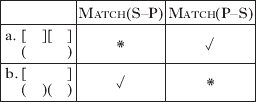
The need for separate constraints that apply in the S–P and P–S directions has also been demonstrated for alignment constraints. McCarthy & Prince (Reference McCarthy and Prince1993) show the need for alignment in two directions with edges of feet and prosodic words in Garawa. Later research has shown that syntax–prosody alignment constraints, too, must apply in both directions (Selkirk Reference Selkirk, Morgan and Demuth1996, Reference Selkirk, Goldsmith, Riggle and Yu2011, Cheng & Downing 2009, Werle Reference Werle2009).
Moving on now to how match constraints apply to the data from (18), recall from §4.2 that a syntactic structure with a main clause containing an embedded clause, i.e. [[ … ]clause … ]illocutionary clause, has three prosodic realisations in Stockholm Swedish. In order to derive all three outputs, different rankings of OT constraints must choose different outputs. The (re-)ranking of two match constraints can derive two of the three variations: (18a) and (18b). This is illustrated in (21) and (22). In (21), the S–P constraint is ranked higher than the P–S constraint. Candidate (a) wins under this ranking because each syntactic edge has a prosodic correspondent. Candidate (b) loses because there is a syntactic edge with no prosodic correspondent.
(21)

In (22) the ranking is opposite to (21), i.e. the P–S constraint is ranked higher than the S–P constraint. Under this ranking, candidate (b) wins because every prosodic edge has a syntactic correspondent. Candidate (a) loses because it has a prosodic edge without a syntactic correspondent.
(22)

5.2 EqualSisters
In fact, however, if only the match constraints were active in the process of selecting a winner for the input syntactic structure in (21) and (22), neither (a) nor (b) would be the winning output structure. This is illustrated in (23) and (24), where the candidate in (18c), i.e. the candidate with one IP containing another IP, wins under any ranking, since this candidate has a perfect correspondence between IP and clause edges, whereas neither (a) nor (b) does.
(23)
(24)
In order to derive (18a) and (18b) as winning output structures in addition to (18c), some additional constraint is needed. This constraint must favour (a) and (b) over (c). For this purpose, EqualSisters, given in (4) above, is assumed in addition to the match constraints. Of the three candidates in (18), (c) violates EqualSisters, while both (a) and (b) satisfy it. In (a), two IPs are sisters, as in (25a). In (b) there is only a single IP dominating a single PP, i.e. there are no sister nodes, as illustrated in (25b). In (c), however, an IP has a PP sister, as in (25c).
(25)
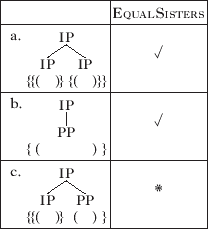
With variable ranking of EqualSisters and the match constraints, each of the three output structures from (18) will be derived as winning structures under at least one ranking.
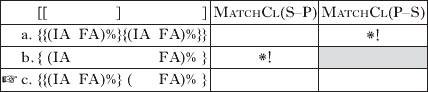
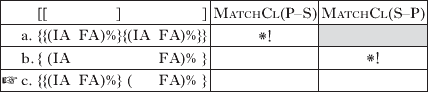
When EqualSisters is high-ranked, as in (26) and (27), it excludes the perfectly matched candidate in (c). The MatchClause constraints are left to choose between (a) and (b). When MatchClause(S–P) is higher-ranked, as in (26), candidate (a) wins, since (b) fails to reflect the right edge of the embedded clause.
(26)

When MatchClause(P–S) is higher-ranked, as in (27), candidate (b) wins, since (a) has a prosodic left edge with no syntactic correspondent after the embedded clause.
(27)

When EqualSisters is ranked below the MatchClause constraints, however, the perfectly matched candidate (c) will be selected, in spite of its violation of EqualSisters. This is shown in (28).
(28)

Importantly, no logically possible ranking of these constraints will select any imaginable candidate other than those in (18). With three constraints (two match constraints+EqualSisters), there are six possible rankings. Only three rankings are shown here, because the three remaining rankings are not crucially different from the ones shown. All possible rankings produce one of the output structures (a)–(c).
Recall now from §4.2 that the coordinated clauses exhibit only a single output structure, where each clause constitutes an IP of its own, and the two clauses together constitutes another IP, as in (17). (29) illustrates the predictions of the constraint set with respect to the coordinated structure in (17). The constraint set correctly predicts that the output structure in (17) (represented as candidate (a) in the tableaux above) will always win, independent of the ranking between EqualSisters and the match constraints. This is because (17) is perfectly matched, in the sense that there is a one-to-one correspondence between syntactic clause edges and prosodic IP edges. Because the syntactic input structure contains only sister nodes which belong to the syntactic clausal category, the perfectly matched prosodic structure contains only sister nodes belonging to the prosodic category IP, and there are no violations of EqualSisters in the perfectly matched candidate. Thus (17) incurs no violations of either the match constraints or EqualSisters, whereas all other candidates do.
(29)

This means that EqualSisters allows coordinated syntactic structures to be perfectly mirrored by the prosodic structure, and will only come into conflict with match constraints when the syntactic input structure contains embedding.Footnote 23 The presence of a constraint such as EqualSisters in the syntax–prosody interface therefore predicts that, in general, coordinated syntactic structures will exhibit less variation with respect to prosodic phrasing than syntactic structures which contain embedding.
5.3 Recursive IP-structure
We have now reached the third part of the analysis section, which discusses the outermost IP brackets in candidate (a) in the tableaux above, repeated in (30a), which create recursion at the IP-level. A candidate without such brackets is given in (30b).
(30)

This section first provides empirical motivation for the presence of the outer IP brackets in the prosodic representation. It is then discussed how these brackets are derived by the match constraints. Match constraints (Selkirk Reference Selkirk2009, Reference Selkirk, Goldsmith, Riggle and Yu2011) are better able to predict the presence of the outer IP brackets than alignment constraints, and this is the main reason why they have been used here instead of alignment constraints. This difference between the constraint types will be explained in §6.1.
There are strong reasons to believe that the outermost IP brackets in candidate (a) in the tableaux above exist, and that (30a) is therefore better than (30b) as a representation of the prosodic pattern in (17) and (18a). Recall from the discussion in §4, and from Fig. 2, that the two coordinated clauses exhibit both left and right IP-boundary phenomena, while at the same time exhibiting a declination pattern which continues throughout both clauses. This declination pattern can be explained if we assume some type of prosodic domain within which declination applies, as in (31a). If no such domain is assumed, we would expect complete reset between the two IPs, as in (31b). However, no (complete) reset is attested in these cases. Thus recursion of the IP level must be assumed.
(31)
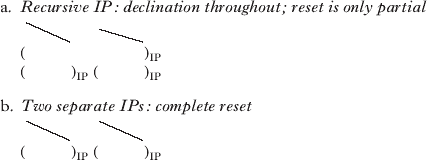
The claim that declination is a reflex of prosodic bracketing as in (31) has been made in the literature, by Ladd (Reference Ladd1986) for English and by Féry & Truckenbrodt (Reference Féry and Truckenbrodt2005) (see also Féry Reference Féry, Erteschik-Shir and Rochman2010) for German. Selkirk (Reference Selkirk2009) also claims that a downtrend pattern throughout three coordinate clauses in Japanese is best represented as a recursive IP structure.Footnote 24
Ladd (Reference Ladd1986) is the first to make this claim. He claims that declination patterns in prosody reflect syntactic embedding, based on the observation that in sentences like (32), ‘the initial accent peaks following the but boundary were higher than those following the and boundary’ (Ladd Reference Ladd1986: 327). Ladd concludes that the distinction in the size of the reset reflects the hierarchical grouping of the clauses, as indicated by the bracketing in (32). Féry & Truckenbrodt (Reference Féry and Truckenbrodt2005) find the same results as Ladd for data from German.
(32)

Ladd (Reference Ladd1992) argues on the basis of the results from his experiment that it is unreasonable to assume that downtrend patterns are governed by purely paralinguistic factors, since the bracketing that the downtrend patterns reflect are of a linguistic nature. He therefore concludes that the declination patterns should be represented in the phonological representation of the sentences in (32). I assume that Ladd's conclusion that downtrend patterns are represented in linguistic structure also holds true for Swedish. The prosodic pattern of the two coordinated clauses discussed in this article confirms this point.Footnote 25
At a first glance, it might seem possible to account for these declination patterns by assuming a prosodic Utterance category. This option must, however, be rejected for two reasons. First, as argued by Ladd (Reference Ladd1992), it is conceptually unsatisfactory to assume that downtrend patterns alone constitute an argument for a prosodic category. Second, as argued by Hansson (Reference Hansson2003), there is no independent evidence for an Utterance category in Swedish.
Ladd (Reference Ladd1992) points out that it would be theoretically unsatisfactory to use the downtrend patterns observed in sentences of the type in (32) to motivate categorically different levels in the prosodic hierarchy. The downtrend patterns are gradient, not categorical, and this makes them unsuitable as a defining criterion for a phonological category. In addition, if each level of downtrend patterning constituted its own phonological category, one category would have to be assumed for each level of embedding in the syntactic structure, but syntactic structure exhibits an unlimited depth of embedding. Thus an uncontrollable number of categories would be needed in the prosodic hierarchy. Ladd therefore concludes that the hierarchical relation between the phrases in (32) cannot be described in terms of different prosodic categories, but must be accounted for by recursion of some prosodic category.Footnote 26
Accounts along the lines of Ladd (Reference Ladd1992) presuppose that prosodic cues are cumulative, such that each layer of prosodic structure adds to the strength of the realisation of a prosodic cue (see e.g. Wagner Reference Wagner2005, Féry Reference Féry, Erteschik-Shir and Rochman2010 and Frota Reference Frota, Cohn, Fougeron and Huffman2012 for similar lines of argumentation). This predicts gradient differences between instances of the same phrasal categories, since the same phonological process is applied multiple times, and the number of applications correlates with a stronger cue in the phonetic realisation.
Hansson (Reference Hansson2003) argues against the existence of the Utterance in Swedish, along similar lines to Ladd (Reference Ladd1992). She conducted a series of experiments on boundary perception in spontaneous speech in South Swedish, which provided ample evidence that boundary perception is gradient and continuous rather than categorical in Swedish. Hansson (Reference Hansson2003: 161) draws the following conclusion:Footnote 27
We … believe that the difficulties associated with defining the difference between the prosodic phrase and the prosodic utterance in spontaneous speech [in Swedish] is related to the continuous (as opposed to categorical) nature of the perception of boundary strength. As there is no separate edge tone or tonal head to distinguish the prosodic utterance from the prosodic phrase, the definitions of the two constituents rest on listeners' ability to distinguish between weak and strong boundaries. The continuously varying boundary strength in (both the production and perception of) spontaneous speech makes this distinction difficult to make and the definition unsatisfactory.
As was mentioned in §3, the assumption that there is no Utterance category in Swedish also accords well with Ito & Mester's (2011) and Selkirk's (Reference Selkirk2009) assumption that, above the IP, there exist no non-gradient distinctions between categories of phonological structure.
Summarising this section so far, the downdrifting patterns observed across coordinated clauses in the Swedish data can be taken as evidence for recursion of the IP. It has been established in previous literature that downtrend patterns are governed by linguistic structure (meaning that they are not only a paralinguistic phenomenon), and that they should therefore be represented in the prosodic structure. At the same time, the downtrend patterns alone are not a sufficient argument to postulate a prosodic Utterance category, and there is no independent evidence for this category in Swedish. Therefore, it is not plausible that an Utterance category is responsible for the downdrifting patterns observed in the Swedish data in (17) and (18a).
Now that the need for the outer IP brackets around (30a), i.e. candidate (a) in the tableaux above, has been established, and a candidate like that in (30b) has been shown to be empirically flawed, I will show that (30b) is prevented from surfacing by the match constraints. I begin by explaining how this works with the embedded structure in (18), which is straightforwardly accounted for by the match constraints. In (33), the input is the embedded structure in (18), candidates (a)–(c) are the same as in the tableaux above, and candidate (d) is identical to that in (30b). Candidate (d) violates the MatchClause(S–P) constraint with respect to the larger clause, because there is no single IP projection corresponding to this clause, which is thus not matched. Candidate (d) in addition incurs a violation of MatchClause(P–S), because there is one edge in the prosodic structure that has no syntactic correlate (this violation is parallel to that in (a)). Candidate (d) therefore violates two of the three constraints. As each of the constraints is violated by exactly one of candidates (a)–(c), the two violations that candidate (d) incurs make it impossible for it to win under any constraint ranking.
(33)
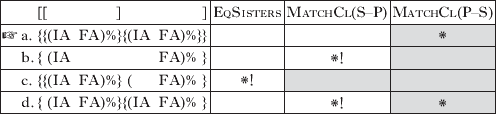
In (34), the input structure is the coordinated structure from (17), and (30b) is again represented in candidate (d). Here too, (d) is dispreferred by the MatchClause constraints. As explained in §4.1, Selkirk (Reference Selkirk2009, Reference Selkirk, Goldsmith, Riggle and Yu2011) assumes that the MatchClause applies not only to what she calls standard clauses, but also to illocutionary clauses. The two coordinated clauses form a single illocutionary clause, to which the MatchClause constraints apply. In order for the match constraints to be satisfied with respect to the illocutionary clause, the outer IP brackets, which are present in (a) but absent in (d), must be present. Therefore, in (34), candidate (d) violates MatchClause(S–P) and can thus never win over (a), which incurs no violations at all.
(34)
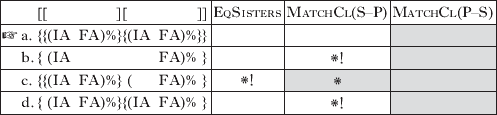
In summary, this section has shown how variable ranking of match constraints and EqualSisters accounts for the fact that a main clause with an embedded clause is realised with one of the three different prosodic patterns in (18), whereas a sentence with two coordinated clauses always exhibit the single pattern in (17).
Throughout this article, it has been assumed that the two IPs in (17) and (18a) are subsumed under one larger IP projection. The last part of this section has presented the empirical and conceptual argumentation which motivates this higher IP projection, and has shown how the match constraints account for this projection.
All logically possible rankings of the match constraints and EqualSisters are allowed in Swedish. Under any of the logically possible rankings, one of the observed candidates in (18) wins if the input sentence is the sentence containing embedding from (18). The structure in (17) is the only possible winner if the input syntactic structure is that in (17). The constraint set thus inherently excludes the possibility of any other imaginable structure winning over the three attested structures.
6 Discussion: alternative accounts
In this section, previously proposed constraints are discussed. The reasons for these constraints not being used in the present article are considered, and some differences in the predictions made by the potential alternatives accounts are mentioned. §6.1 considers the possibility of replacing Selkirk's (Reference Selkirk2009, Reference Selkirk, Goldsmith, Riggle and Yu2011) match constraints with alignment constraints and wrap constraints (Truckenbrodt Reference Truckenbrodt1999). §6.2 discusses the differences between EqualSisters and the constraints Non-recursivity and Exhaustivity (Selkirk Reference Selkirk, Morgan and Demuth1996).
6.1 Match constraints compared to alignment and wrap constraints
For the argumentation in favour of the existence of EqualSisters in the syntax–prosody interface, the choice between match and alignment constraints is not immediately crucial. As there is as yet no real consensus on whether match or alignment constraints make the better predictions from a typological perspective, it is important to note that alignment constraints will interact with EqualSisters in a similar way to match constraints. This means that the need for EqualSisters in the syntax–prosody interface is independent of the choice between match and alignment constraints. The present section shows how alignment constraints could be used to account for the data from §5. However, it is also shown that alignment constraints, in contrast to match constraints, fail to predict the presence of the outer IP brackets in (30a) and candidate (a) in the tableaux in the previous section.
I begin by noting that we can go a long way towards accounting for the data from §4 with the four alignment constraints in (35). These four constraints target left edges (b, d) and right edges (a, c) separately, and apply both in the direction syntax to prosody, as in (a, b), and prosody to syntax, as in (c, d).
(35)

These constraints give us the tableaux in (36)–(39). Ignoring candidate (d) for the moment, we may note first that, when EqualSisters is high-ranked, candidate (a) or (b) wins over (c), as in (36) and (37). When EqualSisters is low-ranked, candidate (c) wins over (a) and (b), as in (38). In (39), where the input is the coordinated structure from (17), candidate (a) is superior to both (b) and (c), under any ranking. This interaction is in principle parallel to the one illustrated for the match constraints in §5.
(36)
(37)
(38)
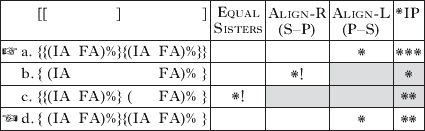
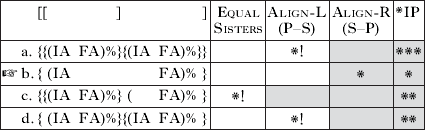
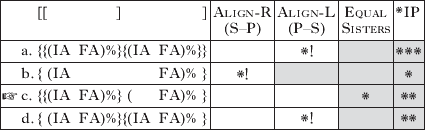
Turning now to the candidate in (d), it should be noted that without the addition of a constraint which actively calls for the outer IP brackets in candidate (a), candidate (a) would never surface. The structure given as (d) in (36)–(39) would be preferred over (a) in (36) as well as in (39).
(39)
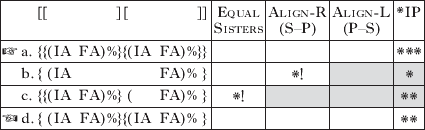
This follows from the hypothesis referred to as richness of the base (McCarthy Reference McCarthy2002: 70). Under this hypothesis, there are no restrictions on the candidates that are evaluated with regard to a certain input structure. Instead, all combinations of linguistic primitives are assumed to be valid candidates for any input structure. When given the choice between candidates (a) and (d), neither the alignment constraints nor EqualSisters have any preference. In such a situation, *Structure constraints (given as *IP in the these tableaux) will select (d) over (a), since (d) contains less structure (two IPs) than (a) (three IPs). *Structure constraints resist any structure, and are present in the grammar to avoid excessive structure in grammatical representations.
Though a constraint that would do the job of excluding the candidate in (d) is imaginable, a number of issues need to be resolved for such an account to make correct predictions. As the match constraints provide a more straightforward account, I do not pursue this issue here.
Before moving on, a comment on the place of wrap constraints in the interaction between alignment and EqualSisters is required. WrapXP, (40a), was the first wrap constraint, proposed by Truckenbrodt (Reference Truckenbrodt1999: 228). Truckenbrodt (Reference Truckenbrodt2005: 14) proposes WrapCP, (40b), where CP corresponds roughly to the more general notion of clause used here.
(40)

Selkirk (Reference Selkirk2009, Reference Selkirk, Goldsmith, Riggle and Yu2011) assumes that the replacement of alignment constraints by match constraints renders the wrap constraints superfluous in the syntax–prosody interface, and this is also true for the analysis outlined in §5. In contrast to match constraints, alignment constraints are usually assumed to interact with wrap constraints. In the present account, however, wrap constraints play no role, even if alignment constraints are adopted instead of match constraints. The primary reason for this is that alignment is assumed to apply both in the S–P and in the P–S directions, in addition to involving both left and right alignment (cf. the four alignment constraints in (35)). These alignment constraints enter into conflict with each other when the syntactic input structure contains embedding, as illustrated in tableaux (36) and (37).
The resolution of these conflicts in some ways resembles the resolution of conflicts between WrapCP and alignment constraints. (41) gives an example from Truckenbrodt (Reference Truckenbrodt1999: 234), which shows that in Tohono O'odham WrapXP prevents the alignment constraint Align-R(XP) from inserting VP-internal prosodic boundaries. Instead, the output structure of this language is one large phonological phrase encompassing the entire VP. In a language where the ranking of WrapXP and alignment were reversed we could imagine that the structure in (d) would be the outcome. The effect of WrapXP vs. alignment here somewhat resembles the effect of the S–P vs. P–S constraints used in the present article.
(41)
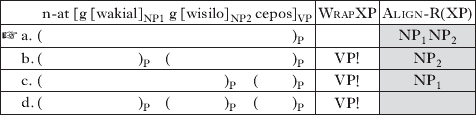
The illustration of the interaction between Align-R(XP) and WrapXP can be translated to clause structures, and to the type of data discussed here. A potential function of WrapCP would then be to predict that when the input syntactic structure contains embedding, as in (42), a prosodic structure which lacks phrase-internal boundaries (like candidate (a)) is sometimes preferred over one which has them (b).
In the present model, this function of WrapCP is not applicable. This is because the desired output structure is (c) rather than (b). WrapCP is satisfied by the structure in (c), because of the larger IP projection which wraps both the large and the small CP. Simultaneously, (c) satisfies the alignment constraint with respect to the phrase-internal boundaries. Since (c) satisfies both WrapCP and the alignment constraint, it will win. The effect of this is that (a) will never surface.
(42)
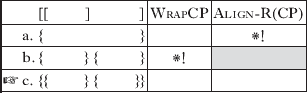
However, it should also be noted that avoiding phrase-internal boundaries by way of alignment constraints cannot necessarily replace the function of WrapXP in any type of context or language. The alignment constraints will be in conflict with each other only when there is an asymmetry of edges in the input syntactic structure. In the type of structure exemplified from Tohono O'odham by Truckenbrodt (Reference Truckenbrodt1999), there is no such asymmetry. Instead there are several XPs in succession, all subsumed under one and the same VP projection. In such contexts, the alignment constraints do not conflict with each other, and cannot account for the choice between one large and several small phrases.
6.2 Exhaustivity and Non-recursivityvs. EqualSisters
In the account developed here for Stockholm Swedish, Exhaustivity and Non-recursivity (Selkirk Reference Selkirk, Morgan and Demuth1996), which have been widely assumed in the literature on the syntax–prosody interface, play no role. The addition of these constraints to the account developed here cannot replace the interaction of EqualSisters with the match constraints. This section discusses how EqualSisters differs from Exhaustivity and Non-recursivity, given in (9c) and (9d).
The three structures from (25) are repeated as (43). (43a) corresponds to the two coordinated IPs in (17), (18a) and candidate (a) in the tableaux in §5, (43b) corresponds to the single IP in (18b) and candidate (b) in §5, whereas (43c) is the embedded IP structure from (18c) and candidate (c) in §5.
As explained in §5.2, it is crucial to the account of Stockholm Swedish that some constraint prefer (43a) and (b) to (c). EqualSisters straightforwardly does this, as shown in the first column in (43). As indicated in the second and third columns, however, neither Exhaustivity nor Non-recursivity prefers (c) to both (a) and (b). Non-recursivity rules out both (a) and (c), whereas none of the three candidates violates Exhaustivity.Footnote 28
(43)
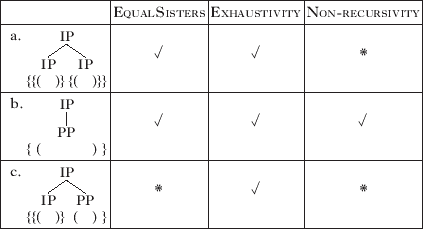
Though both Exhaustivity and Non-recursivity make the same predictions as EqualSisters in two of the three cases in (43), neither constraint has the same set of violations. For instance, neither EqualSisters nor Exhaustivity is violated by (a) and (b). However, Exhaustivity fails to rule out (c), because the PP is only one level down from the IP in the prosodic hierarchy. As formulated by Selkirk (Reference Selkirk, Morgan and Demuth1996), Exhaustivity is violated only if there is skipping of one category in the prosodic hierarchy, i.e. if a constituent Ci dominates a constituent which is two or more categories below Ci. PP however, is only one category below IP.Footnote 29
Non-recursivity, too, has the same effect as EqualSisters in two of the three cases in (43), namely (b) and (c). However, with respect to (a), the constraints differ. Non-recursivity rules out (a), whereas EqualSisters does not. This is because Non-recursivity rules out any structure which contains recursion, independent of how this recursion arises. EqualSisters is not a direct ban on recursion, but bans recursive structures only when they contain sister nodes of different prosodic categories, as in (c).
In Stockholm Swedish, we could imagine that Exhaustivity and Non-recursivity are rendered inactive in the grammar via low ranking, and that instead, match constraints together with EqualSisters determine the relation between syntactic and prosodic phenomena. In other languages, EqualSisters could then interact with all or some of the other constraints.
However, the need to replace Exhaustivity and Non-recursivity in Swedish is largely due to a liberal view on recursion in the prosodic structure, and the absence of an Utterance category in the prosodic hierarchy. These properties of prosodic structure have recently been proposed to be universal by Selkirk (Reference Selkirk2009, Reference Selkirk, Goldsmith, Riggle and Yu2011) and Ito & Mester (Reference Ito, Mester, Borowsky, Kawahara, Shinya and Sugahara2012). Should Ito & Mester's model of prosodic structure prove attractive for the description of many of the world's languages, this will most likely necessitate changes to the way we model the syntax–prosody interface.
Considering that there is some amount of overlap between structures that violate EqualSisters and those that violate Exhaustivity and Non-recursivity, it seems appropriate to assume that under a liberal view on recursion along the lines of Ito & Mester, EqualSisters should replace (some of) the functions of the Exhaustivity and Non-recursivity in UG, in order to create a more constrained account of the mechanisms in the syntax–prosody interface. Exhaustivity and Non-recursivity might either be superfluous altogether, or need to be reformulated. At this point, it is not possible to foresee the extent to which a syntax–prosody interface account using EqualSisters can account for syntax–prosody phenomena from many different languages. Further testing of this hypothesis must rely on careful application of a prosodic model along the lines of Ito & Mester to different languages, and must therefore be left to future research.
7 Summary
This article has discussed how to formalise the intuition that prosody is ‘flat’, which has often been held responsible for the observed lack of isomorphism between syntactic and prosodic structure. It has been argued that the pressure for prosodic flatness is best expressed as a restriction that sister nodes in prosodic structure be equal, in terms of belonging to the same prosodic category. It has been shown that in Swedish there is variation with respect to how syntactic structures are reflected in prosody. This variation reveals that structures that adhere to the requirement of equal sisterhood are favoured over structures that do not.
The fact that one syntactic structure may have several prosodic correlates can be seen as evidence that prosodic structure is not derived directly from syntactic structure, but that it is generated via a set of ranked constraints, which impose separate restrictions on the relation between syntactic and prosodic branching, and on well-formed prosodic structure. The account thus builds on a number of accounts which assume that prosodic structure is independent from syntactic structure, and use Optimality Theory to account for the syntax–prosody interface (e.g. Selkirk Reference Selkirk, Morgan and Demuth1996, Reference Selkirk2009, Reference Selkirk, Goldsmith, Riggle and Yu2011, Truckenbrodt Reference Truckenbrodt1999).
It has been shown that the Exhaustivity and Non-recursivity constraints (Selkirk Reference Selkirk, Morgan and Demuth1996) fail to make correct predictions with regard to the variation observed in Swedish. These are the two most commonly used constraints to formalise the flatness of prosodic structure in relation to syntactic structure in OT. Non-recursivity, however, is violated by too many structures, and thereby fails to make correct predictions with regard to what constitutes good and bad recursive structures, while Exhaustivity is satisfied by too many structures, and thus also fails to distinguish good structures from bad ones. Consequently, the constraints fail to explain why and predict when prosodic structure branches in a way that is different from the input syntactic structure.
It has been argued, therefore, that these constraints should be supplanted by the EqualSisters constraint, which favours structures where prosodic sister nodes belong to the same prosodic category. EqualSisters offers an alternative to the previously proposed constraints which is very close in spirit to the idea of the Compound Prosodic Domains assumed by Ladd (Reference Ladd1992).
EqualSisters, being a markedness constraint, crucially interacts with other constraints to select optimal prosodic output structures as correlates to input syntactic structures. The constraints that EqualSisters most often enters into conflict with are those that impose restrictions on the correspondence between edges in syntax and in prosody. Match constraints (Selkirk Reference Selkirk2009, Reference Selkirk, Goldsmith, Riggle and Yu2011) have been adopted here, and have been shown to make better predictions than the more traditional alignment constraints (McCarthy & Prince Reference McCarthy and Prince1993, Selkirk Reference Selkirk, Morgan and Demuth1996) and the WrapXP constraint (Truckenbrodt Reference Truckenbrodt1999).
The superiority of EqualSisters over Non-recursivity and Exhaustivity is partly due to a change in the view of prosodic structure which has been taking place in the field. A number of recent accounts have argued that the number of categories in prosodic structure should be restricted to a typologically valid set (e.g. Selkirk Reference Selkirk2009, Reference Selkirk, Goldsmith, Riggle and Yu2011, Ito & Mester 2011), and these approaches are also less restrictive with respect to recursion than many previous approaches. This change also has consequences for the syntax–prosody interface. EqualSisters provides one component of a syntax–prosody interface account formulated in OT which applies to prosodic structure representations that are liberal with respect to recursion.