I. INTRODUCTION
Tungsten (W) is an environmentally benign metal with unique properties which include high melting point and density, high hardness, thermal and chemical stability, and excellent electrical conductivity.Reference Lassner and Schubert1,Reference Koutsospyros, Braida, Christodoulatos, Dermatas and Strigul2 These properties make it an essential component in many industrial applications. Cemented carbides, also called hardmetals, are the most important usage of tungsten today to produce industrial drilling and cutting tools.Reference Lassner and Schubert1,Reference Cha, Hong and Kim3,Reference Beste and Jacobson4 Tungsten remains an important component for tool and high speed steels, creep-resistant steels and alloys.Reference Lassner and Schubert1 Recently, tungsten is also intensively considered for applications in nanoscale devices such as contact plugs, electron emitters, and memory devices.Reference Samanta, Yoo, Samudra, Tok, Bera and Balasubramanian5–Reference Yang, Wang, Zhang, Long, Liu and Liu10 The important benefits of W usage in nanoelectronics include such its properties as chemical stability with silicon, inherently low vapor pressure at high temperatures and unusual quantum confinement.
The manufacture of metal powder is a critical step in material production, since the powder properties significantly affect the subsequent operations, such as pressing and sintering. Specifically, nanoscale tungsten crystals promise to yield very hard, strong, and wear-resistant materials via the press-sintering routes. A small particle size changes the response during sintering, requiring lower temperature and shorter processing time to achieve dense nanostructured materials.Reference Yang, Wang, Zhang, Long, Liu and Liu10–Reference Zhou, Ma, Du and Linke15
The main sources of tungsten are the high grade concentrates of wolframite and scheelite ores. Tungsten metal powder is produced from these minerals typically through the intermediate product of ammonium paratungstate (APT). In a subsequent process, tungsten (VI) oxide is obtained from APT by calcination in an oxygen atmosphere between 800 and 1100 K. Tungsten metal powder is then produced by reducing the tungsten (VI) oxide with H2.Reference Lassner and Schubert1 However, it is difficult to produce nanosized tungsten powder with conventional method, due to the high temperatures and long process times. Various approaches have been suggested to obtain nanocrystalline tungsten particles, such as electrical explosion of wires,Reference Gromov, Kwon and Choi16 high-energy ball milling,Reference Ricceri and Matteazzi13 physical vapor deposition,Reference Gleiter17 chemical reduction,Reference Gao, Zhao, Zhu, Ma, Su and Wang18 solvothermal decomposition,Reference Sahoo, Kamal, Premkumar, Kumar, Sreedhar, Singh, Srivastava and Sekhar19 combustion synthesis (CS),Reference Nersisyan, Lee and Won20,Reference Nersisyan, Won, Won and Cho21 etc.
The CS of tungsten powders typically involves exothermic reduction of tungsten oxide (WO3) by magnesium (Mg), zinc (Zn), sodium borohydride (NaBH4), or sodium azide (NaN3). However, in such processes, the reaction temperature is high (above 2000 K) and consequently the conversion degree of reactants is low due to the vigorous evaporation of the reducing compound. Recently, magnesium reduction of sodium tungstate is proposed to produce tungsten nanocrystalsReference Manukyan, Kharatyan, Mnatsakanyan, Zurnachyan, Voskanyan and Danghyan22–Reference Voskanyan, Niazyan, Manukyan, Kharatyan, Mnatsakanyan and Mukasyan25 by the following reaction:
 $${\rm{N}}{{\rm{a}}_{\rm{2}}}{\rm{W}}{{\rm{O}}_{\rm{4}}} + {\rm{Mg}} \to {\rm{W}} + {\rm{MgO}} + {\rm{N}}{{\rm{a}}_{\rm{2}}}{\rm{O(Na)}}\quad .$$
This reaction is sufficiently exothermic to be self-sustained and produce tungsten. However, the conversion degree of sodium tungstate to tungsten is relatively low. Excessive quantity of Mg was used to achieve high conversion degree.Reference Guojian, Jiayue, Hanrui and Wenlan23,Reference Guojian, Jiayue, Hanrui and Wenlan24 Another difficulty of such approach related to the release of sodium vapor, which then condenses on the walls of the chemical reactor and thus produced sodium, which burns in air. Some amount of sodium may also be trapped inside the pores of reacted samples. Later, in water/acid purification stage, it vigorously reacts with water evolving hydrogen.Reference Manukyan, Kharatyan, Mnatsakanyan, Zurnachyan, Voskanyan and Danghyan22
This work addresses some fundamental issues of controlling the combustion reaction in Na2WO4 + Mg system through addition of calcium fluoride (CaF2). The influence of CaF2 on combustion characteristics and microstructure of the synthesized products was investigated. It was shown that using CaF2 changes the reduction mechanism and helps to bind sodium through the formation of NaF. Controlled combustion reaction and subsequent treatment of products allow us to produce either nanocrystals of pure W or WO 3/W nanostructures consisting of two-dimensional (2D) WO3 nanoflakes assembled on the tungsten core.
II. EXPERIMENTAL SECTION
A. Combustion experiments
The reactants used in this study include Na2WO4·2H2O (Sigma-Aldrich, St. Louis, MO, reagent grade, particle size <10 μm), magnesium (Alfa Aesar, Ward Hill, MA, 99.8%, particle size <44 μm), and calcium fluoride (Alfa Aesar, reagents grade, particle size <20 μm) powders. Prior to synthesis, Na2WO4·2H2O was heated to 450 K in air for 2 h to remove hydrate water. Then it was mixed with Mg and CaF2 in a plastic jar containing 3-mm zirconia balls for 3 h. The ball-to-powder ratio was 3:1. The obtained mixture was then uniaxially cold-pressed into cylindrical samples (diameter—10 mm, height—20 mm) at pressure 20 MPa to a relative density of 0.45. Then, a hole (1 mm in diameter, 5 mm deep) was drilled into the specimen perpendicular to the cylinder axis and thermocouple was embedded in the hole for temperature measurements.
Combustion experiments were conducted in a stainless steel chamber. Before reaction initiation, the chamber was sealed, evacuated, and purged with argon (99.9998%) for three cycles and finally filled with argon to the desired pressure. Tungsten filament, positioned at the upper surface of the sample, was electrically heated until the reaction was initiated locally, followed by immediate power turnoff, while the reaction wave propagated along the sample.
The temperature–time history of the synthesis process was recorded by C-type thermocouples with 0.1 mm diameter. The output signals of thermocouples were transformed to PC by a multichannel data acquisition board with a frequency of 1 kHz. All experimental data points for the combustion parameters were determined as average of at least three measurements. The standard error of measurement for maximum combustion temperature (T c) was ±20 K. A model quenching experiment was also performed with Na2WO4 + Mg + CaF2 mixtures placed in a copper wedge to investigate microstructure evolution of reacted media in the combustion wave.
B. Characterization of materials
After CS, the produced materials were kept in the reactor in an inert atmosphere up to complete cooling. Purification of as-synthesized powder includes its treatment by diluted hydrochloric acid (5 vol%). More specifically, 200 mL of acid solution was slowly added to 5 g of the product at room temperature under vigorous stirring conditions. After 4 h, another 200 mL of acid solution was added and stirring was continued for 20 h. Leached powder was washed 3 times by deionized water and recovered by vacuum filtration. The drying of purified material was performed in vacuum at 350 K for 4 h.
The phase compositions of materials were determined by x-ray diffraction (XRD) analysis with Ni-filtered Cu Kα radiation (D8 Advance, Bruker Corporation) operated at 40 kV and 40 mA. Step-scan data (of step size 0.025° and counting time up to 3 s) of materials were recorded for the angular range 20−80° (2θ). The scanning electron microscopy (SEM) and transmission electron microscopy (TEM) analyses of combustion products were used to characterize the composition and morphology of the reaction products as well as the size and atomic structure of materials. The SEM analysis was conducted by EVO 50 (Carl Zeiss, Oberkochen, Germany) and Magellan 400 (FEI, Hillsboro, OR). The SEM Magellan 400 is equipped with a scanning transmission electron microscopy (STEM) detector allowing imaging in transmission at nanometer-level (with a resolution of about 2 nm) and a Bruker energy dispersive x-ray spectrometer (EDS). The Titan 80-300 (FEI) electron microscope has a resolution of 0.136 nm in STEM mode and about 0.1-nm information limit in HRTEM modes. It is equipped with EDS (Oxford Inca, Oxford Instruments, Abingdon, UK) and electron energy loss spectroscopy (EELS, Gatan Inc., Warrendale, PA) systems with a spectral resolution of 130 and 0.8 eV, respectively.
A differential scanning calorimeter (DSC, Metler-Toledo, Columbus, OH) was used to perform thermal analysis for Na2WO4 + Mg + CaF2 mixtures. In these experiments, 0.015 g mixtures were heated to 1070 K at 50 K/min heating rate in an atmosphere of 99.9998% pure argon with a flow rate of 80 cm3/min.
III. RESULTS
A. Thermodynamics
To optimize the reaction conditions, the thermodynamic calculations for Na2WO4 + 3 Mg + CaF2 system depending on the quantity of added CaF2 and inert gas pressure (P) were performed. The THERMO software package was used to calculate adiabatic combustion temperature (T ad) and composition of equilibrium products.Reference Shiryaev26 Calculation of equilibrium characteristics is based on the minimization of the Gibbs free energy of the system, which accounts for the contributions of Gibbs free energies for all components and their concentrations.
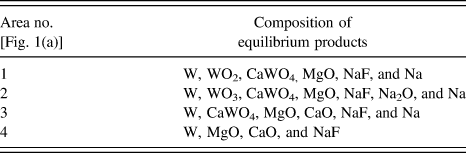
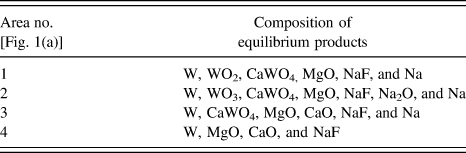
On the basis of thermodynamic calculations, surfaces of adiabatic combustion temperature (T ad) and equilibrium concentrations of Na and Na2O phases depending on CaF 2quantity and inert gas pressure are plotted in Fig. 1. The temperature surface [Fig. 1(a)] shows that for Na2WO4 + 3 Mg mixture (without CaF2 addition), increase in gas pressure leads to growth of T ad from 1350 to 1850 K. Adding CaF2 into the reaction system also results in an increase of T ad value. Several characteristic ranges of temperature, which correspond to distinctive compositions of products, are marked by nos. 1, 2, 3, and 4 on the temperature surface (Fig. 1). It can be seen from Table I that at relatively low T ad (nos. 1, 2, 3), equilibrium products contain tungsten, tungsten oxides, calcium oxide and/or calcium tungstate, sodium fluorides as well as significant quantities of sodium and sodium oxide. Adding CaF2 into the mixture gradually decreases the quantities of Na and Na2O [Fig. 1(b)]. At higher temperatures (no. 4), products consist of tungsten, magnesium oxide, calcium oxide, and sodium fluoride (Table I). Based on such calculations, one may find the optimum amount of CaF2 (e.g., 1 mol at 0.5 MPa) in the initial mixture, which allows the full conversion of sodium to the desired NaF phase [Fig. 1(b)].
Results of thermodynamic simulation for Na2WO4 + 3 Mg + CaF2 system: adiabatic combustion temperature (a) and Na and Na2O equilibrium concentrations (b) as a function of inert gas pressure and CaF2 quantity.

Equilibrium products of combustion for Na2WO4 + 3 Mg + CaF2 system.
B. Combustion synthesis
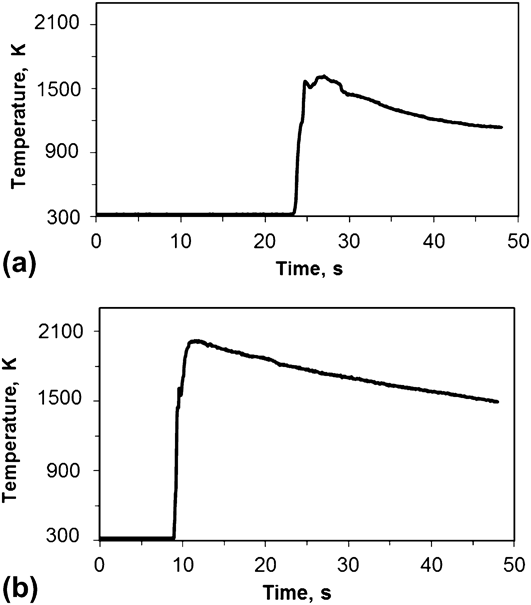
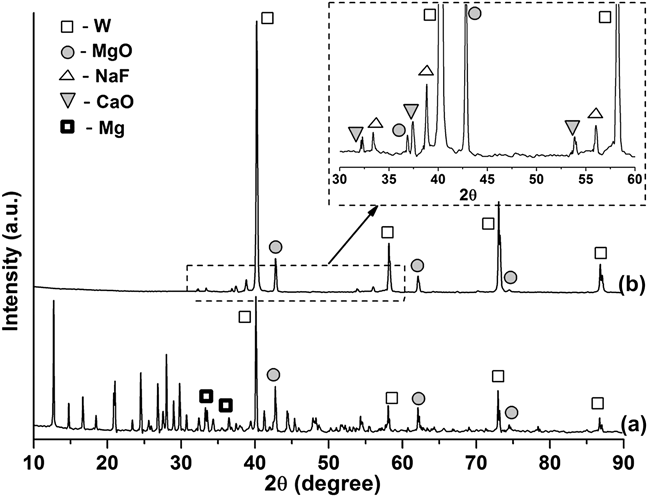
Further, we experimentally studied the reaction in the Na2WO4 + 3 Mg + x·CaF2 system to define the effect of CaF2 on combustion characteristics and composition of the products. The temperature–time profiles, obtained for mixtures with different “x,” i.e., x = 0 and x = 1, demonstrate the effect of CaF2 (Fig. 2) on the reaction conditions. The profiles suggest that the reduction reactions produce a large amount of heat, leading to an abrupt increase in temperature. The maximum heating rate for both mixtures is close to 1500 K/s. Compared to the heating stage, the cooling rate is not as drastic (15–20 K/s). The only difference in temperature regime is that the maximum combustion temperature for CaF2-free system (x = 0) is 1650 K, whereas for Na2WO4 + 3 Mg + CaF2 mixture (x = 1), T ad is ∼2050 K, which fits the trend predicted by thermodynamic calculations. The XRD analysis of synthesized materials (Fig. 3) indicates that the powder produced from calcium-fluoride-free mixture contains W, MgO, and unreacted Na2WO4 and Mg. The product obtained from Na2WO4 + 3 Mg + CaF2 mixture involves W, MgO, CaO, and NaF phases. Thus, it was experimentally confirmed that addition of calcium fluoride enhances conversion of sodium tungstate into tungsten and simultaneously binds sodium through the formation of NaF phase.
Temperature–time profiles of Na2WO4 + 3 Mg (a) and Na2WO4 + 3 Mg +CaF2 (b) mixtures, P = 1 MPa.
The results of XRD analysis of reaction products of Na2WO4 + 3 Mg (a) and Na2WO4 + 3 Mg + CaF2 (b) mixtures (all nonmarked peaks are referred to Na2WO4·2H2O).
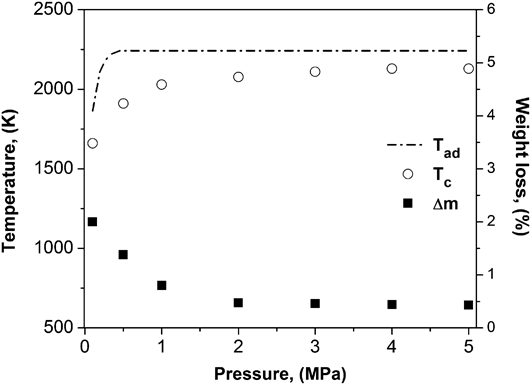
The results of thermodynamic analysis (see Fig. 1, Table I) also pointed out that inert gas pressure has also significant influence on combustion temperature and product composition. Consequently, we performed a series of experiments for Na2WO4 + 3 Mg + CaF2 mixture at different argon pressures. Figure 4 presents the influence of inert gas pressure on combustion characteristics. It can be seen that the maximum combustion temperature (T c) increases gradually and then saturates with pressure increase. The T c is significantly lower than T ad at pressures below 1 MPa. The reason for such disagreement between calculated and measured temperatures is related to heat losses, both due to some phases (primarily Mg) gasification and heating of gas environment during the reaction. The weight loss (Δm) of reacted samples at lower pressures is relatively high (Fig. 4). The increase in pressure leads to decrease in Δm through the suppressing of magnesium volatilization. At P ≥ 1 MPa, essentially zero mass loss is observed, and the XRD analysis (not shown) of reacted samples reveals that complete conversion of reactants may be achieved only at these pressures. It should be noted that the yield of tungsten (mass ration of the leached product to tungsten in initial sodium tungstate) makes ∼95%.
The maximum combustion temperature (T c), calculated adiabatic combustion temperature (T ad), and weight loss (Δm) of Na2WO4 + 3 Mg + CaF2 mixture versus pressures.
C. Structure and morphology of the products
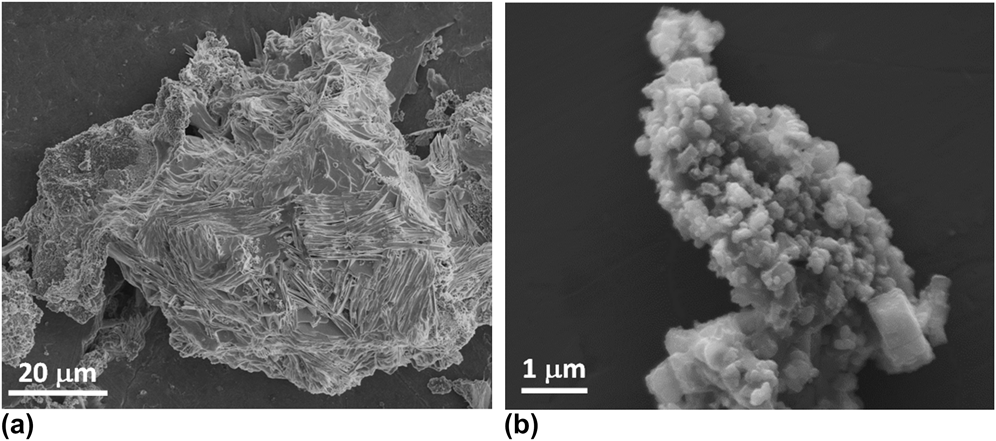
The SEM images (Fig. 5) of as-synthesized materials obtained from Na2WO4 + 3 Mg and Na2WO4 + 3 Mg + CaF2 mixtures show the effect of CaF2 on the microstructure of the products. Although in both cases, the products consist of aggregates, but they have different morphologies. The product synthesized from CaF2-free mixture has ∼100-μm-layered agglomerates [Fig. 5(a)]. The characteristic sizes of aggregates for product from Na2WO4 + 3 Mg + CaF2 mixture [Fig. 5(b)] are much smaller (5–10 μm). The SEM and EDS analyses suggest that these agglomerates are crystallized from a melt in a bulk composite containing a matrix of calcium, magnesium, oxygen, sodium, and fluorine with W inclusions.
SEM analyses of reaction products of Na2WO4 + 3 Mg (a) and Na2WO4 + 3 Mg + CaF2 (b) mixtures.
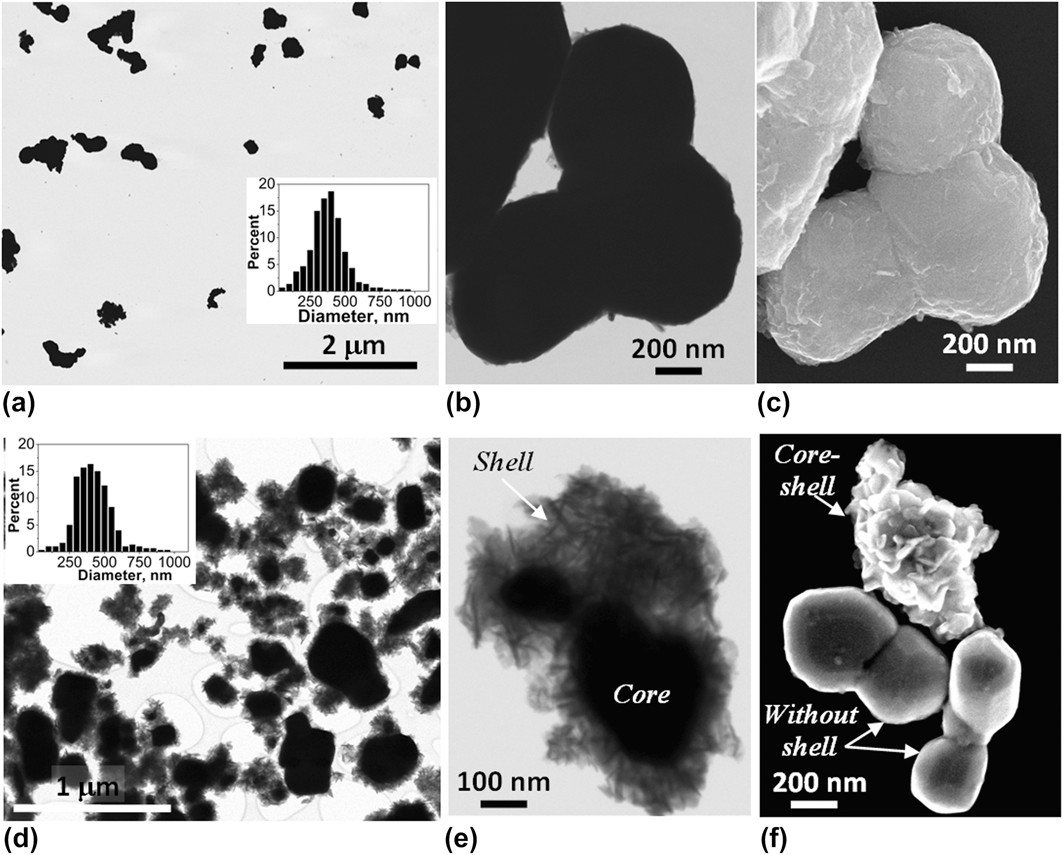
The microstructures of acid/water purified materials are shown in Fig. 6. The STEM images [Fig. 6(a)] of the purified product of Na2WO4 + 3 Mg mixture indicate that the sizes of tungsten crystals are in the range of 50–500 nm [see inset in Fig. 6(a)]. These particles mostly sintered together forming larger agglomerates. The SEM and STEM images [Figs. 6(b) and 6(c)] show that tungsten crystals have smooth surface and quasi-spherical shape. The particles of the purified product of Na2WO4 + 3 Mg + CaF2 mixture have a core–shell-type structure [Fig. 6(d)] that contains a dark tungsten core and lighter shells. These shells primarily contain tungsten and oxygen as determined from the EDS analysis. Closer inspection revealed that shells consist of thin flakes [Fig. 6(e)]. Statistical analyses of STEM images suggest that the size of the dark core varies from 50–500 nm [see inset in Fig. 6(d)]. The thickness of oxygen-containing shell may vary from 50 to 150 nm. The well-faced shell-free tungsten crystals may also be seen in the product [Fig. 6(f)].
Microstructure of products and particle size distributions (insets) after water/acid purification for Na2WO4 + 3 Mg (a, b, c) and Na2WO4 + 3 Mg + CaF2 (d, e, f) mixtures.
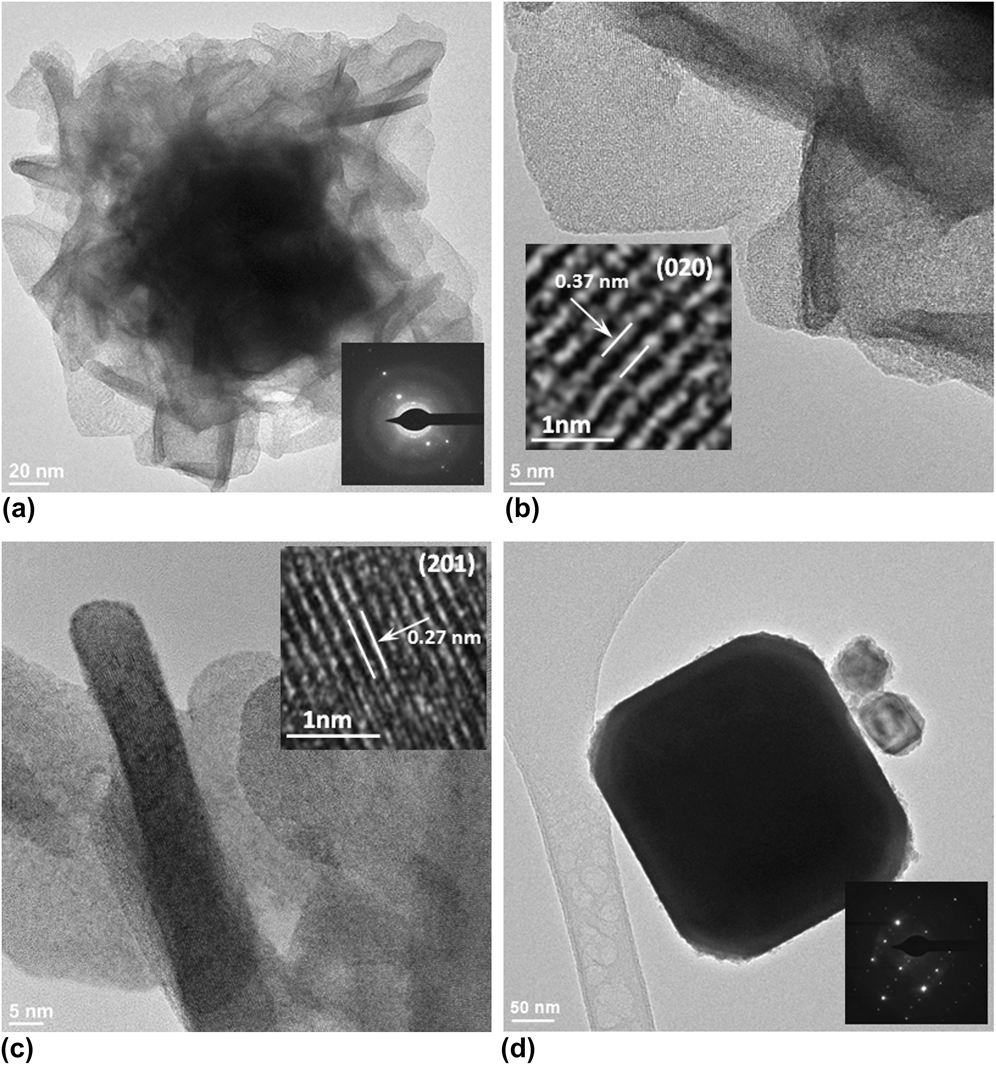
Figure 7 presents the results of TEM analysis of a core–shell particle produced by combustion of Na2WO4 + 3 Mg + CaF2 mixture. The selected area diffraction (SAD) shows overlapped patterns of the tungsten crystal and a fine polycrystalline material [Fig. 7(a)]. The high-resolution TEM analysis of the oxygen-containing shell suggests that they consist of randomly oriented thin flakes [Figs. 7(b) and7(c)]. The analysis of high-resolution TEM images [insets at Figs. 7(b) and 7(c)] reveals that the values of interplanar spacing (d, nm) for flakes well matched with those for hydrated tungsten trioxide (WO3·H2O). The average thickness of 2D flakes estimated by electron-energy loss spectroscopy (EELS) is 6 ± 2 nm. It is also interesting that treatment of such WO3/W particles with 1 M solution of NaOH fully removes the transparent shells, resulting in cubic W crystals (Im3m) with sizes in the range of 50–300 nm [Fig. 7(d)]. The SAD pattern for these particles shows the presence of only one phase, i.e., pure metal tungsten.
TEM analyses (SAD pattern inseted) of particles for the combustion product of Na2WO4 + 3 Mg + CaF2 (a), HRTEM analysis of 2D flakes attached on W particles (b, c) and microstructure (SAD pattern inseted) of particles after sodium hydroxide treatment (d).
Thus, CaF2-assisted CS in Na2WO4 + 3 Mg system allowed us to produce pure tungsten nanocrystals and tungsten oxide—tungsten nanostructures consisting of 2D WO3 nanoflakes assembled on the W core. It should be noted that similar to other 2D nanomaterials (e.g., graphene, MoS2), single- or few-layered WO3 shows unusual physical and chemical behavior of WO3.Reference Kalantar-zadeh, Vijayaraghavan, Ham, Zheng, Breedon and Strano27 From this standpoint, the suggested method can have great potential in developing 2D WO3 nanomaterials with unique properties.
D. The influence of CaF2 on the mechanism of reaction
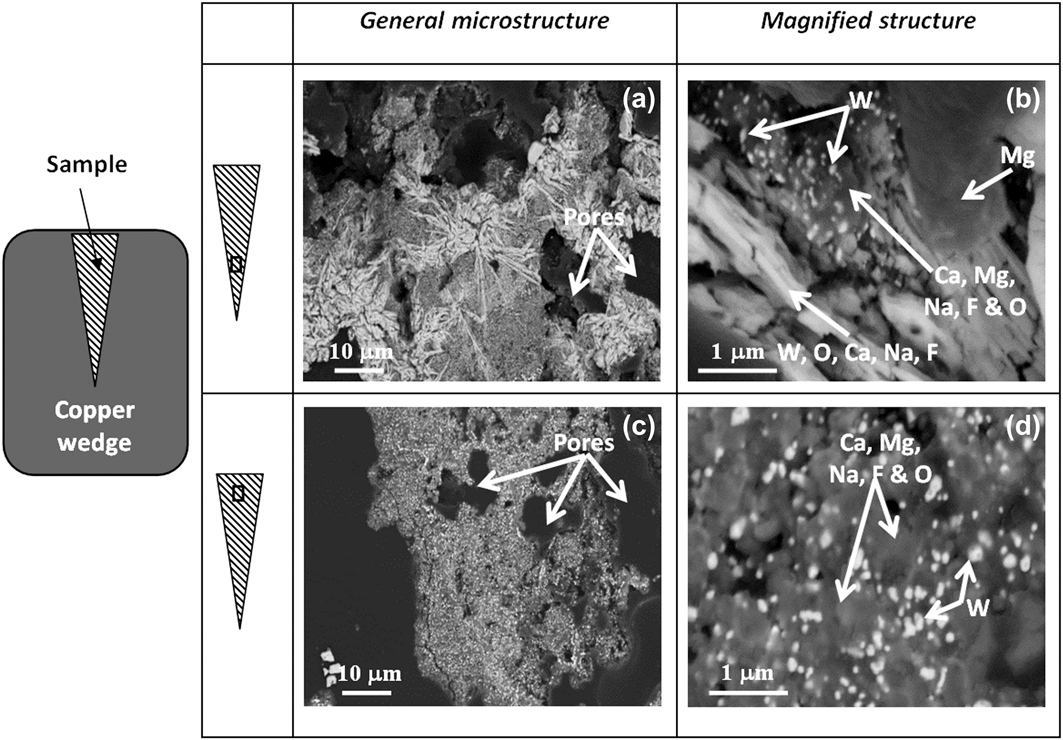
To understand the mechanism of phase transformation in Na2WO4 + 3 Mg + CaF2 reaction system, an attempt was taken to quench the combustion front using a wedge made from copper.Reference Merzhanov, Rogachev, Mukasyan and Khusid28,Reference Jin, Lin, Zhan and Jiang29 The SEM investigations indicated that the microstructures of various parts of reacted samples are considerably different. For example, in a cross-section at the bottom of the sample (where maximum temperature was only ∼1100 K), a two-phase structure with distinct contrast may be seen [Fig. 8(a)]. The magnified image [Fig. 8(b)] clearly shows two distinctive areas with white and gray colors. The EDS analysis shows that white area contains tungsten, calcium, sodium, fluorine, and oxygen, whereas the gray phase is pure magnesium. In between these areas, an area with segregated W nanoparticles, inside a continuous matrix of complex elemental composition (Na, Ca, F, Mg, and O), may be also seen. These results indicate that on the early stage of combustion process, some intermediate phases may form due to interaction between Na2WO4 and CaF2 precursors even before magnesium reduction.
SEM images of polished cross-section of a thin triangle-shape sample made of Na2WO4 + 3 Mg + CaF2 mixture combusted in copper wedge: bottom (a, b) and top (c, d) of the sample.
The SEM images[Figs. 8(c) and 8(d)] of a section from the top of the quenched sample suggest that the microstructure is much uniform, where tungsten particles are uniformly distributed inside the matrix phase [Fig. 8(d)]. Note that the measured maximum temperature in this section is ∼1400 K. The size of the W particles is larger as compared to that at the bottom of the sample, which is also related to the slower cooling rate of the product in top sections of the wedge.
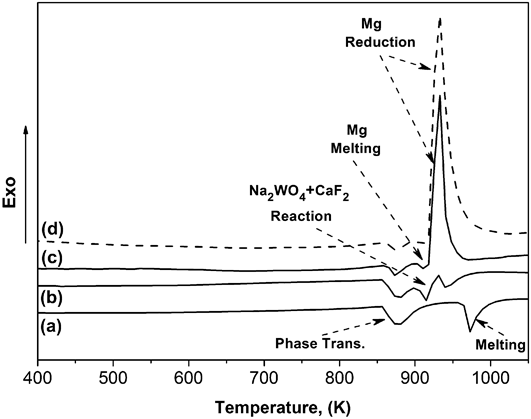
In addition, we investigated the reaction in Na2WO4 + 3 Mg + CaF2 system by DSC method. The results of these investigations are summarized in Fig. 9. The DSC curve (curve a) for Na2WO4 shows two endothermic peaks at 860 and 970 K, which are corresponding to phase transformationReference Lima, Saraiva, Freire, Maczka, Paraguassu, Sousae and Filho30 and melting of Na2WO4, respectively. The DSC curve of Na2WO4 + CaF2 mixture (curve b) indicates that adding CaF2 leads to the appearance of an endothermic peak at ∼920 K. The results of DSC analysis for Na2WO4 + 3 Mg (curve c) and Na2WO4 + 3 Mg + CaF2 (curve d) mixtures show intensive exothermic peaks at ∼920 K.
The results of DSC analysis for Na2WO4 (a), Na2WO4 + CaF2 (b), Na2WO4 + 3 Mg (c), and Na2WO4 + 3 Mg + CaF2 (d) mixtures.
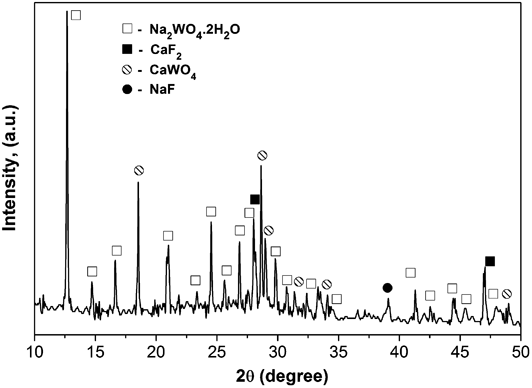
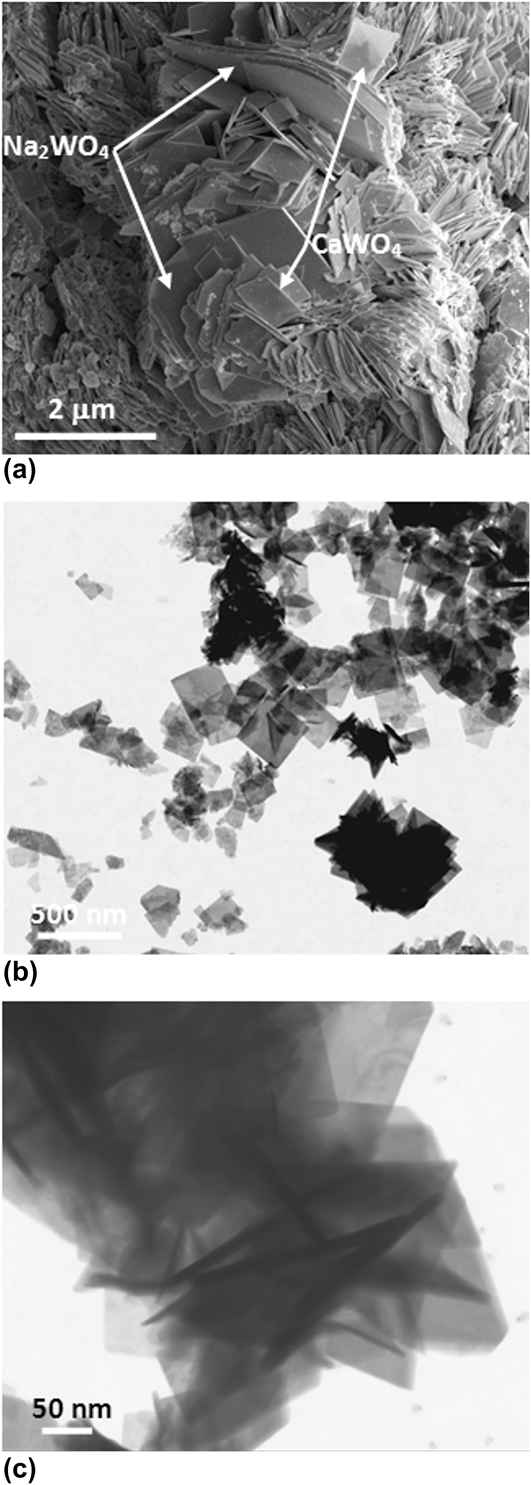
The XRD analysis of Na2WO4 + CaF2 mixture heated to 970 K shows the presence of significant amounts of CaWO4 and NaF phases (Fig. 10). Two distinctive types of sheets may be seen in the SEM image of the product for Na2WO4 + CaF2 mixture annealed at 970 K [Fig. 11(a)]. The EDS analysis reveals that the thick irregular sheets are Na2WO4, whereas relatively thin rectangular- or square-shaped sheets are CaWO4. This product was subjected to double-stage water/acid purification. At first, it was washed several times by hot deionized water to remove Na2WO4 and thus to eliminate the possibility of forming WO3·H2O from sodium tungstate during acid treatment. During the second stage, the hydrochloric acid treatment of CaWO4 leads to the formation of 2D WO3·H2O nanocrystals [Figs. 10(b) and 10(c)] with sheet-type microstructure similar to that formed in the combustion wave on the surface of tungsten particles.
The result of XRD analysis of Na2WO4 + CaF2 mixture annealed at 970 K.
SEM/STEM images of Na2WO4 + CaF2 mixture annealed at 970 K (a) and the resultant WO3·H2O nanosheets produced after hydrochloric acid treatment (b, c).
These results suggest that during combustion, a part of Na2WO4 converts to CaWO4 by the following salt metathesis (or double replacement) reaction at temperatures ∼920 K:
 $${\rm{N}}{{\rm{a}}_{\rm{2}}}{\rm{W}}{{\rm{O}}_{\rm{4}}} + {\rm{Ca}}{{\rm{F}}_{\rm{2}}} = {\rm{CaW}}{{\rm{O}}_{\rm{4}}} + {\rm{2NaF}}\quad {\rm{.}}$$
Simultaneously, another part of Na2WO4 reacts exothermically with magnesium by reaction (2):
 $${\rm{N}}{{\rm{a}}_{\rm{2}}}{\rm{W}}{{\rm{O}}_{\rm{4}}} + {\rm{3Mg}} + {\rm{Ca}}{{\rm{F}}_{\rm{2}}} =\,\, {\rm{W}} + {\rm{3MgO}} + {\rm{CaO}} + {\rm{2NaF}}\quad {\rm{.}}$$
It was shown earlierReference Lee, Jung, Borovinskaya, Vershinnikov and Won31 that CaWO4 may be also reduced to metallic tungsten by magnesium by the following reaction:
 $${\rm{CaW}}{{\rm{O}}_{\rm{4}}} + {\rm{3Mg}} = {\rm{W}} + {\rm{CaO}} + {\rm{3MgO}}\quad .$$
Thus, adding CaF2 changes the reaction mechanism in Na2WO4 + 3 Mg system and helps to bind sodium through the formation of NaF.
IV. DISCUSSION
The classical term “thermite reaction” (TR) is used to describe a class of systems which involves a metal (Me), which exothermally reacts with a metal or nonmetal oxide (AO):
 $${\rm{Me}} + {\rm{AO}} = {\rm{MeO}} + {\rm{A}} + \Delta {\rm{H}}\quad {\rm{,}}$$
where Me: Mg, Al, Ti, Zr, Zn, etc., AO: MoO3, WO3, Fe2O3, Cr2O3, TiO2, SiO2, CuO, etc., and ΔH is the heat generated by the reaction.Reference Lee, Jung, Borovinskaya, Vershinnikov and Won31–Reference Bae, Kim, Jeong and Kim36 The TRs may be initiated locally and then propagate in a self-sustained manner, which makes them extremely energy efficient. These reactions are of interest for a variety of applications, including as explosives, cutting and welding of metals, synthesis of materials, etc.
Recent studies indicate that similar to metal oxides, several inorganic salts of transition metals, e.g., calcium tungstate (CaWO4), ammonium molybdate ((NH4)6Mo7O24), may also be reduced by Mg or Mg + Zn mixture.Reference Lee, Jung, Borovinskaya, Vershinnikov and Won31,Reference Manukyan, Davtyan, Bossertand and Kharatyan37 An interesting feature of these salt reduction (SR) reaction systems is a possibility of tuning the microstructure of resulting metal particles (through the controlled release of NH3 and H2O) during the combustion process. Indeed, the self-sustaining reduction of inorganic salts allows to produce not only highly crystalline nanoparticles but also to design novel metal–metal oxide self-assembled nanostructures (Fig. 7).
A common feature of classical TR and SR systems is that in both cases, the high temperatures of the process make the production of nanosize products difficult. To control the reaction temperature and the microstructure of the products in TRs, several approaches were applied, including excessive use of magnesium in the initial mixture,Reference Guojian, Jiayue, Hanrui and Wenlan23,Reference Guojian, Jiayue, Hanrui and Wenlan24,Reference Lee, Jung, Borovinskaya, Vershinnikov and Won31 the combination of several reducers, e.g., Mg–Zn or Mg–C,Reference Aydinyan, Gumruyan, Manukyan and Kharatyan38,Reference Manukyan, Kirakosyan, Grigoryan, Niazyan, Yeghishyan, Kirakosyan and Kharatyan39 the dilution of a reactive media with the inert salts (e.g., NaCl).Reference Nersisyan, Lee and Won20,Reference Nersisyan, Won, Won and Cho21,Reference Manukyan, Kirakosyan, Grigoryan, Niazyan, Yeghishyan, Kirakosyan and Kharatyan39 In the last case, sodium chloride significantly reduces the reduction temperature, and also molten salt prevents intensive agglomeration processes of product particles at elevated temperatures. However, our recent study showed that sodium chloride may not be always considered as an inert media.Reference Manukyan, Kirakosyan, Grigoryan, Niazyan, Yeghishyan, Kirakosyan and Kharatyan39 In some systems, NaCl intensively reacts with initial oxides forming volatile oxychlorides of metals, which significantly change the reaction mechanism.
Present research also suggests that addition of CaF2 significantly changes the route of the reduction reaction, but in a different way as compared to NaCl. Indeed, addition of CaF2 leads to an increase in the combustion temperature (Figs. 1 and 2), whereas NaCl always reduces the temperature. The observed temperature increase cannot be explained by salt metathesis reaction (1), which produces CaWO4 and NaF, because this reaction is endothermic. However, subsequent magnesium reduction of CaWO4 is highly exothermic. It was shown earlierReference Lee, Jung, Borovinskaya, Vershinnikov and Won31 that the combustion temperature of CaWO4 + 3 Mg mixture is ∼2600 K.
Therefore, the overall reaction pathway of sodium tungstate to tungsten in the presence of CaF2 may be following:
At temperature ∼920 K, a part of sodium tungstate reacts with CaF2 forming CaWO4 and NaF. Another part of Na2WO4 melts at ∼970 K and reacts with magnesium. Therefore, the nucleation of tungsten takes place at the interphase of molten reagents (Na2WO4/Mg) by reaction (2). The melting point of CaWO4 is sufficiently higher (1890 K). The magnesium reduction of CaWO4 by reaction (3) is slower as compared to reaction (2). Some part of calcium tungstate may not be reduced due to the short process duration. At the purification stage, unreduced calcium tungstate reacts with hydrochloric acid by the following reaction:
 $${\rm{CaW}}{{\rm{O}}_{\rm{4}}}\,{\rm{ + \,2HCl}} = {{\rm{H}}_{\rm{2}}}{\rm{W}}{{\rm{O}}_{\rm{4}}} + {\rm{CaC}}{{\rm{l}}_{\rm{2}}}\quad .$$
The presence of WO3·H2O (H2WO4) shell on the tungsten particle is an evidence of the above reaction (4). Indeed, acid treatment of CaWO4 produced by annealing of Na2WO4 + CaF2 mixture at 970 K results in formation of 2D WO3·H2O nanoflakes (Fig. 10) with microstructure similar to that obtained on W particles produced in combustion wave.
It is interesting that CaF2 does not influence much the sizes of tungsten crystals, though increases the overall reaction temperature. The sizes of tungsten crystals at ∼1100 K are 50–100 nm [Fig. 8(b)], whereas at ∼1400 K, particles are in the size range of 50–200 nm [Fig. 8(d)]. High process temperature and presence of molten phase facilitate intensive growth and agglomeration of W particles. Figures 6(a)–6(c) show that at ∼1650 K, the tungsten particles have sizes in the range of 50–500 nm. It is important that further increase in temperature does not affect the size of crystals. For example, the particles formed at 2050 K [Figs. 6(d)–6(f)] have similar sizes compared to those produced at ∼1650 K.
However, the elevated temperature significantly affects the shape of the crystal (Fig. 6). The tungsten particles formed at ∼1650 K have a spherical shape, whereas at ∼2050 K, the particles have well-faced morphology. The final morphology of a crystal depends on both its intrinsic lattice structure and external conditions for growth. The intrinsic factor leads to the equilibrium crystal shape with minimum total surface energy, while different external conditions usually force the crystal to deviate from the equilibrium shape. The observed crystal shape is a product of the competition between these two factors and is related to the growth kinetics. At the initial combustion stages, the W nucleation from melt results in the formation of quasi-spherical crystals. On the next stage, at the elevated temperature (when CaF2 is added), the quasi-spherical W grains develop flat faces and transform toward the equilibrium crystal shape, which is achieved by a faceting process.
IV. CONCLUSIONS
In summary, one may conclude that CaF2 additive efficiently binds sodium during the self-sustaining reaction in Na2WO4 + 3 Mg system. This feature makes CS process in Na2WO4 + 3 Mg + CaF2 a reliable approach to produce a variety of nanostructured materials (e.g., pure tungsten nanocrystals, WO3/W self-assembled structures). The ability of calcium fluoride to change the reaction pathway enables to form intermediate CaWO4 phase. The magnesium reduction of this phase significantly increases the overall process temperature, thus facilitating the formation of tungsten crystals with equilibrium shapes. Some quantities of nonreduced CaWO4 phase in the combustion product allow us to produce unique WO3/W core–shell nanostructures with 2D oxide flakes assembled on metallic particles. Indeed, further investigations are required to define factors, which will allow tuning microstructural characteristics of WO3/W materials, such as the thickness of WO3 nanoflakes and the WO3-to-W ratio.
ACKNOWLEDGMENTS
This research was supported in part by the State Committee of Science of the Republic of Armenia (Project No. 11_1d167). This work was also supported by Notre Dame Integrated Imaging Facility (NDIIF) and Notre Dame Materials Characterization Facility (MCF). Khachatur Manukyan also acknowledges support from Fulbright Program, Bureau of Educational and Cultural Affairs of the U.S. Department of State. The authors acknowledge support and discussions with Y-C Lin and T. Orlova.