Implications
This study was performed within the Welfare Quality® project, which aims at developing an on-farm monitoring system for animals’ welfare. The human–animal relationship is an important component of the welfare of veal calves as the latter are in contact every day with stockpersons. This explains why tests evaluating the human–animal relationship are included in the welfare assessment scheme. In this article, we evaluated whether management or environmental factors could influence the outcome of these tests. We established that factors such as milk distribution systems, breed of the calves or stockperson's level of experience have an impact on the level of response of the calves to these tests. These factors could therefore be taken into account when interpreting results of tests focusing on human–animal relationships between stockpersons and calves. In addition, these results suggest ways of reducing the veal calves’ fear of humans under commercial conditions.
Introduction
The relationship between stockpersons and breeding stock is an important component of the welfare of farm animals (Hemsworth et al., Reference Hemsworth, Barnett and Coleman1993). Several studies have shown that behaviour of the stockperson has an impact on both welfare and productivity of animals (pigs: Hemsworth and Barnett, Reference Hemsworth and Barnett1991; poultry: Barnett et al., Reference Barnett, Hemsworth, Hennessy, McCallum and Newman1994; dairy cattle: Rushen et al., Reference Rushen, Taylor and de Passillé1999; veal calves: Lensink et al., Reference Lensink, Veissier and Florand2001). Therefore, potential indicators of the relationship between stockpersons and animals are included in on-farm welfare assessment schemes (e.g. Botreau et al., Reference Botreau, Veissier, Butterworth, Bracke and Keeling2007). Observations used for integration in these schemes should be easy and quick to perform, be repeatable, valid and ideally not be influenced by external factors such as the test person or the test location (Martin and Bateson, Reference Martin and Bateson1993; de Passillé and Rushen, Reference De Passillé and Rushen2005).
In on-farm conditions, the human–animal relationship is often assessed through the response of animals to human presence or to physical contact by humans during feeding (e.g. veal calves: Lensink et al., Reference Lensink, Boivin, Pradel, Le Neindre and Veissier2000b; dairy cows: Waiblinger et al., Reference Waiblinger, Menke and Fölsch2003), at the feeding place (e.g. veal calves: Bokkers et al., Reference Bokkers, Leruste, Heutinck, Wolthuis-Fillerup, van der Werf, Lensink and van Reenen2009; pigs: Lensink et al., Reference Lensink, Leruste, De Bretagne and Bizeray-Filoche2009) or in the home pen (e.g. dairy cows: Windschnurer et al., Reference Windschnurer, Schmied, Boivin and Waiblinger2008; veal calves: Bokkers et al., Reference Bokkers, Leruste, Heutinck, Wolthuis-Fillerup, van der Werf, Lensink and van Reenen2009). The response of farm animals to the presence of an unfamiliar experimenter who remains stationary has been observed in a special test arena (e.g. dairy cows: Hemsworth et al., Reference Hemsworth, Coleman, Barnett and Borg2000; sheep: Tallet et al., Reference Tallet, Veissier and Boivin2006). A number of reports support that these farm tests can give an indication of the level of avoidance of the tested animals (for review: Waiblinger et al., Reference Waiblinger, Boivin, Pedersen, Tosi, Janczak, Visser and Jones2006). In production systems animals are in contact daily with the stockperson, but also with other people such as veterinarians on a regular basis. Fear of humans might lead to, for instance increased cortisol responses or reduced productivity (for review: Hemsworth and Coleman, Reference Hemsworth and Coleman2010), which are indicators of low welfare.
For veal calves housed in groups, Bokkers et al. (Reference Bokkers, Leruste, Heutinck, Wolthuis-Fillerup, van der Werf, Lensink and van Reenen2009) developed several tests focusing on the human–animal relationship. For two of these tests, the Human Approach Test (HAT) and the Calf Escape Test (CET), the inter-observer and the test–retest reliability were good. Therefore, an on-farm animal welfare assessment scheme for veal calves could consider including these tests. The calves’ responses to a familiar or unfamiliar stockperson were highly correlated, suggesting a generalisation of the calves’ responses to humans. Responses of veal calves in these types of tests were shown to be reflecting the stockperson's behaviour towards the animals in both experimental and on-farm conditions (Lensink et al., Reference Lensink, Boissy and Veissier2000a and Reference Lensink, Boivin, Pradel, Le Neindre and Veissier2000b). In addition to the behaviour of the stockperson, other factors may influence responses of farm animals, including veal calves, in tests focusing on the human–animal relationship. Knowledge of these factors may help to explain differences between farms in the outcome of tests focusing on the relationship between animals and stockpersons, and may provide clues for improving farm parameters that directly affect this relationship. Few studies have focused on the human–animal relationship under farm conditions. In dairy cattle, the avoidance distance of cows is correlated with the quality and quantity of daily contacts with the milker and, to a lesser extent, with factors related to animals, management and housing (Waiblinger et al., Reference Waiblinger, Menke and Fölsch2003). In a previous comprehensive study on veal calves housed individually, factors such as attitude towards calves, years of experience with calves and the number of stockpersons working on the farm were linked with calves’ responses to humans, next to stockperson's behaviour towards calves (Lensink et al., Reference Lensink, Boissy and Veissier2000a). According to current regulations in the European Union, it is compulsory to keep calves in group housing from the age of 8 weeks onwards. Group housing can make handling of calves more difficult, therefore the effect of group size on human–animal interactions must be examined further (Raussi, Reference Raussi2003). In studies on (veal and dairy) calves mainly dairy breeds have been studied so far (Lensink et al., Reference Lensink, Boissy and Veissier2000a and Reference Lensink, Boivin, Pradel, Le Neindre and Veissier2000b; Rousing et al., Reference Rousing, Ibsen and Sorensen2005; Bokkers et al., Reference Bokkers, Leruste, Heutinck, Wolthuis-Fillerup, van der Werf, Lensink and van Reenen2009). In beef cattle, clear breed differences were found in terms of temperament and reactivity to humans (Murphey et al., Reference Murphey, Moura Duarte and Torres Penedo1981; Boivin et al., Reference Boivin, Le Neindre, Chupin, Garel and Trillat1992 and Reference Boivin, Le Neindre, Garel and Chupin1994). Similar differences may therefore also apply between veal calves of dairy and beef breeds.
The objective of the present study was to investigate behavioural responses of veal calves to humans on livestock farms and to determine potential influencing factors other than the stockperson's behaviour. Therefore, at all farms, calves were observed during two behavioural response tests as described by Bokkers et al. (Reference Bokkers, Leruste, Heutinck, Wolthuis-Fillerup, van der Werf, Lensink and van Reenen2009), data regarding housing conditions and management of calves were collected and stockpersons were interviewed. An overall analysis of the potential influencing factors for calves’ behaviour was performed on the data.
Material and methods
Farm sample
Data were collected between summer 2007 and spring 2009 on 148 veal farms in the Netherlands (n = 88), France (n = 36) and Italy (n = 24). Farms were selected so as to make up a representative cross-section of the veal production in Europe. Calves were housed in small groups of 5 to 15 calves and fed milk replacer and solid feed by a bucket (45) or a trough (103). The sample within each country consisted of farms located in the main regions where veal calves are reared. All farmers took part in this study on a voluntary basis. A single batch of calves was considered for each farm, and the tested batches were distributed across all four seasons. Calves arrived at the farms at the age of ∼15 days and were slaughtered at the age of 17 to 33 weeks. Farms showed a variety in type and origin of calves, size of the farm, feeding plan (amount of milk replacer and amount and type of solid feed), climate control, day light intensity and general management.
Behavioural tests
Two behavioural tests were carried out on all farms when the calves were aged 14.9 ± 1.6 (SD) weeks: the HAT and CET previously described by Bokkers et al. (Reference Bokkers, Leruste, Heutinck, Wolthuis-Fillerup, van der Werf, Lensink and van Reenen2009).
HAT: the behavioural response of calves to a passive unfamiliar person (experimenter) was measured. An unfamiliar experimenter approached the pen to be tested and stood still in the middle at the front of the pen. The experimenter was leaning against the fence with his/her elbow on top of the fence allowing the calves to voluntarily approach and touch the person. Eye contact was avoided. The test started when the experimenter with a clear but normal voice said a sentence to catch the attention of the calves. All calves could simultaneously approach and touch the experimenter; the number of calves standing was noted and the latency to every first touch was recorded for each individual calf. A maximum time allowance of 3 min was recorded for calves that did not touch the experimenter.
CET: the behavioural response of a calf to an active approach of an unfamiliar person (experimenter) was measured. The experimenter entered the pen and waited for 1 min to let the calves get used to his/her presence. Next, the experimenter standing erect in the pen chose a calf standing with its head oriented towards the experimenter at ∼1.5 m distance. The test consisted of four stages: (1) the experimenter can only make eye contact with the calf; (2) the experimenter can make one step towards the calf with one arm stretched forward and stand still with two feet next to each other for 1 s; (3) the experimenter can make a second step and stands still again for 1 s; and (4) the experimenter can touch the calf's muzzle. The test was ended whenever the calf moved one of its forelegs backwards. For each successful stage, one point was given (0- to 4-point scale), with 0 points for calves unable to make eye contact with and with a maximum of three attempts per calf.
In total, five experimenters (two men, three women; one experimenter per farm) performed the observations on the farms. They were wearing similar (dark blue coloured) clothing at all farms. Although the experimenters were experienced in behavioural research, they completed a training assessment with videos and photos of calf behaviour and practised together at a farm beforehand. Ten pens per farm were observed for HAT and 20 pens per farm for CET (including the 10 pens observed for HAT). On all farms, the HAT was performed between 1000 and 1200 h, whereas the CET was performed between 1400 and 1600 h.
Farm data
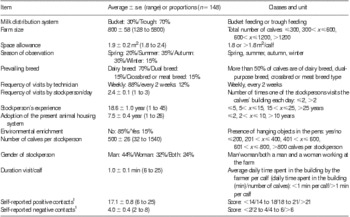
At all farms, information on characteristics of the building and equipment was collected by the experimenter using a pre-defined questionnaire with questions concerning, for example, type of milk distribution system within the farm, number of calves, space allowance per calf, prevailing breed of the batch, etc. Stockpersons were asked before the behavioural observations about their management practises (such as number of years of experience with calves, daily time spent in the building, frequency of visits by a technician, etc.). These data were used to build a list of potential risk factors (Table 1).
List of the analysed potential factors influencing the human–animal relationship in veal calves

1Only for French data set (n = 36).
Stockperson's behaviour
For practical reasons, it was not possible to observe the stockperson's behaviour towards the calves. For the French farms (n = 36) included in this study, an additional questionnaire was filled in by the stockpersons with six questions aiming to obtain a description of their interactions with their calves. The questions were asked in the form of ‘How often do you x your calves?’, where x was either ‘touch’, ‘pet’, ‘talk’, ‘let them suck your fingers’, ‘slap with your hands’ or ‘kick’. Answers were given on a 7-point scale with 1 = never, 4 = sometimes and 7 = very often. This data were then grouped into two variables. First, the farmer's answers about the four forms of positive contact (‘touch’, ‘pet’, ‘talk’ and ‘let them suck your fingers’) were summed up into a score of self-reported level of positive contacts (with possible score ranging from 4 to 28 points). Second, the farmer's answers about the two types of negative contacts (‘slap with your hands’ and ‘kick’) were summed up into a score of self-reported level of negative contacts (with possible score ranging from 2 to 14 points). These scores were added to the list of potential risk factors (Table 1).
Statistical analysis
Data were analysed by using GenStat software (GenStat Committee, 2000), which takes each farm as a statistical unit. Spearman rank correlations were calculated between the behavioural tests. For the CET test, variables used for the analyses were the percentage of calves per farm with a score 0 (CET0) and 4 (CET4) as these variables represent extreme responses of calves to experimenters. For the HAT, mean latency of the first five calves (HATlat) was used for analysis. When means are indicated, standard errors are given.
Two series of risk factor analyses were performed with response variables CET0, CET4 and HATlat. The generalised linear model comprised a logit link function and a binomial variance function with an additional multiplicative dispersion parameter. Estimation was by maximum quasi-likelihood. The multiplicative dispersion parameter was estimated from Pearson's χ 2 statistics. Significance tests were based on the Wald test. Details may be found in McCullagh and Nelder (Reference McCullagh and Nelder1989). For the first series of analyses, explanatory variables were the potential risk factors obtained from the questionnaire (listed in Table 1). For the second series of analyses only performed on the French data, the same explanatory variables were used, together with the farmers’ self-reported contacts with the calves. All explanatory variables were expressed in the form of factors. Factor levels were defined such that each level corresponded to a sizeable number of farms in the sample. First, potential risk factors were inspected one at a time. Risk factors with a significance level below 0.10 (P < 0.10) were retained for further study. Second, the remaining risk factors were jointly entered into the model. Further analyses comprised variable selections by stepwise backward and forward selection. For all potential risk factors that were selected either by backward or forward selection, best subset selection was performed and significance tests for the selected risk factors were evaluated. Only main effects were considered, avoiding multicollinearity problems. Selection was based on adjusted R 2, and final significance (P < 0.05) of potential risk factors. For each risk factor that was finally selected, odds ratios and associated 95% confidence intervals were obtained from the final model. Results are presented in such a way that level I is compared with level II. Odds ratios >1 with a t-value level <0.05 indicate a significant risk factor.
Results
General results
For the HAT, the mean latency for touching the experimenter (HATlat) was 113.4 ± 2.0 s (range 52.8 to 172.0 s). For the CET, the average score (CETaverage) was 1.7 ± 0.1 (range 1.0 to 2.8), with average percentages of 5.8% ± 0.7% of calves per farm that could not be approached (CET0; range 0.0% to 38.1%), 54.4% ± 1.4% of calves per farm with score 1 (range 18.4% to 84.5%), 21.5% ± 0.6% of calves per farm with a score 2 (range 3.6% to 41.7%), 4.5% ± 0.4% of calves per farm with score 3 (range 0.0% to 22.4%) and 13.9% ± 0.8% of calves with score 4 (CET4; range 0.9% to 49.3%).
The mean HATlat was positively correlated with CET0 (n = 148; rs = 0.36; P < 0.01) and negatively correlated with CET4 (n = 148; rs = −0.38; P < 0.01).
Risk factor analyses
The multiple regression analysis showed that none of the variables studied were significantly linked with the mean latency of the calves to be touched in the HAT.
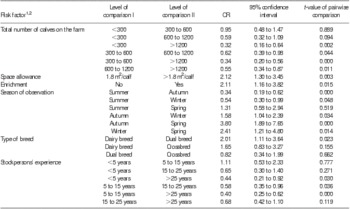
Total number of calves at the farm, space allowance per calf, environmental enrichment, season of observation, breed and stockperson's experience were found to influence significantly (all P < 0.05) the percentage of calves that were scored 0 during CET (Table 2). The variables accounted for 37.89% of the variance. For all the class comparisons (except for farm size <300 calves compared with 300 to 600 calves), a larger farm size was associated with a higher risk of finding a higher proportion of calves with CET0. A space allowance of 1.8 m2 per calf and the absence of environmental enrichment (hanging objects) in the calves’ pens were also associated with higher risks of observing a higher percentage of CET0 on the farm. Observations performed during autumn or winter led to a higher risk of observing a higher percentage of CET0 on the farm when compared with summer or spring observations. Herds with mainly milk type calves when compared with dual-breed calves and crossbred calves had higher percentages of CET0. The more experience a farmer had with veal calves, the lower was the risk of finding increased percentages of calves with CET0.
Multivariate regression model for the percentage of calves scored 0 (could not be approached; n = 138)

OR = odds ratio.
1All risk factors in the multivariate regression model were significant for P < 0.05; adjusted R 2 = 37.89.
2Variable or class is a risk factor when OR > 1 and t-value <0.05.
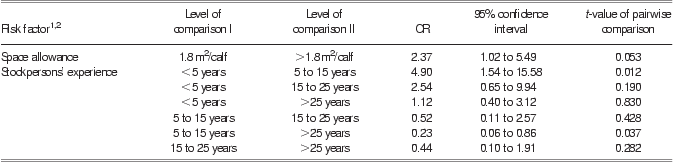
When performing statistical analyses on the French subset (n = 36) by including the stockperson's self-reported levels of positive and negative contacts, these factors did not influence the CET0 level when analysed individually and were omitted from further analyses. For the final model for the French subset, the variables space allowance per calf and stockperson's experience influenced significantly (P < 0.05) CET0 levels and accounted for 20.71% of the variance observed (Table 3). Space allowance per calf and stockperson's experience gave the same interpretations as for the results presented in Table 2, which means a higher space allowance per calf and increased experience of stockpersons leading to lower CET0 levels.
Multivariate regression model for the percentage of calves scored 0 (could not be approached) for the sample with farmer's self-reported contacts (n = 36)
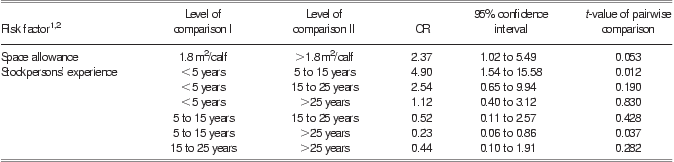
OR = odds ratio.
1All risk factors in the multivariate regression model were significant for P < 0.05; adjusted R 2 = 20.71.
2Variable or class is a risk factor when OR >1 and t-value <0.05.
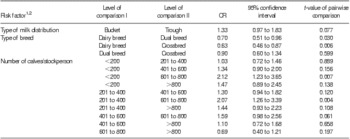
With regard to the proportion of calves with CET4, type of milk distribution, breed and number of calves per stockperson explained significantly (all P < 0.05) 16.26% of the variance in the multiple regression model (Table 4). Calves raised on farms with bucket feeding had a higher risk of increased CET4 levels when compared with those with trough feeding. Farms with dual-breed or crossbred calves were more likely to have a higher proportion of calves with CET4 compared with the farms with only dairy breed calves. In general, farms with a lower number of calves per stockperson had a greater chance of higher levels of calves with CET4.
Multivariate regression model for the percentage of calves scored 4 (could be touched; n = 147)

OR = odds ratio.
1All risk factors in the multivariate regression model were significant for P < 0.05; adjusted R 2 = 16.26.
2Variable or class is a risk factor when OR > 1 and t-value <0.05.
When performing statistical analyses on the French subset (n = 36) by integrating the stockperson's self-reported levels of positive and negative contacts, these factors did not influence the CET4 level when analysed individually and were omitted from further analyses. For the final model for the French subset, the variables type of breed and frequency of visits by the technician influenced significantly (P < 0.05) CET4 levels and accounted for 16.26% of the variance observed (Table 5). Farms with dual-breed or crossbred calves had a higher risk of having a higher proportion of calves with CET4 compared with the farms with dairy breed, and farms with dual-breed calves had a higher risk of having a higher proportion of calves with CET4 compared with farms with crossbreds. Farms that were visited weekly by the technician had a higher risk of increased CET4 levels when compared with those were the technician came every 2 weeks.
Multivariate regression model for the percentage of calves scored 4 (could be touched) for the sample with farmer's self-reported contacts (n = 36)

OR = odds ratio.
1All risk factors in the multivariate regression model were significant for P < 0.05; adjusted R 2 = 16.26.
2Variable or class is a risk factor when OR > 1 and t-value <0.05.
Discussion
In the present study, two tests were performed on all farms in order to determine the human–animal relationship. The HAT was based on the voluntary approach of calves when the experimenter was standing at the feeding fence, whereas during the CET the experimenter entered a pen and tried to touch calves in a standardised way. A higher latency to touch during HAT was moderately negatively correlated with the CET score 4, demonstrating that calves not approaching an unfamiliar person easily, also avoided this person when he/she approached these calves. At farms with a high HAT latency, a low proportion of calves that could be touched was found. However, stockperson's management and animal characteristics did not influence latency to touch during HAT. It is possible that a voluntary approach of a human during the day is not a challenge for the animals. Animals may be in a situation of conflict between curiosity and fear when an unknown person is present (de Passillé and Rushen, Reference De Passillé and Rushen2005). During the CET, a human is clearly provoking a reaction of the animal and it is likely that those that can be touched are not fearful of humans (Boivin et al., Reference Boivin, Garel, Mante and Le Neindre1998). However, animals that cannot be touched may not necessarily be frightened (Waiblinger et al., Reference Waiblinger, Menke and Fölsch2003), and tests like our CET might be a mixture of measuring fear (extreme reactions), disinterest (moderate reactions) and lack of interest (Scott et al., Reference Scott, Laws, Courboulay, Meunier-Salaün and Edwards2009).
Farm animals’ reactions to humans are generally an indicator of the quality and quantity of contacts they had with stockpersons (Hemsworth and Coleman, Reference Hemsworth and Coleman2010). Ideally, the stockperson's behaviour towards the animals should be observed in order to have a more exact evaluation of the human–animal relationship. As for the majority of field studies published, no direct observations of the stockperson's behaviour towards their calves were performed during the present study. For practical reasons it was not possible to perform these observations on such a large scale and within the limited time available for the experimenters. Therefore, for a part of the stockpersons, questions were asked on the quality and frequency of their contacts with calves. In several studies, a clear link was demonstrated between stockperson's attitudes and their behaviour towards animals (Hemsworth et al., Reference Hemsworth, Coleman and Barnett1994 and Reference Hemsworth, Coleman, Barnett, Borg and Dowling2002; Coleman et al., Reference Coleman, Hemsworth, Hay and Cox2000; Waiblinger et al., Reference Waiblinger, Menke and Coleman2002). In the present study, no relationship was established between the level of contacts with the calves reported by the farmer and the behaviour of calves measured in the CET. Several reasons can be imagined for this apparent lack of relationship. It is possible that the variation in the results from the questionnaire and the number of questions were insufficient to have any effect in the analysis. Furthermore, stockpersons might have moderated their responses to questions concerning negative interactions and might have exaggerated their responses to questions regarding positive interactions (Lensink et al., Reference Lensink, Boissy and Veissier2000a). In addition, some aversive contacts such as moving or vaccinating calves and other types of contacts such as visual contact during daily routine procedures were not integrated in the assessment explaining therefore the lack of relationship.
At larger farms, especially those with more than 1200 calves, animals avoided the experimenter more than at smaller farms. Furthermore, on farms with fewer calves per stockperson more calves could be touched during the CET. This supports earlier findings that stockpersons in bigger units have less time to interact individually with animals (English, Reference English1991; Lensink et al., Reference Lensink, Boissy and Veissier2000a). For this reason, these variables are reflecting a lower level of physical and visual contact per animal, which in turn might influence the animals’ reactions to humans (Barnett et al., Reference Barnett, Hemsworth, Hennessy, McCallum and Newman1994).
The way calves were fed influenced their response during the CET. Calves fed in a trough were more fearful than those fed in a bucket. It is possible that in the bucket system, calves have more visual and physical contact with the stockperson compared with the trough system. In fact, in the bucket system, for each meal the stockperson stands still in front of each bucket (and therefore each calf) in order to fill the bucket, whereas in the trough system the stockperson stands only directly in front of one calf or troughs are filled automatically without any human presence. This finding seems to support the suggestion that the amount of visual contact with stockpersons during feeding can influence the animal's behaviour towards humans (Jago et al., Reference Jago, Krohn and Matthews1999; Lensink et al., Reference Lensink, Boivin, Pradel, Le Neindre and Veissier2000b). Furthermore, higher average space allowance per calf led to a lower proportion of calves with a score 0 (no eye contact) during the CET. Normally, farmers keep their calves at the minimum required space allowance as laid down in the regulations of the European Union (1.8 m2/calf), but in some farms calves had some more space. Although the test was standardised, these calves might have been able to escape more easily or walk away from the experimenter or were less challenged by the test situation leading to a lower proportion of score 0.
Breed differences were found in the outcome of the CET. Crossbred calves generally tended less to avoid humans compared with dual-purpose breeds and dairy breed calves, while compared with dairy breed calves, dual-purpose breed calves demonstrated also less avoidance of humans. These findings are in accordance with previous studies demonstrating potential differences in reactivity to humans between beef cattle breeds (Murphey et al., Reference Murphey, Moura Duarte and Torres Penedo1981; adult cattle: Boivin et al., Reference Boivin, Le Neindre, Chupin, Garel and Trillat1992; calves: Boivin et al., Reference Boivin, Le Neindre, Garel and Chupin1994). However, it is generally believed that beef cattle are more fearful of humans than dairy breeds (Murphey et al. Reference Murphey, Moura Duarte and Torres Penedo1981), but this could be partially due to a lower level of contact with humans rather than a genetic effect. In our study, crossbred calves, which were a cross between dairy and beef breeds, and dual-purpose (milk and meat) breed calves were generally less fearful than dairy breed calves. As calves from those different breeds were raised in similar conditions, these effects might be due to genetic differences, but further research is needed to defend this hypothesis.
Seasonal effects were found on the percentage of calves that could not be touched. This result was unexpected as calves are penned and managed in the same conditions throughout the year. A seasonal effect might reflect temperature differences or effects on health. In autumn and winter, calves have a higher risk of lung diseases (Lundborg et al., Reference Lundborg, Svensson and Oltenacu2005), which leads to more medical treatments. These treatments can be accompanied with some additional potentially negative handling by the stockperson or the veterinarian explaining potentially the higher number of calves that could not be touched.
In our study, presence of environmental enrichment (hanging objects in the calves’ pens) was associated with a lower risk of observing a high percentage of calves avoiding the experimenter. Environmental enrichment was shown to reduce fear of humans in pigs (Pearce et al., Reference Pearce, Paterson and Pearce1989) but this impact has not been demonstrated in cattle yet (Raussi, Reference Raussi2003). More research is needed to determine the potential links between hanging objects, general fearfulness and reactivity of animals to humans.
Our study indicates that factors other than the stockperson's behaviour towards their animals can affect calves’ reaction during a human–animal relationship test performed in on-farm conditions. Stockperson's characteristics and management such as the number of calves they take care of, or years of experience, influenced calves’ reactions; in addition, feeding system and breed also affected the outcome of the tests. More detailed studies are needed to clearly identify the importance of different aspects of the stockperson's behaviour because, next to physical contact, factors such as visual contact or being accustomed to human presence seem to have considerable impact on the animals’ reactions to humans. However, as our study did not integrate the observation of the stockpersons’ behaviour towards their calves, care should be taken with the interpretation of all potential effects as confounding issues might remain. In future, more research is needed integrating all aspects of the human–animal relationship in field studies to clarify and confirm the different results obtained.
Acknowledgements
The present study is part of the Welfare Quality® research project that has been co-financed by the European Commission within the 6th Framework Programme, contract no. FOOD-CT-2004-506508. The text represents the authors’ views and does not necessarily represent a position of the Commission who will not be liable for the use of such information. This research was also financed by the Dutch Ministry of Agriculture, Nature and Food Quality, the Dutch Product Board Animal Feed, the Dutch Product Boards of Livestock, Meat and Eggs and the French Product Board for Calves (Interveaux). The authors would like to thank the veal integrators and farmers who took part in the study, Willem Buist for his help with the data analysis, and Jean-Loup Rault for his help during the observations, and Robin Fisher for proof-reading the English manuscript.