Introduction
Obsessive–compulsive disorder (OCD) is a psychiatric condition that affects between 0.3% and 3.1% of the general population (Fontenelle et al. Reference Fontenelle, Mendlowicz and Versiani2006). The onset of OCD is usually gradual and, if left untreated, the course can be chronic, resulting in lower quality of life (Olatunji et al. Reference Olatunji, Cisler and Tolin2007). Fear of contamination, the most common presentation of OCD, can be complex, difficult to control and extraordinarily persistent (Rachman, Reference Rachman2004). Contamination fear in OCD is often characterized by overt compulsive acts of cleaning, washing and disinfecting, which function to alleviate distress from obsessions about contact (real or perceived) with stimuli perceived to be dirty, impure or infectious. Although effective treatments can help a large proportion of patients with OCD, at least 40% remain unimproved with medications and/or cognitive behavioral therapy (CBT) (Greist et al. Reference Greist, Jefferson, Kobak, Katzelnick and Serlin1995; Mataix-Cols et al. Reference Mataix-Cols, Marks, Greist, Kobak and Baer2002).
CBT that focuses on exposure and response prevention (ERP) is currently the psychological treatment of choice for OCD (NICE, 2006). Given that some patients do not respond to CBT, various characteristics of the individuals presenting for treatment may influence its efficacy to some degree. Several studies have attempted to identify variables that predict treatment outcome in OCD (Olatunji et al. Reference Olatunji, Davis, Powers and Smits2012). However, the identification of reliable predictors of treatment outcome in OCD remains elusive. In fact, most of the variables examined to date (age, gender, severity of symptoms, depression, personality disorder, symptom duration, pure obsessiveness, and most symptom dimensions) have not been consistently predictive of improvement with CBT in OCD (Foa & Goldstein, Reference Foa and Goldstein1978; Christensen et al. Reference Christensen, Hadzai-Pavlovic, Andrews and Mattick1987; Basoglu et al. Reference Basoglu, Lax, Kasvikis and Marks1988; van Balkom et al. Reference van Balkom, van Oppen, Vermeulen, van Dyck, Nauta and Vorst1994; Steketee & Shapiro, Reference Steketee and Shapiro1995; Mataix-Cols et al. Reference Mataix-Cols, Marks, Greist, Kobak and Baer2002).
Another important line of research has focused on the identification of neural biomarkers that may predict pharmacological treatment outcomes. For example, resting-state positron emission tomography (PET) studies have found that decreased pre-treatment regional cerebral blood flow (rCBF) in the orbitofrontal cortex is associated with a better response to serotonin reuptake inhibitors (Swedo et al. Reference Swedo, Pietrini, Leonard, Schapiro, Rettew, Goldberger, Rapoport, Rapoport and Grady1992; Brody et al. Reference Brody, Saxena, Schwartz, Stoessel, Maidment, Phelps and Baxter1998; Saxena et al. Reference Saxena, Brody, Maidment, Dunkin, Colgan, Alborzian, Phelps and Baxter1999; Rauch et al. Reference Rauch, Shin, Dougherty, Alpert, Fischman and Jenike2002). Studies have also found that increased rCBF in the posterior cingulate gyrus correlates with clinical improvement after treatment with cingulotomy and fluvoxamine (Rauch et al. Reference Rauch, Dougherty, Cosgrove, Cassem, Alpert, Price, Nierenberg, Mayberg, Baer, Jenike and Fischman2001, Reference Rauch, Shin, Dougherty, Alpert, Fischman and Jenike2002). Higher pre-treatment rCBF in the right caudate nucleus has also been found to be significantly associated with improvement in OCD symptoms with paroxetine (Saxena et al. Reference Saxena, Brody, Ho, Zohrabi, Maidment and Baxter2003). A more recent extension of this body of research found that pre-treatment activation in the right cerebellum and the left superior temporal gyrus predicted subsequent reduction in OCD symptoms with fluvoxamine (Sanematsu et al. Reference Sanematsu, Nakao, Yoshiura, Nabeyama, Togao, Masuda, Nakatani, Nakagawa and Kanba2010).
However, few studies have examined neuroimaging predictors of response to CBT in OCD. In an earlier PET study, Brody et al. (Reference Brody, Saxena, Schwartz, Stoessel, Maidment, Phelps and Baxter1998) found that increased rCBF in the left orbitofrontal cortex correlated positively with clinical improvement. A recent structural neuroimaging study found that pre-treatment gray matter volume within the right medial prefrontal cortex was associated positively with symptom improvement following CBT, whereas gray matter volume within the right middle lateral orbitofrontal cortex was associated negatively with improvement after treatment with fluoxetine (Hoexter et al. Reference Hoexter, Dougherty, Shavitt, D'Alcante, Duran, Lopes, Diniz, Batistuzzo, Evans, Bressan, Busatto and Miguel2013). Taken together, these preliminary findings suggest that it may be possible to identify neural biomarkers of response to different treatment modalities in OCD. This may lead to more targeted and personalized treatment approaches, fewer treatment failures and better overall outcomes. Clearly, this research is in its infancy and more research is required before such ambition can become a reality. For example, prior research does suggest that different OCD symptom dimensions are mediated by distinct neural processes (Mataix-Cols et al. Reference Mataix-Cols, Wooderson, Lawrence, Brammer, Speckens and Phillips2004; van den Heuvel et al. Reference van den Heuvel, Remijnse, Mataix-Cols, Vrenken, Groenewegen, Uylings, van Balkom and Veltman2009; Harrison et al. Reference Harrison, Pujol, Cardoner, Deus, Alonso, López-Solà, Contreras-Rodríguez, Real, Segalàs, Blanco-Hinojo, Menchon and Soriano-Mas2013). This suggests that currently available studies may be limited by use of a heterogeneous sample of patients with OCD, given that different OCD symptom dimensions may have different neural predictors of treatment outcome.
The present study examined the neural correlates of response to CBT among patients with contamination-based OCD during symptom provocation by visual exposure using functional magnetic resonance imaging (fMRI). As different symptom dimensions of OCD may derive from distinct neural systems (Rauch et al. Reference Rauch, Dougherty, Shin, Alpert, Manzo, Leahy, Fischman, Jenike and Bare1998; Phillips et al. Reference Phillips, Marks, Senior, Lythgoe, O'Dwyer, Meehan, Williams, Brammer, Bullmore and McGuire2000; Mataix-Cols et al. Reference Mataix-Cols, Cullen, Lange, Zelaya, Andrew, Amaro, Brammer, Williams, Speckens and Phillips2003, Reference Mataix-Cols, Wooderson, Lawrence, Brammer, Speckens and Phillips2004; van den Heuvel et al. Reference van den Heuvel, Remijnse, Mataix-Cols, Vrenken, Groenewegen, Uylings, van Balkom and Veltman2009), only patients with predominant contamination/washing symptoms were examined to limit the potential confound associated with variability in OCD symptom dimensions. It was predicted that brain regions identified as dysfunctional in prior neuroimaging studies on fear and anxiety more broadly and contamination-based OCD more specifically (Schienle et al. Reference Schienle, Schafer, Stark, Walter and Vaitl2005; Husted et al. Reference Husted, Shapira and Goodman2006) might provide predictive information about CBT treatment response. Based on emotional processing theory (EPT), which postulates that physiological activation is a crucial requirement for extinction learning during exposure-based treatments for anxiety disorders (Foa & Kozak, Reference Foa and Kozak1986), it was predicted that greater activation in limbic and paralimbic brain regions during symptom provocation would be associated with better outcomes after CBT.
Method
Participants
Participants were 12 patients with primary OCD and contamination fears who completed an open trial of CBT at the in-patient CBT unit of Bethlem Royal Hospital, London, UK (n = 11) or at an out-patient clinic in West London (n = 1). Although only patients with predominantly contamination and cleaning symptoms were included in the present study, most had other concurrent symptoms [obsessions: aggressive (55%), sexual (18%), religious (27%), symmetry (55%), somatic (46%), hoarding (27%); compulsions: checking (82%), repeating (73%), counting (36%), arranging (36%), hoarding (27%)]. The Ethics Committee (Research) of the Maudsley Hospital and Institute of Psychiatry approved the study protocol and all subjects signed an informed consent form prior to their participation. Axis I and II diagnoses were made according to DSM-IV criteria by a psychiatrist or nurse therapist using the SCID-CV (First et al. Reference First, Spitzer, Gibbon and Williams1996). Patients with co-morbid diagnoses other than psychosis or substance abuse were not excluded provided that OCD was the main problem for which treatment was sought. Exclusion criteria were brain injury, any neurological condition, psychosis or substance abuse.
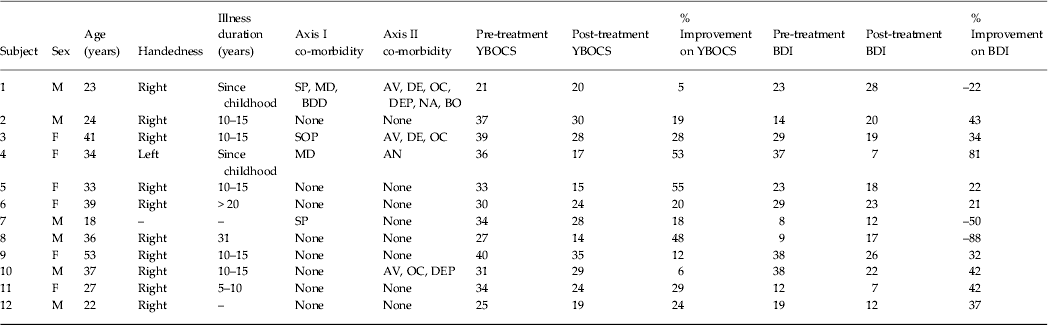
Nine (75%) patients had one or more co-morbid Axis I disorders, and four (33.3%) met the criteria for one or more Axis II disorders. Table 1 shows the demographic and clinical characteristics of the sample. All patients were substantially symptomatic at the time of the scan as indicated by scores on the Yale–Brown Obsessive Compulsive Scale (YBOCS; mean = 32.25, s.d. = 5.73), a rating scale designed to assess the severity of symptoms in patients with OCD (Goodman et al. Reference Goodman, Price, Rasmussen, Mazure, Delgado, Heninger and Charney1989a , Reference Goodman, Price, Rasmussen, Mazure, Fleischmann, Hill, Heninger and Charney b ). Depression symptoms were mild to moderate among OCD patients at the time of the scan as indicated by scores on the Beck Depression Inventory (BDI; mean = 23.25, s.d. = 11.10), one of the most widely used instruments for measuring the severity of depression (Beck et al. Reference Beck, Ward, Mendelson, Mock and Erbaugh1961).
Demographic and clinical characteristics of 12 patients with OCD before and after a trial of CBT

OCD, Obsessive–compulsive disorder; CBT, cognitive behavioral therapy; YBOCS, Yale–Brown Obsessive Compulsive Scale; BDI, Beck Depression Inventory; M, male; F, female; SOP, social phobia; GAD, generalized anxiety disorder; MD, major depressive episode; PD, panic disorder without agoraphobia; SP, specific phobia; BDD, body dysmorphic disorder; AG, agoraphobia without panic; AV, avoidant; OC, obsessive–compulsive; DEP, depressive; DE, dependent; BO, borderline; PA, paranoid; NA, narcissistic; AN, antisocial; –, missing information.
Treatment and outcome measures
The patients were scanned before an open trial of CBT. Consistent with a cognitive approach, ERP strategies were used as a means of helping the patient discover the way in which neutralizing behavior acts to maintain their beliefs and the associated discomfort, and that stopping such behaviors is beneficial (Salkovskis, Reference Salkovskis1999). The majority of the participants (n = 11) received CBT during in-patient treatment with a maximum duration of 12 weeks, each receiving approximately 24 individual treatment sessions. These treatment sessions were more frequent during the first few weeks of admission. One additional patient was treated with ERP techniques guided by a telephone-accessed computer system (Greist et al. Reference Greist, Marks, Baer, Kobak, Wenzel, Hirsch, Mantle and Clary2002) plus telephone clinician support over eight sessions lasting a total of 90 min. The outcome measures included the percentage decrease in YBOCS and BDI scores from pre- to post-treatment.
Most patients (n = 8, 66.7%) had been on stable doses of medications for at least 6 weeks before starting CBT and, for the most part, these medications were maintained stable during the CBT trial. Doses of benzodiazepines were reduced in two cases as part of a withdrawal schedule. One previously unmedicated patient was started on sertraline up to 150 mg/day for 2 weeks before discharge as he had failed to improve with CBT. This patient was not excluded from the study because 2 weeks are usually considered insufficient for a sustained clinical response, as was indeed confirmed in this case (i.e. no clinical response was observed during this 2-week period).
Symptom provocation paradigm
All subjects participated in a 6-min symptom provocation task in which they viewed 10 alternating blocks (each lasting 60 s) of contamination-related or neutral images before undergoing CBT. These images are well validated and have been used effectively in prior research (Mataix-Cols et al. Reference Mataix-Cols, Cullen, Lange, Zelaya, Andrew, Amaro, Brammer, Williams, Speckens and Phillips2003, Reference Mataix-Cols, Wooderson, Lawrence, Brammer, Speckens and Phillips2004, Reference Mataix-Cols, Lawrence, Wooderson, Speckens and Phillips2009). The order in which the contamination and neutral blocks were presented was balanced between subjects. Prior to the presentation of each set of images, participants listened to the following pre-recorded instructions through high-fidelity pneumatic headphones: ‘Imagine that you must come into contact with what's shown in the following pictures without washing yourself afterwards’ (contamination), and ‘Imagine that you are completely relaxed while looking at the following scenes’ (neutral). After each set of images, another pre-recorded sound file of the question ‘How anxious do you feel?’ was played and participants rated their subjective anxiety on a scale from 0 (no anxiety) to 8 (extreme anxiety). Previous research has shown that this provocation procedure is highly effective in provoking contamination-related anxiety and that the patients’ severity of contamination-related fears correlates with the degree of provoked anxiety during this procedure (Mataix-Cols et al. Reference Mataix-Cols, Lawrence, Wooderson, Speckens and Phillips2009).
Image acquisition
Gradient-echo echo-planar imaging (EPI) was performed on a GE Signa 1.5-T Neuro-optimized MR system (General Electric, USA) at the Maudsley Hospital, London. One hundred T2*-weighted whole-brain volumes depicting blood oxygen level-dependent (BOLD) contrast, consisting of 16 slices oriented according to the bicommissural plane (thickness 7 mm, 0.7-mm gap), were acquired over 6 min [repetition time (TR) = 2.0 s, echo time (TE) = 40 ms, field of view (FOV) = 24 cm, flip angle = 70°, 64 × 64 matrix size]. This EPI dataset provided almost complete brain coverage.
In each 20-s stimulus presentation block, subjects viewed either 10 provocative or 10 neutral pictures. Each picture was presented for 1950 ms, with an interstimulus interval of 50 ms. Ten whole-brain volumes were acquired during each block. Each block was followed by: (a) an 8-s period of complete silence during which subjects were asked to rate their level of anxiety; (b) a further 8-s period during which the subjects listened to a sound file containing instructions pertinent to the next stimulus block. Four ‘dummy volumes’ were excited during this 8-s period using the same radio frequency envelope and gradient slice selection parameter, with the same repetition time of 2 s to allow the magnetization to reach an equilibrium amplitude prior to the next period of data acquisition. The frequency-encoding gradient was turned off during this period to minimize acoustic noise and ensure that the instructions were heard clearly by the subjects. The four dummy volumes were later discarded from the time series and this was taken into account during data analysis.
Individual brain activation maps in native space were co-registered to a structural scan with the following acquisition parameters: TE = 40 ms, TR = 3000 ms, FOV = 24 cm, matrix size = 128 × 128, number of slices = 43, slice thickness = 3.0 mm, interslice gap = 0.3 mm, number of signal averages = 8.
Statistical analyses
Prior research has shown that the timing of exposure may modulate the magnitude of the BOLD response during exposure to threat-relevant stimuli among anxious participants (Larson et al. Reference Larson, Schaefer, Siegle, Jackson, Anderle and Davidson2006; Caseras et al. Reference Caseras, Mataix-Cols, Trasovares, López-Solà, Ortriz, Pujol, Soriano-Mas, Giampietro, Brammer and Torrubia2010). Furthermore, such temporal considerations in neural activation have been found to be relevant in predicting treatment outcome (Siegle et al. Reference Siegle, Carter and Thase2006). Accordingly, for data analysis, provocation and neutral blocks were split in half into ‘early’ and ‘late’ phases, resulting in two active phases of 10 s (five volumes) each.
Data were analyzed with the XBAM software developed at the Institute of Psychiatry, King's College London, which implements a permutation-based non-parametric approach to fMRI data analysis (Bullmore et al. Reference Bullmore, Brammer, Rabe-Hesketh, Curtis, Morris, Williams, Sharma and McGuire1999a , Reference Bullmore, Long, Suckling, Fadili, Calvert, Zelaya, Carpenter and Brammer2001; Breakspear et al. Reference Breakspear, Brammer and Robinson2003). Individual brain activation maps (BAMs) were produced for each subject for each contamination phase versus the neutral condition. These were then normalized into standard space (Talairach & Tournoux, Reference Talairach and Tournoux1988) by a two-stage process (Brammer et al. Reference Brammer, Bullmore, Simmons, Williams, Grasby, Howard, Woodruff and Rabe-Hesketh1997) using spatial transformations computed for each subject's high-resolution structural scan. From the statistic maps in standard space, a generic brain activation map (GBAM) was produced for each experimental condition by testing the median observed statistic [called the sum of squares (SSQ) ratio] over all subjects at each voxel (median values were used to minimize outlier effects), against a critical value derived from the permutation distribution for the median SSQ ratio generated from the spatially transformed wavelet-permuted data (Brammer et al. Reference Brammer, Bullmore, Simmons, Williams, Grasby, Howard, Woodruff and Rabe-Hesketh1997). For greater sensitivity and to reduce the multiple comparison problem encountered in fMRI, hypothesis testing was carried out at the cluster level using methods developed by Bullmore et al. (Reference Bullmore, Suckling, Overmeyer, Rabe-Hesketh, Taylor and Brammer1999b ). Image-wise expectation of the number of false-positive three-dimensional (3D) clusters under the null hypothesis is set for each analysis at less than one (that is, the statistical thresholds are adjusted in such a way as to obtain less than one false-positive 3D cluster for each map).
Partial correlation analyses
In each phase (‘early’ and ‘late’), the Pearson product-moment correlation coefficient at each voxel between the standardized power of the fMRI response (SSQ ratio) and the percentage improvement on the YBOCS for each subject was determined. The following covariates were used in three further partial correlation analyses: (1) the YBOCS score at the time of the scan, (2) the BDI score at the time of the scan, and (3) the percentage improvement in BDI from pre- to post-treatment. Only regions that survived all four analyses are reported here. Cluster-level maps of significant correlations were then computed as described in Bullmore et al. (Reference Bullmore, Suckling, Overmeyer, Rabe-Hesketh, Taylor and Brammer1999b ). Voxel and cluster statistical thresholds were again adjusted in such a way as to obtain less than one false-positive 3D cluster per map. Scatterplots were visually inspected to ensure that the results were not due to outliers.
Results
Treatment efficacy
Overall, there was a significant improvement in OCD symptom severity, as assessed by the YBOCS, from pre- to post-treatment (t = 5.24, df = 11, p < 0.001). Three patients exhibited a greater than 35% reduction in total YBOCS scores, and seven exhibited improvement greater than 20%. Patients also experienced a marginally significant reduction in BDI scores (t = 1.81, df = 11, p = 0.09). Table 1 shows the individual pre- and post-treatment scores on these measures.
Validation of the provocation procedure
A paired-sample t test indicated that anxiety ratings for the contamination provocation images (mean = 6.06, s.d. = 1.66) were significantly higher than anxiety ratings for the neutral images (mean = 1.68, s.d. = 1.66, t 11 = 7.49, p < 0.001).
A hierarchical regression analysis was conducted to examine if anxiety ratings for the contamination and neutral images predicted a percentage drop in YBOCS scores after CBT. This analysis was conducted to delineate the extent to which neural biomarkers predict improvement with CBT above and beyond self-report. Anxiety ratings for the contamination and neutral images were entered simultaneously as predictors. The model was not significant (R 2 = 0.05, F 2,9 = 0.24, p = 0.79), and anxiety ratings of neither contamination (β = 0.01, p = 0.98) nor neutral (β = –0.23, p = 0.51) images emerged as a significant predictor of percentage drop in YBOCS scores after CBT.
Neural predictors of treatment outcome
Early symptom provocation phase
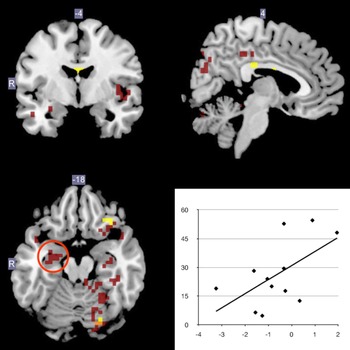
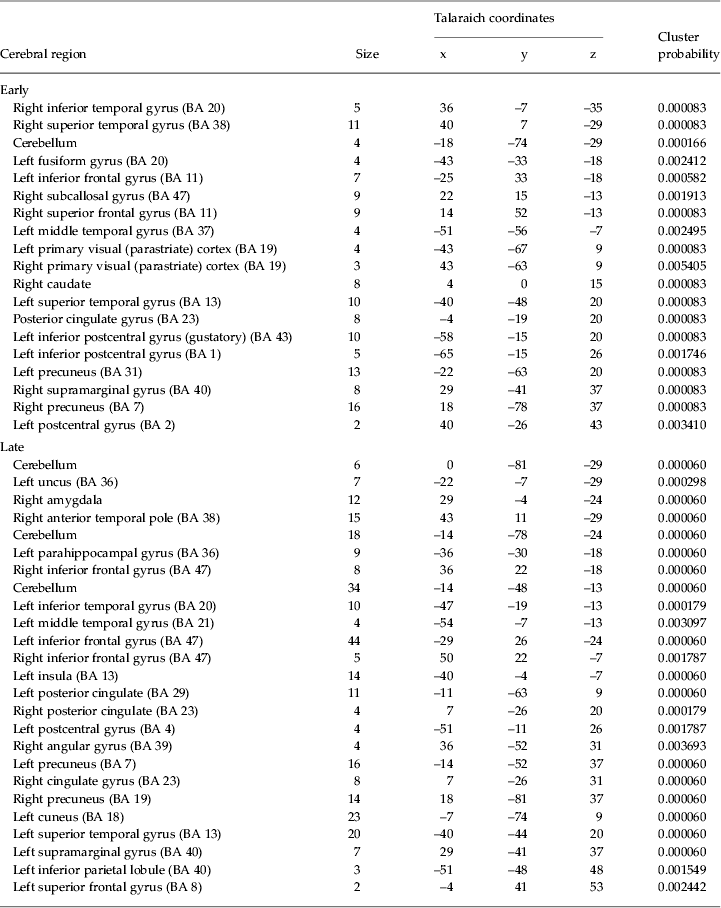
Table 2 and Fig. 1 show the brain regions with significant positive correlations with the percentage decrease in total YBOCS scores during the early phase of symptom provocation. These include the right anterior temporal lobe [inferior temporal gyrus (Brodmann area, BA 20) and middle temporal gyrus (BA 21)]; left posterior temporal lobe [fusiform gyrus (BA 20) and superior temporal gyrus (BA 22)]; ventromedial prefrontal cortex (inferior frontal gyri bilaterally, BA 11); right subcalosal gyrus (BA 47); left inferior postcentral gyrus (BA 3); parastriate cortex bilaterally (middle occipital gyri, BA19); right supramarginal gyrus (BA 40); left postcentral gyrus (BA2); left posterior cingulate (BA 31); right precuneus (BA 7); caudate nucleus (bilaterally); and left pulvinar thalamus.
Significant positive correlations between percentage improvement on the Yale–Brown Obsessive Compulsive Scale (YBOCS) and the blood oxygen level-dependent (BOLD) signal during the early (yellow) and late (red) phases of the exposure blocks, controlling for pretreatment Beck Depression Inventory (BDI) and YBOCS scores and percentage improvement in BDI score. The scatterplot in the shows the correlation between the BOLD signal in the right amygdala during the late phase of exposure and percentage improvement on the YBOCS.

Significant positive correlations between percentage improvement on the YBOCS and the BOLD signal during early and late phases, controlling for pretreatment BDI and YBOCS scores and percentage improvement in the BDI

YBOCS, Yale Brown Obsessive–Compulsive Scale; BOLD, blood oxygen level-dependent; BDI, Beck Depression Inventory; BA, Brodmann area.
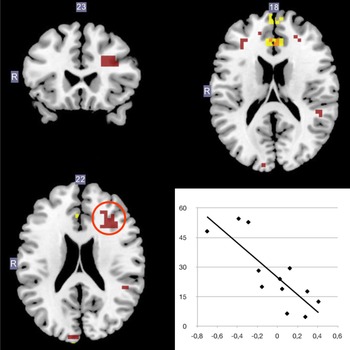
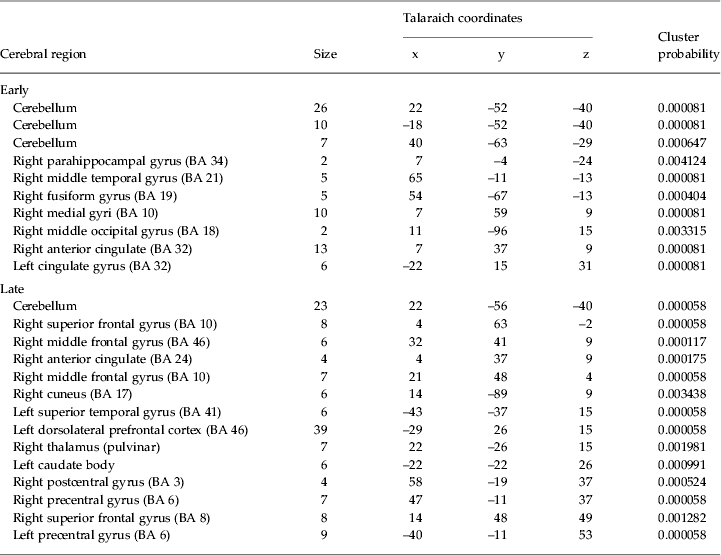
Table 3 and Fig. 2 show the brain regions with significant negative correlations with percentage decrease in total YBOCS scores during the early phase of symptom provocation. These include the anterior cingulate gyrus bilaterally (BA 32); right medial frontal gyrus (BA 10); left inferior temporal gyrus (BA 21); right fusiform gyrus (BA 19); and middle occipital gyrus (BA 18).
Significant negative correlations between percentage improvement on the Yale–Brown Obsessive Compulsive Scale (YBOCS) and the blood oxygen level-dependent (BOLD) signal during the early (yellow) and late (red) phases of the exposure blocks, controlling for pretreatment Beck Depression Inventory (BDI) and YBOCS scores and percentage improvement in the BDI score. The scatterplot shows the negative correlation between the BOLD signal in the left dorsolateral prefrontal cortex during the late phase of exposure and percentage improvement on the YBOCS.

Significant negative correlations between percentage improvement on the YBOCS and the BOLD signal during the early and late parts of the blocks, controlling for pretreatment BDI and YBOCS scores and percentage improvement in the BDI

YBOCS, Yale Brown Obsessive–Compulsive Scale; BOLD, blood oxygen level-dependent; BDI, Beck Depression Inventory; BA, Brodmann area.
Late symptom provocation phase
Table 2 and Fig. 1 show the brain regions with significant positive correlations with percentage decrease in total YBOCS scores during the late phase of symptom provocation. These include the temporal pole bilaterally [superior temporal gyrus (BA 38) and middle temporal gyrus (BA 21)]; on the left parahippocampal gyrus and uncus (BA 36) and right amygdala; in the left posterior temporal lobe [inferior (BA 20) and middle (BA 21) temporal gyri]; right inferior frontal gyrus (BA 47); posterior cingulate bilaterally (BA 30, 23); left insula (BA 13); left postcentral gyrus (BA 3); bilateral precuneus (BA 31, 19); and left cuneus (BA 18).
Negative correlations with symptom reduction in the ‘late’ phase (Table 2 and Fig. 2) were observed in the left dorsolateral prefrontal cortex (BA 46); right middle and superior frontal gyri (BA 9, 10); right anterior cingulate (BA 24); right cuneus (BA 17); left superior temporal gyrus (BA 41); right thalamus (pulvinar), left caudate; precentral gyri (BA 6) bilaterally; and right postcentral gyrus (BA 3).
Discussion
Although CBT that focuses on ERP is very effective for the treatment of OCD, a large proportion of patients remain symptomatic (Mataix-Cols et al. Reference Mataix-Cols, Marks, Greist, Kobak and Baer2002). Several studies have attempted to identify patient characteristics that may reliably predict treatment outcome in OCD. However, such efforts have generally been unsuccessful (Olatunji et al. Reference Olatunji, Davis, Powers and Smits2012). Building on existing research examining self-report and behavioral predictors, the present study examined the neural correlates of symptom improvement with CBT among patients with contamination-based OCD. Examination of treatment outcome revealed that OCD patients who underwent CBT including ERP experienced significant reductions in OC symptoms and marginally significant reductions in depression. Examination of neural correlates revealed positive associations between improvement in OCD severity and activation in areas such as the right anterior temporal cortex, the ventromedial prefrontal cortex and the posterior cingulate during the ‘early’ phase of symptom provocation with contamination threat. This pattern of findings was intensified in the ‘late’ phase of exposure to threat with strong bilateral correlations between improvement in OCD severity and activation in temporal pole regions. Significant correlations between activation in the right amygdala, left uncus and the insula during the ‘late’ phase of symptom provocation and improvement in OCD severity were also observed.
Activation of areas such as the anterior temporal pole and amygdala have been implicated in emotional encoding and processing (Sergerie et al. Reference Sergerie, Chochol and Armony2008; Visser et al. Reference Visser, Jefferies and Lambon Ralph2009). The present findings suggest that heightened encoding and processing during symptom provocation in OCD may predict greater CBT treatment effects. These findings are consistent with mechanisms that have been articulated in the context of EPT (Foa & Kozak, Reference Foa and Kozak1986). According to EPT, the effects of CBT that focuses on ERP derive from activation of a ‘fear structure’ and integration of information that is incompatible with it, resulting in a non-fear structure that replaces or competes with the original one (Foa & McNally, Reference Foa, McNally and Rapee1996). Thus the process of fear activation, which is characterized by physiological reactivity, is a vital mechanism underlying extinction learning during exposure-based treatments for anxiety disorders (Alpers & Sell, Reference Alpers and Sell2008). This view is consistent with the finding that activation in visual areas such as the precuneus and cuneus also correlated positively with treatment response in the present study. Previous research has shown that arousal modulates activity in the visual cortex (Mourão-Miranda et al. Reference Mourão-Miranda, Volchan, Moll, de Oliveira-Souza, Oliveira, Bramati, Gattass and Pessoa2003), and changes in higher-order visual areas have been found to correlate with the effects of behavioral treatment on other anxiety disorders (Doehrmann et al. Reference Doehrmann, Ghosh, Polli, Reynolds, Horn, Keshavan, Triantafyllou, Saygin, Whitfield-Gabrieli, Hofmann, Pollack and Gabrieli2013). Activation in visual areas during symptom provocation may index greater fear activation and processing, which facilitates better treatment outcomes with CBT.
The present study also found that activation in areas such as the anterior prefrontal cortex and anterior cingulate during symptom provocation with contamination images was negatively correlated with improvement in OCD severity during CBT. These findings are also in line with prior research showing that dysregulation in brain regions such as the medial prefrontal cortex and the anterior cingulate may interfere with extinction learning and its retention (Milad & Quirk, Reference Milad and Quirk2002; Phelps et al. Reference Phelps, Delgado, Nearing and LeDoux2004; Milad et al. Reference Milad, Quinn, Pitman, Orr, Fischl and Rauch2005). Activation in the prefrontal cortex and anterior cingulate may also inhibit negative emotional processing in the amygdala (Etkin et al. Reference Etkin, Egner and Kalisch2011), thus dampening subsequent treatment response. A significant negative correlation between activation in the left dorsolateral prefrontal cortex in the ‘late’, but not ‘early’, phase of symptom provocation and improvement in OCD severity was also observed. Activation in these brain regions has been implicated in the appraisal and regulation of negative emotion (Phillips et al. Reference Phillips, Ladouceur and Drevets2008) and prior research suggests that greater dorsolateral prefrontal cortex during emotional processing reflects engagement of cognitive control networks that are beneficial for emotional and cognitive functioning (Aupperle et al. Reference Aupperle, Allard, Grimes, Simmons, Flagan, Behrooznia, Cissell, Twamley, Thorp, Norman, Paulus and Stein2012). Although a replicable finding in the literature is that more prefrontal cortex activation may reduce anxiety by moderating amygdala activity (Hariri et al. Reference Hariri, Matay, Tessitore, Fera and Weinberger2003), the present findings suggest that excessive activation in frontal brain regions may reflect inflexible and maladaptive attempts at emotion regulation during symptom provocation that correspondingly make extinction learning difficult during CBT. One interpretation of such findings is that too much affect regulation may interfere with the mechanism of action of ERP by dampening physiological arousal during exposure.
Excessive cognitive control may be the psychological process that underlies activation of the anterior prefrontal cortex and anterior cingulate during symptom provocation. Such control may include avoiding or suppressing anxiety that arises from exposure to contamination cues. Prior research has shown that suppression, relative to reappraisal, produces later activation in the prefrontal cortex (Goldin et al. Reference Goldin, McRae, Ramel and Gross2008). Given that the dorsolateral prefrontal cortex has been implicated in the conscious regulation of emotion to reduce fear responses (Ochsner et al. Reference Ochsner, Bunge, Gross and Gabriele2002), sustained emotional suppression may partially account for the negative correlation between activation in the left dorsolateral prefrontal cortex in the ‘late’ phase of symptom provocation and improvement in OCD symptoms. Excessive suppression may interfere with CBT by producing a paradoxical ‘rebound’ of intrusive thoughts (Abramowitz et al. Reference Abramowitz, Tolin and Street2001).
The present study also suggests that the time course of activation in different brain regions may have some prognostic value in predicting the effects of CBT for OCD. Indeed, prior research has highlighted the value of the temporal features of brain activation in better characterizing affective disorders (Larson et al. Reference Larson, Schaefer, Siegle, Jackson, Anderle and Davidson2006; Fu et al. 2008). Prior research has also shown that patients with major depressive disorder who showed sustained amygdala reactivity to emotional words had a better response to CBT (Siegle et al. Reference Siegle, Carter and Thase2006). Such research is consistent with the view that the neural timing of brain–behavioral associations may elucidate biomarkers for various interventions (Goldin et al. Reference Goldin, Manber Ball, Werner, Heimberg and Gross2009). In line with this view, activation in the right amygdala and the left dorsolateral prefrontal cortex during the ‘late’ phase of symptom provocation was found to be highly correlated with a drop in YBOCS scores after CBT. These findings suggest that, for patients with OCD, prolonged activation of areas involved in the processing of aversive stimuli (without activation in dorsal ‘emotion regulation’ areas) prior to treatment may be a valuable biomarker for predicting responsiveness to CBT.
These findings highlight neural biomarkers that seem to be uniquely informative in determining who will benefit best from CBT as anxiety ratings of neither contamination nor neutral images predicted treatment response among patients with contamination-based OCD. However, these findings must be considered within the context of the study limitations. One important limitation is the relatively small sample size of the OCD patients and of those with predominantly contamination obsessions and washing compulsions. Replication of these findings in a larger sample is clearly needed before more definitive inferences can be made. Another limitation is the absence of a treatment control group, which makes it difficult to delineate the extent to which the therapeutic effects and their neural correlates are specific to CBT. Despite the study's limitations, these findings suggest that activation in brain areas involved in emotional processing and regulation has prognostic value in the treatment of contamination-based OCD. Prior research does suggest that different OCD symptom dimensions are mediated by distinct neural processes (Mataix-Cols et al. Reference Mataix-Cols, Wooderson, Lawrence, Brammer, Speckens and Phillips2004). Thus, it will be valuable to see if the pattern of findings observed among OCD patients with predominantly contamination obsessions and washing compulsions generalize to other OCD symptom dimensions. Future programmatic research using randomized trial designs comparing various treatment modalities for different OCD symptom dimensions can build on these findings to identify neural correlates that may help to guide treatment selection.
Acknowledgments
This work was funded by a grant from the South London and Maudsley Trust to Professor D. Mataix-Cols.
Declaration of Interest
None.