


1 Overview: the universality of CV syllabification
The question of the universality of the syllable has incited particular excitement among phonologists, at least since Jakobson's (Reference Jakobson1962) proposal of the ubiquity of CV syllabification. In a recent paper, Hyman (Reference Hyman2011a) recants an earlier view (Hyman Reference Hyman, Kaye, Koopman, Sportiche and Dugas1983) that Gokana does not have syllables, arguing instead that a restriction on the maximum prosodic stem size in verbs is best accounted for by assuming bisyllabic trochees. In a related facet of the same kind of debate, Labrune (Reference Labrune2012) claims that Japanese does not have syllables, suggesting that only moras play a role in phonotactic and metrical phenomena (however, see Kawahara Reference Kawahara2016 for a rejoinder). In the present paper, we focus on a similar question of universality, although with respect to syllabification itself, and in particular the nature of the onset as a preferred constituent, favouring CV rather than VC syllables.
The CV syllabification universal under examination favours CV by the principle of onset maximisation (Steriade Reference Steriade1982, Itô Reference Itô1986), under which coda consonants are only allowed as a last resort, when consonants cannot be incorporated as an onset to a following vowel or made into a syllabic consonant. We thus do not limit our discussion to the strict-CV phonology of Lowenstamm (Reference Lowenstamm, Durand and Laks1996), in which codas are claimed never to exist, but are interpreted as onsets followed by empty nuclei; rather, we investigate the broader claim that a VCV sequence will always be syllabified as V.CV under CV syllabification.
By contrast, a putative VC syllabification algorithm would lead to ‘coda maximisation’, whereby onset consonants are only allowed as a last resort, with VCV sequences being syllabified as VC.V. The case study which we will explore is Arrernte, a language previously studied by Breen & Pensalfini (Reference Breen and Pensalfini1999), Henderson (Reference Henderson2013) and a number of other authors, but brought into the universals debate by Evans & Levinson, who contend that, as a result of adopting Breen & Pensalfini's analysis, ‘the status of the CV assumption in any model of UG must be revised’ (Reference Evans and Levinson2009: 434). Evans & Levinson thus have in mind an analysis of the VC type, in which consonants are preferentially syllabified as codas, rather than onsets. Of particular note in this connection, however, is the fact that Breen & Pensalfini (Reference Breen and Pensalfini1999: 10) themselves state ‘if there is a viable alternative to VC(C) syllabification of Arrernte, it should be preferred’. Our goal in this paper is to provide exactly such an alternative, which is consistent with CV syllabification and, for many of the phenomena in question, more straightforward than the VC analysis.
Investigation of the nature of syllabification in Arrernte involves the consideration of processes such as stress assignment, prosodically conditioned allomorphy, ludlings and reduplication, phenomena that are often cross-linguistically weight-sensitive, as catalogued extensively in McCarthy & Prince (Reference McCarthy and Prince1986). Our argument in this paper is that these processes are also weight-sensitive in Arrernte. What makes Arrernte somewhat novel from the perspective of cross-linguistic typology is the fact that the weight-bearing unit to which such processes are sensitive – the mora – can be assigned to onset consonants, an analysis that has been proposed for a number of unrelated languages (e.g. Davis Reference Davis1988, Topintzi Reference Topintzi2010). Seen from this perspective, the patterning of weight-sensitive processes in Arrernte conforms in a principled fashion to a formal universal, once certain consonants are treated as moraic. Attention to the statement of formal universals thus provides a clear methodological guide to understanding the nature of variety in substantive properties. The universal in this case pertains to the set of data structures that learners use to encode sound patterns: the mora, and only the mora, is the formal unit that can be referred to by weight-sensitive properties.
Before we proceed to the analysis of Arrernte, some contextualisation may be helpful. The possibility of VC syllabification in Australian languages was put forward in a series of papers by Sommer (Reference Sommer1970, Reference Sommer and Goyvaerts1981) on Oykangand, and was responded to by Dixon (Reference Dixon1970), Darden (Reference Darden1971) and McCarthy & Prince (Reference McCarthy and Prince1986). Arrernte itself, analysed as part of the Aranda family (Pama-Nyungan), has received generative analyses in Davis (Reference Davis1988) and Downing (Reference Downing1998), based on the description in Strehlow (Reference Strehlow1942). There is certainly some historical precedent for VC syllabification, based on the examination of word-edges alone: Hale (Reference Hale1964) and Blevins (Reference Blevins, Simpson, Nash, Laughren, Austin and Alpher2001) consider the widespread loss of initial consonants throughout Australian languages, attributing it to a shift of stress from the initial to the second syllable. While Arrernte was apparently no exception to this sweeping change, often referred to as the great Australian C-drop, nonetheless ‘25% of Arrernte words … are pronounced in isolation with an initial consonant’ (Breen & Pensalfini Reference Breen and Pensalfini1999: 2). In fact, to account for stems such as /mpwaɻ/ ‘make’ and /taŋk/ ‘be pleased’, Breen & Pensalfini have to propose that these words have an underlying initial vowel, a red flag to any clear demonstration that the language disallows consonantal onsets.
Beyond distributional observations about widespread onsetless word-initial sequences, the specific set of arguments that Breen & Pensalfini propose in favour of VC-only syllables in Arrernte is as in (1) (as summarised in Hyman Reference Hyman2011b).
-
(1)

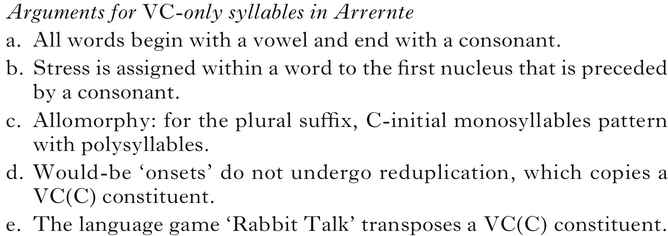
We will challenge each of these arguments throughout this paper, providing alternative analyses, evidence and argumentation. Before turning to the analyses of individual phenomena, however, we wish to stress the main claim of the present paper: Arrernte is a language with onset maximisation like any other, but prefers moraic onsets over moraic codas, from which all other irregularities follow. In fact, moraic codas seem to be banned (see the discussion in §4.1 and §4.2), and thus Arrernte may fill the gap identified by Hyman (Reference Hyman2011b: 8), who asks whether ‘there is a language which has moraic onsets and (only) non-moraic codas’. The Arrernte phenomena we discuss in the following sections, while perhaps unfamiliar in terms of their surface phonological typology, can in fact be straightforwardly understood in terms of a constellation of well-documented ingredients that have received empirical support from elsewhere, namely Prosodic Morphology (McCarthy & Prince Reference McCarthy and Prince1986), moraic onsets (Topintzi Reference Topintzi2010) and cross-anchoring (Itô et al. Reference Itô, Kitagawa and Mester1996).
2 A puzzle: allomorphy in Arrernte and the need for moraic onsets
We begin with a discussion of a seemingly puzzling set of facts within the morphophonology of Arrernte, which displays allomorphy in the plural and the dual/reciprocal suffixes that is dependent on the shape of the base, as shown in (2) (from Breen & Pensalfini Reference Breen and Pensalfini1999 and Henderson Reference Henderson2013: 211–212).
-
(2)
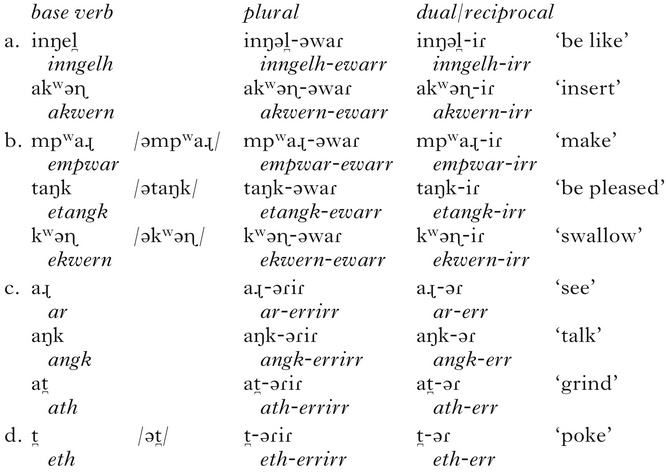
Bisyllabic bases (2a), as well as C-initial monosyllables (b), select the allomorphs [-əwaɾ] and [-iɾ], whereas V-initial monosyllables (c) and subsyllabic C stems (d) choose the allomorphs [-əɾiɾ] and [-əɾ] instead. Setting aside for the moment the case in (d), this distribution is rather surprising; one would expect that monosyllables as a whole would select one allomorph and disyllables another, instead of the situation highlighted here, where monosyllables behave differently, depending on whether they are C- or V-initial. Hyman (Reference Hyman2011b), however, analyses the allomorphy as syllable-based. Subscribing to the idea that Arrernte has VC rather than CV syllables, he unites bisyllabic (2a) with the superficially monosyllabic (b), suggesting that the forms in (b) actually begin with /ə/ (even if they are pronounced without it), thus rendering them bisyllabic too. The same reasoning applies to (d), making C-only stems monosyllabic, alongside the true monosyllables in (c). Monosyllables thus take the [-əɾiɾ] and [-əɾ] allomorphs.Footnote 1 The Arrernte data here are transcribed in IPA, accompanied by the forms in the orthographic system used in schools and by the government (see Appendix A for the correspondences between the two systems). The latter system – shown in italics – is only included the first time the data are presented; we do this for the ease of readers familiar with a range of transcription conventions. In addition, note that all Arrernte words are spelled with a final -e, which we omit, since its presence is predictable at the phrase level, as explained later in this section.Footnote 2
But what if the bases in (2b, d) do not have the initial schwa? Then the generalisation that bisyllabic bases take one type of allomorph and monosyllables the other can no longer be upheld, since the bases in (b) should now falsely pattern like the monosyllables of (c) and not the bisyllables of (a). An account that insists on VC syllabification throughout could then take one of two reasonable options: at best, it could employ an ad hoc mechanism that only admits onsets in truly C-initial words; at worst, it would apply no modification, and simply accept failure to analyse these examples altogether. Either way, this approach provides no explanation for this pattern of allomorphy.
We propose instead that a uniform analysis of the allomorphy data dependent on the shape of the base is possible, but relies on mora-counting rather than syllable-counting. A key component to our proposal is the admission of moraic onsets (Topintzi Reference Topintzi2010). We review the empirical evidence in favour of this position in §3 below. For the time being, it suffices to mention that we apply standard syllabification to Arrernte words, and assign a mora to each syllable onset. The assumed moraicity of the bases is shown in (3).
-
(3)
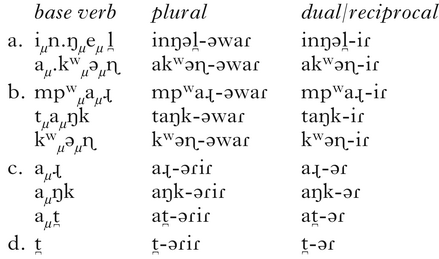
All that need be said for this allomorphy is that bases of maximally one mora (3c, d) take the alternants [-əɾiɾ]/[-əɾ]. Longer bases (3a, b) take [-əwaɾ]/[-iɾ].Footnote 3 Crucial to this generalisation is the claim that onsets are moraic. Their status as moras is exactly what allows the C-initial monosyllables in (b) to pattern differently from the V-initial monosyllables in (c). Notice that the form of the allomorphs themselves does not reflect a particular connection to the shape of their host, a pattern that is not unique to Arrernte; for example, in Axininca Campa, the genitive suffix is [-ni] after bimoraic stems and [-ti] after longer stems (Bye Reference Bye, Blaho, Bye and Krämer2007). While many cases of allomorphy are phonologically optimising (see Nevins Reference Nevins, van Oostendorp, Ewen, Hume and Rice2011 for an overview), there is no necessarily optimising connection between the form of each allomorph and its environment, even though the latter can crucially rely on factors such as mora count. Importantly, the present mora-counting approach has advantages over Hyman's (Reference Hyman2011b) account. For the latter to work, it is critical that the bases in (3b) include an initial /ə/. Without it, and under the non-moraic-onset hypothesis that Hyman endorses, it seems impossible to group (3a, b) together vs. (3c, d), as required by the facts.
In sum, if initial schwas are present in the structure, then either a mora-counting or a syllable-counting approach works, without the need for contentious VC syllables. If there are no initial schwas, then only a mora-counting account with moraic onsets proves workable. However, recall that the adoption of initial schwas is anything but uncontroversial. Wilkins' (Reference Wilkins1989) grammar of Arrernte explicitly adopts the hypothesis that surface C-initial words in Arrernte are indeed C-initial, without a preceding underlying vowel. Evans (Reference Evans and Goldsmith1995) and Tabain (Reference Tabain2009) observe the fleeting nature of schwa, as indicated by the variability of schwa epenthesis. Evans comments that ‘[the word for] ‘sits’, for example, can be pronounced [anǝ́mə] (three syllables), [nǝ́mə] (two), [anǝ́m] (two), or [nəm] (one). Yet the number of underlying VC syllables stays constant at two’ (1995: 745). Presumably Evans is referring to different intonational and contextual environments, and his initial [a] is a variant of epenthetic schwa. Commenting directly on the same example, Henderson (Reference Henderson2013: 269) asserts ‘the variation in the number of surface syllables is directly due to the treatment of word-initial and phrase-final [ə] at the phrase level’. Initial schwas – and also final ones – should be taken to be the result of a late, variable, intonational phrase-conditioned process.Footnote 4 On these final schwas, specifically, Tabain & Breen (Reference Tabain and Breen2011:70) observe that ‘the presence or absence of the final vowel is completely non-contrastive, and its presence is assumed to provide additional phonetic cues to consonant identity’. The same variability is found in Kaytetye, a related language. Panther et al. (Reference Panther, Harvey, Demuth, Turpin, San, Proctor and Koch2017) report that the final schwa may be phonetically present, absent or devoiced, a fact that they take as evidence for CV syllabification.
The status of initial (and final) schwas becomes more complex when we consider additional evidence, which is not present in the central arguments in Breen & Pensalfini (Reference Breen and Pensalfini1999), but brought to bear on this question from ‘external evidence’ presented in Kiparsky (Reference Kiparsky2013). The first is from loanwords; borrowings from English such as paddock into Arrernte as parrike suggest that initial schwas are not necessarily required, again casting doubt on the view that all apparent C-initial words have an initial underlying schwa; instead, these forms seem to be compatible with a CV analysis. At the right edge of the word, there is also evidence for a CV analysis as well: in connected phrasal speech, epenthesis is frequent in phrase-final position, although less so after nasal consonants (Tabain & Breen Reference Tabain and Breen2011, Rob Pensalfini personal communication).
Some of the most revealing external evidence for truly CV-initial bias in Arrernte comes from musicological evidence. In her work on song traditions in Alyawarr (a closely related language), Turpin (Reference Turpin2015) documents the text-setting rule of taking a line-final consonant and moving it to the beginning of a vowel-initial word. This kind of ‘consonant transfer’ (Hale Reference Hale, Kassler and Stubington1984) is widespread in Arandic songs as a way of providing an onset consonant from adjacent or line-final words in order to syllabify onsetless words as CV. As Turpin (Reference Turpin2015: 73) puts it, such a process serves to create ‘a full consonant + vowel syllable on the first (strong) beat of a bar’. In other words, a CV syllable in Arandic aligns with a strong beat, precisely because, we will argue, CV syllables are heavy, given moraic onsets. These phenomena not only point to the fact that initial schwas may not be required in all surface forms (and in fact, go a long way to support the hypothesis that CV syllabification, or a word-initial onset constraint, manifests an emergence of the unmarked effect; McCarthy & Prince Reference McCarthy and Prince1994), but also that our CV-based analyses above can be maintained without invoking hidden leading schwas for every C-initial word.
For these reasons, in the remainder of the paper we propose that schwas at edges, especially initial schwas, are postlexically epenthetic and not phonologically active for the processes in question. On this view, initial schwa, optionally added at the left edge in Arrernte, is no different from the stylistic prepausal final schwa optionally added at the right edge in ‘young’ Parisian French forms such as bonjour[ə] ‘hallo’ (Hansen Reference Hansen and Perrot1997), for which there is no underlying or etymological source (indeed mer ‘sea’ and mère ‘mother’ can both optionally be pronounced [mεʁə]. The initial schwa found in Arrernte may be comparable to paragogic vowels found in prepausal position in Sardinian (Pittau Reference Pittau1991, Bob Ladd personal communication), or more generally, to the non-phonological vocalic elements investigated in Ridouane & Fougeron's (Reference Ridouane and Fougeron2011) study of Berber; indeed, the rich work emerging from such studies may be applicable to future phonetic studies of Arrernte's fleeting schwas, a point to which we return in the conclusion.
Given the evidence surveyed above, however, we reject the analysis of all surface C-initial words as beginning with a hidden underlying schwa, and in what follows, reference to hidden schwas is made only for comparison between our pro-CV analysis and the Breen & Pensalfini pro-VC account, or to highlight any possible effects their presence would have. We maintain that our analysis fares better than its contenders, as these founder as soon as initial schwas are no longer underlying, as in the case of allomorphy just described. Elsewhere, the CV and moraic onset analysis remains equally successful.
3 Moraic onsets in stress, compensatory lengthening and word-minimality
In a large-scale study, Topintzi (Reference Topintzi2010) gathered evidence from stress, compensatory lengthening, reduplication and gemination from a wide range of languages that supports the possibility of moraic onsets. The existence of metrical processes displaying sensitivity to onset consonants has been a topic of research for many years; see, for example, Everett & Everett (Reference Everett and Everett1984), Davis (Reference Davis1988), Downing (Reference Downing1998), Goedemans (Reference Goedemans1998) and Gordon (Reference Gordon2005), who discuss onset-sensitivity of stress in languages ranging from English and Italian to Pirahã and Iowa-Oto. Bagemihl (Reference Bagemihl, Czaykowska-Higgins and Kinkade1998) also proposes mora-bearing obstruents (as opposed to sonorants) for word-minimality effects in Bella Coola, as discussed further below.
An initial example comes from Pattani Malay (Yupho Reference Yupho1989, Abramson Reference Abramson, Ohala, Hasegawa, Ohala, Granville and Bailey1999, Reference Abramson, Solé, Recasens and Romero2003, Hajek & Goedemans Reference Hajek and Goedemans2003, Topintzi Reference Topintzi2008), which distinguishes between initial singleton and geminate consonants. Geminates are usually the result of initial syllable or morpheme reduction, as in (4), from Yupho (Reference Yupho1989: 130).
-
(4)
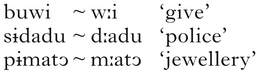
In the examples in (4), the initial syllable deletes, generating a form in which the original onset of the second syllable geminates. In the standard account, which views compensatory lengthening as mora preservation (cf. Hayes Reference Hayes1989 and much work since), this geminate is thus rendered moraic through compensatory lengthening, as a means to preserve the single mora of the originally initial syllable. As a result, the language contrasts forms with initial singletons and geminates, as in (5) (examples from Abramson Reference Abramson, Ohala, Hasegawa, Ohala, Granville and Bailey1999, Reference Abramson, Solé, Recasens and Romero2003, who provides extensive phonetic description of the acoustic cues employed to achieve this contrast).
-
(5)
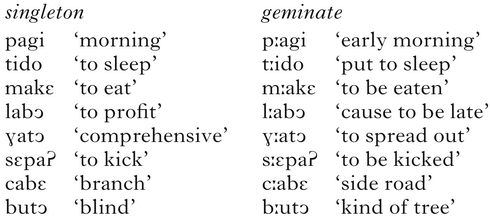
In addition to compensatory lengthening, the stress pattern of Pattani Malay corroborates the moraicity of the initial geminate. In words lacking geminates, primary stress is word-final, with all remaining syllables receiving secondary stress, as in (6a), unless the syllable contains the schwa-like vowel [ɨ], in which case it remains stressless, as in (b). However, words starting with a geminate have primary stress initially, with secondary stress later in the word, as in (c), even if the geminate is followed by the weak [ɨ] (d) (all data from Yupho Reference Yupho1989: 133–135). Assuming that Pattani stress is regulated by quality and quantity considerations, i.e. avoidance of stress on low-sonority [ɨ], and stress on heavy (i.e. geminate-containing) syllables respectively, with the latter condition presiding over the former, then assignment of primary stress on the first (heavy) syllable rather than the default final is easily captured.
-
(6)

Initial geminates in Pattani Malay, then, are represented as moraic onsets, as in (7).
-
(7)
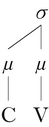
Topintzi (Reference Topintzi2010) also utilises this representation for certain onsets in other languages, including Marshallese, Trukese, Pirahã, Karo and Bella Coola. We propose that onsets in Arrernte are likewise moraic, and thereby contribute directly to stress assignment and allomorph selection, as well as indirectly participating in a variety of other prosodic morphology processes.
While Pattani Malay shows that moraic onsets can arise in the case of geminates, this is not the only environment in which onsets contribute to weight. Moraic onsets can also be found depending on the sonority properties of the consonants involved. Consider the stress pattern of Pirahã, as analysed in Topintzi (Reference Topintzi2010: 76), where voiceless obstruents pattern differently from all voiced consonants, as in the weight scale in (8) (P=voiceless obstruent; B=voiced obstruent or sonorant).
-
(8)

Pirahã has both tone and stress, as shown by the examples in (9) (from Everett Reference Everett1988: 239, Everett & Everett Reference Everett and Everett1984: 708–710 and Dan Everett personal communication.)
-
(9)

The generalisation about weight assignment and therefore stress placement is that it depends on three factors: long vs. short vowels (VV vs. V), presence vs. absence of onsets (CV vs. V) and the quality of onsets (PV vs. BV). Note that there are no codas which could potentially contribute to syllable weight. As is evident from the above, only voiceless obstruents in Pirahã constitute moraic onsets. As a result, this is a case in which only a subset of onsets contribute to syllable weight.
In Arabela, as analysed in Topintzi (Reference Topintzi2010: 85), obstruents are moraic, regardless of voicing.Footnote 5 Stress is rhythmic, and normally creates trochees from left to right, with the rightmost stress being primary, as illustrated in (10) (from Payne & Rich Reference Payne and Rich1988). Degenerate monosyllabic feet are also allowed. However, Payne & Rich state that ‘if a word-final syllable that would have received stress has a voiced [ = sonorant] onset, and the immediately preceding syllable has a voiceless onset, then the syllable with the voiceless onset is stressed’. Topintzi (Reference Topintzi2010) argues that this stress shift of primary stress is due to the moraicity of the voiceless onset in the penult.
-
(10)
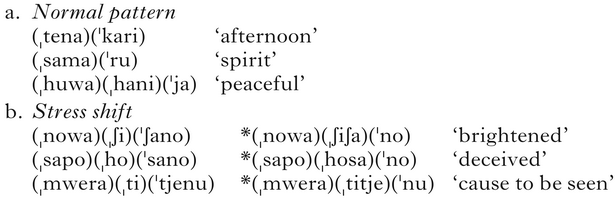
Arabela has codas, but they are irrelevant for weight and stress purposes, e.g. (ˌmoko∫)(ˈtjaka) ‘palm fruit’ instead of *(ˌmo)(ˌko∫)(‘tjaka), indicating that codas are not moraic. A similar, though more complex, pattern is found in Umutina (Wetzels et al. Reference Wetzels, Telles and Hermans2014), where, if the last syllable contains a plosive onset it is stressed, and otherwise vowel sonority decides between the last two syllables. Summarising, we have thus far seen moraic onsets contributing to syllable weight if they are geminate (Pattani Malay), voiceless (Pirahã) or obstruent (Arabela).Footnote 6 Finally, as argued by Davis (Reference Davis1988), English secondary stress can be sensitive to the presence of obstruent onsets. Consider the -ative suffix in American English. In (11a), the two bases have an identical stress pattern, but their derived forms differ in secondary stress. Only the forms with an obstruent onset attract secondary stress ((11b) vs. (11c)).
-
(11)

The contribution of onsets to syllable weight is not restricted to the domain of stress assignment, however. Onsets not only undergo compensatory lengthening, but can also cause it. Deletion of /r/ word-initially as well as in complex onset clusters produces lengthening of the following vowel in Samothraki Greek, as discussed in Topintzi (Reference Topintzi2010: 102–103) (data from Katsanis Reference Katsanis1996: 50–51, 54–56).
-
(12)
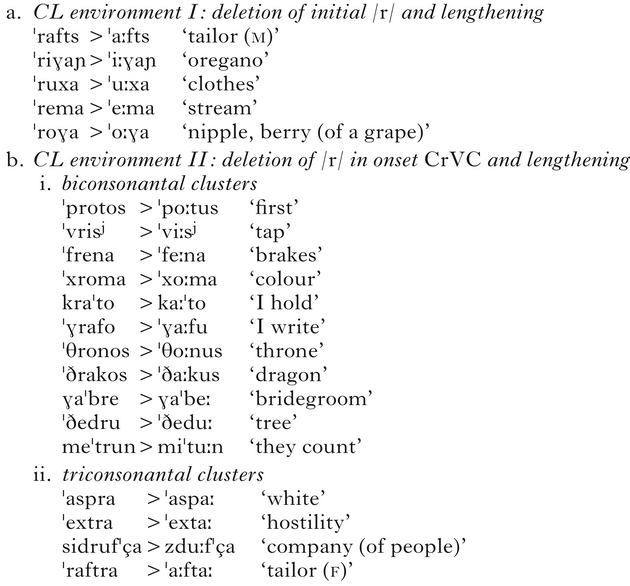
Potentially similar cases, usually involving specific morphemes, are reported in Topintzi (Reference Topintzi2010: 205–206). These patterns demonstrate that when an onset /r/ is lost, its associated mora is preserved, and is transferred to the vowel nucleus. Onsets can therefore be moraic, paralleling the original arguments for the moraicity of codas (Hayes Reference Hayes1989). Conversely, onset lengthening as a response to CL occurs in Pattani Malay (as discussed above), as well as in Trique and Trukese.
We have reviewed the evidence for moraic onsets in terms of their contribution to stress assignment and compensatory lengthening. In Bella Coola (Bagemihl Reference Bagemihl, Czaykowska-Higgins and Kinkade1998), a bimoraic word minimum allows CV words, but not C-only or V-only words (Topintzi Reference Topintzi2010: 146), as in (13).
-
(13)
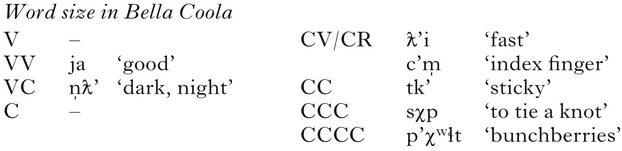
Further discussion of the range of moraic onsets can be found in Kpelle, which treats certain moraic onsets as tone-bearing units. Topintzi (Reference Topintzi2010: 207) attributes this to the moraicity of these onsets.
Recall now the central puzzle with which we started in Arrernte, in the light of moraic onsets. One of Breen & Pensalfini's most straightforward arguments about the nature of Arrernte syllabification comes from the process of stress assignment. Stress appears on the first nucleus in the word after a consonant, as in (14) (syllabification after Breen & Pensalfini Reference Breen and Pensalfini1999: 3).
-
(14)

On the other hand, syllabification of a VCV sequence as either V.CV or VC.V is not directly accessible from the phonetic signal, and so establishing which syllabification pattern a particular utterance contains depends on particular phonological processes that refer to syllables. The behaviour of different syllable types relies on their internal weight structure. As we develop an analysis of weight-sensitive stress in Arrernte in this paper, we assume (15) as a formal universal that regulates such patterns.
-
(15)

This phonological universal, developed by Hyman (Reference Hyman1985), McCarthy & Prince (1986) and Hayes (Reference Hayes1989), is formal, not substantive in nature: it delimits the nature of data structures that can be referred to by morphophonological processes. It is neutral on the substantive question of which segments can bear moras, and does not constitute the only potential formal property to which these processes may refer; cf. sonority-driven stress, tone-stress interactions and so forth.Footnote 8
Of particular interest is the typology of mora-bearing consonants and the nature of the relationship between onset moraicity and coda moraicity. In languages such as Pirahã, voiceless onsets are argued to be moraic, while there are no coda consonants at all (and thus moraic codas are not a prerequisite for moraic onsets). Languages such as Pattani Malay have moraic onset geminates, but others, e.g. Arabela, have moraic onsets but not geminates – the kind of contrast also found in the coda position, where some languages have moraic codas that are singletons, and others have word-final geminates. Turning to the properties of the consonants themselves, in languages with moraic codas, either all consonants are moraic, or there is a difference between sonorant consonants (moraic) and obstruents (non-moraic) (Zec Reference Zec1995). Conversely, in the languages under discussion here, either all onset consonants are moraic (as argued for Arrernte and Pattani Malay), or only a subset is moraic – typically voiceless obstruents or obstruents in general (as found in English, Arabela and Pirahã). In short, whether or not onsets are moraic (and which onsets are) in a given language involves largely the same variables as those determining coda moraicity.
4 Moraic onsets in Arrernte
In this section, we apply the moraic onset analysis to Arrernte. In §4.1, we demonstrate that stress assignment is straightforward if all word-initial onsets are moraic: stress falls on the leftmost heavy syllable. In §4.2, we investigate the transpositional language game Rabbit Talk, demonstrating that the pattern of what is transposed also depends on the assumption of moraic onsets. Finally, in §4.3, we examine reduplication patterns in Arrernte, and propose that the selection of reduplicant material indirectly refers to mora preservation of the segments involved.
4.1 Stress
To begin, consider the stress data in (16), collected from a range of sources (Wilkins Reference Wilkins1989: 87, Breen & Pensalfini Reference Breen and Pensalfini1999: 3, Henderson Reference Henderson2013: 219, Turpin et al.: Reference Turpin, Demuth, Campbell, Pensalfini, Turpin and Guillemin2014: 57, 60). Descriptively speaking, the C-initial words in (a) have initial stress and the V-initial ones in (b) have peninitial stress.
-
(16)
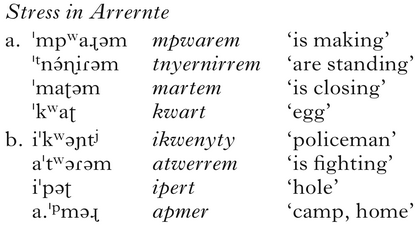
A variety of proposals have been offered for Arrernte stress assignment, including initial-segment extrametricality (Halle & Vergnaud Reference Halle and Vergnaud1987) and stress avoidance on vowel-initial words, as such vowels are considered to be outside the prosodic word (Downing Reference Downing1998); this is also the account adopted in Kiparsky (Reference Kiparsky2013). Conversely, other accounts assume that the foot-edge or the stressed syllable must be aligned with an onset (variants of this approach appear in Goedemans Reference Goedemans1998, Smith Reference Smith2005, Hyde Reference Hyde2007 and Topintzi Reference Topintzi2010) or acknowledge the possibility that onsets pose their own requirements in stress-placement rules (Davis Reference Davis1988, in a grid-based framework). While all these proposals satisfactorily account for Arrernte stress, they fail to straightforwardly extend to other phenomena such as allomorphy, where, as exemplified in §2, the use of moraic onsets has proved indispensable in the absence of initial hidden schwas.
We argue that the moraic onset analysis unifies allomorphy with stress and other phenomena from unrelated domains of the grammar, to be shown below. What is more, it moves towards a demonstration that there are no longer any compelling data in favour of a VC.V analysis of Arrernte.
If vowels and onset consonants, but not coda consonants, are moraic in Arrernte (see also §4.2), the statement of stress assignment becomes quite straightforward if we assume moraic onsets (as shown in (7)): the leftmost bimoraic syllable receives stress (Davis Reference Davis1988). In practice, this amounts to the first syllable in the word, if it has an onset (17a), or the second syllable, if the first one is a light onsetless syllable (17b) (the first heavy syllable is underlined).
-
(17)
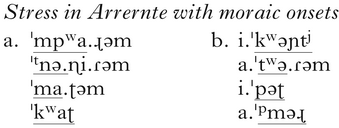
The technical implementation of this pattern can be straightforwardly stated in a model like that of Topintzi (Reference Topintzi2010). Arrernte onsets are rendered moraic on the surface through the ranking Weight-by-Position Ons ⪢ *μ/Ons. In such a model, Weight-by-Position is a generic constraint that assigns weight to consonants, with Weight-by-Position Ons being a specific version that assigns weight to onsets (and Weight-by-Position Coda to codas), while *μ/Ons prohibits onsets from acquiring moras.
Given moraic onsets and the Weight-to-Stress Principle (WSP), which requires that heavy syllables receive stress (Prince Reference Prince1990), the Arrernte stress pattern can be captured as shown in the two tableaux in (18); (18a) displays the evaluation for light-initial words and (18b) that for heavy-initial words. Only candidates that fulfil the moraicity requirements are considered here, and the WSP is categorically evaluated, so that the lack of stress on a trimoraic syllable like [ɾμəμmμ] (not shown here) and on a bimoraic one such as [tw μəμ] are assessed as equivalent.
-
(18)
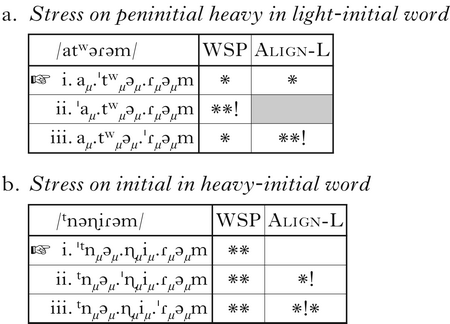
Recall that Breen & Pensalfini instead assume that the words of type (17a) begin with an initial schwa and thus pattern with the truly V-initial ones of (17b), as shown in (19a) and (b) respectively. Stress is then assigned within a word to the first nucleus that is preceded by a consonant (Breen & Pensalfini Reference Breen and Pensalfini1999: 3), or as Evans (Reference Evans and Goldsmith1995) puts it: ‘for words of two or more VC-syllables, stress falls on the second VC syllable’. In our account, no statement of this sort is required. Even if initial schwas were present, our moraic onset account would still predict stress on the first heavy syllable from the left, which would always happen to be the second in the word. (19) illustrates this possibility.
-
(19)
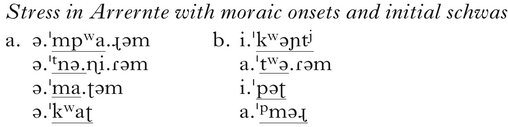
In summary, stress assignment in Arrernte is straightforward, if we assume moraic onsets which contribute to syllable weight and independently play a role in conditioning prosodically determined suffix allomorphy. We now turn to a more intricate data set, involving a transpositional language game.
4.2 Rabbit Talk data and cross-anchoring
Rabbit Talk ‘is a language game that involves transposing the initial portion of a word to the end of the word, not unlike the Pig Latin of English’ (Breen & Pensalfini Reference Breen and Pensalfini1999: 7). The basic pattern can be stated informally as (20).Footnote 9
-
(20)

Transposition affects forms such as those in (21a–c) (after Breen & Pensalfini Reference Breen and Pensalfini1999: 7–8, adapted so that there are no initial schwas (see Appendix B for the original data).
-
(21)
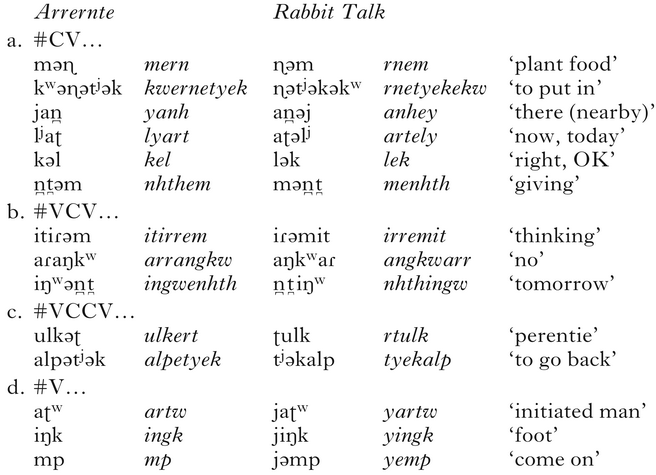
The difference between patterns (a)–(c) has to do with the exact location of the first onset. In (a), it is word-initial and in (b) postvocalic, whereas in (c) it is postconsonantal. The net effect is a difference in the amount of the transposed material, as explained below. Finally, when the base word is onsetless and monosyllabic, as in (d), a different strategy is preferred. Instead of transposition, an epenthetic [j] is added word-initially. This pattern is discussed after the transposed cases have been examined in detail.
Crucially, and rather uncontroversially (see e.g. Itô et al. Reference Itô, Kitagawa and Mester1996, Vogt Reference Vogt2009, Borowsky Reference Borowsky, Baker, Mushin, Harvey and Gardner2010), the transpositional game applies to fully fledged surface words, to which moraification and syllabification have already applied. Onset moraicity is critical in determining how much material will be transposed. This can be expressed by means of the alignment constraint specific to the transposition game in (22).
-
(22)

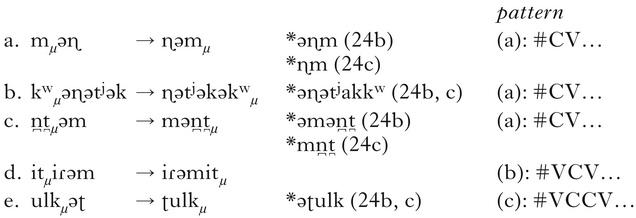
Some schematic transpositions are shown in (23), where only the moraicity of the first onset is shown.
-
(23)
The systematic lack of initial schwas is captured through the constraint ranking in (24b), where we include the surface constraint *[ə, which is consistent with the explicit statement in Tabain et al. (Reference Tabain, Breen and Butcher2004: 178) that ‘the consonant of an utterance-initial /əC/ syllable becomes [an] onset … to the following syllable due to deletion of initial-schwa’. This is of course a word-level constraint, and we make no commitment here to its ranking at the phrase-level phonology, which, as we have noted above, Henderson (Reference Henderson2013: 269) argues to be the locus of variation for the appearance of initial schwa. Similarly, Pensalfini (Reference Pensalfini1998) develops a different word-level and phrase-level analysis for Arrernte, whose rankings differ precisely in their treatment of initial and final schwa.Footnote 10
-
(24)
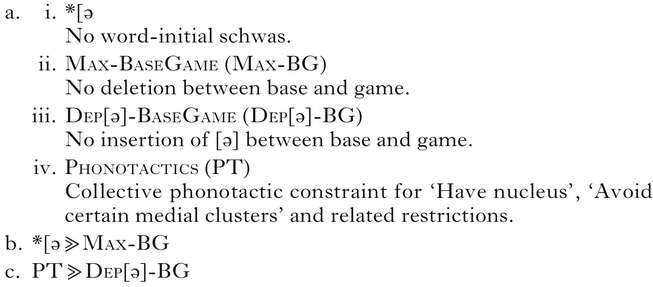
The ranking in (24c) is intended to express the fact that a schwa will nonetheless occasionally be inserted word-medially, for example to avoid the lack of a nucleus. We also assume that there are specific phonotactic considerations that regulate which clusters are acceptable and which are not. For example, [lk] in [ʈulk] is fine, and does not induce [ə]-insertion. Since our focus is not on an exhaustive set of constraints governing allowable clusters, we refer to these conditions collectively as Phonotactics (PT) in (24b), a set of constraints demanding schwa insertion within clusters, as in (23a–c).
In (23a), a shift of [m] would create *[əɳm], a form avoided since it contains an initial schwa (cf. (24a)). [ɳm] is impossible, as it lacks a nucleus, and thus a medial schwa is inserted. Similarly, a shift of the onset in (23b) produces a sequence [kkw], which violates Phonotactics, so a schwa must be inserted to provide a nucleus. As usual, the initial schwa is also deleted. (23c) works in roughly the same way; however, [n̪t̪] is treated as a complex consonant under the onset node. The form *[əmən̪t̪] cannot survive, due to (24a), leaving [mən̪t̪], again resulting in insertion of a medial schwa. (23d, e) demonstrate that longer material than a single onset is transposed in V-initial polysyllables. In particular, a VC sequence is transposed in (d), and a VCC sequence in (e). Data such as these lead Breen & Pensalfini to propose the literal transposition of the first VC(C) syllable of the word at its end. We argue instead that this is merely a superficial side-effect of the moraic onset transposition.
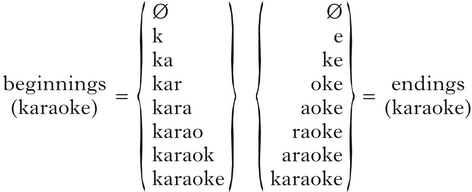
We proceed to formally expressing the mechanism of the transposition itself; effectively, as we have seen, in Rabbit Talk, strings at the left edge of the base word are transposed to the right. To capture this effect, we propose to employ the Cross-Anchor constraint that Itô et al. (Reference Itô, Kitagawa and Mester1996) introduce for a Japanese argot game.Footnote 11 The important intuition this captures is that ‘reversal does not affect single edge segments, but rather edge strings’ and this requires a modification of correspondence ‘from the level of elements to the level of strings, such that a string x can have a string y as its (string-) correspondent’ (Itô et al. Reference Itô, Kitagawa and Mester1996: 247). Let a string x begin/end a string S, iff x is an initial/final substring of S. Consequently, ‘the beginnings of S are the set of strings that begin S and the endings of S are the set of strings that end S’ (1996: 250). By means of illustration, (25) (Itô et al. Reference Itô, Kitagawa and Mester1996: 250) presents the various substrings that can serve as beginnings or endings for the word karaoke. In the argot game, karaoke surfaces as okekara.
-
(25)
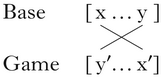
What reversal establishes is that some string x ∈ beginnings of the Base corresponds to some string x′ ∈ endings of the game, and conversely, some string y ∈ endings of the Base corresponds to some string y′ ∈ beginnings of the game, as schematised in (26) (from Itô et al. Reference Itô, Kitagawa and Mester1996).
-
(26)
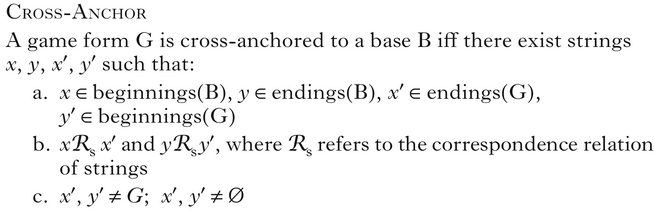
Formally, this requirement is implemented through the Cross-Anchor constraint in (27) (Itô et al. Reference Itô, Kitagawa and Mester1996: 251).
-
(27)
With this background, we return to the Arrernte data. The basic pattern, (21a), involves the interplay between Cross-Anchor and the alignment constraint in (22), which is specific to the game. Finally, a Base–Game (BG) version of the anti-metathesis Linearity constraint ensures that no excessive material will be transposed.
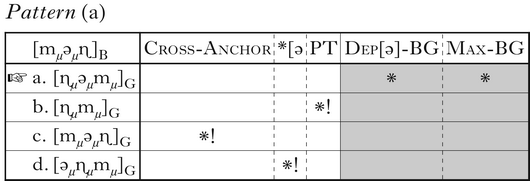
In the following tableaux the input is taken to be the base form upon which Rabbit Talk is formed. As shown in the inputs to the tableaux, the Base, indicated by subscript B, is already syllabified and moraified, along the lines sketched in §4.1. The Rabbit Talk candidate output forms are indicated by subscript G. We first consider pattern (b) in (21), as this requires the bare minimum of the constraints introduced. Pattern (b) transposes what looks like a VC sequence.
-
(28)
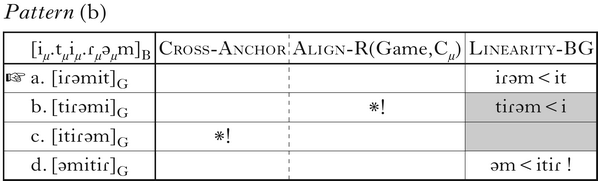
Candidate (28c) is ruled out, as it fails to satisfy Cross-Anchor, unlike the winner, (a), where the correspondence between [itiɾəm]B and [iɾəmit]G satisfies Cross-Anchor. But the remaining pairs are also compatible with it, e.g. [itiɾəm]B – [tiɾəmi]G and [itiɾəm]B – [əmitiɾ]G. However, (28b) can be excluded on the grounds that no Rabbit Talk output forms are ever V-final, under the assumption that they are regulated by high-ranking Align-R(Game, Cμ). The second possibility, (28d), incurs unnecessary violations of the Linearity constraint in (29).
-
(29)

Linearity is not computed over strings, but rather over segments, as traditionally implemented. In particular, it counts how many segments have been misplaced or metathesised from their original position (reading from left to right). In (28a) two segments have shifted position, and in (28d) four.
Pattern (a) exemplifies the effect of the rankings in (24, c), with deletion of an initial schwa and addition of an epenthetic schwa respectively. The latter is warranted by the requirement to provide syllable nuclei (30) or to break up unacceptable clusters, as in (21c, d). Align-R(Game, Cμ) is omitted in (30).
-
(30)
Consideration of pattern (c) highlights the importance of employing moraic onsets. All the candidates below satisfy Cross-Anchor, which is henceforth omitted. The Base [alpətjək]B, for example, corresponds to the actual Rabbit Talk winner [tjəkalp]G in (32b), instead of the possible [alpətjək]B – [pətjəkal]G pairing in (d). The latter form transposes less material, and consequently should be preferred, because it would incur fewer violations of Linearity-BG. It is crucial that the Rabbit Talk alignment constraint requires that the forms end in a moraic consonant, rather than simply a consonant. Alternatively, consider a Rabbit Talk form, virtually identical to (32d), but with insertion of a mora on the final C (cf. (c)). This is ruled out by another constraint, Dep(Cμ)-BG in (31), which bans insertion of consonantal moras on the Rabbit Talk form that were not present in the first place in the Base.
-
(31)

In fact, all Rabbit Talk forms violate this constraint once, since the Base [k] acquires an onset in the Rabbit Talk form by virtue of being an onset. However, (32c) additionally assigns a mora on the final [l] in the Rabbit Talk form. Finally, candidate (a) loses early on, due to violation of dominant *[ə; conversely, (e) escapes violation of the high-ranking constraints, but eventually fails, as Linearity-BG penalises it more severely, due to superfluous transposition.
-
(32)
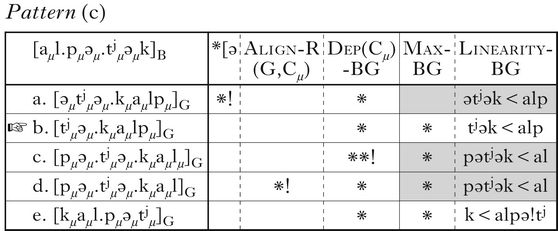
Pattern (c) thus transposes what looks like a VCC sequence. Such a string is not a syllabic constituent, but rather the emergent result of high-ranking constraints. It should be noted that this analysis rests on the assumption that medial codas in Arrernte are not moraic, but onsets are. Had medial codas been moraic, then we would predict a Rabbit Talk pairing [aμlμ.pμəμ.tj μəμk]B – [pμəμ.tj μəμ.kμaμlμ]G, which would fare better than the actual winner, (32b), by virtue of better constraint satisfaction overall. On the other hand, it should be pointed out that the analysis as shown in (32) works equally well whether or not the final codas are moraic, which would mean that Arrernte either has a version of high-ranking Weight-by-Position Coda relativised to final codas that only admits final moraic codas or ranks Weight-by-Position Coda low overall. To maintain the most straightforward analysis, we consider all Arrernte codas to be non-moraic.
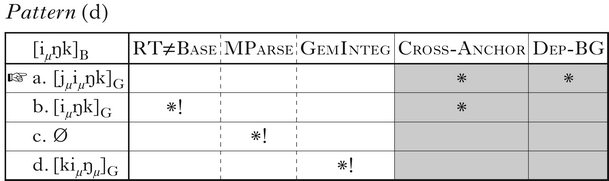
We can now turn to pattern (21d), which affects onsetless monosyllables and involves no transposition. Due to the absence of an onset, Rabbit Talk cannot actively enforce any change in the form. Assuming further that the output of the Rabbit Talk formation cannot be the null parse (a ban formalised here in terms of MParse), we include a high-ranking constraint RT≠Base, which requires that the exponent of Rabbit Talk is non-identical to the base form it is associated with. This makes intuitive sense, since the output of the language game, essentially a disguise form, has to be somehow different from the word it derives from. A solution of last resort, then, is the addition of [j-].
The reasoning behind the lack of transposition is particularly evident in examples such as [aʈw] → [jaʈw] instead of *[ʈwa] in (21d). The Rabbit Talk alignment constraint would promote the candidate [aʈw], but that would violate Cross-Anchor as well as RT≠Base (and Dep(Cμ)-BG if final codas are non-moraic, as assumed throughout). Epenthesis is thus favoured. However, the lack of transposition is harder to see in other cases, especially if final codas are after all moraic. Consider for instance the mapping [iŋk] → [jiŋk] in (21d). What prevents the Rabbit Talk form *[kiŋ] from arising? We claim that this crucially relates to the nature of the clusters involved. We take homorganic [ŋk] and [mp] to behave as (partial) geminates, which are hence resistant to splitting, as reflected by GeminateIntegrity.Footnote 12 In turn, this suggests that onsetless monosyllabic words containing other final clusters might work differently. A form that would be interesting to test is the word [alp] ‘return (imp)’ (Henderson Reference Henderson2013: 48). While this appears later in Henderson's discussion of Rabbit Talk (2013: 267), in that instance it emerges suffixed, and thus no longer provides evidence to answer this empirical question. Other monosyllabic examples with non-homorganic clusters would further refine this aspect of the analysis. The situation just outlined is exemplified in the tableau in (33).
-
(33)
Notably, the replacement of transposition by glide epenthesis when the former is not possible meshes well with typological preferences. Glide insertion is very common cross-linguistically, although rare word-initially, where [ʔ]-insertion is preferred (Uffmann Reference Uffmann2007). Still, the choice of [j] is justified; Arrernte lacks [ʔ] (Breen & Pensalfini Reference Breen and Pensalfini1999: 20). Uffmann (Reference Uffmann2007: 458) suggests that ‘glides are inserted to minimise the contrast to the following or preceding vowel’ (in terms of consonant–vowel transitions) so arguably [j]-insertion is the most cost-effective and least intrusive way of ensuring satisfaction of Rabbit Talk through disguise, while at the same time allowing the base form to be easily recoverable.
Before concluding this section, we briefly consider various ways of capturing the Rabbit Talk data. The intuition pursued here is that Rabbit Talk transposes everything up to the first moraic onset. Given the work on prosodic morphology pivots in work such as Nevins & Vaux (Reference Nevins and Vaux2003) and Yu (Reference Yu2007), statements such as ‘everything before the second vowel’ are not cross-linguistically recurrent, and arguably not expressible in the formal vocabulary of such operations. Thus, while attempting to recast Rabbit Talk without reference to moraic onsets might be possible, our proposal develops a specific analysis of the transposition operation in terms of existing constraints operative in other language games and in terms of a target that ends in a moraic consonant.
4.3 Reduplication patterns in Arrernte
Arrernte displays multiple instances of reduplication (Henderson Reference Henderson2013: 227–264), some of which include ‘linker morphs’, e.g. /-əlp/ (Inkelas & Zoll Reference Inkelas and Zoll2005: §2.2.3). The most productive instances of reduplication involve the attenuative, the iterative and the frequentive, a few examples of which are given in (34), with underlying forms according to Henderson (Reference Henderson2013: 233–238).Footnote 13
-
(34)
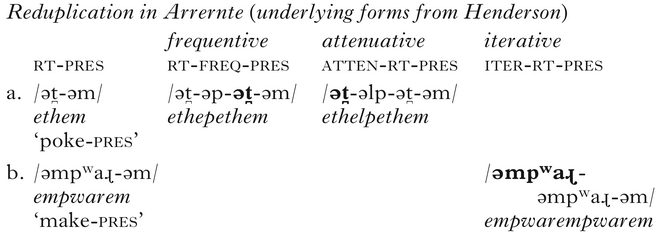
Henderson proposes that, descriptively, the reduplicant includes a VC string (or two sequences of VC strings), a fact which he views as copying of VC syllables (2013: 227). Thus the ‘Frequentive … is marked by a suffix which consists of /əp/ followed by a monosyllabic reduplicant which copies from the end of the preceding stem’ (2013: 237) and ‘the Attenuative is marked by a disyllabic form which consists of a monosyllabic template followed by /əlp/’ (2013: 232), while iterative reduplication ‘involves a disyllabic reduplicant template which precedes and compounds with a verb word’ (2013: 235).
What should make us wary of this interpretation of the facts, however, is Henderson's own admission that a form such as ‘atten-poke-pres’ emerges on the surface as [t̪-əlp-ət̪-əm] (2013: 233), effectively acknowledging the lack of initial schwas. His assumption that reduplication is formed at a level where the initial [ə] of the root is present seems to be driven more by analytical than by empirical choices. On the other hand, our account, which rejects initial underlying schwas, is much closer to the actual pronounced forms. The data in (34) are repeated in (35), with further examples. Surface representations are those of Henderson (Reference Henderson2013), and underlying representations are ours.
-
(35)
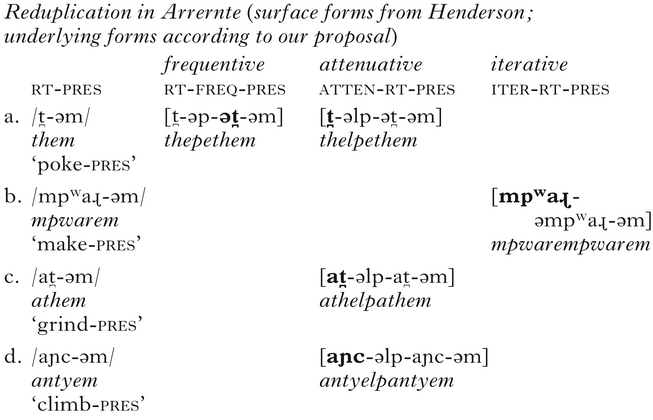
A common feature in the forms above is that the reduplicant itself transcends syllable boundaries, as in [mp w a.ɻ-ə.mpwa.ɻ-əm]. Comparable data are found with reduplication in Oykangand, a Cape York language of Australia, as shown in (36), from Sommer (Reference Sommer and Goyvaerts1981).
-
(36)
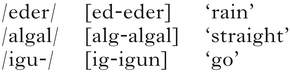
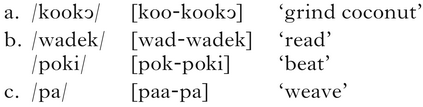
Given the VC(C) output of reduplication, Sommer (Reference Sommer and Goyvaerts1981) syllabifies Oykangand words as [alg.al] rather than [al.gal], on the arguably flawed assumption that the reduplicated portion in [alg-algal] should correspond to a constituent. In fact, this proposal underlies Henderson's (Reference Henderson2013) analysis of VC syllables in Arrernte. But it has long been known that reduplication does not copy a constituent; rather, it aims to fill a particular templatic target (McCarthy & Prince 1986, Reference McCarthy and Prince1993). For example, in Mokilese, reduplication must result in a prefix which is a heavy syllable, and to achieve this will fill up the heavy syllable template in any way it can, either copying a long vowel intact if there is one (37a), copying an onset consonant into coda position to create a heavy syllable (b) or lengthening a vowel if there is no other source of heaviness (c) (McCarthy & Prince 1986).
-
(37)
McCarthy & Prince (1986, Reference McCarthy and Prince1993) present an analysis of Oykangand reduplication in which [alg-algal] involves copying a contiguous string of segments to syllabic positions, so that [al] is mapped as a core CV syllable to the prefixal reduplicant position, but in which the extra /g/ is also retained in the copied material [al.g]. This apparent ‘overcopying’ of an extra segment, according to McCarthy & Prince (1986), occurs precisely to provide an onset for the following syllable, but it also serves an additional purpose: satisfaction of the reduplication constraint StructuralRole (StRole; McCarthy & Prince Reference McCarthy and Prince1993 – see also Bennett Reference Bennett2015), which ensures matching syllable roles between correspondents in base and reduplicant. In the reduplicated form [al.gal.gal], both members of the cluster [lg] display correspondence to their syllable roles in the base. This is not the case in hypothetical *[a.lal.gal], where onset satisfaction is achieved but StRole is not, since [l], originally a coda in the base, emerges as an onset in the reduplicant. Alternatively, one might draw parallels with maximisation of clusters in correspondence, as shown in the formation of German hypocoristics such as Gor.ba.chov → Gorbi (Itô & Mester Reference Itô, Mester, Miglio and Morén1997), and in English ‘millennial’ abbreviations such as presumptuous → presumpsh (Spradlin Reference Spradlin2016). In these truncations, correspondence aims to copy as much as possible of a consonant cluster, even when transcending syllable boundaries. Such data would not constitute an argument for analysing German or English as VCC languages; rather, the prosodic morphology processes in question copy more than ‘is needed’.
We claim that a similar ‘trans-junctural syllabification in reduplicative contexts’ (McCarthy & Prince Reference McCarthy and Prince1993: 134) applies to Arrernte.Footnote 14 Prosodically speaking, then, the template for the frequentive and attenuative looks like a mora, whereas for the iterative it is a syllable. The monomoraic template is demonstrated more clearly by examples such as attenuative [t̪-əl.p-ə.t̪-əm] in (35a), where the reduplicant is merely a moraic onset. The same may be said for the frequentive form, where the preceding schwa is epenthetic to satisfy phonotactic considerations (i.e. the presence of a nucleus).
Let us start with an analysis of the attenuative form [t̪-əl.p-ə.t̪-əm], which fills the reduplicative template of a single mora and requires correspondence between the left edges of base and reduplicant, as specified by (38).Footnote 15
-
(38)

Note that we assume throughout that the linker morph is not part of the reduplicated portion and is thus ignored for the purposes of Faith-BR; any markedness violations, however, are computed as usual. The fully faithful candidate, (39d), is eliminated due to violation of high-ranking Arrernte Phonotactics (24a), which bans *[lpt̪] and other similar sequences. For this reason, an epenthetic schwa appears in the base to break up the cluster between [p] and [t̪] (cf. our analysis of medial epenthetic schwas in (30) above); if the schwa is also copied in the reduplicant, as in (39b, c), Anchor-L-BR is satisfied, but at the cost of the top-ranking *[ə constraint in (24a). The winning form, (39a), consists merely of a reduplicant [t̪], i.e. a moraic onset. Its failure to conform to left-anchoring requirements (the initial element in the reduplicant, i.e. [t̪], does not match the epenthetic schwa at the left edge of the base) nonetheless permits it to fully satisfy the dominant phonotactic constraints of Arrernte.
-
(39)

This analysis would be further supported if a single moraic onset were to arise in reduplication of forms such as C-initial disyllabic roots, but this unfortunately proves hard to test. As mentioned in note 3, forms such as /nthar-iw/ ‘to pinch, throw’, which seemingly fulfil the desired profile, are arguably morphologically complex. Thus /nthar-iw/ is treated as a compound verb, whose first part is difficult to identify, but whose second part, /iw/ ‘to throw away’, corresponds to a free verb form (Wilkins Reference Wilkins1989: 266–267). More generally, David Wilkins (personal communication) points out that Arrernte seems to lack C-initial polysyllabic verb roots that are unambiguously simplex. With this caveat in mind, it is notable that a polysyllabic, complex stem such as [n̪t̪ak-iw] nthakiwe ‘to char fur/scales off game’ forms the attenuative in precisely the manner expected, i.e. [n̪t̪-əlp-ən̪t̪akiw-əm] nthelpenthakiweme (Wilkins Reference Wilkins1989: 267, personal communication; forms in italics as provided by Wilkins), with mere copying of the first moraic onset.
The importance of Anchor-L-BR and Onset becomes apparent with roots that are underlyingly vowel-initial. In such cases, there is no epenthetic schwa in the base, as in (40a), the attenuative form [a.t̪-əl.pa.t̪-əm]. These forms demonstrate the effect of lower-ranked, but still vital, constraints in the phonology of Arrernte reduplication.
-
(40)
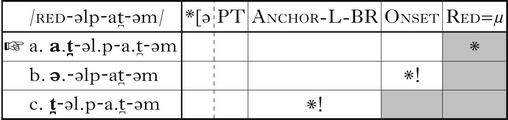
The winner, (a), fully satisfies Anchor-L-BR, unlike the contender in (c), a form comparable to the winner in (39). Candidate (b), on the other hand, exactly fills the templatic constraint (Red=μ), through copying of a single vocalic mora. Nonetheless, the winner presents extension of the reduplicant by means of overcopying of [t̪]. We argue that such overcopying is motivated by Onset satisfaction, while overcopying of clusters such as [¿c] in (35d) also serves to satisfy StRole. These points are illustrated below.
Undercopying, as illustrated by the iterative form [mp w aɻ-əmpwaɻ-əm] in (41a) (cf. [əmp w a.ɻ-əmpwaɻ-əm] in (b)), is also motivated by general markedness principles of the language, specifically the avoidance of initial schwas. Candidate (c) is ruled out on phonotactic grounds, on the assumption that the cluster [ɻ.mpw] is illegal, and must be broken up by an epenthetic schwa. If the cluster is in fact acceptable, then the elimination of (c) becomes more difficult to account for. A solution can be given by the constraint StRole, which we claim is independently needed in light of examples such as (42) below. In particular, if StRole ⪢ Anchor-L-BR, then (41c) will be dispreferred, not due to phonotactic violations, but because it assigns different syllable roles to the [ɻ] in the reduplicant and base, namely coda vs. onset, a fact that (a), with schwa insertion, manages to avoid. The fatal violations in (c) reflect these two analyses.
-
(41)
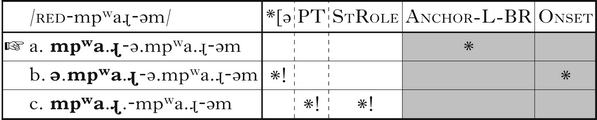
Tableau (42) illustrates the effects of both StRole and Onset for the attenuative form [a¿c-əlp-a¿c-əm]. All forms depicted satisfy anchoring, which is assumed to be dominated by StRole. Minimal copying, as in (42c), best satisfies Red=μ, but incurs a fatal violation of Onset, as explained above. Although candidates (a) and (b) both extend the prosodic template to better satisfy Onset, it is (a), with some extra copying, that wins. We attribute this to satisfaction of StRole with respect to the coda in the first syllable, which (b) violates. While one could instead suggest that (42a) satisfies Max-BR better than (42b), this cannot be generally true of this reduplication pattern, since elsewhere (cf. (39)), absolutely minimal reduplicants are preferred.
-
(42)
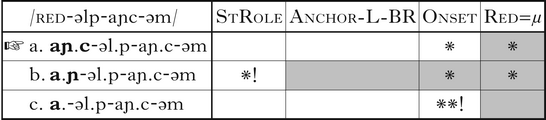
What this brief illustration is meant to demonstrate is that the hypothesis we have been entertaining, arguing against the presence of underlying initial schwas, conforms to the empirical facts of Arrernte reduplication in a straightforward manner. Conversely, proponents of the opposing view, such as Henderson (Reference Henderson2013), need to assume that reduplication takes place at some prior level of representation, because output forms actually emerge without initial schwas. No arguments are given for this, however. In our reduplication analysis, we have employed analytical ingredients adopted earlier on, namely the absence of initial schwas and the insertion of medial schwas. Note that we have marked schwas in affixes and linker morphs as underlying, but this was for convenience, to avoid overburdening the representations. They could equally be epenthetic, like other medial schwas.
In sum, StRole and Onset can determine the size of the reduplicant, vindicating the role of CV syllabification and moraic onsets in the phonology of Arrernte. Reduplication underscores a recurring theme throughout the paper: like so many other languages, Arrernte utilises a prosodic template for reduplication. This template (moraic or syllabic), combined with the regulating effects of markedness constraints such as Onset and StRole, may cause overcopying of consonants. Thus, even in a language that often displays onsetless syllables, to the point that some theorists have taken this as evidence for VC syllabification, we can identify an ‘emergence of the unmarked’ effect in reduplication (McCarthy & Prince Reference McCarthy and Prince1994).
5 Discussion and concluding remarks
We have addressed four of the five arguments in favour of a VC analysis of Arrernte summarised in (1). As we have demonstrated, not only are the phenomena involving allomorphy (§2), stress (§4.1), Rabbit Talk (§4.2) and reduplication (§4.3) amenable to an analysis that utilises classic CV syllabification with moraic onsets, but such an analysis often proves superior to its VC-based alternative.
The remaining argument for VC syllabification relies on the observation that ‘all words begin with a vowel and end with a consonant’. Apart from this statement being somewhat inaccurate (recall Breen & Pensalfini's statement that 25% of Arrernte words are pronounced in isolation with an initial consonant), it does not logically follow that this entails VC syllabification. Consider for a moment Yapese (Broselow Reference Broselow2003). Like Arrernte, Yapese allows both open and closed syllables word-medially, but word-finally permits only closed syllables, a fact that can be attributed to a high-ranked FinalC constraint requiring word-final coda consonants. Once FinalC is treated as a constraint that licenses marked structures at the right word edge, we might propose a mirror licensing constraint, InitialV, which would license marked structures at the left word edge, but not internally. Alternatively, or even complementarily, the V-initial effect could be ascribed to Australian C-drop (§1). The upshot is that a language of the Arrernte #V…C# type is entirely expected, given licensing (and historical) considerations, without recourse to an otherwise unsubstantiated type of syllabification.
Two types of questions arise with respect to the Arrernte moraic onsets vs. onsetlessness debate: phonetic and diachronic. How did Arrernte come to have moraic onsets? Is it due to the consonant inventory or the vowel inventory? Gordon (Reference Gordon2005) suggests that weight-sensitivity in rhymes is dispreferred in languages without vowel-length distinctions, finding a greater perceptual energy difference between Arrernte CV and V than between CV and CVC. He argues that the small vowel inventory allows for open syllable lengthening, rendering the overall energy difference between CV and CVC smaller and hence less reliable than the CV vs. V difference. Gordon's claim is thus that, given the relative consistency of variability, the CV vs. V difference is a more reliable phonetic hook to hang one's phonological hat on, which in our terms paves the way for the phonologisation of onsets as moraic.
Is there any phonetic evidence for VC syllabification? In short, no. Tabain et al. (Reference Tabain, Breen and Butcher2004) looked for acoustic evidence of planned coarticulation and reduced variability (CV vs. VC) in English, Arrernte, and also Yanyuwa and Yindjibarndi, for which ‘there is no explicit hypothesis [of] underlying VC syllables’. They found that ‘it might be noted that (contrary to our hypothesis) on the rare occasion results are significant for the Aboriginal data, it is the VC context which shows more variability than the CV context’ (2014: 185). Tabain looked at articulatory kinematics, but ‘results show no consistent differences between English and Arrernte jaw movement’ (2009: 33). In short, once we adopt the present analysis, there is neither phonological nor phonetic analysis for VC syllabification. In addition, Henderson (Reference Henderson2013: 270) remarks the following:
non-contrastive aspects associated with stress provide some evidence that supports a CV analysis. Firstly, in emphatic pronunciation, stops preceding stressed vowels may show aspiration, something not noted for stops preceding unstressed vowels. The traditional analysis of similar phenomena across languages interprets this as evidence that the target for stress placement is a CV sequence … The fact that consonants preceding primary stressed vowels are of significantly greater duration than in other contexts … may also be interpreted in this way.
Our argument overall, therefore, is that Arrernte is much as it appears on the surface; taking account of the fact that many words start with CV at the left edge (alongside arguments against placing a fleeting underlying schwa at the left edge of such words to save the VC hypothesis), and in light of the evidence for CV syllabification at the left and right edges in connected and sung speech, we have provided a straightforward account of allomorphy and stress assignment in terms of mora-counting among CV syllables with moraic onsets, an account of reduplication that depends on the presence of an Onset constraint in the language and a cross-anchoring account of Rabbit Talk in terms of moraic alignment.
Of special interest for the CV hypothesis of Arrernte is the emergence of the unmarked effect (McCarthy & Prince Reference McCarthy and Prince1994) that occurs in Arandic Baby Talk, as described by Turpin et al. (Reference Turpin, Demuth, Campbell, Pensalfini, Turpin and Guillemin2014). In Arandic Baby Talk, speakers truncate the word-initial vowel of truly V-initial words such as iwenh [iˈwʊn̪ə] ‘what’ to wunh [wʊn̪ɐ] and aperley [aˈpeɭi] ‘father's mother’ to pelyey [‘piʎi]. If Arrernte had any trace of VC syllabification, Baby Talk would be employing a highly marked structure in these CV transformations, an implausible conclusion. We therefore take this as additional evidence that CV structure is unmarked, and that the impulse for CV syllabification in the Baby Talk register directly manifests this structure. Indeed, in terms of models of the development from child language to adult language that involve increased promotion of faithfulness (Gnanadesikan Reference Gnanadesikan, Kager, Pater and Zonneveld2004), moving from a fully CV-syllabified form such as [‘pi.ʎi] to an adult form of the same word with an initial onsetless vowel like [a.ˈpe.ɭi] would involve a reranking of faithfulness above markedness for the initial vowel, but no imaginable resyllabification to a more marked configuration could be involved.
The analysis of Arrernte as having moraic onsets within a CV phonology yields the potential for a range of future phonetic studies of their realisation. Interestingly, the onset consonants lost in the great Australian C-drop were primarily nasals and glides, the mirror image of what are the most favoured codas in languages of the world (Zec Reference Zec1995, Morén Reference Morén2001). This would suggest that, above and beyond the general preference for onsets to be low-sonority and codas to be high-sonority, there is a set of preferences involving weight, whereby moraic codas are preferentially high-sonority, while moraic onsets prefer low-sonority (cf. Topintzi Reference Topintzi2010 for a related proposal). The latter tendency is perhaps ultimately phonologisation from the phonetic effect, discussed by Giavazzi (Reference Giavazzi2010), that stressed vowels prefer to align with less sonorous onsets, as the latter enhance the loudness of the former. In terms of durational correlations, our claim that Arrernte onsets are moraic (while codas are not) can be directly translated into predictions about the phonetic realisation of mora-bearing consonants, in a manner parallel to the cross-linguistic study of Broselow et al. (Reference Broselow, Chen and Huffman1997); see also Ryan (Reference Ryan2014) for a discussion of the contribution of onsets to weight in gradient terms. More broadly, we contend that the most fruitful directions for future phonetic studies of Arrernte would include study of the relation between initial moraic consonants and the phonetic realisation of the preceding fleeting schwa. Arguably, laboratory phonology approaches to Arrernte could yield rich findings through investigating the nature of the initial schwa, paralleling the valuable findings on related phenomena involving non-phonological vocalic elements in languages such as Berber (Ridouane & Fougeron Reference Ridouane and Fougeron2011), and intrusive, non-phonological vocalic elements more generally (Hall Reference Hall2006).
While there is still a lot more to be discovered about Arrernte, the fact that we have been able to reach the present conclusions at all is precisely the result of the fact that previous work on the language has been extremely thorough in terms of morphophonological phenomena, language games and other types of external evidence. We have argued that once moraic onsets are adopted, these phenomena follow straightforwardly from the types of processes that typically refer to moras. There may in fact be more languages like Arrernte, with prosodic morphology phenomena that refer to moraicity in such a way that statements like ‘stress falls on the first vowel preceded by a consonant’ becomes ‘stress the first heavy syllable’. Descriptions of phenomena such as reduplication and language games are a rich source of evidence concerning the interface between morphology and syllable weight, with the computation of the latter determined in certain language-specific ways that rely both on consonantal quality and syllable position.



