INTRODUCTION
End-of-life care for professionals has been described as a challenge (Dunne et al., Reference Dunne, Sullivan and Kernohan2005; Namasivayam et al., Reference Namasivayam, Orb and O'Connor2005) and a complex journey together with the family (Barnard et al., Reference Barnard, Hollingum and Hartfield2006). This caregiving can include positive and valuable experiences (Brännström et al., Reference Brännström, Brulin and Norberg2005) and be a process of personal development (Barnard et al., Reference Barnard, Hollingum and Hartfield2006), resulting in increased knowledge and personal growth (Wallerstedt & Andershed, Reference Wallerstedt and Andershed2007). It is also an encounter with suffering on different levels (Ferrell & Coyle, Reference Ferrell and Coyle2008). The dying patient, often surrounded by worried relatives (Brobäck & Berterö, Reference Brobäck and Berterö2003), can have physical symptoms such as pain, fatigue, and nausea, as well as psychological symptoms, for example depression and anxiety (Bradley et al., Reference Bradley, Davies and Chow2005). Meeting this suffering can contribute to feelings of helplessness, failure, and distress for professionals (White et al., Reference White, Wilkes, Cooper and Barbato2004). End-of-life care encompasses how to stay present during suffering (Tarzian, Reference Tarzian2000) and how to manage one's own feelings of loss (Wakefield, Reference Wakefield2000). A need for professionals to distance themselves from suffering and distressing symptoms can result in handing over parts of the caring role to relatives (Wakefield, Reference Wakefield2000). If the task becomes too challenging, the caregiving at the end of life can be experienced as confrontational and emotionally draining, creating a need for personal support (Mohan et al., Reference Mohan, Wilkes and Ogunsiji2005).
From the perspective of the relatives, both as co-workers and potential clients in end-of-life care (Stajduhar et al., Reference Stajduhar, Nickel and Martin2008), the option of receiving respite care at the end of life may provide important support in the management of the dying process. Respite care can be offered in different forms, for example, as inpatient care, home-based care or day care (Ingleton et al., Reference Ingleton, Payne and Nolan2003; Payne et al., Reference Payne, Ingleton and Scott2004). A particular and highly valued form of respite care is the sitting service for the dying at home (SSH), in which the flexible management of the service creates possibilities for the dying patient to stay at home (Ashworth & Baker, Reference Ashworth and Baker2000). In SSH, professionals have a unique possibility to meet individual needs and stay with the family in their home. In Sweden, it is often enrolled nurses (ENs), with a 2- or 3-year education in caring at the college level, who partly work with SSH. ENs'caregiving at the end of life is, however, often described in the context of nursing homes (e.g., Winchester, Reference Winchester2003; Philips et al., Reference Philips, Davidson and Jackson2008), even though they also work in other caring contexts, such as home care.
Because most research about respite care has been performed from the perspective of patients and relatives (Ingleton et al., Reference Ingleton, Payne and Nolan2003; Payne et al., Reference Payne, Ingleton and Scott2004), there is a need for a professional perspective, about what it is like to work with respite care, especially with SSH. Another need is to focus on the ENs' perspective, as many studies in end-of-life care describe experiences of professional life involving registered nurses (RNs). Therefore, the aim of this study was to describe ENs' experiences of working with SSH.
METHOD
Setting
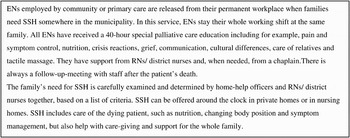
In a municipality in the south of Sweden, a model for respite care, SSH, was introduced in 1998. This care is available when dying persons or their family members have special needs for respite (Fig. 1).
Sitting service at home (SSH) in a municipality in the south of Sweden.

Participants
Information about the study was given at meetings to different healthcare professionals working with end-of-life care in the municipality concerned. A head nurse gave information in writing, together with an invitation to participate, to those ENs who met the inclusion criterion and had provided SSH during the last 3 months before data collection. ENs participated once, twice, or three times in the focus group interview (FGI), as they had provided SSH to different families during several 3-month periods before the interview. In total, 17 ENs met this criterion. They had worked as ENs for between 2 and 39 years, and many of them had also worked with SSH since the model was introduced. Twelve of the ENs worked during the day and evening; one both night and day, and four only at nigh. Eight were employed by the municipality and six by the county council (for three, the place of employment was unknown).
Data Collection
FGIs were chosen (Krueger & Casey, Reference Krueger and Casey2000, p.10) to encourage the participants to discuss and explore their experiences (Kitzinger, Reference Kitzinger1995) of working with SSH.
Four FGIs took place between April 2007 and February 2008. They took place at a municipality building, lasted ~ 90 minutes and were tape recorded. The interviews started with a cup of coffee or tea, and all participants introduced themselves. At each FGI two researchers participated (B.W. and B.A. or B.W. and E.B.); one as a moderator and one mainly as an observer. The moderator kept the discussion going and ensured everybody's chance to talk. The observer made notes and sometimes also asked questions. An interview guide was used, containing questions about aspects of working with SSH, support given to the sick person and the relatives, ENs self-support, and their opinions about the function and organization of palliative care. The interviews started with: “Please, tell us what it is like to work in SSH.” To encourage the conversation, questions such as “Do you agree with that?” or “Are there other opinions about that?” were asked. .At the end, the observer summarized the interview, and the participants could make comments. The study was approved by the Regional Ethics Committee (Dnr 2007/065).
Data Analysis
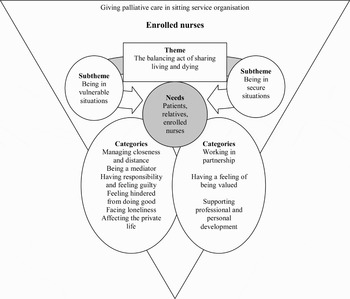
The interviews were transcribed verbatim and analyzed according to qualitative content analysis (Graneheim & Lundman, Reference Graneheim and Lundman2004; Hsie & Shannon, 2005). After reading all interviews, the text was divided into meaning units and condensed into codes. The codes describing the ENs' experiences of their work were put together in text files to get an overview and understanding of their meaning. Then themes and categories were established. Two of the researchers (B.W. and E.B.) coded the text separately and then together with the second author (B.A.). The recordings of the FGIs were listened to once more in order to confirm consistency between the data and the analysis. Finally, one main theme, two sub-themes and nine categories emerged (Fig. 2).
Theme, subtheme and categories.

The following characters are used in the Result Section: omitted words (…) and author's comments between slashes (//).
RESULTS
The Balancing Act of Sharing Living and Dying
The ENs found their task special, important, and different from their permanent job. Their experiences revealed the complexity of end-of-life care, from the patient's private home, but also from nursing homes. Dealing with the family's situation was experienced as a balancing act – they were sharing living and dying at the same time but facing also differences in needs, wishes, and personalities in the family.
In their ambitions to do good, the ENs hovered between feelings of being in a vulnerable situation and being in a secure one, but they could also feel vulnerable and secure at the same time, as these experiences sometimes were intertwined. For example, when waiting for help from the RNs they were worried but nevertheless felt secure, because they knew the help was coming. When they managed difficult situations, they felt both vulnerable and valued. Their balancing capacity, i.e. flexibility, was obvious and of great importance for managing their tasks both at work and in private.
Sharing living and dying included a desire to do good for the whole family and to make a difference in difficult situations; being there, listening, and being sensible and perceptive. On the one hand, because of the smooth rhythm in SSH, the ENs mostly had more time to spend with the sick person and to give individualized care, compared to in their permanent job. On the other hand, the work could be very intense, and there could be stressful situations. However, the impression is that the ENs mostly felt secure working with SSH, despite vulnerable situations.
Being in Vulnerable Situations
Managing Closeness and Distance
The ENs said that it was difficult to manage closeness to and distance from the patient and relatives. They came very close to the families, which was necessary in order to give individualized care. At the same time there had to be limits and professionalism so as not to become too close and personally involved. To share the life situation of the family, including the dying process, was described both as a positive and negative experience. Mostly, the closeness in the caring relation created trust. The patients and relatives felt comfortable talking about what they needed, and the ENs found it natural to show feelings to the family.
FGI 1
D: And they // the patient and the relatives // are very keen that we should be there. We should not be on the sidelines; they want us right there in the middle.
S: …It's difficult, the line between being a member of the family and a professional. You are naturally not a member of the family, of course not. But you are not just a professional or healthcare outsider. It's not at all like my usual job. You get much closer.
Although the ENs often perceived the work with SSH as more calm compared to their permanent job, they sometimes felt exhausted, when they finished their shift. The work included many care duties; for example, regular symptom management, nutrition, and changing body position, as well as supporting and listening to troubled and sad relatives and patients. Experiences from SSH could also be hard to forget, especially if the ENs had been in the home for a long time, if the patient was a younger person, or if the patient had died. However, it was necessary to put these experiences behind. One way to do this was by participating in the follow-up meeting with the staff after the patient's death. Some of the ENs mentally wound down, when they left work, whereas others reflected over the day (or night).
FGI 4
I: You live very close to the sick person and his family for a short or long period of time, and then its over. You think about them. You put a lot of yourself into it.
C: And then it's over.
I: You wonder how they are getting on // the relatives // You think about the family.
M: Then I think that the follow-up meeting you have later is a good idea. … because you think about them and it's a little empty afterwards.
Being a Mediator
Sharing living and dying with the family meant being flexible and perceptive, balancing between different needs and wishes, and coming to terms with both the patients and the relatives. Sometimes the ENs also had to use a mediating function, for example, when the patient was unable to eat, but the relatives did not understand that. In families whom they knew well, they instinctively tried to conciliate. Then the ENs often felt that they were in between the patient and family members. However, they tried not to take sides. This was a vulnerable position for the ENs, because they wanted to meet the whole familýs needs with the same respect.
FGI 1
T: Not all relatives want this, it can be the one who is ill who asks for it. I think it's difficult sometimes. The relative doesn't want it.
S: Because it's too difficult.
T: Yes, there are a lot of promises and they // the relatives // have promised that the patient will be at home And they can't really understand. Yes, it can be incredibly difficult. I was at a place where they didn't really want the patient to die at home where they were going to continue to live.
Having Responsibility and Feeling Guilty
The ENs had a lot of responsibility and dealt with different situations and solved various kinds of problems. One area of responsibility was to decide when death appeared imminent, and it was time to wake up the relatives. This was a hard decision to make, and sometimes they handed over this responsibility to the RNs. Another area of responsibility was symptom management. If it failed, even after using all the available resources, they often felt powerless and had a sense of guilt. In their permanent job, the ENs were able to leave the patient for other duties. In SSH, however, they had no alternative but stay with the family, even when conditions were very difficult. They felt uncomfortable, but still had to endure. Such experiences placed the ENs in a vulnerable situation. They became emotional when talking about this, because they thought they had failed to deal with the responsibility that they had been given.
FGI 1
S: The district nurses did all they could, but it was not possible to relieve the pain, and it was very difficult, because I'm there and I have to do it, it's my job. Now I didn't have a relative by my side, they came in and out … and I could feel, like “What am I doing here for this woman's sake?” But it's not possible to get something complete. She had a pump, and she got extra, and she was given the pen.
P: And it's not certain that it's only the pain then.
// Lively discussion in the group//.
S: There was nothing we could do! // said with emphasis//.
Feeling Hindered from Doing Good
Sometimes the ENs experienced obstacles in their professional role of helping. They could feel challenged by others, for example, the relatives, when they were not permitted to use special drugs to relieve the patient's symptoms. Then they could ask themselves, whether they were of any benefit to the family. At other times, when visitors and relatives were present, ENs could feel uncomfortable and in the way, because it was hard to know whether to stay in the patient's room or not, and how to behave in order to be of benefit. They lost some of their balancing capacity, but they still shared the families' life.
FGI 4
I: Sometimes you have to be a flower on the wallpaper. // merriment in the group // But it's true! There may not be much room, and lots of relatives turn up, and you just have to be there but not be visible so much. You just want to go away and let them be together.
M: And then there is no place you can go away to, and yes, then you have to be a flower.
I: Sometimes they can say, “Now, when we are here, you can perhaps have a break and go out.” That really feels nice. You know what you have to do.
At the end of life when everything is on edge, the ENs perceived an increased vulnerability in patients and relatives. Sometimes they had to mentally tiptoe and felt that the personal chemistry between them and the family was not right. The ENs argued that the only way to manage such a situation was to let another person replace them. This situation exemplifies a case in which vulnerability in the family also created a vulnerable situation for some ENs.
FGI 1
S: It's like that in this kind of care, in some places you don't fit in. The personal chemistry isn't right. They don't like me. When one of the members of the family is dying, then it's not a good situation at all. It can be as good as possible, but the patient is still going to die. I can come to some places where I feel that I shouldn't be. It can be very difficult to go around on tiptoe.
R: But we always try to solve it in a good way by discussing and going through it, and by someone else going instead.
S: And you can come in and perhaps something has just happened … and you hear it. There are many situations that are …That's it, you are so totally vulnerable.
Facing Loneliness
The ENs had to provide care alone in the private home with no other colleagues present. In spite of being able to read the documentation, the ENs wanted to talk to colleagues in the SSH group and exchange experiences about what had happened in the family. However, the only time for professional talk was when they were replaced by another EN. In their permanent jobs, they had more extensive access to each other.
Other situations of loneliness and vulnerability occurred when they called for help but had to wait, because of the long distances the RN had to drive. However, they used their balancing capacity to make the best of the situation. If the problem was unsatisfactory symptom control, rescue medication could be used. All ENs had also learned how to give tactile massage, which was useful for relieving the patient's anxiety and pain and for establishing physical nearness.
FGI 3
T: …You are alone at that moment, the nurse can't come straight away.
S: Instead you have to wait until the nurse comes, which can take half an hour … and then you have this time to make the best of the situation, of course, but sometimes they // the patients // feel really awful, and then it's difficult.
J: I think it's really very demanding, that you are alone.
Affecting the Private Life
The ENs also intensively discussed whether the SSH affected their private life, something that they had various opinions about. Some ENs argued that in this kind of care, it was necessary to be flexible and change working times, otherwise it would not work for the patients and relatives. This need of flexibility influenced their private families in different ways and created a vulnerable situation for some ENs. Others found that this need of flexibility was acceptable and found solutions in relation to their private lives.
FGI 1
R: If you finish at seven in the morning, then you are often still there until eight or nine perhaps, if it feels like the right thing to do.
S: Yes, that's where it can affect your private life. It's not easy to have small children that have to go to nursery school. You can't really be at that age when too much of your private life is very inflexible. You have small children, don't you? // looks at Tanja //.
T: But it's always worked out.
S: It can be difficult to be flexible.
T: It depends what you make of the situation. If there is someone at home, then … It's never been a problem.
Being in Secure Situations
Working in Partnership
The support from other colleagues in the team increased the sense of security. The special experience of this job was a benefit for colleagues at their permanent job. Security through partnership was also created between the ENs and relatives. The ENs described relatives both as a resource and as demanding. Through the partnership with the ENs, relatives were comfortable about staying with the dying patient and sometimes managed the care for a short time on their own. In that way, the ENs' own sense of security provided security for both relatives and colleagues.
FGI 3
R: Oh, it's so nice you're here! // relatives say // Relatives relax when you come at night so that they can sleep.
B: That you can try // the sitting service // then you have energy to get through the day.
R: Or you are there during the day and the wife can have a bit of a break. One relative said: “I don't mind being at home with mum and dad as long as you are here.”
B: Yes, you are a help for the relatives.
Having a Feeling of Being Valued
The possibilities of being with the patient and family in difficult situations gave the ENs a sense of being valued; a deep persisting feeling. Their efforts could make it possible for the dying patient to come home from the hospital for the last days of life and die in the place he or she wanted. Thanks to the ENs, relatives dared to stay near the patient during the dying process, and a potential negative experience for the relatives could turn into a positive one. The ENs' special knowledge of individual care, and their position as an important cog in the care organization, also gave them a feeling of being valued. The satisfaction came from the perception that they were successfully doing something good, which brought security to their professional role in SSH.
FGI 4
C: And you feel how thankful they are when you come, even if they know that they are going to die. But that we come, and that we can be with them and stay there, it is really rewarding. You feel it inside, the feelings. You feel that you are doing a good job, it feels good that you can be there.
M: It feels good being there just for the one who is there. You don't have to divide yourself. It feels nice. You can give so much time.
C: Very often you hear too “It's really nice you are here, it gives me a great sense of security.” It feels like it goes right into your soul. Then everything feels so right.
Supporting Professional and Personal Development
The ENs perceived SSH as a break from their permanent job. Many of them did not want to work exclusively with SSH because of the danger of feeling depressed, if they worked too much in this care context. The ENs also talked about the risk of becoming a “care machine” and not being fully aware of the conditions at the permanent workplace. Working with SSH could reduce this risk and enrich the permanent job. Another result of working with SSH was the pleasure of learning new things from all families. Knowledge gained in one family could be useful for the next one. There was also an open dialogue about the need for different kinds of knowledge in the SSH and in the permanent job, and there was a respect for these differences. Altogether, the ENs had increased their experience of sharing living and dying, in dealing with different situations and people, but also in caring for a unique person with individual needs and feelings. Their wide experience had created a sense of security in the caring relationships and in the teamwork.
FGI 3
R: It was like a nurse said, “You know how to do this, I don't. It feels so good to have you here.” It's great to hear that and it was sincere. It felt good! You can in a way cooperate then. You can help each other, one of you knows about one thing and the other knows about something else. So it can work out well.
Another important factor for increased learning, and in that way an increased sense of security, was the follow-up meetings with the caregiving staff, when a patient had died. During these meetings the ENs could ask questions and get answers about the moment of death. This feedback and the ENs own reflections had increased their understanding of how things they had experienced in SSH were related.
FGI 1
R: We come in somewhere in the middle of the illness and then it's important for us to know. This is what it was like and this is what happened. We get to know about the whole process then. I think that is valuable.
S: And they // district nurses // can also explain things … because they meet the relatives once more after we have gone home, and then we get to hear how they really felt about it.
D: When you know the whole course of the illness, you understand why they // relatives/patient // react the way they do and felt as they did, and you can get an answer.
The ENs were proud of working with SSH, and this work had not only supported the ENs professional progress but also their growth and development as individuals, for example, in the way they organize their priorities in life.
DISCUSSION
This study showed that working with SSH was a balancing act of sharing living and dying, and it involved hovering between being in a secure situation and being in a vulnerable one. The general impression, however, was that the ENs were confident and felt secure in their caregiving, despite working in difficult conditions. One reason for that could have been that they felt secure as people. They also got preparation for their tasks through education in palliative care. Moreover, the ENs worked in partnership with professionals, who all knew the families included in SSH, which also contributed to a sense of security. In the follow-ups, it was possible to express worries and find out if anything had gone wrong during their working shift. In that way, they could optimize the sense of security in the group if needed. However, feelings of vulnerability were also described by the ENs. Vulnerability in end-of-life care is often highlighted when the patients' or relatives' situations are described (Reid, Reference Reid2009). According to Spiers (Reference Spiers2000), from an etic perspective, it is the patient who is vulnerable in nursing interactions, but the emic view points to a mutual vulnerability in the nurse–patient interaction. For the ENs in this study, one critical area was the management of empathy with the patient and family, that is, the closeness and distance in their caring relationships. The ENs had to distance themselves and not be involved too much in a personal way. This is in line with a study by Määtä (Reference Määtä2006), who has identified a model of empathy that allows movement between closeness and distance. Empathy is described in three levels: from active listening through identification to self-recovery. Closeness and distance can also be a way of acting in difficult situations (Blomberg & Sahlberg-Blom, Reference Blomberg and Sahlberg-Blom2007). According to Boston et al. (Reference Boston, Towers and Barnard2001), empathy as a therapeutic act requires vulnerability and personal risk within the patient–caregiver relationship.
The EN's work in SSH involves great responsibility, perhaps too much sometimes. They felt guilty when, for example, the symptom management failed, and described feelings of vulnerability in such situations. According to Sörlie et al. (Reference Sörlie, Larsson and Kihlgren2004), having a bad conscience can be a part of everyday life in professional healthcare. Lützén et al. (Reference Lützén, Dahlqvist and Eriksson2006) argued that moral sensitivity can lead to an internal conflict, if professionals are not able to put the sensitivity into action. Juthberg et al. (Reference Juthberg, Eriksson and Norberg2007) have shown that stress of conscience is related to internal demands, and that sometimes there is a need to deaden one's conscience in order to feel like a good healthcare provider. The ENs'opinions reflected both internal demands on themselves and internal conflicts in their role in symptom management. On the other hand, the ENs also expressed feelings of being valued and of doing something very good, and they were proud of their work. Olthuis et al. (Reference Olthuis, Leget and Dekkers2007) argued that good nursing depends upon the responses from patients, colleagues, and family. These responses make nurses feel valued as people, and enable them to see the value of the work that they do. According to Pask (Reference Pask2003) the capacity of the nurses to see what is important in the work that they do was linked to their view of themselves and their professional practices.
Working in partnership with colleagues created a sense of security in their work in SSH. It was also a tool for creating trust and confidence in caring relationships with relatives, but the significance of SSH for relatives needs to be more thoroughly investigated.
Several studies argued for the importance of partnership and cooperation (Stajduhar & Davies, Reference Stajduhar and Davies1998; Benzein et al., Reference Benzein, Hagberg and Saveman2008), as well as Green and Wakefield (Reference Green and Wakefield2006) for viewing the relative as a resource in caring for the patient. According to Tapp (Reference Tapp2000) one prerequisite is a non-hierarchical relationship, in which the nurse confirms the expertise within the family. Andershed and Ternestedt (Reference Andershed and Ternestedt2001) have pointed out the importance of the participation of relatives based on trust and confidence. The key concept was the staff's respect, openness, truthfulness, confirmation and cooperation, consistent with the ENs descriptions of their work in this study.
The ENs found that experiences in SSH involved learning and developing, enriched their permanent jobs, and provided valuable knowledge to healthcare organizations. That one can learn from the process of death and dying was an important insight, in spite of the fact that death and dying are still surrounded by silence and fear. The ENs' reflections about working with SSH have also contributed to increased knowledge about life and death. Dunniece and Slevin (Reference Dunniece and Slevin2000) have described RNs' learning by reflection, through the encounters and nearness with cancer patients in difficult situations. The need for different kinds of knowledge in end-of-life care, which this study has shown, is confirmed by Bergdahl et al. (Reference Bergdahl, Wikström and Andershed2007) as is the need for interprofessional learning (Lidskog, Reference Lidskog2008).
Discussion of Method
In order to gain variations in the reflected experiences of working in SSH, four FGIs were conducted. The group size was limited to eight participants according to Krueger and Casey (Reference Krueger and Casey2000, p. 74), and five to six ENs participated each time. This was a suitable number and gave everyone the chance to speak. The number of FGIs was adequate, as the last FGI did not add any substantial new information, but confirmed earlier interviews (Krueger & Casey, Reference Krueger and Casey2000, p. 26). The conversations were similar in the four groups, and there was a high degree of consistency among the participants' perceptions of their work. One explanation could be that all ENs in the group knew each other, had received the same education in palliative care, worked together with a limited group of RNs, and had follow-up meetings, which may support the development of shared knowledge and values.
Some researchers have criticized the presentation of results from FGIs, because the interactions among the participants have not been shown (Kitzinger, Reference Kitzinger1995). In this study, we have addressed this criticism by showing various kinds of interactions in the quotations.
For the sake of credibility, all the steps in the study concerning sampling, data collection, and analysis are carefully described. Quotations are used to give voice to the ENs and support the result. Three researchers were involved and worked both together and separately during different parts of the research process. Using a guide for the FGIs was a way of achieving dependability. During the interviews, follow-up questions were used frequently to deepen the discussion. At the end of every FGI, the observer made an overall summary of the interview, and the participants could confirm or question the description, which was one way of achieving confirmability. The transferability of results to other care contexts is dependent upon the judgments of the people working in those contexts and the transparency of the research process (Lincoln & Guba, Reference Lincoln and Guba1985; Hsieh & Shannon, Reference Hsieh and Shannon2005). For example, one should bear in mind that the rural care context is probably not applicable in a metropolitan area.
Recommendations for Further Research
This study has focused on what working with SSH in end-of-life care means for ENs. However, we need to know more about this special care area in order to adapt preparation, and provide support to the professionals working with SSH.
CONCLUSION
Working with SSH gave the ENs special knowledge and supported their professional and personal development. Their work in SSH was an important cog in the healthcare system for two main reasons: first, their support made it possible for the dying person to remain at home or in the nursing home until death, and, second, their support made it possible for the family to manage the dying process. If the SSH organization were not an option for dying patients and their families, the pressure on the healthcare system would be dramatically changed.
ACKNOWLEDGMENT
We express our gratitude to the ENs who participated in the studies, the Medical Research Council of South East Sweden (FORSS), the Municipality of Vetlanda, the County Councils of Jönköping and Kalmar, and the Research Section; the County Council of Kalmar for financial support; and Michael Fenn for revising the English.