During the last several decades, large quantities of engineered nanoparticles (ENPs) have been manufactured owing to their size-dependent properties and numerous applications in consumer and industrial products (Hendren et al., Reference Hendren, Mesnard, Droge and Wiesner2011; Sharma et al., Reference Sharma, Sayes, Guo, Pillai, Parsons and Wang2019; Abbas et al., Reference Abbas, Yousaf, Amina, Munir, El-Naggar, Rinklebe and Naushad2020a), and hence the potential release of ENPs into the land, soil, water, air and ecosystems and the associated impacts of this have attracted considerable attention (Nowack & Bucheli, Reference Nowack and Bucheli2007; Brar et al., Reference Brar, Verma, Tyagi and Surampalli2010; Keller et al., Reference Keller, McFerran, Lazareva and Suh2013). Since Earth's origin, natural nanoparticles (NNPs) formed via various natural processes have been abundantly present, with the estimated annual flux of NNPs (hundreds of teragrams) to the Earth's surface and atmosphere being around three orders of magnitude greater than that of ENPs (Hochella et al., Reference Hochella, Mogk, Ranville, Allen, Luther and Marr2019). Given the distinctive behaviours of natural and anthropogenic nanoparticles (NPs) as well as their abundance and ubiquity in the Earth system, it has become increasingly recognized that NPs might play critical yet not entirely understood roles in many Earth processes, with fundamental implications possibly traversing multiple temporal and spatial scales (Hochella et al., Reference Hochella2002, Reference Hochella, Lower, Maurice, Penn, Sahai, Sparks and Twining2008, Reference Hochella, Mogk, Ranville, Allen, Luther and Marr2019).
One of the most relevant such research topics addresses the interaction of NPs with their surrounding minerals in natural environmental media, specifically the adsorption of NPs on minerals (or heteroaggregation between NPs and minerals). As indicated by numerous previous studies, because the transport, exposure route, fate, distribution and bioavailability of NPs can all be substantially influenced by the adsorption of NPs on minerals, understanding such adsorption behaviour is desirable in various scientific fields, including but not limited to ore deposit formation (Reich et al., Reference Reich, Kesler, Utsunomiya, Palenik, Chryssoulis and Ewing2005; Hannington et al., Reference Hannington, Haroardottir, Garbe-Schoenberg and Brown2016; Zhou et al., Reference Zhou, Sun, Cook, Lin, Fu, Zhong and Brugger2017), explorative geochemistry (Cao & Cheng, Reference Cao and Cheng2020; Hu et al., Reference Hu, Cao, Wang, Lu and Lin2020), environmental science (Novikov et al., Reference Novikov, Kalmykov, Utsunomiya, Ewing, Horreard and Merkulov2006; Sharma et al., Reference Sharma, Filip, Zboril and Varma2015; Hochella et al., Reference Hochella, Mogk, Ranville, Allen, Luther and Marr2019), ecology (Buzea et al., Reference Buzea, Pacheco and Robbie2007; Hochella et al., Reference Hochella, Lower, Maurice, Penn, Sahai, Sparks and Twining2008; Wang et al., Reference Wang, Yang, Chefetz, Xing and Lin2019), nanotoxicity (Borm et al., Reference Borm, Robbins, Haubold, Kuhlbusch, Fissan and Donaldson2006; Amde et al., Reference Amde, Liu, Tan and Bekana2017; Abbas et al., Reference Abbas, Yousaf, Ullah, Ali, Ok and Rinklebe2020b), catalysis (Bond & Thompson, Reference Bond and Thompson2006; Wang et al., Reference Wang, Peng, Hu, Zhang, Hu and Li2014) and analytical science (Alvarez-Puebla et al., Reference Alvarez-Puebla, Arceo, Goulet, Garrido and Aroca2005; Sathuluri et al., Reference Sathuluri, Yoshikawa, Shimizu, Saito and Tamiya2011; de Barros et al., Reference de Barros, Constantino, da Cruz, Bortoleto and Ferreira2017). For example, in the field of ore deposits, the transport and adsorption of metallic NPs on host minerals has long been proposed as an effective metal enrichment mechanism for several important hydrothermal and supergene deposits (Frondel, Reference Frondel1938; King et al., Reference King, Williams-Jones, van Hinsberg and Williams-Jones2014; Saunders & Burke, Reference Saunders and Burke2017; Petrella et al., Reference Petrella, Thébaud, Fougerouse, Evans, Quadir and Laflamme2020, Reference Petrella, Thébaud, Fougerouse, Tattitch, Martin and Turner2022; Saunders et al., Reference Saunders, Burke and Brueseke2020; McLeish et al., Reference McLeish, Williams-Jones, Vasyukova, Clark and Board2021; Wierchowiec et al., Reference Wierchowiec, Mikulski and Zieliński2021), whereas the geochemical anomalies detected in the overburden and that are useful in locating buried economic mineral deposits can result from the natural dispersion of indicator element-bearing NPs and therefore should be influenced by the adsorption/deposition of NPs (Wang et al., Reference Wang, Cao, Lin and Wu2016; Reith & Cornelis, Reference Reith and Cornelis2017; Zhang et al., Reference Zhang, Han, Wang, Liu, Wu and Feng2019). In environmental science, an ongoing concern is how and to what extent nanotechnology will impact the environment, organisms and human health, and various transformations of NPs (especially ENPs), including adsorption, agglomeration and chemical reactions in various environment compartments, have been demonstrated to change significantly their mobility, exposure form, bioavailability and toxicity (Tiede et al., Reference Tiede, Hassellov, Breitbarth, Chaudhry and Boxall2009; Wang et al., Reference Wang, Yang, Chefetz, Xing and Lin2019; Abbas et al., Reference Abbas, Yousaf, Amina, Munir, El-Naggar, Rinklebe and Naushad2020a, 2020b; Spurgeon et al., Reference Spurgeon, Lahive and Schultz2020).
To date, several investigations have been performed to understand the adsorption behaviour of NPs (metals, metal oxides, graphene oxides, etc.) on minerals (pyrite, goethite, quartz, montmorillonite, kaolinite, diatomite, etc.), unveiling a complex adsorption process coregulated by a variety of factors including the physicochemical characteristics of NPs/minerals (composition, structure, morphology, surface charge, etc.) and solution conditions (pH, ionic strength (IS), electrolyte, organic matter, temperature, etc.) (Mikhlin et al., Reference Mikhlin and Romanchenko2007; Zhou et al., Reference Zhou, Abdel-Fattah and Keller2012; Labille et al., Reference Labille, Harns, Bottero and Brant2015; Wang et al., Reference Wang, Dong, Zhu, Li, Keller, Wang and Li2015b, Reference Wang, Yang, Chefetz, Xing and Lin2019; Zhao et al., Reference Zhao, Liu, Wang, Cao and Xing2015; Fu et al., Reference Fu, Nie, Qin, Li and Wan2017; Luo et al., Reference Luo, Nie, Yang, Fu, Zeng and Wan2018; Syngouna et al., Reference Syngouna, Giannadakis and Chrysikopoulos2018; Lu et al., Reference Lu, Lu, Zhang, Shang, Chen and Wang2019; Dong & Zhou, Reference Dong and Zhou2020; Li et al., Reference Li, He, Zhang, Peijnenburg, Liu and Song2020). By combining the effects of van der Waals attraction, electric double-layer (EDL) forces and perhaps additional interactions, the classical and extended Derjaguin–Landau–Verwey–Overbeek (DLVO) theories serve well as useful frameworks to account for observed aggregation and adsorption behaviours between colloidal particles, at least in a semiquantitative manner (Derjaguin & Landau, Reference Derjaguin and Landau1941, Verwey & Overbeek, Reference Verwey and Overbeek1948; Thio et al., Reference Thio, Lee, Meredith and Keller2010; Wang et al., Reference Wang, Adeleye, Huang, Li and Keller2015a). Yet the quantitative explanation and prediction of such behaviours are still lacking (Hotze et al., Reference Hotze, Phenrat and Lowry2010; Petosa et al., Reference Petosa, Jaisi, Quevedo, Elimelech and Tufenkji2010; Liu et al., Reference Liu, Lu, Sprik, Cheng, Meijer and Wang2013, Reference Liu, Cheng, Sprik, Lu and Wang2014), and sometimes the discrepancies between theories and observations can reach several orders of magnitude (Elimelech et al., Reference Elimelech, Gregory, Jia and Williams1995; Petosa et al., Reference Petosa, Jaisi, Quevedo, Elimelech and Tufenkji2010). Such serious disparities, which can be attributed to the challenges stemming from the small size and special structure of NPs and the surface charge heterogeneities of minerals, not only demonstrate the inadequacy of the DLVO theories to quantify NP–mineral interactions accurately, but also warrant experimental endeavours to gather basic adsorption data.
Analytical approaches of counting and sizing NPs, such as dynamic light scattering (DLS) and time-resolved laser diffraction, have often been employed to acquire valuable information on aggregation rate and attachment efficiency. Despite the proven potency of such methodologies in heteroaggregation studies, their general limitation to dilute suspensions and intrinsic overestimation of larger-sized mineral particles cannot be overlooked (Zhou et al., Reference Zhou, Abdel-Fattah and Keller2012; Labille et al., Reference Labille, Harns, Bottero and Brant2015; Liu et al., Reference Liu, Hwang and Lenhart2015; Wang et al., Reference Wang, Dong, Zhu, Li, Keller, Wang and Li2015b, Reference Wang, Yang, Chefetz, Xing and Lin2019; Gallego-Urrea et al., Reference Gallego-Urrea, Hammes, Cornelis and Hassellöv2016; Praetorius et al., Reference Praetorius, Badetti, Brunelli, Clavier, Gallego-Urrea and Gondikas2020). Although many laboratory experiments have been carried out successfully under pre-adjusted pH conditions to obtain equilibrium adsorption results (Labille et al., Reference Labille, Harns, Bottero and Brant2015; Liu et al., Reference Liu, Hwang and Lenhart2015; Wang et al., Reference Wang, Dong, Zhu, Li, Keller, Wang and Li2015b, 2019, Reference Wang, Zhao, Wu, Tang, Zhao and Niu2021; Huang et al., Reference Huang, Guo, Zhao, Liu and Xing2016; Syngouna et al., Reference Syngouna, Giannadakis and Chrysikopoulos2018; Tang & Cheng, Reference Tang and Cheng2018; Lu et al., Reference Lu, Lu, Zhang, Shang, Chen and Wang2019; Dong & Zhou, Reference Dong and Zhou2020; Guo et al., Reference Guo, Wang, Xu, Mao, Zhang and Ghosh2020), we argue that such pre-adjustment of pH is not a necessary step in many important natural and even some engineering processes. Instead, real-world scenarios often involve interaction (or mixing) between a substantial amount of minerals (high solid/liquid ratio) and a NP-containing fluid with an initial pH. For example, as mentioned earlier, the interaction of a metallic NP-bearing fluid (having an initial pH) with wall rock may be critical to the formation of certain ore deposits (e.g. Carlin-type gold deposits), while the rock/fluid ratio can be as high as 5 g L–1 (Kusebauch et al., Reference Kusebauch, Oelze and Gleeson2018; Kusebauch et al., Reference Kusebauch, Gleeson and Oelze2019). The suspended particulate matter (SPM) of some rivers, into which release of ENPs is possible, can reach up to tens of grams per litre (e.g. during floods; Thill et al., Reference Thill, Moustier, Garnier, Estournel, Naudin and Bottero2001; Slomberg et al., Reference Slomberg, Ollivier, Radakovitch, Baran, Sani-Kast and Bruchet2017). In sewage treatment plants, activated sludge is used to remove NPs from wastewater at a solid/liquid ratio of a few grams per litre (Barton et al., Reference Barton, Therezien, Auffan, Bottero and Wiesner2014; Chen et al., Reference Chen, Chen, Zheng, Li and Luo2014), whereas in soil remediation sites, NPs are used to remediate contaminated soil at a solid/liquid ratio of hundreds of grams per litre (Machado et al., Reference Machado, Stawinski, Slonina, Pinto, Grosso and Nouws2013; Zialame et al., Reference Zialame, Jamshidi-Zanjani and Darban2021). It should be noted that dynamic evolution from initial to final pH of the mixed suspensions is expected in most of the above cases due to reactions between protons and minerals, especially at high solid/liquid ratios.
To the best of our knowledge, there are very few systematic investigations of the adsorption of NPs on minerals under conditions of a high solid/liquid ratio and an initial pH, which may simulate accurately several important processes and applications. Therefore, in this work, we carried out an experimental study of gold NP (AuNP) adsorption with illite under the conditions of a relatively high solid/liquid ratio (5 g L–1) and initial pH values of 4–10. AuNPs were chosen as representative metallic NPs mainly because of their confirmed occurrences and potentially important roles in a number of ore deposits (e.g. at the rim of clay mineral grains in weathering deposits) and in some surficial environments (Bakken et al., Reference Bakken, Hochella, Marshall and Turner1989; Hong et al., Reference Hong, Wang, Chang, Liu and Hu1999; Palenik et al., Reference Palenik, Utsunomiya, Reich, Kesler, Wang and Ewing2004; Reich et al., Reference Reich, Kesler, Utsunomiya, Palenik, Chryssoulis and Ewing2005; Hough et al., Reference Hough, Noble, Hitchen, Hart, Reddy and Saunders2008, Reference Hough, Noble and Reich2011; Southam et al., Reference Southam, Lengke, Fairbrother and Reith2009; Lintern et al., Reference Lintern, Anand, Ryan and Paterson2013; Saunders & Burke, Reference Saunders and Burke2017; Zhou et al., Reference Zhou, Sun, Cook, Lin, Fu, Zhong and Brugger2017; Wierchowiec et al., Reference Wierchowiec, Mikulski and Zieliński2021). Clay minerals are important components of sediments and soils that are distributed widely in supergene environments and critical zones (Bergaya & Lagaly, Reference Bergaya and Lagaly2013; Hochella et al., Reference Hochella, Mogk, Ranville, Allen, Luther and Marr2019), and they show great potential in agricultural, industrial and medicinal applications (Bedelean et al., Reference Bedelean, Maicaneanu, Burca and Stanca2009; Floody et al., Reference Floody, Theng, Reyes and Mora2009; Martin et al., Reference Martin, Valdes, Merida, de Menorval, Velazquez and Rivera2018). As one of the most common and major potassium clay minerals in the surface environment, illite (a dioctahedral 2:1 phyllosilicate) accounts for more than half of the total clay minerals in the Earth's crust (Gradusov, Reference Gradusov1974). We thus selected illite to represent the widespread clay minerals in the environment, which, given their ubiquity, are very likely to interact with NPs and affect the fate and transport of NPs significantly (Zhou et al., Reference Zhou, Abdel-Fattah and Keller2012; Sotirelis & Chrysikopoulos, Reference Sotirelis and Chrysikopoulos2016; Yu et al., Reference Yu, Xu, Roden and Wan2019, Reference Yu, Xu, Tan, Fang, Roden and Wan2020). Furthermore, the patch-wise charge heterogeneity and great specific surface area of clay minerals may have a profound influence on the adsorption behaviour of AuNPs. To the best of our knowledge, only a few experimental studies have been reported on the adsorption of AuNPs on clay minerals. Among them, Gallegot-Urrea et al. (Reference Gallego-Urrea, Hammes, Cornelis and Hassellöv2016) tested the aggregation rate of AuNPs (80 μg L–1) under simulated natural freshwater conditions using DLS. Possibly due to the relatively low concentration of illite (650 μg L–1), illite did not promote the agglomeration of AuNPs significantly (Gallego-Urrea et al., Reference Gallego-Urrea, Hammes, Cornelis and Hassellöv2016). By evaluating the distribution and adsorption behaviour of AuNPs in soil, Reith et al. (Reference Reith and Cornelis2017) found that clay minerals and organic matter in soil were the most important adsorbents of AuNPs. Yet the influence of the medium conditions on the adsorption of AuNPs by a single adsorbing component (e.g. a clay mineral) in the soil was not investigated specifically (Reith et al., Reference Reith and Cornelis2017). Our experimental investigation of AuNP adsorption on illite under various solution conditions has generated systematic data and findings that we believe will provide new insights into the governing mechanisms of AuNP–illite adsorption and shed light on the role of NPs in aquatic environments.
Materials and methods
Reagents
Chloroauric acid tetrahydrate (HAuCl4⋅4H2O; ≥99.9%) was purchased from Shanghai Jiuyue Chemical Corporation (Shanghai, China). Trisodium citrate (≥99.9%) was purchased from Shanghai Shenbo Chemical Corporation (Shanghai, China). Hydrochloric acid (HCl; 36–38%), nitric acid (HNO3; 65–68%), sodium chloride (NaCl; ≥99.0%) and sodium hydroxide (NaOH; 99.0%) were purchased from Sinopharm Chemical Reagent Corporation (Shanghai, China). All solutions were prepared using deionized water (Millipore Corporation, Molsheim, France) with a specific resistivity of 18.2 MΩ⋅cm. All glassware was cleaned and soaked in aqua regia (HCl/HNO3 = 3:1, v/v) for at least 8 h, before a thorough rinse with deionized water followed by oven drying at 50°C for 48 h.
Synthesis and characterization of AuNPs
Monodisperse suspensions of negatively charged AuNPs with a particle size of ~18 nm were synthesized using the Frens method (Frens, Reference Frens1973), in which sodium citrate was used as a reducing agent and stabilizer. Briefly, 300 mL of HAuCl4 solution (0.01%, w/w) was first heated to boiling. Then, 10.5 mL of sodium citrate solution (1.00%, w/w) was added rapidly, and the boiling was continued for 20–30 min to complete the reaction. After the reaction, a wine-red suspension of AuNPs was obtained, which was cooled to room temperature and then stored in a refrigerator at 4°C. The Au concentration of the as-synthesized suspension measured using atomic absorption spectroscopy (AAS; 990SUPER, Persee, Beijing, China) was ~57.6 ppm. The particle size and ζ-potential of AuNPs were determined using a multi-angle particle sizer and high-sensitivity ζ-potential analyser (Omni, Brookhaven Instruments, New York, NY, USA), respectively. Only negligible changes in particle size and ζ-potential (Fig. S1) were found after 5 days of storage (greater than the adsorption period), indicating that our AuNP suspensions were relatively stable.
Illite sample characterization
The illite sample was collected from Jinsha, Guizhou Province, China. A fraction of illite particles <2 μm was obtained through washing, crushing, milling and sedimentation. The crystal structure of illite was verified using power X-ray diffraction (XRD; Empyrean, Eindhoven, The Netherlands) analysis, which was conducted with Cu-Kα radiation operated at 40 kV and 40 mA, and with a scan of 5°–60°2θ (Fig. S2a). The major element composition was determined using X-ray fluorescence (XRF; ARL Perform'X 4200, Thermo Fisher, Waltham, MA, USA) spectrometry (Table S1). Because of the similar XRD features of illite and muscovite, thermal analysis (STA 449 F3 Jupiter, Selb, Germany) and XRF were used to distinguish the two minerals. In comparison with muscovite, the lower dehydroxylation temperature (Fig. S2b), lesser potassium content (Table S1) and the XRD analysis results confirmed that our sample was high-purity illite (Gaines et al., Reference Gaines and Vedder1964; Mackenzie et al., Reference Mackenzie and Mitchell1966; Schomburg et al., Reference Schomburg and Zwahr1997). The typical scale-like surface morphology of the illite sample was characterized using scanning electronic microscopy (SEM; Scios, Hillsboro, OR, USA; Fig. S3) with an acceleration voltage of 30 kV. The electrokinetic potential and the point of zero charge (pHPZC; ~5.8) of the illite sample were determined using a ζ-potential analyser (Omni, Brookhaven Instruments, New York, NY, USA) and an automatic potentiometric titrator (Metrohm 905, Herisau, Switzerland), respectively (Fig. S4).
Batch adsorption experiments
Batch adsorption experiments were conducted under controlled solution chemistry conditions to examine the effects of pH, IS, natural organic matter (NOM) and temperature on the adsorption behaviour of AuNPs on illite at a constant solid/liquid ratio of 5 g L–1. All batch experiments were performed in a constant-temperature shaker and were run at least in duplicate. The initial pH of each AuNP suspensions was adjusted in the range of 4–10 using 2 M HCl or NaOH solution. The concentration of sodium citrate in AuNPs suspensions was varied in the range of 1.0–7.5 mM to investigate its effect on adsorption behaviour, with the background concentration of sodium citrate from the as-synthesized AuNP suspension determined to be ~1 mM. The ISs of the Au colloids were controlled by adding various amounts (0, 5 or 10 mM) of NaCl to the suspensions. For a typical adsorption experiment, 0.2 g of illite and 40 mL of 57.6 ppm AuNP suspension were added into a 100 mL conical flask and shaken for 5 days at various temperatures (5, 25 or 60°C). Subsequently, 3–5 mL of the mixed suspension was sampled and centrifuged for 30 min (3000 rpm). Then, 1 mL of the supernatant was collected and digested (1 mL aqua regia, overnight) to analyse the Au concentration using AAS. The sodium citrate concentrations of the suspensions before and after adsorption were determined using high-performance liquid chromatography (HPLC; Agilent 1200, Santa Clara, CA, USA). The ζ-potential and dissolved cation concentrations of illite under various solution chemistry conditions were determined using a ζ-potential analyser (Omni, Brookhaven Instruments, New York, NY, USA) and inductively coupled plasma optical emission spectrometry (ICP-OES; VISTA-MPX, Varian, Palo Alto, CA, USA), respectively. All of the tests were performed at least in duplicate. Based on the measured concentration of Au or sodium citrate, the adsorption amount (qt) and adsorption percentage (%R) were calculated according to Equations 1 and 2:


where c is the concentration of the supernatant at time t, c 0 is the initial concentration of the solution, ${{C} \over {{C}_ 0}}$ is the relative residual (unadsorbed) concentration of Au or sodium citrate in the supernatant, V is the volume of the solution and m is the mass of the illite sample.
The desorption experiments were conducted by first separating illite (centrifugation: 3000 rpm, 30 min) from the sorption suspensions and then shaking it in 40 mL of deionized water or 1 mM sodium citrate solution (similar to the background concentration in the as-synthesized AuNP suspension) at pH 4. As with the adsorption experiments, after desorption, the concentration of Au in the supernatant was measured using AAS.
Results and discussion
Effect of pH on the adsorption of AuNPs on illite
As the surface electrical properties of both AuNPs and illite will change with varying pH (Cottet et al., Reference Cottet, Almeida, Naidek, Viante, Lopes and Debacher2014; Rawat et al., Reference Rawat, Pullagurala, Adisa, Wang, Peralta-Videa and Gardea-Torresdey2018), the adsorption behaviour of AuNPs with pH as a master variable was first investigated. The initial pH range of AuNP suspensions was chosen to be 4–10, which is close to the pH range of natural water (Huertas et al., Reference Huertas, Chou and Wollast2001). As indicated in Fig. S1, within the whole experimental pH range, all of our AuNPs were negatively charged (due to complexation with negatively charged citrate groups) and all suspensions remained stable for over 5 days. For illite as a typical 2:1 clay mineral, the substitution of Si4+ and Al3+ in the tetrahedral and octahedral sheets by lower-valence cations creates permanent negative charges on the basal planes, whereas pH-dependent charges develop at the edges of the illite planes where the Si–Al lamellar structure breaks (Avena, Reference Avena2003; Delhorme et al., Reference Delhorme, Labbez, Caillet and Thomas2010; Liu et al., Reference Liu, Lu, Sprik, Cheng, Meijer and Wang2013). At pH values below the pHPZC (measured to be 5.8), the basal plane of illite is negatively charged, whereas the illite edge is positively charged due to the protonation of the amphoteric Si–OH and Al–OH groups. At pH values greater than the pHPZC, both the illite edge and basal plane are negatively charged. It is worth noting that at a relatively high solid/liquid ratio (5 g L–1), a change in the system pH was anticipated due to the interlayer cation exchange of illite and the protonation or deprotonation of the hydroxyl groups on the edge face of illite. As shown in Fig. S5, when the initial pH was changed from 4 to 7, the suspension pH eventually rose from 4.9 to 8.1, and the decrease of pH from 10.0 to 8.4 was due to the influence of atmospheric carbon dioxide.
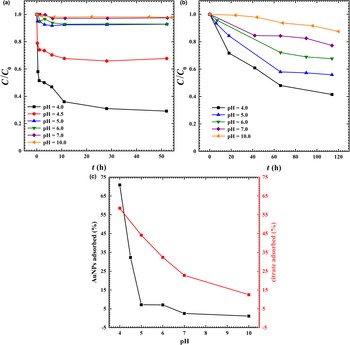
Figure 1a shows the relative concentrations of AuNPs in the supernatant as a function of adsorption time and initial pH. It can be seen that all adsorption experiments at various initial pH values almost attained equilibrium when the adsorption time reached ~30 h, and the adsorption amount decreased with increasing pH. The maximal adsorption (~70%) of AuNPs on illite occurred at the lowest initial pH of 4. At pH > 5, only <10% of AuNPs were adsorbed on illite after 50 h of adsorption, whereas insignificant adsorption of AuNPs was observed at a pH > 7. Such adsorption behaviour is explained through electrostatic interaction between the negative charge of AuNPs and the patch-wise charge on illite. At pH < pHPZC of illite, although the overall electrical interaction between AuNPs and illite (due to its dominant negative charge at basal planes; see Fig. S4a) is still repulsive, the positive charges (i.e. protonated hydroxyl groups) on illite edges provide attractive adsorption sites for negatively charged AuNPs (see Fig. S1a). More importantly, our experiments imply that when AuNPs migrated to the vicinity of the illite edge and possibly with a proper orientation, the repulsion between AuNPs and illite can be overcome and the resulting local net attraction can lead to the favourable adsorption of AuNPs. The adsorption amount would depend on both the repulsive and attractive forces between AuNPs and the heterogeneous structure of illite. Thus, the greatest adsorption took place at pH 4 (among the pH range of 4–10), when the repulsion appeared to be the least (due to lower absolute ζ-potential values for both AuNPs and illite; see Figs S1a & 4a) and the attraction might be greatest (due to greater positive charge at the illite edge; see Fig. S4b). Similarly, when pH increased, the repulsion became stronger while the attraction diminished gradually, leading to a lesser adsorption extent. Finally, when the system pH (e.g. initial pH 7–10) was significantly greater than the pHPZC of illite, the attraction force for AuNPs at the negatively charged illite edge disappeared, and then the AuNPs adsorption became negligible.
(a) Relative residual concentration of AuNPs in the supernatant at various initial pH values as a function of adsorption time. (b) Relative residual concentration of citrate in the supernatant at various initial pH values as a function of pH adsorption time. (c) Adsorbed AuNPs and citrate on illite at various initial pH values.

The adsorption behaviour of citrate alone (c 0: 1 mM, similar to the concentration of the as-synthesized AuNP suspension) on illite was further compared as a function of adsorption time and pH. Figure 1b shows that the adsorption amount of citrate on illite decreased with increasing pH, consistent with the adsorption trend of AuNPs. As citric acid is a triprotic carboxylic acid, the citrate molecule was always negatively charged under our experimental conditions, and its speciation and average charge depended on the pH of the solution. In general, the adsorption behaviour of organic acids can be explained by considering the electrostatic interactions between the carboxylic acid species and the charged surface sites of clay minerals (Ward & Brady, Reference Ward and Brady1998). Similar to the AuNP adsorption mechanism discussed above, a greater pH induces greater repulsion and less attraction between citrate (with more deprotonated species; Ramos & Huertas, Reference Ramos and Huertas2014) and illite (with diminishing positive charges at edge faces), resulting in a reduced adsorption amount of citrate at greater pH values. Such a similar adsorption trend with pH confirms the importance of citrate dissociation on the surface of AuNPs as well as the heterogeneous charging behaviour of illite, therefore reinforcing the related electrostatic mechanism in the adsorption process. Despite the apparent resemblance between AuNP and citrate adsorptions on illite, the percentage adsorption of AuNPs is generally lower than that of citrate (Fig. 1c), which is attributed to the greater repulsion between illite and AuNPs complexed with many citrate surface ligands. As the maximum adsorption amount of AuNPs on illite occurred at pH 4, we will set the initial pH of the suspension to 4 to illustrate the influences of IS, sodium citrate concentration and temperature on the adsorption process in the following sections.
Effect of IS on the adsorption behaviour of AuNPs
IS is known to affect the electrostatic potential of charged particles such as NPs and clay minerals and thus to affect their aggregation and adsorption behaviours (Rawat et al., Reference Rawat, Pullagurala, Adisa, Wang, Peralta-Videa and Gardea-Torresdey2018). Generally, an increase in the solution IS leads to a decrease in both the range and magnitude of the EDL interactions. To elucidate the effect of IS on the adsorption process, we conducted adsorption experiments with controlled IS (through the addition of 0, 5 or 10 mM NaCl) at pH 4 and at a constant solid/liquid ratio of 5 g L–1. As shown in Fig. 2a, the adsorption rate and adsorption amount of AuNPs on illite increased significantly with the addition of NaCl, in agreement with the similar impact of ζ-potential found in previous studies (Saka et al., Reference Saka and Gueler2006; Lu et al., Reference Lu, Lu, Zhang, Shang, Chen and Wang2019). At a concentration of 10 mM added NaCl, ~94% of AuNPs were removed from the suspension within just 0.5 h. Such a sharp influence of IS on the adsorption process can be explained in terms of the following aspects: first, in consideration of the patch-wise charge heterogeneity of illite, the spillover of the illite basal plane EDL to the edge is substantial at low IS and will to some extent shield the edge EDL, thus creating a strong repulsive energy barrier to the approaching AuNPs. At an increased IS, the EDL on the basal plane becomes sufficiently compressed (Fig. 2b) and therefore the attractive EDL on the edge will emerge as a more influential force for the adsorption of more AuNPs (Tombácz & Szekeres, Reference Tombácz and Szekeres2004; Zhou et al., Reference Zhou, Abdel-Fattah and Keller2012). Second, an increase in IS also screens the electrostatic repulsions amongst charged AuNPs, making them less stable and more prone to homoaggregation. Such a promoted homoaggregation of AuNPs by increased IS was also observed in our previous investigations (Luo et al., Reference Luo, Nie, Yang, Fu, Zeng and Wan2018).
(a) Effect of IS (addition of 0, 5 or 10 mM NaCl) on the adsorption of AuNPs on illite. (b) ζ-potential of illite under various IS conditions.

Effect of citrate concentration on AuNP adsorption
As discussed above, citrate exists as a surface ligand that stabilizes AuNPs, and its concentration in our as-synthesized suspension was ~1 mM. As a low-molecular-weight organic anion, citrate has been found in natural environments, including soil, sediments and aerosols, and it can originate from the metabolic processes of plant roots and microorganisms (Ryan et al., Reference Ryan, Delhaize and Jones2001; Braissant et al., Reference Braissant, Verrecchia and Aragno2002). In addition, citrate is often used as a reducing and stabilizing agent in the process of ENP synthesis, and it can be released with ENPs and influence on ENP transformations (Wagener et al., Reference Wagener, Schwenke and Barcikowski2012). Therefore, there is a need to explore the effects of citrate as a representative organic compound on the adsorption of AuNPs on illite. For organic molecules in NP suspensions, both stabilization (due to electrosteric forces) and destabilization (due to bridging) roles have been recorded experimentally, and it is often difficult to predict these interactions (Wang et al., Reference Wang, Adeleye, Huang, Li and Keller2015a; Gallego-Urrea et al., Reference Gallego-Urrea, Hammes, Cornelis and Hassellöv2016; Tang et al., Reference Tang and Cheng2018; Ahmed et al., Reference Ahmed, Rizvi, Ali, Lee, Zaidi, Khan and Musarrat2021). Compared with many other natural organic compounds, such as humic acid, citrate has the advantages of a well-defined and much simpler chemical structure, potentially facilitating the interpretation of its role in adsorption mechanisms.
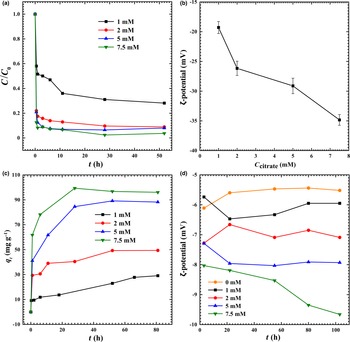
In this work, the citrate concentration was increased from the original concentration of 1 mM in the as-synthesized AuNP suspension to an upper limit of 7.5 mM. It can be seen from Fig. 3a that the adsorption of AuNPs generally increased with increasing citrate concentration. At a citrate concentration of 7.5 mM, nearly full adsorption of AuNPs on illite could be achieved, which is significantly greater than the 70% AuNP adsorption at a citrate concentration of 1 mM. In addition, the time needed to reach the equilibrium c/c 0 value decreased with increasing citrate concentration, indicating an increased AuNP adsorption rate after citrate addition.
(a) Effect of citrate concentration (1.0–7.5 mM) on the adsorption of AuNPs. (b) ζ-potential of AuNPs at various citrate concentrations. (c) The adsorption of citrate on illite at various citrate concentrations (without AuNPs). (d) ζ-potential of illite at various citrate concentrations (without AuNPs).

In general, the stability of NPs in a suspension increases with increasing ligand concentration due to enhanced surface complexation. As shown in Fig. 3b, the ζ-potential of our negatively charged AuNPs did become more negative with increasing citrate concentration, suggesting greater citrate coverage on the surface of the AuNPs (Wagener et al., Reference Wagener, Schwenke and Barcikowski2012). Similarly, the measured adsorption of citrate on illite (Fig. 3c) and thus the absolute value of the illite ζ-potential (Fig. 3d) also increased after citrate adsorption. Such more negative ζ-potential values of both AuNPs and illite should result in greater electric repulsion between particles and contribute to less adsorption of AuNPs. Additionally, the competitive adsorption of citrate on illite edges could also lead to reduced AuNP adsorption. The above mechanisms, although supported by many previous studies (Yang et al., Reference Yang, Yan, Yang, Li, Li and Cheng2013; Wang et al., Reference Wang, Dong, Zhu, Li, Keller, Wang and Li2015b; Dong & Zhou, Reference Dong and Zhou2020; Guo et al., Reference Guo, Wang, Xu, Mao, Zhang and Ghosh2020), do not agree with the observed increased AuNP adsorption at greater citrate concentrations in our work, suggesting that some other role of citrate must be contributing to the improved AuNP adsorption. The well-known destabilizing bridging role is considered minor for citrate in our experiments, as bridging between particles normally occurs with larger organic molecules at relatively low concentrations (Philippe & Schaumann, Reference Philippe and Schaumann2014; Yu et al., Reference Yu, Liu, Yin and Shen2018; Ahmed et al., Reference Ahmed, Rizvi, Ali, Lee, Zaidi, Khan and Musarrat2021). Under high solid/liquid ratio and initial pH conditions, the pH buffering effect of citrate (a tricarboxylic acid anion) deserves attention because pH is a decisive factor in adsorption, and the presence of a large amount of illite is known to cause considerable change in the pH of a system (see Fig. S5). As shown in Fig. S6, the addition of citrate reduced the increase in pH from the initial value (pH 4) to the final value. For example, the final pH became ~4.2 when the citrate concentration was 7.5 mM, compared with the final pH of 4.9 at the original citrate concentration of 1.0 mM. Although this buffering effect may seem to have caused only a small difference in the final pH, the resulting lower pH (at greater citrate concentrations) should be sufficiently favourable to create more positively charged sites at the illite edge (see Fig. S4b), enabling the adsorption of more AuNPs (compared with the effect of an initial pH of 4.0–4.5 presented above). Additionally, an increase in citrate anion concentration increases the IS of the system, which, as shown above, can screen the electrostatic repulsion between negatively charged particles and thus promote their (hetero)aggregation (Johnson & Lenhoff, Reference Johnson and Lenhoff1996; Sadowska et al., Reference Sadowska, Adamczyk and Nattich-Rak2014). Finally, the addition of citrate can facilitate the dissolution of illite (Table S2), which not only significantly increases the IS of the suspension, but also releases some high-valence framework ions, having a strong effect on aggregation according to the empirical Schulze–Hardy rule (Yecheskel et al., Reference Yecheskel, Dror and Berkowitz2019; Dong & Zhou, Reference Dong and Zhou2020) and therefore promoting AuNP adsorption substantially.
Effect of temperature on the adsorption process
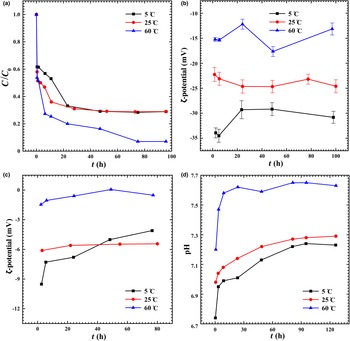
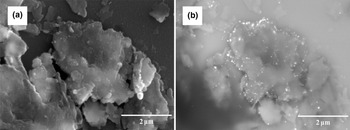
Temperature can affect the thermodynamics and kinetics of adsorption processes profoundly (Freitas & Muller, Reference Freitas and Muller1998; Das, Reference Das2017). Figure 4a shows the overall effect of temperature on the adsorption of AuNPs on illite. Specifically, a significant increase in the adsorption rate during the initial hours of the experiment was found at greater temperatures, which is attributed to the known more rapid kinetics promoted by increased temperature. In addition, when the temperature of the system increased from 5 to 60°C, the equilibrium adsorbed amount of AuNPs on illite increased from ~70% to 95%. Such increased AuNP adsorption on illite with increasing temperature is explained by the following aspects: primarily, it is important to note that the absolute ζ-potential values of AuNPs (Fig. 4b) and illite (Fig. 4c) both decreased with increasing temperature. For example, when the temperature was increased from 5 to 60°C, the ζ-potential values of AuNPs and illite changed from ‒35 to ‒12 mV and from ‒12 to ‒1 mV, respectively. The reduced absolute ζ-potential value of AuNPs with increasing temperature was ascribed partly to the increased pKa value of citric acid, which corresponds to the reduced extent of citric acid dissociation and therefore number of negative charges on the surface of AuNPs (Goldberg et al., Reference Goldberg, Kishore and Lennen2002). In addition, as demonstrated in Table S3, increasing temperature also promoted the dissolution of illite (involving the release of high-valence framework cations), which increased the IS of the suspension and in turn contributed to decreasing the absolute ζ-potential values of both AuNPs and illite. The lowering of absolute ζ-potential values, which reduces the electrostatic repulsion, along with the release of high-valence cations that promote aggregations, made it easier for AuNPs to adsorb on the edges of illite. As shown in Fig. 5, numerous AuNPs were adsorbed on the edge face of illite at 60°C, which is consistent with our previous observations (Fu et al., Reference Fu, Qin, Nie, Li and Wan2020).
(a) Effect of temperature on the adsorption of AuNPs on illite. (b) ζ-potential of AuNPs at various temperatures. (c) ζ-potential of illite at various temperatures. (d) pH changes of illite in deionized water at various temperatures.

SEM images of illite after adsorption of AuNPs at 60°C: (a) secondary electron images, (b) backscattered electron images.

Effect of illite particle size on the adsorption process
Natural mineral particles exist in a range of particle sizes, and these varying sizes could play a role in the AuNP adsorption process. To explore the effect of illite particle size, illite with a greater particle size of ~74 μm was selected for use in adsorption experiments at pH 4–7. Compared with the aforementioned experiments with illite of smaller size (<2 μm), a similar trend in the variation of pH was displayed for the experiments with larger-sized illite particles (see Fig. 6a). That is, the adsorption of AuNPs always decreased with increasing pH. The difference is that the larger-sized illite particles appeared to adsorb fewer AuNPs than the smaller-sized illite particles under the same experimental conditions. At pH 4, compared with 70% AuNP adsorption on the smaller-sized illite, only 40% of AuNPs were adsorbed on the larger-sized illite, whereas at pH 6 (and higher) only <5% of AuNPs were adsorbed on the larger-sized illite (Fig. 6a). The ζ-potential measurements indicated that the larger-sized illite displays approximately two times more negative ζ-potential values than the smaller-sized illite across the whole pH 4–9 range (compare Fig. 6b with Fig. S4a). The reasons for the significant difference in AuNP adsorption between illite particles of various sizes may be twofold: first, the smaller-sized illite exposes more edge sites capable of adsorbing AuNPs; and second, because of there being relatively more positive charges on the exposed edge faces of the smaller-sized illite, the overall ζ-potential becomes less negative and thus exerts less electrostatic repulsion on the approaching AuNPs.
(a) Effect of pH on the adsorption of AuNPs on illite (~74 μm). (b) ζ-potential of illite (~74 μm).

Desorption of negatively charged AuNPs
Whether and to what extent NPs can desorb from mineral surfaces is important, in that desorption behaviour influences the fate and transport of NPs directly and also provides some useful insights into the adsorption mechanism. Thus, we carried out desorption experiments by first obtaining illite from the adsorption suspension (initial pH 4) through centrifugation, and then, with a constant solid/liquid ratio maintained at 5 g L–1, adding deionized water (pH 4) with or without 1 mM citrate to the separated illite. The results of the desorption experiments are shown in Fig. 7. Up to ~9 ppm (slightly more than 20%) of the pre-adsorbed AuNPs were desorbed from illite after exposure to deionized water or sodium citrate solution, implying that the majority of the adsorbed AuNPs might be bonded firmly to the edge sites of illite. In other words, from an energy perspective, we believe that most AuNPs were deposited in the primary energy minima (instead of the secondary energy minima) according to DLVO theory, and the reversible release of such adsorbed AuNPs following changes in solution chemistry is considered improbable. Additionally, Fig. 7 also shows that the amount of AuNPs desorbed in water was greater than that in 1 mM citrate, which demonstrates inhibition of AuNP desorption due to the presence of citrate and is consistent with the result of citrate promoting AuNP adsorption as discussed above.
Au concentration in the supernatant after the desorption experiment.

Conclusion
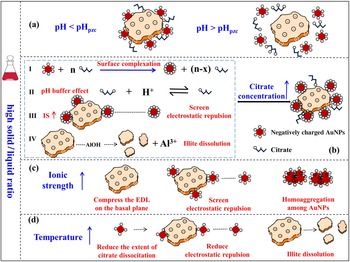
We conducted a systematic study of the adsorption behaviour of negatively charged AuNPs on illite under conditions of relatively high solid/liquid ratios and initial pH. The adsorbed amount of AuNPs, which can vary widely from being negligible (much less than 5%) to nearly complete (up to 100%), was found to decrease with increasing pH or illite particle size and to increase with increasing IS, citrate concentration and temperature. Upon investigation of the effects of the above key factors, a number of complex processes and mechanisms have been identified that control AuNP adsorption behaviour, and the structural and charge heterogeneity of illite have been demonstrated also to play a substantial role. Under our experimental conditions, the suspension pH can be changed significantly with the presence of illite through interlayer cation exchange, edge face hydroxyl protonation and dissolution. The suspension pH and other solution chemistry parameters (IS, citrate concentration, etc.) modulate the electrostatic interaction between illite and AuNPs, which is considered to be the dominant mechanism in the AuNP adsorption process (as summarized in Fig. 8). At pH values greater than the pHPZC, both the basal plane and edge face of illite are negatively charged, and the electrical repulsion between illite and negatively charged AuNPs is strong enough to prevent any significant adsorption. However, at pH values lower than the pHPZC, the illite edge becomes positively charged, resulting in electrostatic attraction and considerable adsorption of AuNPs at the edge sites. The addition of salt to the suspension either directly or through the dissolution of illite (promoted by increased temperature or citrate concentration) can suppress the EDL repulsion between particles and thus facilitate the adsorption and aggregation processes. The pH buffering role of citrate is also proposed to contribute to the increased AuNP adsorption at greater citrate concentrations. Finally, our desorption experiments suggest that most adsorbed AuNPs are bonded strongly with illite, possibly in the primary energy trap. The results from this work are expected to provide new and valuable information applicable to many natural and engineering processes that involve migration and enrichment of elements in NPs. Based on the findings of this work, future studies could aim to further predict or optimize NP adsorption processes to expand the application of clay minerals and NPs in environmental management, catalysis, photoreactions, biomedicine and other fields.
Schematic representation of the mechanism of adsorption of negatively charged AuNPs under various conditions: (a) pH, (b) citrate concentration, (c) IS, (d) temperature.

Financial support
This work was supported financially by the National Natural Science Foundation of China (4187020909 and 42162006) and the Strategic Priority Research Program of Chinese Academy of Sciences (No. XDB 41000000).
Conflicts of interest
The authors declare none.
Supplementary material
To view supplementary material for this article, please visit https://doi.org/10.1180/clm.2023.23.