Introduction
A diagnosis of CHD, and especially complex CHD that requires surgical intervention with cardiopulmonary bypass in the first year of life, is often life-changing for families and associated with caregiver depression, anxiety, and stress in 30–80% of parents. Reference Kolaitis, Meentken and Utens1 Parental mental health challenges can have deleterious effects on neurodevelopmental, behavioural, and social-emotional outcomes in their children. Reference England and Sim2–Reference Zhang, Luo and Ji4 With increasing rates of prenatal detection of CHD, Reference Quartermain, Pasquali and Hill5 there is a focus on the impact of a prenatal diagnosis on maternal mental health during pregnancy.
The American College of Obstetricians and Gynaecologists and the American Academy of Paediatrics both recommend screening for perinatal and post-partum depression both during pregnancy and routinely for six months after birth. Reference Earls6,7 However, implementing parental mental health screening, communicating results, and coordinating follow-up care across different settings (primary care and specialty care) can be challenging. Barriers to screening include timing and process of screening, documentation, social work resources, connecting families to community resources, communication with their primary care provider, and symptom under-reporting. Reference Webb, Uddin and Ford8 Perhaps because of these barriers, rates of prenatal screening for pregnant persons are around 20% nationwide. 9 Screening for parental mental health is a critical first step to providing adequate mental health care for parents and caregivers of children with CHD.
There is a growing body of evidence that suggests a link between mental health and social risk factors. Social risk factors are defined as conditions in one’s social environment that negatively impact risk, such as poverty, housing insecurity, food insecurity, and social isolation. 10 A systematic review identified social support, food insecurity, health literacy, and job strain, among others, to all be associated with depression. Reference Remes, Mendes and Templeton11 Air pollution Reference Pourhoseini, Akbary and Mahmoudi12 and the occurrence of multiple social risk factors (intimate partner violence, low social support, food insecurity, and housing insecurity) during the prenatal period have been associated with higher rates of post-partum depression. Reference Blebu, Jackson, Reina, Dossett and Saleeby13
We sought to determine the need for, and feasibility and acceptability of, outpatient parental mental health screening in two paediatric cardiology clinics at a freestanding paediatric hospital located in the Western United States. We also explored the relationship between social risk factors and parental mental health.
Study design and methods
Setting and patient population
This single-centre, prospective, pilot study assessed the feasibility and acceptability of parental mental health screening in two outpatient clinic settings: the Fetal Heart Program Clinic (fetal clinic) and the Cardiac Neurodevelopmental Clinic (Neurodevelopmental Clinic). The fetal clinic focuses on early fetal detection of CHD, prenatal planning, and expedient management after birth. Ideally, patients are seen multiple times in this clinic for initial diagnosis and then subsequent prenatal planning and management. For this study, pregnant persons carrying a fetus with a confirmed CHD anticipated to require surgical intervention in the first year of life were approached on their second or third visit to the clinic. The Neurodevelopmental Clinic is a multidisciplinary, longitudinal assessment clinic focused on neurodevelopmental outcomes for children with complex CHD. Children are seen 1–4 times in clinic, with goal time points being 6–12 months, 18–36 months, 4–6 years, and 8–13 years of age. In the neurodevelopment clinic, we approached primary caregivers of children seen in the clinic. Participants were excluded if they spoke a language other than English or Spanish, declined to consent, or refused to share screening results with their primary care provider. Parents in the fetal clinic were enrolled in the pilot phase of this project from August 2022 to January 2023. After October of 2023, the screener was fully integrated as a standard of care practice in the fetal clinic. For the Neurodevelopmental Clinic, enrolment took place between August 2022 and January 2024, with a break in enrolment due to social work availability from December 2022 to November 2023. Data from August 2022 to January 2024 is included in this analysis.
Screening tools
The screening tools used included a demographic survey (covering current or previous mental health diagnosis or services), parental mental health screening instruments, a social risk factor screener, and an acceptability survey. Parental mental health in both clinics was assessed using the Depression Anxiety Stress Scales, Short Form, Reference Brown, Chorpita and Korotitsch14 a 21-question, self-report tool designed to measure depression, anxiety, and stress symptom experiences. The Depression Anxiety Stress Scales, Short Form, demonstrates high internal consistency, test–retest reliability, structural validity, and concurrent validity. Reference Brown, Chorpita and Korotitsch14 This form generates 3 graded subscale scores (depression, anxiety, and stress), which are categorised as either normal, mild, moderate, severe, or extremely severe symptom experience. Scores in the moderate, severe, and extremely severe categories for any subscale score were considered a positive screen.
Pregnant persons in the fetal clinic also completed the Edinburgh Postnatal Depression Scale, Reference Cox, Holden and Sagovsky15 a 10-item self-report tool that is the gold standard for assessing depression in the perinatal period. Scores range from 0 to 30, and a score of 12 and above was found to have optimal sensitivity and specificity for detecting depression. Reference Cox, Holden and Sagovsky15,Reference Cox16
Participants also completed the Protocol for Responding to & Assessing Patients’ Assets, Risks & Experiences screener, Reference Weir, Proser and Jester17 an electronic evidence-based, validated screening tool to screen for social risk factors, commonly referred to as the PRAPARE Screener. The scoring algorithm generates a positive or negative result and actionable interventions, which are meant to be implemented by clinic personnel.
Finally, participants completed the Acceptability of Intervention Measure, a four-item scale that demonstrates content validity, reliability, structural validity and invariance, known-group validity, and responsiveness to change. Reference Weiner, Lewis and Stanick18 The Acceptability of Intervention Measure was removed from the screening tools once these tools were considered standard of care.
Study procedures
Study personnel confirmed the eligibility of potential participants in both clinics and approached eligible caregivers to explain the study and obtain informed consent. If caregivers agreed to participate, they scanned a QR code with their phone and completed all aspects of the screener while in the clinic. All people approached for the study, regardless of consent, were given general information and resources related to parental mental health in CHD, including contact information for the clinic social worker. If participants screened positive on one of the mental health screeners, they were approached by the clinic social worker, who reviewed results, discussed current needs and resources, and made referrals to appropriate resources during the clinic or within 24 h. A letter with the results of the screener was also sent to the participant’s primary care provider via electronic or paper letter. Social work remained available for further support and assistance to individuals.
Outcomes of interest
Outcomes of interest from the screener included rates of positive mental health screens and the proportion of participants with a positive screen not currently accessing mental health services. Rates of social risk factors and the relationship between those risks and mental health screener results are another outcome explored. We assessed feasibility by tracking the standard workflow and follow-up by social workers within each clinical setting. Time with participants and time spent on documentation were collected. Lastly, acceptability was assessed by (1) evaluating the rate of participant consent and (2) scores on the Acceptability of Intervention Measure.
Statistical analysis
Descriptive statistics from each clinic setting were generated to describe the study population, rates of positive parental mental health screening, rates of social risk factors, feasibility, and acceptability. Summaries were presented as medians (interquartile ranges, IQR) for continuous variables and counts [percentages] for categorical variables. Results between participants with and without a positive mental health screening result were compared using the chi-square test and the Mann–Whitney U test. Significance was considered as a p < 0.05. All statistics were conducted using SPSS version 28.0.0.
Results
Participant demographics
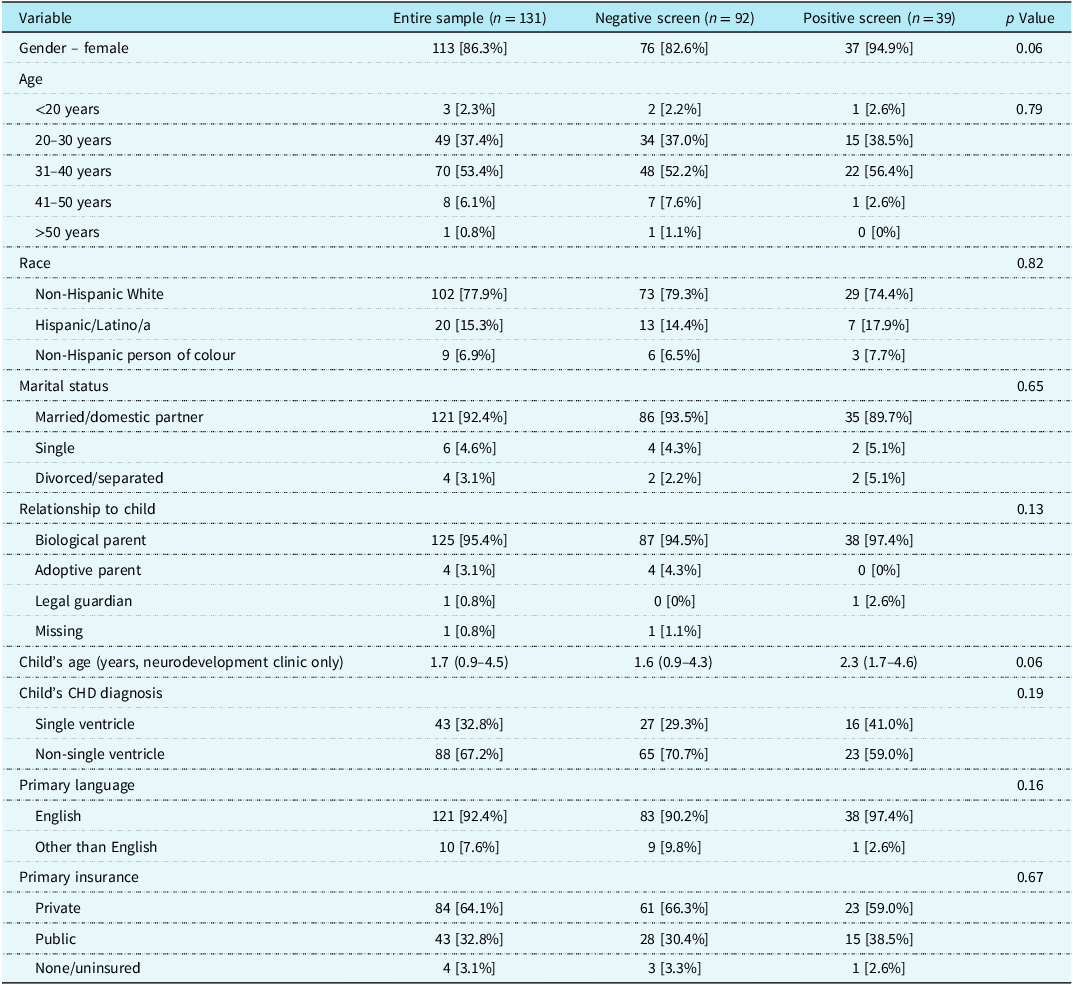
A total of 136 participants were enrolled; however, five of the enrolled participants completed neither mental health screener and were excluded from analysis. Thus, a total of 131 participants were included, with 77 participants in the neurodevelopment clinic and 54 in the fetal clinic. Participants were predominantly non-Hispanic White and female and spoke English as their preferred language, which matches the general demographics of the patients served in our healthcare system. Additionally, most participants were married and were the biological parent of the child being seen in the clinic. Approximately a third of children had a single ventricle cardiac diagnosis, and children in the neurodevelopment clinic had a median age of 1.7 years at the time of parental mental health screening (range = 0.7–12.2 years). Participant demographic characteristics can be found in Table 1.
Participant demographics (n = 131) presented as N [%] or median (IQR)

Table 1. Long description
A table presenting participant demographic characteristics for a study involving 131 participants. The table has 12 rows and 5 columns. The columns are labeled Variable, Entire sample (n = 131), Negative screen (n = 92), Positive screen (n = 39), and p Value. The rows include variables such as Gender, Age, Race, Marital status, Relationship to child, Child’s age, Child’s CHD diagnosis, Primary language, and Primary insurance. Each row provides the count and percentage for each category within the entire sample, negative screen, and positive screen groups, along with p-values for statistical significance. Notable trends include a higher percentage of females, non-Hispanic White participants, married individuals, and biological parents. The median age of children in the neurodevelopment clinic is 1.7 years, and approximately a third of children have a single ventricle cardiac diagnosis.
Mental health screening results
At the time of screening, 35.9% of participants reported they had a current mental health diagnosis, 25.2% were receiving mental health services (including therapy, medication, or some other form of treatment), and 29.8% of participants were interested in receiving mental health services. These rates were similar in both clinics, with a nonsignificant trend toward higher rates of mental health diagnoses and interest in mental health services in the neurodevelopment clinic (Supplement 1).
Overall, 30% (n = 39) of participants screened positive on the mental health screener. Across both clinics, 131 participants completed the Depression, Anxiety, and Stress Scale, Short Form, and 27% (n = 35) screened positive on at least one domain. Positive screening rates in the anxiety, depression, and stress subscales were 15% (n = 20), 16% (n = 21) and 18% (n = 23), respectively. In the fetal clinic, 53 participants completed the Edinburgh Postnatal Depression Scale, and the rate of positive screening was 11% (n = 6). Rates of positive screens on the Depression Anxiety Stress Scales, Short Form anxiety, and stress subscales were similar between clinics, while the rate of positive depression screens on the Depression Anxiety Stress Scales depression subscale was higher in the neurodevelopment clinic than the fetal clinic (Supplement 1). Among all participants with a positive mental health screen, 36% did not have a previous mental health diagnosis, most were not currently receiving mental health services (64%), and more than half were interested in receiving mental health services (54%).
We found no difference in the rates of positive mental health screens between any demographic groups. There was a trend toward significance for gender (p = 0.06), with female participants demonstrating a higher rate of positive screening than male participants. Additionally, the child’s age was marginally higher (p = 0.06) among parents with a positive screen than compared with parents who screened negative among neurodevelopment clinic participants (Table 1).
Social risk factor prevalence and relationship with parental mental health
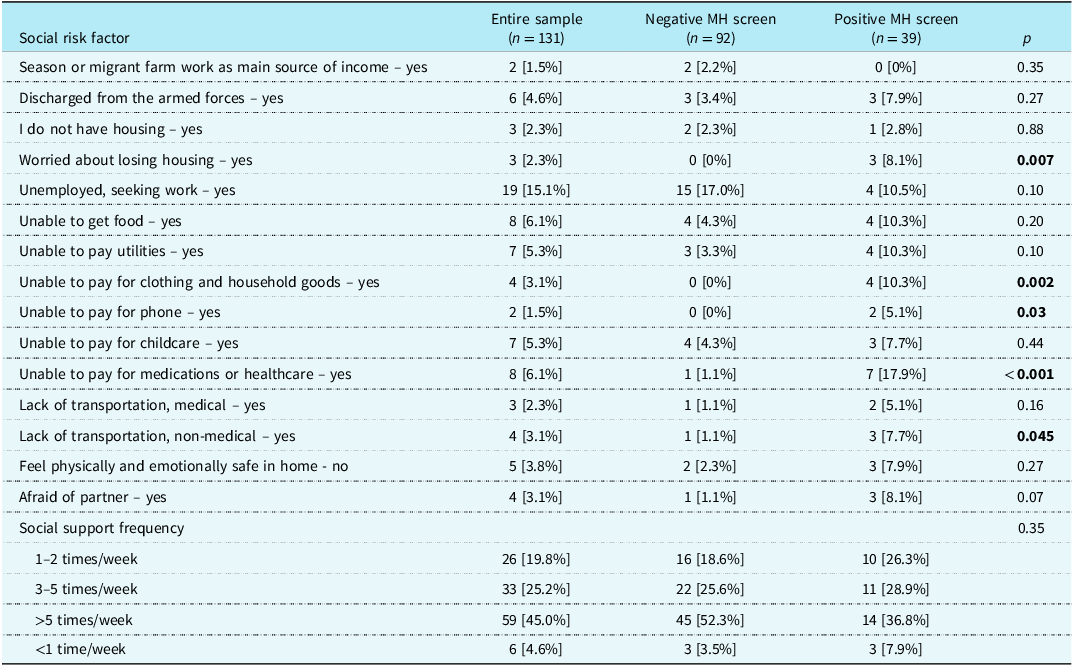
Participants in this sample reported low rates (<10%) of social risk factors, including fear of losing housing or inability to afford food, utilities, clothing, a phone, childcare or healthcare, or domestic violence concerns. Additionally, 15% of the sample were unemployed and seeking work. Finally, the overall sample generally reported moderate to high levels of social support. Despite the low rate of social risk factors, there were some differences between groups based on parental mental health screener results (Table 2). Participants with a positive mental health screen result reported higher rates of worry about losing housing (0% vs. 8%, p = 0.007), inability to pay for clothes and household items (0% vs. 10%, p = 0.002), phone bills (0% vs. 5%, p = 0.03), medications or healthcare (1% vs. 20%, p < 0.001), and higher rates of lack of non-medical transportation (1% vs. 7.5%, p = 0.045).
Social risk factors by mental health screening result N [%]

Table 2. Long description
The table presents data on social risk factors across different groups based on mental health screening results. It has 13 rows and 5 columns. The columns are labeled as follows: Social risk factor, Entire sample (n = 131), Negative MH screen (n = 92), Positive MH screen (n = 39), and p. The rows list various social risk factors and their corresponding percentages for each group. Notable trends include higher percentages of worry about losing housing, inability to pay for clothes and household items, phone bills, medications or healthcare, and lack of non-medical transportation in the Positive MH screen group compared to the Negative MH screen group.
Missing Data by row and columns: Seasonal or migrant work: 4, 3, 1; Armed Forces: 4, 3, 1; No housing: 8, 5, 3; Worried housing: 6, 4, 2; Unemployed: 0, 0, 0; Food: 0, 0, 0; Utilities: 0, 0, 0; Clothing/Household goods: 0, 0, 0; Phone: 0, 0, 0; Childcare: 0, 0, 0; Medications/Healthcare: 0, 0, 0; Transportation, medical: 0, 0, 0; Transportation, non-medical: 0, 0, 0; Safe at home: 5, 4, 1; Fear of partner: 6, 4, 2; Social Support: 7, 6, 1.
Bolded values are significant at the level of < 0.05.
Feasibility and acceptability
Overall, 157 individuals were approached to participate, and 20 declined participation. Of the 136 who consented, 131 went on to complete all aspects of the screening tools and were included in the results, which resulted in an overall participation rate of 83%. The participation rate was similar between the fetal clinic (84%) and the neurodevelopment clinic (89%). The reasons for declining participation were lack of time (n = 15), uninterested in mental health screening (n = 8), already receiving mental health services (n = 1), or uninterested in sharing results with my primary care provider/not having a current primary care provider (n = 1).
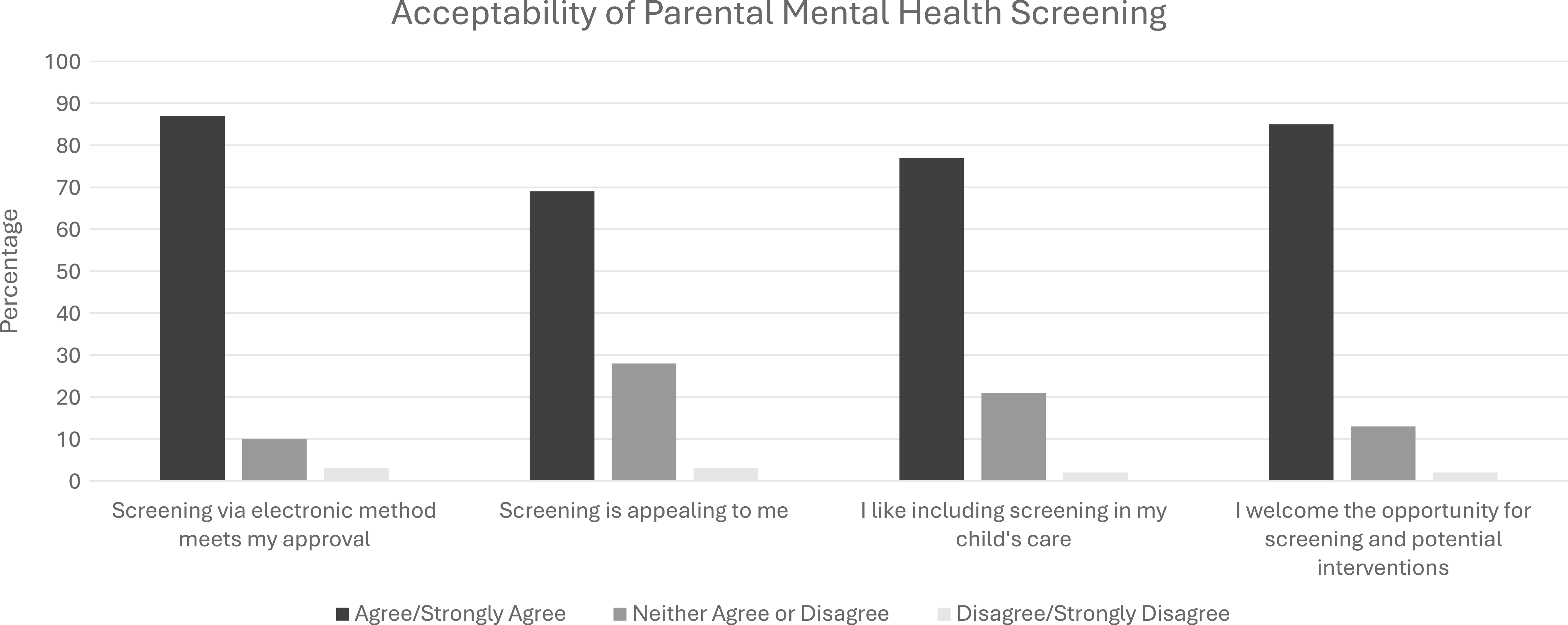
Among the 39 participants who had a positive screen, 87% (n = 33) received follow-up from the clinic’s social worker within 24 h. The social worker was able to send a primary care provider notification letter for all but one of the parents with a positive screening result due to inaccurate contact information. The clinic social worker spent 34 minutes on average (range = 7–110 min) completing screener follow-up counselling and referral for participants. The acceptability measure was completed by 93 participants during the pilot phase of the study. Acceptability was high, with most participants stating that they either agreed (36–40%) or strongly agreed (34–48%) to the four acceptability questions related to parental mental health screening (Fig 1).
PMH.

Figure 1. Long description
The bar graph presents data on acceptability of parental mental health screening. It has 4 acceptability questions, each divided into the 3 likert scale categories of agree/strongly agree, neither agree or disagree, and disagree/strongly disagree. Notable trend across all questions in the ‘agree/strongly agree’ response.
Discussion
Prior work demonstrates a high prevalence of mental health concerns among parents of children with CHD and advocates for the integration of PMH screening and services within the child’s cardiac care setting. Reference Sood, Lisanti and Woolf-King19 Our study aimed to examine the current rates and needs of our population as well as determine the feasibility of including this type of screening within CHD outpatient clinic settings. This study supports prior work that demonstrates a high prevalence of mental health concerns among parents of children with CHD, Reference Kolaitis, Meentken and Utens1,Reference Sood, Lisanti and Woolf-King19,Reference Woolf-King, Anger, Arnold, Weiss and Teitel20 with nearly a third of parents in our sample screening positive for a mental health concern. Furthermore, parents report challenges with depression, anxiety, and stress both at the time of prenatal diagnosis and during their child’s early years, supporting the recommendation for continued screening for parental mental health concerns from the prenatal through post-partum and early childhood periods. In our sample, no difference in the rates of positive mental health screens or social risk factors between any demographic groups was identified, highlighting the importance of universal screening in this population. Our study demonstrated differences amongst participants who self-reported a mental health diagnosis and those who screened positive on a screener in the clinic. While these differences are expected given the nature of screening tools, it also reiterates the importance of asking about mental health in multiple ways to more effectively identify challenges.
In addition to demonstrating a need for parental mental screening in our population, our study demonstrates that it is feasible and acceptable to include screening as part of the child’s CHD care. The high enrolment rate and disclosure of desire for mental health services demonstrate, first, that CHD care settings may be an appropriate location for mental health screening and, second, that this screening is filling a gap in mental health care services. Screening is just the first step in a complex process of addressing parental mental health, which may require ongoing evaluation and treatment. Clinics that choose to integrate parental mental health screening into the care process should ensure that adequate support is available for counselling and referral, considering that this process took half an hour on average. Though we chose to utilise clinic social workers to provide counselling and referral, other healthcare providers (nurses, doctors, and advanced practice providers) could be provided with the training to assess and discuss parental mental health needs in the CHD population if a social worker is not available. Importantly, this pilot study relied solely on social workers to address identified mental health needs, and it was paused for 6 months due to a temporary lack of social work availability. Additionally, since the number and duration of prenatal and postnatal CHD clinic visits are limited, we recommend collaboration with the parent’s primary care providers or strong community partnerships to coordinate impactful and necessary long-term care and follow through for identified mental health needs.
Limitations
It has been well documented that unmet social needs impact a person’s overall health and wellbeing. 10 This study assessed both social risk factors and parental mental health with the understanding that one cannot effectively intervene in one without addressing the other. We are limited in our ability to draw definitive conclusions regarding the link between social risk factors and mental health due to our relatively small sample size and low prevalence of social needs. This low prevalence of social needs may be driven by known inequities in the likelihood of receiving a prenatal diagnosis Reference Davtyan, Ostler, Golding and Sun21 or attending outpatient neurodevelopmental follow-up. Reference Ortinau, Wypij and Ilardi22 Expecting parents without health insurance, in rural areas, experiencing housing instability, or experiencing severe mental health distress during pregnancy all likely experience barriers to accessing comprehensive prenatal care. Similarly, enrolled families seen in the neurodevelopmental follow-up clinic may also not fully represent the community of families of children with CHD, since families of children with CHD have variable ability to travel to the clinic, take time off work, and navigate healthcare bureaucracy. Despite these limitations, our findings suggest that social risk factors may be associated with a mental health condition (i.e., depression, anxiety, and stress) in this population.
During this study, we were unable to track the outcomes of the referrals to mental health and social supports that were made, to determine whether participants were ultimately connected with services or if our referrals met their needs. Further resource investment is needed to understand the experience of parents seeking mental health services beyond the initial referral and is a vital next step. Both mental health Reference Modi, Orgera and Grover23,Reference Thomeer, Moody and Yahirun24 and social services Reference Park, Quinn and Hurvitz25 are limited throughout the country and differ greatly, depending on factors such as state of residence, Medicaid policy, local programming availability, and rurality. For programmes like this to be successful and impactful, the ability to connect parents to services in their communities and reliable outcome-tracking methods for social and mental health services is key.
Conclusion
Parents of children with CHD experience high levels of stress, anxiety, and depression prenatally and after their child is born. Screening parents of children with CHD for mental health and social needs is acceptable and feasible and uncovered a large number of potentially unmet mental health needs. Given the relationship between mental health and social risk factors, we suggest screening for both mental health and social risk as part of a comprehensive assessment. Despite the strength of this screening rollout and resource referral, ensuring follow-up with appropriate resources remains challenging. A structured approach with consistent resource and referral management and expertise is vital to respond to positive screenings.
Supplementary material
The supplementary material for this article can be found at https://doi.org/10.1017/S1047951126123592.
Acknowledgements
We would like to thank the providers and staff at the Grant Scott Bonham Fetal Center at Primary Children’s Hospital and the Heart Center Neurodevelopmental Program at the University of Utah for their expertise and guidance. We are deeply grateful to all the parents who participated in this study, whose contributions made this work possible.
Financial support
This research was supported by Intermountain Healing Hearts, a non-profit organisation for parents of children with CHD in the Intermountain area, and the University of Utah Study Design and Biostatistics Center, with funding in part from the National Center for Research Resources and the National Center for Advancing Translational Sciences, National Institutes of Health, through Grant UL1TR002538 (formerly 5UL1TR001067-05, 8UL1TR000105, and UL1RR025764).
Competing interests
The authors declare none.
Ethical standard
The authors assert that all procedures contributing to this work comply with the ethical standards of the University of Utah’s guidelines on human experimentation and with the Helsinki Declaration of 1975, as revised in 2008, and have been approved by the Institutional Review Board of the University of Utah.