Introduction
The prevalence of obstructive sleep apnoea (OSA) in paediatric patients ranges from 1 to 5 per cent.Reference Lumeng and Chervin1, Reference Marcus, Brooks, Draper, Gozal, Halbower and Jones2 A common cause of OSA in this population is adenotonsillar hypertrophy, and in otherwise healthy children, adenotonsillectomy is considered the first-line treatment.Reference Suen, Arnold and Brooks3, Reference Lim and McKean4 However, when the indication for adenotonsillectomy is OSA, the risk for post-operative respiratory morbidity increases from approximately 1 per cent to 20 per cent.Reference Richmond, Wetmore and Baranak5, Reference McColley, April, Carroll, Naclerio and Loughlin6 A recognised complication in children undergoing adenotonsillectomy is post-operative respiratory compromise, which includes post-extubation stridor, stertor and tracheal tug.Reference Wilson, Lakheeram, Morielli, Brouillette and Brown7
Paediatric Otrivine® (0.05 per cent xylometazoline hydrochloride) is a commonly used nasal decongestant, which is readily available as a single-use preparation in UK ENT units. It is an alpha-adrenergic agonist that constricts the nasal blood vessels, and subsequently decongests the mucosa of the nose and neighbouring regions of the pharynx.Reference Eskiizmir, Hirçin, Ozyurt and Unlü8 In this pilot study, we investigated how the use of paediatric Otrivine affects outcomes, particularly post-operative respiratory compromise.
Materials and methods
Study design and procedure
A comparative study was conducted of paediatric patients undergoing adenotonsillectomy for OSA (diagnosed clinically) in the ENT Surgery Department, Addenbrooke's Hospital, Cambridge, UK. The study was registered with the Clinical Governance Department of Addenbrooke's Hospital, Cambridge.
All operations were performed by one paediatric ENT consultant (NJ). The control group received no intervention. The intervention group received intra-operative paediatric Otrivine administered at induction using two neuro-patties measuring 1.25 × 1.25 cm, soaked in 4 drops of paediatric Otrivine and inserted into the post-nasal space via each nostril. The neuro-patties were left in situ for 20 minutes whilst the operation proceeded, with tonsillectomy first and then adenoidectomy. Removal of the neuro-patties was confirmed at the end of the procedure, as per the World Health Organization checklist, and there was no nasal trauma as a result of insertion.
All patients received a standardised dose of intravenous steroids (dexamethasone 0.22–0.36 mg/kg), and intra- and post-operative opioids (fentanyl 1–2 µg/kg) titrated to effect, in addition to weight-adjusted non-opioid post-operative analgesia (paracetamol and ibuprofen) as standard. No patient required morphine in the operating theatre or post-operatively. A low dose of fentanyl is used as it is short-acting, and in our experience, as coblation is associated with less pain, a lower dose of fentanyl is required. As part of our standard practice, adenotonsillectomy patients were intubated. Airway choice was based not only on surgical and anaesthetic preference, but also underlying patient morbidities. For children undergoing tonsil surgery, it is our preference to intubate because of co-morbidities and/or low weight or growth centile.
Primary outcomes
Five primary outcomes were measured for the post-operative recovery area during the 60 minutes after extubation. These were: (1) pain, assessed using the Face, Legs, Activity, Cry, Consolability (FLACC) scale; (2) signs of respiratory distress, including hypoxia, tachypnoea, stridor, stertor, wheeze and tracheal tug; (3) whether simple medical intervention was required, such as oxygen supplementation, nasopharyngeal or oropharyngeal airway suctioning, or jaw thrust; (4) whether intermediate medical intervention was required, such as a nasopharyngeal airway adjunct; and (5) whether major medical intervention was required, including non-invasive ventilation, reintubation and ventilation, salbutamol nebulisers, or unplanned paediatric intensive care unit admission.
Data collection
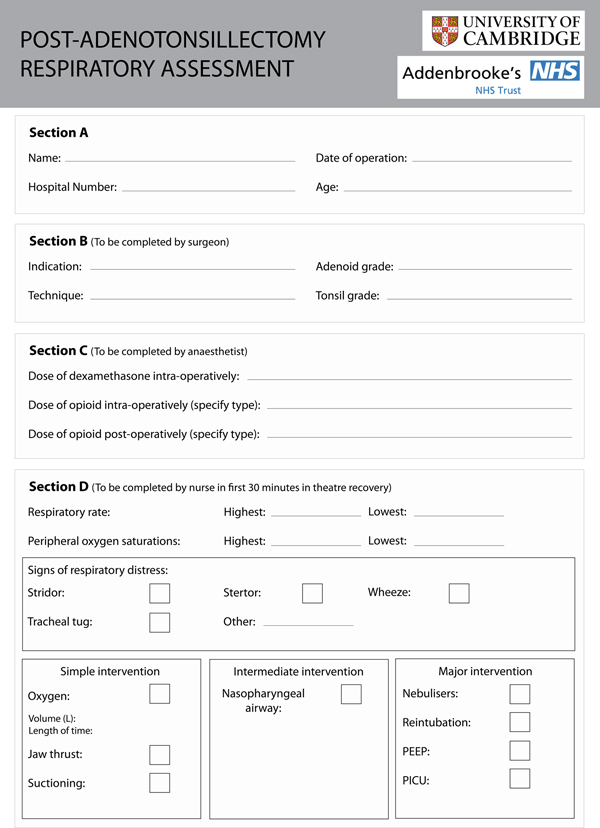
Recovery nurses used the Face, Legs, Activity, Cry, Consolability scale to record outcome 1 (pain) once within the first hour of recovery. Outcomes 2–5 were recorded using a standardised questionnaire, distributed to the primary surgeon, anaesthetist and operating theatre recovery nurse for each case (Figure 1). Other parameters recorded were: the indication for the operation, the technique used, the grades of adenoids and tonsils, and the doses of intra-operative dexamethasone and intra- and post-operative opiates.
Questionnaire used to collect outcome data. PEEP = positive end-expiratory pressure; PICU = paediatric intensive care unit

Results
Participants
Control group
Twenty-four patients received no intervention. The mean age in this group was 50 months (range, 19–102 months). All patients were similar in terms of underlying co-morbidities and American Society of Anesthesiologists physical status grade (grades 2–3).
Three patients had significant co-morbidities that we anticipated may require post-operative care in the paediatric intensive care unit. Of these patients, only two required paediatric intensive care unit admission post-operatively. There was one unplanned post-operative admission in a previously well 33-month-old child, who required post-operative positive end-expiratory pressure in the recovery room, with subsequent monitoring and non-invasive ventilation in the paediatric intensive care unit.
The adenoidectomy technique comprised: suction diathermy, in 33 per cent; coblation, in 46 per cent; and curettage, in 21 per cent. The tonsillectomy technique involved: bipolar diathermy, in 33 per cent; coblation, in 46 per cent; and cold steel dissection and ties, in 21 per cent.
Ten patients had grade 2 adenoids (42 per cent) and 14 had grade 3 adenoids (58 per cent). Six patients had grade 2 tonsils (17 per cent), 14 had grade 3 tonsils (58 per cent) and 4 had grade 4 tonsils (17 per cent).
Intervention group
Twenty-five patients received paediatric Otrivine. The mean age in this group was 48 months (16–103 months). All patients were similar in terms of underlying co-morbidities and American Society of Anesthesiologists physical status grade (grades 2–3).
There were no planned or unplanned paediatric intensive care unit admissions. All patients received bilateral coblation for adenotonsillectomy.
One patient had grade 0 adenoids (4 per cent), 5 had grade 1 adenoids (20 per cent), 8 had grade 2 adenoids (32 per cent) and 11 had grade 3 adenoids (44 per cent). One patient had grade 1 tonsils (4 per cent), 5 had grade 2 tonsils (20 per cent), 9 had grade 3 tonsils (36 per cent) and 10 had grade 4 tonsils (40 per cent).
Outcome data
Pain
Twelve of the control group patients (50 per cent) reported experiencing pain, with a pain score ranging from 2 to 9. Pain was reported in 40 per cent of the Otrivine group (10 patients), with the pain score ranging from 2 to 10.
Respiratory distress signs
Five patients in the control group (21 per cent) were reported to exhibit stridor, stertor and wheeze. One patient in the Otrivine group (4 per cent) was reported to exhibit post-operative signs of respiratory distress.
Simple medical intervention
Ten patients in the control group (42 per cent) required oxygen, suctioning or jaw thrust. Seventeen patients who received paediatric Otrivine (68 per cent) required oxygen, suctioning or jaw thrust.
Intermediate medical intervention
Three patients in the control group (12.5 per cent) required nasopharyngeal airway for airway patency, compared with one patient in the Otrivine group (4 per cent). All four of these patients were noted to have at least grade 2 adenoids and grade 3 tonsils.
Major medical intervention
No patients in the paediatric Otrivine group required a major medical intervention for airway management. Three patients in the control group (12.5 per cent) required major medical intervention; two patients required an anticipated transfer to the paediatric intensive care unit and one patient required unplanned emergent positive end-expiratory pressure non-invasive ventilation. The two patients who required a planned transfer to the paediatric intensive care unit had significant co-morbidities: one patient had a history of atrial septal defect and previous cardiac arrest, and the other had craniofacial and neurological abnormalities including macrocephaly and hydrocephalus necessitating a ventriculoperitoneal shunt. One other patient in the control group with a planned transfer to the paediatric intensive care unit did not require this transfer.
Discussion
Intra-operative paediatric Otrivine is becoming an increasingly popular adjunct for children with OSA undergoing adenotonsillectomy. Several consultant ENT surgeons in tertiary centres around the UK use it, but no study to date has investigated its effect on post-operative respiratory morbidity in paediatric patients undergoing adenotonsillectomy for OSA.
Children with OSA undergoing general anaesthetic are sensitive to airway collapsibility and obstruction post-operatively, with associated morbidity and mortality.Reference Chung, Liao, Yegneswaran, Shapiro and Kang9 Their post-operative sleep architecture is known to change, with reduced sleep efficiency, rapid eye movement sleep and slow wave sleep in the first 24 hours.Reference Chung, Liao, Yegneswaran, Shapiro and Kang9
Additionally, it is known that upper airway neuromotor tone plays a role in OSA in children, and the tone can be increased further in response to a stimulus.Reference Marcus10 It could be postulated that the decongestant and vasoconstrictive effect of Otrivine increases nasal airflow by synergistically working with the anti-inflammatory effect of dexamethasone to provide a beneficial effect for patients post-operatively.
We found that fewer children exhibited signs of post-operative respiratory distress if given paediatric Otrivine intra-operatively when compared with those that did not receive it (4 per cent vs 21 per cent).
In terms of post-operative medical intervention, we found that a greater proportion of the paediatric Otrivine intervention group required simple interventions compared with the control group (68 per cent vs 42 per cent), such as oxygen therapy, suctioning or a jaw thrust airway manoeuvre. However, only one patient in the paediatric Otrivine group (4 per cent) required intermediate intervention (nasopharyngeal airway), and none required major intervention (non-invasive ventilation, reintubation, salbutamol nebulisers or unplanned paediatric intensive care unit admission), compared with three patients (12.5 per cent) requiring both intermediate and major interventions in the control group. It is noted two of the three patients in the latter group had significant pre-existing co-morbidities, which likely contributed to their paediatric intensive care unit admission.
This preliminary study on paediatric Otrivine in adenotonsillectomy for OSA suggests its use can reduce respiratory distress, and decrease the need for post-operative intermediate or major medical intervention. These results warrant greater investigation in terms of the ability to reduce the overall incidence of respiratory compromise following adenotonsillectomy. It has long been accepted that respiratory compromise is the most frequently observed major complication of adenotonsillectomy in children with or without OSA. A recent meta-analysis suggests that the incidence of respiratory complications may be as high as 9.4 per cent across all patient groups.Reference De Luca Canto, Pachêco-Pereira, Aydinoz, Bhattacharjee, Tan and Kheirandish-Gozal11 The incidence is thought to be up to five times higher in children with OSA.Reference Sanders, King, Mitchell and Kelly12 With this in mind, it is wholly possible that this simple, cost-effective intervention could alter the incidence of respiratory complications on emergence from anaesthesia and in the recovery room.
There are limited data in the literature regarding the effects of Otrivine on respiratory function. The use of Otrivine, or xylometazoline, in OSA and nocturnal breathing in adults was investigated in a 2008 study by Clarenbach et al.Reference Clarenbach, Kohler, Senn, Thurnheer and Bloch13 They found that xylometazoline induced an increase in nasal conductance by 70 per cent, associated with its function as a decongestant, and during the periods of maximally improved nasal conductance, the numbers of apnoeic or hypopnoeic episodes and oxygen desaturations were reduced. These findings did not, however, correlate with improved sleep quality; nonetheless, it could suggest the pharmacokinetics involved, as Otrivine showed some benefit on post-operative respiratory morbidity in our study.
El-Seify et al.Reference El-Seify, Khattab, Shaaban, Metwalli, Hassan and Ajjoub14 conducted a study in 2010 on the effect of Otrivine in children undergoing dental surgery, and found that it reduced epistaxis secondary to nasotracheal intubation, likely due to its decongestant effect. Similarly, McCluney et al.Reference McCluney, Eng, Lee and McClymont15 found that Otrivine was just as effective as phenylephrine-lignocaine in reducing bleeding during rigid nasendoscopy.
All our patients underwent adenoidectomy, so it could be hypothesised that the use of Otrivine posteriorly in the nose could contribute to reducing post-operative respiratory morbidity.
• Adenotonsillectomy is frequently performed for obstructive sleep apnoea, but is associated with significant post-operative respiratory morbidity
• This pilot study investigated the effect of paediatric Otrivine on post-operative respiratory compromise in these patients
• Results were promising, with a trend towards reduced post-operative intervention for respiratory compromise in Otrivine patients
Limitations
There are several limitations inherent to our study. This is a pilot study of the effects of Otrivine in paediatric patients following adenotonsillectomy, with a small number of cases and limited data. We appreciate that some of the measured respiratory distress parameters are not specific to upper airway obstruction. For example, stridor can occur after endotracheal intubation, and wheeze can be present in children with lower airway disease. Therefore a further study, namely a large prospective randomised controlled trial, would be necessary to stringently test our hypothesis.
Competing interests
None declared