Second generation antipsychotics (SGAs) have become a standard of care in severe psychotic disorders despite inconsistent evidence on their advantages over first generation antipsychotics (FGAs). It has been maintained that SGAs are at least as efficacious as FGAs in alleviating positive and negative symptoms of illness, but offer improved neurocognitive functioning and adverse effect profile and tolerability. This would suggest better health-related quality of life (HRQoL)—the most important outcome from the patient's point of view. However, while in some studies SGAs have resulted in improved HRQoL as compared to FGAs, in some other studies they failed to do so.
Despite reported ability of stable patients with severe psychiatric conditions to reliably self-rate their HRQoL, these patients' subjective perspective, probably the key aspect of the HRQoL, has been neglected until recently. Furthermore, only few studies (with inconclusive results) have reported the use of subjective, generic measures of HRQoL like Short Form 36 Health Survey (SF-36), Sickness Impact Profile (SIP), or 15D. These instruments, in contrast to the disease-specific ones, permit also comparisons of different medical interventions across different mental and somatic disorders.
On SF-36, outpatients on olanzapine achieved greater change on Mental Component Summary Scores than those on haloperidol (Reference Revicki, Genduso, Hamilton, Ganoczy and Beasley3), but in first-episode patients these two drugs were equal (Reference Strakowski, Johnson and Delbello9). Also regarding other SGAs versus FGAs, the results have been conflicting. On SIP, higher scores on SGAs versus FGAs were reported by some authors (Reference Voruganti, Cortese and Oyewumi10). So far, no SGAs versus FGAs studies with 15D have been published. The positioning of the SGAs-related benefits against those for different medical or surgical interventions has usually not been discussed.
This secondary report from our 12 week randomized, controlled, open parallel group study (Reference Appelberg, Tuisku and Joffe1) set out to test, whether olanzapine will improve the HRQoL of clinically stable but symptomatic outpatients treated previously with FGAs. We also compared the HRQoL of the patients at baseline with that of age-standardized general population.
SUBJECTS AND METHODS
The inclusion and exclusion criteria, as well as descriptive data of the patients and study design have been reported earlier (Reference Appelberg, Tuisku and Joffe1). In brief, FGA-treated stable outpatients with schizophrenia or schizo-affective disorder suffering from residual symptoms or adverse effects, after a complete description of the study gave written informed consent and were randomized to either continue their previous medications or to shift to olanzapine. HRQoL was measured at baseline and at follow-up (12 weeks) by the 15D, a generic, 15-dimensional, standardized, self-administered instrument that can be used both as profile and single index (utility) measure (Reference Sintonen8). HRQoL data were analyzed for all participants whose baseline and follow-up 15D data were available.
Independent samples t-test was used to compare the study subjects' HRQoL with that of age-standardized general population as well as the patient groups at baseline and follow-up. To account for possible differences between the groups in relevant variables at baseline, be the differences statistically significant or not when analyzed individually, the effect of medication on HRQoL at week 12 was estimated with linear regression analysis. The dependent variable was the 15D score at 12 weeks and the explanatory variables were age, gender, body mass index (BMI), time since diagnosis, Positive and Negative Symptom Scale (PANSS), Barnes (akathisia), Clinical Global Impression, severity (CGIs), and the 15D score, all at baseline values, and finally the medication (FGA or olanzapine) used. Pearson correlation was calculated between longitudinal changes in HRQoL and those in relevant clinical parameters. A p ≤ .05 was considered statistically significant.
RESULTS
15D data were available for twenty-one patients in olanzapine and twenty-one patients in FGA groups. The number of dropouts did not differ (four in each group, none due to side effects).
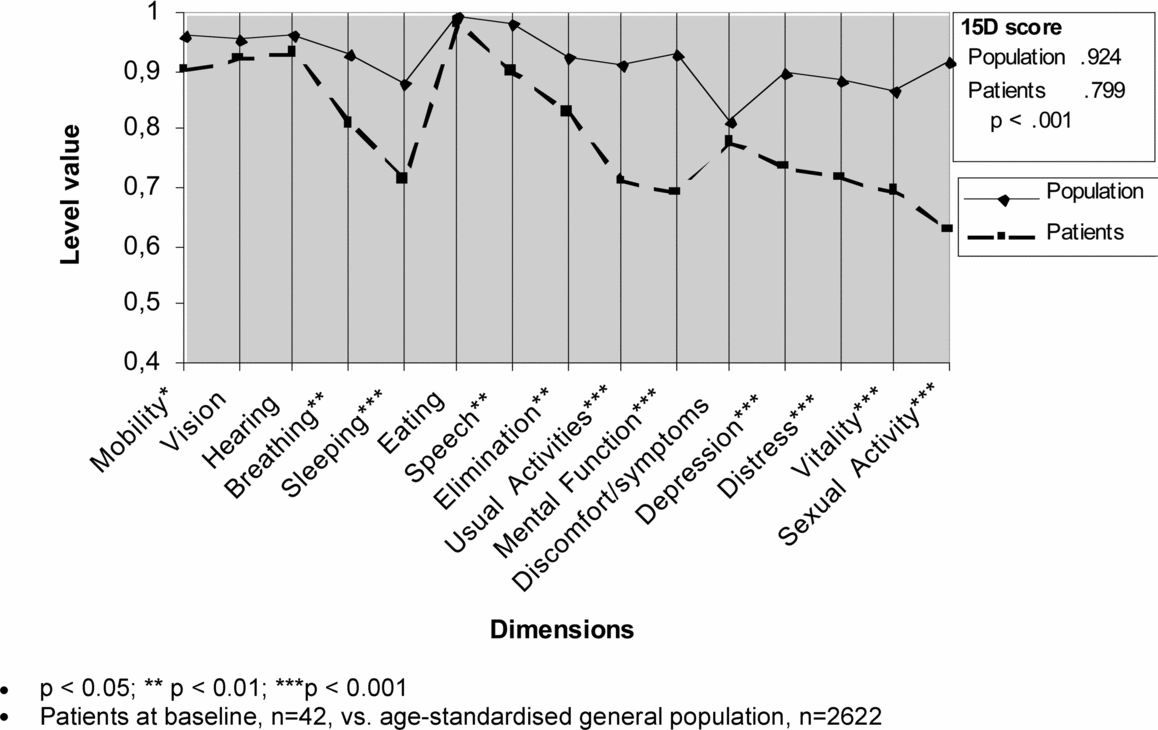
The patients scored at baseline lower than age-controlled general population on a majority of the 15D dimensions and the 15D utility score (see Figure 1).
The 15D profiles and scores of general population and residually symptomatic FGA-treated outpatients with schizophrenia or schizo-affective disorder.

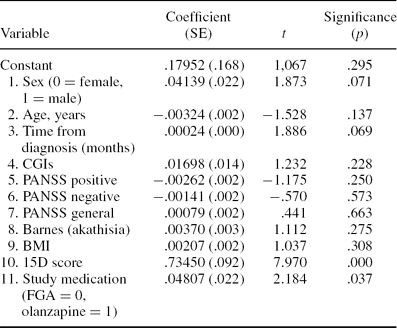
Despite the randomization, there was a statistically significant difference at baseline between the groups in the 15D utility score (but not in other parameters, data not shown). After standardizing for the baseline 15D score and other covariates, the 15D score in the olanzapine group at 12 weeks was 0.048 units higher (on a 0–1 scale) than that in the FGA group (p = .037) (see Table 1).
Regression Analysis for Explaining the Variance in the 15D Score at Week 12 in Patients with Schizophrenia or Schizo-affective Disorder after Continuation of Their FGA Medication (n = 21) or Shift to Olanzapine (n = 21)

Note. Variables 2–10 at baseline.
Prospective changes in the 15D score did not correlate with those in the PANSS, Barnes or CGIs (data not shown).
DISCUSSION
In our FGA-treated outpatients with suboptimal treatment outcome and HRQoL lower than that of general population, shift to olanzapine improved HRQoL, while continuation on the pre-existing FGAs did not. The achieved mean utility score difference of 0.048 (on a 0–1 scale) on olanzapine versus FGA was also clinically important, because the minimum clinically important difference in the 15D score is ±0.03 (Reference Sintonen7).
The olanzapine-related improvement in HRQoL was smaller than that reported for coronary artery bypass or balloon angioplasty (score change 0.11 and 0.10, respectively), but comparable to primary hip replacement (0.05) or cervical or lumbar neurosurgery (0.04 and 0.06), and larger than knee replacement (0.03) or secondary hip replacement or cataract surgery (0.01 each) (Reference Kattainen, Meriläinen and Sintonen2;Reference Räsänen, Öhman and Sintonen4–Reference Räsänen, Paavolainen and Sintonen6).
Of interest, the changes in the 15D score in the olanzapine group did not correlate with changes in psychopathology or neurological adverse effects measures. This might point to an independent beneficial effect of olanzapine on the HRQoL, with mediators still to be established. It is also possible that these variables measure different concepts.
CONCLUSION
HRQoL of stable outpatients with residual symptoms or adverse effects may improve substantially after shift from FGAs to olanzapine.
CONTACT INFORMATION
Grigori Joffe, MD, PhD (grigori.joffe@hus.fi), Director of Profit Unit, Department of Psychiatry, Helsinki University Central, Välskärinkatu 12, 00260 Helsinki, Finland
Harri Sintonen, PhD (harri.sintonen@helsinki.fi), Professor, Department of Public Health, University of Helsinki, P.O. Box 41, Helsinki, 00014 University of Helsinki, Finland
Björn G Appelberg, MD, PhD (bjorn.appelberg@helsinki.fi), Associate Professor, Department of Psychiatry, Helsinki University; Head Physician, Department of Psychiatry, Helsinki University Central Hospital, Välskärink. 12, 00260 Helsinki, Finland