INTRODUCTION
Since the original description of a goblin shark, Mitsukurina owstoni Jordan, Reference Jordan1898, captured off Yokohama, Japan (Jordan, Reference Jordan1898), the species is now known to be wide ranging in the Pacific, Atlantic and Indian Oceans (Compagno, Reference Compagno2001). Despite their wide distribution, goblin sharks are rarely observed, with the exception of Japanese waters, where over 80% of all known specimens have been collected (Rincon et al., Reference Rincon, Vaske and Gadig2012). The first documented occurrence of goblin sharks in the western North Atlantic Ocean is attributed to Kukuev (Reference Kukuev and Parin1982), who described the collection of nine specimens captured between 1976 and 1978 in pelagic trawls conducted at the New England and Corner Rise Seamounts. Since that time, nine additional specimens have been documented in the western North Atlantic Ocean off the coasts of northern Brazil (N = 6; Holanda & Filho, Reference Holanda and Filho2008), French Guiana (N = 1; Uyeno & Sasaki, Reference Uyeno, Sasaki, Uyeno, Matsuura and Fujii1983) and Colombia (N = 1; Grijalba-Bendeck & Acevedo, Reference Grijalba-Bendeck and Acevedo2009), as well as in the Gulf of Mexico (N = 1; Parsons et al., Reference Parsons, Ingram and Havard2002). Whether the paucity of specimens collected in the western North Atlantic Ocean is indicative of a small number of goblin sharks inhabiting the region or is related to relatively limited deep water fishing effort is unknown.
MATERIALS AND METHODS
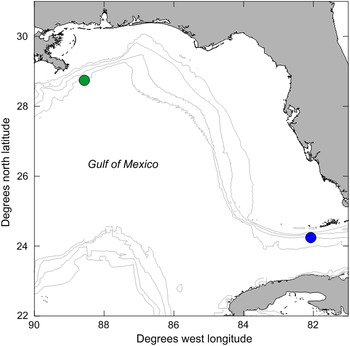
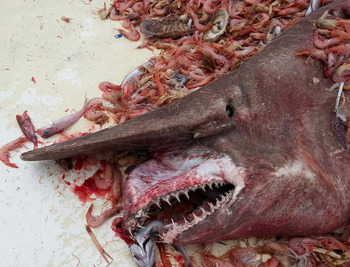
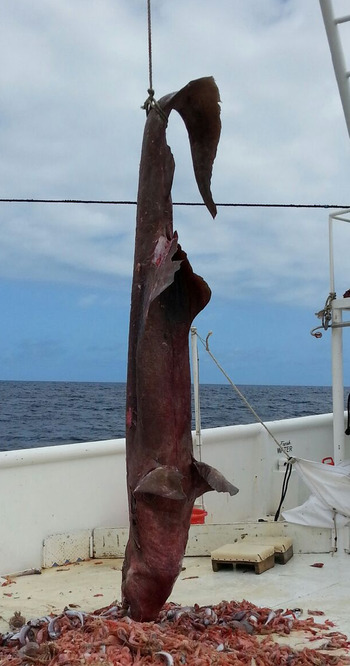
While conducting routine fishing operations on the FV ‘Sea Angel’ at 24o16.60′N and 82o44.80′W, a female goblin shark was captured in an 18 m bottom trawl on 19 April 2014 (Figures 1 & 2). The capture occurred at an approximate depth of 490 m at 0930 hr. After removal from the net, the shark was estimated by an experienced fisherman to be between 4.8 and 5.4 m stretch total length (TL). Due to its level of vigour, it was apparent the shark was alive. A line was quickly secured to the caudal peduncle and the shark was hoisted overboard (Figure 3). The line was then detached and the shark actively swam away. The diameter of the 19 mm line visible in Figure 3 was used to verify the initial length estimate of the shark's TL by comparing the diameter of the line to the shark's pelvic fin base. The morphometric relationship of pelvic fin base length to TL for female goblin sharks provided by Yano et al. (Reference Yano, Miya, Aizawa and Noichi2007) was utilized to calculate the length estimate. Additionally, other organisms captured in the trawl and visible in photographs were identified to the lowest possible taxon.
Capture locations of goblin sharks Mitsukurina owstoni in the northern Gulf of Mexico. Blue circle represents observation reported herein and green circle represents observation reported by Parsons et al. (Reference Parsons, Ingram and Havard2002). The 100, 200, 500 and 1000 m isobaths are displayed.

Head of a live female goblin shark, Mitsukurina owstoni, captured in the northern Gulf of Mexico on 19 April 2014.

Live female goblin shark, Mitsukurina owstoni, being released after capture in a trawl on 19 April 2014 in the northern Gulf of Mexico.

RESULTS AND DISCUSSION
The goblin shark reported herein represents the second goblin shark reported from the northern Gulf of Mexico. Photogrammetric analysis resulted in a pelvic base length estimate of 513 mm. Yano et al. (Reference Yano, Miya, Aizawa and Noichi2007) examined 21 females, ranging in size from 975–1961 mm TL, and reported that pelvic fin base length ranged from 8.08–10.56% of TL. Based on these proportions, the shark reported herein was estimated to be 4,858–6,349 mm TL. The length of the shark was similar to that of the 5,400 to 6,170 mm estimated TL specimen documented by Parsons et al. (Reference Parsons, Ingram and Havard2002). Interestingly, the two goblin sharks collected in the Gulf of Mexico are the largest specimens recorded. For example, Yano et al. (Reference Yano, Miya, Aizawa and Noichi2007) summarized historical catch records of goblin sharks off Japan, and report that specimens collected in this region ranged in size from 1,070–3,730 mm TL. Similarly, Stevens & Paxton (Reference Stevens and Paxton1985) reported a 3,840 mm TL male specimen captured off Australia.
It is not known if the large sizes reported for goblin sharks in the Gulf of Mexico are a result of variability associated with photogrammetric estimates, geographical variability in maximum sizes obtained, size-specific segregation by depth or random chance. However, it is unlikely that random chance or size-specific segregation, are explanatory factors. Parsons et al. (Reference Parsons, Ingram and Havard2002) hypothesized that large goblin sharks could be more associated with benthic rather than pelagic habitats. However, Yano et al. (Reference Yano, Miya, Aizawa and Noichi2007) reported that the largest Japanese specimen (3,730 mm TL) was captured at 270–280 m while a specimen of 1150 mm TL was captured at 600 m in the same locality. Additionally, Prokofiev & Kukuev (Reference Prokofiev and Kukuev2009) reported the captures of a 1,380 mm TL male and a 1,110 mm TL female at 550 m. The large goblin sharks reported by Parsons et al. (Reference Parsons, Ingram and Havard2002) and herein, were captured at approximately 1,000 m and 490 m, respectively. Combined, these data suggest that size-dependent depth segregation does not occur among goblin sharks.
Maximum reported sizes of goblin sharks in the Pacific, Indian and Atlantic Oceans indicate that geographical variability could be the most parsimonious explanation of why the largest recorded specimens have come from the western North Atlantic Ocean. In addition to the large specimens reported by Parsons et al. (Reference Parsons, Ingram and Havard2002) and herein, Kukuev (Reference Kukuev and Parin1982) reported a specimen measuring 4,100 mm TL among the nine he collected. As previously mentioned, the largest goblin shark caught in the Indian Ocean was 3,840 mm TL (Stevens & Paxton, Reference Stevens and Paxton1985) and the largest reported from the Pacific Ocean was 3,730 mm TL (Yano et al., Reference Yano, Miya, Aizawa and Noichi2007). Additional records of goblin shark observations, with corresponding length data, would be needed to determine whether or not there is longitudinal and/or latitudinal variability in the maximum size of goblin sharks.
Coloration of goblin sharks is described as white to pink by many authors (e.g. Compagno, Reference Compagno2001; Castro, Reference Castro2011). Other authors (e.g. Last & Stevens, Reference Last and Stevens2009) describe the coloration of this species as grey to brown, coloration that Compagno (Reference Compagno2001) and Yano et al. (Reference Yano, Miya, Aizawa and Noichi2007) attributed to preservation. Based on the observation of Rincon et al. (Reference Rincon, Vaske and Gadig2012) that recently captured goblin sharks are dark pink and the dark pinkish-brown coloration of the specimen described herein (Figures 2 & 3), it is apparent that the coloration of live goblin sharks can widely vary.
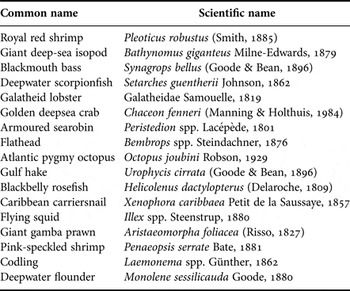
The diet of goblin sharks has been described to include a wide range of prey, including cephalopods, crustaceans and fish; however, off Japan, approximately 60% of the diet is reported to consist of teleosts (Yano et al., Reference Yano, Miya, Aizawa and Noichi2007). In the current study, potential prey species captured in the trawl consisted of at least 17 taxa (Figure 2; Table 1). We were not able to examine the stomach contents of the shark and do not know if the shark was caught while the trawl was fishing on the bottom or was captured during the descent or ascent of the gear. However, if goblin sharks forage on benthic prey, as suggested by Parsons et al. (Reference Parsons, Ingram and Havard2002) and Castro (Reference Castro2011), then the assemblage of species reported in the current study should be representative of available prey species in the area of capture.
Species composition of fauna collected in trawl with a goblin shark, Mitsukurina owstoni, in the northern Gulf of Mexico.

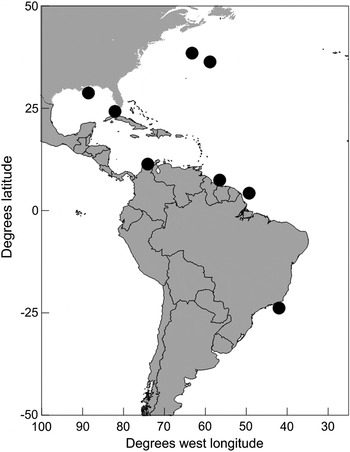
Despite a paucity of data, there appears to be a continuous distribution of goblin sharks in waters of the western Atlantic Ocean in areas associated with slope waters and areas of high relief (e.g. New England Seamounts) (Figure 4). While the distribution could be interpreted as disjunct, particularly between southern and northern Brazil, French Guiana and the northern Gulf of Mexico and the Gulf of Mexico and the northernmost observations in the North Atlantic, a pattern is emerging. Furthermore, because these sharks occupy relatively deep-water habitats, it is likely that the stable abiotic parameters associated with such habitats would allow unrestricted movement among regions. As human activity, such as petroleum industry activity and fishing effort, increases in offshore environments, the distribution of widely ranging deep-water species, such as goblin sharks, will come into greater focus. Such an understanding will only be possible through collaborative work and open lines of communication between biologists and those regularly interacting with deep-sea fauna.
Documented occurrences of goblin sharks, Mitsukurina owstoni, in the western Atlantic Ocean. Black circles represent location of goblin sharks reported in the primary literature. See text for references.

ACKNOWLEDGEMENTS
We thank the crew of the FV ‘Sea Angel’ for assistance in the capture and release of the shark. We also thank K. Rademacher for identifying deep-water organisms captured in the trawl.