

INTRODUCTION
During the de-institutionalisation era of psychiatric care in the UK, many long-stay wards were replaced with open and less restrictive acute wards. Psychiatric Intensive Care Units (PICUs) developed as a pragmatic response to the need for safe and therapeutic care of patients displaying particularly disturbed behaviour. PICUs originally evolved to meet the needs of local psychiatric services, without national guidance. By the late 1980s PICUs were varyingly admitting patients from local acute open wards, known problematic patients directly from the community and permanently disturbed patients who could not be safely managed elsewhere. They also admitted patients from the courts (usually following conviction for minor offences; Bowers et al., Reference Bowers, Jeffery, Bilgin, Jarrett, Simpson and Jones2008).
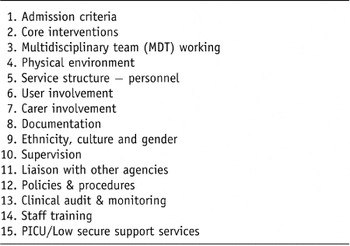
In a national survey, Beer et al. (1997) found that PICUs varied in many aspects of structure and function, including size, level of security, admission of informal patients, and length of patient stay. Concerns were also highlighted regarding the lack of local policies and guidelines for admission and treatment (Pereira et al., Reference Pereira, Beer and Paton1999). There have since been attempts to standardise the practice of UK PICUs in order to provide consistent and high levels of care. In particular, the Department of Health (2002) published a policy implementation guideline on national minimum standards (NMS) of care. This provided a comprehensive framework of design and care delivery for PICUs and low secure units. The NMS are organised into 15 sections (Table 1). Each section is divided into: rationale for developing standards of that nature, the standards pertaining to the topic and any related good practice guidance. This supplies transparency with regards to expectations and gives practitioners, commissioners, patients and their carers a framework for discussion.
Sections within the national minimum standards (NMS)

Further attempts have since been made to improve clinical governance and enable PICUs to meet these standards. The Department of Health has allocated funding to upgrade the physical environment of PICUs and low secure units, to meet the NMS (Pereira et al., Reference Pereira, Chaudhry, Pietromartire, Dale and Halliwell2005a). The National Association of Psychiatric Intensive Care Units (NAPICU) established a national Governance Network (Dye et al., Reference Dye, Johnston and Pereira2005) and the Royal College of Psychiatrists introduced an accreditation scheme that monitors individual participating units against set criteria (Cresswell et al., Reference Cresswell, Beavon and Glover2009). This should provide some impetus to greater uniformity but to date there is little published data determining the extent to which the NMS are being met by PICUs in the UK.
A survey of 17 London PICUs units using a census questionnaire found that none of the PICUs included met the full NMS standards (Pereira et al., Reference Pereira, Sarsam, Bhui and Paton2005b). A subsequent national survey (Pereira et al., Reference Pereira, Dawson and Sarsam2006a; Pereira et al., Reference Pereira, Dawson and Sarsam2006b) employing a similar design, compared 170 PICUs and again identified ongoing inconsistency in areas of operation and standards of care. In particular, more than a quarter of patients were defined as being delayed in their discharge and a further 20% defined as likely to experience a delay in their discharge. This data set was accurate as of June 2002 (one month after publication of the NMS) and thus represents a useful baseline point from which to measure any improvements. Chaudhry and Pereira (2009) used the same data set to compare NHS PICUs against independent providers, revealing differences in facilities, provision of treatment and length of stay (the average for NHS facilities was 23 days and for independent providers, 128 days). Neither type of unit appeared to be fully compliant with NMS standards (for example 62% of NHS PICUs were willing to admit informal patients and 37% were willing to accept patients with a primary diagnosis of learning disabilities).
The present paper describes prospective data for 332 people admitted consecutively to seven English PICUs with an objective to determine adherence to a set of standards based upon a subset of NMS criteria.
METHODS
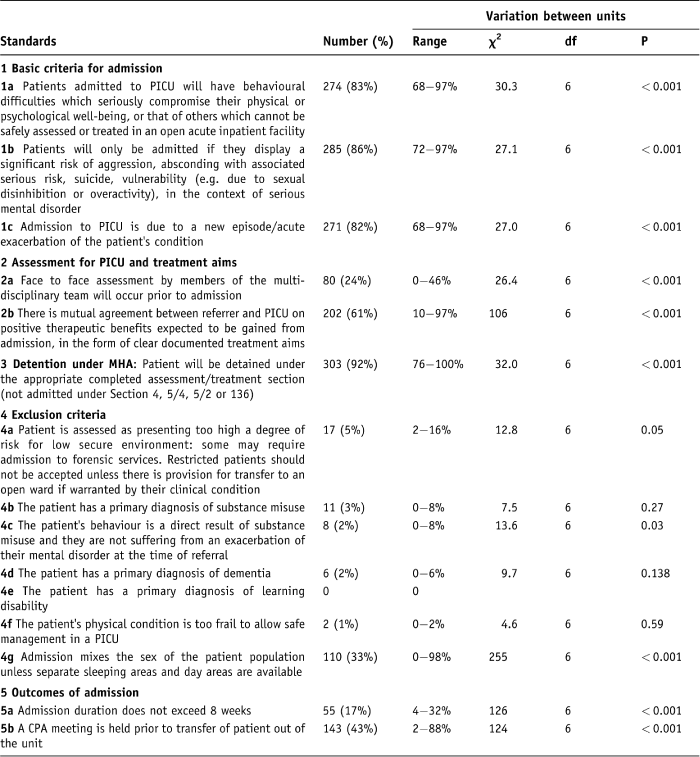
Seven different English PICUs planned to collect data prospectively on 50 consecutive admissions from 2006. The participating units were all members of NAPICU. Six were NHS facilities, one was not. Five admitted patients of either gender, two admitted only males. Standards based on a subset of the Department of Health NMS and deemed to be a priority were chosen by a steering group of representatives from each participating unit. Data were recorded on a semi-structured pro-forma, by a designated clinician at each site, indicating whether each of these standards was met for each patient. The standards examined are described in Table 2. Further details of the units, data collection procedure and patients are described by Brown et al. (2008).
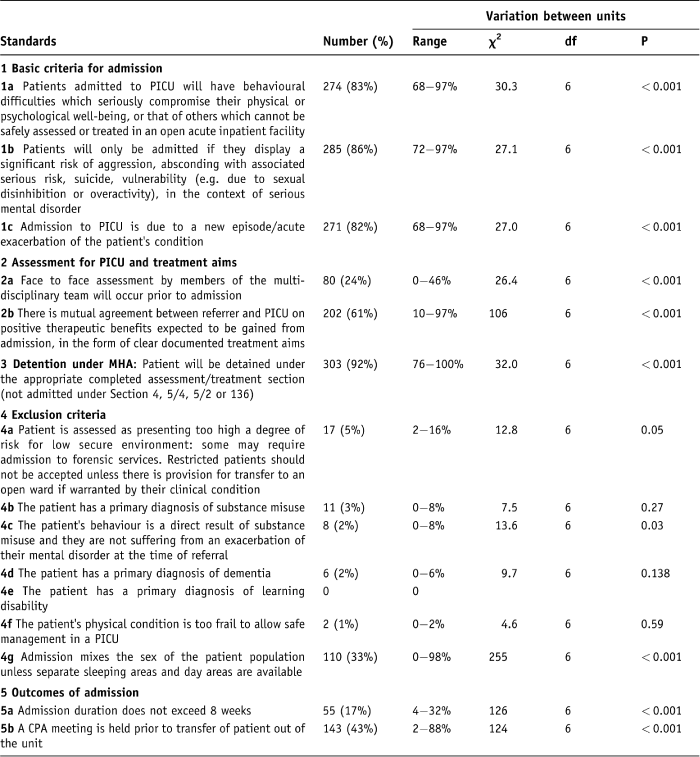
Specific standards used in audit and compliance in 330 successive admissions to seven different PICUs
The research and development co-ordinator at the lead site advised that the project represented service evaluation rather than research and hence did not require MREC ethical approval. Appropriate local audit committees approved the study protocol. Data were analysed with the SPSS-14 statistical package (SPSS, 2005) using Chi-squared analysis of categorical data and non-parametric testing where appropriate.
RESULTS
Data were collected on 332 consecutive admissions to seven different PICUs between 1st February 2006 and 30th September 2007 (one unit changed function during the data collection period). Three clinical data sets were missed for patients with brief PICU stays, but the standards section was retrospectively completed upon one of them hence most of the data analysis was on 330 data sets.
Table 2 shows the overall adherence and variation between the participating units with respect to the chosen standards. Overall, fewer than 5% of admissions breached standards for exclusion on the grounds of behaviour (deemed to present too high a degree of risk or to be too frail for admission) or diagnosis (primary diagnosis of substance misuse, dementia, learning disability, or lack of diagnosis of mental illness). Despite this, 17% of admissions were judged not to meet the basic standards necessitating transfer to psychiatric intensive care (standard 1a). One particular unit identified that 16 out of 50 admissions (32%) did not meet any of the three basic criteria for admission (standards 1a-c).
The standards relating to assessment and communication (2a-b) were poorly adhered to. Only 24% of admissions were preceded by face to face multidisciplinary PICU assessment (the non-NHS unit did not aspire to carrying out face to face assessments due to the nature of geographically distant referrals). Only 61% of patients had clearly documented treatment aims. Only 43% received a Care Programme Approach (CPA) meeting during their PICU admission (one unit identified only one patient who had a CPA meeting during the study period).
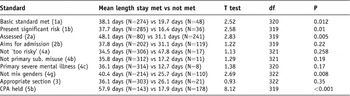
Relation of admission length to standard compliance

Analysis of length of stay against criteria met (Table 3) demonstrated that not meeting basic admission criteria, absence of significant risk, failure to assess prior to admission and inappropriate patient gender mix were all associated with a shorter stay. Having a CPA meeting was associated with a longer stay.
Of the five mixed-sex units in the study, two provided a gender specific lounge, toilet and bath areas (and/or en-suite areas), one provided gender specific toilet and bath areas while the others did not have gender specific facilities. Inappropriate mix of gender within the units occurred in 33% of total admissions. Of those mixed sex units, this figure was 0% (one mixed sex unit claimed to meet all standards of appropriate gender segregated areas), 2%, 12%, 96% and 98%.
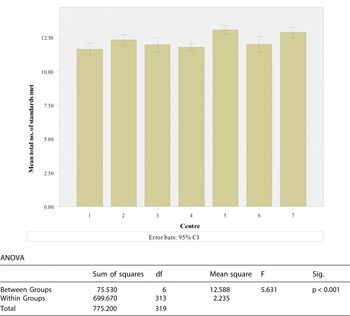
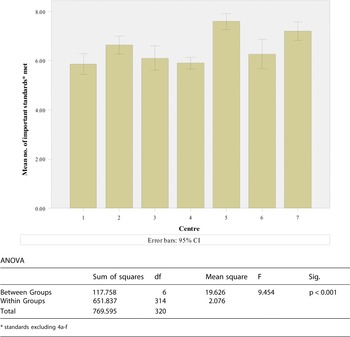
Results are further illustrated in Fig. 1 which highlights differences between units in the numbers of standards met for each of the admissions and Fig. 2, a similar chart that does not include exclusion standards on the grounds of diagnosis or behaviour (as these were small numbers with very few differences). Both charts reveal statistically significant differences in a between-unit analysis of the number of standards met.
Number of total standards met per admission by different units

Number of ‘important standards’* met per admission by different units

DISCUSSION
The aims of this service evaluation against standards were 3-fold: firstly, to determine to what extent chosen NMS were being met and adhered to by English PICUs; secondly to enable individual PICUs participating in the study to benchmark their standards of practice against results obtained; these units would also be in a position to highlight any local issues of clinical governance, implement systems to change areas of concern and complete local audit cycles.
The strengths of this study include the multi-centred and prospective design, enabling a large cohort to be evaluated, with little missing data. Nevertheless the units involved probably presented more positive results than can be expected of all English PICUs, as they were self selected, have a particular commitment to clinical governance (all but one had been involved in the NAPICU governance network) and were aware that results would be shared. The other important weakness was the reliance upon PICU staff to record their own activity, which could lead to a bias towards the recording of standards being met.
The results show that none of the participating units met the full standards included in the study. Conversely, none of the individual standards included were met by all units that participated. These findings are similar to those reported previously by Pereira et al. (2006a; 2006b) and highlight the continuing inconsistency of implementation of national guidance within local services. The NMS were designed as policy implementation guidance and as such continued to allow for local services to develop their own solution to specific local need with regard to management of disturbed behaviour associated with mental illness. In the climate of accreditation and payment by results, such standards may have more teeth in the future.
Unit differences
We can speculate upon the factors contributing to the differences in practice between participating units. Local circumstances and policy decisions may (deliberately or otherwise) breach some NMS, e.g. one unit admitted patients who were not detained under a section of the Mental Health Act (1983) that allowed for treatment to be administered. Individual clinical decisions will also have played a significant role, e.g. in deciding whether patients presented significant risk and required PICU admission. Rigid adherence to strict protocols may hamper an appropriate response to a particular clinical situation (Turner, Reference Turner, Beer, Pereira and Paton2008). Effective systems incorporate this variation into decisions to admit but this probably does not account for all the variation between units. Some variation was probably due to lack of adequate resources (e.g. failure to provide face to face assessments prior to admission or lack of available acute ward beds leading to PICU admission of patients assessed as not meeting the basic admission criteria).
Criteria for admission and interface issues
This study suggests that some patients are admitted to PICU who do not meet the basic criteria justifying this level of care, containment and deprivation of liberty. This may arise through differences in understanding and expectations between acute ward and PICU staff. The same misunderstandings could then lead to delay in transfer out of the PICU once such patients are deemed well enough by the PICU team. It is therefore important to ensure that systems are in place to ensure that there is adequate knowledge and explanation to all staff regarding criteria for admission to enable this interface to work well, enable these standards to be met and to provide optimum patient care.
Seventeen percent of PICU admissions in this study were judged not to meet the basic admission criteria of displaying ‘behavioural difficulties that cannot be safely assessed or managed in an open ward environment’. One possible cause could be that data were recorded at the point of discharge/transfer from the PICU (when the patient is more settled in behaviour) leading to a retrospective bias. Another possibility is that referrers and PICU staff may disagree about the level of behaviour that can be tolerated on open wards, the methods available to manage such behaviour (e.g. change in medication regimen or specific observation) or the diagnosis of mental illness (e.g. primary substance misuse). More worryingly, some units reported that they were used for admissions when open wards were full, a practice which contravenes the accepted principle of treatment within the least restrictive environment. The fact that those patients who were deemed not to meet the standard of presenting with significant risk (and those who did not meet the basic standard for admission) had a shorter length of stay within a PICU may imply that further evaluation by the PICU team confirmed the initial ‘assessment’ that such patients’ needs were not best met within such an environment.
It is also of concern that 5% of admissions were judged to present a degree of risk that was too high for treatment within a PICU setting. This may reflect undue caution by the admitting PICU, however, although a small percentage, this practice is potentially disastrous should an untoward incident occur. Service managers need to remember that PICUs provide low secure treatment and that more secure emergency facilities must be available for the small proportion of patients who cannot be safely contained on a PICU.
Both these findings concerning level of risk could be linked to the fact that only 24% of admissions had an actual face to face assessment prior to admission to PICU (the worst compliance of all the standards used in the survey; standard 2a). The fact that not being physically assessed prior to admission is associated with a shorter PICU stay could be pertinent although there are many confounding variables to consider. The admission of a few patients with an excluding diagnosis (dementia, substance misuse etc.) may suggest a lack of appropriate alternatives to PICU or a failure to consider different management strategies (e.g. aggressive substance users arrested).
The interface between PICU and other acute services could be improved through provision of timely face to face assessment of patients involving both PICU and referring teams and by the agreement of admission aims and objectives (standard 2b). Unfortunately our study reveals that these standards are currently poorly adhered to. Although the NMS make specific reference to assessment prior to admission, they do not specify that a physical assessment takes place. However, the steering group believes that face to face assessment can give better insight into problems that could be managed in an open ward or that may necessitate management in a different environment. Such an assessment also helps with communication between different services and gives opportunity to ease the transition onto a PICU by providing more specific information to patients. There may of course be logistical reasons to prevent face to face assessments from occurring (such as very remote location of the PICU unit from the patient and referring staff as in the case of one of our participating units). However, for many services it is more likely to be a consequence of insufficient resources to enable PICU staff to attend such assessments. Appropriate assessment is therefore only likely to occur (and adherence to these standards improve) if given sufficient priority, investment and training of staff. This would give clarity and aid with information sharing and communication within a framework that allows for flexibility and trust between professionals. This process can be monitored by regular stakeholder meetings (standard 3.2.6. within the NMS: ‘All units should have a 6 monthly forum for meeting with all stakeholders to consider important topics such as referrals, service developments, and issues of concern and to re-affirm good practice.’). Both of these processes can only improve services for patients within a PICU.
An opportunity to further address interface issues arises through the Care Programme Approach (CPA) framework (Department of Health, 2008) and it is disappointing that less than half of the patients admitted had a formal CPA meeting whilst they were treated within a PICU. Again, this may be for a variety of different reasons; for example, because the outcomes of admission and care plan may be robust and agreed prior to transfer to PICU, or because CPA meetings take time to arrange and PICU admission may well have run its course prior to the meeting taking place. The fact that actually having a formal CPA whilst within the PICU is strongly associated with a longer stay may also be due to such meetings only occurring where there is complexity within the presentation or in an attempt to formalise a complicated discharge/transfer pathway of care.
Mixed sex accommodation
The Department of Health (2003) accepts the continuation of mixed-sex wards but recommends the ‘elimination of mixed-sex accommodation, bathing and toilet facilities and the establishment of a women-only lounge, social activities and therapeutic groups’. The NMS also highlight importance of preventing mixed-sex accommodation in PICU; sexual vulnerability and loss of personal dignity is likely to be of greater concern in this setting due to the nature of symptoms and behaviour exhibited by admitted patients and the associated risk with disinhibited patients. This study suggests that some PICUs have tackled this issue through development of single sex PICUs (2 units studied). In those admitting both males and females, over a third of admissions led to inappropriate gender mix. Such admissions were associated with a shorter length of stay for those individuals judged to have been admitted in a way to cause inappropriate gender mix but in the same cohort there was no significant difference in length of stay between males and females (Brown et al., Reference Brown, Chhina and Dye2008). This implies that admissions that give rise to a mixed sex ward with disinhibited patients (most commonly the admission of a disinhibited female to an environment containing (a) similar male(s)) would lead to re-examination of the risk attached and an alternative management strategy. In units that did admit both sexes, some had provision to meet some of the gender specific standards, some met few of the standards and only one claimed to meet all. Anecdotally, in units that didn’t meet gender specific standards, attempts were made to limit female admissions and, should female admissions occur, to move them as soon as possible to a more appropriate environment. It is now expected that the additional financial penalties imposed will lead trusts to ensure that PICUs will meet these mixed sex standards in the future.
CONCLUSIONS
The National Minimum Standards measured in this study are not universally adhered to. A number of barriers may exist; some of these factors may not be perceived as barriers, e.g. deliberate development and implementation of local policy that does not aim to meet a particular standard due to local service need. Other factors are likely to include lack of clarity and poor information sharing between acute ward and PICU teams, and lack of prioritisation, investment or resources to enable particular standards to be met. The introduction of an accreditation scheme will necessitate improvement and units receiving accreditation will have demonstrated how they meet particular standards. We have highlighted the importance of the interface between PICU and other acute teams. We hope that local services will reflect upon the issues of concern.
ACKNOWLEDGEMENTS
We would like to thank everyone who contributed towards this study and especially want to acknowledge the input of the project leaders at each site: Agron Ramadani, Felix Kadzombe, Veronica Daus, Jo Pittam, Lisa Archibald and Catherine Seabourne.
This study was partly financed by a travel grant of £500 to NC from the National Association of Psychiatric Intensive Care Units (NAPICU). We do not identify any conflict of interest.