Introduction
Japan's relations with the Association of Southeast Asian Nations (ASEAN) and its member countries have been guided by pragmatism and redefined constantly by domestic and regional circumstances since the 1970s. ASEAN's perceptions of Japan have evolved from an exploitative, mercantile state into a model of development, and later, a supporter and partner of ASEAN in pursuing its goals and regional aspirations. The 1997 Asian financial crisis, however, challenged the very tenets of the East Asian model of development of which Japan was the prime architect.
For decades, official development assistance (ODA) has played both leading and supporting roles in the Japan–ASEAN relationship. Geographically, ASEAN countries have remained a top priority of Japanese ODA. This reflects the high value that Japan attaches to each ASEAN member and Southeast Asia as a whole. In return, ASEAN has shown its appreciation by inviting Japan to high-level ministerial and head-of-state meetings and summits on several occasions. As competition over foreign direct investments (FDI) intensifies in the advent of China's rise, ASEAN strives to improve its competitiveness by building an ASEAN community by 2015. As Japan's main diplomatic instrument, ODA is expected to play a vital role in the realization of this goal. This was reiterated in the Tokyo Declaration in December 2003 which mentioned, among others that, ‘Japan, through its development assistance and support programs, will give high priority to ASEAN's economic development and integration efforts as it strives to realize the ASEAN Community.’Footnote 1 The Diplomatic Bluebook (Ministry of Foreign Affairs, 2008: 13) has also made clear the continuing support of ASEAN's efforts towards ASEAN integration.
Importantly, Japan's pronouncements of support for ASEAN integration came about against the backdrop of a rising China. In an attempt to dissuade its neighbors from the growing China threat perception, China has gradually established mutually advantageous political relationships with Southeast Asia by taking an accommodating posture in major diplomatic concerns, including the South China Sea dispute. Aside from signing the Treaty of Amity and Cooperation in 2003, China and ASEAN have also strengthened their economic ties by concluding a wide range of trade and industrial arrangements. In particular, bilateral trade linkages have expanded steadily through the formation of the ASEAN–China free trade area (ACFTA). These positive engagements with ASEAN were in accordance with China's regional diplomacy that was articulated in a 2002 report of the 16th Party Congress which served as a guideline in building ‘good neighborly relationships and partnerships’ with its neighbors (Medeiros, Reference Medeiros2009: 126–7). The study, in part, assumes that the evolving ASEAN–China relations have had significant influences on Japan's relations with Southeast Asia and its commitments to ASEAN integration.
The aims of this paper are twofold. First, it examines how Japan has supported the economic integration of ASEAN through the use of its economic resources represented by ODA and other diplomatic measures represented by Japan's strategy on economic partnership agreement (EPA), and its recent regional cooperation with the Mekong countries. Second, the paper seeks to explain how Japan has changed its commitments to ASEAN integration from a broader historical perspective. In addressing these issues, we assume that China's growing ascendancy in Southeast Asia has increasingly affected Japan's ASEAN policy. In particular, we argue that Japan's support for ASEAN integration has both strategic and economic intents. Japan's recent involvement in ASEAN reflects Japan's China policy of mixed ‘balancing and accommodation’, which became apparent during the Koizumi era. This explains the simultaneous existence of competitive and cooperative initiatives of the two countries with ASEAN.
Explaining Japan's growing commitments to ASEAN integration
Two months after the Declaration of ASEAN Concord II in October 2003, the Tokyo Declaration was adopted at the Japan–ASEAN Special Summit, which reiterated Japan's active commitment and support to ASEAN's goal of creating a three-pillar community.Footnote 2 The Declaration became the basis of the twenty-first century Japan–ASEAN relations founded on the ‘acting together, advancing together’ principle. The ASEAN–Japan Plan of Action was later drawn up, outlining three specific areas for cooperation. These were: (1) cooperation for reinforcing integration of ASEAN, (2) cooperation for enhancing economic competitiveness of member countries including investment promotion, and (3) cooperation for addressing terrorism, piracy, and other transnational issues.
How are Japan's growing commitments to ASEAN integration explained? A plausible explanation is provided by the ‘rivalry thesis’, which holds that the recent Japanese initiatives in East Asia (including Southeast Asia) can be explained by the Sino-Japanese competition for influence and regional leadership. This realist-oriented view suggests that China's rise reconfigured the security structure of East Asia in which Japan and China vie for regional leadership. This view also assumes that China would change its economic might into political-military power and challenge the existing power balance, bringing about disorder in the region (Bernstein and Munro, Reference Bernstein and Munro1998; Mearsheimer, Reference Mearsheimer2001). Southeast Asia is the focal point of Japan and China's diplomatic offensives. As observed by one scholar from the region, ‘China and Japan have since been in a race of sorts in reaching out to Southeast Asian economies by using free trade agreements as an instrument’ (Zha, Reference Zha2002). The end of the Cold War brought major structural changes to the region where economic power has become the main basis of interaction among key actors (Zha and Hu, Reference Zha and Hu2006). In this line of reasoning, Japan's support for ASEAN economic integration is therefore part of Tokyo's grand strategy to upgrade its post-Cold War regional image and leadership.
By prompting the ‘countries along China's periphery (including Japan) to readjust their relations with Beijing as well as with one another’ (Shambaugh, Reference Shambaugh2004), the rise of China and the consequent rivalry has shaped Japan's evolving Asian diplomacy and policies. Mulgan (Reference Mulgan2008) argues that Japan sought to limit its vulnerability to China's expanding power and potential threat by aligning with other Asia-Pacific states and engineering a shift in the power balance in its favor. Nabers (Reference Nabers2008) holds that rivalry between China and Japan has led Tokyo to come up with new innovative proposals for regional institution-building each time Beijing approached ASEAN bilaterally. These studies also confirmed that Japan strengthened its commitments to bilateral linkages and regional institution-building as a way to counter China's growing influence.
Any policy readjustment in Japan's ASEAN/Southeast Asia policy, however, should be made in accordance with Japan–ASEAN/Southeast Asia relations. The rise of China may have led to Japan's greater involvement in Southeast Asia, but the relative importance of the region to Japan's continued prosperity is also an aspect to be considered. This is due to the fact that Japan had declared its unwavering support for ASEAN goals and aspirations long before the ‘China threat’ rhetoric became a fad among security scholars. Examples of such previous expressions of support abound: the doubling of the ODA budget to support the infrastructural development of ASEAN members in the 1980s, Prime Minister Fukuda's pledge of US$ 1 billion in assistance to ASEAN's joint industrial projects, another pledge of US$ 2 billion following the 1987 Manila Summit by Prime Minister Takeshita as a development fund for the region, the 1994 establishment of the Working Group on Economic Cooperation in Cambodia, Lao PDR, and Myanmar (CLM-WG), and so on.
Economic and political ties between Japan and ASEAN have progressively strengthened for the past 50 years. Such improvements can be succinctly illustrated by looking at how Southeast Asian perceptions of Japan and vice versa have changed since the 1950s. In the 1960s and 1970s, Japan's image in the region was that of an exploitative economic animal (Sudo, Reference Sudo1992). The riots caused by the visit of former Prime Minister Tanaka to various Southeast Asian capitals explicitly demonstrated this sentiment. This negative image was replaced by a positive image of admiration in the 1980s with Japan's impressive economic growth mixed with Japanese firms’ growing inroads into Southeast Asia. As observed by one scholar, ‘the passage of time and the development of a pragmatic attitude have led to a rather more enthusiastic official embrace of the Japanese model, at least in Singapore and Malaysia’ (Lee, Reference Lee and Broinovski1990: 178).
ASEAN members also showed some degree of receptivity to Japan's political involvement in the region, particularly to its substantial role in the Cambodian peace process (Takeda, Reference Takeda1998). This change of national attitude was crucial in shaping Japan–ASEAN relations in the 1990s and onwards (Singh, Reference Singh2002). On the other hand, Japan's Southeast Asian policy from the early 1950s to 1970s was dominated by economic diplomacy. The region was seen as a source of raw materials and as a market for Japanese exports, a typical North–South exploitative relationship, no more, no less. The Fukuda Doctrine would eventually transform this exploitative stance into an ‘equal partnership’ based on ‘heart-to-heart’ diplomacy. Japan, since then, has high regard for Southeast Asia in its foreign policy. This is manifested by the massive amount of Japanese capital inflows into the region in the form of FDI and ODA.
From the preceding arguments, we contend that Japan's ASEAN/Southeast Asia policy needs to be analyzed from a broader, historical perspective, taking into account both China's regional rise and strengthened Japan–ASEAN/Southeast Asia relations. As to the former, Mochizuki's (Reference Mochizuki, Berger, Mochizuki and Tsuchiyama2007) view on Japan's China policy provides a clue to interpreting the evolving relationship between Japan and Southeast Asia. In the early Cold War days, Japan's China policy was dominated by the principle of seikei bunri or the separation of politics and economics. Following the normalization of ties in the 1970s, Mochizuki (Reference Mochizuki, Berger, Mochizuki and Tsuchiyama2007) averred that Japanese diplomacy had accommodated or offered apologetic gestures on Chinese concerns, such as their objections to visits to the Yasukuni Shrine by Japanese officials.
However, this posture would change dramatically during the term of Prime Minister Koizumi into a less conciliatory stance, exemplified by Koizumi's continuous visits to the shrine. Thus, Japan has been employing a mixture of balance and accommodation in dealing with a rising China (Mochizuki, Reference Mochizuki, Berger, Mochizuki and Tsuchiyama2007; Green, Reference Green2003). Unresolved differences over history and other issues between China and Japan during these periods, however, did not totally prevent the positive progress in economic relations between the two countries. To date, China is one of Japan's most important markets and investment destinations, while Japan is one of China's chief sources of foreign investments that drive Chinese economic growth.
We assume that Japan holds strong orientations to sustain economic development in and integration with Southeast Asia, which has strategic importance for Japan's continued prosperity and with which Japan has fostered a trustworthy relationship through various diplomatic measures. At the same time, the Japanese government after the Koizumi era intensified its orientation to utilize its economic resources towards political and economic links with Southeast Asia as a means to balance China's growing influence in East and Southeast Asia. We will examine this assumption by depicting Japan's various commitments to Southeast Asia including ODA policies, commercial arrangements, and specific policies towards the Mekong region.
How aid can be used to support ASEAN integration
The use of Japanese aid has undergone several transformations and changes since it was started in the 1950s in the form of reparations payments. Indeed, Japan's ODA has been employed on various occasions to achieve a wide variety of diplomatic goals. For instance, ODA pledges were used to promote Japanese exports, mitigate friction with major trade partners, secure energy sources, coordinate trade and investments, and, more recently, to contribute to peace-building operations and to support the economic integration of ASEAN.
The use of Japanese aid has played both leading and supporting roles in Japanese foreign policy and will remain so as long as the renunciation of war clause in its constitution is in place. Japanese aid disbursements have displayed the following patterns since the end of the Cold War. First, ODA has become less and less untied. Second, Japan's goals in the uses of its aid have been diluted with multilateral goals such as the Millennium Development Goals, and conformity to the requirements of the Organization for Economic Co-operation and Development (OECD) of which Japan is a member. Third, the administration of aid policy is moving towards gradual centralization under the leadership of Japan's Ministry of Foreign Affairs (MOFA). Fourth, notwithstanding the successive cuts in the ODA annual budget, grants have become increasingly prominent in the disbursement reports since the onset of the 2000s. Finally, the tight budget constraints will correspondingly make ODA disbursements more and more strategic. Indeed, the use of Japanese aid is moving more and more towards a ‘spending’ strategy (Trinidad, Reference Trinidad2007).
Many previous works on Japanese development assistance in general and on Southeast Asia in particular have focused mainly on ODA policy and reform (Koppel and Orr, Reference Koppel and Orr1993; Rix, Reference Rix1993), effectiveness and post-evaluation (Yamada, Reference Yamada1998), the political-economic aspect (Arase, Reference Arase1995; Mori, Reference Mori1995), strategic uses (Yasutomo, Reference Yasutomo and Curtis1993), and cross-country comparative studies and case studies (Potter, Reference Potter1996). Prior to the publication of ‘A Report from the Study Group on Assistance to the Southeast Asian Region’ (2006) by the Japan International Cooperation Agency (JICA), the aid programs of Japan and their implementation were conducted mainly on a bilateral basis. The report recommended that a ‘program approach’ be adopted especially in dealing with cross-border issues on a regional scale (JICA 2006: 131). Such issues include regional economic integration. Moreover, there is no systematic study on how Japanese aid could help accelerate ASEAN's region-wide economic integration, although there are published papers on Japanese regional cooperation mostly focusing on Mekong regional development. The paper addresses this gap by examining how the Japanese government used aid specifically to support ASEAN integration efforts.
The process of integration requires three sets of policies: (1) liberalization of border measures applied to imports; (2) full national treatment of imports and FDI, and (3) harmonization of measures across member countries (Lloyd, Reference Lloyd and Hew2007: 18). The first policy requirement is arguably the most fundamental for economic integration to succeed. Without fully resorting to market orientation, any effort toward integration by member countries will be fraught with difficulties. By attaching conditions on aid that could push recipient governments toward market orientation, aid could play a leading role in economic integration, at least based on the experience of European Union (EU) during its formative stage (De Long and Eichengreen, Reference De Long and Eichengreen1991).
Japan does not attach explicit conditions to its aid unlike the International Monetary Fund (IMF) and the World Bank, which have attached conditions to their aid programs. Moreover, passively accepting aid conditions is unpopular and, thus, could be very risky politically for the incumbent administration of the recipient state. However, Japanese aid agencies could identify projects to be funded to achieve their purposes. Incorporated in the ODA White Papers and the 2003 ODA charter is the pursuit of market reform in recipient countries as one of the fundamental goals of Japanese aid-giving. These guidelines also, in principle, highlight human rights and democratization as criteria of funneling aid to recipients. While not really intended as a tool for hard power politics, one study claimed that, in certain circumstances, Japanese aid could be an effective tool of influence (Oishi and Furuoka, Reference Oishi and Furuoka2003). But whether or not Japan's aid is an effective or ineffective form of statecraft, there is no doubt that it has contributed hugely to infrastructural development of many recipient states, including those in Southeast Asia. This paper, however, will not assess whether or not Japanese aid has been effective in promoting ASEAN economic integration.
Japan's support for ASEAN's goal of correcting the development gaps between its members was first enunciated in the Obuchi Plan at the ASEAN+1 Summit Meeting in 1999. It coincided with the admission of Cambodia as the 10th member in April of the same year. This was reiterated by then Prime Minister Mori the following year and again by Prime Minister Koizumi at the Japan–ASEAN Commemorative Summit Cooperation in 2003. Koizumi's New Initiatives also mentioned Japan's cooperation with ASEAN on strengthening integration and cooperation on transnational issues. Since then, cooperation with ASEAN in rectifying regional disparity, and support for ASEAN integration have been priorities of Japan's ODA policy.
Impediments to ASEAN integration and the role of Japan
Observers have identified some hurdles that continue to impede ASEAN's community-building effort.Footnote 3 The most fundamental of these, protectionism, needs to be addressed immediately. In some ASEAN members, economic liberalization is still an unpopular enterprise with sensitive political implications. Liberalization may also be a cause of concern especially for governments that stand to lose substantial amounts of revenue from customs duties (Tiongson and Khan, Reference Tiongson, Khan and Hew2007). The variation in the level of openness and receptivity to economic liberalization in each member reflects, to some extent, the public resistance and level of intricacy in implementing free trade accords. As a result, ASEAN integration is fraught with difficulty because the implementation of tariff reduction schemes is left to each member.
Protectionism is also manifested in the number of products that each government included in their ‘sensitive list’ under the Common Effective Preferential Tariff (CEPT). Trade-related issues occasionally arise among members, such as the rift between Malaysia and Thailand over tariffs on automobiles and automotive parts (Nesadurai, Reference Nesadurai2003: 144–50). In certain cases, the problem of opening up the economy to foreign investment is embedded in the laws or constitutions of the member states, which makes conforming to economic agreements more difficult and politically controversial. A good case of this would be the Philippines, where constitutional provisions prevent foreign ownership of real property and specifically define the equity ratio of joint undertakings between foreign and local capitalists (Article 12 of the 1987 Constitution). As a result, conflict between regional agreements and national laws often arises. The revision of the Philippine constitution has been the focus of national debate recently.
Secondly, as strategies for integration were studied, the ‘development disparity’ issue within ASEAN emerged and has since caught the attention of both policymakers and academics.Footnote 4 This problem arises from the fact that the level of economic development of Brunei, Singapore, Malaysia, Thailand, the Philippines, and Indonesia (or ASEAN-6) is highly uneven. The development gap was widened further by the inclusion of Cambodia, Lao PDR, Myanmar (Burma), and Vietnam (or CLMV) as new members in the 1990s. To illustrate, the Gross Domestic Product (GDP) per capita of CLMV ranges between US$330 and US$830 in 2007, while those of the older members were between US$1,660 and US$36,400 (ASEAN Secretariat, 2009: 38). Regional disparity in the level of development impedes ASEAN economic integration because: (1) the economies of member countries tend to compete rather than complement each other, and (2) it creates obvious winners and losers since less developed members would not be able to compete equally with more developed members.
In view of this, ASEAN leaders have seriously taken into account the implications of regional disparity in the integration on their decisions and initiatives. For instance, differential completion dates for tariff reduction and/or elimination were set for old and newer members under the CEPT scheme. The ASEAN leaders also agreed to launch the Initiative for ASEAN Integration (IAI) at the fourth Informal Summit held in November 2000 aimed at ‘narrowing the development gap within ASEAN and between ASEAN and other parts of the world’. A work plan was adopted in HanoiFootnote 5 the following year, which the ASEAN leaders approved at their Summit Meeting in Phnom Penh in 2002.
The IAI Work Plan, thus, outlines the strategies in addressing regional disparity within ASEAN. Four priority fields were identified under the Plan: (1) infrastructure development, (2) human resources development, (3) information and communication technology (ICT), and (4) regional economic integration in CLMV.Footnote 6 Japan declared its full support for the Work Plan at the ASEAN–Japan Commemorative Summit in December 2003. The ASEAN–Japan Plan of Action was adopted to carry out this pledge. It specified the areas of cooperation between Japan and ASEAN, laid down the common strategies for action, and highlighted the importance of human resource development and capacity building as prerequisites to reinforcing integration and enhancing the economic competitiveness of ASEAN. The Plan of Action also specified cooperation for the development of the Mekong Region and other ASEAN growth triangles, such as the Brunei–Indonesia–Malaysia–Philippines East ASEAN Growth Area (BIMP-EAGA).Footnote 7 Japan's role in ASEAN integration is, therefore, guided by the IAI Work Plan and the specific programs covered by the ASEAN–Japan Plan of Action.
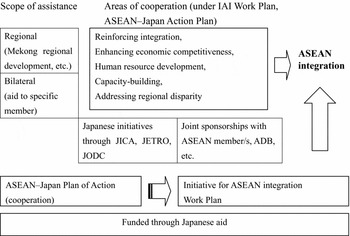
A framework of Japanese support for ASEAN integration is illustrated in Figure 1. The main source of funding for cooperation is Japanese aid, which consists of both regional and bilateral assistance. Bilateral assistance consists of grants, technical assistance, and yen loans to specific ASEAN members, while regional assistance is Japan's support for ASEAN sub-regional projects, such as the Mekong regional development. Priority areas for cooperation include projects to reinforce integration, enhance economic competitiveness, develop human resources, build capacity, and address regional disparity. Projects are carried out by Japanese government-affiliated bodies, such as the Japan International Cooperation Agency (JICA) and Japan Overseas Development Corporation (JODC), or through joint sponsorships with one or more ASEAN member/s or with multilateral institutions like the Asian Development Bank (ADB).
Framework of Japanese support for ASEAN economic integration

Following the successive cuts in net ODA since 1997 and China's growing diplomatic presence in the region, the strategic uses of Japanese aid have become more and more assured and pronounced. The expansion of ASEAN membership in the 1990s, the ASEAN's vision of a three-pillar community, and increased interdependence between Japan and ASEAN have all ushered in a new era in Japan's aid disbursements to the region. More specifically, in a gesture of support to ASEAN community building, the ODA White Papers have given priority to addressing development gaps among ASEAN members and to other activities which promote advances in ASEAN integration. Notwithstanding tight budget constraints, Southeast Asia has remained a major recipient of Japanese aid.
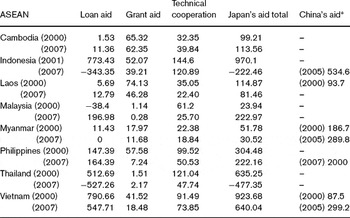
More often, the manner by which grant aid is allocated represents the strategic interests of the donor, while loans signify, to some extent, the donor's commercial interests. Recipients have no obligation to pay for grant aid. Hence, the donor can project its generosity to the recipient depending on how the aid is used. The grant ratio of Japan's ODA was 54.1% in 2005/2006. Although this was far below OECD's average of 89.4%, it was a marked improvement compared to the previous decades. The grant share of US aid during the same period was 99.9% (ODA White Paper, Ministry of Foreign Affairs, 2008: 233). In Southeast Asia, with the exception of grant aid to Myanmar, grant aid to CLV (Cambodia, Lao PDR, and Vietnam) in 2000 and 2007 was higher than those of the older member countries (see Table 1). As in the past years, yen loans were mainly used to finance infrastructural development of recipient countries.
Japan's net ODA disbursements in 2000/07 and selected Chinese aid to Southeast Asia in 2000/05 (both in US$ million)

Note: *China's aid as indicated here were estimates from Kobayashi (Reference Kobayashi2008: 32–3). Those in parenthesis represented the year when the aid was pledged or allotted. Estimates for other countries are unavailable. Figure for the Philippines was based from Lum et al. (Reference Lum, Fischer, Gomez-Granger and Leland2009: 16).
Source: Figures for Japan's aid were compiled from ODA White Paper 2008, Ministry of Foreign Affairs.
Redirecting more grant aid to CLV was part of Japan's declared effort to contribute to addressing regional disparity. Table 1 also suggests that more grants were allocated to ASEAN members with lower GDP per capita. On the other hand, yen loans were much higher in countries which have the capacity to pay (i.e. ASEAN-4). It is also interesting to note that both grant and yen loans to Vietnam have increased since the 1990s. From US$281.24 million in 1992, Japanese ODA to Vietnam increased to US$923.68 million in 2000, while grant aid increased to US$41.52 million from US$5.43 million during the same period. The country, in fact, has become one of the major recipients of Japanese aid since the end of the Cold War and was the largest aid recipient in East Asia in 2007. Vietnam is also becoming an attractive destination of Japanese FDI recently.
Since the onset of the twenty-first century, apart from quantity and quality, Japanese ODA has also undergone major changes in terms of focus and administration in response to international events and domestic constraints. Former Prime Minister Fukuda announced a plan to double Japan's ODA disbursements to Africa (Yoshida, Reference Yoshida2008). Coincidentally, this pronouncement came after a study showed that China's aid activity in Africa from 2002 to 2007 had increased (New York University Wagner School, 2008). Although China has yet to become a major aid provider, a study on the evolution of China's aid policy and how Japan should deal with it as an emerging donor signifies Japanese interest in the issue (see Kobayashi, Reference Kobayashi2008). Against a backdrop of financial constraints and some past cases of corruption, various domestic actors in Japan have also demanded more transparency and civil society participation in ODA administration.
The system of administration of Japanese ODA had undergone streamlining for more efficient operations as well. In the past, yen loans, technical assistance, and grants were administered by separate agencies. Since 1999, the Japan Bank for International Cooperation (JBIC) had supervised the implementation of yen loans, while JICA was in-charge of administering mainly technical cooperation programs of ODA. In October 2008, the Overseas Economic Cooperation Operations (OECOs) of JBIC was merged with JICA, transforming the latter into an independent administrative body in charge of implementing Japan's development assistance.Footnote 8
Unlike Japan, China has yet to become a huge provider of global aid. Chinese financial assistance, which ‘consists mainly of concessional or low-interest loans and government-backed or subsidized investment in infrastructure and natural resources’, is different in character from the type of aid which the members of the OECD usually provide (Lum et al., Reference Lum, Fischer, Gomez-Granger and Leland2009: 1). A growing number of studies suggested that there was an increase recently in China's aid activity in Africa, Latin America, and Southeast Asia (New York University Wagner School, 2008; Kobayashi, Reference Kobayashi2008; Woods, Reference Woods2008). It was estimated that Chinese aid grew from less than US$1 billion in 2002 to about US$25 billion in 2007. Twenty percent of Chinese aid between 2002 and 2007 was allocated to Southeast Asia. This amount is relatively small compared to Japanese aid. However, Lum et al. (Reference Lum, Fischer, Gomez-Granger and Leland2009: 4) claimed that Chinese assistance and other related economic activities often garner appreciation disproportionate to their size for the following reasons: (1) they are made available and generally provided to recipients without conditions that other bilateral and multilateral donors typically attach, (2) they promote economic projects on areas or sectors that other donors ignore or avoid, (3) funded projects are highly visible and provide tangible short-term benefits to recipients, and (4) assistance and investment activities are often announced at bilateral summit meetings with great fanfare. As such, Chinese aid is more accessible than Japanese aid whose disbursements are restricted by human rights and other considerations.Footnote 9Table 1 suggests that Chinese aid was concentrated on CLMV and the Philippines. Both Japan and China have also contributed financial assistance to Mekong regional development.
Aside from bilateral assistance, Japan is also allocating aid to ASEAN on a regional scale.Footnote 10 Based on a JICA study, regional cooperation in Southeast Asia is directed to ‘less developed countries (i.e. the CLMV) . . . alongside Indonesia and the Philippines’ (JICA, 2006: 75). The report also identified at least three major areas for regional cooperation. These are: (1) improvement and efficiency in regional trade system. This includes harmonization of transport infrastructure and services, computerization and other ICT-related projects, adoption of international standards, more efficient border-crossings through standardized documentation, and security and safety of the ASEAN transportation system. This objective corresponds to the areas of cooperation outlined in the ASEAN–Japan Plan of Action, particularly the provisions related to reinforcing comprehensive economic partnership and financial and monetary cooperation. (2) Institution-building including improvements in the system of governance through institutional reforms and human resources development – under the ASEAN–Japan Plan of Action, this extends to cooperation in the development of intellectual property rights and competition policy among ASEAN members. (3) And, finally, strengthening of the ASEAN secretariat through capacity development and training programs (JICA, 2006: 75–6).
In terms of quantity though, a huge proportion of Japanese assistance in support of ASEAN integration is still carried out bilaterally, that is aid to each specific ASEAN member. On the other hand, regionally oriented assistance related to integration is mostly limited to capacity-building support (such as training, conference sponsorship, etc.) and financial contributions to sub-regional projects, more specifically to the Mekong regional development, where Japan has recently been involved proactively. While these are invaluable to ASEAN's goal of integration, for Japanese assistance to be a more effective catalyst of integration, it is necessary that new approaches to aid-giving be designed to elicit political and industrial cooperation and coordination among member countries, just as the Marshall Plan facilitated cooperation among Western European countries. Japan, for instance, could use its yen loans as an incentive to assist the initiation of industrial projects jointly owned by two or more investors from the region. Joint projects to develop new sources of energy and joint scientific research have to be prioritized as well. The existing cooperative framework for the energy sector, such as the ASEAN Center for Energy, must be further enhanced. A list of priority projects or areas for funding that emphasize joint ownership and cooperative behavior, and instill regional consciousness, can be made by JICA. In this way, Japanese ODA would become an element of integration by setting the right incentives for greater region-wide cooperation.
An additional important move in Japan's assistance to ASEAN integration is the formation of an intellectual platform for economic integration. The Japanese government proposed the establishment of the Economic Research Institute for ASEAN and East Asia (ERIA) at the second East Asia summit in January 2007, and the institute was formally set up in June 2008. ERIA, an East Asian version of the OECD, aims to assist in the promotion of economic integration through survey analyses and policy proposals targeting policy research areas such as deepening economic integration, narrowing development gaps, and sustainable development (METI 2008: 438). The major concern of ERIA has been directed towards ASEAN integration, particularly in facilitating ASEAN economic community building and supporting ASEAN's role as the driver of East Asian integration. For instance, it has conducted research on ‘Development Strategy for CLMV in the Age of Economic Integration’ and ‘Deepening Economic Integration: The ASEAN Economic Community and Beyond’.Footnote 11
Japan's strategic commercial policies towards Southeast Asia
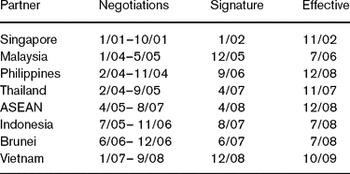
As illustrated in the preceding sections, Japan actively supports ASEAN integration by contributing ODA funds both on a bilateral and regional scale. At the same time, Japan has launched a series of multi-layered negotiations for comprehensive economic partnership agreements (EPAs) with ASEAN at both regional and bilateral levels since 2001. The governments of Japan and ASEAN started negotiating for the ASEAN–Japan Comprehensive Economic Partnership (AJCEP) in April 2005. The agreement was completed and signed by all parties after three years. AJCEP covers not just the free movement of goods and services but also cooperation in various areas such as transnational issues. Recent development in East Asia also shows that Japan actively advocates a region-wide free trade area, and insists on extending membership to India, Australia, and New Zealand in the East Asian Summit.Footnote 12 These initiatives were all unprecedented for Japan, which, in the early 1990s, had turned down a Malaysian proposal for an East Asian Economic Grouping (EAEG) composed of Japan, China, South Korea, and ASEAN.
Japan's FTA/EPA with Southeast Asian countries

Source: Compiled from various documents of Japanese government agencies.
There are two distinctive features in Japan's FTA approach to Southeast Asia. The first was the formation of ‘comprehensive’ FTAs with Southeast Asian countries. Japan aimed to formulate an EPA, which covers investment rules, trade facilitation measures, competition policy, as well as cooperation in technology transfer and intellectual property, in addition to conventional tariff cuts. Japan's EPA strategy was derived from a strong belief that an EPA was superior to an FTA, that it would serve to promote the overall reform of economic structures by targeting broad areas of investment and intellectual property rules, to competition policy, and economic cooperation (Oike, Reference Oike2006). At the same time, Japan's EPAs were intentionally aimed to differentiate them from China's FTAs. The MOFA provided a stark contrast between Japan's and China's approach to ASEAN (MOFA 2007: 17). MOFA characterized Japan's EPAs in the ASEAN Region as comprehensively working on not only border measures such as tariffs and investment regulations but also measures to create an environment that is conducive to fostering cooperative elements in both Japan and ASEAN; and undertaking negotiations on each item for trade in goods in pursuit of a high-level agreement.
The second is its strong emphasis on the bilateral approach. As already explained, Japan and ASEAN members pursued a regional FTA (i.e. AJCEP) after 2005. In parallel, Tokyo committed to bilateral negotiations with certain Southeast Asian countries after early 2004 by starting formal negotiations with Malaysia, the Philippines, and Thailand. By October 2009, Japan's EPA with Singapore, Malaysia, the Philippines, Thailand, Indonesia, Brunei, and Vietnam came into effect. Japan signed an Investment Agreement with Cambodia in June 2007 and later with Lao PDR in January 2008. Thus, Japan has committed to bilateral trade pacts with all ASEAN members, except for Cambodia, Lao PDR, and Myanmar, with the aim to formulate substantial EPA networks with ASEAN members, and ‘steal a march’ on China (Desker, Reference Desker2004: 13).
Importantly, Japan's commitments to FTAs with Southeast Asian countries were sustained by political will. As China has increased its economic leverage and influence in East Asia, senior Liberal Democratic Party (LDP) politicians became apprehensive about the relative decline of Japan's regional leverage. The party's key members who were involved in foreign relations had strong preferences for advancing FTAs with Southeast Asian countries as a way to maintain Japan's national interest against China's growing presence. These politicians took the lead in formulating the party's basic policy, Promotion of EPA/FTA Strategy, in February 2004, which showed the party's will to promote FTAs proactively. This basic policy was formulated despite strong objection from politicians who had long worked for opposing market liberalization in the farm market (Yoshimatsu, Reference Yoshimatsu2006: 494–5).
In contrast, commercial benefits from the FTA conclusion are not necessarily apparent. The 2006 JETRO Survey provides very interesting revelations on the initial effects of FTAs/EPAs to Japanese businesses in Southeast Asia. A total of 793 firms operating in Thailand, Malaysia, Singapore, Indonesia, the Philippines, and Vietnam were asked if their companies currently use any existing bilateral or multilateral FTA or EPA for import or export. The survey showed that only 16% of the surveyed firms said that they currently use FTA or EPA for their imports as against 53.4% that said that they have no plans for using them. On the other hand, 19.7% said that they were currently using EPA or FTA for their exports as against 49% of those that said that they have no plans for using them (JETRO, 2007: 41, 83). The survey showed that almost half of the respondents have no plans for using EPA or FTA. When asked about their reasons for not using them, 60.7% responded that it was because ‘they already enjoy exemption from tariffs through investment benefit schemes’ or because of existing incentives offered by their host states (JETRO, 2007).
It should be noted that the survey was made prior to the ratification of AJCEP. Nonetheless, the survey, in part, suggests that FTAs and EPAs could be rendered useless unless they offer better benefits than the host state currently offers. It also indicates the variation of business incentive schemes across ASEAN member countries. Moreover, the fact that many Japanese firms had no plans to use EPAs or FTAs in their imports and exports signifies that the economic implications of these agreements to Japanese MNCs operating in Southeast Asia could be minimal, if not nil. It also strengthens the argument that they were negotiated for strategic purposes. The point is that, aside from the existing business incentives of the host states, EPAs and FTAs provide extra incentives which Japanese firms could utilize for their imports and exports. Japanese firms would certainly benefit from the harmonization of ASEAN economic policies and, by doing so, ASEAN member countries could mitigate over-competition among themselves over FDI. When this happens, investing in ASEAN truly would be investing in one region. This prospect adds motivation to Japan's support to reinforce ASEAN integration.
Growing strategic orientation in Japan's support for Mekong integration
As ASEAN community building accelerates, ASEAN leaders and dialogue partners, including Japan, China, and South Korea, have set their attention on the Mekong region. By default, the region has become the main platform of cooperation for narrowing the development gap among ASEAN members. For China, cooperation with the countries in the Mekong region is a crucial test of its ‘good neighborhood’ policy. A peaceful coexistence with the countries in the region and with ASEAN countries which have claims over the Spratlys could assuage the ‘China threat’ perception. On the other hand, economic progress in the Mekong region is critical to ASEAN's efforts in narrowing regional disparity.
Since the end of the Cold War, Japan has also showed increasing interest in the Mekong region, manifested in its proactive involvement in the Cambodian issue, and it has become an important area of Japanese diplomacy towards ASEAN and China. Since the early 1990s, the Japanese government has spearheaded a number of initiatives to assist the development of the region. In January 1993, then Prime Minister Kiichi Miyazawa proposed the Forum for Comprehensive Development of Indochina (FCDI), which held its first ministerial meeting in Tokyo in February 1995 with the participation of 24 countries and seven international organizations. The FCDI provided a venue for exchanging information and views on balanced development of the region and strengthening the capabilities of officials engaging in the formulation of development projects (Shiraishi, Reference Shiraishi and Shiraishi2004: 209). The ASEAN Economic Ministers – Ministry of Economy, Trade and Industry [AEM-METI] Economic and Industrial Cooperation Committee (AMEICC), which was launched in December 1997, is another vehicle to support the Mekong development. The AMEICC aimed to promote industrial development in the region through the creation of infrastructure, improvements in business environments as well as industrial and trade financing.
In the new millennium, the Japanese government sought to strengthen links with the Mekong region in a more straightforward way. In November 2004, Prime Minister Koizumi held the first summit meeting with its counterparts from CLV. After this summit, foreign ministers from the four countries discussed concrete cooperative projects. At the third Japan-CLV foreign ministers’ meeting in January 2007, Japan proposed the Japan–Mekong Region Partnership Program. This program contained three guiding pillars and three new commitments. The three guiding pillars were: the promotion of integration and linkages of regional economies, the expansion of trade and investment between Japan and the Mekong region, and the sharing of values and engagement in common problems in the region. The primary new commitment was the expansion of ODA. The Japanese government promised to undertake a renewed ODA of US$40 million for CLMV, of which US$20 million would be allocated to the CLV Development Triangle. The additional two new commitments were investment agreements with Cambodia and Laos, and the holding of a Japan–Mekong Region ministerial meeting.
The Japanese government also sought to establish a formal institution with the countries in the entire Mekong region. In January 2008, the first Mekong–Japan foreign ministers’ meeting was convened in Tokyo. At the meeting, Japan pledged US$20 million from the Japan–ASEAN Integration Fund (JAIF) for improving ‘efficiency of logistics and distribution of the East–West Economic Corridor and Second East–West Economic Corridor in the region’ and the holding of a senior officials’ meeting to coordinate the projects.Footnote 13 The ministers also endorsed 23 concrete projects for the CLV Development Triangle. In November 2009, the first Japan–Mekong summit was held in Tokyo. At the meeting, the leaders issued the Tokyo Declaration, in which Japan expressed its commitments of more than 500 billion yen of ODA in the next three years for further development of both hard and soft infrastructure and environment conservation to achieve a ‘Green Mekong’.
The integration of Mekong transitional economies (or formerly communist countries) into the regional and global economy has been a long-standing goal of Japan and ASEAN. Japan's economic activities with these countries, especially in the areas of trade and investment, have increased since the 1990s. Japan's trade value with Vietnam increased to 1.7 trillion yen in 2008 from 31 billion yen in 1990, while that with Cambodia increased to 31.6 billion yen in 2008 from a mere 1.1 billion yen in 1990 (ASEAN–Japan Center website, 2010). The eventual construction of ASEAN economic community by 2015 would further improve intraregional trade and the integration of the national economies of the Mekong countries to the regional and global economy. The outcome of which is a regional economy that is mutually dependent with the rest of the world and does not rely on one specific country. Apart from China and Japan, ASEAN is now one of the major trade partners of the Mekong transitional countries.
At the same time, Japan's Mekong policy in the new millennium has a clear strategic orientation to balance China's growing influence in the region. The strategic nature was obvious in the summit and ministerial meetings with the Mekong countries in the new millennium. The holding of the meetings was a prominent departure from Japan's conventional diplomacy towards Southeast Asia. Unlike the FCDI and AMEICC, the meetings were linkages between Japan and the Mekong countries alone, excluding the old ASEAN members. The specific membership raised Japan's position in the relationship, enabling it to reflect its policy preferences straightforwardly. More importantly, these meetings provided Japan with the same status as China, which has held ministerial and summit meetings with the five Mekong countries under the Greater Mekong Sub-region (GMS) Economic Cooperation Program.
The strategic nature was demonstrated in a main project of Japanese government commitment to Mekong integration. A distinctive project commitment at the first Mekong–Japan foreign ministers’ meeting was the support for logistics and distribution of the East–West Economic Corridor and Second East–West Economic Corridor.Footnote 14 China has committed to the development of the North–South Economic Corridors linking Kunming and Bangkok as well as Kunming and Hai Phong in Vietnam. Japan hoped to retain influence in the development of transport infrastructure by pushing forward the horizontal economic corridors against China-initiated vertical economic corridors.
Furthermore, Japan tried to differentiate its approach from China's in terms of normative values. The phrase ‘sharing of values’ was included in the three guiding pillars of the Japan–Mekong Region Partnership Program. The values here implied universal values such as democracy and rule of law. The implications of universal values for Japan's diplomacy were elaborated by Foreign Minister Taro Aso who advocated ‘value-oriented diplomacy’ and the building of an ‘arc of freedom and prosperity’.Footnote 15 One of the priorities of the Tokyo Declaration following the first Japan–Mekong summit was the construction of a society that values human security. On this principle, the Japanese government under the Democratic Party of Japan (DPJ), and those of the Mekong countries agreed to tackle challenges such as poverty, environmental devastation, and climate change ‘in order to establish a society where each person can fully preserve one's human dignity from the viewpoint of “human security” through protection and empowerment of individuals and communities’.Footnote 16 The advocacy of normative values enabled Japan to show clearer leadership in looking ahead to the future of the Mekong region, and could support ASEAN's new orientation, giving it more respect.Footnote 17 Equally important, the Japanese government took advantage of normative values as an effective diplomatic card against China, which has difficulty in realizing these values.
Conclusion
In this article, we have examined how Japan has sustained ASEAN's economic integration through ODA and other diplomatic measures, and showed how Japan's engagements in ASEAN economic integration evolved over time from a broader historical perspective. In addressing these issues, we took into account the growing influence of China's ascendancy in Southeast Asia, and assumed that Japan's China policy of mixed accommodation and balance became explicit in Japan's ASEAN policy. The pronouncement of support for ASEAN integration, disbursement of aid to the region, forging of bilateral and regional FTAs/EPAs with ASEAN, and its recent initiatives and proactive involvement in Mekong regional development are indicative of Japan's reactive posture on China's growing influence in the region. Japanese diplomatic initiatives in ASEAN are intended, in part, to accommodate and balance China's increasing prominence in Southeast Asia.
Indeed, Japan's annual budget for ODA has gradually shrunk, and Japanese ODA has undergone major changes in terms of focus and administration. However, Southeast Asia has remained an important target for Japan's foreign aid. In particular, Japan has regarded the correction of the development gap among ASEAN members as a crucial premise to economic integration in Southeast Asia, and has provided robust support for ASEAN's initiatives in this regard. In 2000, for instance, ASEAN leaders launched the IAI, and the Japanese government quickly announced full support for this initiative. In so doing, Japan increased the ratio of the grant in its ODA, reflecting its strategic intents. Japan's new orientations in aid policy demonstrated responses to China's rising status as an aid donor towards Southeast Asia. Bilateral assistance still constitutes the bulk of Japan's assistance to the region. However, regional cooperation, which transcends national borders, will increasingly be featured in Japanese ODA as Japan involves itself deeply in Mekong regional development.
Japan's engagement in ASEAN's economic integration was notable in the commercial field as well. In the new millennium, Japan intensified its commitment to FTA/EPA by pursuing a regional arrangement (AJCEP) as well as by forming a network of bilateral arrangements with individual ASEAN members. Japan adopted the EPA approach with a strong belief that this approach would contribute to structural reform in the ASEAN market, which would then lead to the promotion of ASEAN integration. At the same time, the EPA strategy, which stresses a bilateral approach, reflected Japan's reaction as a counter to China's FTA strategy, which, on the contrary, stresses a regional approach.
Japan's renewed involvement in Mekong development and integration also showed its benign and strategic intents in promoting ASEAN integration. Japan has implemented measures for development in both hard infrastructure and the soft human resource under the CLV projects. Significantly, Japan put emphasis on the formation of Mekong–Japan institutions, the incorporation of normative ideas, and the development of the East–West Economic Corridors. These commitments explicitly countered China's similar moves under the GMS Economic Cooperation Program. Thus, Japan's Mekong policy reflects both the reality to support economic development in the region and the rhetoric to maintain political influence in the region.
The paper has showed the growing complexity of Japan's ASEAN policy due to the rise of China and the transformation of Japan's foreign aid policy. ODA will remain Japan's important tool for diplomacy, but, as overall net ODA outlay continues to shrink, its relative effectiveness as Japan's main soft power instrument will also diminish unless it obtains the kind of appreciation that recipients often give to China for its relatively small amount of aid. Since 2002, China has striven to enhance its status as an aid donor in the region. In this regard, Japan is required to show new ideas to extend ASEAN's integration efforts to a much broader East Asian context, some of which would require collaborative partnership with China.
On the part of ASEAN, Japan's new initiatives in Southeast Asia in response to China's increasing diplomatic prominence provide both opportunities and challenges. As the default platform for Chinese and Japanese diplomatic offensives, ASEAN can perform a coordinating role to complement the two countries’ contributions in order to avoid wasteful overlapping of projects. The worst scenario for ASEAN is to be divided between China-following and Japan-following members.
About the authors
Hidetaka Yoshimatsu is Professor at the College of Asia Pacific Studies, Ritsumeikan Asia Pacific University in Beppu, Japan.
Dennis D. Trinidad is Associate Professor at International Studies Department of De La Salle University, Manila and was also Japan Foundation Research Fellow at Ritsumeikan Asia Pacific University. The authors gratefully acknowledge the editing work of Mr. William Engebretson, currently teaching English classes at Ritsumeikan Asia Pacific University and the three anonymous referees for their comments and suggestions.