What affects who participates in politics? Many studies point out that education is of central importance. In most studies of political behaviour it is found that individuals with higher education participate to a larger extent in political activities than individuals with less education.Footnote 1
Why do highly educated persons participate more in political activities? In their seminal work, Verba, Schlozman and Brady explain that: ‘Education enhances participation more or less directly by developing skills that are relevant to politics – the ability to speak and write, the knowledge of how to cope in an organizational setting’.Footnote 2 And Lewis-Beck et al. point out that: ‘With more formal education comes a stronger interest in politics, a greater concern with elections, greater confidence in playing one's role as a citizen, and a deeper commitment to the norm of being a good citizen’.Footnote 3 Hence, education increases skills and knowledge but might also affect political interest and efficacy; factors that all in turn trigger participation. Moreover, in a classic text, Converse went even further by emphasizing that education ‘is everywhere the universal solvent, and the relationship is always in the same direction. The higher the education, the greater the “good” values of the variable’.Footnote 4 This idea is, explicitly or implicitly, widely accepted in political behaviour research and the relationship between education and political participation is perhaps the most well-established relationship that exists in research on political behaviour.
However, recently a number of studies have started dealing with the question of whether education is a direct cause for political participation or merely works as a proxy for other factors.Footnote 5 The question about causality has become disputed in political behaviour research. This review article will provide an introduction and critical discussion of this debate.
Knowing who participates in politics is a central issue in political behaviour research. Finding out which model can correctly explain the relationship between education and participation has important implications. If education has no direct causal effect, then the relationship between education and participation found in most political behaviour research is misinterpreted. If we do not even know how the most frequently occurring relationship in participation research should be explained, our understanding of who participates in politics must be regarded as shallow. Hence, getting a better understanding of the relationship between education and participation is crucially important for the improvement of knowledge about the causes of political participation.
This article will proceed as follows. The next section provides a theoretical overview and after that the most important empirical analyses in the field are summarized. Finally, the implications are discussed.
Theoretical Overview
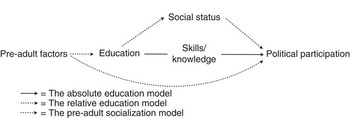
Three models dominate the discussion on how education is related to political participation. Here I will refer to them as ‘the absolute education model’, ‘the pre-adult socialization model’ and ‘the relative education model’. The latter two of these models regard education as a proxy for other factors not directly related to education while the first regards the educational experience as a direct cause. Figure 1 illustrates the three models.
Theoretical models of the relationship between education and political participation

The Conventional View: The Absolute Education Model
According to the absolute education model, illustrated by the solid line in Figure 1, education has a direct causal effect on political participation (and for that reason this model is sometimes synonymously referred to as the ‘education as a cause view’). Education increases civic skills and political knowledge, which function as the causal mechanisms triggering participation. This is also sometimes referred to as ‘the cognitive pathway’, i.e. what individuals learn at school has positive effects on their cognitive ability, which in turn affect participation. In addition to skills and knowledge, it has also been argued that education triggers political efficacy. Jackson explains this idea in this way: ‘Schooling enhances both the belief that the potential voter can influence what the government does (external efficacy) and the belief that the potential voter has the competence to understand and participate in politics (internal efficacy)’.Footnote 6 Hence, education increases citizens’ beliefs that they can effectively play a role in the political process.
According to this conventional view, the more education individuals have, the more likely they are to participate in politics. The model is referred to as the absolute education model since the effects of education are not dependent on the level of education in the environment. This model regards education effects as a process on the individual level.
Numerous studies of political participation in Western democracies confirm this view. However, most of these studies draw on cross-sectional data and the causal mechanisms are seldom directly tested. Even those that stick to the view that education is a direct cause have seldom presented evidence on exactly how and through which mechanisms education influences participation. Rather, when it comes to explaining effects of education it is common to describe the mechanisms at work as ‘remaining hidden’ or as an ‘undeciphered black box’.Footnote 7
It should also be noted that there is no consensus on whether the effect of education is linear or whether it tapers off at some point. While many researchers simply test the effects of ‘years of education’, others argue that it is in fact only higher education (college or equivalent) that is of major importance for participation. But to make the argument even more complicated, studies on the impact of college education even disagree on whether it is college attendance or college completion that is the relevant variable to study.
The First Revisionist View: The Pre-adult Socialization Model
The extreme alternative to the absolute education model is the pre-adult socialization model, illustrated by the dotted lines in Figure 1. It suggests that the relationship could be explained with reference to self-selection effects; pre-adult factors affect both educational choice as well as political participation in adulthood. Education works as a proxy for factors such as family socio-economic status, the political socialization in the home environment and personal characteristics such as cognitive ability.Footnote 8 Hence, some refer to this as the ‘education-as-a-proxy’ view. Other researches argue that factors such as intelligence,Footnote 9 genetic factorsFootnote 10 or personality typesFootnote 11 affect political participation in adulthood, and these factors might also affect educational choice. According to the pre-adult socialization model, it is factors like these rather than education that affect participation. This idea is supported by research showing that political attitudes and behaviour are formed early in life and change little after the ‘impressionable years’.Footnote 12
According to the education-as-a-proxy view, the same pre-adult factors that encourage political participation, also determine the choice of education. The problem is that the measurement of such pre-adult factors is often omitted in surveys. The pre-adult socialization model suggests that when not including pre-adult factors in statistical models of the causes of participation, education will take credit for these unmeasured pre-adult covariates. Hence, the significant coefficients of education are often misinterpreted as a direct effect while they are only a proxy for other factors.
The education-as-a-proxy view goes back to Langton and Jennings's seminal study, which showed null results regarding the impact of civic education courses on political participation.Footnote 13 But since education repeatedly showed a strong impact on participation in cross-sectional studies, scholars regarded education as a major influence on political participation.Footnote 14
The implications of the pre-adult socialization model are drastic. If it is correct, results from most studies on political behaviour that include education as a main independent variable are misinterpreted. It is not the skills and knowledge gained through education that matters, but rather pre-adult factors that are not usually measured in surveys.
The Second Revisionist View: The Relative Education Model
The relative education model, which is often referred to as ‘the sorting model’, offers a revisionist view. As illustrated by the dashed arrows in Figure 1, it suggests a different causal path than those followed in the two previous models. According to the sorting model, there is an indirect effect of education on political participation via social status.Footnote 15 Within this literature, high social status is defined as having a central social network position in society.Footnote 16
The relative education model has been presented as a potential solution to one of the major puzzles in political behaviour research; the paradoxical relationship between education and participation at the micro and macro levels. On the one hand, many studies claim that education has a positive impact on participation at the individual level. But on the other hand, increased levels of education at the macro level do not seem to increase aggregate levels of political participation.Footnote 17 So, while many studies have shown that at any given time, people with higher education participate to a larger extent in political activities, it is does not follow that increasing the level of education in the population as a whole would lead to an aggregate increase in political participation. Delli Carpini writes:
researchers have noted this paradox but have largely addressed it by assuming that other societal changes (the weakening of political parties, the erosion of civil society, the increased complexity of politics, the declining quality of education, the growing dominance of television as a source of political information, and so forth) have worked to cancel out the positive effects of education.Footnote 18
Instead of referring to other factors that might be cancelling out the positive effects of education, Nie, Junn and Stehlik-Barry try to solve the paradox by providing an alternative way to understand how education is related to participation. While this model was first applied to educational effects on political participation in their 1996 book Education and Democratic Citizenship in America, similar theories have been used in, for example, labour market studies. In this context, the argument was made by Fred Hirsch, who argues that, as educational levels rise ‘the effect will be to push competition by hitherto qualified applicants down the hierarchy of jobs’.Footnote 19 According to Nie, Junn and Stehlik-Barry, it is the social status and not the educational content received that increases participation. This means that education should be seen as a ‘positional good’, i.e. something that is ‘valuable to some people only on condition that others do not have it’.Footnote 20
Individuals with high social status are exposed to networks that encourage participation and they are also more likely to be recruited to political activities. Conversely, individuals with lower levels of education are outside recruitment networks.Footnote 21 Franklin's discussion of the costs and benefits of voting illustrates this idea: ‘People in social networks would also incur costs of nonvoting because other members of their group care whether they vote or not ... So, the benefits of voting and the costs of nonvoting are higher for socially connected people’.Footnote 22
An important implication of the relative education model is that the impact of education depends on the level of education in the environment. Less education at the individual level is needed in order to gain a central social network position in a low education environment compared to in a high education environment. This could also be illustrated by the trends over time; for example, as more people obtain higher education, the social status of a college diploma is reduced.
To sum up the theoretical overview, the reason why previous research has had such problems in determining whether a causal link between education and political participation actually exists is due to the difficulties of testing the three potential explanations empirically. It is a central task for the field to provide a better understanding about whether the relationship is causal or a mere correlation. The three models can be summarized as follows: (a) the relationship is due to self-selection processes and education is only a proxy for pre-adult factors, (b) education actually has a causal effect on political participation primarily via the causal mechanisms skills and knowledge, or (c) the social status gained by relative higher education increases political participation. In other words, the ‘education effect’ can be explained with reference to (a) self-selection processes before education is acquired, (b) skills and knowledge gained while educations is being acquired or (c) the social network position gained after education is acquired. All three competing explanations are seldom discussed together in previous research and there is surprisingly little communication between researchers studying the pre-adult socialization model and the relative education model. To my knowledge, there exists no study that tests all three models simultaneously.
Literature Review: Empirical Results
Methodologically, it is a difficult task to estimate the causal effect of education. In one-shot cross-sectional observational studies the causal effect of education is hard to isolate due to confounding factors, i.e. variables possibly related to both education and participation. In studies of causal relationships, randomized experiments are the gold standard for estimating causality.Footnote 23 An ideal research design would randomly assign persons to receive different levels of education. However, such a research design could obviously never be implemented. Even if it would be possible to randomly distribute scholarships for higher education it would be hard to make sure that everyone participated in such experiments. Likewise, it would not be possible to hinder those who were assigned to the control group from receiving any education.
What is left is the possibility of estimating the effect from observational studies and quasi-experimental situations. Hence, even though we lack fully randomized experiments we can get some answers by, for example, following persons over time in panel studies, by exploiting natural experiments like educational reforms, by using statistical tools designed to estimate causal relationships from observational studies and by exploiting regional differences and differences over time. Such studies can provide us with valuable knowledge on how education is related to political participation. Here follows a review of the most important contributions to the debate.
Education as a Cause vs. Education as a Proxy
Recently some studies have begun to use the aforementioned sophisticated methods to gauge whether education is a direct cause (the absolute education model) or a proxy (the pre-adult socialization model) of political participation. Studies include applications using techniques such as instrumental variables,Footnote 24 field experiments,Footnote 25 and matching analyses on panel data.Footnote 26
The education-as-a-proxy view has been supported in many of these studies. Pelkonen uses the natural experiment of an educational reform in Norway initiated in 1959 that increased the length of compulsory education to gauge the causal effects of education on political participation.Footnote 27 This reform was implemented quasi randomly at different times in different areas of Norway. Pelkonen uses both individual level data and data at the municipality level which both show no effects of education on different participatory acts, such as voting, contacting political representatives and demonstrations (with the exception of a significant effect on signing petitions). Given the solid research design – the quasi experiment is a strong identification strategy – the results should be regarded as persuasive evidence in favour of the pre-adult socialization model.
Berinsky and Lenz arrive at a similar conclusion by using the natural experiment of conscription during the Vietnam era, in which young males were randomly assigned to the military by draft lotteries.Footnote 28 But it was possible to bypass the system, since those who went to college could defer military service; hence the draft lottery functioned as an exogenous shock on educational attainment. Berinsky and Lenz find little evidence that increased educational attainment positively affected political participation. Results from this study weigh heavily, since it has the advantage of a randomly assigned exogenous shock that affects educational attainment. But a problem with this study is that there might be a bias in the distribution of the treatment towards (male) persons who want to avoid military service; the treatment is not distributed equally throughout the population.
Kam and Palmer provided the first study that used matching techniques to evaluate this question. Matching can be used to control for selection into education and thereby mirror an experimental design.Footnote 29 When using this method, people with higher education, who are as similar as possible on all the relevant covariates, are matched with less educated people. Kam and Palmer applied propensity score matching to two studies from the United States. They did not find any significant differences in participation between college attenders and non-attenders after matching.
Kam and Palmer were criticized in two independent works. Henderson and Chatfield, as well as Mayer, argue that a main problem in their analyses is that the groups of college and non-college persons remain very different even after matching.Footnote 30 To obtain a better balance between the ‘control group’ and ‘treatment group’, Henderson and Chatfield as well as Mayer use genetic matching, which is a superior technique.Footnote 31 Henderson and Chatfield conclude that ‘selection may be so problematic as to make it practically impossible to recover unbiased causal estimates using even the most sophisticated matching methods as yet available’.Footnote 32 Mayer is more positive as regards the possibility of obtaining causal estimates from matching and concludes that his analysis shows ‘evidence that post-secondary educational advancement has a positive and substantively important causal effect on political participation’.Footnote 33 The debate continued when Kam and Palmer in response re-analysed one of their datasets; this confirmed their initial results as well as showing that, by using genetic matching, balance could be achieved.Footnote 34 Moreover, a recent matching study by Persson using data from the British cohort study of 1970, which includes an extensive measure of childhood cognitive ability, lends support to Kam and Palmer's initial conclusion.Footnote 35
However, there are also a number of recent studies showing evidence indicating that education actually has a direct causal effect. Sondheimer and Green exploit three field experiments in which different interventions affecting educational attainment were randomly assigned to different students (i.e. smaller classes, extra mentoring and pre-school activities).Footnote 36 Students who experienced these treatments were more likely to graduate from high school later on. In this study, which particularly focuses on voting, strong support is found for the education-as-a-cause view. A shortcoming of the study is that randomization was not made among the entire population, or a representative sub-sample, but directed primarily to students with a low socio-economic status. The generalizability of the results is, therefore, unclear; it might be the case that the effect of education is stronger for low socio-economic status students than among the population in general.
Milligan, Moretti and Oreopoulos use compulsory schooling laws as instrumental variables.Footnote 37 They show that completion of high school has a positive impact on voting in the United States, while it has no effect in Britain. However, after controlling for registration requirements, the effect of education in the United States is considerably reduced. The reason why this study comes to different conclusions in the United States and Britain remains unclear.
The study by Dee also uses the adoption of school-leaving laws as an instrumental variable to gauge the causal effects of education in the United States.Footnote 38 In addition, he also uses geographical distance to a higher education institution as an instrument for college education. Dee's analyses indicate that education has a positive impact on voting, but also increases the support for free speech and civic knowledge. However, both instrumental variable approaches used are problematic. As for distance to college, it could reasonably be suspected that the place of residence is correlated with other unmeasured factors influencing participation. Regarding the child labour laws, it is not likely that changing the child labour laws could provide an exogenous shock on educational attainment that would be proportionally spread among the population. It is reasonable to expect that changes in child labour laws primarily affect students from homes with a low socio-economic status, so it could not be a treatment that would be distributed equally throughout the population.
While the studies of Sondheimer and Green, Milligan et al. and Dee use solid research designs exploiting exogenous shocks on educational attainment, they are still far from the ideal experimental design in which persons drawn for a random sample of the population are randomly assigned to different levels of education. It must also be pointed out that none of these studies say anything about how (i.e. through which causal mechanism) education affects participation. They do not confirm that the effect runs along the hypothesized cognitive pathway.
This survey of the field shows that studies using sophisticated designs to trace causality do not agree about whether education causes political participation. Rather, this is an unsettled issue on which different studies show contradictory results.
The Impact of Type of Education
The literature on whether education functions as a cause or proxy for political participation has largely focused on the effects of years of education. Obviously there are also other relevant aspects of education. One important field of research has looked particularly at the effects of civics courses. The panel study by Langton and Jennings is the most important contribution to this field. They found that civic education courses did not affect civic outcomes.Footnote 39 However, Niemi and Junn later challenged this conclusion. Their analyses showed that education in civics had a positive impact on civic outcomes,Footnote 40 in particular civic knowledge. Recent evidence from Kenya provides further evidence of the positive effects of civic education courses on political participation.Footnote 41
Looking more broadly at type of education, it is a frequently occurring argument that different educational tracks lead to different patterns of political behaviours and attitudes.Footnote 42 Other studies focusing more broadly on type of education also find significant correlations with political participation. Using British longitudinal data, Paterson finds positive relationships between political participation and taking social science courses at universities.Footnote 43 Hillygus's study on the impact of type of college education in the United States finds that ‘students who concentrated their studies in biology, chemistry, engineering and the like appear less inclined to participate politically, while those in the social sciences and humanities are more likely to vote and participate in other forms of political activity’.Footnote 44 Hillygus's study is especially interesting since it suggests a causal mechanism; those curriculums that develop civic skills are those who have strongest impact on participation.Footnote 45 A similar pattern has been found in later studies. Niemi and Hanmer's study of voter turnout among American college students showed that those who study mathematics, science, and engineering voted less often than those who study, for example, social science and humanities.Footnote 46 Hence, it is established that there is a correlation between social science courses and political participation. However, an important drawback is that these studies draw primarily on correlational evidence. There is a lack of studies using solid research designs to estimate whether type of education has causal effects on participation. Indeed, many studies point in the direction that social science education, or academic tracks in general, might have positive effects on political participation. But the results from most studies discussed in this section could be consequences of the self-selection process.
A study by Persson and Oscarsson used the natural experiment of the reform of the Swedish gymnasium (upper secondary education at age 16–19) system to analyse the effect of type of education.Footnote 47 In the mid-1990s an extensive reform of the Swedish educational system was initiated in order to create a ‘school for everyone’ intended to function like a ‘social equalizer’. The new unified gymnasium initiated longer vocational educational tracks with an extended curriculum of social science courses. However, the reform did not produce the hypothesized positive effects on political participation. Significant differences in political participation between students from different tracks remained after the number of social science courses had been equalized.
Indeed, there are also other dimensions of education that could possibly affect future political participation, such as the quality of education, teaching styles, etc. However, studies on the influences of these factors are very rare. Hillygus show that the quality of the educational institution has insignificant effects on participation.Footnote 48 When it comes to the impact of teaching styles, Campbell shows that American students who are experiencing an open classroom climate show higher levels on several civic outcomes, including that they are more positive about voting in the future.Footnote 49 But the evidence on the effects of these factors is scarce and, therefore, this is an area in need of further research.
Previous Research on the Relative Education Model
The relative education model proposed by Nie, Junn and Stehlik-Barry suggests that social status is the causal mechanism connecting education and political participation.Footnote 50 According to them, the impact of education is relative rather than absolute. This means that the value of education depends on how many others possess it. The provocative implication of the model is that, when it comes to its relation to political participation, education is only a proxy for social status; it is not the skills or knowledge gained through education that matter.Footnote 51 Using American data Nie, Junn and Stehlik-Barry empirically test the relative education model and find support for it on a broad range of forms of participation. They find that the aggregate-level effect of education is negative and discounts the positive effect of education at the individual level, which could possibly explain the paradox of participation. Educational inflation is thus hypothesized to be the reason why higher aggregate levels of education have not resulted in higher aggregate levels of participation: ‘More education does not change the nature of the hierarchy; rather, it simply shifts the baseline upward’.Footnote 52
A handful of studies have pushed this subfield forward and developed the relative education model.Footnote 53 Most studies on the relative education model have dealt with the American context. But it has also been confirmed in the Swedish contextFootnote 54 and in a comparative study of thirty-seven countries.Footnote 55 However, several aspects of the model have become contested. First and foremost, studies in the wake of Nie, Junn and Stehlik-Barry disagree on the scope of the model. Nie, Junn and Stehlik-Barry claim that all types of participation are affected by relative education. The reason to this is that they consider participation to be a zero-sum game: ‘The instrumental behaviors and cognitions of political engagement can be seen as more of a zero-sum game, bounded by finite resources and conflict, where one's gain will necessarily be another's loss’.Footnote 56 Campbell, by contrast, suggests that some forms of participation are not competitive in character. Hence, it is unclear why the relative education model should be relevant to all forms of political participation and Campbell argues that the model is only valid for forms of political participation that are actually competitive.Footnote 57
There is also disagreement on how to test the relative education model. The disagreement concerns how to define the ‘educational environment’. In the original work of Nie, Junn and Stehlik-Barry, each person's educational level is compared with the mean national levels among individuals aged 25–50 when the respondent was 25. A serious problem with this model specification is that it is not possible to separate the impact of the educational environment from the impact of age and year of birth.Footnote 58 In addition, it does not take geographical variation into account. Helliwell and Putnam try to overcome these problems in their study by using narrow geographic units.Footnote 59 More precisely, Helliwell and Putnam compare each respondent's education to ‘all other living adults, both older and younger’ within the same geographical unit.Footnote 60 Helliwell and Putnam focus only on social capital and find no support for the relative education model. But since Helliwell and Putnam's relative education measure is correlated with geographic region it is impossible to control for state-level variations. In the study by Tenn, intra-birth cohort measures of the educational environment are used to test the relative education model on voter turnout in the United States.Footnote 61 Tenn defines relative education as each individual's education compared to the mean level of education of everyone born in the same year (in the entire United States). But again, a problem with this kind of measure is that it does not consider geographic differences. However, the results from Tenn's study provide strong support for the relative education model. The study by Campbell tries to overcome the problems associated with the previous studies by defining the educational environment narrowly as regards both age and place. Campbell claims that since social status is formed in relation to one's personal contacts, the local geographical context needs to be taken into account. Campbell finds support for the relative education model on competitive forms of political participation, including ‘electoral activities’.Footnote 62
An underdeveloped area in previous research on the relative education model is whether the effect of relative education depends on the aggregate level of participation. Persson's comparative study of the relative education model in thirty-seven countries suggests that differences in turnout between citizens with different levels of relative education are larger when aggregate turnout is lower and that the differences should be smaller when aggregate turnout is higher. Further research on the relative education model would benefit from further study of this issue.
In sum, a number of studies have found empirical support for the idea that the effect of education is relative rather than absolute. However, there is no agreement on how the educational environment should be operationalized or the scope of the model.Footnote 63 Further studies would benefit from trying to develop better ways to measure the ‘educational environment’ and thereby separating the effects of relative and absolute education.
Discussion
Taken together, what can we learn from the state of the field? It is a frustrating fact that studies with equally strong research designs point in different directions. Studies using randomized field experiments, instrumental variable approaches and matching techniques show support for the idea that education is a direct cause for participation.Footnote 64 However, other studies using natural experiments in the form of education reforms, randomized manipulations such as the Vietnam draft era and matching analyses show support for the education-as-a-proxy view.Footnote 65 Hence, it is not the case that studies using strong research designs show support only for one side rather than the other. The literature provides a frustrating, divided picture and we are left without a clear answer as to whether education causes political participation. In addition, a number of studies complicate the discussion further by arguing that the effect of education is relative rather than absolute.Footnote 66 It is a major drawback that all three models cannot be tested in the same study. But as indicated previously, such data (that includes measures of pre-adult factors, education variables, social network indicators and measures of political participation) are hard to find. So, we simply do not know what the result would be if all the models could be tested simultaneously.
Can both the relative education model and the pre-adult socialization model be correct at the same time or do they contradict each other? At first glance it might seem that they contradict each other, but one possible way to combine the models would be to suggest that relative education is also a proxy for pre-adult factors such as family socio-economic status, cognitive ability and political socialization in the family environment. These factors might also be strongly related to social network centrality. People from families with high socio-economic status, with high cognitive ability and from a stimulating home environment are likely to get a relatively high education compared with others in their surroundings, enjoy a higher social status (manifested by their large social networks) and participate more often in political activities. But their social status need not necessarily be a consequence of their relative education; it can just as likely be a consequence of pre-adult factors. Nie, Junn and Stelhik-Barry argue that relative education is what drives social status, but they do not show any results that rule out that it is factors such as the socio-economic status of the family in which one grew up, cognitive ability, or any other pre-adult factor that is the true cause of social status. Hence, it could be the case that relative education, social network position and political participation are all driven by pre-adult factors that are not measured in studies on relative education.
It is reasonable to expect that relative education is more strongly influenced by pre-adult factors than absolute education. When looking at education over time and between regions it is not sensible to say that people who grew up under favourable circumstances can be predicted to have a specific level of education (irrespective of what time and place they live in). However, those who grew up under favourable circumstances can reasonably be predicted to have a relatively high level of education (in relation to their surroundings).
Pre-adult factors, education and social network centrality are interlinked in a complicated nexus and it is hard to isolate the effects of each factor on political participation in an empirical analysis. But further research must try to accomplish such analyses in order to push the field further.
What are implications of this debate for political behaviour research? In the wake of the Michigan school,Footnote 67 empirical political behaviour research has been pre-occupied primarily with individual-level factors for many decades. The relative education model moves beyond such individual level focus by emphasizing the interplay between individual and aggregate levels of education and the importance of social networks. In that sense, it brings some restoration to the Columbia school,Footnote 68 which emphasized contextual level effects on political behaviour.
But the results also signal the importance of not drawing conclusions from correlational evidence too quickly. Education almost always turns out as a significant coefficient in regression models for political participation, but understanding what this coefficient really means is a hard task. Many researchers are too quick to say that significant effects of education signal the direct causal effect of education. From standard regression models using one-shot cross-sectional data it will continue to be almost impossible to understand exactly what the significant coefficient for education actually means. Remember that even the studies arguing that education actually has a direct causal effect on participation say very little about the causal mechanism and seldom show evidence regarding how the relationship can be explained.
Does all this matter for political behaviour research that is not pre-occupied with effects of education, but focusing on the effects of other variables? I suggest that it does matter. Education is one of the most frequently used control variables in the field; it is one of the ‘usual suspects’ in political behaviour research. For that reason it is important to know what it controls for. If we were sure that it, for example, measures skills we might not be as concerned about whether or not skills are a causal effect of education or not. Say that we study the impact of some other factor on political participation and we just want to control for skills in a regression model, and so we control for education and leave the issues about causality aside. Then it might not be so important if the relationship is causal or due to self-selection. But the problem is that we are not sure that education is a proxy for skills. Verba, Schlozman and Brady put forward three factors as central explanations for political participation: resources, motivation and recruitment.Footnote 69 Drawing on the literature on educational effects, education could be related to each of these factors: education might capture social network centrality (possibilities for recruitment), skills (resources), political efficacy (motivation), or other factors. Usually, researchers do not know what they control for when adding education as a control variable. If education is used as a control variable and captures the effects of other variables correlated with the main variables of interest in the analyses, the interpretation of the estimates will be problematic. Hence, even if education is used only as a control variable, it is important to understand what the relationship actually means and what it controls for.