




Introduction
Much like in 2024, Germany’s public and political debate in 2025 was dominated by economic and social challenges, the topic of migration (Deutsche Welle 2026a, 2026b, 2026c), and the growing strength of the far-right Alternative für Deutschland/Alternative for Germany (AfD). The economy remained fragile, with GDP growth of just 0.2% after two years of recession, while unemployment rose above three million in August (Deutsche Welle 2026d, 2026e). Migration policy was a highly salient and polarising issue, particularly during the federal election campaign. Politicians and the media repeatedly linked migration policy to a series of violent incidents in the months before the election. The debate intensified further in January, when the CDU/CSU party groupFootnote 1 put forward a motion in parliament suggesting a ‘five-point plan’ calling for stricter asylum policies, which passed with the support of the AfD. This triggered fierce opposition by the left parties and dominated the final weeks of the electoral campaign (see also Issues in national politics; Deutsche Welle 2025a, 2025b; Weisskircher Reference Weisskircher2025: 228–229).
After the collapse of the coalition in November 2024 (Kinski and Brause Reference Kinski and Brause2025), the federal election on 23 February 2025 saw historic losses of the outgoing traffic-light coalition (Ampelkoalition).Footnote 2 The Christlich Demokratische Union Deutschlands/Christian Democratic Union of Germany (CDU) and Christlich-Soziale Union in Bayern/Christian Social Union in Bavaria (CSU) emerged as the strongest party group (CDU/CSU), albeit with their second-worst result historically, while the AfD became the second-largest party. The election once again highlighted the longer-term trend in the German party system towards increasing fragmentation and polarisation (see also Election report; Schmitt Reference Schmitt2018: 56; Angenendt and Brause Reference Angenendt, Brause, Poguntke and Hofmeister2024: 100), marked by the continued weakening of the former catch-all parties, SPD and CDU/CSU, and the rise of the far-right AfD (Poguntke Reference Poguntke2014; Arzheimer Reference Arzheimer and Weisskircher2023). Rising vote shares at the (right) fringes and declining support for centre parties have contributed to a more centrifugal pattern of party competition. This pattern is asymmetrical because electoral gains have been substantially stronger for the AfD than for parties at the left fringe. Overall, this narrows the range of viable coalition options.
Ultimately, a grand coalition between the CDU/CSU and the SPD was the only option for a minimal-winning coalition and Friedrich Merz (CDU) was elected chancellor (see also Cabinet report). From the beginning, the new government was under considerable pressure for reform given the scale of the challenges facing the country: crumbling infrastructure, persistent economic weakness, an industrial base threatened by high energy costs and eroding innovative capacity (see also Weisskircher Reference Weisskircher2025: 226, 234). The success of the AfD has led coalition partners to argue that they have no choice but to succeed (Welt 2025).
The only state election in 2025 was held in the city state of Hamburg, where the coalition between the SPD and the Greens that had governed since 2015 remained in power despite both parties suffering notable losses, while the CDU made gains (see also Election report).
Election report
Parliamentary elections
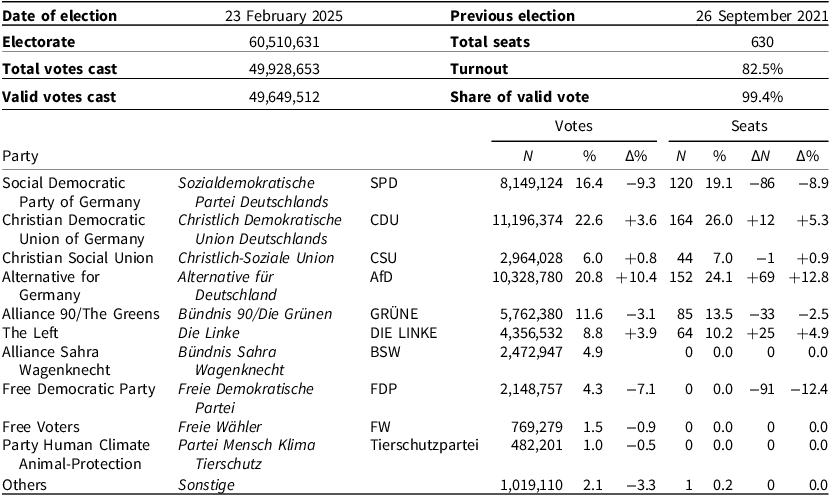
The federal election on 23 February 2025 saw the governing parties suffer heavy losses (see Table 1; Bundeswahlleiterin 2025; Forschungsgruppe Wahlen 2025a; Deutsche Welle 2026f). Bündnis 90/Die Grünen (Alliance 90/The Greens) secured only 11.6% (−3.1 percentage points), which fell short of their ambition to become the new major centre-left party (Deutsche Welle 2026c, 2026f). The SPD, as the leading governing party, achieved its worst result in an election to the German Bundestag with 16.4% (−9.3 percentage points) (Bundeswahlleiterin 2025; Deutsche Welle 2025c). The Freie Demokratische Partei/Free Democratic Party (FDP), as the smallest partner in the former coalition, achieved only 4.3% (−7.1 percentage points) and thus lost parliamentary representation (RedaktionsNetzwerk Deutschland 2025; Bundeswahlleiterin 2025). Although the CDU/CSU won the federal election as the strongest party with 28.6% (+4.5 percentage points), the result also represented the Union’s second-worst election result in the history of the Federal Republic (Bundeswahlleiterin 2025). This meant that the two former catch-all parties received just 44.9% of the vote combined (Bundeswahlleiterin 2025; Deutsche Welle 2025c). The clear winner of the election was the far-right Alternative für Deutschland/AfD, which secured 20.8% of the vote (+10.4 percentage points), making it the second-largest party in the Bundestag, overtaking the SPD for the first time (Deutsche Welle 2026f). The success of Die Linke/The Left came as a surprise, as the party was still well below the five-per-cent threshold in polls as recently as early January and feared for its entry into parliament (Bundeswahlleiterin 2025). The party achieved 8.8%, an improvement of 3.9 percentage points (Bundeswahlleiterin 2025; tagesschau.de 2025a; Deutsche Welle 2026d, 2026f). With 4.98%, the Bündnis Sahra Wagenknecht/Alliance Sahra Wagenknecht (BSW) missed the five-per-cent threshold by a very narrow margin. It was only a few thousand votes short of entering the Bundestag (Deutsche Welle 2025d). For this reason, the party pushed for a recount of the votes and initiated proceedings for the election to be reviewed by the Bundestag’s Election Review Committee which rejected this electoral complaint in December 2025 (tagesschau.de 2025b). This prompted the BSW to bring the case before the Federal Constitutional Court (Bundesverfassungsgericht) (tagesschau.de 2026). This case is still pending at the time of writing.
Elections to the lower house of parliament (Bundestag)

Table 1. Long description
The table presents the results of the federal election held on 23 February 2025. It includes data on the electorate, total votes cast, valid votes cast, and the performance of various political parties in terms of votes and seats. The table has 15 rows and 10 columns. The columns are labeled as follows: Party, Votes N, Votes %, Votes Delta%, Seats N, Seats %, Seats Delta N, Seats Delta%. The row labels include the names of the political parties. The table shows the number of votes and seats each party received, as well as the percentage change from the previous election. Notable trends include the heavy losses suffered by the governing parties and the significant gains made by the far-right Alternative fr Deutschland/AfD. The Social Democratic Party of Germany (SPD) achieved its worst result with 16.4% of the votes and 120 seats, a decrease of 9.3 percentage points and 86 seats. The Christian Democratic Union of Germany (CDU) won the election as the strongest party with 22.6% of the votes and 164 seats, an increase of 3.6 percentage points and 12 seats. The Christian Social Union in Bavaria (CSU) received 6.0% of the votes and 44 seats, a slight increase of 0.8 percentage points and 1 seat. The Alternative fr Deutschland (AfD) secured 20.8% of the votes and 152 seats, an increase of 10.4 percentage points and 69 seats. The Alliance 90/The Greens (GRUNE) received 11.6% of the votes and 85 seats, a decrease of 3.1 percentage points and 33 seats. The Left (DIE LINKE) achieved 8.8% of the votes and 64 seats, an increase of 3.9 percentage points and 25 seats. The Alliance Sahra Wagenknecht (BSW) received 4.9% of the votes but no seats. The Free Democratic Party (FDP) achieved 4.3% of the votes and no seats, a decrease of 7.1 percentage points and 91 seats. Other parties received varying percentages of the votes but did not secure any seats.
Notes: 1. The BSW reached 4.981% of the votes. 2. The Südschleswigscher Wählerverband/South Schleswig Voters’ Association (SSW) won, as in 2021, one seat. The party is not subject to the five-per cent threshold, due to its status as a party of a national minority.
Sources: Bundeswahlleiter (2021); Bundeswahlleiterin (2025); Deutscher Bundestag (2026a).
Overall, this election result shows that the processes of increasing polarisation and fragmentation within the German party system have again reached a new peak. The two former catch-all parties, CDU/CSU and SPD, account for less than half of the votes cast. On the political right, three parties are competing for the electorate (CDU/CSU, AfD, FDP), and the same is true on the political left (SPD, Greens, Left Party). The BSW has a left-authoritarian profile, occupying the economic left and the socio-cultural right of the political spectrum (Heckmann et al. Reference Heckmann, Wurthmann and Wagner2025: 2, Steiner and Hillen Reference Steiner and Hillen2026: 327). This has major implications for potential coalition options, government stability, and Germany’s capacity for reform (Angenendt and Brause Reference Angenendt, Brause, Poguntke and Hofmeister2024). The ‘Brandmauer’ (literally firewall), a Cordon Sanitaire that rules out any cooperation between the other parties and the AfD (Deutsche Welle 2025c) limits the range of coalition options, leaving a coalition between the CDU/CSU and the SPD as the only feasible option for a minimal-winning coalition.
Regional elections
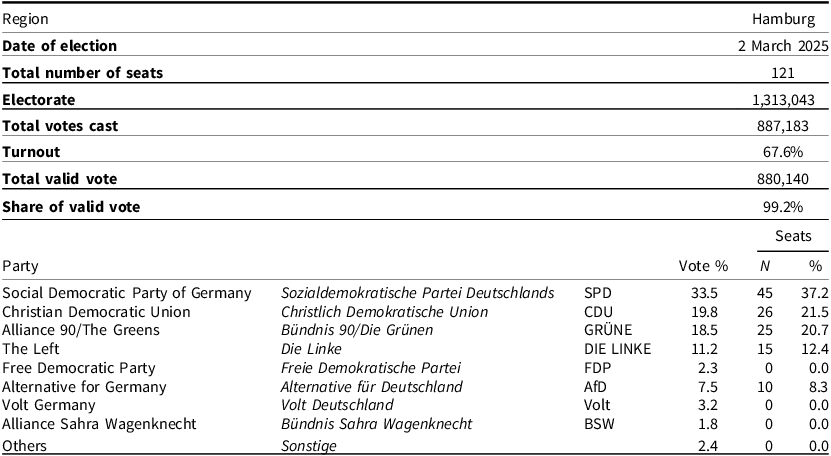
The Hamburg state election on 2 March 2025 confirmed the city’s status as an SPD stronghold but also brought about significant shifts in the political landscape (Statistisches Amt für Hamburg und Schleswig-Holstein 2025; Forschungsgruppe Wahlen 2025b; Deutsche Welle 2025e). The SPD once again won the election with 33.5% of the state vote, however, it lost 5.7 percentage points compared to the 2020 election. The CDU made strong gains (+8.6 percentage points), increasing its share of the vote to 19.8% and moving into second place ahead of the Greens, who received 18.5%, losing 5.7 percentage points compared to 2020. The Left (11.2%) and the AfD (7.5%) each achieved their best-ever results at a Hamburg state election (Statistisches Amt für Hamburg und Schleswig-Holstein 2025; Deutsche Welle 2025e). The FDP (2.3%), Volt (3.2%) and BSW (1.8%) failed to clear the five-per-cent threshold. Voter turnout rose to 67.6% (Table 2) (Statistisches Amt für Hamburg und Schleswig-Holstein 2025). On 24 April 2025, the SPD and the Greens successfully concluded coalition negotiations and agreed on a coalition agreement for the next five years (NDR 2025a). Hamburg thus continues its red-green government, which has been in place since 2015, and Peter Tschentscher was re-elected as First Mayor (Erster Bürgermeister) of the city state of Hamburg (Der Spiegel 2025a).
Results of regional (Hamburg) elections in Germany in 2025

Table 2. Long description
A table summarizing the results of the regional elections in Hamburg, Germany, held on 2 March 2025. The table has 12 rows and 6 columns. The columns are labeled as follows: Party, Vote, and Seats. The Party column lists the names of the political parties, the Vote column shows the percentage of votes each party received, and the Seats column shows the number and percentage of seats each party won. The table includes data for the Social Democratic Party of Germany (SPD), Christian Democratic Union (CDU), Alliance 90/The Greens (GRÜNE), The Left (DIE LINKE), Free Democratic Party (FDP), Alternative for Germany (AfD), Volt Germany (Volt), Alliance Sahra Wagenknecht (BSW), and Others (Sonstige). The SPD received 33.5% of the vote and won 45 seats (37.2%). The CDU received 19.8% of the vote and won 26 seats (21.5%). The GRÜNE received 18.5% of the vote and won 25 seats (20.7%). DIE LINKE received 11.2% of the vote and won 15 seats (12.4%). The AfD received 7.5% of the vote and won 10 seats (8.3%). Volt received 3.2% of the vote and won 0 seats (0.0%). The BSW received 1.8% of the vote and won 0 seats (0.0%). Others received 2.4% of the vote and won 0 seats (0.0%). The FDP received 2.3% of the vote and won 0 seats (0.0%). The table also includes information on the total number of seats (121), the total number of voters (1,313,043), the total votes cast (887,183), voter turnout (67.6%), total valid votes (880,140), and the share of valid votes (99.2%).
Cabinet report
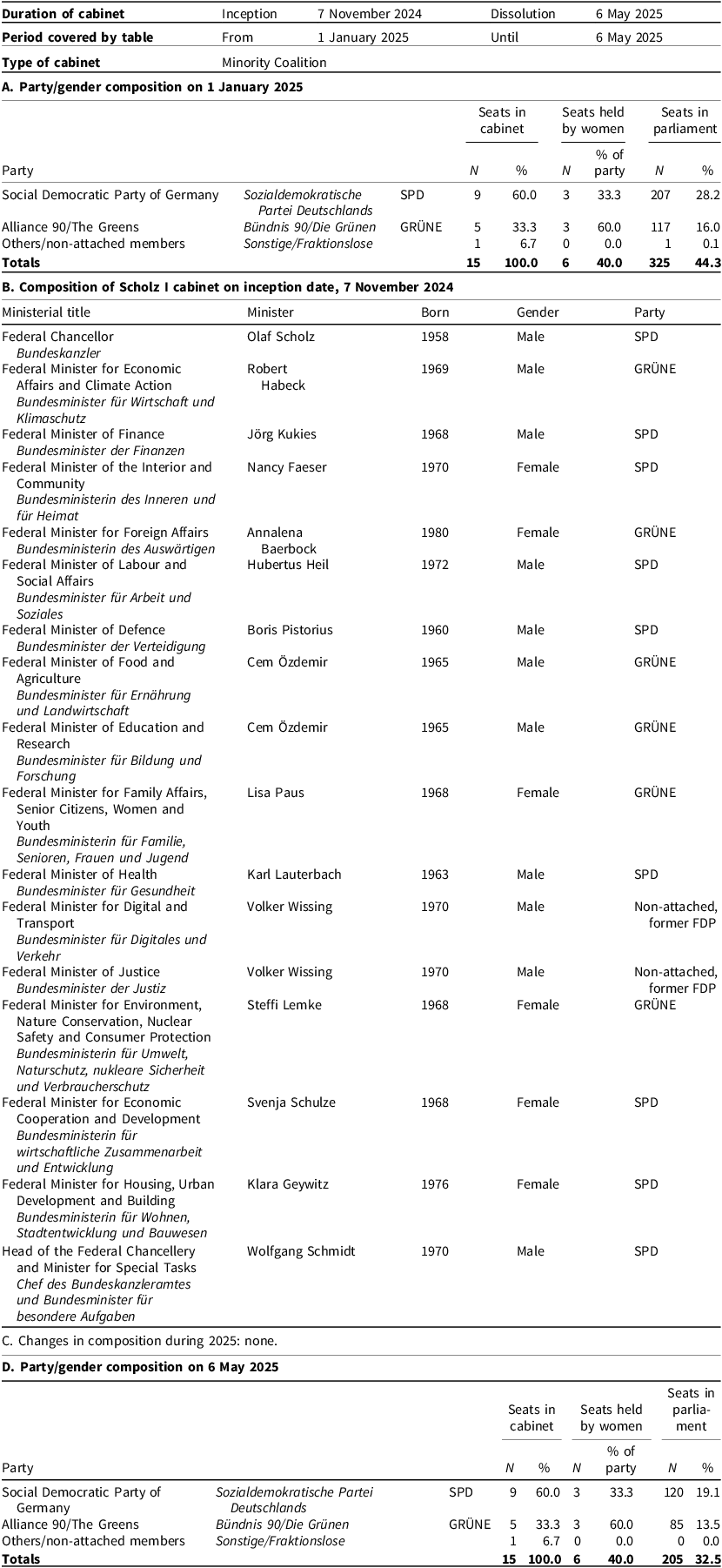
Following the exit of the FDP from the governing coalition in November 2024, the Scholz Government (Table 3) continued to operate as a minority cabinet composed of the SPD and the Greens (Deutsche Welle 2024). Additionally, Volker Wissing, who left the FDP, served as a non-partisan minister, holding both the Justice and the Digital and Transport portfolios (for details, see Kinski and Brause Reference Kinski and Brause2025). The other two ministries previously held by the FDP were reassigned to the SPD and the Greens. Jörg Kukies (SPD) was appointed the new Minister of Finance, and Cem Özdemir (Greens) took on the role of Minister for Education and Research in addition to serving as Minister of Agriculture. After the federal election, coalition negotiations between the SPD and the CDU/CSU were concluded on 9 April 2025 (Deutsche Welle 2025f; tagesschau.de 2025c), resulting in a 144-page coalition agreement (CDU/CSU and SPD 2025).
Cabinet composition of Scholz I in Germany

Table 3. Long description
The table provides a detailed overview of the composition of the Scholz I cabinet in Germany, focusing on the period from January 2025 to May 2025. It includes information on the party and gender composition, ministerial titles, and changes in composition during this period. The table is divided into several sections: A. Party/gender composition on 1 January 2025, B. Composition of Scholz I cabinet on inception date, 7 November 2024, C. Changes in composition during 2025, and D. Party/gender composition on 6 May 2025. Section A lists the number of seats in the cabinet and parliament held by different parties and the percentage of seats held by women. Section B provides the names, birth years, genders, and parties of the ministers in the cabinet on the inception date. Section C notes that there were no changes in the composition during 2025. Section D repeats the information from Section A but for the date 6 May 2025. The table highlights the distribution of seats and the gender balance within the cabinet and parliament, providing a snapshot of the political landscape during this period.
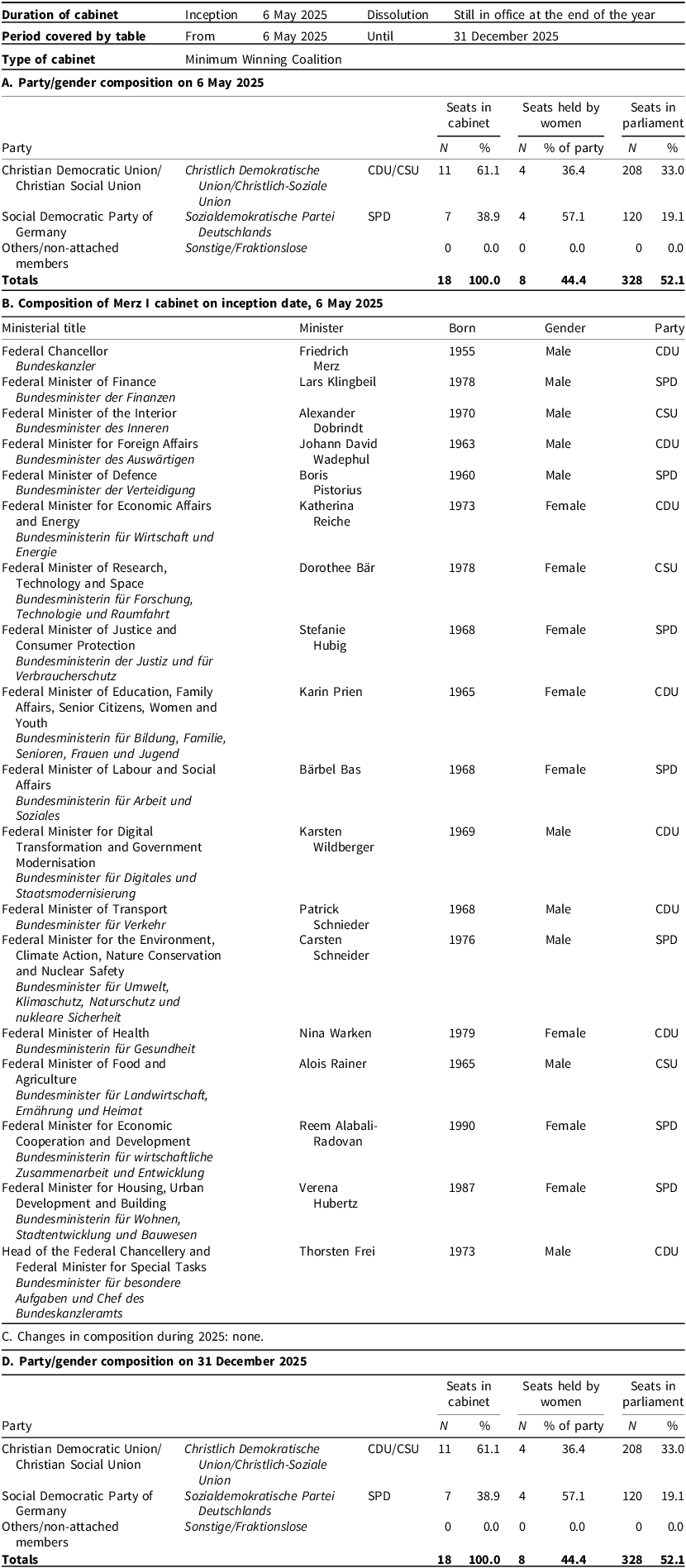
The subsequent chancellor election on 6 May was unprecedented in German parliamentary politics. Friedrich Merz failed to secure the required ‘chancellor majority’ (Kanzlermehrheit)Footnote 3 in the first ballot, despite the coalition partners jointly holding a comfortable majority. This marked the first time in the history of the Federal Republic that a designated chancellor failed to be elected in the first round. Merz was elected as Chancellor in a second ballot later the same day with 325 votes (Deutsche Welle 2025g). In the new cabinet, eight minister positions, including the chancellorship, are held by the CDU, three by the CSU, and seven by the SPD. Lars Klingbeil serves as Vice Chancellor (Table 4; Deutsche Welle 2025h; Bundesregierung 2026a).
Cabinet composition of Merz I in Germany

Table 4. Long description
The table provides detailed information about the composition of the Merz I cabinet in Germany as of 2025. It includes data on the duration of the cabinet, type of cabinet, party and gender composition, ministerial titles, and changes during the year. The table is divided into several sections: A. Party/gender composition on 6 May 2025, B. Composition of Merz I cabinet on inception date, 6 May 2025, C. Changes in composition during 2025, and D. Party/gender composition on 31 December 2025. Section A lists the seats in cabinet, seats held by women, and seats in parliament for the Christian Democratic Union/Christian Social Union, Social Democratic Party, and others/non-attached members. Section B details the ministerial titles, names, birth years, genders, and parties of the ministers. Section C notes that there were no changes in composition during 2025. Section D repeats the party/gender composition data from Section A but for the end of the year. The table captures the political landscape and gender representation within the cabinet and parliament.
As is common, several ministries were restructured. The former Ministry for Economy and Climate Protection transferred its climate portfolio to the Environment Ministry and became the Ministry for Economy and Energy, while its research and technology responsibilities were moved to the renamed Ministry for Research, Technology and Space. Education was transferred from that ministry to the Family Ministry, now called the Ministry for Education, Family Affairs, Senior Citizens, Women and Youth. Additionally, a new Ministry for Digital Transformation and Government Modernisation was created (Bundesregierung 2026a).
Parliament report
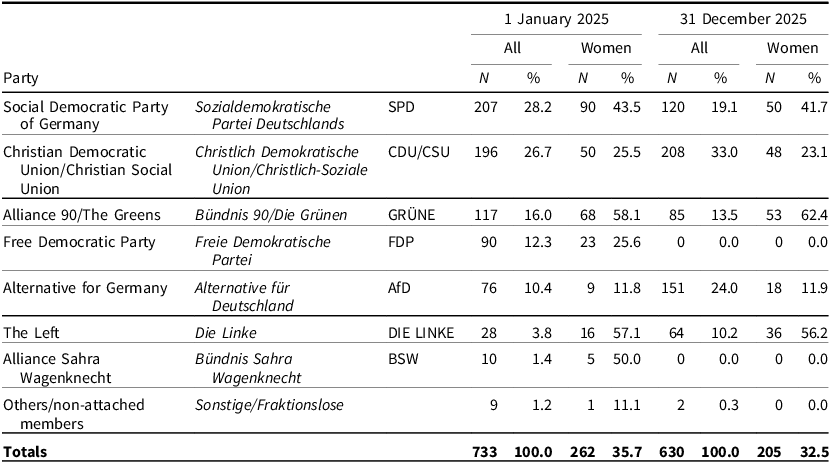
Table 5 displays the composition of the outgoing 20th and the new 21st German Bundestag. With the 2025 election a new electoral law had been applied, which was intended to reduce the size of the Bundestag, which reached a size of over 730 members of parliament in the 20th legislature (for details, see Kinski and Brause Reference Kinski and Brause2025). The new electoral reform introduced a ceiling of 630 seats. Moreover, the first vote, which settles the winner of a district, no longer guarantees that a Bundestag seat is won. A seat is only won, if a party has earned enough (proportional) second votes to cover it (Deutsche Welle 2023). Following the federal election, not only the election results but also the consequences of the electoral reform became the subject of a controversial public debate (Der Spiegel 2025b). This is the first time since 2002 that the Bundestag has seen a reduction in its number of seats and the first time the total number of seats has returned to a level comparable to the 2013 federal election (Bundeswahlleiter 2002, 2013).
Party and gender composition of the lower house of parliament (Bundestag) in Germany in 2025

Table 5. Long description
The table presents the party and gender composition of the lower house of parliament (Bundestag) in Germany on 1 January 2025 and 31 December 2025. It includes data for various political parties, detailing the total number of members (All), the percentage (%), the number of women (Women), and their percentage (%). The table has 11 rows and 10 columns. The columns are labeled as follows: Party, 1 January 2025 All (N, %), 1 January 2025 Women (N, %), 31 December 2025 All (N, %), and 31 December 2025 Women (N, %). The parties listed are Social Democratic Party, Christian Democratic Union/Christian Social Union, Alliance 90/The Greens, Free Democratic Party, Alternative for Germany, The Left, Alliance Sahra Wagenknecht, and Others/non-attached members. The totals for each category are also provided. Row 1: Social Democratic Party, 207, 28.2, 90, 43.5, 120, 19.1, 50, 41.7. Row 2: Christian Democratic Union/Christian Social Union, 196, 26.7, 50, 25.5, 208, 33.0, 48, 23.1. Row 3: Alliance 90/The Greens, 117, 16.0, 68, 58.1, 85, 13.5, 53, 62.4. Row 4: Free Democratic Party, 90, 12.3, 23, 25.6, 0, 0.0, 0, 0.0. Row 5: Alternative for Germany, 76, 10.4, 9, 11.8, 151, 24.0, 18, 11.9. Row 6: The Left, 28, 3.8, 16, 57.1, 64, 10.2, 36, 56.2. Row 7: Alliance Sahra Wagenknecht, 10, 1.4, 5, 50.0, 0, 0.0, 0, 0.0. Row 8: Others/non-attached members, 9, 1.2, 1, 11.1, 2, 0.3, 0, 0.0. Row 9: Totals, 733, 100.0, 262, 35.7, 630, 100.0, 205, 32.5.
The proportion of female members of parliament declined from 35.7% in the 20th Bundestag to 32.5% in the 21st Bundestag. This decrease can largely be attributed to the reduced parliamentary strength of left-wing parties, which on average tend to have a substantially higher share of women MPs (Friedrich-Ebert Stiftung 2025; Deutscher Bundestag 2026a). The election also produced notable shifts in the parliamentary balance of power. For the first time in the history of the Federal Republic, the SPD was no longer one of the two largest parliamentary party groups, while the AfD became the second-largest faction (Deutscher Bundestag 2026a). At the same time, the Left returned to full parliamentary group (Fraktion) status after having been reduced to a parliamentary group (Gruppe) in the previous legislative period (Kinski and Brause Reference Kinski and Brause2025).
Several changes in parliamentary party group membership occurred over the course of the year. In May 2025, Sieghard Knodel left the AfD parliamentary party group and continued his mandate as a non-affiliated member (Deutscher Bundestag 2026b). Together with Stefan Seidler of the South Schleswig Voters’ Association (SSW), this resulted in two non-affiliated members of parliament as of 31 December 2025 (Deutscher Bundestag 2026c). Within the CDU/CSU, Henning Otte left the Bundestag after being appointed Parliamentary Commissioner for the Armed Forces (Wehrbeauftragter) (Deutscher Bundestag 2026d, 2026e). He was replaced by Reza Asghari (Deutscher Bundestag 2026d). Within the Green parliamentary party group, former lead candidates for the Bundestag elections and federal ministers, Annalena Baerbock and Robert Habeck, stepped down from their mandates and were replaced by Andrea Lübcke and Mayra Vriesema (Deutscher Bundestag 2026e). In the Left parliamentary party group, Uwe Foullong left the Bundestag and was succeeded by Lizzy Schubert, who became the youngest member of parliament and the first non-binary MP (Deutscher Bundestag 2026e). The newly constituted Bundestag also elected a new Presidium. Julia Klöckner (CDU) was elected President of the Bundestag, with Andrea Lindholz (CSU), Josephine Ortleb (SPD), Omid Nouripour (Greens), and Bodo Ramelow (Left) serving as Vice Presidents (Deutscher Bundestag 2026f). As in previous legislative periods, no candidate nominated by the AfD was elected as Vice President, as candidates failed to obtain the required majority in the plenary (Deutscher Bundestag 2026f, 2025c).
Political party report
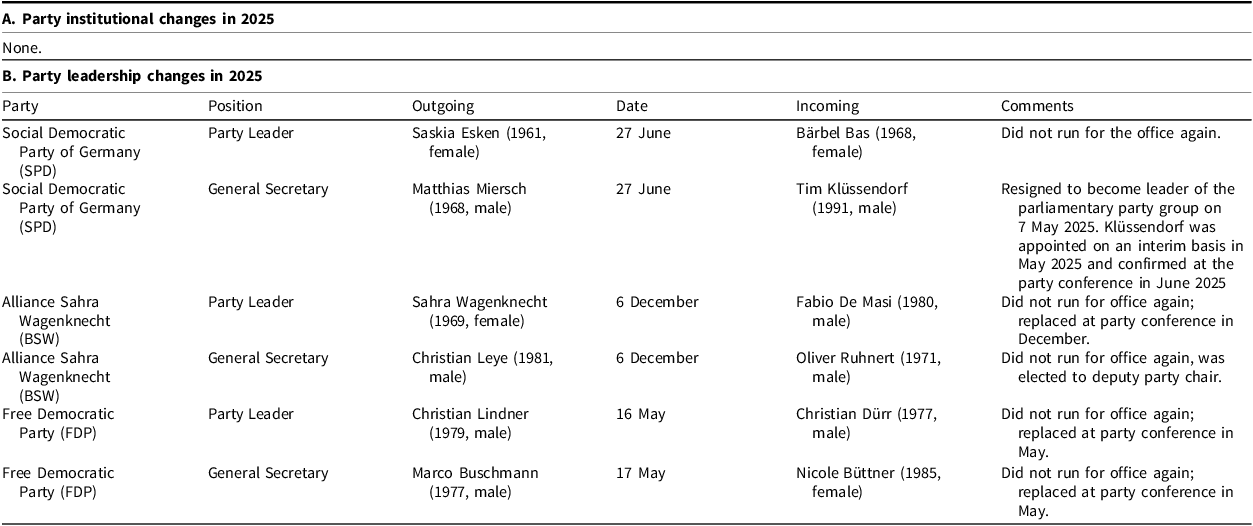
Table 6 summarises the most important changes in political parties in 2025. In the SPD, former chancellor Olaf Scholz did not seek any party office after the election but remained in parliament as an ordinary rank-and-file member. Party leader Saskia Esken did not seek re-election and was succeeded by Bärbel Bas at the party conference on 27 June 2025 (Der Spiegel 2025c; Deutsche Welle 2025i). The office of General Secretary also changed hands. As former interim General Secretary Matthias Miersch was elected as parliamentary group leader, Tim Klüssendorf was appointed on an interim basis in May and formally confirmed at the party conference in June (tagesschau.de 2025d; Zeit Online 2025a). Thus, with the exception of party leader Lars Klingbeil, the SPD changed the entire leadership of the party.
Changes in political parties in Germany in 2025

Table 6. Long description
A table summarizing leadership changes in German political parties in 2025. The table has two sections: A and B. Section A indicates no party institutional changes in 2025. Section B details party leadership changes in 2025. It includes columns for Party, Position, Outgoing, Date, Incoming, and Comments. The table lists changes for the Social Democratic Party of Germany (SPD), Alliance Sahra Wagenknecht (BSW), and Free Democratic Party (FDP). For the SPD, Saskia Esken stepped down as Party Leader on 27 June, succeeded by Bärbel Bas. Matthias Miersch resigned as General Secretary on 27 June, succeeded by Tim Klüssendorf. For the BSW, Sahra Wagenknecht stepped down as Party Leader on 6 December, succeeded by Fabio De Masi. Christian Leye resigned as General Secretary on 6 December, succeeded by Oliver Ruhnert. For the FDP, Christian Lindner stepped down as Party Leader on 16 May, succeeded by Christian Dürr. Marco Buschmann stepped down as General Secretary on 17 May, with no immediate successor mentioned. Nicole Büttner did not run for office again and was replaced at the party conference in May.
The BSW also experienced significant leadership turnover. At its party conference on 6 December 2025, party leader Sahra Wagenknecht did not run for office again and was replaced by Fabio De Masi (Deutsche Welle 2025j). At the same time, Christian Leye stepped down as General Secretary and was succeeded by Oliver Ruhnert (Zeit Online 2025b, 2025c). In addition, the party adopted a decision to change its name from ‘Bündnis Sahra Wagenknecht – Vernunft und Gerechtigkeit/Sahra Wagenknecht Alliance – Reason and Justice’ to ‘Bündnis Soziale Gerechtigkeit und Wirtschaftliche Vernunft/ Alliance for Social Justice and Economic Rationality’, although this change was scheduled to only take effect in October 2026 (BSW 2025a, Deutsche Welle 2025j).
The most consequential leadership changes occurred in the FDP following its failure to re-enter the Bundestag. Party leader Christian Lindner did not run again and was succeeded by Christian Dürr at the party conference on 16 May 2025 (NDR 2025b; tagesschau.de 2025e). One day later, Marco Buschmann was replaced as General Secretary by Nicole Büttner (tagesschau.de 2025f). There were no comparable leadership changes in the CDU/CSU, AfD, Greens, or The Left in 2025.
Institutional change report
On 18 March 2025, the Bundestag adopted an amendment to Articles 109, 115 of the German Basic Law (Grundgesetz) and inserted Article 143h with the required two-thirds majority. The Bundesrat (upper house of parliament) approved it on 21 March (Deutscher Bundestag 2025d). The reform modified the operation of the debt brake (Schuldenbremse), the constitutional rule to limit government borrowing. A permanent exemption for defence and certain security-related expenditure above 1% of nominal GDP was created, so that this spending no longer counts towards the borrowing limits. It also granted the Länder, a limited structural borrowing margin of 0.35% of nominal GDP in aggregate. Finally, it inserted a new Article 143h, which constitutionally authorised a new special fund (Sondervermögen) with its own borrowing power for additional investment (Bundeszentrale für politische Bildung 2025; Deutscher Bundestag 2025d; Deutsche Welle 2025k).
The reform was justified above all by the changed security environment following Russia’s war against Ukraine, increasing geoeconomic tensions, and the investment backlog in infrastructure. The new Sondervermögen Infrastruktur und Klimaneutralität (Special Fund Infrastructure and Climate Neutrality) was set at €500 billion, exempted from the normal debt-brake limits, and designed for investment in infrastructure and to achieve climate neutrality by 2045. According to the adopted arrangement, €100 billion of this sum is to be made available to the Länder (Bundeszentrale für politische Bildung 2025; Deutsche Welle 2025l). The law was passed by the outgoing 20th Bundestag shortly before the newly elected Bundestag convened, because the parliamentary majorities after the federal election would no longer have been sufficient for such a constitutional amendment (Deutscher Bundestag 2025d; Deutsche Welle 2025l).
Issues in national politics
In 2025, the economy and migration dominated public debate (Deutsche Welle 2026a). Structural challenges, including high energy costs, labour shortages, and declining industrial competitiveness, persisted, while unemployment rose markedly, surpassing three million in August. The loss of industrial jobs is particularly serious for the German economic model. In 2025, over 120,000 jobs were lost in the industrial sector (Deutsche Welle 2026b, 2026c, 2026d, 2026e). The new government under Chancellor Friedrich Merz sought to position itself as economically reform-oriented and adopted a major fiscal package, including substantial borrowing for infrastructure and climate investment, as well as tax relief measures for businesses (Bundesregierung 2025a; Deutsche Welle 2025m, 2025n).
The fiscal reorientation was a political controversy, as it marked a reversal of the CDU/CSU’s long-standing position and 2025 electoral promises (Deutsche Welle 2025o, 2026g). Throughout the traffic light coalition years of Olaf Scholz, the CDU/CSU had consistently opposed any relaxation of the constitutional debt brake, and the FDP’s insistence on fiscal austerity had been one of the central fault lines that ultimately caused the coalition to collapse in November 2024 (Angenendt and Kinski Reference Angenendt and Kinski2023; Kinski and Brause Reference Kinski and Brause2025). However, the new Merz government was not able to implement further major structural reforms in 2025, such as reforms of the pension, the public health, and tax systems, and approval ratings for both the government and the chancellor remained low. Socio-economic issues were closely linked to the persistently weak economic situation (Deutsche Welle 2026g; 2025n). Debates focused in particular on pension policy, with a reform package securing the pension level at 48% until 2031. The reform was contested within the governing parties, particularly by the Junge Gruppe (young group) of CDU/CSU MPs, but ultimately passed by a narrow majority in December (Bundesregierung 2025b; Deutsche Welle 2025p, 2025q). At the same time, discussions initiated by the CDU/CSU on labour supply and productivity intensified, with calls for longer working lives and criticism of part-time employment (Deutsche Welle 2026h). Welfare reform also remained central, as the government proposed stricter conditions for benefit recipients and introduced a new basic income scheme, effectively abolishing the Bürgergeld (citizen income) that the traffic-light coalition had introduced and prompting internal dissent within the SPD (Bundesregierung 2026c).
Following the fall of the Assad regime in December 2024, a debate ensued in Germany over whether and when Syrian asylum seekers should return to Syria (Deutsche Welle 2025r). In January, CDU/CSU passed a parliamentary resolution on stricter migration policies with support from the AfD, provoking widespread criticism and shaping the final phase of the electoral campaign. A subsequent legislative proposal failed to secure a majority (Deutsche Welle 2025s). After taking office, the government pursued a more restrictive course, expanding border controls and limits on family reunification, although some were later challenged in court. The salience of migration fluctuated over the year but remained tied to debates about security and social cohesion (Deutsche Welle 2025t; 2025u; 2025v).
The issue of the far-right AfD remained prominent in German politics in 2025. Despite the legal struggle on the classification as a confirmed extreme right organisation by the Office for the Protection of the Constitution in May 2025, and ongoing debates over a potential ban, the party continued to gain in strength and occupied an ever-larger share of political discourse (Deutsche Welle 2025w, 2025x).
Foreign, security and defence policy were shaped primarily by the war in Ukraine and changing transatlantic relations (Deutsche Welle 2026i; 2025y). The new government pledged to expand support for Ukraine (Deutsche Welle 2025z). During the year the relations with the United States deteriorated, impacting both economic and defence policy. At the Munich Security Conference in February 2025, US Vice President JD Vance interfered in German domestic politics just days before the federal election by accusing Europeans of democratic shortcomings (Deutsche Welle 2025aa). Relations were further strained by US tariff policy and a National Security Strategy that no longer described Europe as a natural ally (Deutsche Welle 2026i).
Defence policy was very important, with increased military spending and legislative changes, including exemptions from the debt brake and new provisions for military service registration (Deutsche Welle 2025ab). The debate on reintroducing conscription continued throughout the year (Deutsche Welle 2025ac). In December, the Bundestag passed the Military Service Act, which provided for the compulsory registration of all male citizens aged 18 in the military service register (Deutscher Bundestag 2025e). In addition, Germany’s policy towards Israel shifted temporarily when Israel planned an expansion of the war in Gaza, leading to a suspension of certain arms exports in August (Deutsche Welle 2025ad). Chancellor Merz justified this suspension by arguing that the planned Israeli offensive would harm the security of the hostages and worsen the situation for Palestinian civilians, while also tying it to the annexation of the West Bank. Restrictions were lifted again in November following a ceasefire (Deutsche Welle 2025ad, 2025ae).
Data availability statement
The data used in this study are entirely secondary data from publicly available sources. All data sources are cited within the article. No new data was created.
Acknowledgements
We would like to thank Jil Altmann and Jakob Ordejón for their helpful research assistance and the anonymous reviewers and the editors for their constructive feedback.
Competing interests
The authors declare none.
Declaration of AI use
The authors used AI-assisted tools during manuscript preparation for language editing, translations, and assistance in identifying media sources. All AI-assisted outputs were reviewed, verified, and revised by the authors.

 Open access

