The prevalence of depression rises steeply during adolescence (Birmaher et al., Reference Birmaher, Ryan, Williamson, Brent, Kaufman, Dahl and Nelson1996; Costello, Erkanli, & Angold, Reference Costello, Erkanli and Angold2006; Seeley & Lewinsohn, Reference Seeley, Lewinsohn, Allen and Sheeber2008). In addition, adolescents who have suffered one or more depressive episodes are at risk of subsequent episodes (33% within the next 4 years; Lewinsohn, Clarke, Seeley, & Rohde, Reference Lewinsohn, Clarke, Seeley and Rohde1994) and of developing comorbid conditions, even into adulthood (Lewinsohn, Rohde, Klein, & Seeley, Reference Lewinsohn, Rohde, Klein and Seeley1999). Adolescent depression has severe consequences for current and future psychosocial functioning. It impairs academic performance, increases social difficulties, and is associated with poor self-reported social well-being (Verboom, Sijtsema, Verhulst, Penninx, & Ormel, Reference Verboom, Sijtsema, Verhulst, Penninx and Ormel2014). These serious negative lifetime consequences underline the urgency to discover the mechanisms that precipitate or maintain depressive disorders during adolescence, a life period in which these disorders typically emerge for the first time (Lewinsohn et al., Reference Lewinsohn, Clarke, Seeley and Rohde1994).
Multiple authors have pointed out that within-person neurological, cognitive and socioemotional changes may explain why some adolescents develop depression and why adolescence is such a crucial period (e.g., Allen & Sheeber, Reference Allen and Sheeber2008a). However, several theories and recent research also emphasize the role of contextual factors, especially interpersonal relationships, in the emergence of depression. The occurrence of depression in children and adolescents has been linked to numerous family factors. The importance of the family environment for the development of psychopathology in general and depression in particular is evident for several reasons.
First, as emphasized in theories on developmental psychopathology, the context in which development takes place needs to be taken into account (e.g., Cicchetti & Toth, Reference Cicchetti and Toth1998; Cummings, Davies, & Campbell, Reference Cummings, Davies and Campbell2000). Family is the primary psychological environment a child grows up in, and characteristics of this environment and the mutual interactions that take place in it determine whether a child grows up in a loving and caring or in a rather stressful and threatening environment. A host of research shows that parental characteristics, such as quality of the attachment relation (e.g., Brenning, Soenens, Braet, & Bosmans, Reference Brenning, Soenens, Braet and Bosmans2012; Brumariu & Kerns, Reference Brumariu and Kerns2010; Dujardin et al., Reference Dujardin, Santens, Braet, De Raedt, Vos, Maes and Bosmans2016), parental psychopathology (e.g., Beardslee, Versage, & Gladstone, Reference Beardslee, Versage and Gladstone1998; Loon, de Ven, Doesum, Witteman, & Hosman, Reference Loon, de Ven, Doesum, Witteman and Hosman2014), quality of the relationship of the parents (e.g., Davies & Cummings, Reference Davies and Cummings1994), parenting styles and practices (e.g., Lipps et al., Reference Lipps, Lowe, Gibson, Halliday, Morris, Clarke and Wilson2012; Milevsky, Schlechter, Netter, & Keehn, Reference Milevsky, Schlechter, Netter and Keehn2007), determine risk for depression, and that this risk is largely passed on through how parents and children mutually interact (Sheeber, Davis, Leve, Hops, & Tildesley, Reference Sheeber, Davis, Leve, Hops and Tildesley2007).
Second, as argued by family systems theory, a family forms an emotional unit, a dynamic system in which the individual family members continuously influence each other, while shaping and being shaped by the structure of the family (Haefner, Reference Haefner2014; Minuchin, Reference Minuchin1974). Emotional skills, for example, are to a large extent acquired during affective interactions in the family context: children learn to interpret the emotional expressions of significant others, to express their emotions in an appropriate manner, and to regulate their emotions adaptively depending on context (Hunter, Hessler, & Fainsilber Katz, Reference Hunter, Hessler, Fainsilber Katz, Allen and Sheeber2008; Schwartz, Sheeber, Dudgeon, & Allen, Reference Schwartz, Sheeber, Dudgeon and Allen2012). Although emotional skills initially develop in infancy and early childhood, youth continue to learn and develop skills through adolescence. In this period, pubertal and neural developments trigger changes in cognitive and affective processes (Blakemore, Reference Blakemore2012; DeRose & Brooks-Gunn, Reference DeRose, Brooks-Gunn, Allen and Sheeber2008; Steinberg, Reference Steinberg2005) and in the adolescent's social systems, which become more layered and complex (Allen & Sheeber, Reference Allen, Sheeber, Allen and Sheeber2008b). The affect regulation strategies acquired during infancy and childhood might prove insufficient to face these new developmental challenges: “When the advent of novel emotional states precedes the development of the capacity to regulate them, adolescents may resemble unskilled drivers trying to maneuver a car that has just been turbo-charged by puberty” (Kesek, Zelazo, & Lewis, Reference Kesek, Zelazo, Lewis, Allen and Sheeber2008, p. 135, referring to Dahl, Reference Dahl2004). Not surprisingly, this developmental phase goes hand in hand with an observable increase in the variability and instability of the affective behavior that is displayed in family interactions (Granic, Hollenstein, Dishion, & Patterson, Reference Granic, Hollenstein, Dishion and Patterson2003; Hollenstein, Reference Hollenstein2007; Lichtwarck-Aschoff, Kunnen, & van Geert, Reference Lichtwarck-Aschoff, Kunnen and van Geert2009). The adolescents need to reorganize their affect regulation strategies and skills or adopt new ones that are more appropriate for adult life. How adolescents navigate this is an important pathway linking family interactions to depression (Brenning et al., Reference Brenning, Soenens, Braet and Bosmans2012; Schwartz et al., Reference Schwartz, Simmons, Whittle, Byrne, Yap, Sheeber and Allen2017).
To summarize, how parents and adolescents interact with one another is thought to provide a crucial environment that may create risk for depression, and offers a playground to learn how to deal with emotions. Obtaining a comprehensive picture of the nature and quality of parent–adolescent interaction is therefore of crucial importance to understand the role of family processes in depression. In this paper we aim to obtain a detailed view of how affective expressions are exchanged and potentially regulated during family interactions and how this may differ between families with a depressed adolescent and families with a nondepressed adolescent.Footnote 1 To this end, we will use a novel dynamical network approach.
Affective Family Interactions
Affective family interactions are characterized by a number of features that need to be taken into account when studying their role in depression. First, affective family interactions evolve and unfold across time. Individuals’ affects change from one moment to the next, and dynamically impact each other's affective behavior. To chart these fluctuations over time and the dynamics between them, one needs detailed information about affective behaviors by measuring them at many time points with only small time intervals between them (Walls & Schafer, Reference Walls and Schafer2005), resulting in so-called intensive longitudinal data or time series data (Hamaker, Ceulemans, Grasman, & Tuerlinckx, Reference Hamaker, Ceulemans, Grasman and Tuerlinckx2015).
Second, although many studies focus on the mother–child relationship, for a more complete understanding, interactions with both parents should be taken into consideration. Adolescents may behave differently toward their fathers than toward their mothers (Allen, Kuppens, & Sheeber, Reference Allen, Kuppens and Sheeber2012; Davis, Hops, Alpert, & Sheeber, Reference Davis, Hops, Alpert and Sheeber1998; Davis, Sheeber, Hops, & Tildesley, Reference Davis, Sheeber, Hops and Tildesley2000), and the relationship between the adolescent and the parent depends on whether the other parent is present (Gjerde, Reference Gjerde1986). Such triadic interactions, which constitute the smallest stable unit in family systems theory, are fundamentally different from dyadic interactions, for instance, because the third person forces the actors to split their attention and introduces new roles, such as “peacekeeper” or “withdrawn witness” (Hollenstein, Allen, & Sheeber, Reference Hollenstein, Allen and Sheeber2016).
Third, affective interactions, of course, may involve a host of different emotions, which may elicit one another. As a consequence, to capture the richness of the affective exchange, preferably multiple affective states are considered when studying family interactions, going beyond mere valence-driven distinctions (i.e., positive vs. negative affect). Angry and dysphoric behavior, for example, both indicate negative affect, but serve different functions in social interactions: angry behavior is an aggressive, self-protecting affect likely to elicit reciprocity of anger from other family members, while dysphoric behavior is more likely to elicit sympathetic response and to suppress aggression (Parkinson, Reference Parkinson1996; Van Kleef, De Dreu, & Manstead, Reference Van Kleef, De Dreu and Manstead2010). Positive affect also needs to be taken into account, as it orients toward social bonds and enhances forming of positive relationships (Ramsey & Gentzler, Reference Ramsey and Gentzler2015), while maladaptive regulation of positive affect is associated with depression (Werner-Seidler, Banks, Dunn, & Moulds, Reference Werner-Seidler, Banks, Dunn and Moulds2013; Yap, Allen, & Ladouceur, Reference Yap, Allen and Ladouceur2008).
Fourth, the affective behavior of families themselves may differ in several respects. The overall emotionality (i.e., which affects are expressed and how frequently) might vary across families. Previous studies, for instance, reported that parent–adolescent relationships in depressed families are characterized by more negative and conflictual interaction and less positive feedback and support (Sheeber et al., Reference Sheeber, Davis, Leve, Hops and Tildesley2007; Thompson, McKowen, & Rosenbaum Asarnow, Reference Thompson, McKowen, Rosenbaum Asarnow, Allen and Sheeber2008). High expressivity of positive emotions seems to foster resistance against depression. Regarding the expression of negative affect, a moderate amount might be optimal, as too much might indicate low problem solving and coping skills, while too little does not offer the opportunity to learn how others regulate their affect (for a review, see Morris, Silk, Steinberg, Myers, & Robinson, Reference Morris, Silk, Steinberg, Myers and Robinson2007).
Next to overall emotionality, the extent to which different emotions co-occur between family members, sometimes labeled synchronicity, is a feature of interest. Main, Paxton, and Dale (Reference Main, Paxton and Dale2016) found that high synchronicity of negative affect in a mother–daughter interaction is related to lower discussion satisfaction. Similarly, Hollenstein et al. (Reference Hollenstein, Allen and Sheeber2016) investigated simultaneous emotion displays of mothers, fathers, and adolescents in triadic interactions and identified triadic states that are shown more often in depressed families compared to nondepressed families. Such difference in the co-occurrence of affective states between mother, father, and adolescent should therefore be taken into account when examining differences between depressed and nondepressed families.
Families may also differ in how family members respond to each other's affective behavior. Several studies found important differences in how parents react to the children's display of affect (Schwartz et al., Reference Schwartz, Sheeber, Dudgeon and Allen2012; Sheeber, Hops, Andrews, Alpert, & Davis, Reference Sheeber, Hops, Andrews, Alpert and Davis1998), as well as how children react to parental behavior (Davis et al., Reference Davis, Hops, Alpert and Sheeber1998, Reference Davis, Sheeber, Hops and Tildesley2000). Sadness has been shown to be reinforced if parents react in a facilitative way or diminish their anger display (Schwartz et al., Reference Schwartz, Sheeber, Dudgeon and Allen2012; Sheeber et al., Reference Sheeber, Hops, Andrews, Alpert and Davis1998). Likewise, positive feelings of the child are dampened by dysphoric reactions of the parents (Katz et al., Reference Katz, Shortt, Allen, Davis, Hunter, Leve and Sheeber2014; Schwartz et al., Reference Schwartz, Sheeber, Dudgeon and Allen2012). Such patterns are particularly interesting as they resonate with principles of learning theory and could explain why depressed adolescents have problems in maintaining positive emotions (due to the negative reaction) or in downregulating sadness (as it is rewarded by support and anger avoidance).
A Dynamic Network Approach for Studying Affective Family Interactions
Numerous studies have investigated affective family interactions using time series data. Most of the studies typically zoom in on a single aspect of the interaction: frequency and duration of affective behavior (Chaplin, Reference Chaplin2006; Sheeber et al., Reference Sheeber, Allen, Leve, Davis, Shortt and Katz2009), reactions of children to a specific parental behavior (Davis et al., Reference Davis, Hops, Alpert and Sheeber1998, Reference Davis, Sheeber, Hops and Tildesley2000), parental reactions to a specific child behavior (Sheeber, Allen, Davis, & Sorensen, Reference Sheeber, Allen, Davis and Sorensen2000; Sheeber et al., Reference Sheeber, Hops, Andrews, Alpert and Davis1998), or synchronicity of positive or negative affect between mother and child (Main et al., Reference Main, Paxton and Dale2016). The literature has been advanced significantly through the use of these approaches. However, researchers are also beginning to capture the total sum of interactions and processes that take place, by attempting to take into account all affective behaviors at once, and studying how the affective states of the mother–father–adolescent triads change across time. Hollenstein et al. (Reference Hollenstein, Allen and Sheeber2016) adapted the state space grid approach (Hollenstein, Reference Hollenstein2013; Lewis, Lamey, & Douglas, Reference Lewis, Lamey and Douglas1999) to identify attractor states (i.e., frequently occurring affective triadic states) that maximally discriminate between depressed and nondepressed families. In addition, the amount of variability in the affective states is quantified by means of different measures (e.g., dispersion, transitions, and predictability; Hollenstein et al., Reference Hollenstein, Allen and Sheeber2016). While this approach gives an excellent overall summary of the central tendencies and spread of the affective states during interactions, it does not zoom in onto concurrent and sequential linkages between particular behaviors.
In the present study, we aim to combine the investigation of overall dynamics with the detailed view on pairwise interactions, by charting (and depicting visually) the frequencies, co-occurrences, and temporal linkages of all the affective behaviors of the three persons involved, in the form of networks. The network approach is increasingly popular in computer sciences, systems biology, and social sciences, but only recently has started gaining ground in the study of psychopathology. In a seminal paper, Borsboom and Cramer (Reference Borsboom and Cramer2013) argued that psychopathological syndromes should be conceptualized as a dynamic system of interacting symptoms. The vicious interplay of these symptoms define the psychopathology itself, offering a new perspective on therapy in that clinicians may target influential or central symptoms (i.e., symptoms that activate others once elicited, which allows negativity to spread rapidly through the network). Network analysis is then the perfect tool to shed light on the behavior and characteristics of such dynamic systems, as Barabási (Reference Barabási2011, p. 15) said: “Reductionism deconstructed complex systems, bringing us theory of individual nodes and links. Network theory is painstakingly reassembling them, helping us to see the whole again.”
Network analysis has been used thus far to study affective dynamics within a single individual (Bringmann et al., Reference Bringmann, Vissers, Wichers, Geschwind, Kuppens, Peeters and Tuerlinckx2013, Reference Bringmann, Pe, Vissers, Ceulemans, Borsboom, Vanpaemel and Kuppens2016; Pe et al., Reference Pe, Kircanski, Thompson, Bringmann, Tuerlinckx, Mestdagh and Gotlib2015); in this approach, several emotions are depicted as nodes of the intraindividual affect network, while the temporal sequencing is visualized as links between these nodes (also called edges). This visualization of the networkFootnote 2 allows one to obtain a complete picture of the interaction between different affective states of an individual. In many cases, this visualization generates new questions, as, for example, which behaviors play a central role in the interaction (centrality of nodes; Bringmann et al., Reference Bringmann, Vissers, Wichers, Geschwind, Kuppens, Peeters and Tuerlinckx2013), which behaviors are related to each other (the density of links; Pe et al., Reference Pe, Kircanski, Thompson, Bringmann, Tuerlinckx, Mestdagh and Gotlib2015), or what is the overall structure of the network (van Borkulo et al., Reference van Borkulo, Borsboom, Epskamp, Blanken, Boschloo, Schoevers and Waldorp2014).
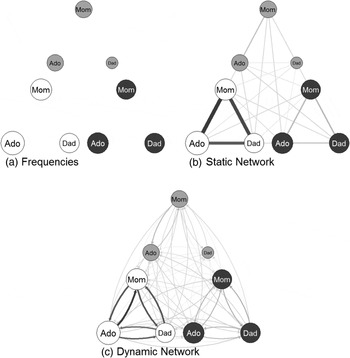
The present paper extends this intraindividual approach to multiple individuals, in this case parents and adolescents. By charting the networks of emotional interaction between different individuals, we can obtain insights into the affective interplay between family members, and how this may differ between depressed and nondepressed families. As we will illustrate by means of Figure 1, showing the average network of the nondepressed families, our network approach also goes beyond existing ones in that it is built to directly represent the three central features of affective family interactions mentioned above. First, we will inspect how frequently different affects are expressed by family members in general. This feature is reflected by the node size in Figure 1. For example, from Figure 1a, we can derive that the fathers of the nondepressed families behave angrily less often than the mothers and adolescents. Second, we will visualize the co-occurrence of affective expressions in static networks and investigate whether they differ between depressed and nondepressed families. For example, in Figure 1b, the thick edges between the happiness nodes of the different actors indicate that happiness co-occurs more frequently between actors than sadness or anger. Third, we will infer dynamic networks that depict temporally sequenced affective behaviors within and between actors. For instance, the dynamic network (Figure 1c) reveals that the adolescent's happiness is more often followed by the mother's happiness, than the other way around.
Visualization of the expressed affect between family members. (a) Frequencies, (b) static network, and (c) dynamic network. Grey shading indicates anger, black shading indicates dysphoric affect, and white shading indicates happiness. The node size represents the average relative frequency of the corresponding affect; the thickness and saturation of the links indicate the strength of the tie.

The Present Study
In the present study, we will reanalyze data from a previous study on affective interactions within families with a depressed adolescent and families with a nondepressed one (Allen et al., Reference Allen, Kuppens and Sheeber2012; Sheeber et al., Reference Sheeber, Kuppens, Shortt, Katz, Davis and Allen2012). In this study, three family members (mother, father, and adolescent) were invited for a lab session. During the session, they engaged in three types of family discussions, which were videotaped and coded in 1-s intervals for the presence and absence of the expressions of angry, dysphoric, and happy affect. Here, we will focus on the problem-solving family interactions, which were intended to elicit conflict, as such interactions have been shown to discriminate between families with depressed and those with nondepressed adolescents (Hollenstein et al., Reference Hollenstein, Allen and Sheeber2016; the results for event planning and family consensus, the two other types of interaction, can be consulted in the online-only supplementary material). Specifically, we will investigate the frequency of angry, dysphoric, and happy affect; their co-occurrence; and how they affect one another across time. Moreover, as each of the adolescents was either healthy or diagnosed with major depressive disorder (MDD), the data allow the exploration of the extent to which these three interaction features differ between the two subgroups. To this end, we will compare the average network of families with an adolescent who has been diagnosed with MDD with the average network of families with a nondepressed adolescent in order to detect depressotypic structures.
We expect to find differences between depressed and nondepressed families in overall frequencies of affective expressions (i.e., more anger and dysphoric affect, but less happiness in the depressed families), and this for all family members. For the depressed adolescent, these expectations match the DSM criteria for depressive disorder. We expect similar frequency differences for the parents, because it has been argued that parental behavior plays an important role in learning how to express and regulate emotions (Morris et al., Reference Morris, Silk, Steinberg, Myers and Robinson2007), implying that adolescents’ affective behavior may therefore simply reflect parental behavior. Another theoretical rationale for this hypothesis is the parental meta-emotion philosophy theory (Gottman, Katz, & Hooven, Reference Gottman, Katz and Hooven1996; Katz, Maliken, & Stettler, Reference Katz, Maliken and Stettler2012), which states that parents transfer their ideas about which emotional behavior is appropriate in which situations to their children.
Based on a review of recent findings on the co-occurrence of emotional behaviors in families, Main et al. (Reference Main, Paxton and Dale2016) conjectured that co-occurrence of positive affect is related to positive developmental outcomes (e.g., secure attachment) while co-occurrence of negative affect points toward negative outcomes (e.g., maladaptive emotion regulation). As these variables relate to depression (Brenning et al., Reference Brenning, Soenens, Braet and Bosmans2012; Joormann & Vanderlind, Reference Joormann and Vanderlind2014), we expect to find a strong co-occurrence of happiness in the nondepressed families and a strong co-occurrence of negative affect in the depressed families.
As concerns the temporal dependencies between the emotional expressions of the family members, theories about emotion socialization indicate how parental responses to child's emotional expression may relate to adolescent depression (Schwartz et al., Reference Schwartz, Sheeber, Dudgeon and Allen2012) through reinforcement and punishment processes. On the basis of this, we hypothesize that dysphoric behavior of the adolescent might be reinforced by increased displays of parental happy behavior in the depressed families or that happy behavior of the adolescent might be dampened by dysphoric or angry parental reactions.
Method
Participants
The emotion study (Allen et al., Reference Allen, Kuppens and Sheeber2012; Sheeber et al., Reference Sheeber, Kuppens, Shortt, Katz, Davis and Allen2012) involved 141 adolescents (47 boys, 94 girls), aged 14.5–18.5, and their parents. Adolescents were included if they met the criteria for either the depressed or the nondepressed group and lived together with at least one parent or permanent guardian. Consistent with the demands of the larger study, adolescents were excluded if they evidenced comorbid psychotic, externalizing, or substance dependence disorders or if they were taking medication with known cardiac effects, or reported regular nicotine use (Allen et al., Reference Allen, Kuppens and Sheeber2012).
In this paper, we focused on affective interaction patterns between adolescents and both of their parents. Therefore, 46 of the 141 families were excluded because only one parent participated. Another 2 families were excluded due to technical problems with the video recordings. Hence, the analyses reported here are based on a sample of 93 families, of which the adolescents (aged between 14.5 and 18.5; 57 girls, 36 boys) in 43 families were diagnosed with MDD and in 50 families were healthy controls. Depressed and nondepressed adolescents did not differ significantly with respect to sex, age, or pubertal development.
Recruitment and assessment procedure
We briefly describe the recruitment and assessment procedure. More details can be found in Sheeber et al. (Reference Sheeber, Allen, Leve, Davis, Shortt and Katz2009).
Recruitment procedure
Adolescents were selected and enrolled using a two-gate recruitment process consisting of a depression screening and a diagnostic interview for the selected adolescents. Adolescents were categorized depressed, if they had elevated scores (>31 for boys, >38 for girls) on the self-report Center for Epidemiologic Studies Depression Scale (Radloff, Reference Radloff1977) and met the criteria for current MDD during the Schedule for Affective Disorders and Schizophrenia for School-Aged Children (Orvaschel & Puig-Antich, Reference Orvaschel and Puig-Antich1994). Nondepressed adolescents scored below an adolescent appropriate cutoff on the Center for Epidemiologic Studies Depression Scale (<21 for boys, <24 for girls) and did not meet the criteria for current or lifetime depressive or other disorders in the subsequent interview.
Lab assessment
Adolescents who met the criteria for inclusion were invited for a lab assessment together with their parents. During this assessment, the adolescents and their parents engaged in six family interactions: two event planning, two family consensus, and two problem-solving interactions. Each interaction consisted of a 9-min discussion and was video recorded. The affective behavior of both parents and their adolescents during the discussion was coded using the Living in Family Environments coding system (Hops, Biglan, Tolman, Arthur, & Longoria, Reference Hops, Biglan, Tolman, Arthur and Longoria1995). Living in Family Environments is an event-based, microanalytic coding system that codes the presence of anger, happiness, and dysphoric affect, based on facial expression, voice tone, and body language: anger is indicated by hostile, harsh, furious, annoyed, or irritated behavior (e.g., staccato rhythm, short, clipped speech, tight jaw or clenched teeth, involuntary twitches or jerks, or, of course, by direct statement of anger, complaints about the other person, and sharp exhalations). Happiness is coded if the person displays happiness through his/her facial expression, tone of voice, or body language. Happiness includes clues like laughter, giggling, bright and beaming positive facial expressions, excited looks that reflect a positive experience or positive energy, speech that is louder than usual, but not angry, exaggerated, or animated expressions or gestures, jumping up and down, or clapping hands. Dysphoria represents all sad, blue, unhappy, distressed, withdrawn, depressed, discouraged, downhearted, and tearful behavior. Clues for dysphoria are, for instance, low voice tone, with a slow pace of speech, sighing and yawning, crying, or facial features of dysphoric affect.
For each individual each affective expression was first coded on an event basis (i.e., a coder indicated when a certain affective expression starts and when it is replaced by a different expression; in the coding scheme, different affective expressions exclude each other). Next, the codes of all individuals were restructured into second-by-second time series: for each second, a code indicated whether a certain behavior was shown. The coding procedure results in multivariate binary time series data (i.e., nine variables that indicate the presence/absence of the three affective expressions for the adolescent, mother, and father) for each of the six discussions, each consisting of approximately 540 time points. If the observation of one or more persons was missing, then the time points were deleted. Because this happened exclusively in the beginning of the video recording, when the conversation just lifted off, and never exceeded beyond 10 s, the impact on the data analysis is negligible. The experienced, extensively trained observers were blind to diagnostic status. About 25% of the videos were coded by two observers, yielding κ values between 0.60 and 0.64 (Allen et al., Reference Allen, Kuppens and Sheeber2012), reflecting good reliability.
Results
Affect frequency
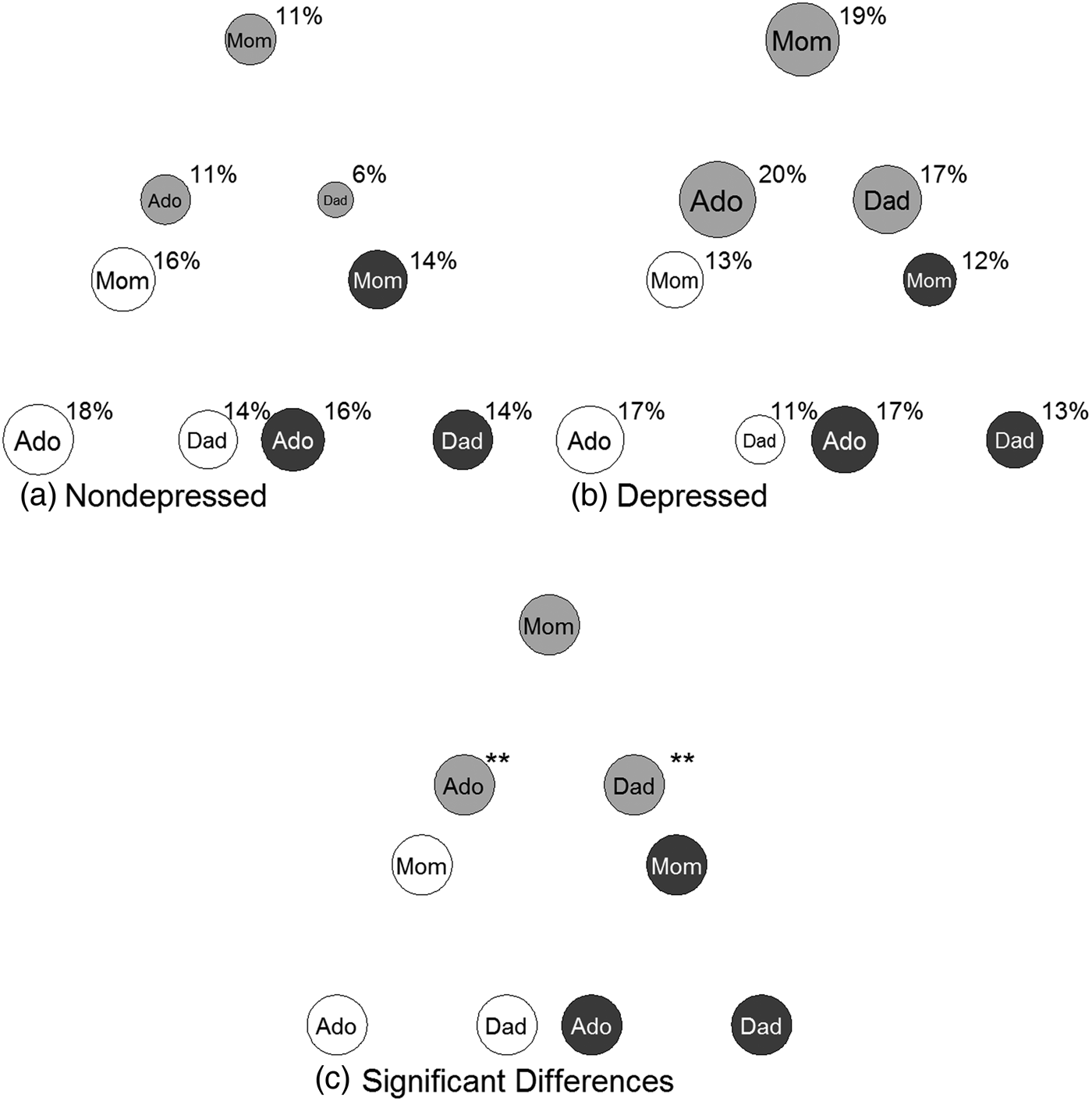
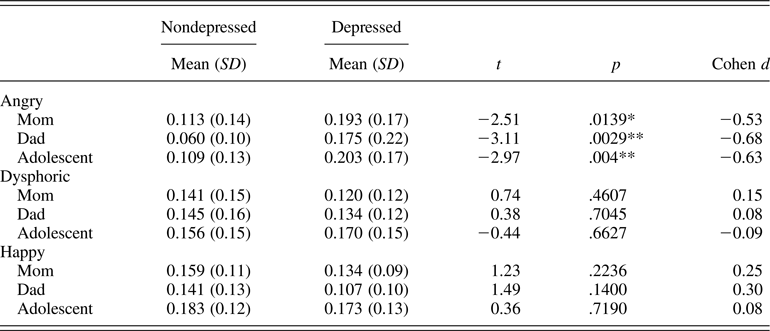
For each family member and each affect, we calculated the relative affect frequency by computing the proportion of time the affect is shown, across the two problem-solving interactions. Note that we use relative rather than absolute frequencies to account for the minor differences in the number of coded time points per family. Figure 2 visualizes the average relative affect frequencies for (a) the nondepressed and (b) the depressed families, by adapting the size of the node to the corresponding average relative affect frequency: the larger the node, the higher the average relative frequency. The t tests (Table 1) confirm the visual impression that anger occurs more frequently for adolescent and father in depressed families than in nondepressed ones, with moderate effect sizes (i.e., Cohen d = –0.63 and –0.68). The relative frequency of the other affects did not differ.
Relative affect frequency. (a) Average relative frequency of nondepressed families, (b) average relative frequency of depressed families, and (c) significant differences (**p < .01, ***p < .001). Grey shading indicates anger, black shading indicates dysphoric affect, and white shading indicates happiness. (a,b) The node size represents the average relative frequency of the corresponding affect.

Differences in relative affect frequency

Note: The p values were calculated with t tests assuming unequal variances.
*p < .05. **p < .01.
Static network
With the static network, we focus on the co-occurrence of affect. To quantify the co-occurrence of two affective responses (referred to as first and second behavior), we computed a static Jaccard similarity (Jaccard, Reference Jaccard1912):
 $${\rm Ja}{\rm c}_{{\rm stat}} = \displaystyle{{n{\rm } _{11}^{{\rm stat}}} \over {n{\rm} _{11}^{{\rm stat}} + n{\rm} _{01}^{{\rm stat}} + n{\rm} _{10}^{{\rm stat\;}}}}\comma$$
where  $n_{11}^{{\rm stat}} $ denotes the number of time points that both affective responses are shown at the same moment,
 $n _{10}^{{\rm stat}} $ the number of time points that only the first affective behavior is shown, and
 $n _{01}^{{\rm stat}}$ the number of time points that only the second affective behavior is shown. A static Jaccard similarity of 1 is achieved when both affects always co-occur; a score of 0 indicates that they never co-occur.
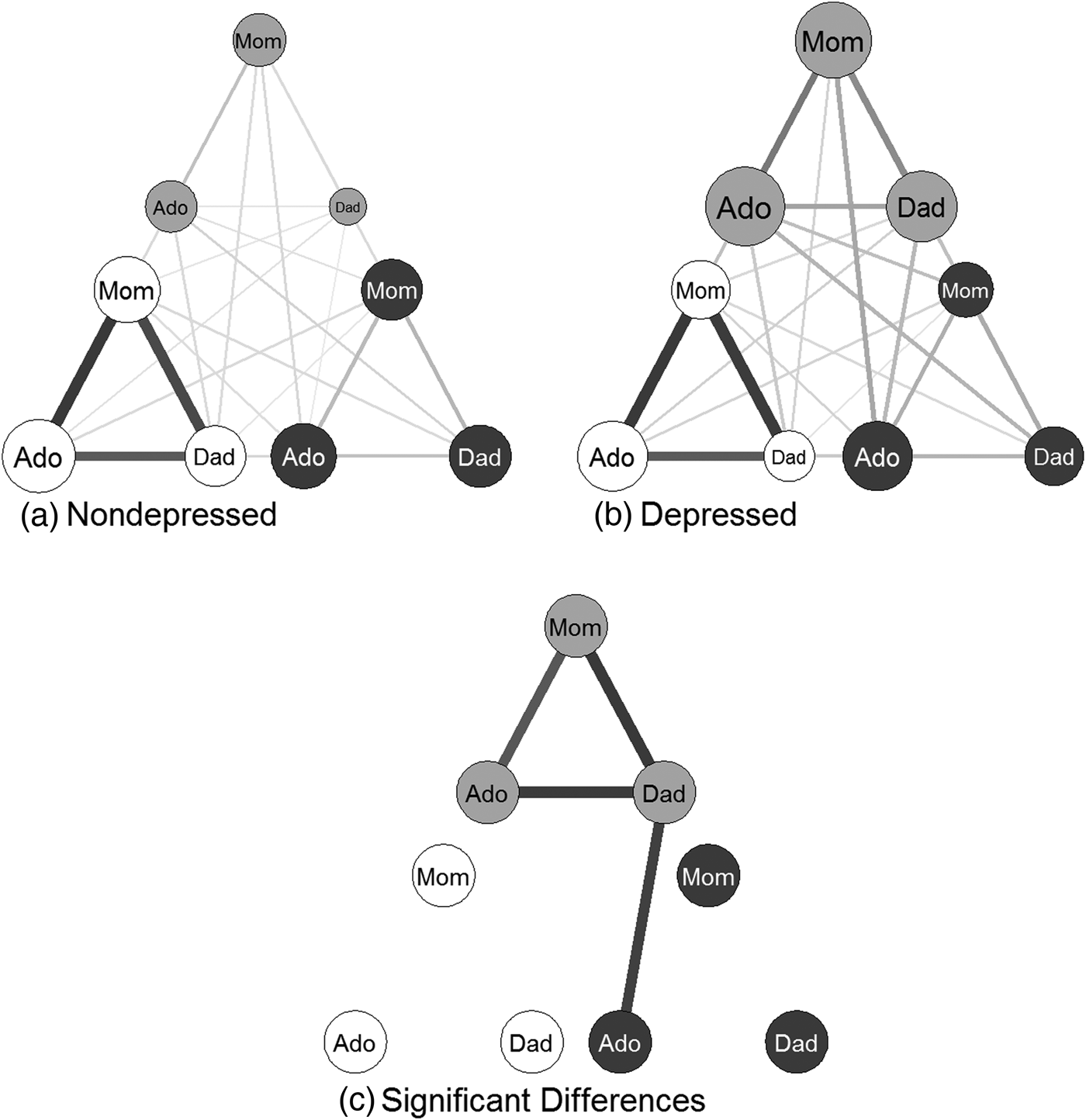
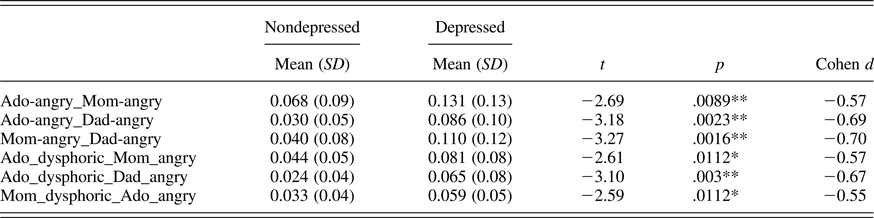
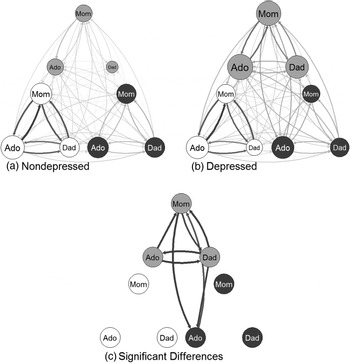
Figure 3 visualizes the static Jaccard similarities by drawing edges between the nodes of Figure 2. Figure 3a shows the average static Jaccard similarities for the nondepressed families and Figure 3b those for the depressed families. The width of the edges reflects the size of the average similarity indices. Conducting t tests (assuming unequal variances) on the corresponding edges of both groups of families, revealed four significant differences (p < .01; see Table 2). These differences are plotted in Figure 3c. In this plot, the width of the edges are based on the value of the Cohen d.
Co-occurrence of affects. (a) Average static Jaccard similarity of nondepressed families, (b) average static Jaccard similarity of depressed families, and (c) significant differences (p < .01). Grey shading indicates anger, black shading indicates dysphoric affect, and white shading indicates happiness. (a,b) The node size represents the relative frequency of the corresponding affect; the thickness and saturation of the links indicate the strength of the tie. (c) The linewidth indicates the Cohen d value.

Differences in co-occurrence of two affective behaviors
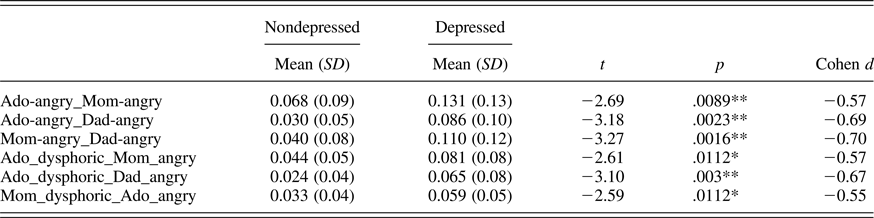
Note: The p values were calculated with t tests assuming unequal variances. Only links for which p < .05 are listed.
*p < .05. **p < .01.
Figure 3 demonstrates that in both groups, happy responses co-occur most frequently. However, the strength of these edges does not differ between depressed and nondepressed families. In contrast, anger is on average displayed more often together in depressed families, for each pair of actors. In addition, dysphoric affect of the adolescent co-occurs more often with angry affect from the father, in depressed families.
Dynamic network
The dynamic network charts the temporal dependencies between family members’ affective responses. The goal is to investigate how a certain behavior (indicated as first behavior) dynamically impacts another behavior (indicated as second behavior) across a time lag of 5 s, where the two behaviors may stem from the same or from different individuals. The lag of 5 s is based on the assumption that the reaction of one partner to the behavior of the other partner takes some time (Allen et al., Reference Allen, Kuppens and Sheeber2012; Gottman, Reference Gottman2002). However, to be sure that this lag also applies to our data, we checked on lags between 1 and 10 s, but did not find differences in significance between the two groups. Taking a smaller interval might cause confusion with the simultaneously occurring emotions, while taking too big an interval increases the risk that behavior is included that does not directly result from the behaviors in question, but is a response to other events. To quantify these temporal relations, we computed a dynamic Jaccard similarity on the lagged data, which indicates how frequently the second behavior is preceded by the first:
 $${\rm Ja}{\rm c}_{{\rm dyn}} = \displaystyle{{n{\rm} _{11}^{{\rm dyn}}} \over {n{\rm} _{11}^{{\rm dyn}} + n{\rm} _{10}^{{\rm dyn}} + n{\rm} _{01}^{{\rm dyn}}}}\comma$$
where n dyn11 denotes the number of times the first affective behavior is followed 5 s later by the second affective behavior; n dyn10 the number of times the first affect is expressed, but not followed by the second affective behavior 5 s later; and n dyn01 the number of times the second affect is expressed, without being preceded by the first affective behavior 5 s earlier.
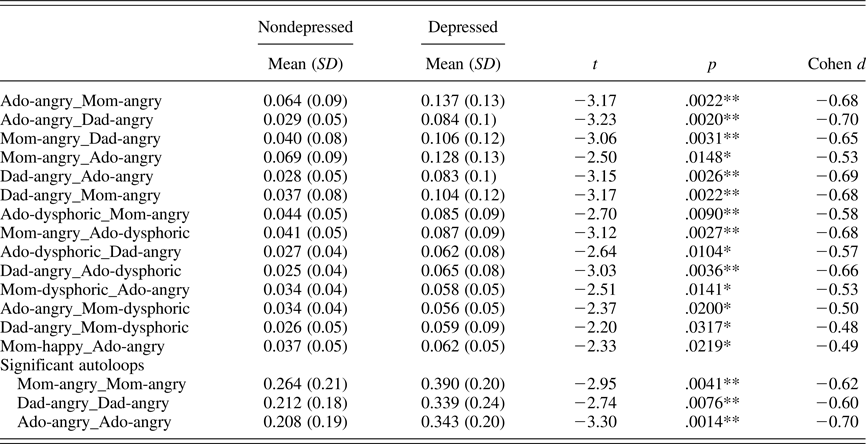
Figure 4 visualizes the dynamic Jaccard similarities for all pairs of affect by drawing directed arrows between the nodes. Figure 4a shows the average values for the nondepressed families and Figure 4b those for the depressed families. We omitted the autoloops, which chart the carryover effect of an affective state on itself, as these within-person inertia effects are not the focus of this study and have already been investigated in this sample (Kuppens, Allen, & Sheeber, Reference Kuppens, Allen and Sheeber2010). Comparing the dynamic Jaccard similarities between the two groups using t tests assuming unequal variances, revealed eight edges that are significantly different (p < .01; see Table 3). These differences are plotted in Figure 4c, in which the width of the edges reflects the corresponding value of the Cohen d.
Affective dynmics (calculated on 5-s lagged data). (a) Average dynamic Jaccard similarity of nondepressed families, (b) average dynamic Jaccard similarity of depressed families, and (c) significant differences (p < .01). Grey shading indicates anger, black shading indicates dysphoric affect, and white shading indicates happiness. (a, b) The node size represents the relative frequency of the corresponding affect; the thickness and saturation of the links indicate the strength of the tie. (c) The linewidth indicates the Cohen d value. Autoloops are generally omitted.

Differences in temporal sequencing of affect (5-s lag)
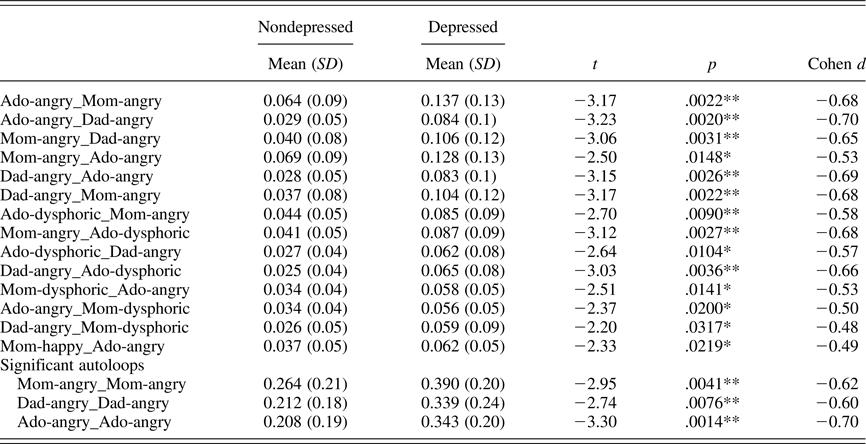
Note: The p values were calculated with t tests assuming unequal variances. Only links for which p < .05 are listed.
*p < .05. **p < .01.
In both depressed and nondepressed families, happiness is the most contagious state, in the sense that happiness in one individual is frequently followed by happiness in another individual. Both groups do thus not differ in this respect. However, for anger, the links are significantly stronger in the network of the depressed families. In other words, in depressed families angry behavior by one member is more frequently followed by angry behavior of another family member. Particularly relevant for understanding depressive mood in adolescents, adolescents’ dysphoric behavior and angry behavior of their parents follow upon each other more often in depressed than in nondepressed families.
Discussion
In this paper, we used a novel network approach to explore how affective interactions differ between families with and without a depressed adolescent. Charting and visualizing the average static and dynamic networks for both types of families revealed that in depressed families, anger was expressed more often, co-occurred more frequently between the family members, and predicted angry behavior in others more strongly than in nondepressed families. Dysphoric affect of the adolescent and angry behavior of the parents followed upon each other more often in depressed compared to nondepressed families. Contradictory to what could be expected, no differences in happiness were found.
Happiness
No evidence was found that depressed families show less happiness or interact less happily than nondepressed families during problem-solving interactions as neither the relative frequency, nor the co-occurrence measures, nor the temporal dependencies differed significantly between the depressed and nondepressed families. These results are not consistent with loss of pleasure or interest as one of the diagnostic criteria for MDD (DSM-5; American Psychiatric Association, 2013). However, this finding may be explained by a discrepancy between experienced and observed happiness. For instance, Chaplin (Reference Chaplin2006) found that individuals with higher depressive symptoms report less happiness, but do not seem less happy during a stressful interaction. Regarding affect regulation, our results do not support the notion of lower levels of reinforcement of happiness in depressed families (Cole & Rehm, Reference Cole and Rehm1986), as parents do not interact less happily with each other or with their depressed child. Likewise, the results yield no evidence of increased parental dampening (Yap et al., Reference Yap, Allen and Ladouceur2008) or punishment of happiness, as neither mothers nor fathers displayed more dysphoric or angry responses to adolescents’ happy behavior. A possible explanation is that such mechanisms supporting or undermining happiness have been observed in studies with younger children (Cole & Rehm: 8–12 years; Yap et al.: 11–13 years), but are not always found in those with older ones (e.g., Chaplin, Reference Chaplin2006). Main et al. (Reference Main, Paxton and Dale2016) also pointed out that the problem-solving task might not elicit differences in happiness between families, due to its focus on conflict resolution. However, although happiness is more often shown in the event-planning tasks (see online-only supplementary material), even in these tasks, neither frequency nor links between happiness nodes differed significantly between the two types of families.
Dysphoria
The frequency of dysphoric affect does not differ significantly between the depressed and nondepressed families. The same holds for the co-occurrence of dysphoric affect and the temporal dependencies involving only dysphoria. These results are remarkable, as they are not in line with commonly used diagnostic procedures that consider dysphoric affect as a key diagnostic symptom of depression (the adolescents designated as depressed in this study would have had to endorse this symptom to be included in the depressed group). Note that Sheeber et al. (Reference Sheeber, Kuppens, Shortt, Katz, Davis and Allen2012) also reported that the depressed group examined in the current study did demonstrate higher baseline levels of dysphoric affect. As the latter used microcoded data from a mix of different tasks (i.e., a problem-solving task and a family-consensus task, compared to just examining the problem-solving tasks as we did here), contextual aspects of these different tasks might explain at least part of the difference in findings. More precisely, the problem-solving interaction task seems to elicit conflict and therefore angry behavior, but not dysphoric behavior (Sheeber et al., Reference Sheeber, Kuppens, Shortt, Katz, Davis and Allen2012). During the family-consensus tasks (see online-only supplementary material), all three family members show more dysphoric behavior than during the problem-solving task; nevertheless, the differences between the two types of families (nondepressed vs. depressed) are not significant for any of the three features in these family consensus tasks.
Anger
Anger was expressed more frequently in the families with depressed adolescents than in the nondepressed families, and these expressions of anger were also shown more often contemporaneously or following expression of anger of another person. However, a leader–follower pattern, in the sense that anger of one family member did more often follow or lead the anger of another family member, did not emerge.
These findings are in line with results of previous research. Depressed adolescents showed more anger and irritability than do nondepressed adolescents (Ingram, Trenary, Odom, Berry, & Nelson, Reference Ingram, Trenary, Odom, Berry and Nelson2007; Sheeber et al., Reference Sheeber, Allen, Leve, Davis, Shortt and Katz2009; Wenze, Gunthert, & Forand, Reference Wenze, Gunthert and Forand2007). With regard to the co-occurrence of anger, higher simultaneous expression of negative affect was found by Main et al. (Reference Main, Paxton and Dale2016) for low satisfied mother–adolescent dyads. Finally, with respect to the temporal dependencies, Schwartz et al. (Reference Schwartz, Sheeber, Dudgeon and Allen2012) found that reciprocation of adolescents’ anger was related to depression. Overall, our findings are consistent with previous evidence that depressed adolescents experience harsher and more conflictual interactions with both of their parents than do nondepressed adolescents (Sheeber, et al., Reference Sheeber, Davis, Leve, Hops and Tildesley2007).
Combining the findings of higher frequency, co-occurrence, and temporal sequencing of anger between family members in depressed relative to control families, these findings paint a picture of the depressed family becoming stuck in a cycle of angry affectivity. As such, our findings seem to extend earlier results on intraindividual affect dynamics that showed that depressed individuals tend to perseverate longer in specific negative affective states (inertia; Kuppens et al., Reference Kuppens, Allen and Sheeber2010), and are more predictable and less flexible in moving from one negative affect to another (higher density of negative emotions in affect network; Pe et al., Reference Pe, Kircanski, Thompson, Bringmann, Tuerlinckx, Mestdagh and Gotlib2015). In this problem-solving family interaction, anger regulation strategies seem to fall short for all three family members (on average, at least), as the elevated irritability found is not only shown by the depressed person (i.e., the adolescent) but also characterizes the behavior of the parents. It is not unlikely that intergenerational transmission of maladaptive affect regulation could explain part of this finding (Buckholdt, Parra, & Jobe-Shields, Reference Buckholdt, Parra and Jobe-Shields2014). For this reason, interventions that address only child factors of adolescent depression, while not addressing the problematic functioning of the parents at the same time, might fall short (Kazdin & Weisz, Reference Kazdin and Weisz1998). Thus, our findings point into the same direction as Restifo & Bögels (Reference Restifo and Bögels2009), who indicate that “communication,” “problem solving,” and “parent–youth conflict” are among the most important elements that family-based therapy should target.
Interaffect dynamics
Several links between anger and dysphoric affect are stronger in the depressed families when compared with the nondepressed families: next to a concurrent link between paternal anger and adolescents’ dysphoric behavior, maternal anger and adolescents’ dysphoric affect reciprocate each other, and paternal anger is followed by adolescents’ dysphoric affect but not vice versa. Normally, adolescence is a period of highly flexible behavior as adolescents abandon familiar child behavior patterns and experiment with new behaviors (Granic et al., Reference Granic, Hollenstein, Dishion and Patterson2003). The temporal dependencies between anger and dysphoria reinforce the impression that the interaction between mother, father, and adolescent gets stuck in negativity (see above), rather than engaging in a healthy exploration of other ways of dealing with negative affect.
Implications for clinical practice
The novel network approach used in the present study reveals how affective interaction patterns differ between depressed and nondepressed families. The results inform clinical practice by suggesting that family-based intervention may be helpful when treating adolescent depression, as this allows one to address parental factors as well as child factors and to strengthen or build adaptive affective interaction patterns between parents and adolescents.
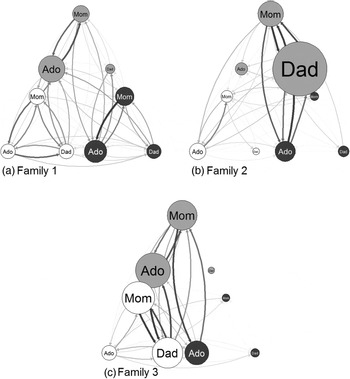
Though this study concentrated on the differences between the two subgroups (depressed vs. nondepressed) the pattern of behavior observed in each triad varied considerably. On the one hand, this may call for further refinement to be accomplished by looking at heterogeneity of family interactions within subgroups, especially, given the symptomatic heterogeneity in the presentation of depression (Fried & Nesse, Reference Fried and Nesse2015). Therefore, it may be advisable to cluster families within diagnostic groups (Bulteel, Tuerlinckx, Brose, & Ceulemans, Reference Bulteel, Tuerlinckx, Brose and Ceulemans2016a), or take into account covariates (e.g., family characteristics). On the other hand, in clinical practice, it may point toward studying family-specific networks. Figure 5, for example, depicts the interaction of three different depressed families in our sample. Each family shows a somewhat different picture: while in the first family (Figure 5a), the adolescent and mother strongly follow each other in anger and dysphoric affect; in the second family (Figure 5b), father's anger seems to play a central role. For the third family (Figure 5c), mother's anger is connected with both adolescent's anger and dysphoria, while neither mother's nor father's happiness is adopted by the adolescent. Such individual networks are promising for differential diagnostics (Wigman et al., Reference Wigman, van Os, Borsboom, Wardenaar, Epskamp and Klippel2015) or for tailored personalized intervention approaches (Fried et al., Reference Fried, van Borkulo, Cramer, Boschloo, Schoevers and Borsboom2017; van Roekel et al., Reference van Roekel, Masselink, Vrijen, Heininga, Bak, Nederhof and Oldehinkel2016).
Affective dynamics in different families with a depressed adolescent. (a) Family 1, (b) Family 2, and (c) Family 3. Grey shading indicates anger, black shading indicates dysphoric affect, and white shading indicates happiness. The node size represents the relative frequency of the corresponding affect. The thickness and saturation of the links indicate the strength of the tie. Autoloops are omitted.

Theoretical implications
In this paper, we addressed onset and maintenance of adolescent depression theoretically and methodologically from two different viewpoints. First, family systems theory conceptualizes the depressive symptoms of the individual as a problem of the whole family, which is clearly visible in the interplay of the whole family unit (e.g., communication patterns in real time), and therefore aims to understand the complex family dynamics. Second, developmental psychopathology focuses on the individual's development over time, taking into account how context and previous experiences shaped the individual. These two approaches do not necessarily exclude each other: Davies and Cicchetti (Reference Davies and Cicchetti2004), for example, argued that much could be gained by combining the two frameworks. Family systems theory could improve the understanding of the family dynamics by examining how they impact the individual, while developmental psychopathology would get a deeper understanding of the individual's development by considering the related family processes. The method we used in this study is able to bridge the gap between the two approaches as it allows us to quantify and depict the complexity of the family system in a rigorous way and relate it to developmental outcomes. We showed that the average affective interaction patterns in families differ considerably depending on whether the adolescent is depressed or not. This method provides empirical researchers with a new tool in hand to operationalize and translate theoretical concepts (such as emotional learning, meta-emotional philosophy) into quantifiable network features.
Future directions for the network approach
Future research could extend this approach in several ways. First, in this study, we investigated all pairwise interactions between mother, father, and adolescent. An important next step is to consider the combined influence of two persons on the third one at the next time point. Is it, for example, necessary that both parents are angry for the adolescent to become angry, or is it sufficient that one parent is angry? Can anger of the mother be counteracted by simultaneous happiness from the father? Such questions can be addressed by constructing networks based on Boolean (e.g., Aldana, Coppersmith, & Kadanoff, Reference Aldana, Coppersmith, Kadanoff, Kaplan, Marsden and Sreenivasan2003; Kauffman, Reference Kauffman1969) or logistic (e.g., Lumino, Ragozini, Duijn, & Vitale, Reference Lumino, Ragozini, van Duijn and Vitale2016; Schumacher, Roßner, & Vach, Reference Schumacher, Roßner and Vach1996; van Borkulo et al., Reference van Borkulo, Borsboom, Epskamp, Blanken, Boschloo, Schoevers and Waldorp2014) regression models, although one should be cautious when interpreting regression weights as they only reveal unique direct effects ignoring shared dynamics (Bulteel, Tuerlinckx, Brose, & Ceulemans, Reference Bulteel, Tuerlinckx, Brose and Ceulemans2016b).
Second, we have focused on sequential dependencies between two behaviors, so far. However, influential parenting theories have elaborated more complex patterns and behavioral cycles, for example, coercive processes by Patterson (Reference Patterson1982; for a review, see Scaramella & Leve, Reference Scaramella and Leve2004). Adapting the network approach to unravel such multistep behavioral sequences might bring important new insights in maladaptive interaction processes between parents and adolescents and how they relate to depression.
Third, we calculated all networks over the entire course of the interaction. However, it is very likely that an interaction consists of meaningful phases, for example, getting angry and starting to quarrel, but also of transition phases where not much is going on. Calculating a network for the entire interaction might obscure the characteristics of the maladaptive phases. A possible way out is to isolate these meaningful phases with change point detection methods (e.g., Cabrieto, Tuerlinckx, Kuppens, Grassmann, & Ceulemans, Reference Cabrieto, Tuerlinckx, Kuppens, Grassmann and Ceulemans2017) and to draw networks for different episodes during the conversation.
Conclusion
In this study, a network approach was used to depict (a) the frequencies of different affects (b) concurrent expressions of affect, and (c) the temporal relationship between affective behaviors among family members of depressed or nondepressed adolescents during problem-solving interactions. The results show that families of depressed adolescents express more anger than families with a nondepressed adolescent. These expressions of anger co-occur and interact more often in families with a depressed adolescent than in the other families, potentially creating a more self-sustaining network of angry negative affect in depressed families. Moreover, parental angry behavior and adolescents’ dysphoric affect follow upon each other more often in the depressed families. Taken together, these patterns reveal a particular family dynamic that may contribute to the adolescents’ depressed mood. Using a network approach to visualize affective interaction patterns might help us, in the long run, to understand adolescent depression and illuminate the road toward effective strategies of treatment or prevention of adolescent depression.
Supplementary Material
To view the supplementary material for this article, please visit https://doi.org/10.1017/S0954579417001699.