1 Introduction
Nonlinear solitary waves in various plasma models and compositions have been investigated for the last half century, both theoretically and observationally. Theoretical descriptions were initially based on reductive perturbation techniques (Zabusky & Kruskal Reference Zabusky and Kruskal1965; Washimi & Taniuti Reference Washimi and Taniuti1966) and, almost contemporarily, on the Sagdeev pseudopotential method (Sagdeev Reference Sagdeev and Leontovich1966). This has resulted in a vast body of literature which is hard to cite in a way which would do it justice. We therefore only refer to those papers needed for the understanding or illustration of our present endeavour.
Reductive perturbation methods have the advantages of both flexibility and algorithmic procedures in exploring many different models. Yet, they are restricted to weakly nonlinear waves by their iterative way of working through the (asymptotic) expansions which are only valid for sufficiently small amplitudes. This precise aspect is difficult to quantify and its limitations are often disregarded in numerical illustrations. For acoustic solitary modes, the archetype is the Korteweg–de Vries (KdV) equation (Korteweg & de Vries Reference Korteweg and de Vries1895), initially established for surface waves on shallow water, but much later found to have applications in many other fields of physics (Zabusky & Kruskal Reference Zabusky and Kruskal1965; Miura et al. Reference Miura, Gardner and Kruskal1968), particularly in plasma physics (Washimi & Taniuti Reference Washimi and Taniuti1966).
On the other hand, the Sagdeev pseudopotential procedure (Sagdeev Reference Sagdeev and Leontovich1966) is more difficult to work through because it requires, at the intermediate stages, integrations and inversions to express all dependent variables in terms of a single variable. Finding the latter is not always obvious, let alone possible. Its advantage, however, is that it is not limited to solitary waves of small amplitude, but admits large though bounded solutions, given the various restrictions imposed by the model. Some models that admit solitary waves can be treated by both methods. In those cases, the expansion of the Sagdeev pseudopotential to its lowest significant orders is instructive because it offers an insight in the acceptability of the reductive perturbation results by determining the deviation from the fully nonlinear solutions. This will be illustrated for the model treated in this paper.
The relative success of reductive perturbation theory in describing nonlinear wave problems is based on a separation of fast and slow time scales and of linear and nonlinear effects. Ideally, this leads to a balance between nonlinearity and dispersion, enabling the emergence of stable solitary waves that propagate unchanged in time and space. These waves are characterized by nonlinear relations between amplitude, width and propagation speed (Drazin & Johnson Reference Drazin and Johnson1989). In addition, KdV solitons have remarkable interaction properties. Indeed, if slower solitons are overtaken by faster ones, they both emerge from the collision unaltered, apart from a phase shift (Zabusky & Kruskal Reference Zabusky and Kruskal1965). The application of reductive perturbation theory requires two key elements: a proper stretching to rearrange the independent variables (essentially a comoving coordinate at the linear phase speed and a slow time scale), plus a suitable expansion of the dependent variables. The linear dispersion properties govern the choice of stretching (Davidson Reference Davidson1972), which, in turn, determines the form of the evolution equation one obtains when coupled to the expansion scheme.
For simple wave problems, like the nonlinear description of an ion-acoustic soliton in an electron–proton plasma, most of the compositional parameters are fixed or eliminated by a proper normalization, and the result is the ubiquitous KdV equation (Washimi & Taniuti Reference Washimi and Taniuti1966) with a quadratic nonlinearity reflecting the ordering between the scaling of the independent variables and the parameter governing the expansion of the dependent variables. When the plasma model becomes more involved, there are so-called critical choices for the compositional parameters which annul the coefficient of the nonlinear term in the KdV equation, leading to an undesirable linear equation. In other words, the combination of stretching and expansion used must then be adapted to account for nonlinear effects of higher degree. This is easiest done for the stretching and leads to the modified KdV (mKdV) equation (Watanabe & Taniuti Reference Watanabe and Taniuti1977; Buti Reference Buti1980; Watanabe Reference Watanabe1984) with a cubic nonlinearity.
An interesting question which then arises is whether one can take this procedure to a higher level. Indeed, one might wonder if for complicated enough plasma models the coefficients of both the quadratic and the cubic nonlinearities can be annulled simultaneously for a specific and clearly restricted set of compositional parameters. Obviously, for many models and soliton types such supercritical compositions will be impossible. Some aspects of this issue have been discussed before (Verheest Reference Verheest1988, Reference Verheest2015) in an effort to establish classes of wave problems for which supercriticality cannot occur.
However, there are many situations where supercriticality is possible, even though the model might become rather constrained and is consequently not easily physically realisable. Nevertheless, there are several aspects of this problem which merit closer attention because they lead to a type of KdV equation which has not been much derived in the plasma physics literature, although it was on the radar of the discoverers of solitons (Zabusky Reference Zabusky and Ames1967, Reference Zabusky1973; Kruskal et al. Reference Kruskal, Miura, Gardner and Zabusky1970) and has been quoted in more mathematically inclined studies as one of the higher-degree extensions of the KdV family of equations (Drazin & Johnson Reference Drazin and Johnson1989; Wazwaz Reference Wazwaz2005, Reference Wazwaz2008).
In the present paper, we investigate a rather simple plasma model with cold positive ions in the presence of a two-temperature electron population, and show that it can indeed exhibit supercritical behaviour. Although there is no compositional freedom left for the model under investigation, the conclusions are instructive and will remain valid for classes of more complicated plasmas, with, e.g. four rather than three species, but at the cost of more complicated algebra (Olivier et al. Reference Olivier, Maharaj and Bharuthram2015). Moreover, this three-constituent plasma model has also been studied via the Sagdeev pseudopotential method (Baluku et al. Reference Baluku, Hellberg and Verheest2010), though for generic values of the composition, with the focus on changes in electrostatic polarity of the resulting modes and related issues. We will thus be able to compare the reductive perturbation and Sagdeev pseudopotential treatments, and infer some of the limitations of the former in terms of its numerical validity.
The paper is structured as follows. The reductive perturbation analysis is presented in § 2, showing that we can indeed have supercritical densities and temperatures, leading to an mKdV equation with a quartic nonlinearity. Its soliton properties are then investigated in § 3. In § 4 the problem is treated with the Sagdeev pseudopotential approach, allowing for a comparison with the reductive perturbation results in the weakly nonlinear case. Finally, conclusions are summarized in § 5.
2 Reductive perturbation formalism at supercritical densities
2.1 Model equations
We consider a three-component plasma comprising cold fluid ions and two Boltzmann electron species at different temperatures (Nishihara & Tajiri Reference Nishihara and Tajiri1981; Baluku et al.
Reference Baluku, Hellberg and Verheest2010). The basic equations are well known, and consist of the continuity and momentum equations for the cold ions and Poisson’s equation coupling the electrostatic potential
 ${\it\varphi}$
to the plasma densities. Restricted to one-dimensional propagation in space and written in normalized variables, the model reads
 $$\begin{eqnarray}\displaystyle & \displaystyle \frac{\partial n}{\partial t}+\frac{\partial }{\partial x}\left(nu\right)=0, & \displaystyle\end{eqnarray}$$
 $$\begin{eqnarray}\displaystyle & \displaystyle \frac{\partial u}{\partial t}+u\,\frac{\partial u}{\partial x}+\frac{\partial {\it\varphi}}{\partial x}=0, & \displaystyle\end{eqnarray}$$
 $$\begin{eqnarray}\displaystyle & \displaystyle \frac{\partial ^{2}{\it\varphi}}{\partial x^{2}}+n-f\exp [{\it\alpha}_{c}{\it\varphi}]-(1-f)\exp [{\it\alpha}_{h}{\it\varphi}]=0. & \displaystyle\end{eqnarray}$$
Here
 $n$
and
 $u$
refer to the ion density and fluid velocity, respectively, and
 $f$
is the fractional charge density of the cool electrons. The temperatures
 $T_{c}$
and
 $T_{h}$
of the Boltzmann electrons are expressed through
 ${\it\alpha}_{c}=T_{eff}/T_{c}$
and
 ${\it\alpha}_{h}=T_{eff}/T_{h}$
for the cool and hot species, respectively, whereas the effective temperature is given by
 $T_{eff}=T_{c}T_{h}/[fT_{h}+(1-f)T_{c}]$
, such that
 $f{\it\alpha}_{c}+(1-f){\it\alpha}_{h}=1$
. In this description, densities are normalized by their undisturbed values (for
 ${\it\varphi}=0$
), velocities by the ion-acoustic speed in the plasma model,
 $c_{ia}=\sqrt{{\it\kappa}T_{eff}/m_{i}}$
, the electrostatic potential by
 ${\it\kappa}T_{eff}/e$
, length by an effective Debye length,
 ${\it\lambda}_{D}=\sqrt{{\it\varepsilon}_{0}{\it\kappa}T_{eff}/(n_{i0}e^{2})}$
and time by the inverse ion plasma frequency,
 ${\it\omega}_{pi}^{-1}=[n_{i0}e^{2}/({\it\varepsilon}_{0}m_{i})]^{-1/2}$
. Hence, the dependent and independent variables, as well as the parameters in (2.1)–(2.3), are dimensionless.
Various KdV-like equations have been studied in a great variety of plasma models. We briefly review the two equations that are most relevant to this paper but are widely studied in the relevant plasma physics literature (Verheest Reference Verheest2000) and elsewhere (Drazin & Johnson Reference Drazin and Johnson1989). The standard KdV equation is of the form
 $$\begin{eqnarray}\frac{\partial {\it\psi}}{\partial {\it\tau}}+B\,{\it\psi}\,\frac{\partial {\it\psi}}{\partial {\it\xi}}+\frac{\partial ^{3}{\it\psi}}{\partial {\it\xi}^{3}}=0,\end{eqnarray}$$
where
 ${\it\xi}$
and
 ${\it\tau}$
refer to the stretched space and time variables, respectively, to be defined later,
 ${\it\psi}$
is the relevant lowest-order term in an expansion of
 ${\it\varphi}$
and the coefficients of the slow time variation term (
 $\partial {\it\psi}/\partial {\it\tau}$
) and the dispersive term (
 $\partial ^{3}{\it\psi}/\partial {\it\xi}^{3}$
) have been rescaled to unity. This can be done without loss of generality for these coefficients were strictly positive. The coefficient
 $B$
of the quadratic nonlinearity has in principle no fixed sign as it depends on the details of the plasma model. In the generic case
 $B\not =0$
, but when the plasma composition is critical,
 $B=0$
and the analysis has to be adapted accordingly. Doing so yields, in principle, the well-studied mKdV equation (Wadati Reference Wadati1972),
 $$\begin{eqnarray}\frac{\partial {\it\psi}}{\partial {\it\tau}}+C\,{\it\psi}^{2}\,\frac{\partial {\it\psi}}{\partial {\it\xi}}+\frac{\partial ^{3}{\it\psi}}{\partial {\it\xi}^{3}}=0,\end{eqnarray}$$
with a cubic nonlinearity. As has been shown for certain modes and plasma compositions (Verheest Reference Verheest1988, Reference Verheest2015), under the conditions that the dispersion law is adhered to and
 $B=0$
, it is not easy to make
 $C=0$
for this implies severe restrictions on the compositional parameters.
However, as will be seen, the model with two Boltzmann electron species and cold ions allows one to have both
 $B=0$
and
 $C=0$
at the cost of the compositional parameters
 $f$
,
 ${\it\alpha}_{c}$
and
 ${\it\alpha}_{h}$
being completely fixed. We will call this a supercritical composition (Verheest Reference Verheest2015), which might not easily be realized in practice yet gives an insight in the special properties of such a model. In particular, its reductive perturbation analysis leads to a modified KdV equation with a quartic nonlinearity,
 $$\begin{eqnarray}\frac{\partial {\it\psi}}{\partial {\it\tau}}+D\,{\it\psi}^{3}\,\frac{\partial {\it\psi}}{\partial {\it\xi}}+\frac{\partial ^{3}{\it\psi}}{\partial {\it\xi}^{3}}=0,\end{eqnarray}$$
for which integrability issues and solitary wave solutions (solitons) will be discussed below. Although (2.6) appears to be new in connection with equations (2.1)–(2.3), it has received some attention in the early development of soliton theory (Zabusky Reference Zabusky and Ames1967, Reference Zabusky1973; Kruskal et al. Reference Kruskal, Miura, Gardner and Zabusky1970) and on various occasions has resurfaced in the mathematical physics literature (Wazwaz Reference Wazwaz2005, Reference Wazwaz2008).
2.2 Reductive perturbation analysis at supercritical densities
There is no point in first deriving the usual KdV equation (2.4), thus finding
 $B$
explicitly, then assuming that
 $B=0$
, changing the stretching and deriving (2.5), with the expression for
 $C$
, so that
 $C=0$
(still under the restriction that
 $B=0$
) requiring yet another stretching. These steps are well known, and there is a plethora of papers and books where this procedure is illustrated (Verheest Reference Verheest2000).
Instead, we start from a stretching which will generate (2.6) right away. The properties of the stretching can be determined in several ways. Here, we use the scaling properties of (2.6). A comparison of the first and last terms indicates that
 $\partial /\partial {\it\tau}\sim \partial ^{3}/\partial {\it\xi}^{3}$
, and from the middle and the last terms one obtains
 ${\it\psi}^{3}\sim \partial ^{2}/\partial {\it\xi}^{2}$
. Using a standard expansion, we take
 $$\begin{eqnarray}\displaystyle \left.\begin{array}{@{}c@{}}\displaystyle n=1+{\it\varepsilon}n_{1}+{\it\varepsilon}^{2}n_{2}+{\it\varepsilon}^{3}n_{3}+{\it\varepsilon}^{4}n_{4}+\cdots \,,\\ \displaystyle u={\it\varepsilon}u_{1}+{\it\varepsilon}^{2}u_{2}+{\it\varepsilon}^{3}u_{3}+{\it\varepsilon}^{4}u_{4}+\cdots \,,\\ \displaystyle {\it\varphi}={\it\varepsilon}{\it\varphi}_{1}+{\it\varepsilon}^{2}{\it\varphi}_{2}+{\it\varepsilon}^{3}{\it\varphi}_{3}+{\it\varepsilon}^{4}{\it\varphi}_{4}+\cdots \,.\end{array}\right\} & & \displaystyle\end{eqnarray}$$
We strive to obtain a nonlinear evolution equation in
 ${\it\psi}={\it\varphi}_{1}$
and thus
 $\partial /\partial {\it\xi}\sim {\it\varepsilon}^{3/2}$
and
 $\partial /\partial {\it\tau}\sim {\it\varepsilon}^{9/2}$
, leading to the stretched variables
 $$\begin{eqnarray}{\it\xi}={\it\varepsilon}^{3/2}(x-t),\quad {\it\tau}={\it\varepsilon}^{9/2}t.\end{eqnarray}$$
This means that (2.1) and (2.2) will yield terms to order
 ${\it\varepsilon}^{5/2}$
,
 ${\it\varepsilon}^{7/2}$
and
 ${\it\varepsilon}^{9/2}$
which can be integrated with respect to
 ${\it\xi}$
, the derivatives with respect to
 ${\it\tau}$
only appearing at the order
 ${\it\varepsilon}^{11/2}$
. In these integrations it is assumed that for solitary waves all dependent variables and their partial derivatives with respect to
 ${\it\xi}$
vanish for
 $|{\it\xi}|\rightarrow \infty$
. Thus, the intermediate results are
 $$\begin{eqnarray}\displaystyle \left.\begin{array}{@{}c@{}}\displaystyle n_{1}=u_{1},\\ \displaystyle n_{2}=u_{2}+n_{1}u_{1},\\ \displaystyle n_{3}=u_{3}+n_{1}u_{2}+n_{2}u_{1},\end{array}\right\} & & \displaystyle\end{eqnarray}$$
and
 $$\begin{eqnarray}\displaystyle \left.\begin{array}{@{}c@{}}\displaystyle u_{1}={\it\varphi}_{1},\\ \displaystyle u_{2}={\it\varphi}_{2}+\textstyle \frac{1}{2}u_{1}^{2}={\it\varphi}_{2}+\textstyle \frac{1}{2}{\it\varphi}_{1}^{2},\\ \displaystyle u_{3}={\it\varphi}_{3}+u_{1}u_{2}={\it\varphi}_{3}+{\it\varphi}_{1}{\it\varphi}_{2}+\textstyle \frac{1}{2}{\it\varphi}_{1}^{3}.\end{array}\right\} & & \displaystyle\end{eqnarray}$$
Eliminating
 $u_{1}$
,
 $u_{2}$
and
 $u_{3}$
from (2.9) and (2.10) yields
 $$\begin{eqnarray}\displaystyle \left.\begin{array}{@{}c@{}}\displaystyle n_{1}={\it\varphi}_{1},\\ \displaystyle n_{2}={\it\varphi}_{2}+\textstyle \frac{3}{2}{\it\varphi}_{1}^{2},\\ \displaystyle n_{3}={\it\varphi}_{3}+3{\it\varphi}_{1}{\it\varphi}_{2}+{\textstyle \frac{5}{2}}{\it\varphi}_{1}^{3}.\end{array}\right\} & & \displaystyle\end{eqnarray}$$
This has to be linked to results from (2.3) to order
 ${\it\varepsilon}$
,
 ${\it\varepsilon}^{2}$
and
 ${\it\varepsilon}^{3}$
, before the Laplacian contributes to order
 ${\it\varepsilon}^{4}$
. For notational brevity we introduce
 $$\begin{eqnarray}A_{\ell }=f{\it\alpha}_{c}^{\ell }+(1-f){\it\alpha}_{h}^{\ell }=f({\it\alpha}_{c}^{\ell }-{\it\alpha}_{h}^{\ell })+{\it\alpha}_{h}^{\ell }\quad (\ell =1,2,3,\ldots ),\end{eqnarray}$$
so that (2.3) leads to
 $$\begin{eqnarray}\displaystyle \left.\begin{array}{@{}c@{}}\displaystyle n_{1}=A_{1}{\it\varphi}_{1},\\ \displaystyle n_{2}=A_{1}{\it\varphi}_{2}+\textstyle \frac{1}{2}A_{2}{\it\varphi}_{1}^{2},\\ \displaystyle n_{3}=A_{1}{\it\varphi}_{3}+A_{2}{\it\varphi}_{1}{\it\varphi}_{2}+\textstyle \frac{1}{6}A_{3}{\it\varphi}_{1}^{3}.\end{array}\right\} & & \displaystyle\end{eqnarray}$$
Equating the expressions for
 $n_{1}$
,
 $n_{2}$
and
 $n_{3}$
in (2.11) and (2.13) leads to significant intermediate results:
 $$\begin{eqnarray}\displaystyle \left.\begin{array}{@{}c@{}}\displaystyle \left(1-A_{1}\right){\it\varphi}_{1}=0,\\ \displaystyle \left(1-A_{1}\right){\it\varphi}_{2}+\textstyle \frac{1}{2}\left(3-A_{2}\right){\it\varphi}_{1}^{2}=0,\\ \displaystyle \left(1-A_{1}\right){\it\varphi}_{3}+\left(3-A_{2}\right){\it\varphi}_{1}{\it\varphi}_{2}+\textstyle \frac{1}{6}\left(15-A_{3}\right){\it\varphi}_{1}^{3}=0.\end{array}\right\} & & \displaystyle\end{eqnarray}$$
In order to continue with
 ${\it\varphi}_{1}\not =0$
, the coefficients of the powers of
 ${\it\varphi}_{1}$
in these equations need to vanish. The first one,
 $A_{1}=1$
, is nothing but the dispersion law, given the judicious choices of
 $T_{eff}$
and
 $c_{ia}$
in the normalization and also in the stretching (2.8a,b
). The second one,
 $A_{2}=3$
, is equivalent to the annulment of
 $B$
in the KdV equation (2.4). The third one,
 $A_{3}=15$
, is nothing but the annulment of
 $C$
in the mKdV equation (2.5).
Before proceeding, one should be assured that these relations can be fulfilled for
 $f$
,
 ${\it\alpha}_{c}$
and
 ${\it\alpha}_{h}$
. Using (2.12) and slightly rewriting the conditions gives
 $$\begin{eqnarray}\displaystyle \left.\begin{array}{@{}c@{}}\displaystyle f({\it\alpha}_{c}-{\it\alpha}_{h})=1-{\it\alpha}_{h},\\ \displaystyle f({\it\alpha}_{c}^{2}-{\it\alpha}_{h}^{2})=3-{\it\alpha}_{h}^{2},\\ \displaystyle f({\it\alpha}_{c}^{3}-{\it\alpha}_{h}^{3})=15-{\it\alpha}_{h}^{3},\end{array}\right\} & & \displaystyle\end{eqnarray}$$
from which it follows that
 $$\begin{eqnarray}f={\textstyle \frac{1}{6}}(3-\sqrt{6}),\quad {\it\alpha}_{c}=3+\sqrt{6},\quad {\it\alpha}_{h}=3-\sqrt{6}.\end{eqnarray}$$
Eliminating
 $u_{4}$
between (2.1) and (2.2) at order
 ${\it\varepsilon}^{11/2}$
and expressing all terms as functions of
 ${\it\varphi}_{i}$
yields
 $$\begin{eqnarray}\frac{\partial n_{4}}{\partial {\it\xi}}=2\frac{\partial {\it\varphi}_{1}}{\partial {\it\tau}}+\frac{\partial {\it\varphi}_{4}}{\partial {\it\xi}}+3\frac{\partial }{\partial {\it\xi}}({\it\varphi}_{1}{\it\varphi}_{3})+3{\it\varphi}_{2}\frac{\partial {\it\varphi}_{2}}{\partial {\it\xi}}+\frac{15}{2}\,\frac{\partial }{\partial {\it\xi}}({\it\varphi}_{1}^{2}{\it\varphi}_{2})+\frac{35}{2}\,{\it\varphi}_{1}^{3}\frac{\partial {\it\varphi}_{1}}{\partial {\it\xi}}.\end{eqnarray}$$
On the other hand, using the specific values (2.16) rendering effectively
 $B=0$
and
 $C=0$
, from (2.3) one finds to order
 ${\it\varepsilon}^{4}$
that
 $$\begin{eqnarray}\frac{\partial ^{2}{\it\varphi}_{1}}{\partial {\it\xi}^{2}}+n_{4}-{\it\varphi}_{4}-3{\it\varphi}_{1}{\it\varphi}_{3}-\frac{3}{2}{\it\varphi}_{2}^{2}-\frac{15}{2}{\it\varphi}_{1}^{2}{\it\varphi}_{2}-\frac{27}{8}{\it\varphi}_{1}^{4}=0.\end{eqnarray}$$
Taking the derivative of this equation with respect to
 ${\it\xi}$
and eliminating terms in
 $n_{4}$
and
 ${\it\varphi}_{4}$
yields the supercritical mKdV equation with a quartic nonlinearity:
 $$\begin{eqnarray}\frac{\partial {\it\varphi}_{1}}{\partial {\it\tau}}+2{\it\varphi}_{1}^{3}\frac{\partial {\it\varphi}_{1}}{\partial {\it\xi}}+\frac{1}{2}\,\frac{\partial ^{3}{\it\varphi}_{1}}{\partial {\it\xi}^{3}}=0.\end{eqnarray}$$
Related results have been obtained by Das & Sen (Reference Das and Sen1997) for the same plasma model but including relativistic effects and three-dimensional motion of the plasma species. This leads to variations of the Kadomtsev–Petviashvili (KP) equation (Kadomtsev & Petviashvili Reference Kadomtsev and Petviashvili1970), which reduce to the corresponding KdV equations when the extra space-dimensional features are omitted. A weakness of their approach is that they determine expressions equivalent to our coefficients
 $B$
,
 $C$
and
 $D$
of the nonlinear terms, and use the conditions
 $B=C=0$
to derive supercritical KP and KdV equations without explicitly checking that this can indeed be done. This oversight causes Das & Sen (Reference Das and Sen1997) to discuss the supercritical evolution equations (of KP and KdV types) as if the coefficient of the quartic nonlinearity (equivalent to our
 $D$
) were a freely adjustable parameter of either sign. However, the values they should have computed from annulling the coefficients of the quadratic and cubic nonlinearities are equivalent to (2.16), non-essential differences being due to a slightly different normalization. In any case,
 $D=2$
follows, as expected, a positive parameter which cannot be varied!
Before concluding this section, we stress that for more involved plasma configurations allowing for
 $B=C=0$
(together with the usual conditions regarding charge neutrality in the undisturbed configuration and the appropriate dispersion law), an evolution equation with a quartic nonlinearity like (2.6) and (2.19) will be obtained, but with different coefficients. This implies that mutatis mutandis the discussion and conclusions about soliton solutions and integrability, obtained in the next section, will still hold.
3 Soliton solutions and integrability
The discussion of (2.19) involves two aspects: its solitary wave (soliton) solutions, and its integrability, in particular the lack of so-called complete integrability. A one-soliton solution is easily found by changing to a slightly superacoustic coordinate,
 $$\begin{eqnarray}{\it\zeta}={\it\xi}-W{\it\tau},\end{eqnarray}$$
and using the tanh method (Malfliet Reference Malfliet1992; Malfliet & Hereman Reference Malfliet and Hereman1996) or sech method (Baldwin et al. Reference Baldwin, Göktaş, Hereman, Hong, Martino and Miller2004). Alternatively, as shown for the KdV equation in (Hereman Reference Hereman and Meyers2009), one can integrate (2.19) twice which readily yields the solution
 $$\begin{eqnarray}{\it\varphi}_{1}=\sqrt[3]{5W}\text{sech}^{2/3}\left(3\sqrt{\frac{W}{2}}\,{\it\zeta}\right).\end{eqnarray}$$
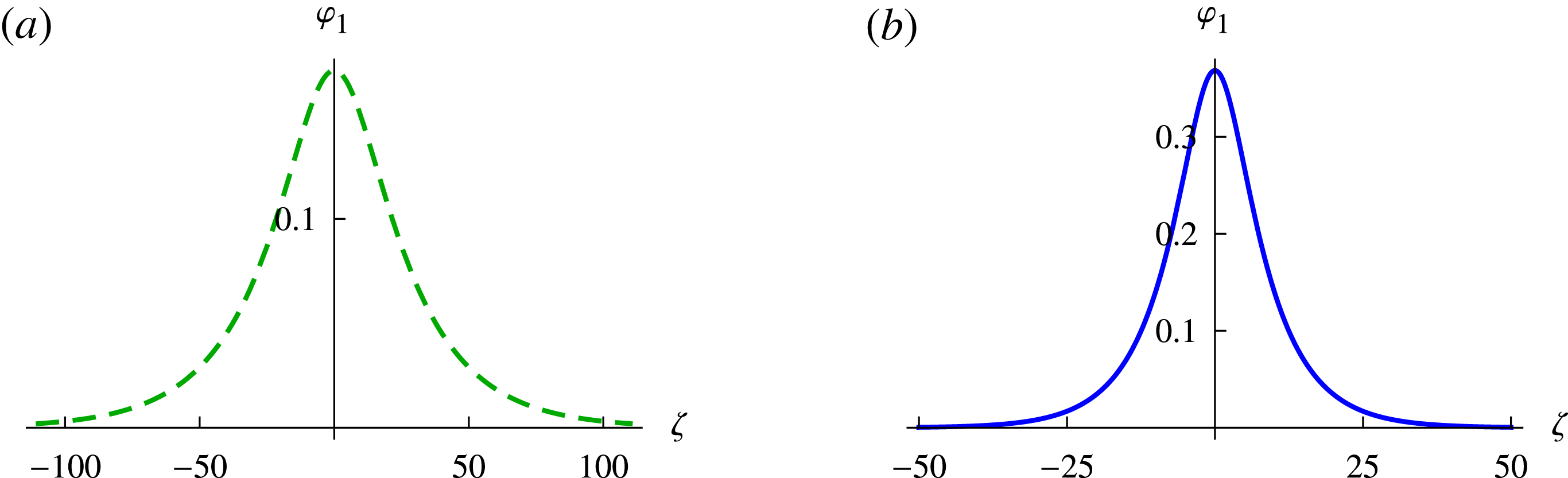
This solution is plotted in figure 1 for
 $W=0.001$
(a) and
 $W=0.01$
(b). In the second case, the amplitude is already over the limit of what might be acceptable in a reductive perturbation method resting on an expansion and iterative procedure. In an inertial frame this gives a soliton velocity of 1.01.
Plot of KdV-type solitons for
 $W=0.001$
(a) and
 $W=0.01$
(b), with amplitudes 0.171 and 0.368, respectively.

When we rewrite (2.19) as
 $$\begin{eqnarray}\frac{\partial {\it\varphi}_{1}}{\partial {\it\tau}}+\frac{1}{2}\,\frac{\partial }{\partial {\it\xi}}\left({\it\varphi}_{1}^{4}+\frac{\partial ^{2}{\it\varphi}_{1}}{\partial {\it\xi}^{2}}\right)=0,\end{eqnarray}$$
the equation is of the form
 $$\begin{eqnarray}\frac{\partial {\it\rho}}{\partial {\it\tau}}+\frac{\partial J}{\partial {\it\xi}}=0.\end{eqnarray}$$
This is called a conservation law, with density
 ${\it\rho}$
and flux
 $J$
both being functions of
 ${\it\varphi}_{1}$
and its derivatives with respect to
 ${\it\xi}$
. Because
 ${\it\varphi}_{1}$
and its derivatives go to zero as
 $|{\it\xi}|\rightarrow \infty$
, upon integration over the whole real line, one finds
 $$\begin{eqnarray}\int _{-\infty }^{+\infty }\frac{\partial {\it\rho}}{\partial {\it\tau}}\,\text{d}{\it\xi}+\int _{-\infty }^{+\infty }\frac{\partial J}{\partial {\it\xi}}\,\text{d}{\it\xi}=\int _{-\infty }^{+\infty }\frac{\partial {\it\rho}}{\partial {\it\tau}}\,\text{d}{\it\xi}+J\,\big|_{-\infty }^{+\infty }=\frac{\partial }{\partial {\it\tau}}\int _{-\infty }^{+\infty }{\it\rho}\,\text{d}{\it\xi}=0.\end{eqnarray}$$
Consequently,
 $\int _{-\infty }^{+\infty }{\it\rho}\,\text{d}{\it\xi}$
remains constant when the system evolves in time, and therefore
 ${\it\rho}$
represents the density of a conserved integral.
Thus, (3.3) expresses that
 ${\it\varphi}_{1}$
is a conserved density. As can straightforwardly be checked, two other independent conserved densities and corresponding fluxes can be established with the method described in (Verheest & Hereman Reference Verheest and Hereman1994),
 $$\begin{eqnarray}\frac{\partial {\it\varphi}_{1}^{2}}{\partial {\it\tau}}+\frac{\partial }{\partial {\it\xi}}\left[\frac{4}{5}\,{\it\varphi}_{1}^{5}+{\it\varphi}_{1}\,\frac{\partial ^{2}{\it\varphi}_{1}}{\partial {\it\xi}^{2}}-\frac{1}{2}\left(\frac{\partial {\it\varphi}_{1}}{\partial {\it\xi}}\right)^{2}\right]=0,\end{eqnarray}$$
 $$\begin{eqnarray}\displaystyle & & \displaystyle \frac{\partial }{\partial {\it\tau}}\left[{\it\varphi}_{1}^{5}-\frac{5}{2}\left(\frac{\partial {\it\varphi}_{1}}{\partial {\it\xi}}\right)^{2}\right]+\frac{\partial }{\partial {\it\xi}}\left[\frac{5}{4}\,{\it\varphi}_{1}^{8}-10{\it\varphi}_{1}^{3}\left(\frac{\partial {\it\varphi}_{1}}{\partial {\it\xi}}\right)^{2}+\frac{5}{2}\,{\it\varphi}_{1}^{4}\,\frac{\partial ^{2}{\it\varphi}_{1}}{\partial {\it\xi}^{2}}\right.\nonumber\\ \displaystyle & & \displaystyle \qquad +\,\left.\frac{5}{4}\,\left(\frac{\partial ^{2}{\it\varphi}_{1}}{\partial {\it\xi}^{2}}\right)^{2}-\frac{5}{2}\,\frac{\partial {\it\varphi}_{1}}{\partial {\it\xi}}\,\frac{\partial ^{3}{\it\varphi}_{1}}{\partial {\it\xi}^{3}}\right]=0.\end{eqnarray}$$
One might think of these conservation laws as expressing conservation of mass, momentum and energy. As an aside, we note that the building blocks of any conserved density or flux belong together under the scaling properties of (2.19). Noting that
 $$\begin{eqnarray}\frac{\partial }{\partial {\it\xi}}\left({\it\varphi}_{1}\frac{\partial {\it\varphi}_{1}}{\partial {\it\xi}}\right)={\it\varphi}_{1}\,\frac{\partial ^{2}{\it\varphi}_{1}}{\partial {\it\xi}^{2}}+\left(\frac{\partial {\it\varphi}_{1}}{\partial {\it\xi}}\right)^{2},\end{eqnarray}$$
it is seen that, e.g. the building blocks of the flux in (3.6) are those of the conserved density in (3.7), barring the term
 $(\partial /\partial {\it\xi})({\it\varphi}_{1}\partial {\it\varphi}_{1}/\partial {\it\xi})$
which can be moved into the flux of (3.7). Full details regarding the construction of densities and the computation of fluxes can be found in (Hereman et al.
Reference Hereman, Adams, Eklund, Hickman, Herbst and Yan2009; Poole & Hereman Reference Poole and Hereman2011).
Before continuing it has been shown, historically first in a rather haphazard way (Zabusky & Kruskal Reference Zabusky and Kruskal1965) and later more systematically (Miura et al. Reference Miura, Gardner and Kruskal1968), that for completely integrable equations such as (2.4) (KdV) and (2.5) (mKdV) one can generate an infinite number of polynomial conserved densities. This serves as one of the possible definitions of what is understood by completely integrable nonlinear evolution equations. Indeed, the existence of an infinite number of conserved densities is an indicator that the evolution equation has a rich mathematical structure resulting in the extraordinary stability of solitary waves and the elastic collision property of ‘solitons’, a particle-like name appropriately coined by Zabusky & Kruskal (Reference Zabusky and Kruskal1965). Completely integrable nonlinear PDEs have remarkable features, such as a Lax pair, a Hirota bilinear form, Bäcklund transformations and the Painlevé property. They can be written as infinite-dimensional bi-Hamiltonian systems and have an infinite number of conserved quantities, infinitely many higher-order symmetries and an infinite number of soliton solutions.
Modified KdV equations with a third-order dispersion term but nonlinearities of degree higher than three, as in (2.6) or (2.19), are known to have no more than three polynomial conservation laws (Zabusky Reference Zabusky and Ames1967; Kruskal et al.
Reference Kruskal, Miura, Gardner and Zabusky1970) and none of those contain
 $t$
and
 $x$
explicitly. Thus there is a fundamental difference with the classical KdV and mKdV equations which both have infinitely many independent polynomial conserved densities and have long been known to be completely integrable.
With reference to (3.2), we are in principle not allowed to use the word ‘soliton’ since that name should be reserved for waves that collide elastically. Yet, adhering to common practice, we will continue to use soliton as a shorthand for solitary wave. In the absence of complete integrability,
 $N$
-soliton solutions do not exist, not even a genuine 2-soliton solution where a faster and taller soliton is seen to overtake a slower and smaller one without distorting their shapes. Further properties of the quartic KdV-type equation have been investigated by Zabusky (Reference Zabusky1973) and Martel & Merle (Reference Martel and Merle2011). In the latter paper, the authors discuss soliton stability and 2-soliton interactions in an asymptotic sense for solitons of either widely different or nearly equal amplitudes.
4 Comparison with Sagdeev pseudopotential treatment
The Sagdeev pseudopotential (Sagdeev Reference Sagdeev and Leontovich1966) for the model of a two electron temperature plasma with a single cold ion species was derived by Baluku et al. (Reference Baluku, Hellberg and Verheest2010) as
 $$\begin{eqnarray}S({\it\varphi},M)=M^{2}\left[1-\left(1-\frac{2{\it\varphi}}{M^{2}}\right)^{1/2}\right]+\frac{f}{{\it\alpha}_{c}}[1-\exp ({\it\alpha}_{c}{\it\varphi})]+\frac{1-f}{{\it\alpha}_{h}}[1-\exp ({\it\alpha}_{h}{\it\varphi})].\end{eqnarray}$$
The derivation is straightforward: start from (2.1)–(2.3) written in a frame comoving with the solitary structure, and integrate the resulting equations to obtain the energy integral
 $$\begin{eqnarray}\frac{1}{2}\left(\frac{\text{d}{\it\varphi}}{\text{d}{\it\chi}}\right)^{2}+S({\it\varphi},M)=0.\end{eqnarray}$$
The new parameter is the Mach number
 $M=V/c_{ia}$
, where
 $V$
is the soliton velocity. The comoving coordinate introduced here,
 $$\begin{eqnarray}{\it\chi}=x-Mt,\end{eqnarray}$$
(Buti Reference Buti1980; Bharuthram & Shukla Reference Bharuthram and Shukla1986; Baboolal et al.
Reference Baboolal, Bharuthram and Hellberg1988; Baluku et al.
Reference Baluku, Hellberg and Verheest2010) is similar to
 ${\it\zeta}$
, but not limited to slightly supersonic solitons.
It is clear from (4.1) that
 $S({\it\varphi},M)$
is limited for positive
 ${\it\varphi}$
by
 $M^{2}/2$
, whereas in principle there are no constraints on the negative side. The limitation at
 ${\it\varphi}=M^{2}/2$
comes from an infinite compression of the cold ion density, and if one wants to obtain a soliton solution, a positive root of
 $S({\it\varphi},M)$
must be encountered before
 $M^{2}/2$
is reached. From
 $S(M^{2}/2,M)=0$
a maximum value
 $M=M_{c}$
is obtained, although at
 $M_{c}$
the root is not an acceptable solution since the ion density would be infinite.
Now, insert the critical values (2.16) and rewrite
 $S({\it\varphi},M)$
as
 $$\begin{eqnarray}\displaystyle S({\it\varphi},M) & = & \displaystyle \frac{5-2\sqrt{6}}{6}\,\{1-\exp [(3+\sqrt{6}){\it\varphi}]\}+\frac{5+2\sqrt{6}}{6}\,\{1-\exp [(3-\sqrt{6}){\it\varphi}]\}\nonumber\\ \displaystyle & & \displaystyle +\,M^{2}\left[1-\left(1-\frac{2{\it\varphi}}{M^{2}}\right)^{1/2}\right].\end{eqnarray}$$
As usual, charge neutrality in the undisturbed plasma far from the nonlinear structure and suitable integration constants imply that
 $S(0,M)=S^{\prime }(0,M)=0$
, where the prime denotes the derivative of
 $S({\it\varphi},M)$
with respect to
 ${\it\varphi}$
. At the next stage,
 $S^{\prime \prime }(0,M)=0$
yields the acoustic Mach number. Here,
 $M_{s}=1$
, as a result of the normalization and conditions (2.16) on the supercritical composition, serving at the same time as the lowest possible value for
 $M$
.
The next stages lead to
 $S^{\prime \prime \prime }(0,M_{s})=S^{(4)}(0,M_{s})=0$
, translating effectively into
 $B=C=0$
from the KdV analyses, and
 $S^{(5)}(0,M_{s})=24$
, showing that only positive polarity (i.e. compressive) solitons are possible. The terminology compressive or rarefactive depends on how one chooses to define this notion for plasmas with more than two constituents, as it is then no longer unambiguous.
The conclusion about the soliton polarity is an extension of the result that in generic plasmas the sign of
 $S^{\prime \prime \prime }(0,M_{s})$
determines the sign of
 ${\it\varphi}$
, i.e. the polarity of the KdV-like solitons (Verheest et al.
Reference Verheest, Hellberg and Baluku2012). By ‘KdV-like’ we mean that their amplitudes vanish at the true acoustic speed and increase monotonically with the increment in soliton speed over the acoustic speed, but these solitons might reach appreciable amplitudes not limited by the KdV constraints imposed by the reductive perturbation analysis. Sometimes solitons of the opposite polarity can be generated for the same set of compositional parameters, in addition to the KdV-like solitons, but these cannot be obtained from reductive perturbation theory, only through a Sagdeev pseudopotential treatment.
As a check on the link between the Sagdeev pseudopotential and reductive perturbation approaches, we expand (4.4) to fifth order in
 ${\it\varphi}$
, replace in the third- and higher-order terms
 $M$
by
 $M_{s}=1$
, but in the second-order term put
 $M=M_{s}+W=1+W$
and retain only the linear terms in
 $W$
. The rationale for this procedure is that the solitons are now slightly supersonic, as they should be in KdV theory, but that higher-order contributions are already small enough so that the correction in
 $W$
is no longer important. Putting it all together, we obtain from (4.2) that
 $$\begin{eqnarray}\frac{1}{2}\left(\frac{\text{d}{\it\varphi}}{\text{d}{\it\zeta}}\right)^{2}-W{\it\varphi}^{2}+\frac{1}{5}\,{\it\varphi}^{5}=0,\end{eqnarray}$$
having replaced
 ${\it\chi}$
by
 ${\it\zeta}$
and provided
 ${\it\varphi}$
is interpreted as
 ${\it\varphi}_{1}$
. It is now straightforward to check that the solution to (4.5) is precisely (3.2), again setting
 ${\it\varphi}={\it\varphi}_{1}$
. Analogous connections can be found elsewhere for other KdV related problems (Verheest Reference Verheest2000).
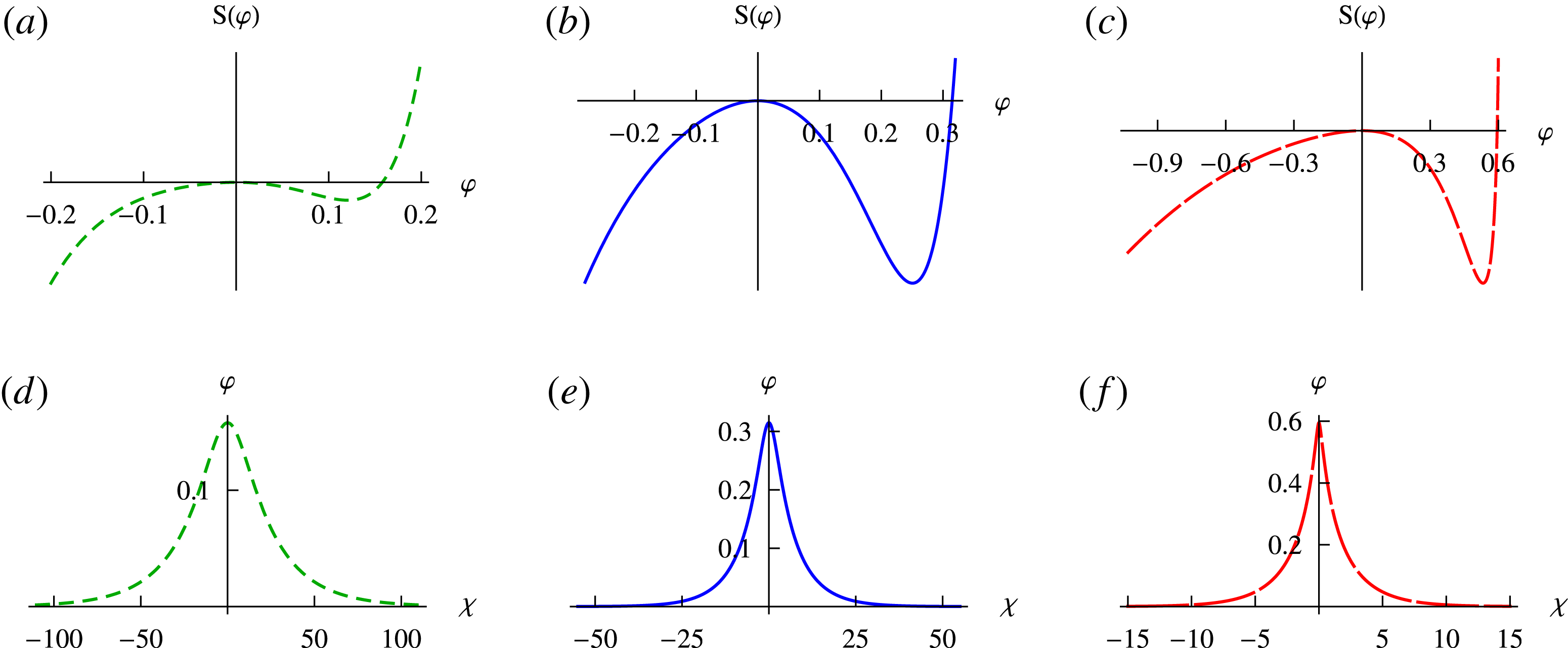
Plots of Sagdeev pseudopotentials (a–c) and their soliton solutions (d–f), going from left to right for
 $M=1.001$
(a,d),
 $M=1.01$
(b,e) and
 $M=1.1$
(c,f), with amplitudes 0.158, 0.315 and 0.595, respectively.

Returning to numerical examples drawn from (4.2) and (4.4), we see in figure 2 that the soliton amplitudes increase with
 $M$
, until a maximum for
 $M$
is reached at
 $M_{c}=1.149$
when
 ${\it\varphi}=0.660$
, beyond which
 $S({\it\varphi},M)$
and the cold ion density are no longer real. At the same time, the soliton widths decrease with
 $M$
, so that taller solitons are narrower and faster, although one can no longer express these relations analytically in contrast to what was possible for the supercritical KdV soliton (3.2).
A comparison of figures 1 and 2 is interesting because at
 $M=1.001$
(equivalent to
 $W=0.001$
) the KdV soliton amplitude is slightly larger than the one obtained under the more complete Sagdeev solution. This is also the case for
 $M=1.01$
or
 $W=0.01$
. Moreover, although not shown in figure 1, for
 $M=1.1$
the KdV soliton amplitude would be 0.794, which exceeds the validity limits of the reductive perturbation ansatz, as well as the maximum 0.660 that the Sagdeev formalism allows when keeping the nonlinear terms in full without restriction. This is, once again, a salutary reminder that KdV results have to be used and interpreted with great care, which unfortunately is lacking in many applications where graphs are included.
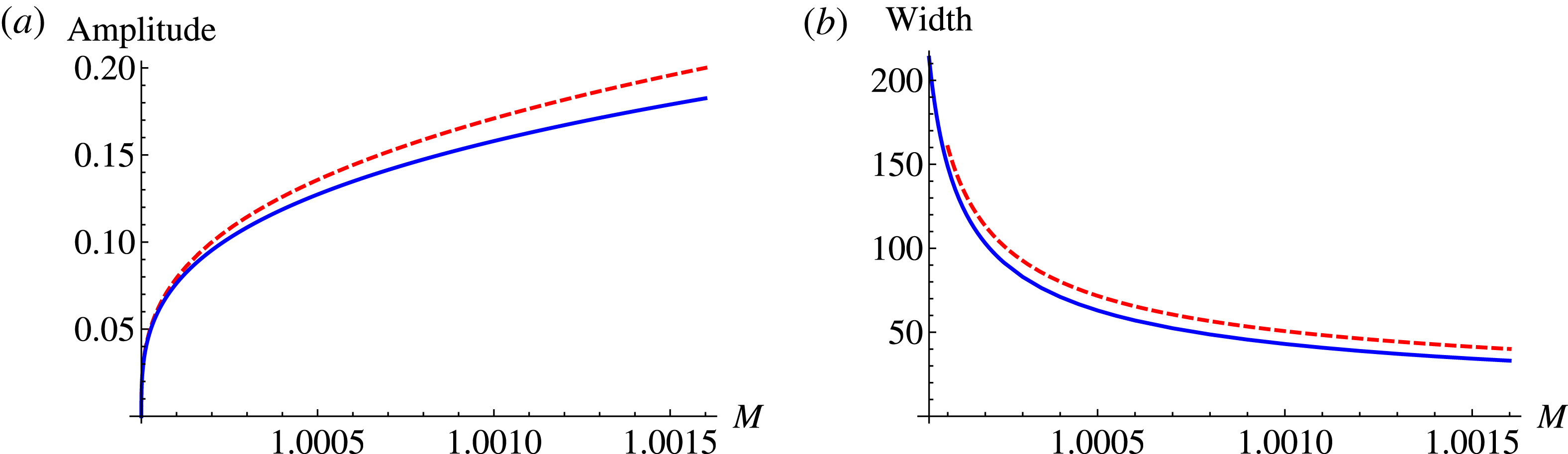
We will now explore the accuracy of the KdV solitons in more detail. Numerical results show that the KdV equation consistently overestimates the soliton amplitudes. In figure 3(a) the amplitudes of the solitons obtained from the Sagdeev pseudopotential (solid line) and from the KdV equation (dotted line) are shown. There is reasonable agreement for velocities
 $M<1.0002$
, where the soliton amplitude is below
 $0.1$
. As the velocity increases beyond
 $M>1.0002$
, the estimate becomes more and more inaccurate.
Comparison between the amplitudes (a) and widths (b) for solitons obtained from the Sagdeev pseudopotential (solid lines) and the modified KdV (dotted lines).

The accuracy of the widths of the solitons obtained from the KdV equation is also considered. In figure 3(b) we show the widths of the solitons obtained from the Sagdeev potential (solid line) and from the KdV equation (dotted line). Once again, the results agree for smaller velocities
 $M<1.0002$
, while larger velocities result in larger inaccuracies.
It is interesting to note that the KdV solitons consistently overestimate both the amplitude and width of the soliton. Also, the KdV approximation applies only to velocities that slightly exceed the acoustic speed.
5 Conclusions
In this paper we have investigated the supercritical composition of a plasma model with cold singly charged positive ions in the presence of a two-temperature electron population, starting initially from a reductive perturbation approach. The combined requirement that the evolution equation of the KdV family be free of quadratic and cubic nonlinearities leads to a unique choice for the set of compositional parameters and a modified KdV equation with a quartic nonlinear term. We believe that the model adopted here is one of the simplest that can sustain supercriticality, but the discussion of its properties is in terms of the structure of the modified KdV equation rather than the precise values of its coefficients. Even though the present model might be difficult to generate in practice, the conclusions will be valid for more complicated plasma compositions with some free adjustable parameters remaining in the model equations.
Once the quartic modified KdV equation was derived, we discussed and plotted its one-soliton solution and computed the conserved densities. Only three of those have been found. Consequently, the equation is not completely integrable, which precludes finding multi-soliton solutions. The solution is merely a solitary wave, without the elastic interaction properties expected from solitons.
Next, since the full Sagdeev pseudopotential method had already been worked before with completely different focus and aims, it was straightforward to adjust it for the chosen set of parameters and plot the corresponding fully nonlinear solutions. As expected, the soliton widths decrease with their velocities, so that taller solitons are narrower and faster. In contrast to the supercritical KdV solitons for which an analytic expression was readily computed, one can no longer express these relations analytically, hence, one has to rely on numerical results.
All this allows for an interesting comparison between the KdV and Sagdeev results, which shows that the KdV solitons have slightly larger amplitudes than those obtained under the more complete Sagdeev solution. Only for solitons which are slightly superacoustic does the KdV analysis yield acceptable amplitudes. With respect to full solutions this is, once again, a salutary reminder that KdV results have to be used and interpreted with great caution, which is unfortunately not always the case in many applications where graphs are included.