Introduction
The question of representation in the political process has long been of interest to citizens and scholars. For decades, political scientists have explored the question of whose voices are amplified by organised interests in the policy-making process, with particular attention to the legislative process and the ecology of interest groups in general. By now the dominance of business interests is an often-rehearsed dictum.Footnote 1
Champions of administrative policy-making have argued that it has the potential to mitigate some of the biases of interest representation in other policy-making venues. Since administrative procedures are subject to conscious control in statute and judicial doctrine, it is possible that guaranteed access for and equal treatment of underrepresented interests in the administrative policy process can be enshrined in law.Footnote 2 This hope is crystallised by, but not unique to, the optimistic take of Francis Rourke:
“One of the historic functions of bureaucracy in America has been to provide a means of effective expression in policy deliberations for community groups that are inarticulate, poorly organized, or for some other reason unable to speak for themselves. With administrative help, these stepchildren of the political system may acquire a political equality with other groups that they could never hope to attain through the ordinary processes of politics alone.” (Rourke Reference Rourke1976. See also, for example, Riccucci Reference Riccucci1995, pp. 6-8; and Mosher Reference Mosher1982.)
But legal codification of equal access and treatment in the administrative venue is one thing; actual equality of representation across interests is another. The law cannot require different types of interests to have the same degree of political acumen, wherewithal and resources to use in administrative lobbying.
To explore whether the administrative policy process lives up to its potential to mitigate biases in legislative lobbying, it is necessary to compare interest representation across policy-making venues. Previous research has shown that administrative lobbying is important to interest groups,Footnote 3 and that business interests are the predominant voices heard in administrative policy-making.Footnote 4 But without a comparison of interest representation across venues, it is impossible to determine whether, at the least, the administrative or bureaucratic policy-making venue lessens some of the biases of interest representation in the policy process. Even if business interests predominate in administrative lobbying, they might predominate less than they do in legislative lobbying.Footnote 5
Very little research has compared interest representation across legislative and administrative venues.Footnote 6 We know of only four such published studies. Two of these, Greene and Heberlig (Reference Greene and Heberlig2002) and Holyoke (Reference Holyoke2003), focus on samples of membership groups only and do not examine patterns of representation within or across venues or policy areas. Thus, while informative, these studies do not resolve the question laid out above. More closely related is Heinz, Laumann, Nelson and Salisbury (Reference Heinz, Laumann, Nelson and Salisbury1993), which uses survey data from organisational representatives on lobbying in four issue areas. Their results (particularly Table 4.3) are highly suggestive: of the groups that contact at least one of the legislative or executive branches, 60 per cent report lobbying both venues. This foreshadows results we obtain in a more comprehensive survey of over 70 different issue areas. Finally, McKay (Reference McKay2011) examines this issue, bolstering the overall findings of Holyoke (Reference Holyoke2003) as well as providing more nuanced findings, including that group- and issue-specific factors do influence venue choice. McKay's findings complement those provided here.
Given the importance of the issue and the lack of existing empirical research addressing it, in this paper we attempt to give a more comprehensive comparison of interest representation in the legislative and administrative policy-making venues. Our analysis utilises information on all groups reporting lobbying activities in a given time period for two different levels of government. This allows us to draw comparisons that cross boundaries of group networks, policy areas, and state and federal governments. In order to address these issues, we rely on two different sources of data. Firstly, we use data compiled from reports filed by groups active in Washington DC under the 1995 Lobbying Disclosure Act (LDA), as collected and examined in Baumgartner and Leech (Reference Baumgartner and Leech2001). Secondly, we use new data constructed from lobbying reports filed in the state of Minnesota. Both data sets include information on lobbying activities in both the legislative and administrative branches. In addition, they both include information that allows us to (coarsely) compare the amount of activity across venues in different policy areas.
These data allow us to answer four specific questions crucial for assessing interest and issue representation in the policy system as a whole. Firstly, what is the extent of bureaucratic lobbying? At this point, while there exist a few studies that examine interest group activity in the administrative branch, they are all based on relatively small samples of groups. Thus, our data expand the literature (for example, as surveyed by Furlong and Kerwin (Reference Furlong and Kerwin2005)) by providing detailed evidence regarding the pervasiveness of administrative lobbying. Secondly, we study the pattern of venue choice across groups, both at the group level and at the group-policy level. This allows us to understand the pattern of representation across venues. For example, do groups tend to specialise in a single venue or do they target both equally? Thirdly, we also examine whether there is venue specialisation across policy areas. If this is the case, then groups with an advantage in the dominant venue may ultimately be better positioned to achieve their goals. Finally, we aggregate these data to study the distribution of representation of types of interests across venues: do business interests dominate in all venues or do rules promoting equal access in the bureaucracy help alleviate this bias?
Our findings have a number of important implications. The most important is a theoretical one about the functions of administrative policy-making institutions, and whether they balance out representational biases arising in the legislature. Our federal-level data indicate that the distributions of groups across venues are quite similar. Business dominates in and across venues, and to at least the same degree in administrative as legislative lobbying. If anything, there may be greater business dominance among groups that lobby the administrative branch relative to those that just lobby the legislature. This suggests that participation in the administrative arena does not alleviate any biases in the pressure group system in the legislature; rather, it primarily allows the “rich to get richer”. In addition, we provide a first look at the ecology of representation in the administrative branch inclusive of all groups, issues and agencies. Our data suggest that administrative lobbying has been overlooked as a means of interest representation, with almost two-thirds of all groups indicating an interest in this venue. By extension, our study provides an important context for the growing literature on administrative lobbying (see, for example, Golden Reference Golden1998 and Yackee and Yackee Reference Yackee and Yackee2006) that has found it difficult, in the absence of a baseline for comparison, to reconcile its finding that business interests are well represented with the existence of formal requirements for equal footing of participants.
Theoretical expectations about lobbying activity
Lobbying is a well-understood term for an amorphous collection of activities pursued for a bevy of varied reasons. Our focus in this article is narrower than why lobbying occurs or why it is effective. Given that our focus is on venue choice (namely, where or who groups choose to lobby), we accordingly focus here on theoretical treatments of the strategic choice of venue.Footnote 7 An empirical focus on venue choice as a strategy choice highlights the breadth of the notion of lobbying. More importantly, it provides an important starting point for the evaluation of a set of theoretical claims. One of these is the classic question of the proper degree to which a legislature should grant its legislative authority to unelected administrators (namely, bureaucratic agencies and their denizens) and a second concerns inferences about how interested parties pursue policy change. We discuss these in turn.
Venue choice and rationalising delegation
Administrative lobbying is illustrative of a key ambiguity in the notion of “lobbying”. After all, implicit in the classic picture of a voter lobbying his or her elected representative is the presumption that the act of lobbying is potentially informative about how the voter will cast his or her vote in the upcoming election. The analogous linkage between lobbying and reward/punishment is much more tenuous in the realm of administrative lobbying: indeed, bureaucrats have various institutional protections against direct application of analogous incentives by interested parties. With this in mind, it is useful to contrast the idealised separation of “politics” and “administration”Footnote 8 with the importance (or at least inevitability) of participatory administration in “interest representation” theories of governance.Footnote 9 In this canonical understanding of governance, the typical justification for delegating legislative authority to unelected agents centres on the possibility that unelected bureaucrats may possess greater expertise, ability and/or information than elected legislators. Obviously, evaluating such a grand claim is beyond the scope of this article. However, the claim carries an important implication for venue choice in lobbying: how does (or should) one reconcile the potential conflict between policies pursued by outside participants and the policies suggested by the expertise, abilities or information of the appointed bureaucrats?
If one concludes that there is no conflict because the combined efforts of lobbyists (that is, “the people”) will, in the end, generally indicate the proper policy decision, then delegated authority is arguably justified only as an efficiency measure for otherwise time-strapped elected legislators. On the other hand, if one presumes there is no conflict because the bureaucrats’ expertise, abilities and information should be given pride of place in the setting of policy, the normative appeal of public participation in administration (that is, administrative lobbying) in terms of information provision is commensurately reduced. Accordingly, empirical support for an information/expertise rationale for delegation of legislative authority would hinge on some difference in those who choose to lobby in administrative venues versus those who lobby the legislature.
On the other hand, one might justify administrative lobbying as providing another outlet for expressive political action and/or as an approximate mechanism through which the legislature monitors the bureaucracy (for example, as a “fire alarm” in the terminology of McCubbins and Schwartz (Reference McCubbins and Schwartz1984)). In these theoretical conceptions of the role of administrative lobbying, administrative participation may be effective even when the participants in the various lobbying venues appear similar.
Determinants of venue choice
From a (positive) theoretical perspective, the literatures on lobbying and administrative policy-making stand in stark contrast to one another. Compared to the voluminous and active theoretical literature in administrative policy-making,Footnote 10 the theoretical understanding of administrative lobbying is rather shallow. For example, Holyoke (Reference Holyoke2003), cited earlier, offers a strong preliminary analysis of venue choice, but the theoretical framework is founded on the theoretical models cited earlier, which consider single venue lobbying. One of the primary goals of this article is to extend the study of multiple venue lobbying. Lobbying in a multiple venue setting is theoretically distinct from a single venue setting in more than a descriptive fashion. In particular, the theoretical works cited earlier largely focus on the information potentially conveyed through the act (and degree) of lobbying. Including multiple venues greatly broadens the spectrum of information that might be conveyed through lobbying strategy: it might matter not only how often and intense one lobbies, but also where or whom one lobbies.Footnote 11
This is demonstrated by recent theoretical work that has begun to address the topic of administrative lobbying.Footnote 12 These works demonstrate the importance of incorporating multiple lobbying venues within the question of the proper (or predicted) design of government institutions and policy choice within democratic polities. However, for our purposes, each of these theories is somewhat limited in applicability due to the fact that they each focus primarily on the impact of lobbying on the degree to (and/or means by) which a legislature would delegate discretionary authority to a bureaucratic agency, which is beyond the scope of our analysis in this article. That said, the theoretical frameworks most closely related to our analysis are Bennedsen and Feldmann (Reference Bennedsen and Feldmann2006) and Boehmke, Gailmard and Patty (Reference Boehmke, Gailmard and Patty2006).
Bennedsen and Feldmann examine the joint effect of administrative lobbying and exogenous preference divergence between an agency and the legislature on the degree of discretion granted to agency. Boehmke, Gailmard and Patty highlight a different but related logic, pointing out that preference divergence between the legislature and the agency promotes informative lobbying of the bureaucracy, which is desirable to the legislature for policy purposes. Boehmke, Gailmard and Patty succinctly and unexceptionably summarise their theory's prediction about how interest groups choose their lobbying venue as follows: “the group should lobby the (venue) whose policy gives it the highest utility” (Boehmke, Gailmard and Patty Reference Boehmke, Gailmard and Patty2006, 146). Accordingly, even to the degree that this literature accounts for the possibility that interest groups might seek to influence bureaucratic decision-making, its hypotheses speak to the legislative choice about agency design and discretionary authority rather than to individual group choices about which venue to lobby, and less to the representational consequences of those choices. In short, they do not deliver implications that this paper addresses.Footnote 13
In short, the theoretical framework of Boehmke, Gailmard and Patty is the only one of which we are aware that explicitly incorporates the strategic choice of venue into a group's decision calculus. However, their framework does not lend itself to generating specific (group- or venue-specific) hypotheses to test with respect to this decision. In spite of this, we do not believe that the analysis presented below in this paper is atheoretical. Rather, we believe that existing theoretical work offers a clear motivation for our analysis, as it suggests that bureaucratic lobbying is important. Furthermore, this literature provides justification for examining exactly the types of measures that we report later in this paper (proportion of lobbying effort devoted to administrative lobbying and the variation of this proportion across different policy areas). Space constrains us from labouring this point further, but the simple fact is that the existing theoretical literature represents this paper's starting point. In addition, it should be noted that the measures and regularities reported in this paper will be of interest to scholars who have no interest or stake in the literature cited above, and are of independent interest in their own right.Footnote 14
Empirical analysis for the creation of new theory
Our data collection and analysis reported here represents a step toward traversing this divide. Put another way, the paucity of a positive theoretical understanding of lobbying in general and more specifically the choice of various lobbying strategies, such as venue choice, is due to the inevitably inductive starting point of theorising. Measurement is the starting point of any theoretical enterprise, and this analysis, along with the various earlier works cited throughout this article, represents steps toward framing the theoretical problems and conundrums of and within lobbying. Accordingly, we now turn to describing the data analysed in this article.
Data on lobbying, venues and policies
In order to study interest group representation across venues, we require detailed information that links organisations’ lobbying efforts to specific issues and venues. Because studies of lobbying behaviour as well as government laws governing lobbying have traditionally focused on lobbying in the legislature, there are few currently utilised data sources that are appropriate. As government reporting requirements for lobbying organisations have become more expansive over the years, however, information suitable to our task can now be gathered in some cases. Here, we rely on information filed by groups at both the federal level and in the state of Minnesota.
The federal data come from reports filed under the 1995 Lobbying Disclosure Act (LDA), which requires groups to file reports in specific policy areas and also to include information about the various components of government that they contacted, including the legislature and the administrative branch. We use data from Baumgartner and Leech (Reference Baumgartner and Leech2001), which were compiled from reports filed in 1996. Our second source of data arises from reports filed by groups in Minnesota; we compiled these data from the state's Campaign Finance Regulation website. These reports include comparable information on lobbying across policy areas and venues.
Relying on two different data sets provides a number of strengths for our study. Firstly, we are able to provide a more robust understanding of the prevalence of administrative lobbying by studying it at multiple levels of government. Secondly, the data were gathered by independent research teams under different guises, reducing the chances that any similarities between the two are due to decisions made by the researchers. Thirdly, the reporting schemes for policy areas are different: groups are required to report in 77 specific policy areas at the federal level; in Minnesota, groups choose their own areas, which we relied on in developing our own coding of policy areas. Because the federal data have been discussed in previous studies (Baumgartner and Leech Reference Baumgartner and Leech2001), we focus our discussion here on the new data from Minnesota.
Lobbying data in Minnesota
Minnesota requires both groups and lobbyists to register with the state if they exceed a minimum amount of lobbying activity. Lobbying is defined in the Handbook for Lobbyists and Lobbyist Principals for each of three venues.Footnote 15 Legislative lobbying constitutes efforts to influence action of either legislative house on a variety of actions, including bills, resolutions, nominations or reports. Administrative lobbying includes attempts to influence rule-making procedures or rule application for rate setting and power-related issues.Footnote 16 Metropolitan lobbying involves attempts to influence the official actions of a Metropolitan governmental unit.
The definition of a lobbyist consists of three components. Firstly, it includes individuals who receive compensation of at least $3,000 from all sources in a given year for engaging in the lobbying activities just described. Secondly, it includes individuals who spend at least $250 of their money engaging in lobbying activities (travel costs are exempt). Finally, any local official or government employee who spends at least 50 hours in a month lobbying the government (excluding that individual's political subdivision) is a lobbyist. Groups that lobby are required to register if they spend more than $500 on a lobbyist in a calendar year or if they spend in excess of $50,000 on their own lobbying activities. Registration of lobbyists and principals must occur within three days of any lobbying activities.
We compiled data from the 2004 reports as reported in a summary file of lobbyist reports available from the state website.Footnote 17 For each of the groups that a lobbyist represents, the report lists the general issues to be lobbied on and, for each issue, a list of the venues to be lobbied. Including 321 cases of lobbyists that failed to report an issue for a given organisation, we have a total of 5,935 lobbyist-issue-organisation and 3,975 issue-organisation observations from 1,092 organisations. For the purposes of this paper, we focus only on groups that lobby the legislature or the administrative branch, excluding the 24 per cent of all groups that report only metropolitan lobbying. We leave the analysis of additional venues for future research.
Overall, lobbyists report activity on a total of 669 alphanumerically unique issues in these data. In order to study lobbying activity across policy areas, we code these issues into 96 different policy areas based on a list of suggested reporting categories from the state's website.Footnote 18 Most groups use these categories for reporting; many of the exceptions are merely minor variations or misspellings of the 96 policy areas.Footnote 19
Of course, while this article's focus on Minnesota has the merit of a large and rich set of data, it comes at the costs typically associated with delimiting the scope of any empirical study. We have attempted to be modest in the conclusions we draw from this set of data about lobbying as a whole. It is undoubtedly true that Minnesota differs from other polities, be they states, nations or other units. For example, the activity in various venues will presumably be a function of jurisdictional variation in both the degree of access (such as procedural participation rights) and (temporal and spatial) differences in the nature of policy change, constituent preferences and other external factors such as the organisation of various social and economic interests. We believe, however, that the quality of the data – and the degree to which their measurement fits with the phenomena of interest in this article – is sufficient to warrant examination on its own.
We believe this point applies to the related question of the temporal limitations of the data examined in this article.Footnote 20 After all, the national policy debate was more closely focused on welfare reform in 1996 than in many other years, and the public policy debate in Minnesota during the appropriate time period (2003 to 2004) was largely focused on gun control (specifically, the state legislature relaxed restrictions on handguns in 2003) and, to a lesser degree, budgetary matters, including the state pension system. That noted, however, it is simply not feasible for us to consider the external political situations in any detail in this article.Footnote 21
Lobbying data at the federal level
To study lobbying across venues and policy areas at the federal level, we utilise data filed under the 1995 Lobbying Disclosure Act (LDA). The LDA requires groups to file semi-annual reports listing their total lobbying expenditures if they exceed a minimum threshold of lobbying activity (spending at least $20,500 in 1996 or employing an individual who devotes at least 20 per cent of his or her time to lobbying activities during a six-month period), though the definition of lobbying excludes most forms of grassroots lobbying as well as notice and comment participation. In particular, we rely on data from 1996 filings, which they have made available online.Footnote 22 While the level of detail varies, each report contains information on lobbyists, lobbying targets and lobbying expenditures.Footnote 23
Whereas Baumgartner and Leech (Reference Baumgartner and Leech2001) were interested in the number of groups involved in a sample of 137 issues (out of 49,518 total issues mentioned in the reports), we focus on group activity in and across policy areas in order to maintain comparability with the Minnesota data. Because the LDA requires groups to file separate reports for 76 different policy areas (now 77 with the addition of Homeland Security), it is relatively straightforward to calculate lobbying activity at the group-policy level. Further, we can study lobbying across venues using the information in these reports: groups are asked to list which branch of government they contacted for each policy area, including the House, Senate, White House and the number of agencies. To compare lobbying activity across the legislative and administrative venues, we determine whether a group mentions either the House or Senate and whether they mention an agency. Unfortunately, information about lobbyists and expenditures is not reported separately by policy area or venue. Finally, we rely on Baumgartner and Leech's coding of these 5,838 groups into 11 categories based on the organisation's type or the substantive interest they represent.Footnote 24
Levels of analysis
Using the two data sources described above, we construct three measures of lobbying across venues. Firstly, we use the Minnesota data to construct measures of venue choice at the group-policy-lobbyist level by creating dichotomous variables indicating whether each lobbyist reported lobbying the legislature or the administrative branch. In Washington DC, we create similar variables at the group-policy-report level based on whether each report listed a branch of Congress or at least one agency. Secondly, we aggregate to the group-policy level and create variables indicating whether a group had at least one lobbyist reporting the legislative or administrative venues for each policy area. Finally, we make the same calculation at the group level by determining whether each group had at least one lobbyist on any policy for each venue. While we would prefer to have a more detailed measure of group activity across venues, such as lobbying effort or expenditures, we follow the approach of Baumgartner and Leech (Reference Baumgartner and Leech2001) by counting reports (or lobbyists employed) by venue and policy area in order to obtain more information on whether groups devote any attention to different venues. We do this because we are interested in representation not just by specific groups, but by the representation of groups in specific policy areas; venue choice is made in the context of different policies, so studying it at that level is crucial.
As an example, consider the reports filed by the Automotive Service Industry Association, which indicated a six-month expenditure of $80,000. It filed eight different reports in seven subject areas. For the two reports in the Clean Air and Water policy area, one indicates only administrative lobbying while the other lists both administrative and legislative lobbying. Of the other six reports, four are in policy areas with just legislative lobbying, one has only administrative lobbying and one lists both venues. In our group-policy-report level data set, then, we have eight observations for this group: five of them mention Congress, two mention both Congress and the administrative branch, and one lists just the administrative branch. When we aggregate to the group-policy level, there are seven observations: five policy areas mentioning just Congress and two mentioning both venues. Finally, at the group level this association is recorded as lobbying both venues.
Incidence of lobbying across venues
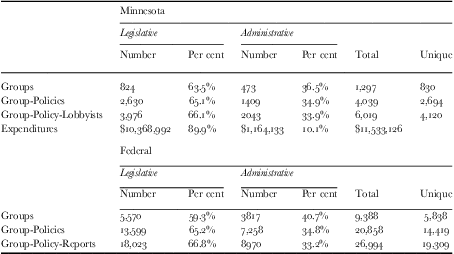
Table 1 offers our first look at the total amount of interest group lobbying across venues. The main result from this table is that a substantial amount of interest group lobbying occurs in the administrative venue, ranging from 33 per cent to 41 per cent at different levels of aggregation. In different terms, the average group lobbies in 1.6 of the two venues we examine; the average report or lobbyist lists 1.4 venues.
Distribution of lobbying activity across venues
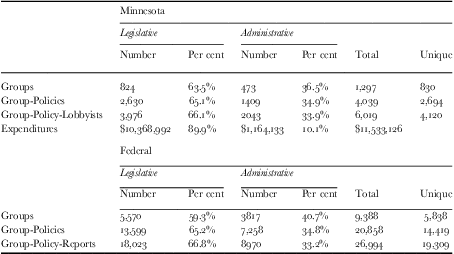
Source: Federal lobbying reports filed under the LDA (Baumgartner and Leech Reference Baumgartner and Leech2001); authors’ data compiled from Minnesota lobbying report. Minnesota data exclude 262 groups that only engaged in metropolitan lobbying. Entries, with the exception of spending data, are the number of observations mentioning each venue at least once at the listed levels of observation. See the text for additional details.
A number of other notable features emerge. Firstly, the percentages of groups lobbying in the administrative branch at the federal level and in Minnesota are almost identical at comparable levels of aggregation; secondly, they both indicate less venue specialisation at higher levels of aggregation. Starting with the group-policy-lobbyist and group-policy-report level, the percentages mentioning the administrative branch are 34 per cent in Minnesota and 33 per cent in Washington DC; these both increase to 35 per cent at the group-policy level. At the group level, 37 per cent of groups in Minnesota and 41 per cent of groups in Washington DC mention the administrative branch. These numbers indicate that there is more specialisation in venues at the policy level than at the group level, suggesting that groups make different venue choice decisions for different policies. The fact that groups’ venue choices are policy-specific is consistent with the notion that political representation within a policy area depends on the details of the policy area, the legislative and executive design of policy-making processes, or both.
As an aside, aggregate expenditure figures by venue for the state of Minnesota show a much greater tilt of lobbying activity toward the legislative venue than reports do.Footnote 25 Almost 90 per cent of lobbying disbursements are targeted to that branch, suggesting that legislative lobbying requires more expenditure-intensive activities than administrative lobbying does. On the other hand, the disbursements data exclude lobbyist salaries, which constitute about 75 per cent of total lobbying expenditures. To the extent that administrative lobbying relies more heavily on lobbyists’ time, then the disbursements figures will overstate attention to the legislature. We hope to return to this issue in future work.
Venue choice at the group level
In this section, we compare the attention and resources devoted across venues by individual groups. Groups’ choices of venue or venues in which to lobby is of interest for several reasons. For example, if many groups focus only on one venue, it would increase the chance that representation varies across venues. Additionally, it seems reasonable to presume that a group will allocate its resources to the venue or venues that are most productive in achieving the group's goals. See, for example, Boehmke, Gailmard and Patty (Reference Boehmke, Gailmard and Patty2006). Thus, there are several reasons why one might want to know whether the same groups are represented in both the legislative and administrative venues.
We use our data on group lobbying registrations to tackle these questions in two ways. Firstly, we examine the pattern of venue choice for individual groups by tabulating lobbying by venue, allowing us to determine how many groups focus on a single venue and how many lobby in both venues. We also report correlations of venue choice at the group-policy level. Secondly, we compare the amounts of attention devoted to legislative and administrative lobbying by comparing the number of lobbyists or reports for each venue. Admittedly, this is a very coarse measure of the amount of attention, but it still provides a more detailed analysis of groups’ allocation of attention across venues and the degree of specialisation for groups lobbying both venues.
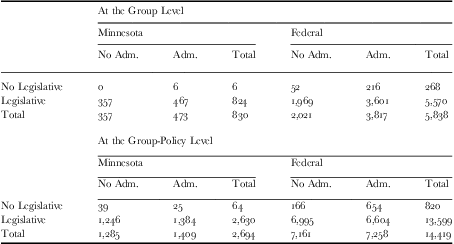
Table 2 reports the tabulations of venues at the group level and at the group-policy level. There are a number of interesting results in this table. Almost no groups specialise solely in administrative lobbying: over 94 per cent of the groups at both levels of government and at both levels of analysis lobby the legislature. Nonetheless, a majority of groups do indicate an interest in the administrative branch, with about 59 per cent of groups registering in both venues. At the same time, about 49 per cent of registrations at the group-policy level are in both venues, suggesting that groups often specialise in specific venues when appropriate for a given policy area. This tendency is further suggested by the fact that groups that are involved with both branches are involved with more policies: groups interested in just the legislative venue indicate activity on 2.7 policies in Minnesota and 1.8 policies in Washington, whereas those interested in both venues indicate interest in 3.9 and 2.9 policies, respectively. Again, note the similarity between the results at both levels of government.
Tabulations of venue declarations
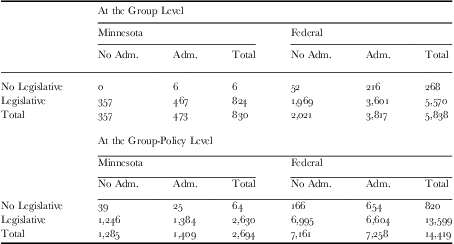
Entries correspond to the number of groups that mention each venue choice combination for the listed level of observation. Minnesota data exclude 262 groups that only engaged in metropolitan lobbying. Some reports at both levels listed no venues.
Because so few groups lobby just the administrative branch and nearly half of those that lobby the legislature also lobby the administrative branch, there is mixed evidence regarding venue specialisation. While some groups specialise in legislative lobbying, very few specialise in only administrative lobbying. By and large, however, the majority of groups tend to lobby both venues. Since groups that pursue administrative lobbying are largely a subset of groups that pursue legislative lobbying, it seems unlikely that the administrative venue opens the policy process to interests unheard elsewhere in it.
Moving from whether groups express any interest in either venue to the amount of attention they devote, which we again measure with the number of lobbyists or reports indicating each venue, further supports this contention. The correlation between the number of lobbyists or reports mentioning the legislature and the number mentioning the administrative branch is 0.69 at the group-policy level in Minnesota and 0.42 in Washington DC. At the group level, the correlations between the number of administrative and legislative mentions are even stronger, with values of 0.90 in Minnesota and 0.76 in Washington DC. Again, these results are driven by the fact that groups that lobby extensively in one venue also lobby extensively in the other venue.
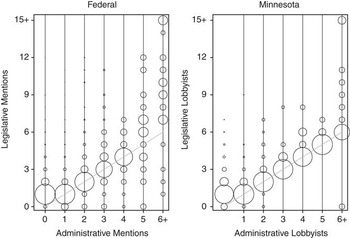
In order to provide a more detailed perspective on lobbying activities across venues, we compare levels of legislative and administrative lobbying at the group-policy-lobbyist level in Minnesota and the group-policy-report level in Washington DC. To present the data more clearly, we calculate the conditional distribution of legislative lobbying for each level of administrative lobbying and graph the results in Figure 1. The circles marking each combination of administrative and legislative lobbying are proportional to the number of legislative lobbyists given a specific number of administrative lobbyists. (Results at the upper ends of the ranges are combined both for presentation purposes and to have a reasonable number of observations for each level of administrative lobbying.)
Distribution of groups’ legislative lobbyists/reports conditioned on their administrative lobbyists/reports, by group-policy area
The diagonal line corresponds to equal levels of lobbying in the two venues. Cases with six or more administrative or 15 or more legislative lobbyists or reports were collapsed into one category for presentation (20 and three cases, respectively, at the federal level and eight and two cases in Minnesota). Minnesota data exclude all groups that only engaged in metropolitan lobbying.

It is clear from Figure 1 that the greatest proportion of groups devote the same amount of attention to each venue, as the largest circles are on the diagonal line for equal lobbying. For instance, at the federal level 80 per cent of groups with one administrative report have one legislative report; 74 per cent of those with two administrative have two legislative; and so on. In Minnesota, the percentages are over 75 per cent for all cases involving one to five administrative lobbyists. The exception, of course, is for groups that have no administrative lobbyists: the majority of these groups has one legislative lobbyist and a sizable proportion has two. It is also apparent that most groups have more legislative than administrative lobbyists. Finally, as evidenced by the largely empty space below the 45 degree line, one characteristic of the Minnesota lobbying system is that almost no lobbyist lists only the administrative branch.
Activity across venues by policy area
In this section, we examine the aggregate level of attention to the two venues within each policy area. Substantively, this analysis provides a picture of which of the two venues is seen by the participants in the process to be more important in each policy area. For example, the administrative venue might receive significantly more attention than the legislative venue in certain policy areas because of administrative specialisation, delegated discretionary powers and/or legislative abdication in those policy realms.
This analysis is also important from the standpoint of representation. Specifically, the presence of a dominant venue within a policy area may produce an advantage for organisations that have a comparative advantage in lobbying that venue. Thus, any variation in the relative levels of aggregate attention paid to the two venues across policy areas necessarily raises questions about the uniformity of representation of different interests within different realms of public policy.
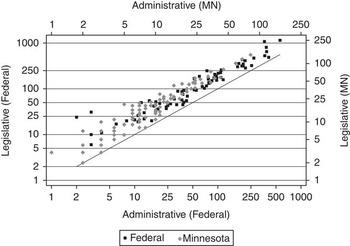
To address this issue, we count the number of groups mentioning each venue for each policy area, which allows us to compare the Minnesota and federal data. This variable reflects the number of groups paying at least some attention to each venue. Scatter plots based on these calculations are presented in Figure 2. Because there are a different number of policy areas in the two data sets and because the scale of activity is much greater at the federal level, we use two different sets of axes. Further, the data are presented on a log-log scale in order to better separate the large number of policy areas with relatively low levels of lobbying from the few policy areas that attract the bulk of lobbying.
Total groups per venue by policy area (axes on log scale)
Data are counts of the number of groups that list each venue at least once for each of the 76 federal and 96 Minnesota policy areas. The diagonal line indicates equal number of mentions of both venues. In Minnesota, one policy area (Public Safety/Policy) is excluded due to no groups in the administrative venue. In Washington DC, one policy area had no observations (Accounting).

The results in this figure are unequivocal: activity levels in one venue are strongly associated with activity levels in the other venue, with correlations of 0.95 in Minnesota and 0.98 in Washington DC. Put differently, the administrative policy process is not directed by lobbyists to pick up policy issues neglected in the legislative process. As alluded to above, there is a great degree of variation in lobbying activity across the different policy areas, with the number of groups mentioning Congress varying from six for Unemployment to 1,147 for Budget/Appropriations; the number of groups mentioning the administrative branch varies from two for District of Columbia to 560 for Budget. The average number of groups for the legislature is 183; for the administrative branch it is 98. In Minnesota the averages are 24 and 13, respectively. Clearly, these data indicate little substitution among venues in terms of the locus of (unconditional) interest group attention.
Consistent with our earlier findings, more groups mention the legislative venue than the administrative venue in every policy, and at both levels of government. In Minnesota, the average ratio of legislative to administrative groups is 1.90; at the federal level it is 2.27. Interestingly, this ratio shrinks as the number of groups in a given policy increases, though more so at the federal level.
Representation across venues
The analysis so far gives some sense that representation in the bureaucracy tracks representation in the legislative branch – at least when measured by lobbyists or reports. The groups active and pressing their issues in the legislature are also active and pressing their issues in the bureaucracy. Put differently, whoever the bureaucracy is hearing from and on whatever issues, they are not hearing from interests wanting for representation elsewhere in the policy process.
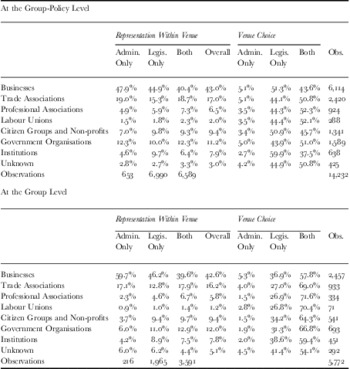
Yet the analysis so far tells us little about the identity of those groups, and therefore about the composition of the interests heard. Because around 50 per cent of groups lobby both venues for a given policy, it could be the case that the overall pattern of representation is quite different across venues. To address this issue, we rely exclusively on the federal data, which partition groups into ten categories. Following the approach of Baumgartner and Leech (Reference Baumgartner and Leech2001), we combine the professional lobbying firms category with the business and corporation category and create an “institutions” category by combining universities, hospitals and other institutions, resulting in seven final categories. Because groups can report lobbying in either or both venues, we examine the distribution of organisations based on three categories: (1) those that lobby the administrative venue, (2) those that lobby the legislative venue and (3) those that lobby both venues. To compare representation across venues, we calculate the distribution of organisational types for each of these categories, both at the group-policy level and at the group level. Because the proportions in each column depend on the venue choice decisions of all types of groups, they make it harder to understand the pattern of venue choice for each category of group. In order to illuminate this issue, we also report the distribution of venue choice by organisation type.
The results are presented in Table 3. Overall, the distribution of organisations within one venue is fairly similar to the distribution in the other, suggesting that any representational bias indicated by activity in the legislature venue extends to the administrative venue as well. Some interesting patterns emerge beyond this. In particular, business dominance is greater among groups that lobby a single venue than among those that lobby both, with its percentage increasing from 40 per cent of observations in both venues to about 45 per cent of observations in just the legislature at both the group and group-policy levels to 48 per cent of observations in just the administrative branch at the group-policy level and 60 per cent at the group level. Citizen groups, on the other hand, comprise a lower percentage of groups in the administrative branch at both levels of analysis. After business groups, only trade associations and government organisations are better represented in the administrative branch-only column. Our findings for the administrative venue are consistent with previous work that examines representation only in the notice and comment process (Golden, Reference Golden1998).
Representation and patterns of venue choice by organisations at the federal level

Groups that listed no venues are excluded from these tabulation. See the text for details on the construction of group categories.
The comparison across venues demonstrates a somewhat surprising similarity between citizen and business groups: along with institutions, citizen and business groups are the only categories of groups at the group-policy level for which a majority lobby just the legislature rather than both venues. At the group level, these three categories are still the most likely to lobby only the legislature, but the proportion has dropped nearer to a third rather than a half. At both levels of analysis, business groups are the most likely to lobby only the administrative branch, with 5.1 per cent of observations at the group-policy level and 5.3 per cent at the group level. Citizen groups are the least likely to lobby just this venue at the group level (1.5 per cent) and the second least likely at the group-policy level (3.4 per cent). Because of their greater numerosity, of course, these small differences lead to a much greater edge for businesses in the administrative venue. Another interesting finding comes from comparing the pattern of venue choice across the group and group policy levels of analysis. Specifically, professional associations, government organisations and citizen groups are much more likely to lobby in just the administrative venue at the group-policy level, which helps explain why they constitute twice as high a proportion of groups in this venue at the same level of observation.
While these results advance our understanding of representation of types of interests across venues, they must be read in light of four tempering facts. Firstly, the number of groups lobbying in just the administrative branch is small (less than 5 per cent for both levels of analysis). Accordingly (and somewhat unsurprisingly), the portrait of representation is sparser in this venue than in the legislative branch. Secondly, the differences are still relatively small, particularly at the group-policy level: the overall pattern of representation is fairly consistent across the three venues and exhibits the well-known, pro-business bias in representation. Thirdly, making inferences about how the existence of multiple venues changes representation involves a counterfactual about how groups’ lobbying would change if the available venues were different. Groups registered in just one venue might, if that option were closed off, move their efforts to the other. Fourthly, our data do not indicate the “substance” of lobbying activities in each venue. For example, it is possible that groups exclusively lobbying the administrative branch offer policy-specific information about the technical details of implementation, while they communicate political preferences to the legislative branch. The next section partially addresses this question by considering the relative representation of citizen and business groups in different policy areas, but future work should consider the differences in form and substance (if any) that distinguish administrative and legislative lobbying.
Representation across venues and policies
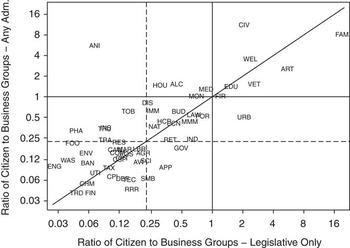
In this section, we continue to focus on the issue of representation of group types across venues but add a comparison across policy areas, in order to obtain a better understanding of the locus of business dominance vis à vis citizen groups. To make this comparison, we implement a number of simplifications, since it would be very difficult to fully investigate the distribution of nine types of groups across three venue choice outcomes and 76 policy areas. Firstly, we focus only on the representation of business groups vis à vis citizen groups. This is not to suggest that representation by other types of groups is not important. Rather, much scholarly attention is focused on the divide between these two categories. Secondly, we compare groups that lobby only the legislature with those that lobby the administrative branch – either on its own or in addition to the legislative branch. We do this in recognition of the fact that very few groups lobby just the administrative branch: the major decision appears to be whether to lobby the administrative branch in addition to the legislature. Finally, we use the ratio of the number of citizen groups to the number of businesses as our measure of representational disparity. Low values correspond to business dominance. This leaves us with two numbers for each policy area: the citizen to business ratio for groups that only lobby the legislature and the same ratio for groups that lobby the administrative branch, either alone or in addition to the legislature (hereafter, we refer to the latter category as the combined administrative category).Footnote 26
For the legislative venue, the mean value across policy areas is .78 while the median is .15. For the combined administrative category the mean is .73 and the median is .17. The two categories reveal a substantively similar degree of business dominance. It certainly does not seem that access to administrative policy channels counterbalances the business dominance in legislative lobbying.
Because the distributions of these ratios are highly skewed and clustered toward smaller values, we convert them to a log scale.Footnote 27Figure 3 plots these two ratios for each policy area, along with an equal bias line. Policy areas above this line have a smaller pro-business representational disparity in the combined administrative category compared to the legislative-only category. The dashed lines are located at the mean ratio for each venue; the solid vertical and horizontal lines at one demarcate cases where citizen groups have an actual representational advantage – observations beyond these lines represent cases where there are more citizen groups than business groups. Finally, the three-letter symbols correspond to the government codes for each policy area.
Representational disparities by venues: ratio of citizen groups to business groups across policy areas in Washington DC (axes on log scale)
Legislative-only category includes all cases for which a group mentions only the legislature; the any administrative category includes all cases for which groups mention only the administrative branch or both the administrative and legislative venues. The diagonal line indicates equal ratios in both venues, while the dashed lines correspond to the average ratio in each venue in the full group-policy data set. A few policy areas are lost due to the presence of no businesses or citizen groups. See the text for more information. The three letter codes are used by the federal government for each policy area (see www.senate.gov/reference/resources/pdf/ld-198.pdf or Baumgartner and Leech's codebook for the LDA data).

On average, policy areas with greater ratios in one category also have greater ratios in the other category, as evidenced by the correlation of .60 between the two measures. Yet the results in the figure indicate a great deal of variation across policy areas in terms of the relative representational disparity across venues, especially considering the conversion to the log scale (which spreads the data out, but also reduces relative distances to the equal disparity line). Of the 57 policy areas, 30 lie above the equal disparities line, indicating better relative representation of citizen groups in the combined administrative category. Put differently, only 36 per cent of the variation in representational disparity in the combined administrative category is explained by the legislative-only category. This leaves a lot of variation to differences between the venues within policy areas. Notably, there are only nine policy areas where citizen groups have an absolute advantage in the legislative-only venue and ten where they have this advantage in the combined administrative venue; six cases meet the threshold in both venues.Footnote 28
Focusing on the policy areas with the biggest representation differences, a few unusual findings surface amidst mostly unsurprising results. Policy areas where the value for the combined administrative category is less than one-half the value for the legislative-only category – indicating much greater business representation in the administrative branch relative to the legislative branch – are: Urban Development/Municipalities, Apparel/Clothing Industries/Textiles, Small Business, Railroads, Government Issues, Indian/Native American, Family Issues/Abortion/Adoption, Telecommunications, Arts/Entertainment and Defence. These are industries generally dominated by business interests, though with a couple of exceptions. Note that for one of these exceptions – namely, Family Issues/Abortion/Adoption – greater relative business representation in the administrative branch does not change the fact that citizen groups dominate in both branches. Those with a ratio of four or greater – indicating much reduced relative business dominance in the administrative branch – are: Trucking, Insurance, Tobacco, Housing, Food Industry (Safety/Labelling), Civil Rights/Civil Liberties, Pharmacy and Animals. Given that most of these are areas one would expect to be dominated by businesses, it is interesting that citizen groups do better in the combined administrative category.
An interesting feature of this figure is that there are few policy areas in which one type of group dominates in one venue while the other type of group dominates in the other. Of course, this may be a consequence of the fact that our combined administrative category includes groups that lobby both venues, which inevitably reduces the clarity of our findings, though we note that the figure is not terribly different if we use groups that only lobby one venue. The two exceptions would be Animals, for which business has a 15 to 1 advantage in the legislature while citizen groups have an 11 to 2 advantage in the administrative branch, and, to a lesser extent, Urban Development/Municipalities, for which business groups’ 2 to 1 advantage is reversed in the combined administrative category. Note that these are the actual number of groups, so the latter is based on only three groups of each type.
Discussion: participation in administrative policy-making
A consistent pattern in the evidence above is of an interest group ecology that, collectively, attempts to direct administrative agencies to much the same set of groups and issues as the legislature.Footnote 29 This pattern has several important implications for the role of the bureaucracy in the policy process. Firstly, the strategic calculus behind these venue choice decisions suggests that groups do not feel content to lobby the legislature and let it direct the bureaucracy in turn. Rather, our data suggest that many groups who lobby at all spread their lobbying efforts throughout the policy-making process. They consistently use more resources, at least when measured by lobbyists or reports, on legislative than administrative lobbying, but in general, the more they use on one, the more they use on the other. This is difficult to rationalise unless the groups believe that bureaucratic agencies do possess discretionary authority over some or all policies that the groups care about. If agencies were mere ciphers or subordinate actors for the legislature, the legislature would see most or all lobbying action. Lobbying the bureaucracy would only support policy choices that could be overturned at will by the legislature if the latter were the source of all policy direction, rendering bureaucratic lobbying largely useless.
Furthermore, to the extent that the lobbying activities as measured here are consequential in the determination of public policy outcomes, our findings indicate that administrative policy processes may simply reinforce the advantages possessed by particular groups and policies in the legislature. Administrative lobbying does not broaden the representation of interests beyond those that pursue representation within the legislative venue. That would require interests and issues relatively inactive in the legislature to be more active in the administrative venue, which would yield a different distribution of organisation types in the two venues. Across several measures, that is not the case.
A natural explanation for this pattern of activity is the basic logic of collective action (Olson, Reference Olson1965). Administrative lobbying may be subject to essentially the same collective action problems as legislative lobbying. To that extent, it makes sense that groups very active in the legislature would also be relatively active in the bureaucracy.
In any case, this pattern sheds light on the effect of participation opportunities in bureaucratic policy-making.Footnote 30 The bureaucratic venue presents another opportunity for the active, high-spending interests that predominate in legislative lobbying to be heard. The lobbying patterns it is exposed to do not direct it to broaden the set of groups or policies privileged in other parts of the policy process. Our data suggest that – at least as measured by lobbying activities – any representational biases that exist in the legislature carry over to the administrative branch as well.
Conclusion
This study constitutes the first broad examination of interest group representation across multiple venues. Using existing data from the Federal government and a new data set from the state of Minnesota, we are able to answer a number of important questions about administrative lobbying vis-à-vis legislative lobbying. First and foremost, administrative lobbying is a widespread phenomenon: about two-thirds of all registered lobbying organisations indicate at least some interest in this venue. Second, for most groups, larger levels of activity in one venue are matched by larger levels of activity in the other venue. Finally, within many policy areas, the well-documented pro-business bias in lobbying activity exists in both venues.
In terms of representation, the findings are simultaneously revealing and potentially troubling. After all, an easy way to summarise the finding is that administrative lobbying might very well exacerbate what one might term an “access bias” in favour of the privileged in society, as famously examined and discussed by (Walker, Reference Walker1991). Of course, we are cognizant that registered lobbying is only one form of participation in the policy process.Footnote 31 Our data do not include groups that engage solely in “outside” lobbying, groups that fall below the reporting thresholds, or additional forms of participation in the bureaucracy, whether through the process of notice and comment or through service on advisory committees. These alternative forms of participation may open up the door to groups not represented in our data; studies that analyse the distribution of groups in notice and comment, however, also find a significant pro-business bias, whether measured by participation (Golden Reference Golden1998; Furlong and Kerwin Reference Furlong and Kerwin2005) or influence (Yackee and Yackee Reference Yackee and Yackee2006). It is also worth repeating the caveat that our data on lobbying are quite coarse, extending no further than the number of lobbyists or reports that groups devote to or file in each venue for a given policy area. While presence is an important measure of representation, a finer measure of lobbying activity may help illuminate the issue in more detail and help us understand the conditions under which representation can lead to access and, ultimately, influence (see, for example, Hansen Reference Hansen1991 and Kollman Reference Kollman1997).
Linkages to existing work
Given the pervasiveness of administrative policy-making and the breadth and depth of lobbying/participation in the administrative process, it is important to briefly consider/revisit the linkages between our findings and those of other scholars.
Broad lobbying and policy uncertainty
Firstly, and specific to this article's focal question of venue choice, our results indicate that many groups pursue broad lobbying strategies in the sense of using multiple venues. Indeed, many groups devote similar amounts of time to both administrative and legislative venues. Thinking about the process by which policies are actually made – statutes enacted and rules then made to (attempt to) implement the appropriate social, economic and political outcomes – this finding is particularly consistent with those of McKay and Yackee (Reference McKay and Yackee2007) with respect to administrative participation and Heinz, Laumann, Nelson and Salisbury (Reference Heinz, Laumann, Nelson and Salisbury1993) more generally. Specifically, the findings are suggestive of lobbying as a mechanism by which groups deal with inherent policy uncertainty.
Differentiating between groups
Following the idea of uncertainty and monitoring as a motivation for lobbying activity, it is important to differentiate accordingly between types/constituencies of groups. For example, while we replicate many earlier studies insofar as we provide evidence of a “pro-business” bias in terms of the prevalence of participation in both administrative and legislative venues, the results of Baumgartner, Berry, Hojnacki, Kimball and Leech (Reference Baumgartner, Berry, Hojnacki, Kimball and Leech2009) suggest reconsidering what forms lobbying activities take and, perhaps just as importantly, the various intents behind these activities. Solving collective action problems (as discussed in great detail by both Walker (Reference Walker1991) and Heinz, Laumann, Nelson and Salisbury (Reference Heinz, Laumann, Nelson and Salisbury1993), for example) are arguably a greater challenge binding upon citizen- and issue-specific groups than they are for business interests. This reality might imply that business groups are simply more capable of procuring resources for sustained, “monitoring motivated” activities and thus, in line with the conclusions suggested by Baumgartner, Berry, Hojnacki, Kimball and Leech (Reference Baumgartner, Berry, Hojnacki, Kimball and Leech2009), merely looking at the levels of lobbying activity might mask what is in fact a more equal playing field when policy change moments, or “punctuations”, are actually occurring.
Collective action, administrative lobbying and representation
On the other hand, our finding that groups who specialise in administrative lobbying exhibit a more strongly pro-business tinge provides some evidence, in line with the traditional collective action logic of Olson (Reference Olson1965), that assessing the true aggregate policy impact of a participation bias might require not losing the forest for the trees. Our results are consistent with the notion that business interests are more broadly and pervasively represented when practical matters of implementation – the last, but no less pivotal, steps of the policy process – are being decided.
Group heterogeneity, venue choice and representation
Finally, our finding that the intra-group relationship between usage of the two venues is weak is consistent with the recent findings reported by McKay (Reference McKay2011). Specifically, her results suggest that various group-specific factors are in some cases quite important in determining the venue or venues in which a group chooses to participate. Accordingly, understanding the normative impact of the empirical landscape of participation will require more careful consideration of the nature and distribution of these group-specific factors and their linkage with broader normative concepts such as social welfare, political equality and economic efficiency.
Next steps
In general, the study of interest group activity across multiple venues allows analysis of many new questions and ways of assessing the policy process as a whole. Datasets containing detailed information on activities and expenditures and that link lobbying behaviour across venues are only now becoming available. As they do, we believe that exploring how an interest group's strategic problem of venue choice is related to the characteristics of each issue, the relevant venues, and the behaviour of other interests active on that issue will provide important insights into the consequences of government structure for representation. In concluding, we humbly suggest three directions that we believe our results indicate future theoretical and empirical work should more actively engage.
Groups and issues
In line with the discussion of our conclusions above, our findings, along with those reported by Holyoke (Reference Holyoke2003) and McKay (Reference McKay2011), clearly indicate the importance of gathering more data and constructing more detailed theories about the group- and issue-specific factors that influence the choice of venue.Footnote 32 Venue choice is merely one (important) aspect of how a group constructs its lobbying strategy, broadly construed. Accordingly, the conclusions we will be able to draw from pursuit of this direction are of broader interest to the study of interest groups and political/policy representation.Footnote 33
Lobbying strategies
Our findings indicate that lobbying is similar across legislative and administrative venues. While it is clearly important extending to more venues (such as courts) and groups (such as elected officials, government agencies, other governments and individual citizens), a more specific conclusion we take from this finding is the importance of gathering data and theorising about the nature of intra-venue lobbying strategies. That is, are different groups acting similarly in the same venue? (This is closely related to the findings of McKay and Yackee (Reference McKay and Yackee2007)). More interestingly, perhaps, is whether a given group pursues similar strategies and/or messages in different venues? From a theoretical perspective, why might there be differences within and across venues – how do the different incentives of various policy-makers provide differential incentives to those that lobby them?
Institutional effects
Finally, while we consider a single state, our analysis indicates a somewhat new angle on the question of venue choice that is of broad interest to scholars of interest groups and policy as well as state and comparative politics. Namely, how do institutional factors such as variation in bureaucratic structure (such as civil service protections, executive agencies vs independent commissions holding delegated authority) and legislative career incentives (such as legislative pay, perks, staffs and/or term limits) affect the degree to which various interests pursue policy change through the legislature and/or the bureaucracy?
Overall, of course, we join numerous other scholars in calling for research on interest group lobbying to pay greater attention to the role that issues play in determining interest group lobbying decisions (see, for example, Baumgartner, Berry, Hojnacki, Kimball and Leech (Reference Baumgartner, Berry, Hojnacki, Kimball and Leech2009)) and the characteristics of interest group lobbying communities. We believe that adding information on groups’ menu of venues in which to seek representation to these approaches is a logical step that will simultaneously add to our understanding of policy-making and interest group behaviour.
Acknowledgements
Research support provided by the Robert Wood Johnson Foundation is greatly appreciated. The authors wish to thank Joseph Peters at the University of Iowa and Ezra Golberstein at the University of Michigan for their help with gathering and coding much of the data used in this study. We appreciate comments and suggestions from Tony Bertelli, Eric Heberlig, Susan Yackee, seminar participants at the universities of Iowa and Michigan, and the anonymous reviewers.