Summations
-
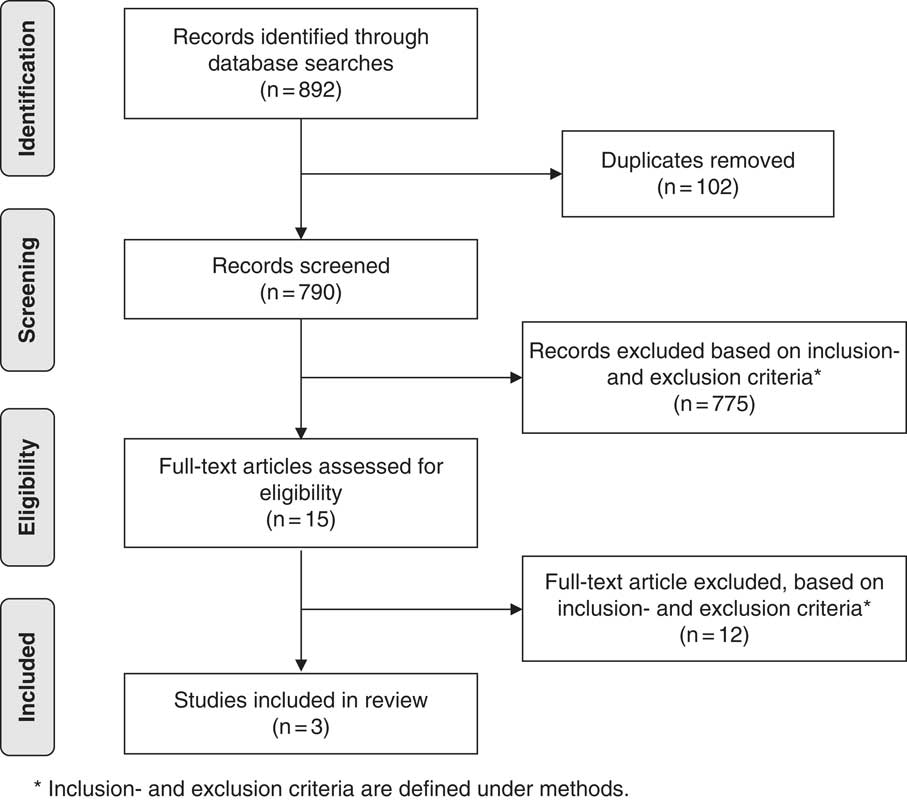
∙ The search conducted for our systematic review of empirical investigations of natural selection-based evolutionary accounts for ADHD identified 790 records. Of these, 15 full-text articles were assessed for eligibility, and only three were included in the review.
-
∙ The authors of the three studies included in this review interpreted their findings as favouring the notion that ADHD-traits may have been associated with increased fitness during human evolution. However, we argue that none of the three studies really tap into the core symptoms of ADHD, and that their conclusions therefore lack validity for the disorder.
-
∙ This review indicates that the natural selection-based accounts of ADHD have not been subjected to empirical test and therefore remain hypothetical. We suggest that this gap in knowledge should be addressed in future studies.
Limitations
-
∙ Publications relevant for this topic may have gone undetected in our search.
-
∙ It is noteworthy that there are so many more publications raising hypotheses for the evolutionary background for ADHD than there are studies testing them empirically.
Introduction
Attention-deficit/hyperactivity disorder (ADHD) is a childhood-onset neurodevelopmental disorder with a prevalence of ~5% among children/adolescents (Reference Polanczyk, de Lima, Horta, Biederman and Rohde1). The syndrome is characterised by hyperactivity, inattention, and impulsiveness causing significant burden on those affected, their families and society as a whole (Reference Harpin2–Reference Tajima-Pozo, Ruiz-Manrique, Yus, Arrazola and Montanes-Rada7). Twin studies have shown that ADHD is among the most heritable mental disorders (Reference Freitag, Rohde, Lempp and Romanos8,Reference Bienvenu, Davydow and Kendler9) with heritability estimates of 70–80% in both children and adults (Reference Faraone, Asherson and Banaschewski10).
The fact that ADHD is highly impairing, highly heritable, and yet highly prevalent, presents a challenge to natural selection-based accounts of human evolution: If a mental disorder, such as ADHD, is so disabling and impairing, one would expect it to reduce the reproductive fitness of the individual affected by it so that the genetic variants responsible are selected out (Reference Keller and Miller11). In the face of this challenge a number of different explanations for the evolutionary persistence of ADHD have been proposed. Specifically, it has been suggested that while ADHD may be maladaptive in the present environment, it has contributed to increased fitness in an ancestral environment allowing individuals to survive and pass on their genes (Reference Jensen, Mrazek and Knapp12,Reference Bradshaw and Sheppard13). Examples of this so-called ‘mismatch theory’ (Reference Crawford and Salmon14) are outlined below.
The hunter-farmer theory
This theory, proposed by Hartmann (Reference Hartmann15), considers individuals with ADHD-traits as ‘hunters’. In this context, inattention is described as the ability to constantly monitor a scene and notice changes in the environment. Similarly, hyperactivity is interpreted as being energetic and tireless. Finally, impulsivity is interpreted as flexibility, that is the ability to change strategy quickly and to start a chase on a moment’s notice. In contrast, individuals without ADHD-traits are considered to have the virtues of ‘farmers’.
The response-readiness theory
This theory, proposed by Jensen et al. (Reference Jensen, Mrazek and Knapp12), claims that ADHD-traits may be beneficial in environments characterised by rapid changes, external threats, and scarce food resources. Under such circumstances, attention deficit can be viewed as ‘vigilance’, which would be adaptive wherever humans are considered as prey or enemies. Similarly, impulsivity can be viewed as ‘response-readiness’ (the ability to fight or flee), which is critical in the face of danger. Finally, in an impoverished environment, hyperactivity can be viewed as ‘exploratory behaviour’, which is useful for identifying new food-sources in the surrounding area, or for migrating towards better habitats. This hypothesis for understanding the evolutionary development of ADHD is supported and developed further by several others (Reference Bradshaw and Sheppard13,Reference Crawford and Salmon14,Reference Stolzer16,Reference Glover17).
The wader theory
This model by Shelley-Tremblay and Rosen (Reference Shelley-Tremblay and Rosen18) is based on the ‘Aquatic Ape Theory’ (Reference Morgan19) and proposes that in the evolutionary transition of becoming bipedal toolmakers, wading to gather food along shorelines played an important role. Over the course of evolution, these ‘waders’ lost significant body hair, as streamlining was advantageous when moving in water. With the loss of body hair, infants could no longer cling to their mothers for protection and breastfeeding, which is a primary survival mechanism in all other primate species. Shelley-Tremblay and Rosen suggest that wader-infants who were able to attract maternal attention would have an advantage, as they would be more likely to be breastfed. According to Shelley-Tremblay and Rosen, children with ADHD instigate more contacts with their mothers and hypervocalise, which could have mediated positive selection among the waders.
The fighter theory
This theory, also proposed by Shelley-Tremblay and Rosen (Reference Shelley-Tremblay and Rosen18), suggests that ADHD-associated aggression (Reference Hamshere, Langley and Martin20–Reference Young and Thome22) may have been advantageous for fighting and warfare in a potential ‘genocidal’ war between Homo sapiens and the Neanderthals.
These evolutionary hypotheses seem somewhat speculative and certainly remain nothing but hypotheses until supported by empirical evidence. We therefore conducted a systematic review following the PRISMA guideline (Reference Moher, Liberati, Tetzlaff and Altman23), in order to investigate to which extent the natural selection-based accounts of ADHD have been investigated in empirical studies.
Methods
Search strategy
The following search, combining search terms covering evolution/selection/fitness with search terms covering ADHD/hyperkinetic disorder, was carried out in PubMed: (‘Attention Deficit Disorder with Hyperactivity’[Mesh] OR attention deficit disorder with hyperactivity* OR attention deficit hyperactivity disorder* OR attention deficit disorder* OR adhd OR hyperkinetic disorder*) AND (‘Biological Evolution’[Mesh] OR ‘biological evolution’ OR evolution OR ‘Natural Selection’ OR ‘Selection, Genetic’[Mesh] OR ‘genetic selection’ OR ‘allostasis’ OR ‘homeostasis’ OR ‘Allostasis’[Mesh] OR ‘Homeostasis’[Mesh] OR ‘Adaptation, Biological’[Mesh] OR ‘Adaptation, Biological’ OR ‘Genetic Fitness’[Mesh] OR ‘fitness’ OR ‘Fertility’[Mesh] OR ‘fertility’ OR ‘Mortality’[Mesh] OR ‘Mortality’). Equivalent searches were performed in Embase and PsycINFO. Searches of the three databases were conducted on 11 June 2015.
Study selection
Abstracts for the records identified by the database search were obtained and screened. Subsequently, the full-text versions of relevant records were assessed. The following inclusion and exclusion criteria were employed throughout the study selection:
Inclusion criteria
-
∙ Focusses on ADHD or its subtypes
-
∙ Focusses specifically on evolution, natural selection, adaptation or fitness
-
∙ Is based on empirical testing of a natural selection-based hypothesis
Exclusion criteria
-
∙ Not published in the English language
-
∙ Published as dissertation, book chapter, or conference abstract
Furthermore, the reference lists of the full-text articles included in the review were screened for eligible articles.
Results
Study selection
The PRISMA flowchart (Fig. 1) illustrates the screening of the literature.
PRISMA flow diagram.

The searches in PubMed, Embase and PsycINFO identified a total of 892 titles, which were reduced to 790 after removal of duplicates. Fifteen abstracts were selected for full-text screening. Of these, three were found eligible for inclusion in the review. The screening of the reference lists of the included articles identified no further articles eligible for inclusion. The three included studies are described below:
Ding et al.: Evidence of positive selection acting at the human dopamine receptor D4 gene locus
Ding et al. (Reference Ding, Chi and Grady24) focussed on the seven-repeat (7R) allele of the dopamine receptor D4 gene (DRD4), which has been associated with novelty seeking and ADHD in a number of studies (Reference Faraone, Doyle, Mick and Biederman25–Reference Wu, Xiao, Sun, Zou and Zhu28). Specifically, Ding et al. analysed DRD4 haplotypes stemming from cell-lines isolated from populations across the world. Calculations of the age of the various DRD4 alleles based on intraallelic variation as well as allele frequencies suggested that the four-repeat (4R) allele is >300 000 years old and represents the human progenitor allele. In contrast, the 7R allele was estimated to be at least 5–10-fold ‘younger’ (30 000–50 000 years old). According to Ding et al., the combination of the young age and relatively high frequency of the 7R allele frequency is highly indicative of positive selection (Reference Ding, Chi and Grady24). In their conclusion, Ding et al. ask ‘why an allele that seems to have undergone strong positive selection in human populations nevertheless is now disproportionately represented in individuals diagnosed with ADHD’. They speculate that ‘the very traits that may be selected for in individuals possessing a DRD4 7R allele may predispose behaviors that are deemed inappropriate in the typical classroom setting and hence diagnosed as ADHD’ (Reference Ding, Chi and Grady24) in accordance with the mismatch theory outlined in the introduction of this review.
Wang et al.: The genetic architecture of selection at the human dopamine receptor D4 (DRD4) gene locus
Wang et al. (Reference Wang, Ding and Flodman29) pursued the findings made by Ding et al. (Reference Ding, Chi and Grady24). In order to test whether the proposed positive selection acted at the 7R DRD4 allele itself, rather than at an adjacent site, Wang et al. sequenced the DRD4 locus in 103 individuals of European, African, Asian, North and South American, and Pacific Island ancestry. The pattern of recombination suggested that the selection was indeed acting on the 7R allele. Furthermore, Wang et al. refined the age estimate of the 7R allele to be 40 000–50 000 years (before the upper Palaeolithic era), coinciding with the last major out-of-Africa exodus (44 000–47 000 years ago) (Reference Harpending and Rogers30). Based on these results, and current knowledge of the function of the DRD4 gene, Wang et al. summed up their paper with an evolutionary model as follows. The 7R DRD4 allele arose as a rare mutation ~40 000–50 000 years ago. Compared to the 4R version of the receptor, the 7R version has a significantly blunted response to dopamine (higher dopamine concentrations required to obtain same effect) (Reference Asghari, Sanyal, Buchwaldt, Paterson, Jovanovic and Van Tol31,Reference Swanson, Posner, Fusella, Wasdell, Sommer and Fan32). This altered sensitivity to dopamine is hypothesised to cause risk-taking, novelty seeking, and response-readiness, which have been sufficiently advantageous to explain a dramatic rise in the frequency of the 7R allele (positive selection) for the past 40 000–50 000 years, possibly initiated by an adaptive role in the out-of-Africa exodus. Furthermore, according to Wang et al. the 7R allele is likely to have been subjected to positive sexual selection (reproduction advantages) in polygynous societies (Reference Wang, Ding and Flodman29). There is some support for this ‘sexual exuberance’ hypothesis in the literature on ADHD (see the discussion).
Williams and Taylor: The evolution of hyperactivity, impulsivity and cognitive diversity
Williams and Taylor (Reference Williams and Taylor33) examined the impact of group diversity on fitness. Their key assumption was that ‘unpredictability’ is a cardinal feature of individuals with ADHD, particularly for boys of the hyperactive/impulsive subtype. The main hypothesis of the study was that unpredictability, displayed by individuals, could be a major benefit for the fitness of a social group, and would consequently be subjected to positive selection at the group level. This hypothesis was tested in two computational simulation paradigms: ‘The changing food task’ and ‘Evolutionary simulation’.
The changing food task tests how groups of various compositions (in terms of the proportion of unpredictable individuals) would survive in environments with changing availability of food sources – of variable quality. In this paradigm, the group members could either die from malnutrition or from poisoning. The results showed that the group composed of 5% unpredictable individuals and 95% predictable individuals survived better than the three comparison groups (100% unpredictable individuals, 100% predictable individuals, and 25% unpredictable+75% predictable individuals). The population with 100% unpredictable individuals was quickly reduced due to poisoning, while the population with 100% predictable individuals was diminished due to malnutrition. In the group composed of 5% unpredictable individuals and 95% predictable individuals, a balanced level of risk-taking (the willingness to test new food sources of unknown quality) resulted in low risks of both poisoning and malnutrition, and thus, led to the highest group survival.
In the evolutionary simulation, population survival under fluctuating conditions was tested. Specifically, population size was estimated as a function of (i) the rate of environmental change, and (ii) the relationship between an individual’s unpredictability and the rate of reproduction. The results showed that a reproductive bias (selection) favouring the unpredictable individuals helped populations cope with rapid environmental change, without imposing major costs during periods of environmental stability. According to Williams and Taylor, the results of both the changing food task and the evolution simulation suggest that unpredictability (as a proxy for ADHD-like behaviour) may have been subjected to positive selection during human evolution.
Discussion
In this systematic review of the literature on empirical tests of evolutionary hypotheses for ADHD, we found only three relevant articles for inclusion after screening 790 abstracts. Two of these articles report results from genetic studies (Reference Ding, Chi and Grady24), and one reports a computational simulation study (Reference Williams and Taylor33). The genetic studies by Ding et al. (Reference Ding, Chi and Grady24) and Wang et al. (Reference Wang, Ding and Flodman29) find evidence for positive selection acting on the 7R allele of the DRD4 gene. They suggest that ADHD traits associated with the DRD4 7R allele have been adaptive during the evolution of man. The development of the 7R allele, roughly coincided with the latest out-of-Africa exodus, and both Ding et al. and Wang et al. speculate that this event may have played a critical role for the positive selection acting on the 7R allele. The computational study by Williams and Taylor (Reference Williams and Taylor33) found that populations containing 5% unpredictable individuals, a proportion that matches the current prevalence of ADHD (Reference Polanczyk, de Lima, Horta, Biederman and Rohde1), have had better chances of surviving in ancestral environments characterised by changing conditions.
All three studies included in this review have limitations that have consequences for the extent to which their results can be considered as support for a natural selection-based hypothesis for ADHD. Specifically, the studies by Ding and Wang rely on the assumption of a causal association between the 7R DRD4 allele and ADHD. However, far from all individuals with the 7R allele have ADHD, and not all individuals with ADHD have the 7R allele (Reference Faraone, Doyle, Mick and Biederman25,Reference Li, Sham, Owen and He27,Reference Wu, Xiao, Sun, Zou and Zhu28). The 7R allele was associated with ADHD in a meta-analysis of candidate gene studies (Reference Gizer, Ficks and Waldman34), but the odds ratio was low (only 1.3). Furthermore, DRD4 has not yet been implicated by genome-wide association studies (Reference Neale, Medland and Ripke35) and current thinking is that ADHD susceptibility is influenced by many common and rare variants (Reference Faraone, Asherson and Banaschewski10). Similarly, the study by Williams and Taylor is based on the assumption that individuals with ADHD are unpredictable (Reference Williams and Taylor33), which may be true in some, but certainly not in all cases. Furthermore, unpredictability (also referred to as behavioural variability by Williams and Taylor (Reference Williams and Taylor33)) is not part of the symptom criteria for ADHD and, to our knowledge, there is not substantial evidence indicating that individuals with ADHD are more unpredictable than individuals without ADHD. However, there is a robust literature showing that people with ADHD show greater variability in some behavioural parameters, particularly reaction time (Reference Kofler, Rapport and Sarver36). This suggests that people with ADHD may be less predictable if it were to generalise to a wide range of behaviours. Furthermore, it can be argued that unpredictability (or behavioural variability) may be one of the factors driving impulsivity (Reference Williams and Taylor33), supporting its role in ADHD.
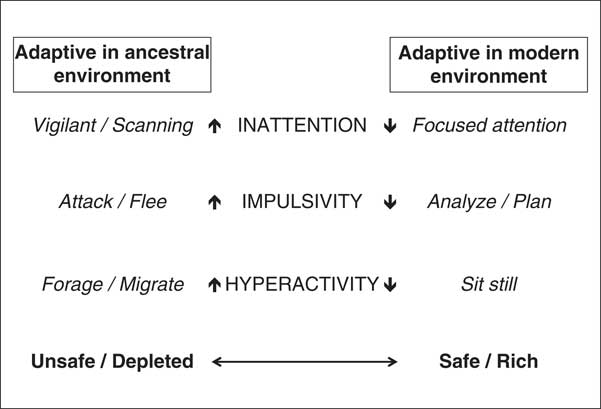
As outlined above, none of the studies investigating the natural selection-based accounts of ADHD really tap into the core symptoms of ADHD (hyperactivity, impulsivity, and inattention). However, if we give the assumptions of the studies the benefit of the doubt, it is notable that their results are all compatible with the ‘response-readiness’ hypothesis proposed by Jensen et al. (Reference Jensen, Mrazek and Knapp12), which was described briefly in the introduction. According to Jensen et al., the defining traits of ADHD (inattention, impulsivity, and hyperactivity) are very likely to have been adaptive in ancestral (unsafe and resource depleted) environments, while they are predominantly maladaptive in modern (safe and resource rich) environments, hence the definition of ADHD as a mental disorder. This environmental mismatch is illustrated in Fig. 2.
The adaptive properties of ADHD traits in various environments.

However, according to Jensen et al., ADHD behaviour can also be considered as adaptive in modern societies under certain circumstances. Specifically, if a child is neglected by its parents, being vigilant, quick to pounce, or causing a stir in order to attract attention may be beneficial. This would correspond to the environment illustrated to the left (unsafe/depleted) on the ruler at the bottom of Fig. 2. However, if these traits (vigilance, quick to pounce, causing a stir) are stable, they go from being advantageous to disadvantageous if the environment changes permanently from unsafe/depleted to safe/rich (a move towards the right on the ruler in Fig. 2). This hypothesis is compatible with findings made by the English and Romanian Adoptees (ERA) study team (Reference Rutter37). These studies of adopted children subjected to early rearing in extremely deprived institutions in Romania, showed that ADHD traits, which may have been beneficial in the context of the institution, were highly prevalent and persistent, despite the radical change in environment represented by the adoption into English families offering above-average rearing circumstances (Reference Kreppner, O’Connor and Rutter38–Reference Stevens, Sonuga-Barke and Kreppner40). However, not all Romanian adoptees that were subjected to early adversity developed significant ADHD traits, which is indicative of differential susceptibility. This is in line with the findings from a series of gene-environment interaction studies, which suggest that ADHD behaviour arises as a consequence of interaction between genetic risk (e.g. inferred by the DRD4 gene) and early adverse environmental exposures (Reference Laucht, Skowronek and Becker41–Reference Nikitopoulos, Zohsel and Blomeyer45).
In their paper included in this review, Wang et al. raise the possibility that ADHD-related traits (such as risk-taking) may have been subjected to positive sexual selection (reproduction advantages) during evolution (Reference Wang, Ding and Flodman29). There is some support for this hypothesis in the literature focussing on sexual behaviour of individuals with ADHD or related traits. Based on results from a follow-up study, Barkley et al. reported that hyperactive individuals were significantly younger at first sexual intercourse, had more sex partners, and were significantly more likely to have been involved in a pregnancy, compared to a community control group (Reference Barkley, Fischer, Smallish and Fletcher46). Similarly, Flory and colleagues demonstrated that childhood ADHD predicted earlier initiation of sexual activity, more sexual partners, more casual sex, and more partner pregnancies (Reference Flory, Molina, Pelham, Gnagy and Smith47). Finally, Sarver and colleagues showed that ADHD was associated with risky sexual behaviour (as quantified by the Sexual Risk Behaviour Scale (SRBS), primarily driven by ‘conduct problems’ and ‘problematic use’ of marijuana and alcohol (Reference Sarver, McCart, Sheidow and Letourneau48). However, whether individuals with ADHD actually have more children compared with individuals without ADHD remains to be studied. A study providing such information would, along with the mortality estimates for ADHD (Reference Harpin2–Reference Murray, Vos, Lozano, Naghavi, Flaxman and Michaud4,Reference Dalsgaard, Ostergaard, Leckman, Mortensen and Pedersen6), give an estimate of the current selection pressure on ADHD.
Future studies of evolutionary aspects of ADHD
This systematic review shows that the natural selection-based accounts for ADHD have only been investigated to a very limited extent and that the link to ADHD in existing studies is less than optimal. Furthermore, we noticed that this research question has never been addressed by means of behavioural studies, which is somewhat paradoxical given that ADHD is a phenotype defined by behaviour (5). Self-evidently, it is not possible to study the behaviour of our forefathers in the controlled setting of a laboratory. However, turning this scenario upside down, it could be possible to test individuals displaying various degrees of ADHD-behaviour under circumstances mimicking key features of an ancestral environment (rapidly changing, time critical and resource depleted) (Reference Jensen, Mrazek and Knapp12). If the environmental mismatch hypothesis suggested by Jensen et al. is correct, individuals with ADHD-traits should outperform individuals without such traits under these circumstances. Our group is currently designing a behavioural test paradigm, which we believe will enable investigation of this hypothesis.
Why study natural selection-based aspects of ADHD in the future?
Some may argue that studying the natural selection-based aspects of ADHD is a mere ‘academic exercise’. However, as pointed out by Jensen et al.:‘Understanding ADHD symptoms within the context of their adaptive functions is a promising alternative strategy for discovering and understanding gene-environment and brain-behavior interactions’ (Reference Jensen, Mrazek and Knapp12). Furthermore, viewing ADHD from the natural selection perspective could potentially inform the design of new behavioural interventions that may improve the educational and vocational outcome of children with ADHD. Indeed, the classical version of classroom teaching, which requires sustained attention, suppression of impulses, and virtually no motor activity, seems almost tailor made not to fit individuals with ADHD. Furthermore, the behavioural interventions, which have been tested with the aim of improving outcome for school-aged children with ADHD (Reference Pfiffner and Haack49,Reference Evans, Langberg, Egan and Molitor50), are typically based on modifications of the behaviour of the children (or the parents’ behaviour towards the children), and not on modifications of the school environment to fit the nature of the children. According to the environmental mismatch hypothesis, modifying the school environment (and not the children) may be a more meaningful approach.
Conclusion
Knowing the natural selection-based background for ADHD may lead to novel perspectives on both the aetiology and the clinical management of the disorder. However, this review shows that the natural selection-based accounts of ADHD have not been subjected to proper empirical testing and therefore remain hypothetical. We suggest that this gap in knowledge should be addressed in future studies.
Acknowledgements
Authors’ contributions: The study was designed in collaboration between all authors. The search of databases was performed by M.S.T. and the systematic review was conducted by M.S.T. and S.D.Ø.
All authors contributed to the interpretation of the results. M.S.T. and S.D.Ø. wrote the initial draft of the manuscript, which was revised by S.V.F. and E.J.S-B. The final version of the manuscript was approved by all authors before submission. The authors are thankful to research librarian Helene Sognstrup, Psychiatric Research Library, Aarhus University Hospital, Risskov, Denmark.
Conflicts of Interest
In the past year, S.V.F. received income, potential income, travel expenses and/or research support from Arbor, Pfizer, Ironshore, Shire, Akili Interactive Labs, CogCubed, Alcobra, VAYA Pharma, and NeuroLifeSciences. With his institution, he has US patent US20130217707 A1 for the use of sodium-hydrogen exchange inhibitors in the treatment of ADHD. In previous years, he received income or research support from: Shire, Alcobra, Otsuka, McNeil, Janssen, Novartis, Pfizer and Eli Lilly. Dr. Faraone receives royalties from books published by Guilford Press: Straight Talk about Your Child’s Mental Health, Oxford University Press: Schizophrenia: The Facts and Elsevier: ADHD: Non-Pharmacologic Interventions. In the last 3 years E.J.S.S-B. has received speaking fees, consultancy, research funding and conference support from Shire Pharma, speaker fees from Janssen Cilag and has undertaken consultancy for Neurotech solutions, Aarhus University, University of Copenhagen and Berhanderling, Skolerne, Copenhagen and KU Leuven. He has received book royalties from OUP and Jessica Kingsley. He receives an honorarium as Editor-in-Chief for the Journal of Child Psychology & Psychiatry. M.S.T. and S.D.Ø. report no conflicts of interest.
Funding
S.D.Ø. is funded by a grant from the Lundbeck Foundation.