Experimental
Castor (Ricinus communis L.) is an important non-edible oilseed crop. Castor seeds are poisonous to humans and animals because they contain ricin, which can inhibit protein synthesis by inactivation of ribosomes (Vietta and Uhr, Reference Vietta and Uhr1985). However, castor oil has multiple uses including medicinal, as an ingredient in shampoo, soap, hand lotion, high-speed lubricant and as a coating material (Morris, Reference Morris2004). Due to its high oil content, castor has recently drawn attention for biodiesel production. The US castor germplasm collection contains 1033 accessions collected or donated from 48 countries. The oil content for these accessions has never been completely surveyed. Therefore, the objectives of this study were to determine the variability of oil content among 1033 accessions within the United States Department of Agriculture (USDA) collection by a non-destructive method and to identify accessions with a wide range of oil content for further experimentation, confirmation and utilization.
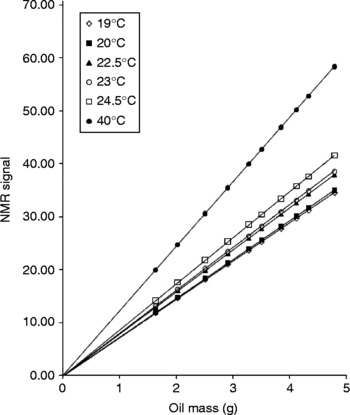
To survey the oil content, available seeds in the entire USDA collection were obtained from two locations: 364 accessions from the USDA–ARS, Plant Genetic Resources Conservation Unit, Griffin, GA, USA and 669 accessions from the USDA–ARS, National Center for Genetic Resources Preservation, Fort Collins, CO, USA. The oil content was measured using a Minispec mq10 nuclear magnetic resonance (NMR) analyzer (Bruker Optics Inc., Houston, TX, USA). All accessions were measured in triplicate (25 seeds for each replication) to verify the precision of the NMR signal. The castor oil content was averaged from three replications. The NMR analyzer was operated at a resonance frequency of 9.95 MHz and was maintained at 40°C. Our preliminary experimental results indicated that even small differences in sample temperature can have a substantial effect on the NMR signal of castor oil (Fig. 1). To avoid the effects of temperature fluctuations on samples, all samples were tempered to 40°C for 90 min before measurements. In addition to oil content, 100-seed weight and seed-coat colour were also recorded. For data analysis, an analysis of variance was performed and means were separated using Tukey's multiple comparison procedure.
Effect of temperature on nuclear magnetic resonance (NMR) signals.

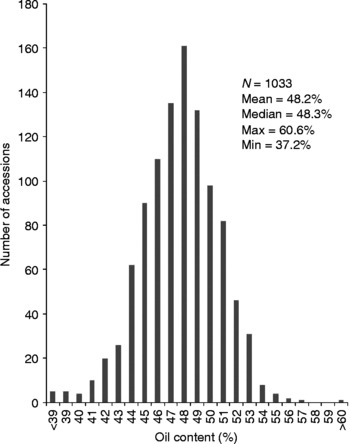
The results for oil content, 100-seed weight, seed-coat colour and country of origin were listed in Supplementary Table S1 (available online only at http://journals.cambridge.org). The oil content of castor in the USDA collection ranged from 37.2 to 60.6% with an average of 48.2%. Tukey's studentized range (honestly significant differences (HSD)) test for oil content was 0.5927%. The variation range and sample distribution of oil content generally formed a normal distribution (Fig. 2). Most of the samples had an oil content averaging 48%. Only five samples (NSL 86 416, PI 167238, PI 250573, PI 384013 and PI 274773) had extremely low oil content ( < 39%) and two samples (NSL 15 621 and PI 240673) had extremely high oil content (>57%). These accessions would be useful breeding materials for developing high or low oil content castor cultivars. A significant variation for 100-seed weight was detected in the collection, ranging from 10.1 to 73.3 g with an average of 28.3 g. Tukey's Studentized Range (HSD) test for 100-seed weight was 7.41 g (Table S1). There was a significant correlation between seed weight and oil content but the correlation value was low (r = 0.1572, P < 0.0001).
The range and sample distribution of oil content in the entire United States Department of Agriculture castor germplasm collection.

Discussion
Our results for oil content were similar with a previous published report (da Siliva Ramos et al., Reference da Siliva Ramos, Tango, Savi and Lea1984). They reported oil content ranging from 39.6 to 59.5% with an average of 51.6%. The slight difference between these two reports may come from the number of samples tested and the location of samples collected. In their study, only 36 samples were surveyed but the samples were harvested from the same location in the same year. In our study, 1033 samples were surveyed; however, the samples were harvested from different locations in different years. We suggest that a wider range of oil content variation (37.2–60.6%) among castor accessions in our study occurred because more number of accessions were surveyed. In addition, the correlation between seed weight and oil content with a low value was shown statistically significant (r = 0.1572, P < 0.0001). This was also due to more number of accessions being surveyed in our study.
Our preliminary results indicate that significant variability in oil content and 100-seed weight has been detected among accessions within the USDA castor germplasm collection. Thus, using the accessions identified in this study with high oil content in breeding programmes may help breeders to develop high oil castor cultivars for biodiesel production.
Acknowledgements
The authors thank Brandon Tonnis and Jessica Norris for their excellent assistance with the oil content analysis.