Introduction
Demographic surveys in developing countries provide useful information on the reproductive history and health status of large numbers of women. Analyses of birth history data have provided insights such as the importance of maternal education, birth spacing, antenatal care and demographic composition of households for child mortality (e.g. Hobcraft et al., Reference Hobcraft, McDonald and Rutstein1983; Cleland & Sathar, Reference Cleland and Sathar1984; Muhuri & Preston, 1991; Bhargava, Reference Muhuri and Preston2003). While children born to undernourished mothers are likely to face higher mortality, utilization of health care services has lowered child mortality in most developing countries (United Nations, 2009). In future research, the determinants of health and nutritional status of the surviving children merit closer attention. Utilization of health care services by pregnant women and postnatal care such as child vaccinations are likely to reduce morbidity and enhance child health indicators such as height, weight and haemoglobin concentration. Such indicators, in turn, influence children's cognitive development and hence the future supply of skilled labour that is critical for economic growth (Bhargava et al., Reference Bhargava, Bouis and Scrimshaw2001a).
A major advantage of demographic surveys is the diverse socioeconomic and health information compiled on large numbers of households. However, the limited resources for surveys can introduce higher degrees of approximations in measurement of variables. While epidemiological studies gather accurate health information, the scope of analyses is hampered by small sample sizes, especially in randomized controlled trials settings. By contrast, demographic surveys can shed light on a range of issues though the information needs to be meticulously processed. For example, the National Family Health Survey-3 (NFHS-3) in India (International Institute for Population Sciences, 2007) compiled information on food consumption patterns by inquiring how frequently mothers consumed seven broad food groups. The responses can be processed in the spirit of nutrition research for assessing diet quality (e.g. Willett, 1998).
Further, while the estimated parameters from logistic and probit models for child mortality quantify the effects of demographic, socioeconomic and health care variables, the causes of deaths are seldom recorded with precision in developing countries. Moreover, subtle factors such as worse access to health care services for ‘unwanted’ female children born at high birth orders can exacerbate child mortality (Bhargava, Reference Bhargava2003). By contrast, models for children's height, weight and haemoglobin concentration provide direct information. In spite of such advantages, methodological issues arise in the estimation of models for child health from demographic surveys. For example, haemoglobin concentration is affected by intake of ‘bioavailable’ iron, which depends on interactions between iron and nutrients such as ascorbic acid in the meal (Monsen et al., Reference Monsen, Hallberg, Layrisse, Hegstead, Cook, Mertz and Finch1978; Bhargava et al., Reference Bhargava, Jamison, Lau and Murray2001b). While information on food consumption patterns in the NFHS-3 cannot afford assessment of bioavailable iron intakes, the surveys inquired if mothers and children received medications against intestinal parasites, which are ubiquitous in India due to poor sanitation. Thus, modelling the NFHS-3 data on haemoglobin concentration, taking into account measures of diet quality and iron loss, can provide useful insights.
In a recent analysis of the NFHS-3 data, Subramanian et al. (Reference Subramanian, Ackerson, Smith and John2009) found that children of taller mothers had significantly lower chances of infant mortality and experienced lower ‘stunting’ (height-for-age) and ‘wasting’ (weight-for-age). While women's height is a proxy for socioeconomic factors and can be influenced in a long time frame via food supplementation programmes for girls, the authors largely ignored the role played by health care services in improving child health. Thus, for example, infant (under 1 year) mortality in the state of Kerala was 15.3 (per 1000 live births), where 99.3% of women delivered babies in health facilities. By contrast, in the ‘backward’ state of Rajasthan, despite the fact that mothers were on average a centimetre taller, only 41% of women delivered babies in health facilities and infant mortality rate was 65.3, i.e. it was four times higher. It is important to take into account variables reflecting public and private health care utilization and maternal health status for modelling child health indicators. Moreover, height and weight are inter-related (Ehrenberg, Reference Ehrenberg1968; Cole, Reference Cole and Himes1991; Kronmal, Reference Kronmal1993) and it is important to test if they can be combined as the body mass index (BMI is weight in kilograms divided by square of height in metres; Bhargava, Reference Bhargava1994).
This paper presents a comprehensive analysis of the data from NFHS-3 on height, weight and haemoglobin concentration for over 25,000 Indian children. Methodological aspects are tackled and emphasis is placed on jointly addressing demographic, biological, socioeconomic and statistical aspects. Several indices were computed to reflect health care received by women and children in public and/or private health care facilities and for child vaccinations against diphtheria, pertussis and tetanus (DPT) and polio. The analytical framework underlying the models for children's height, weight and haemoglobin concentration is developed and implications of the findings for public policies are discussed.
Methods
The NFHS-3 data from India
The NFHS-3 was a multi-stage stratified survey in 29 Indian states and covered 124,385 women with a response rate of 94.5% (International Institute of Population Sciences, 2007). Height, weight and haemoglobin concentration were measured for up to 51,555 children who were under 5 years of age and for their mothers. Weight was measured using electronic scales that were accurate to 100 g; height was measured using adjustable measuring boards. Haemoglobin concentration was measured by analysing two drops of capillary blood via photometers. Due to missing observations and outliers, height and weight data were available on 43,492 children, and haemoglobin concentration was measured for 35,759 children.
The NFHS-3 survey compiled several variables such as age of the mother, birth history, access to and utilization of health care and family planning services in public and private facilities, indicators of female empowerment, household possessions and food consumption patterns. Several indices were created to capture the salient features of the socioeconomic circumstances. The index of household possessions was based on seventeen items: if the household had electricity, mattress, pressure cooker, chair, bed, table, electric fan, sewing machine, radio, black and white television, colour television, refrigerator, bicycle, scooter, car and computer. The (0–1) responses were summed and this index ranged from 0 to 17. The Chronbach (1984) alphas showed high reliability of the indices; alpha was 0.80 for the household possession index.
Another index reflecting difficulties in getting medical help was based on eight items: if mothers had difficulties in getting permission, getting money, reaching the health facility, having to take transport, not wanting to go alone, were concerned that no female health providers were available, were concerned that no health providers were available, and were concerned that no drugs were available. The responses were coded as zero if there was no problem, 1 if it was ‘not a big problem’, and 2 if it was a ‘big problem’; this index ranged from 0 to 16.
Further, mothers were asked about the number of children after whose birth they started using family planning, and the categorical responses were recorded from 0 to 5, with zero representing before any children were born, and 5 for after five or more children. The mothers were asked six questions regarding their reasons for not utilizing government health facilities: no nearby facility, facility times inconvenient, health personnel unavailable, waiting time too long, poor quality of services, and other. The responses were summed and this index ranged from 0 to 6, with higher values reflecting greater inadequacies. The mothers were asked if they received drugs against intestinal parasites such as hookworm.
The food consumption patterns of mothers were investigated by asking how frequently they consumed seven food groups: milk or curd, pulses or beans, dark green leafy vegetables, fruits, eggs, fish and meat. The responses were coded as never, once a month, once a week, and daily, and were processed in the spirit of nutrition research. For example, a mother consuming all seven foods daily would have the score 210 for the month. The index of food consumption for children was based on (0–1) responses for consumption of 23 food groups: if mothers gave them juice, tea or coffee, fresh or tinned milk, baby formula, baby cereals, porridge or gruel, chicken, meat, foods made from lentils, nuts, bread or noodles, potatoes or tubers, eggs, pumpkin or squash, dark green leafy vegetables, mangoes or papayas, other fruits and vegetables, liver, fresh or dried fish, foods made from nuts, cheese or milk products, oil or fat products, and other semi-solid foods. The responses were summed and the children's food consumption index ranged from 0 to 23.
For the children, age was recorded in months and the numbers of DPT and polio injections were recorded from vaccination cards or as reported by the mothers; it was also inquired if the children received vaccination against measles. Mothers were asked if children received drugs against intestinal parasites in the last 6 months. The preceding birth interval was calculated for children; for the first born, birth interval was set equal to the number of months between marriage and the child's birth. Also, children's birth order and numbers of surviving older brothers and sisters were computed.
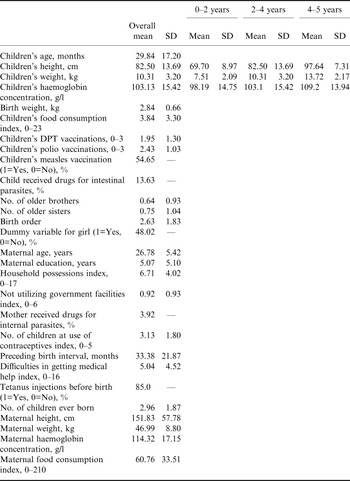
The sample means and standard deviations of selected variables from the NFHS-3 data are presented in Table 1. The average age of the children was 30 months. The means of children's height, weight and haemoglobin concentration are reported for age groups 0–2, 2–4 and 4–5 years. There was a significant increase in haemoglobin concentration with age, as documented in previous studies among well-nourished populations (Dallman & Siimes, Reference Dallman and Siimes1979). The mean reported birth weight was 2.85 kg. The mean of numbers of DPT and polio vaccinations were 1.95, and 2.43, respectively. Approximately 55% of the children were vaccinated against measles, and 14% received drugs against intestinal parasites. The mean birth order was 2.63 and mean numbers of older brothers and sisters were 0.64 and 0.75, respectively; the mean of food consumption index was 3.84.
Sample means and standard deviations of variables from NFHS-3a

a There were 51,555 children in the sample; different numbers of observations were used to compute means of the variables.
The mean age of the mother was 27 years and mean number of children born was 2.96; the mean maternal education was 5 years. The mean of the index for not utilizing government health facilities was 0.92, and approximately 4% of mothers received drugs against intestinal parasites. The mean preceding birth interval was 33 months and mean number of children before family planning was used was approximately three. The mean of the index for difficulties in getting medical help was 5, reflecting poor access; the mean for maternal food consumption index was 60.8. The mean haemoglobin concentration was 114.3 g/l, and the distribution showed wide prevalence of anaemia (haemoglobin <120) in this population.
Modelling the determinants of children's height, weight and haemoglobin concentration
The empirical models for child mortality estimated using demographic data from developing countries have provided insights such as the importance of public and private health care infrastructure for reducing mortality (e.g. Bhargava et al., Reference Bhargava, Chowdhury and Singh2005). However, nutritional status of surviving children, reflected in anthropometric measures and haemoglobin concentration, remains poor in countries such as India. While interventions for improving nutritional status require a long time frame, infections and nutrient loss can be reduced via timely interventions such as vaccinations. The diverse sets of variables compiled in demographic surveys are useful for modelling the proximate determinants of child health.
The comprehensive empirical models for children's height, weight and haemoglobin concentration using NFHS-3 data tackled several conceptual and methodological aspects. The models take into account explanatory variables such as maternal nutritional status (Dangour et al., Reference Dangour, Hill and Ismail2002), birth intervals (Dewey & Cohen, Reference Dewey and Cohen2007) and dietary patterns (Tengco et al., Reference Tengco, Rayco-Solon, Solon, Sarol and Solon2008). Further, it is useful to examine the effects of maternal nutritional status on child health indicators. The emphasis on maternal heights (Subramanian et al., Reference Subramanian, Ackerson, Smith and John2009) is useful since height reflects socioeconomic factors. However, it is important to include indicators of current maternal nutritional status such as weight and haemoglobin concentration. Because weight can be predicted by height (Ehrenberg, Reference Ehrenberg1968; Cole, Reference Cole and Himes1991), ignoring the inter-dependence between anthropometric measures can lead to anomalous results (see below). However, unobserved factors affecting height may be correlated with errors on models for weight so that it is necessary to employ instrumental variables or maximum likelihood estimators for the estimation of parameters.
The empirical models
The model for heights of N children in the sample is given by:

The model in eqn (1) controlled for children's ages and gender. The numbers of older brothers and sisters were included to investigate differential effects of older siblings on health status of younger siblings. Non-linearities were postulated with respect to household possessions index, which was based on seventeen items. The numbers of DPT and polio vaccination doses were included in the model, whereas the variable for measles vaccinations was a (0–1) dummy variable. Maternal height, weight and haemoglobin concentration were included to account for genetic and other factors such as diet quality affecting children's heights. However, these variables were dropped in Specification 2 (Table 2), partly to investigate the possible underlying correlations between the errors (u 1i) and these variables; joint significance of maternal variables was also tested. Dummy variables for Indian states were included in some of the models though multi-level models were not estimated because endogeneity issues were tackled.
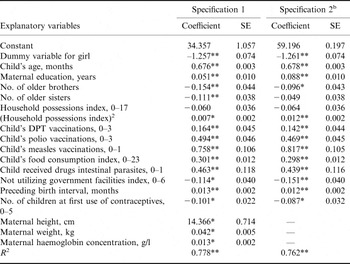
Estimated parameters from models for children's heights using the NFHS-3 dataa
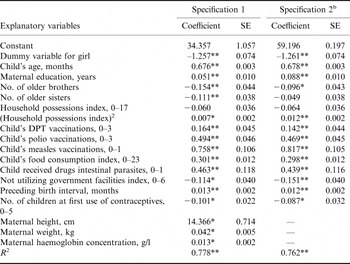
a There were 26,985 children in the sample.
b Specification 2 dropped the maternal anthropometric indicators and haemoglobin concentration from the model.
* p<0.05;
** p<0.01.
Models similar to eqn (1) were estimated for children's weight and haemoglobin concentration. In the model for weight (Table 3), Specifications 2 included height as an exogenous explanatory variable; height was treated as an endogenous explanatory variable in Specification 3 since unobserved factors affecting height could be correlated with the errors u 1i. Moreover, the null hypothesis that height and weight can be combined as the BMI was tested.
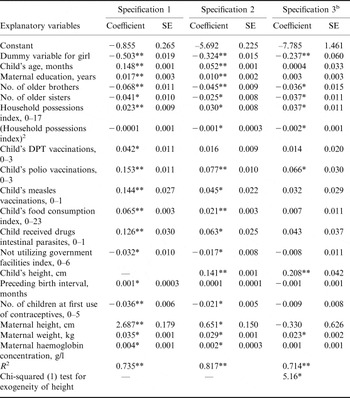
Estimated parameters from models for children's weight using the NFHS-3 dataa

a There were 27,198 children in the sample.
b Specification 3 treated child height as an endogenous variable.
* p<0.05;
** p<0.01.
Statistical and econometric issues
The methodological issues addressed in the analyses are the endogeneity of explanatory variables and testing of restrictions on parameters for combining height and weight as the BMI. First, in the model for children's weight, height is an important explanatory variable though it could be correlated with errors affecting the models; unobserved variables including genetic factors can induce correlations between height and errors on the models for weight. Such correlations vitiate consistency properties of ordinary least squares (OLS) estimators and it is necessary to use instrumental variables or maximum likelihood estimators that require the instruments to be highly correlated with endogenous explanatory variables (Sargan, Reference Sargan1958). The exogeneity hypotheses were tested using chi-squared statistics, which are asymptotically equivalent to Lagrange multiplier tests (Rao, Reference Rao1948) and are available in packages (e.g. Stata, 2008).
The second sets of methodological issues arise in testing the restrictions on coefficients of height and weight for combining them as the BMI. It is known that children's linear growth in developing countries is compromised so that measures such as BMI may over-state nutritional status (Martorell & Habicht, Reference Martorell, Habicht, Falkner and Tanner1986). Also, conversion of variables into ratio forms can induce spurious correlations (Pearson, Reference Pearson1897; Kronmal, Reference Kronmal1993). In the model for children's height in eqn (1) with maternal height and weight expressed in natural logarithms, the null hypothesis that maternal height and weight can be combined as BMI translates into the restrictions (Bhargava, Reference Bhargava1994):

If the null hypothesis cannot be rejected using the test statistic that is distributed for large N as a chi-squared variable with one degree of freedom, then maternal height and weight can be combined as the BMI. If, however, the null were rejected, then the use of maternal BMI can lead to misleading inferences.
Results
Empirical results from models for children's heights using the NFHS-3 data
Table 2 presents the results from two versions of the model for children's heights. Specification 1 included all the explanatory variables, whereas Specification 2 dropped maternal height, weight and haemoglobin concentration from the model. First focusing on Specification 1, girls were significantly shorter than boys (p<0.01), and children's age and maternal education were positively and significantly associated with height. Second, the numbers of older brothers and sisters variables were estimated with negative coefficients that were statistically significant. Coefficients of the older brother variable were generally larger in magnitude, though the differences were not statistically significant.
Third, there were non-linearities apparent with respect to household possession index, though only the coefficient of the squared term was significant. More importantly, children's vaccinations against DPT, polio and measles were estimated with positive coefficients that were statistically significant. The benefits of vaccination for child growth have seldom been reported in demographic analyses (see the Discussion), though it is known in the nutritional literature that vaccinations enhance immune systems, thereby reducing nutrient loss (Scrimshaw et al., Reference Scrimshaw, Taylor and Gordon1959). Fourth, children's food consumption index was estimated with positive and significant coefficients showing beneficial effects of diversified diets. Coefficients of the indicator variable for whether children received drugs against intestinal parasites were positive and significant. Reduction in intestinal parasites is likely to improve children's iron status and can be viewed as an increase in bioavailable iron intake, which is beneficial for growth.
Fifth, mothers not utilizing government health facilities were likely to have children that were significantly shorter. Moreover, preceding birth interval was a positive and significant predictor of height. Also, delaying the use of family planning services was negatively associated with children's heights. Sixth, maternal height, weight and haemoglobin concentration were estimated with positive and significant coefficients. While certain genetic factors are common to mothers and children, dietary patterns reflected in maternal weight and haemoglobin concentration were also likely to play an important role in promoting children's linear growth.
Finally, the results were very similar in Specification 2, where maternal height, weight and haemoglobin concentration were dropped from the model partly to circumvent the problem of possible correlations between errors affecting children's heights and the maternal variables. While a likelihood ratio test rejected the null hypothesis that the coefficients of maternal variables were zero, the estimated coefficients of the remaining variables were similar in Specifications 1 and 2. These results also suggest that multi-collinearity was not a problem in these models since magnitudes of the standard errors in the two specifications were similar despite the omission of maternal variables in Specification 2.
Results for children's weight
The results for children's body weight are presented in Table 3 for three specifications: children's height was excluded from Specification 1, height was included in Specification 2 as an exogenous variable, and height was treated as an endogenous variable in Specification 3. The results for weight were similar to those for children's height in Table 2. For example, girls were significantly lighter than boys, and maternal education and children's age were positive and significant predictors. Coefficients of the numbers of older brothers and sisters variables were negative and significant; vaccinations against DPT, polio and measles were estimated with positive and significant coefficients. Children's food consumption index and the dummy variable for treatment against intestinal parasites were significantly positively associated with weight. The coefficient of the index for not utilizing government facilities was negative and significant. In Specification 2, children's height was included in the model and its estimated coefficient (0.14) was significant. Height was treated as an endogenous variable in Specification 3 and the estimated coefficients increased to 0.21, and so did its standard error (from 0.001 to 0.004). Instrumental variables such as indices reflecting antenatal health care utilization and the maternal food consumption index were used in the estimation; the chi-squared exogeneity test statistic was 5.16 and it rejected the null hypothesis, indicating that height should be treated as an endogenous variable, as in Specification 3. However, the estimated standard errors were larger in Specification 3, and some of the explanatory variables were not statistically significant. Another index of food consumption based on seven food groups (milk, chicken, other meat, eggs, liver, fish and cheese) was added to the set of instrumental variables since these were likely to be more strongly correlated with height; food consumption index based on the remaining sixteen food groups was included in the model for weight. The results from this specification had lower standard errors, though the statistical significance of coefficients was unchanged.
Finally, the children's BMI was also modelled. However, the chi-squared test for combining height and weight as the BMI was 3713.11 and strongly rejected the null hypothesis. The coefficients from this model were not included in Table 3, partly because the invalid BMI restrictions led to changes in signs of some coefficients. Overall, the models for weight that included height as an exogenous or endogenous explanatory variable yielded similar results so that the underlying correlations between children's height and errors affecting the model for weight appear to have induced small biases.
Results for children's haemoglobin concentration
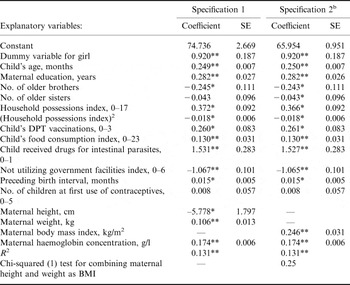
The results for children's haemoglobin concentration are presented in Table 4 for two specifications; in Specification 2, maternal height and weight were combined as the BMI. The salient findings were, first, in contrast with the height and weight variables, girls had significantly higher haemoglobin concentration than boys. The haemoglobin concentration of girls in well-nourished populations is higher than that of boys, but exhibits a decline around the age of 10 years, presumably due to puberty (Dallman & Siimes, Reference Dallman and Siimes1979). The haemoglobin concentration of girls in this Indian population was likely to show even a greater decline around puberty due to poor diet quality and intestinal parasite infections.
Estimated parameters from models for children's haemoglobin concentration using the NFHS-3 dataa

a There were 23,441 children in the sample.
b Specification 2 combined maternal height and weight as the body mass index.
* p<0.05;
** p<0.01.
Second, coefficients of number of older brothers and sisters were negative and significant in both specifications. However, the null hypothesis that older brothers and sisters had the same coefficient was rejected; older sisters can help in food preparation and improve cleanliness, which reduces bacterial transmission and blood loss. Third, children's food consumption index and dummy variable for treatment against intestinal parasites were estimated with positive and significant coefficients in both specifications. Coefficients of the index for not utilizing government facilities were negative and statistically significant.
Fourth, the coefficient of maternal height was negative and significant in Specification 1, whereas the coefficient of maternal weight was positive and significant. While one would expect taller mothers to be well-nourished with higher haemoglobin concentration, maternal BMI reflects the current nutritional status. The chi-squared test statistic for combining maternal height and weight as BMI in Specification 2 was 0.25 and it accepted the null hypothesis. This test outcome was plausible and maternal BMI was a positive and significant predictor of children's haemoglobin concentration in Specification 2. Coefficients of maternal haemoglobin concentration were positive and significant in both specifications. Finally, the overall fit of the models reflected in R 2 was worse for children's haemoglobin concentration than in the models for heights and weights, presumably because haemoglobin concentration exhibits greater variation.
Discussion
This paper analyses in detail the effects of demographic, socioeconomic and health care variables on the child health indicators height, weight and haemoglobin concentration using data from the NFHS-3 in India. Because demographic surveys cover large numbers of women and children, the analyses provide useful insights, though it is essential to process the variables and employ appropriate statistical methods. The main findings can be summarized as follows. First, the models for children's height, weight and haemoglobin concentration showed that vaccinations against DPT, polio and measles were significant predictors. However, the average child received 1.95 doses of DPT and 2.43 doses of polio vaccinations, and 45% of the children were not vaccinated against measles, underscoring the need for expanding immunization coverage for Indian children. Moreover, timely vaccinations may also be important though such issues could not be addressed using the NFHS-3 data.
Second, treatment against intestinal parasites and children's food consumption patterns were beneficial for children's height, weight and haemoglobin concentration. Using the estimates from the model for weight for illustrative purposes, children who were vaccinated against measles weighed an additional 0.14 kg, and those receiving treatment against intestinal parasites were heavier by 0.13 kg. In addition, the elasticities (percentage change in the dependent variable resulting from a 1% change in an independent variable) of children's weight with respect to DPT and polio vaccinations computed at the means were 0.01 and 0.04, respectively. Thus, if a child had the measles vaccination, received anthelmintic treatment, and had all three doses of DPT and polio vaccinations, then the model predicted that the child would be heavier by 0.29 kg than children without the treatments. Thus, comprehensive health policies are essential for improving child health outcomes in India.
Third, several methodological aspects were addressed and children's heights were treated as endogenous variables in the models for weight. Moreover, transformation of height and weight as the BMI was found to be inappropriate for children, though not for mothers in the model for children's haemoglobin concentration. The results underscored the need for addressing biological, socioeconomic and statistical aspects in the formulation of empirical models. Fourth, from a policy standpoint, maternal height, weight and haemoglobin concentration were important predictors of children's anthropometric indicators and haemoglobin concentration. Thus, for example, iron supplementation programmes for pregnant women in India are likely to be beneficial. In addition, removal of intestinal parasites would be helpful since diets containing high quantities of bioavailable iron are often unaffordable for poor households. Although intestinal parasitic infections can be reduced via treatment of sewage, the associated costs are often beyond the budgets of local governments. By contrast, the costs of removing intestinal parasites via chemotherapy are low (less than one dollar per annum per individual) and such treatments should be widely available for improving maternal and child health in India.
Finally, an effort is underway in India to increase the uptake of health care services by women in rural areas (e.g. Peters et al., Reference Peters, Yazbeck, Sharma, Ramana, Pritchett and Wagstaff2002; National Health Rural Mission, 2008); certain schemes pay pregnant women to deliver babies in public health care facilities. Such programmes, together with iron supplementation and removal of intestinal parasites, should be available to all women, especially in the backward Indian states. The southern states such as Tamil Nadu and Kerala have expanded health care for rural populations, thereby achieving better health outcomes. Because of the inter-dependence in the quality of health care services in public and private facilities (Bhargava et al., Reference Bhargava, Chowdhury and Singh2005), investments in public health care are likely to be beneficial for improving child health that is critical for economic development.
Acknowledgments
While retaining the responsibility for the views presented in this paper, the authors thank the Research Committee of the World Bank for supporting these analyses, and the referee and, especially, the Editor for helpful comments.