INTRODUCTION
The relationship between age of onset and second language (L2) attainment has been one of the most widely explored issues in the second language acquisition (SLA) literature. Beginning from studies that looked into age effects on immigrants, or naturalistic learners (e.g., Johnson & Newport, Reference Johnson and Newport1989), the scope of research has extended to other learner populations, including those in L2 immersion programs (e.g., Swain, Reference Swain2000) and classroom learners in foreign language learning contexts (e.g., García Mayo & García Lecumberri, Reference García Mayo and García Lecumberri2003). Taken together, the different patterns found in these age-related studies (Abrahamsson & Hyltenstam, Reference Abrahamsson and Hyltenstam2008, Reference Abrahamsson and Hyltenstam2009; Al-Thubaiti, Reference Al-Thubaiti2010; Cenoz, Reference Cenoz, García Mayo and García Lecumberri2003; DeKeyser, Reference DeKeyser2000; Flege et al., Reference Flege, Yeni-Komshian and Liu1999; García Mayo & García Lecumberri, Reference García Mayo and García Lecumberri2003; Granena & Long, Reference Granena and Long2013; Huang, Reference Huang2016; Johnson & Newport, Reference Johnson and Newport1989; Larson-Hall, Reference Larson-Hall2008; McDonald, Reference McDonald2000; Muñoz, Reference Muñoz and Muñoz2006, Reference Muñoz2008, Reference Muñoz2011; Muñoz & Singleton, Reference Muñoz and Singleton2011; Patkowski, Reference Patkowski1980; Singleton & Ryan, Reference Singleton and Ryan2004) have suggested that the potential advantage of an early start in learning another language can differ according to context; in cases in which there is maximal naturalistic input, early learners tend to outperform later ones, while the opposite pattern is observed in cases in which there is minimal exposure to the target language.
Based on the empirical findings on age effects on L2 acquisition in different environments, many countries have implemented educational policies to maximize the learning opportunity for learners in their specific context, such as lowering the age at which English becomes a mandatory subject in school in East Asian countries (Butler, Reference Butler2015; Enever, Reference Enever2018). With the growing importance of learning English, a global language, primary and preprimary English education is gaining popularity worldwide, including Asia and Latin America (Enever, Reference Enever2018). One of the more recent trends found in these foreign language learning settings is the emerging population of children who attend private educational programs that provide partially immersive learning experiences, an example being English kindergartens in South Korea. These differ from full immersion programs in Canada, which are well integrated into the state educational system (e.g., Lambert & Tucker, Reference Lambert and Tucker1972). In Korea and elsewhere, immersion learners typically experience a sharp discontinuity after the immersion experience as they transition into regular classrooms at school. The learners are suddenly situated in a different learning environment where there is significantly reduced amount of input and less opportunity to use and develop the target language, in addition to being surrounded by peers who have had less, or no, prior L2 exposure (Long, Reference Long, Granena and Long2013).
Despite the rising popularity of early partial immersion programs, to the author’s knowledge, no empirical research has yet examined whether such short, discontinuous experience of immersion in childhood can yield significant long-term benefits. The present study explores this issue by comparing L2 English morpho-syntactic sensitivity among Korean college students who attended an English kindergarten before age 6 and those who began learning English in regular classrooms later, usually at age 8. By observing their ability to detect morpho-syntactic errors in online listening, the study investigates whether limited experience of immersion in early childhood can benefit ultimate L2 attainment.
LITERATURE REVIEW
AGE OF ONSET IN DIFFERENT LEARNING CONTEXTS
Earlier studies on the effect of starting age, or age of onset, on L2 acquisition were mainly focused on the case of immigrants acquiring the target language naturalistically in an environment where continuous, rich input is usually available (Abrahamsson & Hyltenstam, Reference Abrahamsson and Hyltenstam2008, Reference Abrahamsson and Hyltenstam2009; DeKeyser, Reference DeKeyser2000; Flege et al., Reference Flege, Yeni-Komshian and Liu1999; Granena & Long, Reference Granena and Long2013; Johnson & Newport, Reference Johnson and Newport1989; McDonald, Reference McDonald2000; Patkowski, Reference Patkowski1980). The majority of these studies consistently found a negative correlation between age of arrival and ultimate attainment (but cf. Birdsong & Molis, Reference Birdsong and Molis2001; White & Genesee, Reference White and Genesee1996). The most well-known example is Johnson and Newport’s (Reference Johnson and Newport1989) study, which found that Korean and Chinese immigrants who arrived in the United States at a younger age scored higher on a grammaticality judgment task (GJT) than later arrivals. Following that seminal work, numerous studies have produced similar results with Hungarian (DeKeyser, Reference DeKeyser2000), Korean (Flege et al., Reference Flege, Yeni-Komshian and Liu1999), and Spanish (Granena & Long, Reference Granena and Long2013) immigrants. Although different theoretical proposals have been put forth to explain the advantage of an early start, such as maturational constraints (e.g., Long, Reference Long1990), the “less-is-more” hypothesis (e.g., Newport, Reference Newport1990), and the Fundamental Difference Hypothesis (e.g., Bley-Vroman, Reference Bley-Vroman1990), the general consistency in finding early starters outperforming later ones on various measures of L2 attainment has led most people to accept “the younger, the better” notion in understanding the role of age in SLA.
When it comes to a different learning context, however, this inverse relationship between age of onset and L2 attainment does not seem to hold. Classroom learners, or instructed learners, refer to those in a foreign language learning environment who typically receive classroom instruction for a few hours a week and have minimal exposure to naturalistic input and little opportunity to use the language outside the classroom (Muñoz, Reference Muñoz2008). Studies exploring age effects with these learners often reveal the opposite pattern to the one seen with naturalistic learners: older starters outperform younger ones (Al-Thubaiti, Reference Al-Thubaiti2010; Cenoz, Reference Cenoz, García Mayo and García Lecumberri2003; García Mayo & García Lecumberri, Reference García Mayo and García Lecumberri2003; Huang, Reference Huang2016; Muñoz, Reference Muñoz and Muñoz2006, Reference Muñoz2008, Reference Muñoz2011; Muñoz & Singleton, Reference Muñoz and Singleton2011; Singleton & Ryan, Reference Singleton and Ryan2004; but cf. Larson-Hall, Reference Larson-Hall2008). Typically, these studies compare learners who began receiving formal L2 instruction early (e.g., age 8) against those who began later (e.g., age 11) by testing their proficiency after comparable hours of instruction (e.g., Muñoz, Reference Muñoz and Muñoz2006), and tend to find older learners surpassing the younger ones on various L2 measures. One possible explanation is that older learners have a superior ability to understand explicit linguistic rules, which can maximize at least short-term gains in a classroom context (DeKeyser, Reference DeKeyser2013). Unlike adults, children rely on implicit learning mechanisms, for which input quality and quantity may be more crucial in developing L2 knowledge (DeKeyser, Reference DeKeyser2000). This is supported by the results of Qureshi’s (Reference Qureshi2016) meta-analysis of 46 samples coming from 26 studies that examined the relationship between age of onset and L2 morpho-syntactic acquisition; while a medium-to-large effect size of the age effect was found with naturalistic learners, the difference between early and late starters in foreign language learning contexts did not produce a reliable effect. The author concluded that “the potential beneficial effects of an early start might be present only in contexts where L2 learners are completely immersed in the target language context” (Qureshi, Reference Qureshi2016, p. 158). Based on these findings, it can be argued that having limited input and minimal opportunity to use the L2 can create an adverse setting for young learners to take advantage of their earlier start, while a rich-input, immersive environment can be most supportive (Muñoz, Reference Muñoz and Muñoz2006, Reference Muñoz2011; Muñoz & Singleton, Reference Muñoz and Singleton2011; Qureshi, Reference Qureshi2016).
EARLY LEARNERS IN L2 IMMERSION
Learners in immersion programs are unique in that they receive much more input than regular classroom learners, yet they are not as entirely immersed in an L2-speaking context because the target language may not be used outside program hours. This makes the extent to which partially immersive experience at a young age can yield benefits in language development a theoretically interesting and practically important issue to explore.
Research on L2 immersion began with evaluations of French immersion in Canada (e.g., Lambert & Tucker, Reference Lambert and Tucker1972), and more recently has extended to investigations of early English immersion programs in East Asia, typically showing immersion learners outperforming nonimmersion learners with minimal costs for L1 development (e.g., Li et al., Reference Li, Shu, McBride-Chang, Liu and Peng2012). Yet, most studies have focused on measures of phonological awareness following immersion in primary school (Butler, Reference Butler2015), with very few examining other language domains or younger populations like preschool to kindergarten-aged learners, who are theoretically the ones most likely to benefit from the immersion experience.
In a recent study, Bergström et al. (Reference Bergström, Klatte, Steinbrink and Lachmann2016) assessed German children’s receptive English grammar over the course of years in a kindergarten English immersion program and discovered that the immersion learners scored higher than their nonimmersion peers in posttests of receptive vocabulary knowledge and use. Similar outcomes were found by Knell et al. (Reference Knell, Haiyan, Miao, Yanping, Siegel, Lin and Wei2007), where Chinese children in early English immersion programs (kindergarten to grade 3) surpassed regular classroom learners on measures of English vocabulary, word identification, and oral proficiency (also see Cheng et al., Reference Cheng, Li, Kirby, Qiang and Wade-Woolley2010). Further positive outcomes were reported for the ELIAS (Early Language and Intercultural Acquisition Studies) project, a two-year implementation of preschool immersion programs in four European countries (for a report, see Kersten, Reference Kersten2010). One of the important observations was that input quality (i.e., how much rich and continuous input was available during immersion) correlated with learners’ receptive grammar growth (Weitz et al., Reference Weitz, Pahl, Flyman Mattsson, Buyl and Kalbe2010). This not only highlights the potential benefit of learning an L2 in a partially immersive setting but also reinforces the idea that type of input plays a significant role in determining how supportive a particular context can be for early learners (Flege, Reference Flege2018; Foster et al., Reference Foster, Bolibaugh and Kotula2014). Foster et al. (Reference Foster, Bolibaugh and Kotula2014) demonstrated that an early start in immersive learning led to the most nativelike performance on a task that involved choosing word combinations. They suggested that the appropriate combination of age of onset and context of learning is the most reliable factor in predicting success in ultimate L2 attainment. According to these studies, early immersion programs seem to foster advantages in terms of L2 development when compared against regular classroom learners.
There are several caveats, however. One critical gap in the current literature on early immersion is that its long-term benefits are unknown. Most, if not all, relevant studies measured L2 performances when the learners were still in the early stages of L2 development (e.g., Bergström et al., Reference Bergström, Klatte, Steinbrink and Lachmann2016; Kersten, Reference Kersten2010; Knell et al., Reference Knell, Haiyan, Miao, Yanping, Siegel, Lin and Wei2007). Tests were administered during or immediately following the few years of immersion, and it is unclear whether positive gains can last longer than the initial apparent success or whether they can affect ultimate attainment (Buysse et al., Reference Buysse, Peisner-Feinberg, Páez, Hammer and Knowles2014). Another significant limitation is that the current literature does not account for an emerging population of L2 learners in a context with rather limited input, including learners in East Asia learning English as a foreign language (EFL). Typically, these learners would be classified as classroom learners who begin learning the language through formal L2 instruction at school. However, with increasing demands for attaining native-like proficiency in English, there are now countless private programs that provide English education from a younger age, a representative example being English-only kindergartens in South Korea (Song & Cheng, Reference Song and Cheng2011). These early partial immersion programs have gained immense popularity in recent years, as parents are willing to invest considerable amounts of money and time to provide their children a head start in learning English. Unlike the full immersion curriculum in Canada and some European countries, where the educational system supports continuous immersion throughout primary and secondary school (Kersten, Reference Kersten2010; Weitz et al., Reference Weitz, Pahl, Flyman Mattsson, Buyl and Kalbe2010), early immersion in the EFL context is typically followed by an abrupt switch to formal instruction when the children enter elementary school. The discontinuity in the type of learning experience that arises from immersion children suddenly being surrounded by peers who lack the same experience is a major concern for SLA researchers when predicting the potential benefits of early L2 acquisition in this kind of context (Burstall, Reference Burstall1975; Long, Reference Long, Granena and Long2013).
The dearth of research on partial early immersion makes it unclear whether such a short amount of exposure in early childhood can foster positive outcomes in the long run. Some predictions can be made, however, based on the case of a learner population that is faced with a similar type of discontinuous learning experience. Heritage speakers typically have experienced naturalistic exposure to their first language in childhood, subsequently abandoned the language while using the more societally dominant L2, and then learned it again several years later (Valdés, Reference Valdés2005). In this respect, the discontinuity in use of the target language in an immersion setting is similar to that of young EFL immersion learners. Studies typically find heritage speakers outperforming L2 learners (e.g., Lee, Reference Lee2012; Lee et al., Reference Lee, Moon and Long2009; Montrul et al., Reference Montrul, Foote and Perpiñán2008; for a review, see Montrul, Reference Montrul2008), even in areas that require detailed linguistic knowledge, such as gender agreement in Spanish (Montrul et al., Reference Montrul, Foote and Perpiñán2008) and reflexives in Korean (Lee, Reference Lee2012). The findings demonstrate how a brief exposure to naturalistic input in childhood can still foster a long-term advantage over a later age of onset. In light of these findings, similar benefits can be predicted for English kindergarteners in Korea who attended partial immersion programs over peers who start English in classroom settings later (Long, Reference Long, Granena and Long2013). Yet, the quality and quantity of input available in immersion programs are likely to be more limited than is the case with heritage learners, and the generalization remains to be tested. There is a need for further investigation of the effects of early partial immersion in foreign language learning contexts (Butler, Reference Butler2015; Cheng, Reference Cheng2012; Long, Reference Long, Granena and Long2013).
The present study addressed these unexplored areas of early partial immersion research by examining the long-term effect of an English-only kindergarten experience on Korean learners of English. L2 attainment by students who attended English-only kindergartens was compared with that of others who began learning English in a regular classroom setting at the normal age.
AGE OF ONSET AND THE ACQUISITION OF L2 MORPHO-SYNTACTIC FEATURES
A large proportion of earlier studies of immigrant learners used offline, unspeeded GJTs to test participants’ knowledge of a wide range of morpho-syntactic features, including basic word order, different types of agreement (number, gender, tense), and question formation (Birdsong, Reference Birdsong1992; DeKeyser, Reference DeKeyser2000; Flege et al., Reference Flege, Yeni-Komshian and Liu1999; Granena & Long, Reference Granena and Long2013; Johnson & Newport, Reference Johnson and Newport1989; McDonald, Reference McDonald2000). While the focus of these studies was on observing overall attainment without specific attention to the individual grammatical features, DeKeyser (Reference DeKeyser2000) noticed that there was a consistency across studies in the features that were more susceptible to age effects. Both DeKeyser (Reference DeKeyser2000) and Johnson and Newport (Reference Johnson and Newport1989) found that simple word order and yes/no questions yielded high accuracy for both early and late arrivals, while articles, subcategorization, and pluralization more strongly correlated with age of onset (i.e., low accuracy for late arrivals).
The difficulty learners have with pluralization, or number agreement, in particular, has been found in the L2 processing literature as well. Jiang (Reference Jiang2004, Reference Jiang2007) employed a self-paced reading task to examine whether late Chinese learners of English were sensitive to plural -s and discovered that learners did not slow down when reading errors in plurality. There are other studies, however, that have reported learners showing sensitivity to plural inflection errors, despite the absence of the feature in the L1. Using self-paced reading, Song (Reference Song2015) examined whether Korean learners of English would show sensitivity to simple and complex types of plural -s errors (e.g., simple: Haley ordered four brown leather chairs/*chair…; partitive: Frank promoted three of the engineers/*engineer to…). The results showed that the learners slowed down when reading both types of ill-formed sentences (Song, Reference Song2015). This kind of finding is at odds with what was found by Jiang (Reference Jiang2004, Reference Jiang2007) and other studies that discovered that L2 learners do not show sensitivity when the number agreement feature does not exist in the L1 (Chen et al., Reference Chen, Shu, Liu, Zhao and Li2007; Jiang et al., Reference Jiang, Novokshanova, Masuda and Wang2011; VanPatten et al., Reference VanPatten, Keating and Leeser2012), while it is supported by findings that do show learners’ sensitivity to number agreement errors (Foote, Reference Foote2011; Hopp, Reference Hopp2010; Lim & Christianson, Reference Lim and Christianson2015). The inconsistency in overall results and the fact that most of these studies involved visual processing leave open the question of whether learners are sensitive to L2 plural inflections, especially in online aural sentence processing.
In addition to plural -s, third-person singular in English is also considered a difficult feature for Korean learners (Kim, Reference Kim2017). Processing studies tend to show that for those whose L1 does not have subject-verb number agreement, it is difficult to detect the absence of third-person -s in online reading (Bannai, Reference Bannai2011; Shibuya & Wakabayashi, Reference Shibuya and Wakabayashi2008). Regarding age effects, Yeni-Komshian et al. (Reference Yeni-Komshian, Robbins and Flege2001) discovered that despite the identical phonological realization (i.e., adding “s”), Korean U.S. immigrants were better at noticing errors of third-person -s than plural -s and that the size of the difference became larger with increasing age of onset; late learners were better at third-person -s than plural -s, while early learners did not show as much difference. The authors reasoned that Korean is a verb-centered language, which could potentially aid the acquisition of the third-person -s that attaches to the verb rather than to the noun, as in plural -s (Yeni-Komshian et al., Reference Yeni-Komshian, Robbins and Flege2001). Jia and Fuse (Reference Jia and Fuse2007) also reported that the acquisition of the third-person singular was susceptible to age effects, with early and late learners showing different degrees of sensitivity.
Based on the previous work on morpho-syntactic features considered difficult for Korean learners of English and believed most susceptible to age effects, the following features were selected for the present study: articles, subcategorization, plural -s (simple, complex), and third-person -s. The underlying assumption was that if there were any differences in attainment between immersion and instructed learners, they would appear in the sensitivity to these features, as has been found in research mostly with naturalistic acquirers. The present study set out to answer the following research questions:
1. Do advanced Korean EFL learners who attended an English-only kindergarten outperform those who began learning English through regular classroom instruction on a speeded aural GJT, in terms of accuracy and reaction time?
2. Do advanced Korean EFL learners show sensitivity to subtle morpho-syntactic errors during online L2 aural processing to a similar extent as native English speakers?
3. Do advanced Korean EFL learners show different degrees of sensitivity to different types of L2 morpho-syntactic features?
METHOD
PARTICIPANTS
Participants were 40 Korean university students who had either attended an English kindergarten in Korea for at least 1.5 years (English-Kindergarten group [EK]: n = 18; 11 females), or had begun learning English later in a regular classroom setting at age 8 or 9 (Late-Classroom group [LC]: n = 22; 14 females), when English becomes a mandatory subject in elementary school in Korea.Footnote 1 The recruitment criteria required participants to have an iBT TOEFL score above 100 or an equivalent score on another standardized English proficiency test.Footnote 2 These demographics were purposely chosen to examine the potential long-term effect of early partial immersion on learners who had potentially reached their L2 asymptote, well after 10 years following initial exposureFootnote 3 (DeKeyser, Reference DeKeyser2013). The two groups were comparable in terms of English proficiency [t(38) = .96, p = .344] and age at testing [t(38) = ‒1.64, p = .109] (see Table 1). Although the EK group reported spending more hours using English than the LC group, the difference was not statistically significant [t(38) = 1.33, p = .191]. However, to be sure this variable did not account for any potential difference in performance between the two groups, hours of current L2 use was included as a covariate in the statistical analyses, along with TOEFL scores.
Descriptive statistics of the two learner groups

Note: M = mean, SD = standard deviation, Min = minimum, Max = maximum.
a Maximum iBT TOEFL score is 120.
b Hours per week using English.
Participants were recruited from the same university in Seoul, Korea, to minimize potential differences due to level of education. More detailed information about the participants’ language-learning experience and background is presented in the results section.
In addition to the two learner groups, a group of native English speakers (Native-Speaker group [NS]: n = 14; 8 females) were recruited to serve as a control group.Footnote 4 They were students enrolled at the same university in Maryland, in the United States. All participants were recruited through advertisements posted on campus, on university student portal websites, and on a subject pool website. No participant reported any hearing or vision problems.
MATERIALS
Speeded Aural Grammaticality Judgment Task
A speeded aural GJT was created for the purpose of the study. This task was selected for two reasons: (a) to measure learners’ automatic processing ability to detect morpho-syntactic errors and (b) to select a language skill in which early starters’ advantages were likely to be found (i.e., listening). Plonsky et al.’s (Reference Plonsky, Marsden, Crowther, Gass and Spinner2019) meta-analysis of judgment tasks in SLA research has shown that speeded GJTs could be a measure of more implicit L2 knowledge, compared to untimed GJTs. Although the modality of the task (i.e., written or aural) did not influence task performance according to the meta-analysis (Plonsky et al., Reference Plonsky, Marsden, Crowther, Gass and Spinner2019), other studies have shown that an aural version produces higher construct validity than a written one in terms of measuring implicit knowledge (e.g., Kim & Nam, Reference Kim and Nam2017). Moreover, the majority of L2 processing studies relied on visual sentence processing, using tasks like self-paced reading (e.g., Jiang, Reference Jiang2004), while very few studies have used listening tasks. It was also important to consider that the main form of learning by children is through listening and speaking, so long-term benefits of an early start would more likely be reflected in these modalities than others, just as how heritage speakers tend to outperform L2 learners in oral and aural tasks more than in other ones (Montrul et al., Reference Montrul, Foote and Perpiñán2008, Reference Montrul, Davidson, De La Fuente and Foote2014). Thus, a speeded and aural GJT was used in the present study.
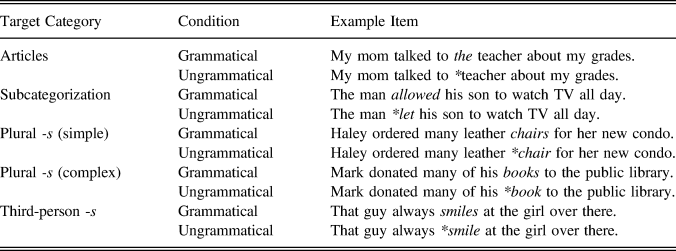
The target features in the GJT were selected based on previous studies on age effects and L2 processing, and included the following: articles, subcategorization, simple and complex plural -s, and third-person -s. Six sentences were created for each category, with each sentence having a grammatical and an ungrammatical version (Table 2). Test items were adapted from DeKeyser (Reference DeKeyser2000), Jiang (Reference Jiang2007), and Song (Reference Song2015), and some modifications were made to control for sentence length and the linear distance between the subject and verb for the plural and third-person -s items. The target items used can be found in Appendix A. In addition to the 60 target items, 60 distractors (half grammatical) that included various kinds of structures were added, to prevent participants from recognizing the target features. A combined total of 120 items were included in the GJT. The internal reliability of the GJT was acceptable (Cronbach’s alpha = .92).
Example target items in the GJT

All sentences were recorded by a female native English speaker in a recording booth, with a Tascam DR-05 recorder. The audio files were split and edited into individual files using the Praat software (Boersma, Reference Boersma2001). The items were pseudorandomized, with no item from the same category immediately following another, and divided into two lists, with the grammatical and ungrammatical versions of each sentence appearing in different lists. All participants were exposed to both lists, half in one order, the other half in the opposite order. A short break was provided in between to ensure that some time elapsed between seeing the grammatical and ungrammatical versions of the same sentence.
Language Background Questionnaire
A language background questionnaire was created to collect information about participants’ previous English learning history, current use of English, academic performance, and socioeconomic status (SES). The responses were used to examine whether participants in the two groups had comparable L2 learning experience and educational background. The complete questionnaire can be found in Appendix B.
PROCEDURE
The experiment was conducted in quiet labs located in the participants’ universities in the United States and Korea. Participants signed the consent form, then completed the first session of the GJT, took a break during which they filled out the language background questionnaire, and then finished the second session of the GJT.
The GJT was administered using PsychoPy (Peirce & MacAskill, Reference Peirce and MacAskill2018). Participants were asked to sit in front of a computer and given instructions to listen to each sentence and press the “j” key if the sentence sounded acceptable or the “f” key if it sounded unacceptable in English. A speaker icon first appeared on the screen for 1000 ms, followed by an aural presentation of a test item. After each sentence, a question mark appeared on the screen asking for a response. To minimize the possibility of participants using their explicit linguistic knowledge, each item was presented only once, with the question mark immediately following each auditory stimulus. Participants were asked to respond as soon as they saw the question mark. The order of presentation is shown in Figure 1. There were four practice items to familiarize participants with the task. The complete procedure took about 30 minutes, and participants received monetary compensation or extra course credit for their participation.
Example presentation of stimuli in the GJT
Note: Sentences were presented aurally in the experiment.

DATA ANALYSIS
For both accuracy and reaction times on the GJT, the two learner groups’ results were submitted to statistical comparisons; the native speakers’ data are only reported for reference purposes. The mean accuracy (% correct) and reaction times (in milliseconds) were computed for each group and target category. For reaction times, only those items responded to correctly were included in the analysis. The data from three outliers exceeding 2.5 standard deviations from the group mean were removed from the analysis. One participant’s data was also eliminated, due to technical problems during the experiment.
Two separate repeated measures analyses of covariance (ANCOVA) were conducted, one for the grammatical and one for the ungrammatical items, for both the accuracy and reaction time data. Each ANCOVA included category (five levels: articles, subcategorization, simple plural -s, complex plural -s, and third-person -s) as the within-subjects variable and group (two levels: EK group, LC group) as the between-subjects variable. Participants’ TOEFL scores and the number of hours of current English use were included as covariates, to control for any performance differences caused by global L2 proficiency and current L2 use. For all categories and groups, the skewness and kurtosis of the standardized residuals were in the acceptable range for normality (approximately  $\pm$2; George & Mallery, Reference George and Mallery2002). In cases in which Mauchly’s test of sphericity was significant (p < .05), the Greenhouse-Geisser corrected p-values were used to interpret the results. All post-hoc tests were Bonferroni corrected.
RESULTS
LANGUAGE BACKGROUND QUESTIONNAIRE RESPONSES
The language background questionnaire responses revealed that the majority (more than one-third) of the participants were mostly in the top 10% in terms of their academic performance, which was reflected by school GPAs. Fathers’ occupations showed fairly comparable SES between the groups: the common ones were white-collar jobs including CEOs, lawyers, engineers, and businessmen, as well as jobs in academia, including teachers, professors, and researchers. Some of the other occupations listed in the EK group were banker, financial analyst, fund manager, taxi driver, and construction field manager, and other jobs in the LC group included pressman, pharmacist, photographer, and technical director of a broadcasting company.
The two groups also had fairly comparable profiles with respect to L2 learning experiences. There were similar numbers of participants who had graduated from a foreign language high schoolFootnote 5 (EK group: n = 7; LC group: n = 8) and those who had studied abroad in an English-speaking country (EK group: n = 9; LC group: n = 6). The mean age at which the learners had gone abroad was 14, with an average duration of stay of one year for both groups. Most had attended school in the country concerned (EK group: n = 7; LC group: n = 5), while one in the EK group had attended a language program, and one participant in each group had no kind of formal education during their study abroad experience. These similarities indicate that the EK group and the LC group had comparable L2 learning experiences, as well as SES, suggesting that the comparison between the group performances was reasonable.Footnote 6
Regarding the EK group’s early immersion experience, the average period spent in an English-only kindergarten was 1.89 years. All but one responded that they enjoyed their kindergarten experience. The activities held in English during the kindergarten experience included free play, reading books, singing and dancing, physical activities, alphabet/phonics learning, and vocabulary learning. Eight out of 18 responded that they had also learned grammar. In terms of time spent with native English speakers during immersion, the majority responded that they had interacted with native speaker(s) more than 70% of the time, while two participants reported having spent less than 50% of the time interacting with native speakers.
ACCURACY
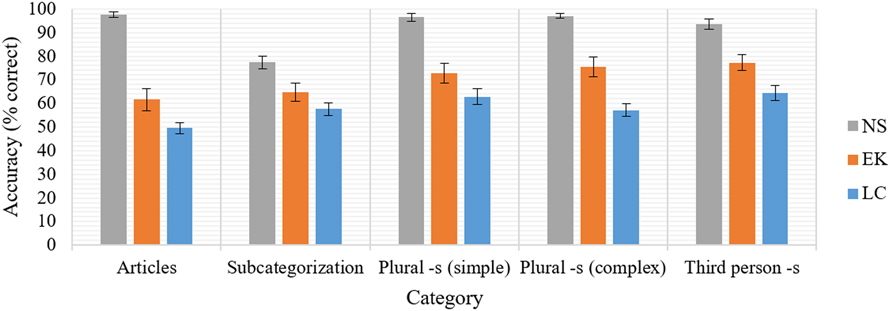
Descriptive statistics for all the target categories and groups are shown in Table 3 and Figure 2. According to mean accuracy, the GJT was easy for native English speakers, with total mean accuracy exceeding 90%. One unexpected finding was the low accuracy for subcategorization, in which native speakers scored as low as 60% for the ungrammatical items. Although this was unexpected, given that a pilot test did not reveal such high error rates, the result indicates that caution should be taken when interpreting results for this specific category. The learner groups together performed with lower accuracy, with larger standard deviations, compared to the native speaker group. The EK group had a higher total mean accuracy than the LC group. The grammatical categories showing the highest and lowest performances were identical for both learner groups: the highest accuracy was in third-person -s, the lowest in articles.
Descriptive statistics of accuracy (%) on the GJT

Note: G = grammatical items, U = ungrammatical items, M = mean, SD = standard deviation.
Participants’ mean accuracy on the GJT
Note: Error bars indicate standard errors.

The repeated measures ANCOVA for grammatical items revealed no main effect of group; the difference between the EK group and the LC group did not reach significance [F(1, 36) = 3.26, p = .079, ηp2 = .083]. There was also no main effect of category and no group and category interaction (all F < 1.1, ps < .03).
The repeated measures ANCOVA for ungrammatical items, however, revealed a significant main effect of group [F(1, 36) = 6.86, p = .013, ηp2 = .161] and a marginally significant main effect of category [F(4, 144) = 2.32, p = .059, ηp2 = .061]. A subsequent pairwise comparison showed that the EK group scored higher than the LC group (p = .013). Post-hoc tests comparing accuracy scores for the five categories revealed significant differences between articles and simple plural -s (p = .012), and between articles and third-person -s (p = .010), where the learners as a whole scored lower on articles than on simple plural -s and third-person -s. There was no group and category interaction [F(4, 144) = .41, p = .798, ηp2 = .011], indicating that the EK group’s superior performance was a general pattern that did not differ according to category.
REACTION TIME
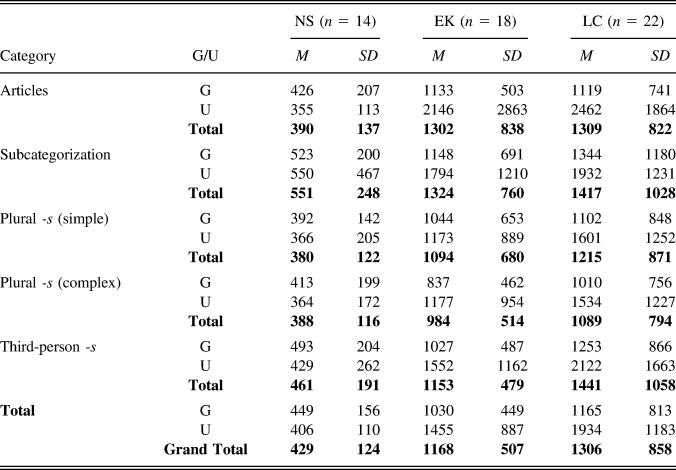
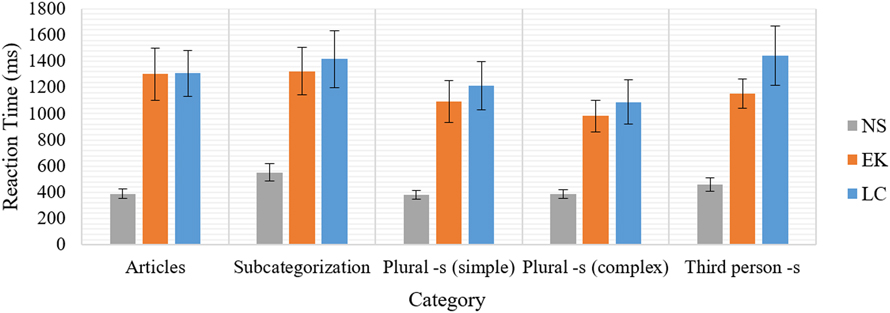
Mean reaction times for each group and category are shown in Table 4 and Figure 3. Native English speakers were almost three times faster than both learner groups in judging sentences in the GJT. The EK group was slightly faster overall than the LC group. Despite the apparent reaction time differences among the groups and categories, the repeated measures ANCOVAs revealed no significant main effects of group or category in the grammatical and ungrammatical sets (all F < 1.3, ps < .09).
Descriptive statistics of reaction times (ms) on the GJT

Note: G = grammatical items, U = ungrammatical items, M = mean, SD = standard deviation.
Participants’ mean reaction times on the GJT
Note: Error bars indicate standard errors.

DISCUSSION
The present study examined whether attending a partial L2 immersion program in early childhood has an effect on ultimate L2 morpho-syntactic sensitivity during online processing. The results of a speeded aural GJT revealed that Korean college students who had attended an English kindergarten outperformed those who began learning English later in a regular classroom setting – in terms of accuracy, but not reaction time. This advantage for early partial immersion was found across all the grammatical features observed.
EARLY PARTIAL IMMERSION AND ULTIMATE L2 ATTAINMENT
The comparison between GJT accuracy in the two learner groups confirmed that those who had attended an early partial immersion program were significantly better at detecting L2 morpho-syntactic errors than those who had begun learning through regular classroom instruction when they were older. The reaction time data did not reveal any significant differences between the groups, although there was a tendency for the English-kindergarten graduates to respond faster. The results together indicate that a brief, partially limited immersion experience in early childhood can foster significant advantages in ultimate attainment of L2 morpho-syntactic sensitivity, which is similar to what is often found in naturalistic acquisition (e.g., DeKeyser, Reference DeKeyser2000; Johnson & Newport, Reference Johnson and Newport1989) and the advantage of heritage speakers over L2 learners (e.g., Montrul, Reference Montrul2008). Moreover, the findings partially support the idea that an early age advantage is only found in contexts where learners are fully immersed in the L2 speaking environment (Qureshi, Reference Qureshi2016). The results of this study demonstrate that even in a foreign language learning context, if learners are exposed to a substantial amount of nativelike input and have more opportunity to interact using the L2 in an immersive setting, such as in English kindergartens, this kind of experience can still yield advantages for early learners.
The current findings also resemble those of previous studies that specifically examined the effect of early immersion in a foreign language learning context and reported positive outcomes (Bergström et al., Reference Bergström, Klatte, Steinbrink and Lachmann2016; Foster et al., Reference Foster, Bolibaugh and Kotula2014; Knell et al., Reference Knell, Haiyan, Miao, Yanping, Siegel, Lin and Wei2007). While those studies tested participants during or shortly after the completion of the program and on measures of explicit L2 knowledge, like receptive vocabulary (e.g., Bergström et al., Reference Bergström, Klatte, Steinbrink and Lachmann2016), to the author’s knowledge, this was the first to discover long-term effects, and in the domain of morpho-syntax. Participants in the present study were tested more than 10 years after their first exposure, a point at which (assuming continued access to L2 input and opportunities for use) their performance can be considered to reflect ultimate attainment, at least in naturalistic settings (Long, Reference Long, Granena and Long2013). They also had high global L2 proficiency, reflected in their near-perfect TOEFL scores. Based on these factors, the results likely represent effects on ultimate attainment rather than immediate outcomes. Furthermore, the positive effect found is more surprising when taking into account that the L2 participants were highly educated students enrolled at a top national university, who also spent extra time and effort in learning English to attain high proficiency. Even for these learners, a significant difference was found depending on whether they had attended an English-kindergarten or not. This suggests that learning a second language from a younger age in an immersive environment can predict long-term benefits in attaining L2 morpho-syntactic sensitivity.
One may, however, wonder whether the advantage for the English-kindergarten group could alternatively be simply due to their having had more years of exposure than the nonimmersion group, not because of their immersion experience. This could be a potential confound when interpreting the data, as the two groups’ total years of exposure were different. Yet, it is important to note that in foreign language learning contexts, “where instructional time is not constant and younger starters have had greater exposure than older starters, the former do not succeed in showing a significant advantage” (Muñoz, Reference Muñoz2008, p. 582). Even with naturalistic learners, the age at which the learner was first exposed to the L2 in the home country through classroom instruction before immigration does not show a significant correlation with test performance (e.g., Johnson & Newport, Reference Johnson and Newport1989). Thus, the difference in the total amount of exposure is a less likely factor that explains the group differences found in the present study; it is rather the appropriate combination of age of onset and type of exposure (i.e., early immersion) that produced an advantage for the English-kindergarten group.
It is also important to note that the advantage of kindergarten immersion was discovered in a task that requires fast, automatic processing of aurally presented sentences. While the majority of previous studies had found positive outcomes on offline behavioral measures of L2 knowledge (Bergström et al., Reference Bergström, Klatte, Steinbrink and Lachmann2016; Foster et al., Reference Foster, Bolibaugh and Kotula2014; Knell et al., Reference Knell, Haiyan, Miao, Yanping, Siegel, Lin and Wei2007), the present study provides new evidence that the benefit of an early immersive exposure can be observed in the ability to notice grammatical errors during real-time L2 processing. There is a possibility that the English-kindergarten group’s superior performance is partially due to the fact that most L2 learning during early immersion would have been through listening and speaking, which could have fostered more advantages in these domains than in others (Qureshi, Reference Qureshi2016), similar to how heritage speakers tend to outperform L2 learners on oral and aural measures (Montrul, Reference Montrul2008). While it has been suggested that the modality of GJTs do not have critical effects on the results (e.g., Plonsky et al., Reference Plonsky, Marsden, Crowther, Gass and Spinner2019), future studies that compare different tasks and their susceptibility to early immersion effects could provide more information about whether task modality plays a significant role.
Although the results of the present study showed a statistically significant benefit for early partial immersion learners, the difference produced a small effect size. One reason may be due to the small number of participants. Having a larger number could alleviate within-group variation, which could then yield larger effect sizes. Another explanation could be that partial immersion in the foreign language learning context may be limited in providing the most supportive environment for early L2 acquisition. As described earlier, English kindergartens in Korea differ from immersion programs in Canada (e.g., Lambert & Tucker, Reference Lambert and Tucker1972), in that children in Korean English kindergartens typically do not receive much input outside program hours and experience a discontinuity when transitioning into classrooms with nonimmersion learners (Long, Reference Long, Granena and Long2013). It is possible that these unique characteristics foster only minimal, although still measurable, benefits for early learners. The small effect size could also be due to the specific demographics of participants in this study; the performance difference between the groups could have been reduced by the extra measures both groups took to attain high L2 proficiency. It is possible that a similar study with participants with lower proficiencies or motivation could reveal even stronger effects for early partial immersion.
Regarding the within-group variation in both learner groups, one potential explanation is that the specific kind of kindergarten experience the EK group learners had enjoyed had influenced the extent to which the early immersion fostered an advantage in ultimate attainment. Even though the questionnaire responses revealed that the participants had been involved in similar activities in the English kindergartens, it is possible that the specific curricula had contributed to the variation in the learners’ development of morpho-syntactic sensitivity. For example, the amount of interaction learners had with native English speakers could have played a critical role, as the participants in the EK group with the lowest raw mean scores were those who had had less than 50% interaction with native English speakers during their immersion experience. The quality of input and interaction could be a significant moderating variable that determines how beneficial the immersion experience can be, which has been empirically shown (Flege, Reference Flege2018; Foster et al., Reference Foster, Bolibaugh and Kotula2014; Weitz et al., Reference Weitz, Pahl, Flyman Mattsson, Buyl and Kalbe2010).
SENSITIVITY TO L2 MORPHO-SYNTACTIC ERRORS IN ONLINE SENTENCE PROCESSING
To examine potential effects of early partial immersion, the present study specifically targeted English morpho-syntactic features (articles, verb subcategorization, simple and complex plural -s, and third-person -s) that have been found most susceptible to age effects in naturalistic L2 acquisition (DeKeyser, Reference DeKeyser2000; Jia & Fuse, Reference Jia and Fuse2007; Johnson & Newport, Reference Johnson and Newport1989) and especially difficult to acquire for learners who do not have the same features in their L1 (Chen et al., Reference Chen, Shu, Liu, Zhao and Li2007; Jiang, Reference Jiang2004, Reference Jiang2007; Jiang et al., Reference Jiang, Novokshanova, Masuda and Wang2011; VanPatten et al., Reference VanPatten, Keating and Leeser2012). The results showed that the English-kindergarten group was better at detecting errors with these features compared to those who had begun learning English in a formal classroom setting. There was no interaction between the group and category variables, which indicates that the advantage applied generally across all the features observed. This finding corroborates the pattern found in earlier studies of naturalistic L2 acquisition, in which these features showed greater differences according to age of onset compared to others (DeKeyser, Reference DeKeyser2000; Jia & Fuse, Reference Jia and Fuse2007; Johnson & Newport, Reference Johnson and Newport1989). While whether the early immersion effects are limited to these features remains to be further explored, the present results suggest that even brief, partially immersive exposure can be beneficial in developing sensitivity to L2 morpho-syntactic features that are difficult to acquire.
Although the difference between the learner groups was significant, both groups showed considerably poorer performance than the native speakers. The native speaker group exceeded 90% accuracy and were three times faster in responding to sentences than the learners, who performed at near chance, or even below, in detecting errors in the ungrammatical items. The large difference between the performance of native speakers and learners, including those who have had early immersive exposure, has been documented in previous work, as well (Bergström et al., Reference Bergström, Klatte, Steinbrink and Lachmann2016; Kersten, Reference Kersten2010), and poor sensitivity to nonnative morpho-syntactic errors in online sentence processing has also been reported (Chen et al., Reference Chen, Shu, Liu, Zhao and Li2007; Jiang, Reference Jiang2004, Reference Jiang2007; Jiang et al., Reference Jiang, Novokshanova, Masuda and Wang2011; VanPatten et al., Reference VanPatten, Keating and Leeser2012). Considering the profiles of participants in the present study, the results illustrate how even for learners with very high global L2 proficiency and even for those who have had additional early immersive exposure, it is difficult to attain high sensitivity to L2 morpho-syntactic features in online processing. This suggests that global proficiency and sensitivity to grammatical errors can be two different dimensions of L2 attainment.
The learners as a whole demonstrated the poorest performance with articles, while showing significantly greater accuracy with simple plural -s and third-person -s. The particularly low sensitivity to articles is unsurprising considering that previous work on Korean learners’ acquisition of English articles has consistently found evidence of this difficulty (e.g., Ionin & Montrul, Reference Ionin and Montrul2010). Moreover, of the various kinds of errors that can be made regarding the use of articles, the type constructed in this study involved the absence of definite articles in obligatory contexts. Detecting the absence of an essential feature may require more sensitivity than noticing the presence of an ill-formed or unnecessary one, in this case, articles (Ionin & Montrul, Reference Ionin and Montrul2010). Hence, a short immersive exposure in early childhood may be insufficient to develop sensitivity to this feature.
Unlike articles, simple plural -s and third-person -s both have overt cues that indicate their grammaticality. In the GJT items, the plural -s attached to the nouns were paired with lexical items that mark plurality (i.e., [+ plural]), such as the word “many” in “Haley ordered many leather chairs….” The third-person -s has a [+ singular] cue marked on the subject, such as “guy” requiring a singular verb in “That guy always smiles at….” In both cases, there are clearly defined cues that indicate whether the sentence is grammatical. However, in the case of articles, the requirement is less clear (i.e., a singular noun does not always require a definite article). It is likely that for learners, the well-defined lexical and structural cues in agreement are more useful in checking grammaticality than the requirements in processing articles, which could explain why it was easier to detect errors in plural and third-person -s than to notice missing articles.
Another explanation could be the way these features are taught in classrooms. The importance of agreement, like plural and third-person -s, is often emphasized in English classes in Korea, where students are trained to pay close attention to those features. Rules for using English articles, however, are difficult for teachers to define and teach explicitly, and it is rare to find cases in which they are formally taught. Thus, the different familiarity with articles and agreement through inflection based on typical L2 instruction could explain why learners showed greater sensitivity to plural and third-person -s compared to articles.
CONCLUSION
The present study examined the potential long-term benefits of early partial L2 immersion by comparing Korean university students who had attended an English-only kindergarten and those who had begun learning English later in a formal classroom setting in terms of their L2 morpho-syntactic sensitivity during online sentence processing. The results of a speeded aural GJT revealed that the kindergarten-immersion learners were better at detecting L2 grammatical errors than the classroom learners and that the advantage was significant across all the morpho-syntactic features observed. The results indicated that even a short, discontinuous immersion experience in early childhood can yield significant benefits in the long run. The present findings are novel in that they represent the effects of early immersion on ultimate attainment, rather than immediate outcomes, and specifically on the ability to recognize grammatical errors in a real-time listening task, as opposed to an offline task. The highly proficient learners’ relatively low accuracy compared to native speakers also demonstrated that attaining high sensitivity to nonnative grammatical features is difficult, even for very advanced learners. While a significant long-term effect of early partial immersion was found in the domain of morpho-syntax, whether similar advantages appear in other linguistic domains requires further investigation.
The implications of the findings are not that parents should send their children to early immersion programs, but rather, that “if early language teaching is needed, it should rely on large doses of communicative input and interaction” (DeKeyser & Larson-Hall, Reference DeKeyser, Larson-Hall, Kroll and de Groot2005, p. 101), such as those provided in immersion settings. It is the appropriate combination of age of onset and type of exposure that facilitates second language learning, in which fostering a rich input, interactive environment can help young learners take advantage of their early start.
APPENDIX A
TARGET ITEMS IN THE GRAMMATICALITY JUDGMENT TASK
*Grammatical and ungrammatical versions of each sentence are marked within the parentheses.
Articles
• Tommy read (a/*__) book in the bathtub this morning.
• Johnson went to (the/*__) library in the afternoon.
• The girl got (a/*__) puppy for her sixteenth birthday.
• My mom talked to (the/*__) teacher about my grades.
• The boy ate (a/*__) cookie in the park with his friend.
• The student used (the/*__) computer to write his essay.
Subcategorization
• The man (allowed/*let) his son to watch TV all day.
• John (said/*told) to me that his wife was seriously ill.
• The teacher (wanted/*insisted) the student to start again.
• They (felt/*agreed) the plan to be very unwise.
• Mina (saw/*realized) my friend entering the building.
• The teacher (encouraged/*supported) them to send the letter.
Plural -s (simple)
• Haley ordered many leather chair(s/*__) for her new condo.
• Kevin memorized many Latin word(s/*__) in 10 seconds.
• Erin fixed several broken desk(s/*__) with some tools.
• Kenny got several wooden table(s/*__) from his neighbor.
• Ted chose two pretty shirt(s/*__) for his new girlfriend.
• Mark runs three local store(s/*__) with his brother.
Plural -s (complex)
• Bonnie invited many of her classmate(s/*__) to her birthday party.
• Mark donated many of his book(s/*__) to the public library.
• Alex gave several of his toy(s/*__) to his baby cousins.
• Hilary blamed several of her colleague(s/*__) for the financial loss.
• David recommended two of his student(s/*__) for an internship program.
• Amy finished five of her painting(s/*__) in her private studio.
Third-person -s
• That guy always smile(s/*__) at the girl over there.
• The child usually sit(s/*__) next to her grandma.
• My friend often come(s/*__) to my house after school.
• My dog sometimes waits(s/*__) for me at the corner.
• My cat rarely look(s/*__) at me in the eye.
• Her brother never clean(s/*__) his dirty room.
APPENDIX B
LANGUAGE BACKGROUND QUESTIONNAIRE
Hello!
This is a short questionnaire that asks for information about your previous English learning experience. Please complete all sections carefully. You may take as much time as you need.
Basic Information
• Year of birth:
• Gender:
• Standardized English proficiency test and score:
Early English Education
• At what age did you begin learning English?
• Did you attend an English-only kindergarten in Korea? (If yes, go to “English-Only Kindergarten Experience”/If no, go to “Private English Education”)
English-Only Kindergarten Experience
• At what age did you enroll in the English-only kindergarten?
• At what age did you stop attending the English-only kindergarten?
• How many years did you attend the English-only kindergarten?
• How much percentage of your time in kindergarten involved contact with a native speaker?
• What kind of activities did you do in English (e.g., free play, reading books)?
• Did you enjoy your kindergarten experience?
Private English Education
• At what age did you begin attending a private English academy? (If you did not attend one, go to the last question of this section)
• How many hours per week did you spend at the academy? (e.g., 1‒3, 4‒6, 7 or more)
• What was the focus of your academy (e.g., grammar, conversation)?
• Do you have experience living in an English-speaking country for more than one month? (If yes, go to “ Study Abroad Experience”/If no, go to “Current Use of English”)
Study Abroad Experience
• What country did you go to?
• At what age did you go to the country?
• How long were you there (in years)?
• Did you attend school or language programs during your stay?
Current Use of English
• How many hours per week do you use English?
General Information
• What kind of middle school did you attend? (e.g., public, private)
• What kind of high school did you attend? (e.g., public, private)
• What was your academic performance overall (based on GPA; e.g., top 10 %)?
• What is your father’s occupation?