




No CrossRef data available.
Phantom Theories of pre-Eudoxean Proportion
Published online by Cambridge University Press: 01 September 2003
Abstract
Argument
This paper proposes an alternative view to Becker’s reconstruction of pre-Eudoxean theory of proportion. No extant document explicitly demonstrates the alleged alternation of theories of proportion before Book V of the Elements. Books V and VI of the Elements are not so complete as a theory of proportion in the abstract, and can be interpreted better as a collection of propositions useful in geometry. It follows then that older theories, if they existed at all, must have been less complete. Prevailing interest in geometry on the part of Greek mathematicians is also visible in some expressions in Book VI for specific ratio and proportion used only in definite geometric context. It is therefore more fruitful to consider the “theory” of proportion before Eudoxus as an aggregate of techniques about proportion that are useful in geometry, rather than as the result of a conscious effort to build a logically consistent set of propositions based on a definition.
Information
- Type
- Articles
- Information
- Copyright
- 2003 Cambridge University Press
1. Book V of the Elements and Its Alleged Precursors
1.1 Three Steps that are Alleged to Culminate in Book V
Book V of Euclid’s Elements proves fundamental theorems about ratio and proportion from a sophisticated definition of proportion (V-def. 5), which is applicable both to commensurable and incommensurable magnitudes. This definition and the whole book are usually attributed to Eudoxus (ca. 408-355 BC, or ca. 390-337 BC).1
Book V is not unanimously attributed to Eudoxus. Knorr attributes to Eudoxus another definition of proportion that can be reconstructed from arguments by Archimedes and Pappus, reserving the authorship of Book V to Euclid himself (Knorr 1978). We use the name Eudoxus as a convenient abbreviation for “the original author of the Elements Book V,” without strong claim that this book and its definition of proportion must be attributed to him.
Several twentieth-century studies concerned the reconstruction of the proportion theory before this definition. Oskar Becker’s reconstruction (Becker 1933) of a proportion theory by anthyphairesis (Euclidean algorithm) was so successful that it became almost an established fact that the development of the theory of proportion went through the following three phases:
- First, before the discovery of incommensurability, the theory of proportion was based on the assumption that all magnitudes were commensurable. This corresponds to what we have now in Book VII to IX (arithmetic books) of the Elements.
- Then, incommensurability made this assumption inadequate for geometric magnitudes because they may be incommensurable. A theory of proportion based on anthyphairetic definition came to the rescue. Most basic theorems about proportion could be derived from this definition, but some propositions remained difficult or awkward to prove.
- Eudoxus gave the final solution with his theory of proportion based on the ingenious definition (V-def. 5 of the Elements) by equimultiples.
Now we are going to take issue with this widely accepted story of the alternation of pre-Eudoxean theories of proportion. Apart from the suspicion that this story may be influenced by the retro-projection of a foundational crisis at the beginning of the twentieth century, the problems with this thesis are summarized in the following three points. First, documents that are supposed to support the thesis are scant and vague. Second, this thesis is based on extrapolating to earlier periods the level of theoretical completeness found in Book V. In other words, modern scholars started from the assumption that a complete and systematic treatise of ratio and proportion always existed, so that the existence of a “theory” has never been doubted. Third, the whole approach is based on, and at the same time reinforces the assumption that ratio and proportion were primary, established objects of Greek mathematics, and that logical consistency and generality in their treatment were among the major preoccupations of Greek mathematicians. However, the documents themselves suggest a different situation.
1.2 Testimony
Elements Books VII to IX
Let us now examine the alleged testimonies for pre-Eudoxean theories of proportion.
As for the first stage of commensurable definition, the definition of proportion in Book VII is often regarded as its trace. However, Books VII to IX themselves present a fairly sophisticated theory of arithmetic wherein a part of Book VIII virtually treats the condition of mean proportionals between two numbers to be commensurable or incommensurable.2
Proposition VIII-8 proves that: as many mean proportional numbers exist between two numbers, so many mean proportional numbers exist between two numbers having same ratio as the first two numbers (the word “number” always means positive integer in arithmetic books). In particular, it follows that if there were numbers a and x satisfying a : x :: x : 2a (i.e., if the side and diagonal of the square were commensurable and have the ratio of a : x), then there would be a number y such that 1 : y :: y : 2, since 1 and 2 have the same ratio as a and 2a (1 : 2 :: a : 2a). This is obviously impossible, so the side and diagonal of the square is incommensurable. This part of Book VIII is often attributed to Archytas since Boethius attributes to him a similar (though more particular) proposition.
Slightly more subsistent seems a passage of Hippocrates of Chios, reported through the intermediary of Eudemus and Simplicius: “similar sections (of circles) are those which are the same part of the circle, such as semicircle (is similar) to semicircle, one-third to one-third” (Simplicius 1882-1885, 9:61).
Even if this passage really derives from Hippocrates himself (though this is not certain), this seems rather an illustrative clarification of the term “similar sections,” and though it uses the term “same part” (

) as the definition of proportion in Book VII of the Elements (VII-def.21),
3In Heath’s translation, this is def. 20 (Euclid [1925] 1956). I use the numbering in Heiberg’s edition, which is followed by Vitrac (1990-2001).
A Passage in Topics and Becker’s Thesis
Let us now look at Becker’s thesis of anthyphairetic theory of proportion, which has been so influential in the study of pre-Eudoxean mathematics.4
Though our examination is limited to Becker 1933, there are a lot of studies inspired by this article, among which Fowler (1999) is the most extensive and original. But see also Unguru’s critical review (Unguru 2002).
Becker’s thesis is based on an Aristotelian passage.
It appears also in mathematics that the difficulty in constructing a figure is sometimes due to a defect in definition; e.g. in proving that the line which cuts the plane parallel to one side divides similarly both the line and the area. If the definition is given, the fact asserted becomes immediately clear; for the areas have the same anthyphairesis as have the sides and this is the definition of the same ratio. (Topics, 158b29-35)5
English translations of the Aristotelian passage are taken from Aristotle 1984. Here I have changed “the same fraction subtracted from them” to “the same anthyphairesis.”
This passage seems to be definitive testimony to the anthyphairetic definition of proportion, which resolved the embarrassing situation of the lack of definition. Becker tried to prove the propositions of Book V of the Elements from this anthyphairetic definition, and showed that most of the propositions can be derived, with the exception of propositions that necessitate the so-called Archimedean principle (e.g. V-9) and propositions that are related to the multiplication (in modern terms) of magnitudes and ratios. The latter group contains V-16, alternando proposition (if a : b :: c : d, then a : c :: b : d) for which only separate demonstration was possible for lines, areas, etc.6
We do not enter into the details of Becker’s reconstruction of the demonstration of each proposition of Book V, about which we have some technical doubts. Our concern is concentrated on Becker’s whole approach.
Then, another Aristotelian passage in Posterior Analytics, which seems to describe the advantage of a newer theory that corresponds to Book V of the Elements, is taken as evidence for the substitution of anthyphairetic theory by Eudoxean theory.7
Anal. Post. 74a: “And it might seem that proportion alternates for things as numbers and as lines and as solids and as times – as once it used to be proved separately, though it is possible for it to be proved in all cases by a single demonstration. But because all these things – numbers, lengths, times, solids – do not constitute a single named item and differ in sort from one another, it used to be taken separately. But now it is proved universally; for it did not belong to things as lines or as numbers, but as this which they suppose to belong universally.”
Eudemus’ History of Geometry
On the other hand, strangely enough, there is no clear reference to the alternation of theories of proportion in ancient documents describing the history of mathematics. The testimony in Proclus’ Commentary to the First Book of Euclid’s Elements, taken mainly from Eudemus’ History of Geometry, does not contain explicit reference to this issue, even though the difficulty in the definition of proportion and the effort to build a satisfactory theory may well have been of interest to Eudemus and Proclus.
The only mention of the theory of proportion is found in the discussion of the meaning of the “elements” after the well-known summary of the history of mathematics before Euclid. Proclus reports that among the compilers of the Elements, “some have avoided the reduction to impossibility, others proportion” (Proclus 1873, 73; English translation by Morrow in Proclus 1970). Since this passage appears in the context of the selection of the basic materials to be included in the Elements, it is not likely that the “avoidance of proportion” should indicate that there might have been difficulty in the definition of proportion.
In the Historical Summary itself, there is no explicit mention of the evolution of the theory of proportion, though the reports about Theaetetus: “by whom the theorems were increased in number and brought into a more scientific arrangement” (Proclus 1873, 66), and Eudoxus: “was the first to increase the number of the so-called general theorems; to the three proportionals already known he added three more and multiplied the number of propositions concerning the ‘section’” (ibid., 67) are not particularly contradictory to Becker’s attribution of anthyphairetic theory to Theaetetus and Book V to Eudoxus (Becker 1933, 314). Though it seems strange that Eudemus-Proclus omitted Eudoxus’ new theory of proportion while speaking of new proportionals (probably mean proportionals), it is also possible to ascribe each theory to other mathematician(s). So one cannot say that the Summary contradicts the thesis of alteration of theories of proportion.
The problem is rather in the style of the description of the Summary, where it is repeatedly stated that theorems increased in number, demonstrations became more and more rigorous, and better systemization was given, with relatively little mention of the particular achievements of each mathematician. The author of the Summary may have simply arranged the names of mathematicians in chronological order in a preconceived logical scheme of the development of mathematics.8
Vitrac examines the Summary and points out this attitude in the description of the origin of Greek mathematics (Vitrac 1996).
Philodemus’ History of Academy, another ancient document that narrates a history of Greek mathematics, contains a phrase that can be read as attribution of renewal of Hippocrates’ old definition to Eudoxus: “and the problems concerning the definitions, Eudoxus renewed the archaic method of Hippocrates” (

) (Dorandi 1991, 126-127; English translation mine, following Dorandi’s Italian translation). If Philodemus is speaking about the definition of proportion, there would be no place for anthyphairetic proportion theory between Hippocrates and Eudoxus, though the text is uncertain because of the damaged condition of the papyrus. In fact, some scholars read the word “definition” as “arithmetic” (

). Anyway, neither does Philodemus afford positive support to the theory of proportion before Eudoxus.
1.3. Questions and Remarks
Though Becker’s thesis seems to be well supported by Aristotelian passages, we should raise two basic questions: 1. If the Greeks really followed this way of constructing a theory of proportion sketched by Becker, how far did they really go? And a more fundamental question: 2. Did they follow this way at all?
Let us make two remarks about the second question. First, the Topics passage is not a historical description about the definition of the same ratio, but an example intended to illustrate the necessity of stating appropriate definitions (necessity on the part of Aristotle, not always shared by mathematicians, as we shall see later). Therefore, Aristotle did not intend to speak about the lack of definition, but simply recommended that precise definitions be given. One cannot use this passage to support introducing anthyphairesis to explain the lack of definition.10
Szabó even proposes that Aristotle used vague expressions on purpose, as an illustration of the improper use of terms. According to him, in the passage “the line which cuts the plane parallel to one side divides similarly both the line and the area,” one should say “parallelogram” or “rectangle,” not simply “plane” (

), “proportionally” or “in the same ratio,” not “similarly” (

), and “the side” not simply “line” (

)(Szabó 1964).
The other remark is that Becker’s article contains a too often overlooked passage, where he notes that the Elements did not exploit the merit of Eudoxean definition. In fact, after arguing that the definition of Book V could have eliminated the assumption of the existence of fourth proportional used in Book XII, Becker says:
, there is a particular situation: the new theory of proportion of Eudoxus is not exploited in the only point in which it is superior to the old anthyphairetic theory in purely mathematical point of view. There is no single proposition that was proved for the first time by Eudoxus’ theory of proportion, or at least more rigorously.11
Es besteht also der eigentümliche Tatbestand, dass die neue Proportionenlehre des Eudoxus in dem einzigen Punkte, in dem sie der alten anthyphairetischen in rein mathematischer Hinsicht überlegen war, nicht ausgenutzt wurde. Es gibt keinen einzigen Satz der griechischen Mathematik, der mit ihrer Hilfe zum erstenmal oder wenigstens strenger als früher bewiesen worden ist. (Becker 1933, 328; emphasis his)
It is worth noticing that as early as 1975, almost in the beginning of his career, Knorr pointed out that Becker’s approach under the influence of phenomenology sought what must have happened. See Knorr 2001, transcript of a lecture delivered in 1975.
2. Ratio and Proportion in the Elements
2.1 What is intended by “Theory of Proportion”?
Let us now turn to the Elements, and examine its theory of proportion usually attributed to Eudoxus. We hope this examination reveals some basic attitudes in Greek mathematics, and illuminates our investigation of its possible precursors.
First, let us make a point clear: what does the term “theory of proportion” mean, and what do we intend by claiming that pre-Eudoxean theories of proportion are phantoms?
If we construe the term “theory of proportion” in a minimalist way, it would mean a set of propositions about ratio and proportion usable in Greek mathematics (mainly in geometry) – whether it was written and arranged on papyrus, or existed only in mathematicians’ mental toolbox.13
Obviously every mathematician has a set of theorems and techniques in memory ready to use for investigation. We call this kind of set “toolbox,” a term which is also shared by the group of contemporary mathematicians. See Netz 1999, 216ff. for a description of the toolbox in Greek mathematics.
In this minimalist sense, it is obvious that some theory of proportion always existed, and we can trace it back at least to Hippocrates of Chios. However, this term seems to have been used in a stronger sense. “Theory of proportion” often implies not only a treatise with proofs of theorems about ratio and proportion, but also the existence of interest and conscious effort on the part of Greek mathematicians for elucidation and systematization of those theorems. It has been assumed that it was their important task to demonstrate all the propositions concerning ratio and proportion in a systematic and exhaustive manner starting from some explicit definition. (Indeed, how could the foundation crisis thesis have gained attention and support if “theory of proportion” had not been understood in this sense?) This view is accompanied by another implication that ratio and proportion were mathematical objects in their own right.
However, if this kind of assumed characteristic were lacking in Book V, the most developed form of the theory of proportion in Greek mathematics, then the basis of reconstruction of pre-Eudoxean proportion would collapse. This is precisely what we intend. We will in fact show some examples where interest in investigation in geometry prevails over the concern for logical completeness of the theorems concerning ratio and proportion. This would mean at least that the reconstruction-approach of the theory of proportion is not very fertile for our understanding of the development of early Greek mathematics, since it has led modern scholars to concentrate on reconstruction of earlier theories of proportion from the vaguest traces, leaving other important aspects of Greek mathematics unattended. The alternative we suggest will be that theorems concerning ratio and proportion are primarily tools for investigation in geometry.
2.2 Book V of the Elements : Separation from Book VI
The object of Book V is magnitude (

in Greek), and the demonstration is carried out independent of what kind of magnitude (line, area, solid, etc.) is at issue.
14In the following discussion, I avoided citing Mueller 1981, the obligatory reference for any kind of argument concerning the deductive structure of the Elements. The reasons are that most of my discussion is concerned with the presence/absence of certain propositions and definitions in Books V and VI, and does not go into very much detail concerning deductive arguments there, and that anyway a careful reader will consult Mueller’s work.
Another caveat is that the Greek text of the Elements that we have now is considerably different from the original. Relative credibility of Arabo-Latin tradition, newly advocated by Knorr (1996) for Book XII, then by Rommevaux, Djebbar and Vitrac (2001) for Book X, has turned out to be the case also for Book V by Acerbi (2003). Though I hope that inauthenticity of some parts of the Greek text would not essentially affect my arguments, one should now be careful of any argument that depends heavily on some small piece of text in the Elements.
Acerbi’s extensive and penetrating paper also develops an argument similar to that of this paper on the state of pre-Eudoxean proportion theory through a different approach.
So, the first thing to say about Book V is that even Eudoxus could not include in this book all the propositions belonging to the theory of proportion in the modern arithmetic sense. Let’s look at the propositions that are successfully included in Book V, and those left to Book VI. Proposition V-16 would be an eminent example of the former. This is the theorem for alternando or permutando (if a : b :: c : d then alternando, we have a : c :: b : d). The inclusion of this proposition into Book V was made possible only by Eudoxean definition of proportion, if Aristotle’s passage in Posterior Analyticsrefers to the demonstration we have in Book V.
To the latter belongs
VI-16: a : b :: c : d [hArr ] r(a, d) = r(b, c)
Hereafter I use r(x, y) as an abbreviation for “rectangle contained by the two lines x, y,” and q(x) for “square on the line x.”
VII-19: a : b :: c : d [hArr ] ad = bc.
The latter is one of the fundamental theorems of proportion for us moderns. But since there was no concept of product of magnitudes, nor that of lines, areas, etc. – in short, magnitudes were not quantities equipped with the operation of multiplication – there was no place for this proposition in Book V, so its counterpart in geometry appears in Book VI.16
VI-16 is not the only counterpart of VII-19 in geometry. As we will see later, similar properties are stated for two equal figures of various kinds.
There are still other omissions of propositions in Book V that are not due to theoretical impossibility. The propositions concerning inequality of ratios are obviously incomplete. Nowhere in Book V is found the transitivity of inequality of ratios, i.e., if a : b > c : d and c : d > e : f then a : b > e : f, while a relatively trivial result is proved as V-13: if a : b :: c : d and c : d > e : f then a : b > e : f. In fact, V-13 is lemma for V-14, which in turn is used in the proof of alternando proposition V-16.17
Proposition V-14 is also a “local” lemma, intended as a lemma for V-16. It shows that if a : b :: c : d, then a = c ⇒ b = d (also a > c ⇒ b > d and ac ⇒ b > d), and is used in the proof of V-16. However, when Greek mathematicians including Euclid have to deduce b = d from a : b :: c : d and a = c, V-16 is used to obtain a : c :: b : d, then b = d is deduced from a = c. The implicit theorem used in this reasoning is “if a : b :: c : d, then a = b ⇒ c = d,” which is not explicitly demonstrated in the Elements, though evident from the definition of proportion (V-def.5). So Book V is not always complete even from the point of view of its application to geometry. For further arguments, see Netz 1999, 227ff., and Saito 1994.
We can add other examples of incompleteness in the treatment of inequality of ratios. Several theorems including V-16 could be extended to the cases in which proportion is replaced by inequality of ratios, though not proved in the Elements. These extended theorems are used at least by mathematicians after Euclid. Apollonius uses alternando (V-16) for inequality of ratios in Conics I-31, 33 and 34; Conics II-53 contains application of separando (V-17), componendo (V-18), convertendo (V-19,coroll.) to inequality of ratios. Pappus explicitly demonstrates these extended theorems in the beginning of the propositions in Collection Book VII (Pappus 1986, 1:126ff.).
Lack of compounded ratio in Book V reveals another characteristic of this book. If one considers ratio as a sort of quantity, compounding of ratios is multiplication of ratios, and constitutes one of the fundamental operations of ratios. However, the term compounding does not appear in Book V although the proposition V-22 practically treats compounding.19
Proposition V-22 states if a : b :: A : B and b : c :: B : C, then a : c :: A : C. Since a : c is compounded out of a : b and b : c (and A : C out of A : B and B : C), this proposition shows to the effect that the ratios compounded of equal ratios are equal. However, the operation of taking the extreme terms a and c to form the ratio a : c is called ex aequali (

), not compounding.
2.3 Geometry-oriented Propositions in Book V
In the definitions of Book V, some expressions are defined to describe particular manipulations of ratios such as composition (def.14), separation (def.15), and conversion (def.16). It is then demonstrated that these manipulations preserve proportion. For example, composition means to transform a : b into a + b : b, and if magnitudes are in proportion (a : b :: c : d) they will also be proportional componendo, i.e., a + b : b :: c + d : d (V-18).20
Similarly, proportional magnitudes will also be proportional separando or dirimendo (a − b : b :: c − d : d, V-17), and convertendo (a : a − b :: c : c − d, V-19 coroll.).
The very definition of proportionality (V-def.5), which can be expressed in modern algebraic terms, for example, as ma > nb ⇒ mc > nd ∧ ma = nb ⇒ mc = nd ∧ ma < nb ⇒ mc < nd, is stated by Euclid without symbols for arbitrary numbers m, n. See Acerbi (2003, 193 ff), sub-section 3.2.5) for the discussion concerning the appropriate modern transcription of this definition.
In reality, these propositions of transformation of ratios are intended for use in geometry. For example, in VI-24 Euclid deduces BA : AE :: DA : AH from BE : EA :: DH : HA by componendo (see fig. 1). A more complicated example can be found in the Conics I-37 of Apollonius, where he transforms the property of tangent of hyperbola and ellipse (our examination is limited to hyperbola) (see fig. 2). Let BG be hyperbola with diameter AB and center Z. It is demonstrated that for an ordinate GE and tangent GD, the proportion AD : DB :: AE : EB holds. Starting from this proportion, componendo, taking the halves of antecedents, then convertendo, Apollonius obtains EZ : ZB :: ZB : ZD (Apollonius 1891-1893. 1:110,11-18). If we write the first proportion a : b :: c : d, then the last one would be : ½ (c + d) : ½ ( c - d):: ½ (a + b)½ (a - b). But this expression does not clarify Apollonius’ approach very much. He had the diagram in front of him, and the transformations of ratios like componendo etc. were performed to the lines in the diagram, not to the abstract quantities like a and b. In this context, his reasoning has little to do with symbolic calculations like ½ (a + b). These examples show that componendo and other similar propositions are not theorems of abstract proportion for general magnitudes, but convenient tools for investigation in geometry, in which the help of a diagram is indispensable. Book V is thus constructed, at least in part, for the arguments concerning geometric objects (mostly lines and areas), not for that of abstract magnitudes.
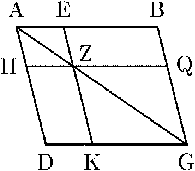
Fig. 1.Elements, VI-24
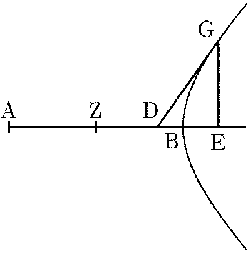
Fig. 2.Conics, I-37
Our examination of Book V can be resumed as follows. Book V handles only the propositions for which the same demonstrations are valid for all kinds of magnitudes. Some propositions that cannot be proved generally (e.g., those concerning the multiplication such as VII-19) are therefore left out and included in later books treating proportion in geometry. Book V is therefore not a complete theory of proportion from the modern point of view. Moreover, there are other propositions missing, such as the transitivity of inequality of ratios, though provable within Book V. On the other hand, some propositions of Book V (componendo etc.) are intended for application in arguments in geometry, and are not theorems for general, abstract magnitude. If we do not ascribe all these features to some negligence of its author and/or its compiler, we should consider the aim of Book V to be not a presentation of a complete theory of ratio and proportion, but rather a justification of some of the fundamental propositions useful in geometry. Then, the appellation “theory of proportion” may be misleading, since it gives the impression that Book V is more abstract and logically complete than it really is, and that its author (and the mathematicians of the day) was preoccupied in giving such formal completeness to this book. The same appellation might be still more misleading for the alleged precursors of Book V.
3. Efficient Techniques in Geometry: Book VI of the Elements
Let us now turn to Book VI (and XI), which will confirm the geometry-oriented
character of the “theory of proportion” in the Elements. Our examination is concentrated on particular expressions for ratio and proportion in this book, used only in the context of particular geometrical construction or particular geometrical configuration satisfying certain conditions. We will examine three expressions: “compounded ratio”; “to cut similarly (= proportionally)”; and “reciprocal (= reciprocally proportional).”
As we have seen above, “compounded ratio” virtually appears in proposition V-22. However, this term is used only in Book VI, in the context of a theorem (VI-23) that states the relation between the ratio of two equiangular parallelograms and the ratios of their sides, though the term compounded could be defined perfectly for ratios of magnitudes in general within the scheme of Book V.22
Euclid did not define the term “compounded ratio” (

), probably because he thought of it as a kind of addition. In fact, the word

, and its original verbal form

(mostly in third person

) are used to express the sum in other contexts in the Elements (see, for example, II-6, IX-28). Euclid uses many other expressions for addition such as “both A and B” (

A, B) and “A with B” (

A

B), never defining what the sum or addition is. Probably the concept of putting together two or more things was too simple to be defined for Euclid. He may have simply thought, for ratios too, that ratios a : b and b : c, put together, make a : c. We can at least say that it did not occur to Euclid that this operation of ratios is rather multiplication than addition when he called a : c compounded ratio.
“To cut similarly” is the very expression cited by Aristotle in Topics theorem, and appears also in the Elements : “VI-10: To cut a given straight line similarly to a given cut straight line.” Of course “similarly” here means “proportionally,” and despite Aristotle’s admonition, Euclid does not bother to define this term. It seems as if Euclid had not shared Aristotle’s concern for definitions.
Book VI as well as XI and XII contain another expression of proportion restricted to a specific geometrical context. Of two equal figures of the same kind, the sides (or bases) are reciprocally proportional, and vice versa. This property is proved for various figures: in VI-14 for two equiangular parallelograms, VI-15 for triangles having one angle equal to one angle, VI-16 for rectangles, XI-34 for parallelepipeds, XII-15 for cones and cylinders. Let us call them “equal-area (volume) propositions.” Many of these propositions are stated in the expression

, which literally means “are reciprocal” without a definite sense of proportionality. It is worth mentioning that Aristotle specifies its meaning when he defines the condition of justice as “reciprocity in accordance with a proportion and not on the basis of equality” (

, Ethic. Nic. 1132b32-33), criticizing Pythagorean definition of justice simply as reciprocity (

, ibid., 1132b22-23).
23The same word is used to express the law of lever in Archimedes’ Plane Equilibrium I-6, 7 (

) without being specified by expression like

. It is not certain whether a similar statement in Pseud-Aristotelian Mechanics 850b2 (

) means mathematically precise law of lever, i.e., reciprocal proportionality. For detailed discussion of the Mechanics passage, see Micheli 1995, 79ff. esp. 83.
These particular and ambiguous (at least according to Aristotle’s criterion) expressions are different from standard expressions of proportion such as “as a is to b so c is to d” or “a has to b the same ratio as …” in that they are not used to express arbitrary proportional relation between any magnitudes, but are inseparably connected to some particular construction (e.g., cutting a line or figure) or to some particular geometrical configuration which satisfies certain conditions (e.g., two equal figures of the same kind). What they express is not ratio and proportion of abstract quantities but specific relation in definite geometrical context.
Lack of definition on the part of Euclid is understandable, since these expressions are not so ambiguous, as Aristotle insists, in the geometrical context where they appear. And it is this type of relation, not ratio and proportion in themselves that was important to Greek geometers. Again, interest in geometric investigation prevails over interest in ratio and proportion in the abstract.
It is also worth noting that the expression “reciprocal” is connected not only to a definite geometrical context of equal-area proposition, but also to a repeatedly-used technique for proof and problem-solving.
Proposition VI-14, the first of the equal-area propositions, is adapted to triangles having one angle equal to one angle in VI-15. This in turn is used to prove VI-19: similar triangles are in duplicate ratio of corresponding sides, though VI-19 could have been proved rather directly, without recourse to equal-area proposition (see Saito 1993 for details).
Specific cases of VI-14 (VI-16 for two rectangles, and VI-17 for one rectangle and one square) are very often used to handle the ratio of two rectangles and squares, with the aid of parabolic application of areas (I-44, 45). Proposition XIII-10 of the Elements, a lemma for construction of icosahedron, affords an excellent example (see fig. 3).24
The Euclidean text is written in synthetic manner, largely in reverse order of our exposition here. For detailed discussion, see Taisbak 1999, to which we owe very much.
q(s5) = q(s6) + q(s10).
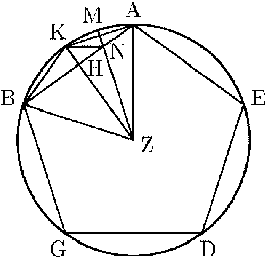
Fig. 3.Elements, XIII-10.
The essence of the proof consists in the application (in the sense of application of areas) of a rectangle equal to the square on BZ (= radius of the circle = the side of the hexagon), on AB (= the side of the pentagon). Let the width of the applied rectangle be BN, i.e., r(AB, BN) = q(BZ). Then, the difference q(s5) − q(s6) = q(AB) − q(BZ) can be transformed into q(AB) − r(AB, BN) = r(BA, AN). On the other hand, one obtains AB : BZ = BZ : BN by VI-16, so that the triangles ABZ and NZB are similar to each other. Hence it turns out that ZN bisects AK, the side of the decagon, and again by similarity of triangles (BAK and KAN), the difference q(s5) − q(s6) = r(BA, AN) becomes equal to the square on AK, i.e., q(s10).25
It should be noted that the sum (or difference) of two squares in this proposition is not treated by Pythagorean theorem. We tend to think simply that sum or difference of two squares can be transformed into one square by Pythagorean theorem, but Greek treatment of geometrical magnitudes always depends on the configuration in which the squares appear, and there are several techniques to handle the sum and difference of squares according to the context in which they appear.
The role of equal-area proposition is twofold in this argument. The transformation of q(BZ) into r(AB, BN) enables the evaluation of the difference q(AB)–q(BZ) (otherwise how could one handle the difference of two squares in the configuration given in this proposition?), and at the same time enables the invocation of equal-area proposition (VI-16) to obtain the proportion AB : BZ = BZ : BN. This example shows how the knowledge and technique concerning proportion worked in the investigation of Greek geometry.26
More examples can be found in Archimedes and Apollonius. Equal-volume proposition for cones (XII-15) is restated by Archimedes in Sphere and Cylinder lemma 4 before I-17 and used in I-17. In the second book of the same work he uses the same property for cylinders (proposition II-1) (see Saito 1995 for a detailed analysis). Book I of Apollonius’ Conics affords at least four examples of the recourse to VI-16, in propositions 27, 32, 39 and 40.
Before concluding our discussion about equal-area propositions, it is worthwhile to take a look at how they are evaluated by modern scholars. Heath cites De Morgan who criticized proposition VI-14 (the first of the equal-area propositions, concerning two equiangular parallelograms), because it was but a special case of VI-23 (Euclid [1925] 1956, 2:217). Heath tried to rescue Euclid by saying “it is perfectly consistent with Euclid’s manner to give a particular case first and its extension later (ibid., 218).” Then, afterwards in his comments to VI-19, Heath correctly emphasizes the importance of the “method adopted” (ibid., 234; emphasis in the original) in the defense of VI-14. If one viewed Books V and VI as “theory of proportion,” i.e., as a description and elucidation of ratio and proportion, De Morgan’s criticism would be reasonable and even inevitable; but then an important proof-technique in Greek geometry would be overlooked. Heath’s interpretation is more fruitful in this respect, but his position could be more consistent if he extended this argument to the whole of Books V and VI. In fact, these books can be better understood as description and justification of techniques in geometry concerning proportion, not as presentation of theorems about ratio and proportion in the abstract.
The aim of Book V and VI is then, not so much to construct a logically complete “theory” of ratio and proportion, as to present and justify available techniques for investigation in geometry.27
As we have seen in notes 17 and 18, not all the propositions used in geometry are explicitly proved. To be precise, these books illustrate how to justify major theorems and techniques in geometry concerning ratio and proportion, so as to make readers confident that others are also well-founded, without the intention of being exhaustive and complete as book X.
4. Concluding Remarks
We have proposed an alternative to the predominant historiography of pre-Eudoxean mathematics which assigns central position to the theories of proportion, especially to the inquiry for adequate definition of proportion. We believe that ratio and proportion in themselves were not the object of primary concern for early geometers. They of course invented and developed theorems and techniques about ratio and proportion for their investigation of geometric figures but this was not necessarily from an intrinsic interest in “theory of proportion.”
The definitions of proportion different from that of Book V reconstructed from various documents do not necessarily testify to the existence of a “theory” in a stronger sense. They offer rather an efficient and convincing argument to justify certain propositions that cannot be false if a certain argument concerning ratio is to be used in geometry. In fact, these pre-Eudoxean definitions seem to be connected to specific propositions they justify. Anthyphairetic definition is suitable to explain the truth of Topics proposition (Elem. VI-1), because, as Aristotle states, it is evident that sides and areas have the same anthyphairesis. The “definition” of proportion for incommensurable magnitude, which Knorr (1978) reconstructed from Archimedes’ Plane Equilibrium I-7, can be seen as a very efficient technique to extend the result for commensurable cases to incommensurable ones in certain situations.28
See also Mendell's elucidating paper (Mendell 2002).
Giusti’s thesis about the nature of mathematical objects is pertinent to this situation (Giusti 1999). He proposes that a new mathematical object appears first as an efficient technique for investigation, and later the object is discovered as a crystallization of this technique; for example, permutation is a technique invented for the investigation of the solution of higher degree equations, later crystallized into the concept of group. Ratio and proportion seem to fit this scheme well.
We believe this is the natural interpretation of the whole of the documents we possess. The term “theory of proportion” itself has contributed to hindering this natural interpretation, because it makes one imagine something more systematic and abstract, and tends to induce sophisticated reconstructions of the “pre-Eudoxean theory of proportion,” neglecting the practice of mathematicians of the time which is more plausibly reconstructible from extant documents. Thus the “pre-Eudoxean theory of proportion,” a phantom created by moderns, has distorted our perspective of early Greek mathematics, magnifying its particular (probably small) element disproportionately.
References
Acerbi, F.2003. “Drowning by Multiples: Remarks on the Fifth Book of Euclid’s Elements, with Special Emphasis on Prop. 8.” Archive for History of Exact Sciences 57:175-242.Google Scholar
Apollonius.1891-1893. Apollonii pergaei quae graece exstant cum commentariis antiquis. Edited by I. L. Heiberg.2 vols. Leipzig.
Aristotle.1984. The Complete Works of Aristotle. 2 vols. Edited by Jonathan Barnes.Princeton: Princeton University Press.
Becker, O.1933. “Eudoxos-Studien I: Eine voreudoxische Proportionenlehre und ihre Spuren bei Aristoteles und Euklid.” Quellen und Studien zur Geschichte der Mathematik, Astronomie und Physik, Abt.B, Bd. II:311-330.Google Scholar
Dorandi, T.ed. 1991. Filodemo, Storia dei Filosofi [.] Platone e L’Academia (PHerc. 1021 e 164). Naples: Bibliopolis.
Euclid.[1925] 1956. The Thirteen Books of the Elements. 3 vols. >2nd ed. Cambridge University Press. Reprint, New York: Dover Publications.
Fowler, D.1999. The Mathematics of Plato’s Academy: A New Reconstruction, 2nd. ed. Oxford: Clarendon Press.
Giusti, E.1999. Ipotesi sulla natura degli oggetti matematici. Turin: Bollati Boringhieri. (French translation. 2000. La naissance des objets mathémathiques. Paris: Ellipses.)
Knorr, W. R.1978. “Archimedes and the pre-Euclidean Proportion Theory.” Archives internationales d’histoire des sciences 28:183-244.Google Scholar
Mendell, H.2002. “Two Traces of Two-Step Eudoxean Proportion Theory in Aristotle.” Paper read at Sixth International Conference on Ancient Mathematics. Not yet published.Google Scholar
Knorr, W. R.1996. “The Wrong Text of Euclid: On Heiberg’s Text and Its Alternatives.” Centaurus 38:208-276.Google Scholar
Knorr, W. R.2001. “The Impact of Modern Mathematics on Ancient Mathematics.” Revue d’histoire des mathématiques 7:121-135.Google Scholar
Micheli, G.1995. Le origini del concetto di macchina. Florence: Olschki.
Netz, R.1999. The Shaping of Deduction in Greek Mathematics. Cambridge: Cambridge University Press.
Pappus of Alexandria.1986. Book 7 of the Collection. Edited with Translation and Commentary by Alexander Jones. 2 vols. New York: Springer-Verlag.
Proclus. 1873. Procli Diadochi in primum Euclidis Elementorum librum commentarii. Edited by G. Friedlein.
Proclus.1970. A Commentary on the First Book of Euclid’s Elements. Translated by G. R. Morrow. Princeton: Princeton University Press.
Rommevaux S.,A., Djebbar,and B. Vitrac.2001. “Remarques sur l’histoire du texte des Éléments d’Euclide.” Archive for History of Exact Sciences 55:221-295.Google Scholar
Saito, K.1993. “Duplicate Ratio in Book VI of Euclid’s Elements.” Historia Scientiarum, 2nd ser. 3:115-135.Google Scholar
Saito, K.1994. “Proposition 14 of Book V of the Elements – A Proposition that remained a Local Lemma.” Revue d’histoire des sciences 47:273-284.Google Scholar
Saito, K.1995. “Doubling the Cube: A New Interpretation of Its Significance for Early Greek Geometry.” Historia Mathematica 22:119-137.Google Scholar
Simplicius.1882-1885. Simplicii in Aristotelis Physica commentaria. Edited by H. Diels.Commentaria in Aristotelem Graeca, vols. 9-10. Berlin.
Szabó, Á.1964. “Ein Beleg für die voreudoxische Proportionenlehre? Aristoteles: Topik Θ3, p.158b29-35.” Archiv für Begriffsgeschichte 9:151-171.Google Scholar
Taisbak, Ch. M.1999. “Splitting a square: Analysis of Euclid’s Elements xiii.10.” Centaurus 41:293-295.Google Scholar
Unguru, S.2002. “‘Amicus Plato sed…’ Fowler’s New Mathematical Reconstruction of the Mathematics of Plato’ Academy.” Annals of Science 59:201-210.Google Scholar
Vitrac, B., trans. 1990-2001. Euclide d’Alexandrie. Les Éléments. 4 vols. Paris: Presses Universitaires de France.
Vitrac, B.1996. “Mythes (et réalités?) dans l’histoire des mathématiques grecques anciennes.” In L’Europe mathématique. Edited by C. Goldsteinet al., 33-51. Paris: Éditions de la Maison des Sciences de l’Homme.

Fig. 1.Elements, VI-24

Fig. 2.Conics, I-37
Fig. 3.Elements, XIII-10.
 You have
Access
- 7
- Cited by