Introduction
Mukhinite Ca2(Al2V3+)[Si2O7][SiO4]O(OH) is a rare vanadium mineral of the epidote group (Shepel and Karpenko, Reference Shepel and Karpenko1965; Armbruster et al., Reference Armbruster, Bonazzi, Akasaka, Bermanec, Chopin, Gieré, Heuss-Assbichler, Liebscher, Menchetti, Pan and Pasero2006). Until recently, it was known from only three locations in Russia which are situated in Western Siberia (Shepel and Karpenko, Reference Shepel and Karpenko1965; Konovalenko et al., Reference Konovalenko, Ananyev and Garmaeva2012), Kola Peninsula (Karpov et al., Reference Karpov, Voloshin, Savchenko and Selivanova2013), South Urals (Tomilina et al., Reference Tomilina, Kisin, Sustavov and Rostova2016), and several localities in Slovakia (Uher et al., Reference Uher, Kováčik, Kubiš, Shtukenberg and Ozdín2008; Bačík and Uher, Reference Bačík and Uher2010; Bačík et al., Reference Bačík, Uher, Kozáková, Števko, Ozdín and Vaculovič2018). The geological setting of the three occurrences is rather different. Mukhinite from Kola Peninsula forms reaction rims around primary vanadium minerals (mainly coulsonite) in banded ores of the Pyrrhotite Gorge deposit (Karpov et al., Reference Karpov, Voloshin, Savchenko and Selivanova2013). At the Tashelginsky deposit, Western Siberia, mukhinite occurs in a skarn association together with diopside–hedenbergite, grossular, vesuvianite, hercynite, magnetite and corundum; the assemblage forms nests in marble (Shepel and Karpenko, Reference Shepel and Karpenko1965; Konovalenko et al., Reference Konovalenko, Ananyev and Garmaeva2012). In the third occurrence, near the village of Kvarkeno, Suunduk River basin, South Urals, mukhinite was found in a coarse-grained calcite marble in association with crystals of phlogopite, fluorite, pyrite, green muscovite and dravite (Tomilina et al., Reference Tomilina, Kisin, Sustavov and Rostova2016) (the authors associate the formation of mukhinite with the reaction of a hydrothermal fluid with the marble after the intrusion of granites of the Suunduk massif).
This paper describes a new find of mukhinite with an unusual REE-rich Mg- and Cr-bearing variety from a medium-grained calcite–dolomite dyke of a carbonate rock cutting metamorphosed volcano-sedimentary rocks exposed in the walls of the quarry of the Svetlinsky gold deposit, Plastovsky District, South Urals (Kolisnichenko and Popov, Reference Kolisnichenko and Popov2008). The crystal structure of natural mukhinite has been studied for the first time.
Geological setting and petrological data for calcite–dolomite dykes of the Svetlinsky deposit
Numerous thin (up to several tens of cm thick) meridional dykes of calcite–dolomite rocks are exposed in the eastern wall of the Svetlinsky quarry located on the East Uralian elevation at 26.7 km to the west of the town of Plast, Chelyabinsk region, Russia (54°17'45"N, 60°24'39"E). Brief descriptions can be found in Kolisnichenko and Popov (Reference Kolisnichenko and Popov2008), Kolisnichenko et al. (Reference Kolisnichenko, Popov, Epanchintsev and Kuznetsov2014), Korinevsky et al. (Reference Korinevsky, Kotlyarov and Kolisnichenko2019) and Korinevsky and Korinevsky (Reference Korinevsky and Korinevsky2020). These investigations provide geological and mineralogical evidence of the magmatic nature of these carbonate bodies rather than their metasomatic origin. The carbonate rocks form a set of closely spaced bodies (veins) dissecting the metamorphosed volcanic-terrigenous rocks.
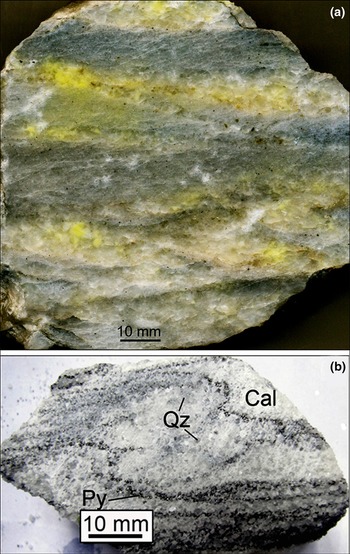
Most carbonate rocks of the Svetlinsky deposit have a uniformly medium-grained massive texture. Lenticular (2.5–5 cm long) secretions of pale-yellow native sulphur and fluorophlogopite-enriched areas give the rocks a banded texture (Fig. 1a). The presence of sulfide impregnations and sulphur aggregates in the rocks causes a strong hydrosulfuric smell during crushing. When the carbonate rock powder is heated in an open flame, intense yellow–orange thermoluminescence is observed (Korinevsky et al., Reference Korinevsky, Kotlyarov and Kolisnichenko2019).
(a) Banded texture of sulfur-containing phlogopitic calcite–dolomite rock in a fragment of the dyke from the Svetlinsky quarry; and (b) a specimen of essentially carbonate rock enriched in quartz (Qz) and fluorophlogopite with dark bands containing fine impregnation of pyrite (Py).

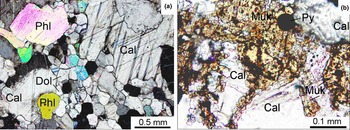
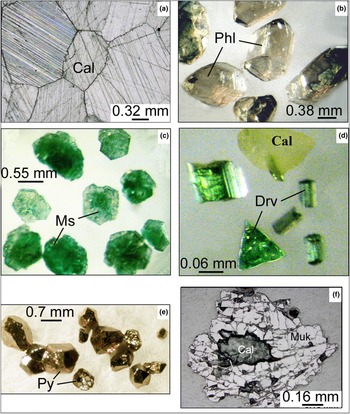
The carbonate veins of the Svetlinsky deposit are composed predominantly of a medium-grained calcite aggregate with subordinate dolomite grains (Fig. 2a, 3a), phlogopite, pyrite, quartz, and diverse accessory mineralisation which is confined mainly to quartz-rich bands.
Fragments of the mukhinite-bearing carbonate rock from the Svetlinsky deposit: (a) intergrowths of calcite (Cal), dolomite (Dol) and phlogopite (Phl); (b) anhedral grains of REE-rich mukhinite (Muk) in association with pyrite (Py). Photos of thin sections of in polarised light.

Minerals associated with REE-rich mukhinite: (a) an aggregate of medium-grained calcite (Cal) – optical microscopy of a thin section); (b) fluorophlogopite (Phl) crystals; (c) bright green crystals of chromium-bearing muscovite (Ms); (d) green crystals of V- and Cr-bearing dravite (Drv) from intergrowths in calcite; (e) crystals of pyrite (Py) from intergrowths with calcite; and (f) a back-scattered electron (BSE) image of REE-rich mukhinite (Muk) in the calcite aggregate. The photos (b) to (e) are made using a stereo-microscope.

In most cases, calcite is homogenous in composition. Usually, it contains magnesium (MgO ≈1 wt.%) and iron (FeO up to 3.25 wt.%). Occasionally, sulfur (up to 8.46 wt.% of SO3) and uranium (up to 0.05 wt.% of UO2) were detected as a result of the presence of submicroscopic inclusions of native sulphur (Korinevsky et al., Reference Korinevsky, Kotlyarov and Kolisnichenko2019) and uranium minerals. Some calcite grains contain syntactic growths of dolomite (Fig. 2a).
Accessory mineralisation, represented by small anhedral grains and euhedral crystals of various minerals, is distributed unevenly in carbonate rocks of the Svetlinsky deposit. The set of accessory minerals differs in different dykes. Usually, they are disseminated in the groundmass of the rock and are not confined to any cracks or veins. The most diverse accessories are observed in quartz-rich bands. Most individuals of accessory minerals have induction boundaries indicating their joint growth with carbonates and other minerals. No signs of metasomatic replacement of any minerals by other minerals have been found. The anhedral habit of sulfur and fluorite indicates that these minerals crystallised at the latest stages of the carbonate rocks formation.
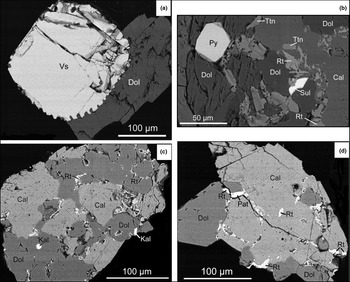
Among accessory minerals, individuals of muscovite and fluorophlogopite, dravite, actinolite, tremolite, fluoro-tremolite, pargasite, ferrous spinel, corundum, margarite, fluorapatite, V- and Nb-bearing rutile, titanite, REE-rich mukhinite, uranium hydroxides, bastnäsite, vaesite, sulvanite, kalininite, patrónite, florensovite, gersdorffite, corundum (ruby), sphalerite, galena, gold and graphite have been identified. The total amount of accessory minerals in the carbonate rocks rarely exceeds 1–3 vol.%. Grains and crystals of some accessory minerals of the carbonate rocks are presented in Figs 3b–f and 4. Most of them contain essential amounts of V (Table 1).
BSE images of rare sulfides in phlogopite-bearing dolomite–calcite carbonatite from the Svetlinsky quarry: (a) vaesite (Vs) in association with dolomite (Dol); (b) sulvanite (Sul) in association with rutile (Rt), titanite (Ttn) and pyrite (Py); (c) kalininite (Kal) crystals; and (d) patrónite (Pat) in association with rutile (Rt) in calcite–dolomite rock.

Chemical composition of some minerals, coexisting with REE-rich mukhinite from сarbonatites of the Svetlinsky deposit (wt.%).

‘nd’ – not detected.
* Analyses performed on SEM REMMA-202 M by V.A. Kotlyarov (other analyses were performed on Cameca SX100). Additionally found: Analysis 1: F 5.17 wt.%, –O≡F –2.18 wt.%, F 1.13 apfu; analysis 8: Nb2O5 0.63 wt.%. Nb 0.04 apfu; Analysis 9: SO3 58.57 wt.%, S 1.00 wt.%.
A characteristic feature of some minerals associated with mukhinite (fluorophlogopite, dravite, muscovite, rutile and clinochlore) is the presence of significant amounts of vanadium (up to 2.5 wt.% of V2O3 in fluorophlogopite, 3.26 in dravite, 1.23 in muscovite and 16.97 in rutile). Titanite (Fig. 5c) has unusually high contents of both V2O3 (up to 5.22 wt. %) and Al2O3 (up to 6.6 wt. %). In particular, the charge-balanced empirical formula of V-bearing titanite calculated on (SiO4)(O,OH) is Ca1.00(Ti0.61Al0.30V0.09)(SiO4)[O0.61(OH)0.39]. In muscovite, dravite, titanite and pargasite, chromium is also typically present, causing their bright green colour. Phlogopite is rich in fluorine; the F content reaches 5.92 wt.%, which corresponds to fluoro-phlogopite. Some grains of amphiboles are enriched in fluorine (up to 1.205 F atoms per formula unit (apfu) in fluoro-tremolite).
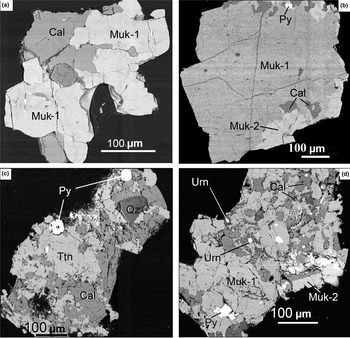
REE-rich mukhinite and closely associated minerals from carbonate rocks of the Svetlinsky deposit (BSE images): (a) mukhinite individuals with sinuous induction boundaries; (b) segregation of the Muk-2 on the periphery of a Muk-1 grain; (c) aggregates of V-bearing titanite (Ttn), calcite (Cal), anhedral grain of quartz (Qz) and crystals of pyrite (Py); and (d) calcite–mukhinite aggregate with inclusions of uranium hydroxides (Urn).

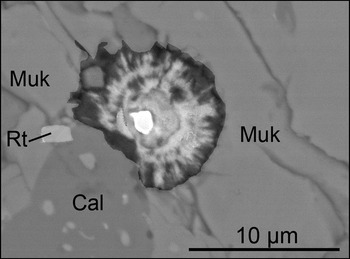
Within the grains of calcite, mukhinite and margarite, very small grains of a uranium mineral, probably representing uranium hydroxides are found repeatedly (Fig. 6). Small interstitial crystals of a uranium hydroxide with 87.69–91.02 wt.% UO2 and 3.42–4.06 wt.% PbO (presumably, radiogenic lead) are observed occasionally between mukhinite and calcite individuals. Some grains have Th and La admixtures (ThO2 up to 1.80 wt.% and La2O3 up to 1.48 wt.%). Around such crystals, zonal radiating rims of unusual REE-rich (with a predominance of La) minerals are occasionally observed (Fig. 6). Their compositions range as follows (wt.%): SiO2 6.49–7.57, Al2O3 3.39–4.04, V2O3 1.30–1.50, MgO 0.24–0.51, CaO 9.03–9.46, La2O3 27.93–28.27, Ce2O3 9.06–9.81, Pr2O3 3.29–3.83, Nd2O3 7.83–8.36, SO3 2.64–3.09, UO2 1.27–2.38; total 73.54–73.77 wt.% which may correspond to REE-hydroxide carbonates or high-hydrous hydroxides contaminated by inclusions of silicate and other phases.
BSE image of uranium (hydr)oxide (?) (white) in the core of a radiated aggregate of REE-rich minerals situated between grains of REE-rich mukhinite and calcite, in association with rutile (Rt).

Materials and methods
Samples and their chemical composition
The samples studied in this work were collected from carbonate veins exposed in the walls of the quarry of the Svetlinsky gold ore deposit, South Urals. A representative specimen of calcite–dolomite rock with REE-rich mukhinite, vaesite, sulvanite and patrónite is stored in the Natural Science Museum of the Ilmeny Reserve, Miass, Russia, with the catalogue number 17502.
Separation of minerals for chemical analyses was carried out using an optical microscope. The chemical composition of rock-forming minerals in polished samples and their images produced by back-scattered electrons were obtained on a REMMA-202M scanning electron microscope with an LZ-5 Link Systems energy-dispersive with a Si–Li detector at an accelerating voltage of 20 kV and a beam diameter of 1–2 μm. Correction of data was carried out using the Magallanes and ZAF procedure. Afterwards, the composition of mukhinite and some associated minerals were refined using a Cameca SX100 microanalyser at an accelerating voltage of 15 kV and an electron probe current of 40 nA. The probe standards (natural and synthetic reference materials) were: diopside (Mg, Ca and Si), jadeite (Al and Na), rhodonite (Mn), orthoclase (K), glass doped with REE at 4 wt.% (La and Ce) and 10 wt.% (Nd, Pr and Y), V2O3 (V), TiO2 (Ti), Cr2O3 (Cr), Fe2O3 (Fe), Co and Ni. The detection limits of REE (ppm) are: 230 for Y, 450 for La, 430 for Ce, 770 for Pr and 1600 for Nd. Abbreviations of minerals in photographs and tables are after Warr (Reference Warr2021).
Raman spectroscopy
The Raman spectrum of REE-rich mukhinite was recorded from zones of ~10 μm in size on a polished thin section in the spectral range of 100–1200 cm–1 using a Horiba Jobin Yvon IHR 320 LabRAM Raman spectrometer, equipped with an Olympus BX41 microscope, a TV camera and a cooled CCD detector. The 632.8 nm line of a He–Ne laser (Pmax = 20 mW) served as the excitation line; the spectral slit width was 2 cm–1. The scattered light was collected in the 180° reflection mode. The spectra were obtained by adding 20 intermediate spectra with an accumulation time of 10 s and processed using the Horiba Labspec v.5 program.
Single-crystal X-ray analysis
An anhedral grain of mukhinite was extracted carefully using a polarising microscope and its quality was tested by single-crystal X-ray diffraction. Single-crystal X-ray data for mukhinite were collected at room temperature on an Xcalibur Oxford Diffraction diffractometer with a graphite monochromatised MoKα radiation source (λ = 0.71073 Å) and a CCD detector using the ω scanning mode. The CrysAlis software package (Oxford Diffraction, 2009) was used to determine and refine unit-cell parameters using least-square techniques, integrate data, and to correct them for background, Lorentz and polarisation effects.
The supplementary crystallographic data is deposited at CCDC/FIZ Karlsruhe database with number CSD 1893666 [https://www.ccdc.cam.ac.uk/structures/] and as Supplementary material (see below).
Results
General appearance and chemical composition of REE-rich mukhinite
Individual grains of REE-rich mukhinite do not have distinct crystallographic outlines. Their boundaries with other minerals are sharp, sinuous and smoothly curved (Fig. 5a, d). Mukhinite grains are broken by thin cracks into small blocks that preserve a common optical orientation (Fig. 3f). The colour of the mineral is dark brown in transmitted light (in thin sections) and light brown or greenish grey in reflected light.
Chemical data for V-rich epidote-group minerals from the Svetlinsky deposit together with literature data for mukhinite from other deposits are presented in Tables 2 and 3 and in Fig. 7. The assignment of the analysts to mukhinite or clinozoisite was made based on the dominant component (V or Al) at the M3 site of the crystal structure provided that all V, Cr, Fe, Mn and Mg are concentrated at this site, in accordance with Armbruster et al. (Reference Armbruster, Bonazzi, Akasaka, Bermanec, Chopin, Gieré, Heuss-Assbichler, Liebscher, Menchetti, Pan and Pasero2006). Most formulae based on 12.5 oxides, i.e. O12(OH), are in good agreement with the stoichiometry of epidote-group minerals.
Diagram showing relative contents (apfu) of the major trivalent cations at M sites in REE-rich mukhinite Muk-1, this work (black triangles); REE-rich mukhinite Muk-2, this work (black squares); V3+,REE-rich clinozoisite, this work (black circles); mukhinite from Kvarkeno, South Urals (open circles, Tomilina et al., Reference Tomilina, Kisin, Sustavov and Rostova2016); mukhinite from Pyrrhotite gorge, Kola Peninsula (open square, Karpov et al., Reference Karpov, Voloshin, Savchenko and Selivanova2013), and mukhinite holotype sample from the Tashelginsky occurrence, Gornaya Shoria (open triangle, Konovalenko et al., Reference Konovalenko, Ananyev and Garmaeva2012).

Chemical composition of REE-rich mukhinite and V3+,REE-rich clinozoisite from the Svetlinsky deposit, and mukhinite from other deposits in Russia (wt.%).

bdl: below detection limit; nd: not detected or no data; *analysis also includes MnO 0.21 wt.%.
Notes: 1–13 are samples from carbonatites of the Svetlinsky deposit (this study): 1–2 is mukhinite with low REE contents (Muk–1), 3–9 is mukhinite with elevated REE contents (Muk–2; analysis 7 corresponds to the crystal used for the crystal structure refinement), and 10–13 is V3+,REE-rich clinozoisite. Other analyses: 14 – mukhinite from calcareous skarns of the Tashelginsky deposit, Gornaya Shoria (Konovalenko et al., Reference Konovalenko, Ananyev and Garmaeva2012); 15 – mukhinite with moderate vanadium content from pyrite ores of the Pyrrhotite gorge deposit in Kola Peninsula (Karpov et al., Reference Karpov, Voloshin, Savchenko and Selivanova2013), 16–17 – mukhinite from marbles of the Suunduk anticlinorium near the village Kvarkeno, South Urals (Tomilina et al., Reference Tomilina, Kisin, Sustavov and Rostova2016). In detail: 16 – from central parts of the crystals of mukhinite (average of 5 analyses), 17 – from marginal parts of the same crystals of mukhinite (average of 6 analyses). Fe is calculated as Fe2O3.
Chemical composition of mukhinite from the Svetlinsky deposit (mean of 15 analyses, wt.%).

*Calculated from the charge-balanced empirical formula Ca(Ca0.80La0.13Ce0.04Nd0.03Pr0.01)Σ1.01(Al2.30V0.39Cr0.10Mg0.21)Σ3.00(SiO4)(Si2O7)O[(OH)0.97O0.03] based on (SiO4)(Si2O7)O(OH,O].
The presence of rare-earth elements (4.0 to 9.7 wt.% of ΣREE2O3) in the epidote-group minerals from the Svetlinsky deposit is noteworthy. Measured rare-earth elements belong to the group of light lanthanides. Among them, La (La2O3 2.4–6.0 wt.%) predominates, but Ce (Ce2O3 0.7–1.7 wt.%) and Nd (Nd2O3 0.8–1.5 wt.%) are constantly present. The presence of detectable amounts of Pr (Pr2O3 0.1–0.4 wt.%) and Sm is very rare and was found only in some samples. Mukhinite from the Svetlinsky deposit differs significantly from REE-free mukhinite from other localities.
Raman spectroscopy
The Raman spectrum of REE-rich mukhinite is given in Fig. 8 (curve a) together with spectra of epidote and clinozoisite. The assignment of the Raman bands of epidote-group minerals is as follows (Varlamov et al., Reference Varlamov, Ermolaeva, Chukanov, Jančev, Vigasina and Plechov2019; Kasatkin et al., Reference Kasatkin, Zubkova, Pekov, Chukanov, Škoda, Polekhovsky, Agakhanov, Belakovskiy, Kuznetsov, Britvin and Pushcharovsky2020a; Reference Kasatkin, Zubkova, Pekov, Chukanov, Ksenofontov, Agakhanov, Belakovskiy, Polekhovsky, Kuznetsov, Britvin, Pushcharovsky and Nestola2020b): 1000–1100 cm–1 is assigned to stretching vibrations of Si–O–Si fragments in the Si2O7 groups; and the 850 to 1000 cm–1 range to stretching vibrations of apical Si–O bonds. The range between 650 and 710 cm–1 is assigned to M–O⋅⋅⋅H bending vibrations. 300 to 610 cm–1 are from mixed modes and overlapping bands of M–O-stretching vibrations, as well as bending vibrations of silicate groups. Below 300 cm–1 bands are due to lattice modes involving REE–O-, Ca–O- and Fe2+–O-stretching vibrations and librational vibrations of silicate groups.
(a) Raman spectra of REE-rich mukhinite from the Svetlinsky deposit. The spectra of (b) epidote and (c) clinozoisite from the RRUFF database (Lafuente et al., Reference Lafuente, Downs, Yang and Stone2015) are given for comparison.

The position of the band within the range of 1020–1200 cm–1 related to stretching vibrations of the Si–O–Si fragment depends on the value of the Si–O–Si angle: the higher this angle, the higher the frequency of corresponding vibrations (Chukanov, Reference Chukanov2014). The Si–O–Si angle in the Si2O7 group depends on the force characteristics of a cation in the A2 site. In particular, the substitution of Ca with REE results in the lowering of both the Si–O–Si angle and frequency of stretching vibrations of Si–O–Si fragments (Varlamov et al., Reference Varlamov, Ermolaeva, Chukanov, Jančev, Vigasina and Plechov2019). As a result, the band at 1090–1094 cm–1 in the Raman spectra of REE-free epidote-group minerals shifts to lower frequencies in the Raman spectrum of REE-bearing mukhinite. Numerous local maxima in the range of 1000–1090 and shoulders in the range of 290–330 cm–1 observed in the Raman spectrum of mukhinite from the Svetlinsky deposit reflect different local situations around the Si2O7 group and A2 site, respectively.
Crystal structure of REE-rich mukhinite from the Svetlinsky deposit
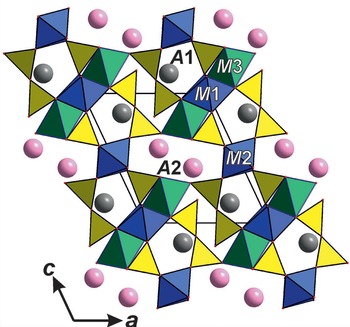
The crystal structure of REE-rich mukhinite from South Urals is similar to the structures of other epidote-supergroup minerals (Armbruster et al., Reference Armbruster, Bonazzi, Akasaka, Bermanec, Chopin, Gieré, Heuss-Assbichler, Liebscher, Menchetti, Pan and Pasero2006) as well as the synthetic analogue of mukhinite (Nagashima et al., Reference Nagashima, Nishio-Hamane, Nakano and Kawasaki2019). The epidote-type structure is based on chains of two types (Chain 1 and Chain 2) formed by edge-sharing octahedra (M2O6 and M1O6 octahedra, respectively). Chain 2 is decorated by additional M3O6-octahedra, attached to the alternate sides along the chain. These chains are linked together via SiO4-tetrahedra and Si2O7 disilicate groups to form a heteropolyhedral pseudo-framework (Fig. 8) with two types of cavities, occupied by large A1- and A2-cations.
A total of 3545 reflections within the sphere delimited by θ = 29.01° were measured for the sample studied. The refined monoclinic unit-cell parameters are: a = 8.8972(11) Å, b = 5.6221(6) Å, c = 10.1519(12) Å, β = 115.169°; and V = 459.60(11) Å3. The space group P21/m (No. 7), which is common for the epidote-supergroup minerals, was chosen on the basis of systematic absences of reflections and intensity statistics. Details of the data collection and refinement results are listed in Table 4.
Crystal data, data collection and refinement procedure results for the studied crystal of mukhinite.

The structure determination and refinement were carried out using the JANA2006 program package (Petricek et al., Reference Petricek, Dusek and Palatinus2014). The initial model for the mukhinite structure refinement was based on the atomic coordinates of its synthetic analogue (Nagashima et al., Reference Nagashima, Nishio-Hamane, Nakano and Kawasaki2019). Atomic scattering factors and anomalous dispersion corrections from the International Tables for Crystallography (Prince, Reference Prince2004) were used. Illustrations were produced in the JANA2006 program package in combination with the program DIAMOND3 (Brandenburg and Putz, Reference Brandenburg and Putz2005). Because of the complex chemical composition, the cation distribution on the structural sites was proposed, taking into account site-scattering factors, interatomic distances and ionic radii of the cations: firstly the number of electrons associated with the atoms at the site (e calc) (Hawthorne et al., Reference Hawthorne, Ungaretti and Oberti1995) was determined; secondly, for each value of e calc the most suitable ratio between the atoms with the closest final refined amount of electrons (e ref) was selected and atoms coordinates and ADPs were refined. The final refinement cycles converged to R 1 = 3.84 and wR 2 = 4.97 with GoF = 1.22 for 1160 observed reflections with I > 2σ(I). Table 5 lists the fractional atomic coordinates, occupancy, site symmetry and equivalent isotropic atomic displacement parameters (U eq). Anisotropic atomic displacement parameters (U ij) are presented in Table S1 (Supplementary materials). Selected interatomic distances as well as hydrogen bonding parameters are given in Table 6.
Fractional coordinates, site multiplicities (Mult.), equivalent displacement parameters of atoms (U eq, Å2), site scattering (electrons per formula unit, epfu), mean bond distances in coordination polyhedra (Å), and site occupancies in the structure of mukhinite.

Selected interatomic distances in mukhinite.

Bond-valence sum (BVS) calculations can be used as indirect verification of mixed oxygen/hydroxyl sites in the structure. BVS calculations (Table S2) were performed using the bond-length parameters for Ca2+–O, La3+–O, Al3+–O, V3+–O, Mg2+–O (Brown and Altermatt, Reference Brown and Altermatt1985), Si4+–O (Brese and O'Keeffe, Reference Brese and O'Keeffe1991) and H+–O (Brown, Reference Brown2006).
The refined crystal-chemical formula of REE-rich mukhinite is (Z = 2) {A 1CaA 2(Ca0.8REE0.2)}{M 1(Al0.95Cr0.05)M 2AlM 3[(V,Cr)3+0.40Al0.35Mg0.25]}(Si2O7)(SiO4)O(OH), which is in an excellent agreement with the empirical formula (Table 3). The smallest M2O6-octahedron with the mean M2–O distance of 1.882 Å is occupied by Al3+, while the largest M3O6-octahedron (with <M3–O> = 2.029 Å) concentrates V3+, Mg2+ and a part of Cr3+. The M1O6-octahedron having an intermediate size (with <M1–O> = 1.915 Å) contains a minor admixture of a cation heavier than Al3+. Taking into account that the ionic radius of [6]Cr3+ (0.615 Å) is intermediate between those of [6]Al3+ and [6]V3+ (0.535 and 0.640 Å, respectively) (Shannon, Reference Shannon1976), we suppose that a minor admixture of Cr3+, rather than V3+, occurs at the M2 site. The incorporation of the large Mg2+ cation with the ionic radius of 0.72 Å (Shannon, Reference Shannon1976) in the M3 site is confirmed by the increased mean bond length in comparison with synthetic mukhinite with M3 = V3+0.62Al3+0.38 and <M3–O> = 2.023 Å (Nagashima et al., Reference Nagashima, Nishio-Hamane, Nakano and Kawasaki2019).
Members of epidote group (Armbruster et al., Reference Armbruster, Bonazzi, Akasaka, Bermanec, Chopin, Gieré, Heuss-Assbichler, Liebscher, Menchetti, Pan and Pasero2006) are characterised by the predominance of divalent cations at both A1 and A2 sites of large cations. In the crystal structure of REE-rich mukhinite (Fig. 9), the A1 site with <A1–O> = 2.585 Å is completely occupied by Ca2+, while the A2 site with <A2–O> = 2.679 Å hosts REE3+ cations (with the predominance of La3+, in accordance with the chemical data) and has a mixed composition with 0.80(1) Ca apfu and 0.20(1) REE apfu, which is in a good agreement with the site scattering factor (e ref = 27.30 epfu; e calc = 29.40 epfu).
The crystal structure of REE-rich mukhinite (a general view). Grey circles correspond to the A1 site, completely occupied by Ca, whereas pinky circles correspond to the A2 site, characterised by the predominance of Ca with the admixture of REE (0.20 apfu).

Thus, the structural data confirm that the mineral studied is a member of the epidote group, namely, a V-deficient, Cr-bearing and REE-rich variety of mukhinite. In particular, the data obtained confirm that V3+ is concentrated at the M3 site. The crystal structure of natural mukhinite was solved for the first time.
Discussion
When analysing the data on the chemical composition of V- and REE-containing minerals of the epidote group from the Svetlinsky deposit and mukhinite from other localities, it turned out that there is a perfect positive correlation (with a correlation coefficient of 0.979) between the total REE content and the formula coefficient of magnesium, as well as a distinct negative correlation (with a correlation coefficient of –0.706) between the total V+Cr content and the formula coefficient of aluminium (Figs 10 and 11). Thus, the main schemes of isomorphic substitutions in these minerals are ΣREE + Mg ↔ Ca + Al and V+Cr ↔ Al.
Correlation between ΣREE and Mg (apfu) in V-rich epidote-group minerals. For legend, see Fig. 7.

Correlation between V+Cr and Al (apfu) in V-rich epidote-group minerals. For legend, see Fig. 7.

The simultaneous occurrence of significant amounts of Cr and REE in a mineral of the epidote supergroup was noted by us in the rocks of the dyke complex of the Kosyu ore field, Chetlassky Kamen, Middle Timan Mts., which belongs to the Riphean Chetlas hypabyssal complex of alkaline picrites and carbonatites (Varlamov et al., Reference Varlamov, Ermolaeva, Chukanov, Jančev, Vigasina and Plechov2019). This potentially new mineral is characterised by low aluminium contents. Its idealised formula is CaCeFe3+CrFe3+Si2O7)(SiO4)O2 or CaCeFe3+CrFe2+(Si2O7)(SiO4)O(OH) (depending on the valence state of iron). It is similar to mukhinite from the Svetlinsky deposit by a number of features: confinement to a carbonatite-containing complex, simultaneous occurrence of significant amounts of Cr and REE, and the presence of a magnesium impurity.
According to Armbruster et al. (Reference Armbruster, Bonazzi, Akasaka, Bermanec, Chopin, Gieré, Heuss-Assbichler, Liebscher, Menchetti, Pan and Pasero2006), the M3 site is most preferable for the incorporation of Mg2+ and ions of transition elements (e.g. Cr, V, Mn and Fe). The authors of that paper recommend placing these ions in the M3 site when calculating empirical formulae of epidote-group minerals with VIAl ≥ 2 apfu, whereas in samples with VIAl < 2 apfu the excess of M-cations other than Al should be placed in the M1 site. However, X-ray structural analysis shows that there is a statistical distribution of these cations over the M sites. For example, in the holotype sample of ferriakasakaite-(La), a part of Fe3+ occurs at the M2 site despite the M1 site containing 0.18 Al apfu (Nagashima et al., Reference Nagashima, Nishio-Hamane, Tomita, Minakawa and Inaba2015). The holotype sample of ferriallanite-(La) contains 0.06 Fe apfu at the M2 site despite the M1 site containing 0.42 Al apfu (Kolitsch et al., Reference Kolitsch, Mills, Miyawaki and Blass2012). Mukhinite from the Svetlinsky deposit is thus, one more example showing statistical distribution of a transition element over M sites.
On the basis of available data on chemical composition of Cr- and V-bearing epidote-group minerals from different localities one can suppose that there is a trend to the enrichment of REE-bearing samples with Cr, which may require partial substitution of trivalent cations with Mg and/or substitution of OH groups with O. Indeed, in the epidote-supergroup mineral from Middle Timan, both Ce and Cr are the species-defining components. V-bearing epidote-group minerals from the Svetlinsky deposit are characterised by lower contents of Cr and ΣREE. In mukhinite from other localities, both Cr and REE are absent or occur in trace amounts. The cause of this regularity is unclear.
The close similarity of the carbonate dykes of the Svetlinsky deposit in mineral composition and structural features indicate their simultaneous formation. The bedding of these carbonate rocks in the form of secant bodies with parallel contacts indicates their possible magmatic origin. The calcite–dolomite rock of the dyke in which REE-rich mukhinite is found, differs from the classical rare-metal carbonatites of Urals in which apatite, zircon, pyrochlore-group minerals, monazite and other rare earth minerals play a significant role among accessories (Levin et al., Reference Levin, Ronenson and Levina1978). Obviously, this is due to the difference between the primary magmas. Rare-metal carbonatites are closely related genetically to alkaline–ultrabasic magmas, and the calcite–dolomite rocks described in this paper are probably formed by magma that arose during the re-melting of marbles, limestones and serpentinite melange plates under the exposure of the heat of granite intrusions and their fluids (Kolisnichenko and Popov, Reference Kolisnichenko and Popov2008; Ivanov, Reference Ivanov2011). The specific features of the chemical composition of the minerals associated with REE-rich mukhinite (Table 1), including relatively high amounts of vanadium and chromium in most accessories, fluorine in fluorophlogopite and fluoro-tremolite, as well as the appearance of uranium hydroxides reflect the specific composition of the melt that could form the carbonate dykes.
High-temperature and high-pressure conditions for the formation of the calcite–dolomite rocks have been shown by independent methods of geothermometry and geobarometry. The presence of syntactic intergrowths of various minerals (pyroxenes, amphiboles, garnets, micas and plagioclases) made it possible to determine the temperatures of crystallisation as in the range of 600–900°С (Korinevsky and Korinevsky, Reference Korinevsky and Korinevsky2020). Such temperatures correspond to magmatic formations (carbonatites) (Shumilova et al., Reference Shumilova, Kovalchuk, Mingalev and Divaev2012). The equilibrium pressure for these parageneses, determined using amphibole geobarometers, ranges from 8 to 12 kbar. The presence of native sulphur in carbonate rocks indicates a reducing environment for the formation of high-temperature and high-pressure carbonate melts.
According to the previous works (Kolisnichenko and Popov, Reference Kolisnichenko and Popov2008; Ivanov, Reference Ivanov2011), carbonate rocks of the Svetlinsky deposit have a crustal rather than mantle origin. The carbonatite-forming magma was generated as a result of melting of marbles, limestones and serpentinite melange under the exposure of heat and fluids supplied by granite intrusions. As a result, carbonate rocks of the Svetlinsky deposit are enriched with B, V, Ni, Cr, U, REE and P and depleted in Fe and Mn. This set of elements is not typical for the classical carbonatites of the Urals (Levin et al., Reference Levin, Ronenson and Levina1978).
The composition of minerals found in veins of carbonate rocks at the Svetlinsky deposit is very similar to those from the ruby-bearing carbonatites described previously from the limestone quarry situated 14 km to the East of the Kuchinsky quarry (Kolisnichenko and Popov, Reference Kolisnichenko and Popov2008). A very similar association of minerals was observed in marbles from the outcrops along the Suunduk River in the South Urals (Tomilina et al., Reference Tomilina, Kisin, Sustavov and Rostova2016). There are some common features of these two localities such as the strong hydrosulfuric smell released during crushing, a bright green colour of some silicate minerals containing Cr3+ impurities, and the presence of noble spinel. In Gornaya Shoriya and the Urals, mukhinite was found in marbles, also in the exocontact zone of granite intrusions (Shepel and Karpenko, Reference Shepel and Karpenko1965; Tomilina et al., Reference Tomilina, Kisin, Sustavov and Rostova2016). At the Ilmeno–Vishnevogorsky complex and Svetlinsky gold deposit, low concentrations of REE, V and Cr were assumed for the original carbonate sediments (Krasnobaev et al., Reference Krasnobaev, Pushkarev, Busharina and Gottman2013). During transformations of the sediments to a marble, the transition elements were released by hydrothermal solutions, which were activated by granite intrusions and lead to concomitant metasomatism of the rocks. In all above-listed localities, V–Cr mineralisation, including mukhinite, is considered as a late product of thermal and fluid impact of intrusive masses on the volcanogenic–sedimentary rocks, enriched initially with V, Cr, carbon and their subsequent reprocessing in regional and contact metamorphism. High contents of REE are a specific feature of V-bearing epidote-group minerals from the Svetlinsky deposit, unlike mukhinite from other deposits related to carbonatites (Shepel and Karpenko, Reference Shepel and Karpenko1965; Karpov et al., Reference Karpov, Voloshin, Savchenko and Selivanova2013; Tomilina et al., Reference Tomilina, Kisin, Sustavov and Rostova2016).
Conclusions
The accessory mineralisation in carbonate rocks of the Svetlinsky gold deposit is very diverse and is individual for each dyke. Most individuals of accessory minerals have induction boundaries indicating their joint growth with carbonates and other minerals. No signs of metasomatic replacement of any minerals by other minerals have been found. Most accessory silicates and oxides associated with mukhinite contain appreciable amounts of Cr and V.
The calcite–dolomite rocks of the Svetlinsky gold deposit are probably formed by magma of crustal origin that arose during the re-melting of marbles, limestones and serpentinite melange plates under the influence of the heat of granite intrusions and their fluids. According to the data of mineral geothermobarometers, the crystallisation occurred at temperatures of 560–800°С and a pressure of ~10 kbar. The carbonate rocks of the Svetlinsky deposit differ from the classical rare-metal carbonatites of the Urals in which zircon and minerals of the apatite, pyrochlore and monazite groups, as well as other rare earth minerals play a significant role among accessories.
Accessory mukhinite from the Svetlinsky gold deposit has a REE-rich, Cr-bearing and V-deficient variety. The crystal structure of natural mukhinite has been studied for the first time. The structure refinement has shown that the distribution of cations having octahedral coordination among M sites violates from the ideal scheme of the crystal-chemical formula calculation. Based on the correlation analysis of the chemical composition of mukhinite and associated V,REE-bearing clinozoisite, it was concluded that the coupled replacement of ΣREE + Mg with Ca + Al and the homovalent substitution of V+Cr for Al are the main schemes of isomorphic substitutions in these minerals.
Acknowledgements
This research was funded by themes of the state assignment of the Institute of Geology and Geоchеmistry of Ural Branch of Russian Academy of Sciences (No. AAAA-A18-118053090045-8), Kola Science Center of Russian Academy of Sciences (No. 0226-2019-0011), and Institute of Problems of Chemical Physics of Russian Academy of Sciences (No. ААAА-А19-119092390076-7). S.M.A. thanks the Russian Science Foundation, grant numbers 20-77-10065 (refinement of the crystal structure).
Competing interests
The authors declare none.
Supplementary material
To view supplementary material for this article, please visit https://doi.org/10.1180/mgm.2022.30