Introduction
Depression is a major public health concern affecting approximately 121 million people and is a leading cause of the increase in the global burden of disease (World Health Organization, 2010). Depression is highly prevalent among older people, and the negative impacts of depression on health and well-being in later life have been widely reported (Beeckman et al., Reference Beekman, Deeg, Braam, Smit and van Tilburg1997; Alexopoulos, Reference Alexopoulos2005; World Health Organization, 2010). Depression can be diagnosed and treated, but it is often undertreated or untreated (Alexopoulos, Reference Alexopoulos2005; McCabe et al., Reference McCabe, Davison, Mellor and George2009). Less than optimal care for depression is a well-known risk factor for suicide, a growing critical health problem (Lee et al., Reference Lee, Jung, Kang, Kang, Lee and Kim2009).
Although many studies have examined the relationships between depression and health, a relatively small, albeit growing, number of studies have examined the impact of depression on health care utilization among older adults. Interest in the health care use of older adults with depression is increasing because depression is often undiagnosed or undertreated in the population, which tends to make older adults’ use of health services less than optimal (Luber et al., Reference Luber2001; Alexopoulos, Reference Alexopoulos2005). Some studies have reported that depressive symptoms are positively associated with health care utilization (Luber et al., Reference Luber2001; Katon et al., Reference Katon, Lin, Russo and Unutzer2003; Himelhoch et al., Reference Himelhoch, Weller, Wu, Anderson and Cooper2004), but others have found mixed or no such relationships (Beekman et al., Reference Beekman, Deeg, Braam, Smit and van Tilburg1997; Friedman et al., Reference Friedman, Delavan, Sheeran and Bruce2009).
A key confounding factor is co-existing chronic medical illness. Studies examining the relationships between depressive symptoms and health care utilization often note high levels of health service use among older adults with chronic medical conditions, but chronic medical or physical conditions were often simply included as a covariate (Katon et al., Reference Katon, Lin, Russo and Unutzer2003; Feng et al., Reference Feng, Yap, Kua and Ng2009). Only a few studies have examined the relative and combined relationships of depressive symptoms and chronic medical conditions to health care utilization; these studies have reported an association between co-existing conditions and higher utilization (Himelhoch et al., Reference Himelhoch, Weller, Wu, Anderson and Cooper2004; Stein et al., Reference Stein, Cox, Afifi, Belik and Sareen2006). Moreover, these studies have mostly been conducted in North American and European countries. Little is known about whether such relationships exist among older adults in Asia – a region with different social and cultural contexts from those in North American and European countries.
South Korea is an East Asian country with a rapidly aging population. It has compulsory social health insurance with universal coverage, although high out-of-pocket payments due to the limited benefits have been an issue (Chun et al., Reference Chun, Kim, Lee and Lee2009). Health care in the country is predominately delivered by the private sector with limited primary care services and gate-keeping systems. The payment system is mainly fee-for-service based, resulting in increased service volume and intensity, and disincentives for implementing coordinated or integrated care for people with complex conditions, such as co-existing mental and medical conditions.
Depression in older adults in South Korea has recently received great attention as a public health issue, as the country has the highest rate of suicide among older people of all countries of the Organization for Economic Co-operation and Development (OECD, 2009). Several empirical studies have recently been conducted on depressive symptoms among older people in South Korea, but most of these studies have focused on the factors associated with depressive symptoms (Kim and Sohn, Reference Kim and Sohn2005). Moreover, only one study using a large secondary administrative dataset has been undertaken on the health care use of older adults with a depression diagnosis, and it focused solely on their use of depression treatment (Kim et al., Reference Kim, Kim, Lee, Paek and Lee2008). The purpose of the current population-based study was to examine the relative and combined relationships of depressive symptoms and chronic medical illness (CMI) with the use of four types of health care services – inpatient services, outpatient physician services, public health centers (PHCs), and oriental medicine – among older adults in South Korea.
Methods
Data and study sample
The data for this study were obtained from the Korean Longitudinal Study of Ageing (KLoSA) (Korea Labor Institute, 2006). Similar to the Health and Retirement Study (HRS) in the USA and the Survey of Health, Ageing, and Retirement in Europe (SHARE) in Europe, KLoSA provides in-depth interview data on various aspects of the later life of adults in South Korea, including health and health care utilization, family relations, employment status, and retirement situation. KLoSA is an ongoing longitudinal panel survey of a nationally representative sample of community-dwelling adults aged 45 years or older who were alive at the time of the baseline interview in 2006. The survey is based on a multistage stratified area probability sample of households representing the entire population of South Korea. Approximately 10,000 Koreans aged 45 or older living in households were interviewed by trained interviewers using computer-assisted personal interviewing (CAPI) methods. The response rates of the households and the individuals in the households were 70.7% and 89.2%, respectively, in the baseline survey. Detailed information on sampling design and survey approach can be found at the KLoSA website (http://www.klosa.re.kr). This study analyzed 2006 baseline interview data from 3224 people aged 65 or older at the time of the survey.
Variables and measures
The dependent variable in this study was health care utilization, measured by whether or not a person used one of the four types of health care services – inpatient services, outpatient physician services, public health centers (PHCs) and oriental medicine – at least once during the preceding year. Oriental medicine, a type of complementary and alternative medicine, refers to traditional Korean medicine practiced by oriental medicine physicians (Chun et al., Reference Chun, Kim, Lee and Lee2009). There were approximately 10,400 oriental medicine facilities (hospitals and clinics) in South Korea in 2006; major treatments and procedures include acupuncture, herbal medications, cupping, and moxibustion. PHCs are facilities that provide primary health care, focusing on health promotion and disease prevention for the population within a local district (Chun et al., Reference Chun, Kim, Lee and Lee2009). There are about 251 PHCs across South Korea, promoting access to health care for low-income populations. All are financed and operated by the central and/or local government and function as a health care safety net.
The key explanatory variables of the study were depressive symptoms and chronic medical illness. Depressive symptoms were measured with the 10-item short-form Center for Epidemiological Studies-Depression (CES-D10), a screening tool to assess depressive symptoms experienced during the most recent week. The CES-D10 is a symptom rating scale, a kind of dimensional diagnostics of depression using a continuous scale, while categorical diagnostics of depression are based on classification systems (e.g. the DSM-IV) based on yes/no decision (Prisciandaro and Roberts, Reference Prisciandaro and Roberts2009). The clinical relevance of a dimensional approach to assessing depression has been supported by several existing studies (Flett et al., Reference Flett, Vredenburg and Krames1997; Cheng and Chan, Reference Cheng and Chan2005).
Eight items in the CES-D10 were negatively stated and two items were positively stated, so the two positive items were reversely coded to calculate the CES-D10 score for each respondent. The possible scoring range for each item was 0 (very rarely; less than one day in the past week) to 3 (almost always; 5–7 days). In the KLoSA dataset (2006), each item is recoded as 1 if it has a score of 1 (sometimes; 1–2 days) or higher, and older adults responding positively to four or more items are regarded as a high risk group for depression (Irwin et al., Reference Irwin, Artin and Oxman1999). We adopted the KLoSA's cut-off score of 4 or greater in the CES-D10 to identify older adults with clinically relevant depressive symptoms. This cut-off was also reported to be valid in screening Chinese older adults for clinically relevant depressive symptoms without losing specificity and sensitivity (Cheng and Chan, Reference Cheng and Chan2005).
Similar to the study by Jang et al. (Reference Jang2009) that also analyzed the KLoSA dataset, chronic medical illness (CMI) was determined by self-report of whether or not one had one or more of the following eight chronic diseases diagnosed by a physician: hypertension, diabetes, cancer, chronic lung disease, liver disease, heart disease, cerebrovascular disease, or arthritis.
Potential covariates of health care utilizations of older adults in South Korea were selected, guided by the Behavioral Model of Health Services Use (Andersen, Reference Andersen1995). The model was developed to explain how and why people use health care services, and it proposes three categories of determinants: people's predisposition to the use, enabling or impeding factors of that use, and the need for care. Sociodemographic variables that have been reported as predisposing and enabling factors in the literature were included in our analytic model: age (65–74, 75 and older), sex, marital status, education (no schooling, 1–6 years, and 7 or more years), insurance type (National Health Insurance (NHI) or Medical Aid Program (MAP); Chun et al., Reference Chun, Kim, Lee and Lee2009), annual household income by quartiles, and location (urban or rural).
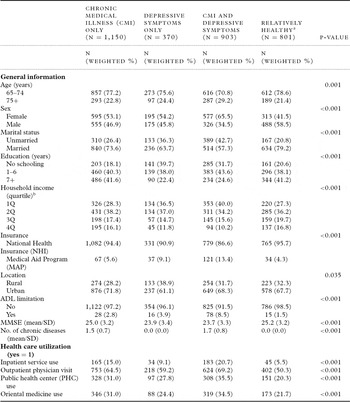
The extent of disability, which would affect the need for health care utilization (Andersen, Reference Andersen1995), was measured by the mean score in activities of daily living (ADL) using the 7-item (dressing, washing face and hands, bathing, eating, transferring, toileting, and continence) Korean activities of daily living (K-ADL) scale. The validity and reliability of the K-ADL are well established (Won et al., Reference Won, Rho, Kim, Cho and Lee2002). The extent of chronic conditions was also adjusted for using the total number of chronic conditions. Cognitive function was measured using the Korean Mini-Mental State Examination (K-MMSE), whose psychometric properties including scoring validity have been evaluated by Kang et al. (Reference Kang, Na and Hahn1997). We excluded the older adults with the lowest 25% of K-MMSE scores, a cut-off determined in light of the relatively low education level of the Korean older population (Son, Reference Son2002). The general characteristics of the sample are summarized in Table 1.
Sample characteristics (n = 3,224)

a These people had neither CMI nor depressive symptoms; b Mean (standard deviation) for household income per quartile (Q) is as follows (unit = 10,000 South Korean won): 1Q = 147.6 (98.8); 2Q = 648.7 (179.1); 3Q = 1,190.4 (197.6); and 4Q = 2,465.5 (1645.0).
ADL = activities of daily living; MMSE = Mini-Mental State Examination.
Analysis
We categorized older adults into four groups according to clinical characteristics: CMI only; depressive symptoms only; CMI and depressive symptoms; and neither CMI nor depressive symptoms. First, we compared the general characteristics of the four groups using a χ2 test for categorical variables and ANOVA for continuous variables. Second, we estimated the relationships between the clinical conditions and the four types of health care utilization being investigated in this study (inpatient services, outpatient physician services, PHCs, and oriental medicine), using logistic regression models that take into account the complex multistage sampling survey design. All statistical analyses were conducted using SAS 9.2, and the statistics reported here were properly weighted to obtain national population estimates.
Results
The sample included 3224 older adults representing approximately 3.4 million adults aged 65 or older in South Korea in 2006 (see Table 1). About 35.3% of Korean older adults had CMI but no depressive symptoms, and 11.6% had depressive symptoms but no CMI. Those with both depressive symptoms and CMI comprised 27.9% of the Korean older adult population, and those with neither (hereafter the “relatively healthy” group), comprised 25.2%. The proportion of survey respondents in each of the four groups varied significantly by socioeconomic factors and health status in the bivariate analysis: compared to the relatively healthy older people, those having depressive symptoms with or without CMI were more likely to be female, unmarried, have no schooling, be MAP beneficiaries, and have lower functional status.
As for health care utilization overall, outpatient physician visits were the most prevalent type of health care use (61.6%) among older adults in South Korea, followed by PHC visits (29.2%), oriental medicine (28.8%), and inpatient services (13.5%, not shown). Inpatient service use was highest among older adults with both CMI and depressive symptoms (20.7%), followed by those with CMI only (15.0%), those with depression only (9.1%), and the relatively healthy group (5.5%). This same order among the groups was also observed in the utilization of other services.
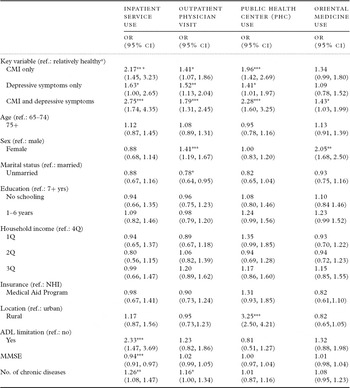
Table 2 presents regression analyses of the relationships of CMI and depressive symptoms to the utilization of the four types of health care services among older adults, while adjusting for sociodemographic and clinical covariates. Having CMI (odds ratio (OR) = 2.17; confidence interval (CI) = 1.45–3.23) and having depressive symptoms (OR = 1.03; CI = 1.00–2.64) each increased the odds for the use of inpatient services. When CMI and depressive symptoms co-existed, the odds rose (OR = 2.75; CI = 1.74–4.35). Similar patterns of association were observed in the use of outpatient physician services and also PHCs (p<0.05). Co-existing CMI and depressive symptoms were also significantly associated with the use of oriental medicine (OR = 1.43; CI = 1.03–1.99).
Regression results for inpatient service use, outpatient physician visit, public health center use, and oriental medicine use (n = 3,224)

a These people had neither CMI nor depressive symptoms.
*p < 0.05, **p < 0.01, ***p < 0.001
ADL = activities of daily living; CMI = chronic medical illness; MMSE = Mini-Mental State Examination; NHI = National Health Insurance.
The relationships between sociodemographic factors and health care utilization varied by the type of health care. No sociodemographic factors significantly decreased or increased the odds of the use of inpatient services among older adults in South Korea when adjusting for CMI, depressive symptoms, and other clinical covariates. Outpatient physician services were more likely to be used by females than males (OR = 1.41; CI = 1.19–1.67) but less likely to be used by unmarried older adults (OR = 0.78; CI = 0.64–0.95) compared to married people. The odds of the use of PHCs were higher in older adults residing in rural areas (OR = 3.25; CI = 2.50–4.21) compared to those residing in urban areas. Lastly, the likelihood of the use of oriental medicine was about two times higher for females than males (OR = 2.05; CI = 1.68–2.50).
Discussion
Depressive symptoms as measured by the CES-D10 were prevalent (39.5%) among community-dwelling older adults in South Korea; in particular, among socioeconomically disadvantaged people. The high prevalence of self-reported depressive symptoms suggests high mental distress in this population; this is also supported by existing evidence, such as a recent increase in the use of depression treatment by older Koreans (Kim et al., Reference Kim, Kim, Lee, Paek and Lee2008) and also South Korea's position at the top of the OECD ranking of suicide rates among the elderly by country (OECD, 2009). The suicide rate in South Korea was as high as 81.8 per 100,000 older adults aged 65–74 and 160.4 per 100,000 among those aged 75 or older, while the average suicide rates in the same age cohorts in OECD countries were 16.3 and 19.3, respectively. Drastic changes in social norms and traditional values due to rapid industrialization and westernization over the past three decades are often considered key contributors to the psychogeriatric issues prevalent in South Korean society (Lee et al., Reference Lee, Jung, Kang, Kang, Lee and Kim2009). This study shows that later-life depressive symptoms constitute a new epidemic in South Korea, for which more proactive policies and interventions beyond raising awareness of the critical mental health issues are urgently needed.
We also found that depressive symptoms often co-existed with CMI in this population: more than one in four community-dwelling Korean older people (27.9%) had both the mental and medical conditions. Considering health care is delivered predominantly by medical specialists in South Korea (Chun et al., Reference Chun, Kim, Lee and Lee2009), the findings suggest that health professionals treating older adults with CMI in South Korea should pay attention not only to medical conditions but also to depressive symptoms from which the older adults might potentially be suffering. Several chronic care management programs at the community level have recently started in Korea, but they are mainly specific only to a handful of selected chronic medical diseases such as hypertension and diabetes (Korea Ministry of Health and Welfare, 2009). In addition, mental health screening and counselling for older people is often provided in community social welfare centers, and coordination and collaboration between the community centers and health care organizations is limited (Lee et al., Reference Lee, Jung, Kang, Kang, Lee and Kim2009). More comprehensive, seamless, patient-centered chronic care management covering multiple co-existing chronic medical diseases and also mental health issues is needed across the continuum of health and social care.
This study supports growing evidence of positive relationships between depression and health care use of older people (Katon et al., Reference Katon, Lin, Russo and Unutzer2003; Himelhoch et al., Reference Himelhoch, Weller, Wu, Anderson and Cooper2004). In particular, our findings suggest that older people with both CMI and depressive symptoms may be more likely to use inpatient and also outpatient services (physicians’ offices and PHCs) than those with either depressive symptoms or CMI only. Moreover, co-existing mental and medical conditions were also associated with an increased use of oriental medicine. Unlike most other studies, we adjusted for the existence of CMI and also its severity using the number of chronic medical conditions and still found positive associations between depressive symptoms and health care utilization.
Our findings are consistent with existing studies reporting higher health care utilization, such as the use of acute care services or outpatient physician services, among older adults with depressive symptoms compared to those without such symptoms (Luber et al., Reference Luber2001; Katon et al., Reference Katon, Lin, Russo and Unutzer2003; Himelhoch et al., Reference Himelhoch, Weller, Wu, Anderson and Cooper2004). Few of the existing studies, however, were population-based studies observing more than one type of health care service and also examining both the relative and combined effects of depression and CMI; our study fills this gap in the literature. Unlike other studies, Stein et al. (Reference Stein, Cox, Afifi, Belik and Sareen2006) observed the relative and combined effects of depression and physical illness on health care utilization using a representative sample in Canada, and their findings were consistent with our study. Their study, however, was not specific to older adults – they included all people aged 12 years or older – and they measured health care use with a single question regarding consultation with any health care professional during the past year.
The existing literature on depression among older people also hints that co-existing depressive symptoms and CMI may increase health care service use. Considering that the major user group of inpatient services is people with acute or critical medical conditions, the link between co-existing depressive symptoms and CMI and increased episodes of hospital admissions could be due to actual or perceived worsening of medical symptoms or exaggerated somatic symptoms along with poor compliance with medical treatment (Himelhoch et al., Reference Himelhoch, Weller, Wu, Anderson and Cooper2004; Wong et al., Reference Wong, Mercer, Leung and Woo2009). Visits to outpatient physicians’ offices are mostly made by older people who need to monitor their conditions, get medication prescribed, and/or get physical therapies (Chun et al., Reference Chun, Kim, Lee and Lee2009). The major user group of PHCs is similar to that of outpatient physicians’ offices, but we found PHCs were more likely to be used by older people in rural areas, where the access to outpatient physicians’ offices was lower than in urban areas (Chun et al., Reference Chun, Kim, Lee and Lee2009). Studies have suggested that multiple factors at the patient, clinician, and system levels could simultaneously increase outpatient service use among older people with depression and CMI. Unawareness of being depressed or the stigma of pursuing screening or treatment for mental health problems may result in repeatedly ineffective outpatient visits that focus only on chronic medical conditions (Murray et al., Reference Murray, Banerjee, Byng, Tylee, Bhugra and Macdonald2006; Jang et al., Reference Jang, Kim, Hansen and Chiriboga2007). Poor self-care coupled with lower social support and clinicians’ prioritization of CMI over depressive symptoms may also be risk factors for inappropriate management of the complex conditions of older patients with depressive symptoms (Alexopoulos, Reference Alexopoulos2005; McCabe et al, Reference McCabe, Davison, Mellor and George2009). Further studies are needed to understand the mechanism by which co-existing depressive symptoms and CMI intensify health care use. In addition, multidimensional policy and clinical approaches are necessary to better meet the complex care needs of this population and decrease excess or under-use of appropriate health care among the population.
Our study has limitations, mostly related to the KLoSA dataset we analyzed. Self-report of depressive symptoms and CMI could be subject to recall errors, but there is a view that self-reported health is critical information that can complement more objective measures; an individual's perception of symptom experience may also affect adherence and compliance with treatment regimens (McGrady et al., Reference McGrady, Lynch, Nagel and Tamburrino2010). Further studies are necessary on the psychometric properties of various measurement approaches for assessing the mental health of older adults in South Korea. Depressive symptoms were assessed in this study using only the CES-D10, a symptom rating scale. The KLoSA dataset included a four-point-scale CES-D10 rather than the conventional two-point scale, which may have weakened the validity of the findings. In addition, the threshold of the CES-D10 when screening people at high risk for clinical depression may need to be upwardly adjusted given the high medical and mental morbidities among older South Korean people. Cultural differences in reporting psychological symptoms are also an important topic for further research. We could measure only the existence of health care use because of the lack of information in the KLoSA dataset on the extent (frequency) of health care use. Health care utilization should be examined in more detail and within different time periods according to the type of service (e.g. previous three months for outpatient services and previous six months for inpatient services). This cross-sectional study using one-year data cannot determine causal links between CMI, depression, and health care utilization. Potential confounders such as social support, perceived stigma, or compliance with prescribed medical regimens were not measured.
Conclusions
This study, which used a representative sample of older people in South Korea, supports the growing evidence that self-reported depressive symptoms and CMI are common, that they commonly occur together, and that they may increase health care utilization, as has been reported mostly in North American and European countries. The study underscores the burden of later-life depression among Korean older adults and the need to educate patients and clinicians in order to increase awareness and appreciation of the significance of mental health issues among Korean older people. The quality and outcomes of current health care services aimed at the mental health of older people in Korea should be evaluated to determine how the provision of mental health services can best be coordinated or integrated with chronic medical disease management.
Conflict of interest
None.
Description of authors' roles
H. Kim designed the study, acquired the data, conducted the statistical analysis, and prepared the paper. S. Park contributed to the study design and discussion, and reviewed and edited the paper. S-N. Jang contributed to the interpretation of results and the study discussion, and reviewed and edited the paper. S. Kwon contributed to the data analysis and interpretation, and reviewed and edited the manuscript.
Acknowledgments
This work was supported by Research Settlement Fund for the new faculty of Seoul National University. The authors thank Ho Kim, PhD, for his guidance on statistical analysis, and Young-il Jung, MPH, for his assistance with the statistical analysis and preparation of the paper. Both are at Seoul National University Graduate School of Public Health.