Introduction
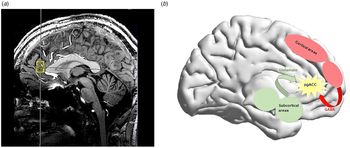
Emotion regulation is one of the main processes of behavioral functioning and deficits in related circuitry might contribute to the development of affective disorders. Neural models propose an interplay of feedforward and feedback processes between subcortical areas, especially the amygdala and cortical areas such as the prefrontal or orbitofrontal cortex to be essential for successful emotion regulation (Phillips et al., Reference Phillips, Ladouceur and Drevets2008). A ventral area of the anterior cingulate cortex (ACC), the pregenual ACC (pgACC), is suggested as an integrative hub between subcortical and cortical areas (Phillips et al., Reference Phillips, Ladouceur and Drevets2008). Automatic emotion regulation is thought to be mediated by stimulating feedforward processes from subcortical to cortical areas, while voluntary cognitive mechanisms are mediated by downregulating feedback from cortical to subcortical areas (Fig. 1).
(a) Voxel position of the spectroscopy voxel in the pgACC. (b) Schematic representation of GABAergic feedback projections and Glutamatergic feedforward projections. Adapted from Phillips et al. (Reference Phillips, Ladouceur and Drevets2008), schematic brain figure from BrainNet Viewer (http://www.nitrc.org/projects/bnv/, Xia et al., Reference Xia, Wang and He2013).

Automatic or ‘intrinsic’ emotion regulation is closely related to the direct experience of emotions. It starts automatically, is effortless and without awareness (Gyurak et al., Reference Gyurak, Gross and Etkin2011). It is considered as a protective factor against the development of depression (Joormann and Gotlib, Reference Joormann and Gotlib2010), while its absence is related to alexithymia and increased psychopathology (Green et al., Reference Green, Cahill and Malhi2007; Angst, Reference Angst2008). Neuroimaging investigations of automatic emotion regulation revealed that glutamate (Glu) concentrations in the pgACC were related to emotional dysregulation in youth (Wozniak et al., Reference Wozniak, Gönenç, Biederman, Moore, Joshi, Georgiopoulos, Hammerness, McKillop, Lukas and Henin2012). Furthermore, depression, a disorder marked by aberrant automatic emotion regulation, has been found to be associated with activity and glutamatergic neurotransmission in the pgACC (Horn et al., Reference Horn, Yu, Steiner, Buchmann, Kaufmann, Osoba, Eckert, Zierhut, Schiltz, He, Biswal, Bogerts and Walter2010; Peng et al., Reference Peng, Shen, Zhang, Huang, Liu, Liu, Jiang, Xu and Fang2012; Victor et al., Reference Victor, Furey, Fromm, Öhman and Drevets2013; Li et al., Reference Li, Metzger, Li, Safron, van Tol, Lord, Krause, Borchardt, Dou, Genz, Heinze, He and Walter2014; Philippi et al., Reference Philippi, Motzkin, Pujara and Koenigs2015; Colic et al., Reference Colic, von Düring, Denzel, Demenescu, Lord, Martens, Lison, Frommer, Vogel, Kaufmann, Speck, Li and Walter2019).
A second aspect of emotion processing is voluntary or cognitive emotion regulation. In contrast to automatic emotion regulation, this process is consciously evoked and effortful (Gross, Reference Gross1998; Gyurak et al., Reference Gyurak, Gross and Etkin2011; Braunstein et al., Reference Braunstein, Gross and Ochsner2017). One aspect of voluntary emotion regulation is self-awareness – a cognitive process closely associated with reflective functioning (RF) (Gyurak et al., Reference Gyurak, Gross and Etkin2011). RF is defined as ability to mentalize – the capacity to understand one's own and other's behaviors as expressions of mental states and feelings (Fonagy and Target, Reference Fonagy and Target1997) and reflects a cognitive understanding of emotions. Studies showed that mentalizing is an important factor for psychological well-being as low RF is associated with psychiatric conditions, such as depression (Toth et al., Reference Toth, Gersner, Wilf-Yarkoni, Raizel, Dar, Richter-Levin, Levit and Zangen2008) or borderline personality disorder (Guttman and Laporte, Reference Guttman and Laporte2002; Deborde et al., Reference Deborde, Miljkovitch, Roy, Dugré-Le Bigre, Pham-Scottez, Speranza and Corcos2012; New et al., Reference New, aan het Rot, Ripoll, Perez-Rodriguez, Lazarus, Zipursky, Weinstein, Koenigsberg, Hazlett, Goodman and Siever2012). Mentalizing was associated with activity in ventromedial prefrontal and orbitofrontal cortex (Schurz et al., Reference Schurz, Kogler, Scherndl, Kronbichler and Kühberger2015) and was affected by interpersonal stress (Nolte et al., Reference Nolte, Bolling, Hudac, Fonagy, Mayes and Pelphrey2013). Moriguchi et al. (Reference Moriguchi, Maeda, Igarashi, Ishikawa, Shoji, Kubo and Komaki2007) reported a hypoactivation in these areas during mentalizing tasks in alexithymic subjects, indicating a possible disturbance in metabolic excitation/inhibition (E/I) balance. Local inhibitory metabolites were shown to correlate with the activity of the pgACC during emotional tasks (Northoff et al., Reference Northoff, Walter, Schulte, Beck, Dydak, Henning, Boeker, Grimm and Boesiger2007), thus further emphasizing the importance of pgACC metabolism in emotion processing. In conclusion, voluntary cognitive emotion processing is in part mediated by projections from prefrontal areas to the cingulate cortex and further to subcortical structures, which are hypothesized to be modulated by GABAergic local circuitry (Northoff et al., Reference Northoff, Walter, Schulte, Beck, Dydak, Henning, Boeker, Grimm and Boesiger2007; Phillips et al., Reference Phillips, Ladouceur and Drevets2008; Wiebking et al., Reference Wiebking, Duncan, Qin, Hayes, Lyttelton, Gravel, Verhaeghe, Kostikov, Schirrmacher, Reader, Bajbouj and Northoff2014).
Deficits in emotion processing, regulation or experience are features of alexithymia, a personality trait describing a general lack of emotional understanding that is present in about 10% of population. Alexithymia is a multifaceted construct and integrates a cognitive emotion regulation deficit and an automatic emotion regulation deficit (Taylor, Reference Taylor2000). In line with this theory, general emotion regulation was repeatedly shown to be dysfunctional in alexithymia (Taylor and Bagby, Reference Taylor and Bagby2004; Vermeulen et al., Reference Vermeulen, Luminet and Corneille2006; Swart et al., Reference Swart, Kortekaas and Aleman2009; Venta et al., Reference Venta, Hart and Sharp2013) and impairments in both types of emotion processing have been reported. Regarding cognitive emotion processing, it has been shown that reflective functioning is negatively associated with alexithymia (Antonsen et al., Reference Antonsen, Klungsøyr, Kamps, Hummelen, Johansen, Pedersen, Urnes, Kvarstein, Karterud and Wilberg2014; Rothschild-Yakar et al., Reference Rothschild-Yakar, Peled, Enoch-Levy, Gur and Stein2018) and lower mentalizing skills are a risk factor for alexithymia (Moriguchi et al., Reference Moriguchi, Ohnishi, Lane, Maeda, Mori, Nemoto, Matsuda and Komaki2006; Swart et al., Reference Swart, Kortekaas and Aleman2009). Regarding automatic emotion regulation, it has been reported that behavior and neural activity (Pollatos and Gramann, Reference Pollatos and Gramann2012; van der Velde et al., Reference van der Velde, Servaas, Goerlich, Bruggeman, Horton, Costafreda and Aleman2013) are altered in experiments eliciting automatic emotion processing (e.g. priming, masked emotional stimuli, Donges and Suslow, Reference Donges and Suslow2017). Additionally, alexithymia has been associated with habitual suppressive emotion regulation (Lane et al., Reference Lane, Sechrest, Riedel, Shapiro and Kaszniak2000; Swart et al., Reference Swart, Kortekaas and Aleman2009; Chen et al., Reference Chen, Xu, Jing and Chan2011; Walker et al., Reference Walker, O'Connor and Schaefer2011), which has been proposed as a primarily automatic process impairing emotional experience (Mauss et al., Reference Mauss, Bunge and Gross2007a, Reference Mauss, Cook and Gross2007b; Abler et al., Reference Abler, Hofer, Walter, Erk, Hoffmann, Traue and Kessler2010). Alexithymia was previously described as a risk factor for affective disorders (Conrad et al., Reference Conrad, Wegener, Imbierowicz, Liedtke and Geiser2009; Luminet, Reference Luminet2010; Leweke et al., Reference Leweke, Leichsenring, Kruse and Hermes2012). Nonetheless, the underlying mechanisms of alexithymia are still not fully understood (Salminen et al., Reference Salminen, Saarijärvi, Äärelä, Toikka and Kauhanen1999). Neuroimaging investigations pointed toward ACC as a region of interest, identifying overlapping neuronal substrate for emotion regulation processes and alexithymia (Berthoz et al., Reference Berthoz, Artiges, Van de Moortele, Poline, Rouquette, Consoli and Martinot2002; Leweke et al., Reference Leweke, Stark, Milch, Kurth, Schienle, Kirsch, Stingl, Reimer and Vaitl2004; van der Velde et al., Reference van der Velde, Servaas, Goerlich, Bruggeman, Horton, Costafreda and Aleman2013; Grabe et al., Reference Grabe, Wittfeld, Hegenscheid, Hosten, Lotze, Janowitz, Völzke, John, Barnow and Freyberger2014).
Inconsistent results of increased (Berthoz et al., Reference Berthoz, Artiges, Van de Moortele, Poline, Rouquette, Consoli and Martinot2002; Mériau et al., Reference Mériau, Wartenburger, Kazzer, Prehn, Lammers, van der Meer, Villringer and Heekeren2006; Heinzel et al., Reference Heinzel, Minnerop, Schäfer, Müller, Franz and Hautzel2012) or decreased ACC activity (Leweke et al., Reference Leweke, Stark, Milch, Kurth, Schienle, Kirsch, Stingl, Reimer and Vaitl2004; Silani et al., Reference Silani, Bird, Brindley, Singer, Frith and Frith2008; Bird et al., Reference Bird, Silani, Brindley, White, Frith and Singer2010; Reker et al., Reference Reker, Ohrmann, Rauch, Kugel, Bauer, Dannlowski, Arolt, Heindel and Suslow2010) during emotional tasks have been reported in subjects with alexithymia. To overcome a potential task bias, magnetic resonance spectroscopy (MRS) studies subsequently showed an association between GABA concentration in the pgACC and alexithymia (Ernst et al., Reference Ernst, Böker, Hättenschwiler, Schüpbach, Northoff, Seifritz and Grimm2014). Moreover, a general shift in neuronal integrity markers was found in the pgACC (Colic et al., Reference Colic, Demenescu, Li, Kaufmann, Krause, Metzger and Walter2016). The latter study revealed pgACC as region of general association with alexithymia regardless of sex while other cingulate regions, such as dorsal ACC and posterior ACC had sex-specific associations. Congruently, volumetric studies also showed a negative association between pgACC volume and alexithymic features (Sturm and Levenson, Reference Sturm and Levenson2011), specifying this region as a starting point of emotion regulation deficits, as expressed in alexithymia.
Within the framework of emotion regulation proposed by Phillips et al. (Reference Phillips, Ladouceur and Drevets2008), we attempt to offer a more integrated explanation of alexithymia, considering both voluntary and automatic emotion regulation processes and their differential biological substrates. We suggest that alexithymia is related to alterations in emotional experience in two complementary dimensions: automatic emotion regulation, characterized by a more immediate emotional experience, and cognitive regulation, characterized by self-awareness. We propose that these two regulation processes are linked to subcortical–cortical feedforward processes (automatic emotion experience) and cortical–subcortical feedback mechanisms (voluntary emotion regulation), which are in turn reflected by excitatory (glutamatergic) and inhibitory (GABAergic) inputs, respectively. We therefore focused on the pgACC as key region integrating these signals on both the metabolic and the behavioral level. We first tested an association between E/I balance, measured as glutamate to GABA ratio (Glu/GABA), in the pgACC and alexithymia. We additionally used the dorsal ACC (dACC) as a control region, to corroborate the regional specificity of both processes. Second, we assessed associations of emotion regulation facets with alexithymia and their respective metabolic contributions. We predicted that cognitive self-awareness would be associated with GABA, whereas we expected automatic emotion regulation to correlate with Glu levels in the pgACC.
Methods
Participants
Participants were 68 healthy volunteers (age = 26.15 ± 4.22, 30 women), recruited through advertisement and reimbursed for their participation. All subjects were screened for prior neurological or psychiatric illnesses with the German Version 5.0.0 of the Mini International Neuropsychiatric Interview (M.I.N.I.) (Ackenheil et al., Reference Ackenheil, Stotz-Ingenlath, Dietz-Bauer and Vossen1999) and underwent an interview with the study physician. The subjects completed three questionnaires concerning alexithymia, reflective functioning and emotional experience. Participants underwent a magnetic resonance session in the 7 T, where anatomical and MRS data were acquired. The ethical committee of the University of Magdeburg reviewed and approved the study. The study was conducted in accordance with the Declaration of Helsinki and all subjects gave written informed consent.
Psychometric tests
The Toronto Alexithymia Scale (TAS-20) has 20 items with a 5-point Likert scale. We used the total alexithymia score in our analysis. The original English version has good reliability and item consistency (Bagby et al., Reference Bagby, Parker and Taylor1994a, Reference Bagby, Taylor and Parker1994b; Parker et al., Reference Parker, Taylor and Bagby2003) and comparable results were obtained for the German version (Bach et al., Reference Bach, Bach, de Zwaan, Serim and Böhmer1996; Taylor et al., Reference Taylor, Bagby and Parker2003; Franz et al., Reference Franz, Popp, Schaefer, Sitte, Schneider, Hardt, Decker and Braehler2008).
The ‘Skalen zum Erleben von Emotionen’ [SEE, Emotional Experience Scales (Behr and Becker, Reference Behr and Becker2004)] were employed to measure habitual emotion regulation experience. The questionnaire consists of 42 items divided into seven subscales, which are rated on a 5-point Likert scale. We used the subscale ‘Experiencing Emotion Regulation’ (EER), as alexithymia has been previously shown to be associated with deficient emotion regulation (Taylor and Taylor, Reference Taylor, Taylor, McCallum and Piper1997).
To measure mentalizing capacities, we used the Reflective Functioning Questionnaire, RFQ (Fonagy et al., Reference Fonagy, Luyten, Moulton-Perkins, Lee, Warren, Howard, Ghinai, Fearon and Lowyck2016). It uses a 7-point Likert scale and consists of 54 items. The scores are nonpolar and higher scores represent lower mentalizing capacity. For analysis, we used the subscale assessing uncertainty about the mental state of oneself (LRFuS), as a measure for impaired self-awareness. The RFQ has satisfactory internal consistency and test-retest reliability (Fonagy et al., Reference Fonagy, Luyten, Moulton-Perkins, Lee, Warren, Howard, Ghinai, Fearon and Lowyck2016).
MRS data acquisition
MRI data were acquired with a Siemens 7T scanner using a 32-channel head array coil (Siemens, Erlangen, Germany). High-resolution T1-weighted anatomical MR images were obtained with magnetization-prepared rapid gradient-echo (MPRAGE) sequence (TE = 2.73 ms, TR = 2300 ms, TI = 1050 ms, flip angle = 5°, bandwidth = 150 Hz/pixel, isotropic voxel size = 0.8 mm). The MR spectra were acquired from pgACC (20 × 15 × 10 mm3) and dACC (25 × 15 × 10 mm3) voxels with a STEAM sequence. The following scan parameters were used: TE = 20 ms, TR = 3000 ms, TM = 10 ms and 128 averages. Tissue water spectra were measured to serve as an internal concentration reference for quantification. LCModel (Stephen Provencher, Inc., Oakville, ON, Canada, V6.3.0) was used to analyze the spectral data (0.6–4.0 ppm). Concentrations were obtained for GABA and Glu [expressed using institutional units (i.u.)] together with their Cramér-Rao Lower Bound (CRLB) and full width at half maximum (FWHM) values. To ensure sufficient data quality, measurements with CRLB > 20%, FWHM > 24 Hz or signal-to-noise ratio (SNR) < 20 were excluded and data were visually inspected by two independent raters and excluded if both agreed on insufficient data (Li et al., Reference Li, Woelfer, Colic, Safron, Chang, Heinze, Speck, Mayberg, Biswal, Salvadore, Fejtova and Walter2018; Ristow et al., Reference Ristow, Li, Colic, Marr, Födisch, von Düring, Schiltz, Drumkova, Witzel, Walter, Beier, Kruger, Ponseti, Schiffer and Walter2018). The ratio of glutamate to GABA was calculated as a representation of the E/I balance. The gray matter proportions used for tissue content correction were obtained from segmented anatomical T1 images using VBM8 (www.neuro.uni-jena.de/vbm) in SPM8 (Wellcome Trust Centre for Neuroimaging, London, United Kingdom). Co-registration of voxel location and T1 images was performed using an in-house script.
Statistical analysis
Several subjects had to be excluded for each analysis because of either incomplete questionnaires (N TAS = 1, N EER = 12, N LRFuS = 4) or insufficient MRS data quality pgACC: N = 4 (2 FWHM, 2 insufficient curves), dACC: N = 19 (4 SNR, 3 CRLB, 12 insufficient curves). As some participants had multiple measures missing, the final sample sizes are stated for each analysis. The primary hypothesis of a differential association of alexithymia with the E/I balance in the pgACC compared to the dACC was assessed in a subsample (N = 46) with satisfactory MRS data quality in both regions. Subsequent analyses were focused only on pgACC, thereby increasing the sample size.
First, data were tested for distribution with the Smirnov–Kolmogorov test. Psychometric data were not normally distributed, thus nonparametric partial Spearman-rank correlations were used, thereby accounting for outliers. Age, sex and gray matter proportions were included as covariates. Furthermore, we calculated bootstrapped confidence intervals for all effects. The p-levels were adjusted for multiple comparisons by applying Bonferroni correction for each hypothesis separately. As the metabolite measures are not independent, we used an adjusted Bonferroni correction (Sankoh et al., Reference Sankoh, Huque and Dubey1997) considering the mean correlation of r = 0.35 between metabolites (Glu/GABA, GABA and Glu). The significance threshold was p corr = 0.027 for correlations regarding alexithymia, automatic emotion regulation or cognitive self-awareness with metabolite concentrations and p corr = 0.025 for the correlations between TAS-20 and EER or LRFuS. Correlations between dACC/pgACC metabolite concentrations and alexithymia were compared with Steiger's Z coefficient for dependent correlations. All analyses were performed with SPSS (Release 20.0, SPSS, Inc., Chicago, IL, USA). Subsequently, we tested the specificity of the associations between questionnaires and metabolites by evaluating three multiple regressions, one for each metabolite including all three scales as independent variables and age, sex and gray matter ratio as covariates. To assess if the relationship of TAS-20 and the E/I balance is explained by alterations in reflective functioning or emotion regulation, we tested a mediation model with the same covariates and EER and LRFuS as proposed mediators. Significance of indirect effects was tested using bootstrapping.
Results
First, we determined the relationship of alexithymia with emotion regulation and reflective functioning. TAS-20 correlated with low levels of self-awareness characterized by high uncertainty [LRFuS, N = 60, ρ(56) = 0.30, p = 0.024, CIboot (0.01–0.54)], corrected for multiple comparisons. In contrast, there was no association with emotion regulation [EER, N = 56, ρ(52) = −0.14, p = 0.30, CIboot (−0.43 to 0.15)]. Explorative analysis revealed that EER and LRFuS were negatively correlated with each other [N = 51, ρ(47) = −0.38, p = 0.006, CIboot (−0.62 to −0.11)].
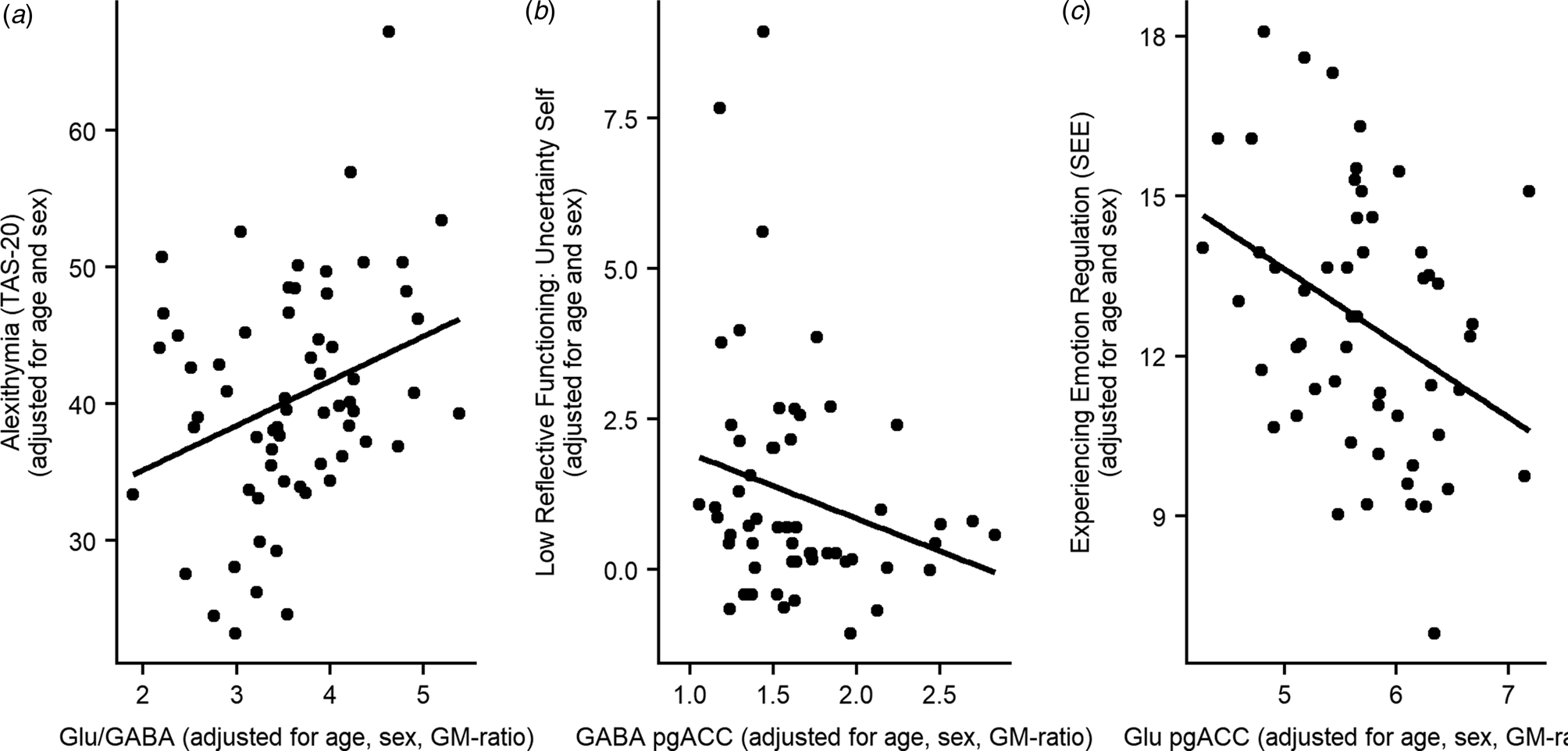
We then tested the association between alexithymia and E/I balance in a subsample (N = 46) with data from pgACC and dACC, to elucidate regional specificity of pgACC. There TAS-20 correlated with the pgACC Glu/GABA ratio [ρ(41) = 0.393, p = 0.009, CIboot(0.10–0.65)]. In contrast, the correlation between TAS-20 and the Glu/GABA ratio in the dACC was not significant [ρ(41) = 0.015, p = 0.923, CIboot (−0.32 to 0.34)]. The regional specificity was confirmed by a significant difference in correlations (Z = −2.11, p = 0.017). Therefore, follow-up analyses focused on metabolites in the pgACC, which lead to an increased sample size (N = 64). In this larger sample Glu/GABA ratio was still significantly correlated to TAS-20 [ρ(59) = 0.30, p = 0.019, CIboot (0.05–0.58), Fig. 2a]. Further analysis revealed an association of TAS-20 with GABA concentration in the pgACC on trend-level [uncorrected, ρ(59) = −0.223, p = 0.087, CIboot (−0.46 to 0.04)], and no association with Glu [ρ(59) = 0.043, p = 0.798, CIboot (−0.22 to 0.34)]. Similar results were found in the subsample of the primary analysis [GABA: ρ(41) = −0.314, p = 0.04, CIboot (−0.58 to −0.003); Glu: ρ(41) = 0.092, p = 0.557, CIboot (−0.23 to 0.43)].
Scatterplots of correlations between metabolite concentrations in the pgACC (corrected for age, sex and gray matter ratio) and alexithymia, automatic emotion regulation and reflective functioning (all corrected for age and sex). (a) Partial Spearman-rank correlation between alexithymia (TAS-20) and Glu/GABA corrected for age, sex and gray matter ratio, ρ(58) = 0.30, p = 0.019. (b) Spearman-rank correlation between experiencing emotion regulation (EER) and Glu corrected for age, sex and gray matter ratio, ρ(49) = −0.37, p = 0.008. (c) Spearman-rank correlation between Low Reflective Functioning: Uncertainty Self (LRFuS) and GABA corrected for age, sex and gray matter ratio, ρ(52) = −0.28, p = .041.

After confirming that alexithymia is associated with E/I balance in the pgACC, we analyzed correlations between possibly implicated emotion regulation facets and metabolite concentrations in subsamples with complete data for the respective measures.
We found that higher experience of emotion regulation (EER) was significantly correlated with lower Glu levels in pgACC [N = 54, ρ(49) = −0.37, p = 0.008, CIboot (−0.56 to −0.08)], Fig. 2b) on a corrected level, correlated with Glu/GABA on an uncorrected trend-level (ρ(49) = −0.24, p = 0.095, CIboot (−0.51 to 0.05)], and not correlated with GABA levels [ρ(49) = 0.06, p = 0.674, CIboot (−0.21 to 0.35)].
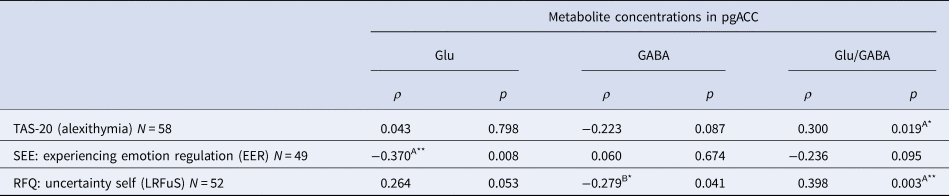
In contrast, cognitive contributions were more strongly related to the E/I balance. The Glu/GABA ratio was significantly correlated with low reflective functioning due to high uncertainty about mental states of oneself [N = 57, ρ(52) = 0.398, p = 0.003, CIboot (0.14–0.58)], surviving Bonferroni-correction. A significant negative correlation with GABA [ρ(52) = −0.28, p = 0.041, CIboot (−0.47 to −0.021), Fig. 2c] was additionally accompanied by a trend-level correlation with Glu levels [ρ(52) = 0.26, p = 0.053, CIboot (−0.0012 to 0.51)], although both correlations were on an uncorrected level (Table 1).
Correlations of alexithymia, reflective functioning and emotion regulation with metabolite concentrations in pgACC

All correlations are partial spearman-rank correlations corrected for age, sex, and gray matter proportion.
A*p < 0.05, Bonferroni corrected, A** p < 0.01, Bonferroni corrected; B* p < 0.05, uncorrected.
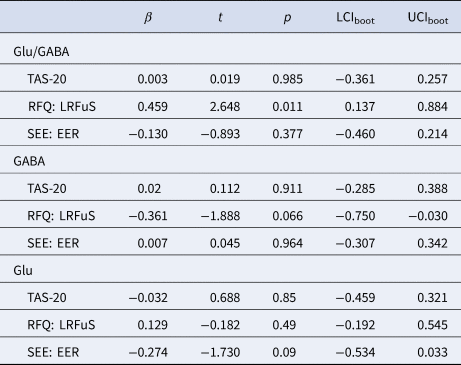
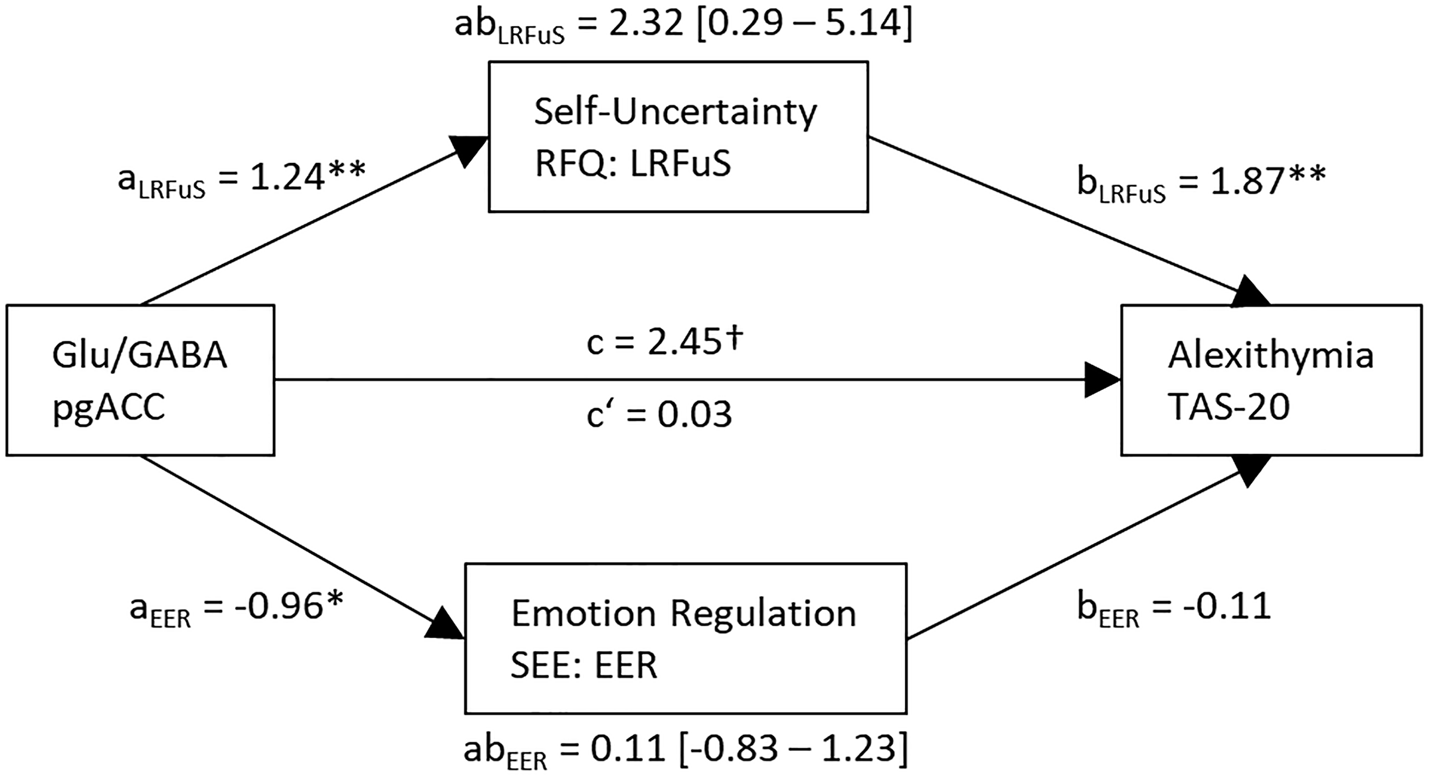
Lastly, we confirmed the general pattern of the correlation analyses in the subset (N = 49) with complete data for all variables using multiple regression analyses. The associations between Glu and EER [β = −0.274, p = 0.09, CIboot (−0.534 to 0.033)] as well as GABA and LRFuS [β = −0.361, p = 0.066, CIboot (−0.750 to −0.030)] were still significant on trend-level, while the other psychometric scales were not (Table 2). Critically, the association between alexithymia and Glu/GABA was not significant [β = 0.003, p = .985, CIboot (−0.361 to 0.257)] anymore when self-awareness [LRFuS, β = 0.459, p = 0.011, CIboot (0.137–0.884)] was added as additional predictor, indicating that the relationship between alexithymia and E/I balance is partly explained by self-awareness. Indeed, a mediation model revealed a significant indirect [2.32, CIboot (0.29–5.14), Fig. 3] effect for LRFuS as a mediator between pgACC Glu/GABA levels and alexithymia (TAS-20). In contrast, no significant indirect effect [0.11, CIboot (−0.83 to 1.23)] was found for EER.
Multiple regression analyses of metabolite concentrations in the pgACC by alexithymia and emotion regulation facets

All models include covariates for age, sex, and gray matter proportion.
The association between alexithymia (TAS-20) and Glu/GABA is mediated by Reflective Functioning (LRFuS). *p < 0.05, †p < 0.10.

Discussion
By combining behavioral and metabolic profiling, we have shown that the pgACC E/I profile correlated with alexithymia. Furthermore, proposed constructs implicated in alexithymia were distinctively correlated with inhibitory and excitatory transmitter concentrations. Impaired autonomic emotion regulation was associated with Glu. In contrast, lack of cognitive self-awareness was most strongly correlated with the E/I balance, which seems to be mainly driven by an association with GABA. However, additional contributions of Glu could not be excluded.
Our findings add to recent observations outlining the importance of the pgACC in alexithymia, in terms of brain activity (van der Velde et al., Reference van der Velde, Servaas, Goerlich, Bruggeman, Horton, Costafreda and Aleman2013) and metabolic associations (Ernst et al., Reference Ernst, Böker, Hättenschwiler, Schüpbach, Northoff, Seifritz and Grimm2014; Colic et al., Reference Colic, Demenescu, Li, Kaufmann, Krause, Metzger and Walter2016). The relationship between E/I balance in the pgACC (Table 1) and alexithymia supports our hypothesis that such an imbalance might represent an underlying mechanism in the complex pathophysiology of alexithymia. Multimodal imaging studies investigating E/I balance are still rare due to technical requirements for such MRS studies. Most commonly used editing sequences such as MEGA-PRESS, allowing sufficient detection accuracies for GABA also at 3 T, normally limit the accuracy for isolated glutamate measurements and allow solely the assessment of combined glutamine–glutamate (Glx) levels. Alternatives, e.g. 2D resolved spectroscopy would in principle overcome this problem, however, the inference on regional specificity is not possible, given the increased acquisition times per voxel (Dou et al., Reference Dou, Palomero-Gallagher, van Tol, Kaufmann, Zhong, Bernstein, Heinze, Speck and Walter2013). We benefited from equally well-suited measurements for both components of the E/I balance and for the first time investigated its regional profile in alexithymia. We found that associations between alexithymia and Glu/GABA levels differed significantly between pgACC and dACC. Similarly, using multiple single voxel PRESS sequences at 3 T, Colic et al. (Reference Colic, Demenescu, Li, Kaufmann, Krause, Metzger and Walter2016) found, that the association of alexithymia with N-acetylaspartate (NAA), a subtle indicator of neuronal integrity, was sex unspecific and restricted to the pgACC, while the association with Glx/NAA was specific for male participants in the dACC. Although extensive, our sample was not large enough to segregate sex-specific effects on the E/I balance; however, sex was considered as a covariate in our analysis. This and a more detailed investigation of relationships between subtle molecular and structural markers will have to be subject of future investigations.
Most importantly, different emotion regulation processes (automatic and cognitive) that are altered in alexithymia were indirectly related to the E/I balance through respective inhibitory and excitatory metabolites (Table 1). The sign of correlations herein needs to be interpreted in the context of the respective scaling: EER scores lowest for highest impairments in emotion regulation, while high-RFQ values indicate strongest deficits in self-awareness.
The negative correlation of experiencing emotion regulation and Glu levels in the pgACC (Table 1) supports our hypothesis that deficits related to automatic emotion processing might be related to excitatory inputs to the pgACC. The importance of the pgACC in emotion regulation and experience has been extensively reported (Etkin et al., Reference Etkin, Egner and Kalisch2011; Lee et al., Reference Lee, Heller, van Reekum, Nelson and Davidson2012; Victor et al., Reference Victor, Furey, Fromm, Bellgowan, Öhman and Drevets2012). Specifically, this association corresponds well with the emotion regulation model described by Phillips et al. (Reference Phillips, Ladouceur and Drevets2008) which postulated that feedforward mechanisms, initiating in the amygdala, passing through the pgACC and ending in medial prefrontal areas, are essential for automatic emotion regulation. These connections have been found directly affected, e.g. in bipolar patients, where anatomical fiber connections of the uncinate fasciculus, linking hippocampus and amygdala with the orbitofrontal cortex, showed altered fractional anisotropy in diffusion tensor imaging (DTI) (Versace et al., Reference Versace, Almeida, Hassel, Walsh, Novelli, Klein, Kupfer and Phillips2008; Lin et al., Reference Lin, Weng, Xie, Wu and Lei2011). The functional importance of Glu in the pgACC has been shown in functional connectivity between cortical and subcortical regions (Duncan et al., Reference Duncan, Enzi, Wiebking and Northoff2011, Reference Duncan, Wiebking, Tiret, Marjańska, Hayes, Lyttleton, Doyon and Northoff2013), activity at rest (Enzi et al., Reference Enzi, Duncan, Kaufmann, Tempelmann, Wiebking and Northoff2012), neural activity in response to emotional stimuli (Walter et al., Reference Walter, Henning, Grimm, Schulte, Beck, Dydak, Schnepf, Boeker, Boesiger and Northoff2009) and abnormal functional coupling (Horn et al., Reference Horn, Yu, Steiner, Buchmann, Kaufmann, Osoba, Eckert, Zierhut, Schiltz, He, Biswal, Bogerts and Walter2010) of the pgACC to the anterior insula, another region associated with alexithymia (Ernst et al., Reference Ernst, Böker, Hättenschwiler, Schüpbach, Northoff, Seifritz and Grimm2014). Importantly, glutamate metabolism of the pgACC is also altered in depressive disorders (Yüksel and Öngür, Reference Yüksel and Öngür2010; Taylor, Reference Taylor2014; Moriguchi et al., Reference Moriguchi, Takamiya, Noda, Horita, Wada, Tsugawa, Plitman, Sano, Tarumi, ElSalhy, Katayama, Ogyu, Miyazaki, Kishimoto, Graff-Guerrero, Meyer, Blumberger, Daskalakis, Mimura and Nakajima2018), for which alexithymia is a risk factor (Conrad et al., Reference Conrad, Wegener, Imbierowicz, Liedtke and Geiser2009).
Surprisingly, the direct association of automatic emotion regulation and alexithymia was not significant. One possible explanation is that alexithymia, at least measured with TAS-20, reflects cognitive and self-aware aspects of deficits in emotional understanding. Other questionnaires, such as Bermond–Vorst Alexithymia Questionnaire, measure automatic processing deficits in alexithymia more directly (Goerlich-Dobre et al., Reference Goerlich-Dobre, Bruce, Martens, Aleman and Hooker2014) and thus might be better suited to assess associations with EER.
In contrast to automatic emotion processing, self-uncertainty was correlated with the Glu/GABA and, at least on a trend-level, with Glu (positive) and GABA (negative) concentrations separately (Table 1). While this suggests that cognitive emotion regulation is not only related to inhibitory top-down signaling, GABAergic processes may still dominate this relationship. Nonetheless, the positive correlation with Glu/GABA and the negative correlation with GABA indicate that subjects with low GABA levels show strongest deficits in self-awareness. This strengthens the idea that the association of Glu/GABA and alexithymia also reflects GABAergic top-down processes from the cognitive control network (Northoff et al., Reference Northoff, Walter, Schulte, Beck, Dydak, Henning, Boeker, Grimm and Boesiger2007; Wiebking et al., Reference Wiebking, Duncan, Qin, Hayes, Lyttelton, Gravel, Verhaeghe, Kostikov, Schirrmacher, Reader, Bajbouj and Northoff2014) involved in generating self-awareness of emotions. The involvement of cognitive affect processing at the level of emotional self-awareness in alexithymia was supported by their positive correlation. More generally, the association between GABA and self-certainty corresponds to the emotion regulation model proposed by Phillips et al. (Reference Phillips, Ladouceur and Drevets2008), in which voluntary emotion regulation processes are mediated by feedback mechanisms from lateral and medial prefrontal areas to the ACC. Additionally, these cognitive control networks and the related pgACC have been implicated in the cognitive experience of emotions and self-judgments (Kjaer et al., Reference Kjaer, Bertelsen, Piccini, Brooks, Alving and Lou2002; Onoda et al., Reference Onoda, Okamoto, Nakashima, Nittono, Ura and Yamawaki2009; Denny et al., Reference Denny, Kober, Wager and Ochsner2012; D'Argembeau et al., Reference D'Argembeau, Jedidi, Balteau, Bahri, Phillips and Salmon2012).
The positive relationship between alexithymia and uncertainty about one's own mental states replicates findings from Badoud et al. (Reference Badoud, Luyten, Fonseca-Pedrero, Eliez, Fonagy and Debbané2015), who observed a positive correlation of alexithymia with the RFQ uncertainty scale. Further, this corresponds well to the previously described cognitive dimension of alexithymia, which is characterized by diminished abilities to name, evaluate and express one's own feelings (Aleman and Kahn, Reference Aleman and Kahn2005; Swart et al., Reference Swart, Kortekaas and Aleman2009).
Critically, cognitive self-awareness almost completely mediated the association between alexithymia and the E/I balance, whereas the experience of automatic emotion regulation did not. This suggests that the increased E/I balance in high alexithymia is predominantly driven by GABAergic processes of cognitive emotion regulation and self-awareness about feelings. In contrast, while automatic emotion regulation is related to Glu levels in pgACC, this relationship is not significantly reflected in alexithymia related alterations of the Glu/GABA ratio.
We could not explicitly replicate the previously reported specific association between the GABA concentration in pgACC and alexithymia in 22 subjects using MRS at 3 T by Ernst et al. (Reference Ernst, Böker, Hättenschwiler, Schüpbach, Northoff, Seifritz and Grimm2014) Instead we found an association of Glu/GABA ratio in the pgACC with alexithymia, while GABA was only correlated on trend-level (Table 1). Methodological differences between the two studies might contribute to discrepant findings; next to a much smaller sample size the voxel position was considerably different. In the present study outlines of the ACC subregions were confined to histoarchitectural and receptor-architectural boundaries (Dou et al., Reference Dou, Palomero-Gallagher, van Tol, Kaufmann, Zhong, Bernstein, Heinze, Speck and Walter2013), whereas Ernst et al. (Reference Ernst, Böker, Hättenschwiler, Schüpbach, Northoff, Seifritz and Grimm2014) relied on larger voxels to reach sufficient SNR given the low field strengths. Furthermore, inclusion of correction for gray matter content in the respective voxels, which was not done by Ernst et al. (Reference Ernst, Böker, Hättenschwiler, Schüpbach, Northoff, Seifritz and Grimm2014), has become feasible for most institutions and will hopefully lead to more consistent findings. Those limitations of the initial results by Ernst et al. (Reference Ernst, Böker, Hättenschwiler, Schüpbach, Northoff, Seifritz and Grimm2014) on isolated GABAergic effects may explain the difference to our finding of a more general effect of the Glu/GABA ratio.
To the best of our knowledge, a relationship between self-uncertainty and experience of emotion regulation has so far not been reported. A negative correlation between these two scales indicates that high uncertainty regarding the mental and emotional state of oneself is associated with the reduced experience of emotion regulation. While implications of both concepts in psychopathologies are often investigated separately, this finding is in accordance with the emotion regulation theories proposing that self-awareness and introspection are essential for the regulation of emotions (Koole, Reference Koole2009). Further evidence comes from a study by Sharp et al. (Reference Sharp, Pane, Ha, Venta, Patel, Sturek and Fonagy2011) describing a correlation between mentalizing and emotion regulation.
Limitations
The results and conclusions should be interpreted with caution, considering the demographic characteristics of the sample. The sample included only healthy subjects in the normal range of alexithymia. Accordingly, range and distribution included here (TAS-20: mean 40.33, s.d. 8.26, range 23–68) varied from large scale epidemiological samples as reported in Franz et al. (Reference Franz, Popp, Schaefer, Sitte, Schneider, Hardt, Decker and Braehler2008) (TAS-20: mean 48.8, s.d. 9.3; range 22–85). The screening for psychiatric disorders excluded participants with pathologic autistic characteristics, nonetheless there is considerable overlap between alexithymia and autism that we have not assessed with additional questionnaires. Therefore, further research is necessary to delineate alexithymia and autism-related processes. However, it has previously been shown, that alexithymia but not autism is related to emotion processing deficits (Bird et al., Reference Bird, Silani, Brindley, White, Frith and Singer2010; Bird and Cook, Reference Bird and Cook2013; Cook et al., Reference Cook, Brewer, Shah and Bird2013). Subjects were within the age range of 18–40 and thus results are not representative for children, adolescents or elderly, who can have distinct metabolite profiles (Brooks et al., Reference Brooks, Roberts, Kemp, Gosney, Lye and Whitehouse2001) and have been shown to differ in alexithymia scores and associated ACC gray matter volume (Paradiso et al., Reference Paradiso, Berardino, de Pinto, Sanita di Toppi, Storelli, Tommasi and De Gara2008). Further, values for all scales, but most prominently cognitive self-awareness, were not normally distributed. While we used appropriated non-parametric statistical methods that are robust to outliers, e.g. Spearman-rank correlations and bootstrapping, replication in a more heterogeneous sample would be advisable. Finally, it should be considered that data measured in this study representing excitation or inhibition, is not assessing the neuronal activity of regions or fiber connectivity between regions, but rather reflects average metabolite concentrations regardless of neuron or glia-specific origin. This makes MRS a non-specific measurement and individual differences in MRS transmitter estimates do not directly measure differences in synaptic/vesicular concentrations from one represented neural subtype (e.g. long-range projections from the prefrontal cortex) within a region. This may be crucial particularly when interpreting the lack of specificity for GABAergic mechanisms related to RFQ. Furthermore, regional metabolite concentrations, while used to decipher the state of the region of interest, do not explain the direct structural connectivity underlying the hypothesized bottom up and top-down processes. It would be necessary to perform studies using DTI, to further determine the connectivity leading to metabolite profiles and explain underlying mechanisms of autonomic and cognitive aspects of emotion processing.
Conclusion
We demonstrated that alexithymia is associated with the pgACC E/I balance. Variance in E/I balance seems to incorporate individual variations of GABA and Glu levels, which were shown to correlate differentially with automatic emotional experience and cognitive self-awareness. Although scales of automatic emotional experience and cognitive self-awareness dimensions were correlated with each other, their contribution to alexithymic features seems to reflect distinct biological mechanisms of feedforward and feedback control, which are integrated in this area and are important for general emotion regulation.