Introduction
Protracted and severe anti-Semitic persecutions before, after and during the Second World War genocide (Lemkin, Reference Lemkin1944), commonly known as the Holocaust (Bauer, Reference Bauer1992), generated maximum adversity among European Jews (Levav, Reference Levav and Dohrenwend1998). With time, reactive psychopathology was identified in many clinical and a few community-based studies (Levav, Reference Levav, Lindert and Levav2015). The latter have reported higher rates of emotional distress, sleep disturbances and common psychiatric disorders among survivors than in comparison groups (Sharon et al. Reference Sharon, Levav, Brodsky, Shemesh and Kohn2009; Barel et al. Reference Barel, Van, Sagi-Schwartz and Bakermans-Kranenburg2010). Despite their contributions, the community-based studies have methodological limitations. For example, most studies omitted reference to the severity or the nature of the traumatic experiences of the Holocaust. An exception, however, showed that the more severe the brutal experiences the greater the emotional distress (Fenig & Levav, Reference Fenig and Levav1991). Also, some studies simply identified the Holocaust exposure group as immigrants to Israel in the post-Second World War years, and the comparison group as pre-Second World War immigrants (e.g. Keinan-Boker et al. Reference Keinan-Boker, Vin-Raviv, Liphshitz, Linn and Barchana2009; Nakash et al. Reference Nakash, Liphshitz, Keinan-Boker and Levav2013; Sagi-Schwartz et al. Reference Sagi-Schwartz, Bakermans-Kranenburg, Linn and van Ijzendoorn2013). Hence refugees who fled the persecutions by the Nazi regimes in Germany and Austria, and arrived in pre-State Israel (1933–1939; a period in which severe persecutions started and concentration camps were established) were classified as unexposed in some of those studies.
To date, no study has ascertained the association between exposure to genocide and the risk of schizophrenia to provide evidence regarding its aetiology (Levav, Reference Levav, Lindert and Levav2015), or the effects of critical periods of Holocaust exposure, with a single exception (Levine et al. Reference Levine, Levav, Yoffe and Pugachova2014). However, theoretical notions (Selten & Cantor-Graae, Reference Selten and Cantor-Graae2007), aetiological considerations (Marenco & Weinberger, Reference Marenco and Weinberger2000) and empirical observations (Susser & Stein, Reference Susser and Stein1994; St Clair et al. Reference St Clair, Xu, Wang, Yu, Fang, Zhang, Zheng, Gu, Feng, Sham and He2005; Xu et al. Reference Xu, Sun, Liu, Feng, Yu, Yang, He, Sham, Susser, St Clair and He2009) make examining the association between genocide exposure and the risk of schizophrenia a relevant subject of inquiry and hypotheses testing.
We tested four hypotheses regarding the association between exposure to genocide and the incidence of schizophrenia, of which the first and second are competing, while the third and fourth are nested within the second. Hypothesis I proposes that the survivors are less likely to be at risk of schizophrenia, since the most vulnerable individuals were unlikely to have survived the multiple severe assaults of the Holocaust. These included the targeted killing or sterilization of between 73% and 100% of persons with schizophrenia (Torrey & Yolken, Reference Torrey and Yolken2010). Hence, persons with schizophrenia (Kral, Reference Kral1951) or those who may have developed the disorder had they survived, were likely to have been murdered (i.e. selective mortality). This may explain at least in part why survivors have been found to be resilient in community studies (Shuval, Reference Shuval1957; Antonovsky et al. Reference Antonovsky, Maoz, Dowty and Wijsenbeek1971), and, conceivably, at a reduced risk of schizophrenia. In contrast, hypothesis II states that Holocaust exposure increased the risk of schizophrenia. This risk may be due to prolonged intense exposures to multiple adversities that resulted in complex vulnerabilities. This is posited, for example, by the social defeat theory (Selten & Cantor-Graae, Reference Selten and Cantor-Graae2007) and supported by the epidemiological community-based surveys previously alluded to earlier (Sharon et al. Reference Sharon, Levav, Brodsky, Shemesh and Kohn2009; Barel et al. Reference Barel, Van, Sagi-Schwartz and Bakermans-Kranenburg2010; Levav, Reference Levav, Lindert and Levav2015).
Hypothesis III suggests that survivors with in utero (henceforth, likely in utero) initiated exposure to the Holocaust were at increased risk of schizophrenia. Evidence from studies of the Dutch famine in the Second World War and the Great Chinese Famine from 1958 to 1962 (Susser et al. Reference Susser, Neugebauer, Hoek, Brown, Lin, Labovitz and Gorman1996; St Clair et al. Reference St Clair, Xu, Wang, Yu, Fang, Zhang, Zheng, Gu, Feng, Sham and He2005) converged to show that compared with those born in famine-free periods, prenatal famine exposure was associated with a two-fold risk of schizophrenia. In contrast, significantly elevated risk for schizophrenia was not observed following prenatal exposure to the Yom Kippur War in 1973–1974 (Selten et al. Reference Selten, Cantor-Graae, Nahon, Levav, Aleman and Kahn2003). The exposures to this war and the Holocaust constitute highly stressful events, but the latter was considerably more severe inasmuch as it was protracted, disrupted entire social support networks by death, internment and other means, as well as being chronically accompanied by malnutrition and disease. This suggests that prenatal stress that imprints on the in utero fetus is specific to extreme and close psychosocial and/or physical proximity to prolonged adversities and/or malnutrition. This may be imputed to folic acid deficiency and neural tube defects (Weinberger, Reference Weinberger1986; Marenco & Weinberger, Reference Marenco and Weinberger2000). Although malnutrition, including starvation (Eitinger, Reference Eitinger1972) and famine (Helweg-Larsen et al. Reference Helweg-Larsen, Hoffmeyer, Kieler, Hess Thaysen, Hess Thaysen, Thygesen and Hertel Wulff1952), were salient and prolonged conditions among Holocaust adversities (Eitinger, Reference Eitinger1972; Bachar et al. Reference Bachar, Canetti and Berry2005), the effect of prenatal genocide exposure on the risk of developing schizophrenia is unknown. Hypothesis IV submits that childhood is a sensitive period during which exposure to severe traumas potentially increases the risk of schizophrenia (Morgan & Fisher, Reference Morgan and Fisher2007; Varese et al. Reference Varese, Smeets, Drukker, Lieverse, Lataster, Viechtbauer, Read, van Os and Bentall2012).
We tested these hypotheses by contrasting directly affected Holocaust survivors with an ethnically identical comparison group with relational trauma (Pat-Horenczyk et al. Reference Pat-Horenczyk, Ziv, Asulin-Peretz, Achituv, Cohen and Brom2013) using a population-based study design.
Method
The Institutional Review Board at the University of Haifa approved linking the study data sources with a waiver of written informed consent. Data sources were provided by: the Ministry of the Interior, to identify the study population; the Central Bureau of Statistics (CBS) (Central Bureau of Statistics, 1995), for socio-economic status (SES) information; and the Ministry of Health (2009), to ascertain the individuals with schizophrenia disorder. Common unique identification numbers were encrypted prior to receiving the data to ensure participant anonymity and confidentiality.
Nationwide population register of the Ministry of the Interior
It was reported that of the Holocaust survivors who immigrated to Israel, 90% were born after 1920 (Eitinger, Reference Eitinger1972). Hence, our study population consisted of all Jews born in Holocaust-exposed European countries from 1928 to 1945, who immigrated to Israel by 1966. Data were at the individual level and included encrypted identification numbers; birth, immigration and death years; nation of birth; and city of residence.
CBS registry (Central Bureau of Statistics, 1995)
This registry enabled the identification of each person's residential status area (i.e. a neighbourhood measure of SES). This measure of SES is derived from household census data that are based on number of electrical appliances per person and per capita income. Residential status was obtained by linking each individual's first address from the Population Register of the Ministry of the Interior with the CBS census track and neighbourhood ranking.
Ascertainment of schizophrenia
National Psychiatric Case Registry (NPCR)
Psychiatric care in Israel is freely available by law to all de-jure residents (Levav & Grinshpoon, Reference Levav and Grinshpoon2004). Psychiatric hospitalization was the prevailing treatment policy for psychotic disorders during a majority of the study years. Since 2001 onward, however, the national healthcare policy has slightly reduced in-patient psychiatric hospitalization rates. The NCPR started in 1950 and consists of all psychiatric hospitalizations in mental or general hospitals that take place in the country. Research has found that the NPCR captures almost all people with schizophrenia among Israel-born Jews (Weiser et al. Reference Weiser, Werbeloff, Dohrenwend, Levav, Yoffe and Davidson2012). The law mandates that all in-patient and day-care psychiatric settings submit information on all admissions to the Ministry of Health. A special unit verifies reporting compliance, updating diagnostic coding schemes and information consistency. The information in the registry included admission and discharge dates, and International Classification of Diseases (ICD)-10 discharge and admission diagnoses made by a board-certified psychiatrist.
NPCR diagnosis
The current study used the last registry diagnosis of schizophrenia at the time of discharge, or upon admission if the hospitalization was current or the patient died in hospital. Validation research has shown that the last diagnosis of schizophrenia in the NPCR has acceptable sensitivity and specificity when assessed against research diagnosis (Weiser et al. Reference Weiser, Kanyas, Malaspina, Harvey, Glick, Goetz, Karni, Yakir, Turetsky, Fennig, Nahon, Lerer and Davidson2005), and is longitudinally reliable (Rabinowitz et al. Reference Rabinowitz, Slyuzberg, Ritsner, Mark, Popper and Ginath1994). Prior studies used a similar approach to ascertain a diagnosis of schizophrenia in this registry (Davidson et al. Reference Davidson, Reichenberg, Rabinowitz, Weiser, Kaplan and Mark1999; Weiser et al. Reference Weiser, Reichenberg, Rabinowitz, Kaplan, Mark, Nahon and Davidson2000; Levav et al. Reference Levav, Lipshitz, Novikov, Pugachova, Kohn, Barchana, Ponizovsky and Werner2007).
Statistical analysis
Exposure groups and subgroups
The population studied was disaggregated into exposure groups and subgroups. Across all analyses, the comparison group comprised of Jewish persons born in European nations where the Holocaust occurred, and had immigrated to pre-State Israel before the anti-Semitic persecution begun or markedly increased in their respective country of origin. This group did not directly experience the Holocaust, but probably had family and social ties (relational trauma) to people who did; this is the likely ‘indirect’ exposure group (Pat-Horenczyk et al. Reference Pat-Horenczyk, Ziv, Asulin-Peretz, Achituv, Cohen and Brom2013).
The likely ‘direct’ exposure group comprised of all persons in the study population who immigrated in Israel after the end of the Second World War (1945). The initial period of exposure was the year that the Nazi occupation or fascist ruling began in each nation (Bauer, Reference Bauer1992) (e.g. Germany, 1933; see online Supplementary Table S1). Our classification thus differs from all other Holocaust studies (e.g. Keinan-Boker et al. Reference Keinan-Boker, Vin-Raviv, Liphshitz, Linn and Barchana2009) that define the indirect group, based on pre-Second World War immigration and the direct group based on post-Second World War immigration, after 1945.
The likely direct exposure group was further classified as subgroups according to the initial developmental period of exposure: (a) ‘likely in utero only’ subgroup, if they were born at the last year of the war (e.g. 1945); (b) combined ‘likely in utero and postnatal’ subgroup, if they were born during the war and survived a period of postnatal exposure (e.g. born in Germany in the years 1933–1944); and (c) ‘likely early postnatal’ subgroup, if their initial Holocaust exposure occurred by age 1–2 years (e.g. born in Germany in the years 1931 or 1932), that coincides with the critical period up to the age of 2 years, as defined by a consensus expert committee (Shonkoff et al. Reference Shonkoff, Boyce and McEwen2009); and (d) ‘likely late postnatal’ subgroup (e.g. born 1928–1930 in Germany).
Data analysis
First, numbers and incidence rates of psychiatric hospitalization for schizophrenia were computed. Rates were computed using a previously validated and used R function (Aragón et al. Reference Aragón, Enanoria, Fay, Porco and Samuel2007). Second, survival analyses were computed to examine the outcome, age at first psychiatric hospitalization for schizophrenia following immigration.
Kaplan–Meier estimates were computed to examine the average age at first psychiatric hospitalization in Israel for schizophrenia. Hazard ratios (HRs) from Cox regression were examined to test the hypotheses regarding subgroup differences following standard guidelines (Therneau, Reference Therneau2000). The HR is the ratio between groups in instantaneous risk over the study time. Values with associated 95% confidence intervals (CIs) crossing the unity mean that there is no difference in survival between the subgroups. Hence, since across analytical models the indirect exposure group was the reference group, a HR and corresponding 95% CI over 1 mean a greater risk for schizophrenia for the exposure subgroup. The survival times were computed to account for censoring (i.e. death of subject or end of follow-up without a diagnosis). All analyses were computed adjusting for birth year, sex and SES with the survival package in R Core Team (2014).
Three sensitivity analyses were conducted by re-computing the Cox regression model adjusting for birth year, sex and SES. The first sensitivity analysis was computed from age 18 years onward, because the first psychiatric hospitalization took place at age 18 years in both direct and indirect exposure groups. Specifically, before the age of 18 years in the direct exposure group, but not in the comparison group, 58 persons had been hospitalized. The second sensitivity analysis was computed to the age of 60 years to account for late-onset schizophrenia; hence persons after the age of 60 years were excluded from the analysis. The third sensitivity analysis was computed to the year 2001, to account for the psychiatric beds downsizing policy that was implemented from that year onwards. Hence persons hospitalized after 2001 were removed from the analysis.
Results
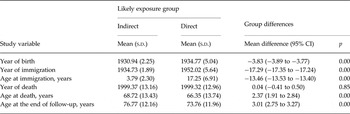
The population (N = 113 932) mean birth year was 1934 (s.d. = 0.5), and comprised of more females (n = 58 903; 51.7%) than males (n = 55 029; 48.3%). The direct exposure group was statistically significantly (p < 0.05) born later, immigrated later and at an older age, died at a younger age, and ended the study at a younger age compared with the indirect exposure group. Group differences on the calendar year of death were not statistically significant (Table 1).
Exposure groups by study periods

s.d., Standard deviation; CI, confidence interval.
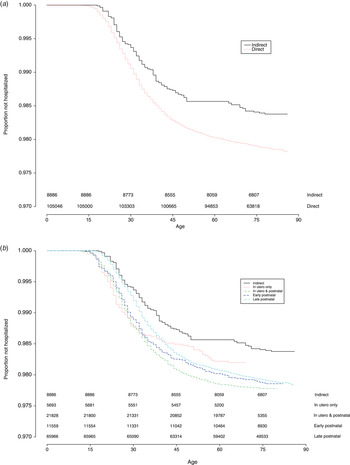
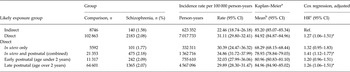
The likely direct exposure group, as well as the following three subgroups: likely combined in utero and postnatal, early postnatal (age under 2 years), and late postnatal (over age 2 years) had a higher incidence rate of schizophrenia than the likely indirect exposure group (Table 2). In contrast, the difference between the in utero only exposure subgroup and the likely indirect exposure group did not reach statistical significance based on non-overlapping CIs. Based on Kaplan–Meier estimates each likely direct exposure subgroup had significantly younger age at first psychiatric hospitalization for schizophrenia than the indirect exposure group (based on non-overlapping CIs in Table 2). For clarity, this is illustrated in Fig. 1a and b .
Survival curves depicting age at first psychiatric hospitalization for schizophrenia. (a) Direct and indirect exposure groups; (b) indirect, in utero only, in utero and postnatal, early postnatal and late postnatal exposure groups. The vertical axis is the proportion with a psychiatric hospitalization for schizophrenia, the horizontal axis is time (age, years), and the numbers above the horizontal are numbers at relative risk every 15 years.

Risk of schizophrenia and critical periods of genocide exposure

CI, Confidence interval; HR, hazard ratio; Ref., reference.
a Kaplan–Meier analysis estimated the years from immigration to the first psychiatric hospitalization or censoring (by death or end of follow-up).
b Estimated mean from the Kaplan–Meier analysis.
c HR is the ratio between groups in instantaneous risk over the study time and is adjusted for birth year, sex and socio-economic status.
* Statistically significant (p < 0.05).
The likely direct and indirect exposure groups were compared on the risk of schizophrenia using two Cox regression models. First, the likely direct exposure group had a statistically (p < 0.05) higher risk of schizophrenia (HR = 1.27, 95% CI 1.06–1.51; Table 2) than the indirect group. Second, the likely combined in utero and postnatal (HR = 1.41, 95% CI 1.12–1.77), and late postnatal subgroups (over age 2 years; HR = 1.26, 95% CI 1.06–1.51) were at statistically (p < 0.05) greater risk of schizophrenia than the indirect group. The likely in utero only exposure and early postnatal exposure subgroups did not significantly differ statistically from the indirect group (Table 2).
Sensitivity analysis
We computed three sensitivity analyses by removing persons with a first psychiatric hospitalization: (a) before the age of 18 years to attain equal initial ages at first hospitalization across groups; (b) after the age of 60 years, to account for late-onset of schizophrenia; and (c) after 2000, to account for the psychiatric bed downsizing policy. Across sensitivity analyses, the same statistically significant trend replicated as in the primary analysis (see online Supplementary Table S2). Specifically, the likely combined in utero and postnatal, and late postnatal (over age 2 years) exposure subgroups were at statistically (p < 0.05) greater risk of schizophrenia than the indirect group. The likely in utero only and early postnatal exposure subgroups did not significantly differ statistically from the indirect group (see online Supplementary Table S2).
Discussion
This study is the first population-based study to examine the association between critical periods of and exposure to genocide and the risk of schizophrenia. Persons were followed up to 64 years (1950–2014) for the risk of schizophrenia to delineate the effects of genocide exposures compared with a suitable group. Four hypotheses by which exposure to genocide could have altered the risk of schizophrenia were tested. The results showed that, compared with the indirect exposure group, the direct exposure group, the likely combined in utero and postnatal exposure and the late postnatal exposure subgroups were at a modest yet significantly elevated risk of schizophrenia. However, compared with the indirect exposure group, the likely in utero only and early postnatal exposure subgroups did not differ on the risk of schizophrenia.
Hypothesis I, that states that selective mortality left alive resilient survivors thus reducing the risk of schizophrenia among the direct exposure group (Solomon & Prager, Reference Solomon and Prager1992; Barel et al. Reference Barel, Van, Sagi-Schwartz and Bakermans-Kranenburg2010; Sagi-Schwartz et al. Reference Sagi-Schwartz, Bakermans-Kranenburg, Linn and van Ijzendoorn2013), was rejected. Selective mortality most likely occurred, although some vulnerable people may have remained alive, such as those who were hidden (e.g. by non-Jewish families). Nonetheless, it was insufficient to attain the hypothesized risk reduction in schizophrenia. This suggests that the levels of survivor resilience observed in other studies do not extend to schizophrenia. Conversely, hypothesis II, exposure to the maximum adversities of the Holocaust resulted in multiple vulnerabilities, was supported since compared with the indirect exposure group, survivors were at a modest statistically yet significant increased risk of schizophrenia.
Contrary to hypothesis III, in utero exposure alone did not elevate the risk of schizophrenia, possibly due to selective mortality of vulnerable fetuses or miscarriage. However, the subgroup with combined initial in utero followed by postnatal exposures had a modest but significant elevated risk of schizophrenia. This is consistent with the hypothesis that origins of adult disease result from cumulative damage over time or by biological embedding of adversities within sensitive developmental periods (Shonkoff et al. Reference Shonkoff, Boyce and McEwen2009). Several mechanisms could be implicated in prenatal stress. These include, initial critical period insults may occur in utero to the fetal immune system (Marques et al. Reference Marques, O'Connor, Roth, Susser and Bjorke-Monsen2013), increase glucocorticoid levels and hypothalamic–pituitary–adrenal axis activity (Harris & Seckl, Reference Harris and Seckl2011), and/or viral infections, hence disrupting neural development (Elmer et al. Reference Elmer, Estes, Barrow and McAllister2013). Possibly, as suggested by the results, these factors ‘programmed’ the unborn fetus to maladaptive reaction in a highly stressful postnatal environment.
Hypothesis IV, that childhood and adolescence constitute a sensitive period for the risk of schizophrenia under conditions of severe stress, received support (Morgan & Fisher, Reference Morgan and Fisher2007; Varese et al. Reference Varese, Smeets, Drukker, Lieverse, Lataster, Viechtbauer, Read, van Os and Bentall2012). This hypothesis proposes that the association between purposeful inflicted childhood trauma and risk of schizophrenia reflects the ‘putative pathogenic influence of the experience of (chronic) humiliation’ (Selten et al. Reference Selten, van der Ven, Rutten and Cantor-Graae2013). Collectively, this may indicate that a mechanism of specific childhood neurological developmental disturbances increase the risk of schizophrenia. This is consistent with the neurodevelopmental hypothesis positing childhood as a critical period for development (Murray & Lewis, Reference Murray and Lewis1987; Weinberger, Reference Weinberger1987).
Limitations and conclusions
There are a few limitations to the current study. First, since 6 of the 9 million Jews of Europe were murdered by the Nazis, selective mortality is plausible. Our results show some evidence of this. A second limitation refers to the nature of the case-registry diagnoses that are not based on research criteria. Despite this concern, research evidence supports the validity and reliability of the diagnoses in this data registry (Rabinowitz et al. Reference Rabinowitz, Slyuzberg, Ritsner, Mark, Popper and Ginath1994; Weiser et al. Reference Weiser, Kanyas, Malaspina, Harvey, Glick, Goetz, Karni, Yakir, Turetsky, Fennig, Nahon, Lerer and Davidson2005, Reference Weiser, Werbeloff, Dohrenwend, Levav, Yoffe and Davidson2012).
Third, we had no information to identify the exact developmental period that prenatal exposure may have had an effect on the risk of schizophrenia. Namely, there are no traceable records on the exact gestational month and precise traumatic experiences the mother endured. Furthermore, based on available information, our data contain birth and immigration years only. Consequently, some pre- and postnatal periods may have been misclassified. For this reason the denomination we used in the text was a conservative ‘likely’ exposure. Compared with prior studies of prenatal adversity and the Holocaust, the absence of prenatal dietary information in the current study data resembles the Chinese famine (St Clair et al. Reference St Clair, Xu, Wang, Yu, Fang, Zhang, Zheng, Gu, Feng, Sham and He2005) and prior epidemiological Holocaust studies (e.g. Keinan-Boker et al. Reference Keinan-Boker, Vin-Raviv, Liphshitz, Linn and Barchana2009; Nakash et al. Reference Nakash, Liphshitz, Keinan-Boker and Levav2013; Sagi-Schwartz et al. Reference Sagi-Schwartz, Bakermans-Kranenburg, Linn and van Ijzendoorn2013), yet differs from the Dutch famine data (Xu et al. Reference Xu, Sun, Liu, Feng, Yu, Yang, He, Sham, Susser, St Clair and He2009). However, as has been noted, famine studies classify individuals as being with ‘likely famine exposure’ based on their presence in a famine setting using well-defined periods and geographical areas. Like those studies, ours is an ecological measure of exposure, insofar as there are no data on individual food intake (Lumey et al. Reference Lumey, Stein and Susser2011). Furthermore, compared with the famine studies, exposure to adversity in the current study was as severe as in the Chinese famine where in excess of 15 million people perished, but the stressors were more heterogeneous, being comprised of more protracted psychological, social and biological, including nutritional, adversities. To address the timing of exposure, we accounted for the period of exposure to Nazi or fascist persecutions within each nation by birth year.
Fourth, Israel was a nation with relatively high emigration rates at certain periods of its history, which is unaccounted for in our analysis. Nonetheless, emigration from 1951 dropped almost linearly to the post-1973 Yom Kippur War (Cohen, Reference Cohen1988), a period by which the youngest birth-cohort individuals (born in 1945) would have been aged 28 years. That age is past the average age of the first lifetime psychiatric hospitalization for schizophrenia in Israel (approximately 22 years). Also, in Israel, all Jewish residents were screened – and if needed, diagnosed – at the age of 16–17 years for the military, drafted to the army by law from the ages of 18 to 21 years, and medically attended during the active and reserve duty services. Therefore, missing cases were unlikely. Also, the national ethos and legislation at that time discouraged emigration prior to military service (Cohen, Reference Cohen1988). The aforementioned factors made the emigration option for persons with schizophrenia very rare. Collectively, this suggests that while emigration may have influenced the study results, it is unlikely that its size manifestly affected the study conclusion.
Fifth, we omitted a non-immigrating Jewish–Israeli group for comparison purposes. Such a group could have introduced mixed ethnicity, making comparison less stringent (i.e. a comparison group without relational exposure; a possible different gene pool). Additionally, non-immigrant Jews of European descent born during the study period probably had family-based relational trauma.
Sixth, we did not examine social mobility. That is relevant because frequently persons who develop schizophrenia do not achieve the social class they were born into, and drift into a lower social class by the time of initial contact with psychiatric care (Jones et al. Reference Jones, Bebbington, Foerster, Lewis, Murray, Russell, Sham, Toone and Wilkins1993). Nonetheless, we prospectively adjusted for sex, birth year and SES (that had a significant effect in our results: HR = 1.30, 95% CI 1.19–1.41).
Several strengths balance the study limitations. First, the indirect exposure comparison group had probably been affected by relational trauma (Pat-Horenczyk et al. Reference Pat-Horenczyk, Ziv, Asulin-Peretz, Achituv, Cohen and Brom2013). This raises the stringency of the comparator group inasmuch as it reduces the difference with the direct exposure group. Second, the study design was strengthened by the use of documented psychiatric admissions, a population-based case registry that captures most individuals with schizophrenia (Dohrenwend et al. Reference Dohrenwend, Levav, Shrout, Schwartz, Naveh, Link, Skodol and Stueve1992), a large sample size, and an extensive follow-up period of up to 64 years.
In conclusion, the current study results demonstrate that compared with suitable counterparts, the combined prenatal and postnatal, as well as postnatal (i.e. childhood and adolescence) exposures to the maximal adversities of genocide constitute a critical period that elevates the risk of schizophrenia, due to likely malnutrition, neurodevelopmental insults and psychosocial adversities. Our findings inform health policy decision makers about genocide survivors, as well as complementing and extending existing results regarding the role of famine and most severe stress in early life.
Supplementary material
For supplementary material accompanying this paper visit http://dx.doi.org/10.1017/S0033291715002354
Acknowledgements
This study is part of a larger project on the psychiatric aftermath of the Holocaust jointly supported by non-overlapping funds from the Claims Conference and Israel Science Foundation. Through recovering the assets of the victims of the Holocaust, the Claims Conference enables organizations around the world to provide education about the Shoah and to preserve the memory of those who perished. This research was supported by the Israel Science Foundation (grant no. 130/13) and the Claims Conference (grant no. 14441). This work may or may not reflect the views of these funding bodies. Neither funding body provided feedback on this paper.
We thank Professor Yehuda Bauer who clarified the years of increased/onset and desistence of persecution per country.
Declaration of Interest
I.L. and Y.G. report no disclosure. R.Y., Y.B. and I.P. are employees of the Ministry of Health, Israel. In unrelated work S.Z.L. has received research support, and/or consultancy fees and/or travel support from Maccabi Healthcare Services, F. Hoffmann-La Roche, Shire Pharmaceuticals and Eli Lilly that are not relevant to this study.