Introduction
A central endeavor of variationist sociolinguistics is to inform understandings of the mechanisms of linguistic change through the analysis of synchronic patterns of variation. Since the emergence of variationist linguistics in the 1960s and 1970s (Weinreich, Labov, & Herzog Reference Weinreich, Labov, Herzog, Lehmann and Malkiel1968; Labov Reference Labov1972; Trudgill Reference Trudgill1974), many variables have been identified as undergoing change in progress using the methods of apparent time analysis. Accompanying a characterization of change in progress is a trajectory for that change, with the concomitant assumption that change will continue along the identified trajectory. Some recent scholarship, however, has profiled variables identified as undergoing change in progress in a particular direction that have abruptly reversed their trajectory in a short time (Labov, Rosenfelder, & Fruehwald Reference Labov, Rosenfelder and Fruehwald2013).
This article documents the reversal of a change in progress for a salient feature of New York City English (NYCE), raised boughtFootnote 1 (productions of the vowel /ɔ/ with low F1 valuesFootnote 2 in words like coffee, awful, and dog), and argues that bought's social meaning sheds light on its reversal. A variationist analysis of production data conducted on the Lower East Side neighborhood from 2006–2009 demonstrates that the use of raised bought by Lower East Siders is in decline. In 1966, bought-raising was found to be a change in progress from below that would continue to spread in NYCE, led by central class groups, women, and speakers of Jewish ethnicity. In the half century since, however, bought's trajectory has reversed and the Lower East Side community is lowering bought in apparent time, a change led by young people, white and Jewish speakers, and the upper middle and lower middle classes. A second source of data are perceptions of bought gathered from a matched guise experiment, which establish raised bought's indexical field (Eckert Reference Eckert2008), a set of related social meanings that describe an older, white ethnic New Yorker from the outer boroughs who is mean and aloof. These social meanings, which comprise a ‘classic New Yorker’ persona that is negatively evaluated, provide the context for bought's reversal and highlight the impact of social meaning on the trajectory of linguistic change.
The importance of social meaning and social evaluation to the mechanisms of language change was clear as early as Labov (Reference Labov1963), which found that residents of Martha's Vineyard with positive orientations towards the island produced the most centralized /ay/ and /aw/ diphthongs. These variables, which initially served as a geographic distinction between Vineyarders and Mainlanders, came to index a locally specific character type, a ‘dramatized island character’ (Labov Reference Labov1963:37) that connected speakers to an ‘English stock fisherfolk’ persona (Eckert Reference Eckert2004:43). This connection allowed younger speakers to use /ay/ and /aw/ to index an iconic, authentic Vineyarder and so reject the encroachment of summer tourism from the Massachusetts mainland. In this case, centralized /ay/ and /aw/ took on positive social meanings in the local Vineyard context, and were used by speakers to reverse the broader change towards decentralization happening in New England. The broader norm of decentralization had the prestige of the standard language ideology (Milroy & Milroy Reference Milroy and Milroy2012), while in contrast centralization of /ay/ and /aw/ held covert prestige, or a favorable connection to nonstandard language and its users (Trudgill Reference Trudgill1972). Indeed, Eckert (Reference Eckert2004) argues that ‘prestige and stigma…have come to be the primary social meanings associated with variables’ (2004:45). Recent third wave variationist studies (Eckert Reference Eckert2012) have worked to centralize social meaning more generally in sociolinguistic studies of variation, effectively demonstrating the indexical relationships between linguistic variables and social information and describing the processes by which social meaning arises in local interaction ( Zhang Reference Zhang2005, Reference Zhang2008; Podesva Reference Podesva2007; Eckert Reference Eckert2008; Campbell-Kibler Reference Campbell-Kibler2009, Reference Campbell-Kibler2010). Third wave scholarship moves beyond prestige and stigma as the primary social meanings that variables index, citing a range of social information that social actors link with variables in local contexts, from stances and attributes like tough or authentic to macrodemographic categories like working-class or woman to holistic speaker styles like Valley Girl or Beijing Smooth Operator (Ochs Reference Ochs, Duranti and Goodwin1992; Eckert Reference Eckert2004, Reference Eckert2008; Zhang Reference Zhang2008). The richness of these links between the social world and linguistic variables, in combination with a perspective on speakers as agentic social actors, has led some scholars to build off the early findings from Martha's Vineyard and argue that social meaning is a central component of language change (Milroy Reference Milroy and Fought2004; Woolard Reference Woolard2008).
This article aligns with work from Labov (Reference Labov1963) to the third wave in highlighting the social meaning of an iconic feature of NYCE that has reversed its trajectory of change. The seminal work from Labov (Reference Labov1966) established that NYCE speakers were sensitive to the stigma of NYCE variables. In subjective reaction tests, they consistently demonstrated a mismatch between reports of their own language use and what they viewed as ‘correct speech’, which came to be the primary evidence for their linguistic insecurity (Labov Reference Labov1972). Further, they behaved in response to this perceived stigma of NYCE variables in production. The most well-known case is variable nonrhoticity in the syllable coda, or the variable (r). Nonrhoticity was the prestige norm in New York City before World War II, but in the post-war decades (r) began undergoing change in the direction of rhoticity, a change socially motivated by the stigma of nonrhoticity as nonstandard in North American English (Labov Reference Labov1966; Labov, Ash, & Boberg Reference Labov, Ash and Boberg2006; Becker Reference Becker2009, Reference Becker2014a). The change to rhoticity is a classic case of change from above, characterized by awareness of and movement towards the overt prestige of a variable. Other variables analyzed in the 1966 work, including raised bought, were characterized as changes from below, thought to fall below the level of social awareness. While (r) was expected to continue on its trajectory of change in the direction of increased rhoticity, raised bought's trajectory was in the direction of further raising, both in the vowel space and in NYCE.
Changes from below and above (the level of speaker social awareness) are characterized by assessing a speech community's social evaluation of a variable along the continuum of prestige and stigma. Given that the stigma of NYCE is widespread not just within New York City, but outside of it as well (Niedzielski & Preston Reference Niedzielski and Preston2003), it is perhaps not a surprise that variables first considered to be changes from below might later reverse as speakers become sensitive to stigma. As Labov notes, ‘social reaction may afterwards fasten on the results of such a change, and force a reversal in whole or in part by pressure from above’ (1966:224). This article attempts to move beyond a basic dichotomy between prestige and stigma, and between change from above and change from below, by exploring the complex social meanings of raised bought. Instead of finding that raised bought is simply stigmatized, results show that the variable indexes a specific New York character type—an older, white ethnic from the outer boroughs. Further, raised bought indexes negative personality attributes, specifically the qualities mean and aloof. The reversal of the change for raised bought is best understood when foregrounding this ‘classic New Yorker’ persona, moving beyond prestige and stigma to the complex social meanings that drive speaker withdrawal from raised bought.
Raised bought in NYCE
Raised bought has been documented as a feature of NYCE since the mid-twentieth century (Thomas Reference Thomas1942, Reference Thomas1947; Frank Reference Frank1948; Hubbell Reference Hubbell1950; Westmore Reference Westmore1959; Labov Reference Labov1966; Berger Reference Berger1968; Labov et al. Reference Labov, Ash and Boberg2006). Although raised bought is produced along the eastern seaboard from Providence south to Baltimore (Labov et al. Reference Labov, Ash and Boberg2006), in NYCE it is part of a larger set of long and ingliding vowels that are considered unique to the dialect due to NYCE's continued variable nonrhoticity. A nonrhotic speaker can produce a full set of long and ingliding vowels, including long vowels in rhotic contexts (beer, bare, boor, bore, and bar) which become long and ingliding diphthongs when /r/ is vocalized or deleted, and long and ingliding balm in words like father and spa. NYCE also traditionally maintains a short-a split (of bad and bat), where a complex set of constraints condition the fronting and raising of bad (Labov Reference Labov2007; Becker & Wong Reference Becker and Wong2009). The nuclei of bad and bought were found to raise in parallel along the vowel periphery in Labov (Reference Labov1966) and even merge with the nonrhotic mid and high vowels in the front and back respectively.
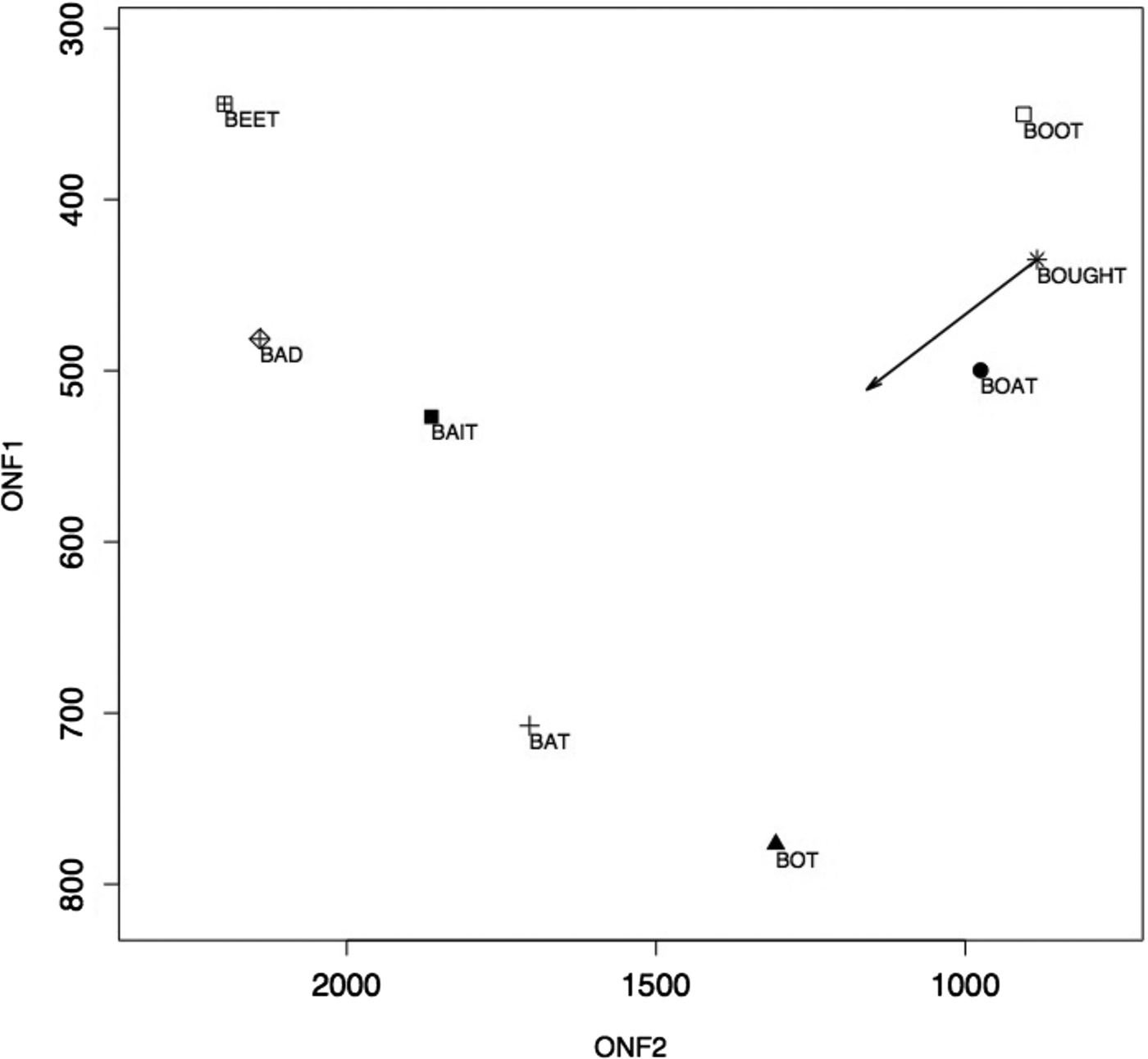
Acoustically, the Atlas of North American English provides a ‘cut-off’ for raised bought, with F1 values at or less than 700 Hz considered raised and those with F1 values above 700 Hz considered nonraised (2006:108). Figure 1 displays the vowel plot for Michael, a white Lower East Sider born in 1933 and interviewed for Becker (Reference Becker2010), who shows a traditional NYCE vowel system with a raised and ingliding bought well above the cut-off line of 700 Hz. Michael also has the traditional NYCE short-a split, with bad raised and fronted along the front vowel periphery.
Vowel plot for Michael, born on the Lower East Side in 1933.

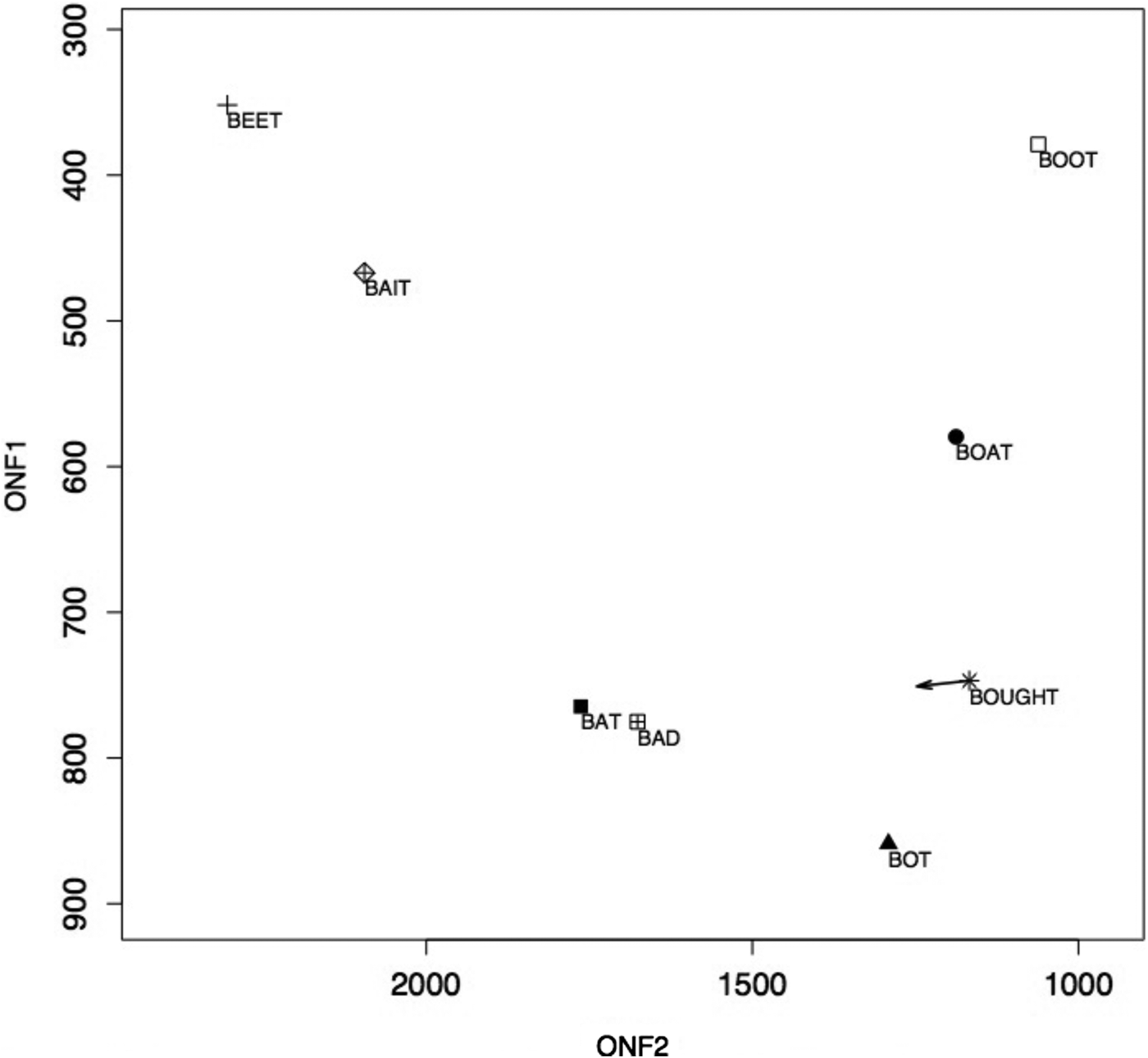
In contrast, Figure 2 displays the vowel plot for Sam, a white Lower East Sider born in 1984. Sam's bought does not meet the cut-off for raised bought provided by the Atlas of North American English. His bad is also not raised and does not appear to be distinct from bat.
Vowel plot for Sam, born on the Lower East Side in 1984.
Michael produces the classic NYCE vowel system, including raised bought, that was profiled in Labov (Reference Labov1966). Labov's study found bought to be a change in progress from below in the direction of raising. The variable showed the curvilinear distribution indicative of change from below, with the central class groups leading in use of raised bought, as well as hypercorrection by the lower middle class in formal contextual styles (1966:171–72). Women also led in the production of extreme variants and in hypercorrect behaviors. Ethnic differentiation was found for Jewish and Italian Lower East Siders, with Jews leading Italians in bought-raising, prompting Labov to suggest that bought-raising began in the Jewish community (1966:246). He further argued that in-group ethnic identification was the primary motivation for both bad and bought-raising:
the social significance of most changes from below is a form of self-identification, of group membership, which establishes the speaker as an authentic representative of a subgroup within the community. Since identification as a Jew or an Italian has long been an important social theme for New Yorkers, it is understandable that (eh) [bad] and (oh) [bought] should be involved in this opposition (1966:248).
According to the three-way indicator-marker-stereotype distinction, raised bought was a marker in 1966, displaying both social and stylistic stratification. Yet Labov noted that not all speakers treated bought as a marker. Specifically, lower and working class speakers did not regularly style shift for bought, nor were they consistent in inaccurately reporting their bought usage on subjective reaction tests. As the latter was the primary evidence of linguistic insecurity, Labov concluded that raised bought was lagging behind other NYCE variables with respect to negative evaluation. Although it was overall negatively evaluated, raised bought was still in the process of rising in salience as a stigmatized feature of NYCE:
Subjective reactions to phonological variables form a deeply embedded structure which is recognized by the entire speech community. The variable (oh) [bought] is the latest arrival in this structure, and is not fully integrated for all classes (1966:310).
In more recent work, raised bought is characterized as a linguistic stereotype that is highly iconic of NYCE. Labov, Rosenfelder, & Fruehwald (Reference Labov, Rosenfelder and Fruehwald2013) argue that the withdrawal away from raised bought in Philadelphia is in fact a consequence of negative associations with NYCE raised bought and with the low prestige of NYCE more generally. Similarly, Wong & Hall-Lew (Reference Wong and Hall-Lew2014) suggest that Chinese Americans in New York City use raised bought to construct an intersectional regional and ethnic identity that draws on the stereotype of a ‘typical New Yorker’. Objects of commodification (Johnstone Reference Johnstone2009), like the presence of orthographic ‘cawffee’ on the mug in Figure 3, also provide evidence that raised bought is currently an iconic feature of NYCE that serves to index a stereotypical New Yorker.
The commodification of raised bought, in the word coffee, written as ‘cawffee’, used in an online ad to recruit speakers of ‘Brooklyn-ese’. (Posted in April 2010).
Figure 3 also links the use of raised bought to stereotypes of working-class speech captured in the popular term ‘Brooklyn-ese’. Although most New Yorkers believe they can identify other New Yorkers by borough of residence, no reliable linguistic evidence of borough differentiation exists (Labov et al., Reference Labov, Ash and Boberg2006: 234). Instead, the term ‘Brooklyn-ese’ uses borough as a proxy for socioeconomic status, capturing the indexical link between certain locations within New York City and working-class speech. Brooklyn is further called on as a proxy for what are commonly referred to as the ‘outer boroughs’, which are the four boroughs besides Manhattan—The Bronx, Queens, Brooklyn, and Staten Island. Most New Yorkers associate the outer borough locations with stereotypical working class speech, solidifying the intersectional links between raised bought, location, and social class.
In sum, raised bought was a change in progress from below in 1966 led by the central class groups, women, and Jewish speakers. Ethnic differentiation between Jews and Italians was suggested as the primary motivation for raising. Although raised bought was a marker of NYCE with negative social evaluation in 1966, it had not yet reached full saturation of speaker awareness. In the sections to come, this article argues that both production and perception of raised bought have changed in the half century since Labov (Reference Labov1966). First, production data from current Lower East Side data demonstrate a reversal of the change in progress towards raising, with young people, the upper middle and lower middle classes, and white and Jewish speakers leading in bought-lowering. Second, perception data from a matched guise experiment establish an indexical field for contemporary raised bought that confirms that it is both indexical of a stereotypical New Yorker and that it holds negative social meanings. Taken together, these results highlight the importance of considering raised bought's social meaning as a way to shed light on the dramatic reversal of its trajectory of change.
The Lower East Side
While the Lower East Side continues to be characterized by ‘rapid social change’ (Labov Reference Labov1966:98), it differs in terms of both its ethnic and its socioeconomic makeup from the neighborhood profiled by Labov in the 1960s. The white ethnic groups (namely Germans, Irish, Italians, Poles, and Eastern European Jews) that predominated during the neighborhood's emergence as a port of entry for immigrants in the mid-nineteenth century have ceased to be a major presence. Further, many of the white ethnic residents who remain in the neighborhood consider themselves to be members of a supra-ethnic ‘white’ identity. The so-called white/nonwhite binary, in which white speakers inhabit a single, unmarked ethnic category that contrasts as a whole with nonwhite speakers, is a common model of ethnic differentiation in North America (Fought Reference Fought2006; Cutler Reference Cutler2008; Bucholtz Reference Bucholtz2011). Labov (Reference Labov1966) noted the beginnings of a shift to a white/nonwhite binary in New York City, observing that the ‘three-cornered structure of Jews, Irish, and Italians’ had collapsed and was ‘now contrasted as a whole with Negro and Puerto Rican groups’ (Labov Reference Labov1966:248). Indeed, nonwhite residents now make up the majority of the neighborhood's population (U.S. Census 2010). Chinese residents are primarily of Cantonese heritage and are the fastest growing ethnic group on the Lower East Side in part as a result of the growth of neighboring Chinatown (Mele Reference Mele2000). Many Latino residents are of Puerto Rican heritage following the influx of Puerto Rican immigrants to the Lower East Side and elsewhere during the decade following World War II (Zentella Reference Zentella, Garcia and Fishman1997). There is also a smaller but sizeable African American population, many of whom relocated from black neighborhoods, including Harlem, in earlier decades. While many residents of the Lower East Side continue to identify as Jewish, seeing their identities as similar but not identical to a white identity, no residents in the current fieldwork identified as Italian, despite the fact that some are of Italian ancestry.
Socioeconomically, the Lower East Side is at the forefront of the rapid gentrification occurring in many New York City neighborhoods (Mele Reference Mele2000), increasing the range of socioeconomic stratification in the neighborhood as a whole. Though most wealthy gentrifiers are white, they are transplants from other parts of the US, leaving a significant native population of working and lower middle class residents of all ethnic backgrounds who feel the adverse effects of gentrification, from the rising cost of living to a lack of community cohesion.
Becker (Reference Becker2010) revisited the Lower East Side fieldsite of Labov (Reference Labov1966) in a long-term ethnography and oral history project from 2006–2009. The macrodemographic changes to the neighborhood were among the sources of community tension that arose during discussions of affordable housing at community forums and in individual oral history interviews (Becker Reference Becker2010). Many residents felt antagonism towards other community members along racial and class lines, as well as over notions of authenticity and residents' status as ‘true’ Lower East Siders (Becker Reference Becker2009). At the same time, native residents aligned in a discourse of nostalgia (Hill Reference Hill2010) for a happier, more inclusive Lower East Side of the past in opposition to gentrifying transplants. Thus, topics related both to a regional New York City identity and to a more local Lower East Side identity were common during interviews, as were discussions of neighborhood tensions related to race/ethnicity, age, class, and length of family history in the neighborhood.
Raised bought in production
Methods
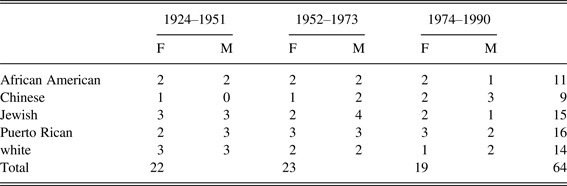
A sample of sixty-four speakers evenly distributed for age, gender, and ethnicity was selected from the larger set of over one hundred interviews conducted with residents of the Lower East Side. The demographic characteristics of this sample are presented in Table 1. Speakers were ‘binned’ using three age categories, although Year of Birth is treated as a continuous variable below. Ethnic categories reflect the contemporary demographic make-up of the neighborhood, as described above, and align with the terms used by informants as in-group labels as well as the categorizations used by the US Census.
Sample of Lower East Siders for production data, by year of birth, gender and ethnicity.
Data come from the body of the interview.Footnote 3 Formant information from the full vowel space was extracted using a script in the software package Praat (Boersma & Weenink Reference Boersma and Weenink2009) that extracted F0, F1, F2, and F3 at three points—25%, 50%, and 85% of the duration of the vowel. These data were normalized (Thomas & Kendall Reference Thomas and Kendall2007) using the Labov Telsur G method, which allows for direct comparability with the Atlas of North American English (Labov et al. Reference Labov, Ash and Boberg2006). In the current analysis, the 25% or onset measurement is used as a measure of bought height. While tokens were generally restricted to those in ideal phonetic contexts (Thomas Reference Thomas2011), words with preceding /r/ (Broadway, brought, across) as well as words with following /l/ (call, fault, ball) were included when a measurement at 25% or the point of inflection could confidently be taken.
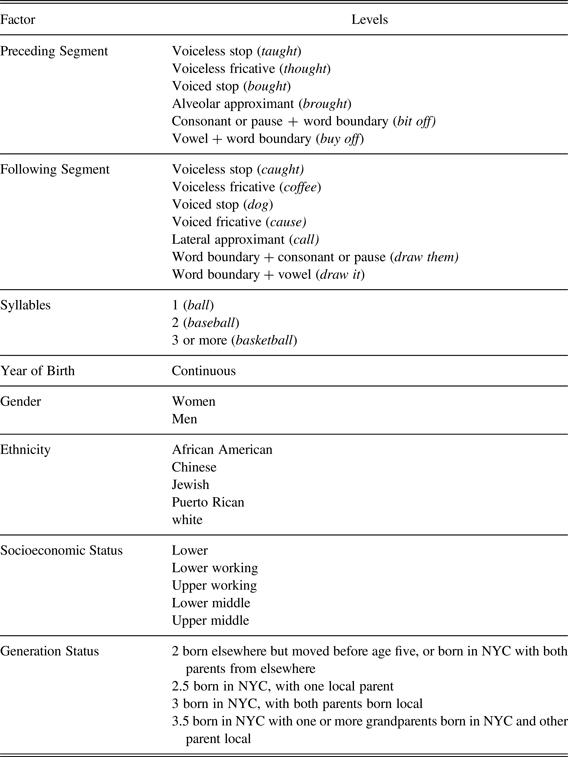
A linear mixed-effects model with speaker and word as random effects was fit to the data using Rbrul (Johnson Reference Johnson2012) and investigated both internal (linguistic) and external (social) predictors of the F1 of bought, run as a continuous response variable. Table 2 lists the factors and levels used for analysis, which include the internal factors of Preceding and Following Segments and Number of Syllables, and the external factors of Year of Birth, Gender, Ethnicity, Socioeconomic Status, and Generation Status. For Socioeconomic Status, speakers were first assigned a class score using the traditional measures of occupation, level of education, and housing type (Becker Reference Becker2010). These scores were then collapsed into five ranked class groups that correspond to the lower, lower working, upper working, lower middle, and upper middle class labels. The factor Generation Status quantifies the length of a speaker's family history in the neighborhood. Speakers were originally placed into six groups for Generation Status, ranging from Generation 1.5 (a speaker who arrived in New York City before the age of five, with both parents nonlocal) to Generation 4 (a speaker who was born in New York City, with both parents and all four grandparents also local). Due to small ns in Generations 1.5 and 4, these were collapsed with Generations 2 and 3.5, respectively, resulting in four levels for analysis. Of note is the fact that Year of Birth and Generation Status are orthogonal factors, so that each Generation Status level includes speakers from a range of ages.
Internal and external factors and levels.
A step-down model of main effects was fit to the F1 of bought for 2,094 tokens, or an average of thirty-four tokens per speaker. Interaction terms were then explored and compared to the model using main effects, and only interactions that improved that model were included. The following section first presents the model best fit to the data for main effects, and then discusses an interaction (between Year of Birth and Ethnicity) that significantly improves that model.
Results
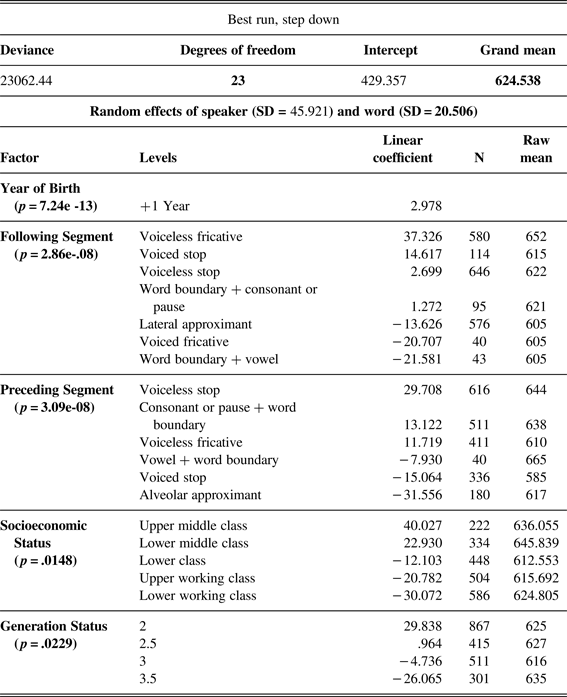
Table 3 presents the best-fit model for main effects. Significant factors selected from the step-down analysis are listed with their corresponding p-values. The linear coefficients in the third column are the corresponding Hz values for each level, which are added to the intercept of the linear model if a bought token has that factor. The result is the predicted Hz value for that token. This means that levels with positive coefficients add Hz to the model and so increase F1 values (or generally lower bought's visual height on a vowel plot), while those with negative coefficients decrease F1 values (or generally raise bought's visual height on a vowel plot).
Main effects of a linear mixed-effects model for F1 of bought.
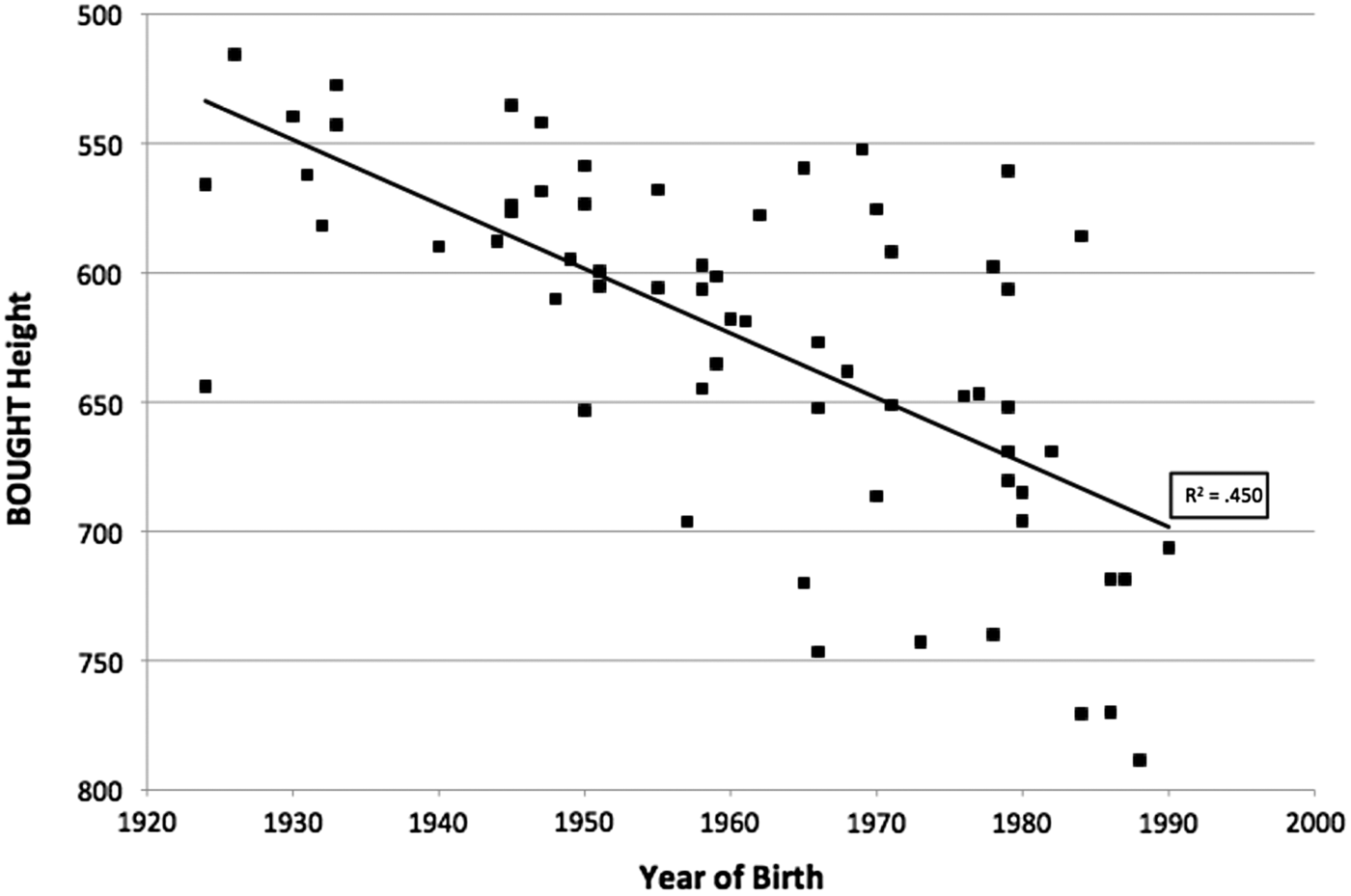
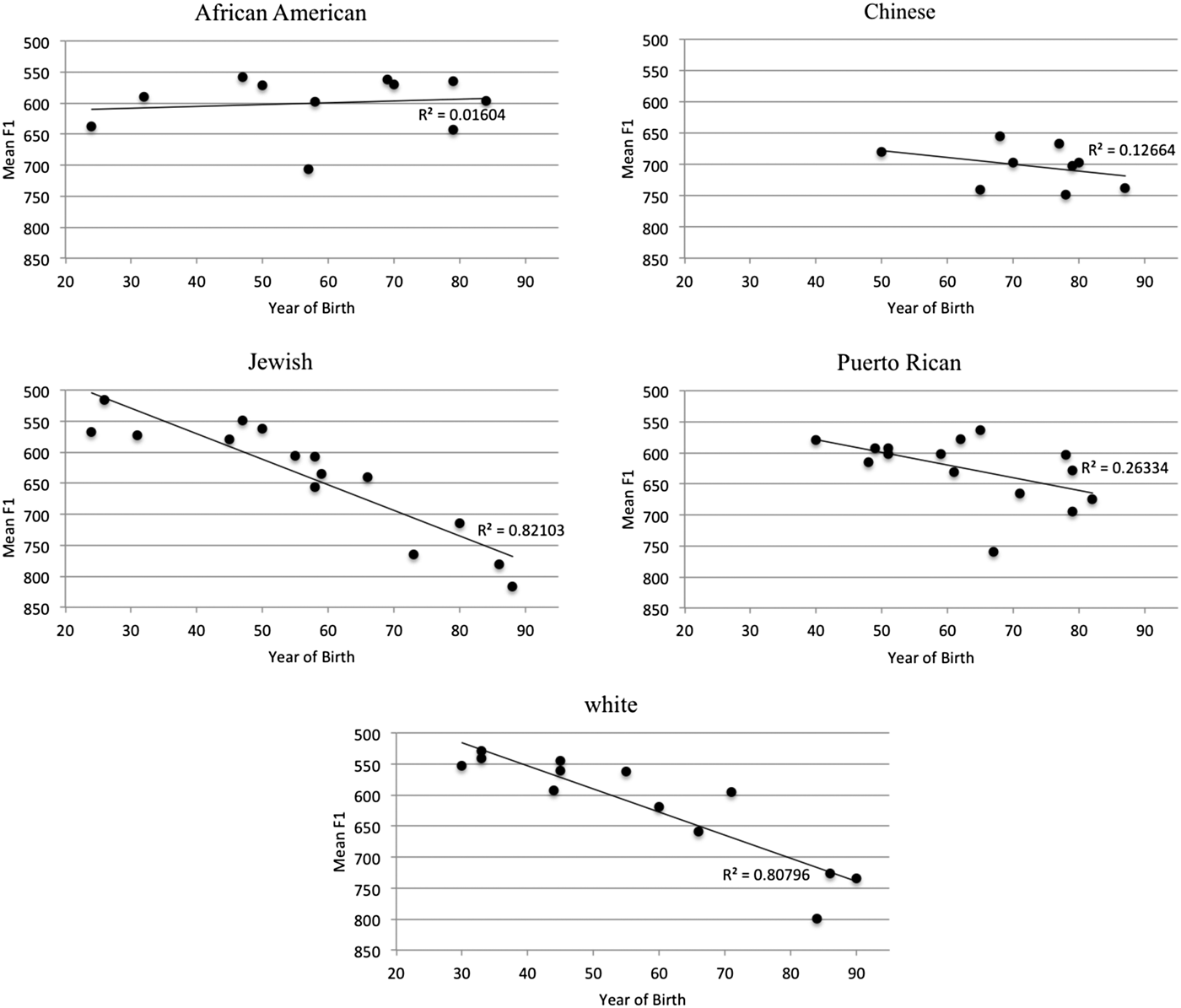
Year of Birth is a highly significant predictor of bought height. The Year of Birth predictor has a positive regression coefficient of 2.978, meaning that for every year of birth increase, the predicted F1 for bought increases by 2.978 Hz (i.e. the younger the speaker, the greater the F1 value by about 3 Hz a year).Footnote 4 This clear indication of change in apparent time is represented in Figure 4, which plots each speaker's mean F1 for bought as a function of their year of birth. The correlation between Year of Birth and bought height is highly significant (p < 10e-145) and demonstrates the reversal of bought-raising by Lower East Side speakers.
bought lowering in apparent time.
For Socioeconomic Status, the upper middle and lower middle class groups have positive coefficients corresponding to increased F1 values, while other class groups have negative coefficients corresponding to lower F1 values. While Labov (Reference Labov1966) found a curvilinear pattern for bought-raising, with central class groups leading in a change from below, here the highest class groups lead in bought-lowering. This finding is associated with change from above in casual or interview speech (Labov Reference Labov1972) and supports a picture of change in apparent time away from raised bought.
Generation Status is also a significant predictor of bought height, with Generations 2 and 2.5 corresponding to increased F1 values and Generations 3 and 3.5 corresponding to lower F1 values. While Labov did not take Generation Status into account, he did note that many speakers in his sample were the equivalent of Generation 2 (1966:98). Here, speakers with longer family histories in New York City produce a more raised bought relative to speakers with shorter family histories. This is not an unexpected finding given current theories of linguistic change by transmission, in which change advances incrementally by generation (Labov Reference Labov2007). Speakers of Generation 2 or 2.5, who do not have local parents from which to acquire and slightly augment local tokens of bought, will instead acquire slightly lowered boughts relative to their peers of Generations 3 and 3.5, who do have local parents. This effect should be separate from speaker Year of Birth, as speakers from all age groups would differentiate themselves slightly based on Generation Status.
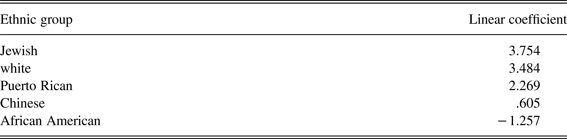
As mentioned above, statistical interactions between factors that significantly improved the model were explored. One interaction, between Year of Birth and Ethnicity, was a significant improvement to the model fit with main effects (p = 6.81e-6). The linear coefficients that result from this interaction are presented in Table 4. Jewish and white speakers have the largest positive coefficients, adding 3.8 and 3.5 Hz, respectively, for every year of birth increase. Puerto Rican speakers also have a positive coefficient that is slightly smaller (2.3). Chinese speakers have a small but positive coefficient (.6), which corresponds to a slight increase in Hz as Chinese speakers get younger. In contrast, African American speakers are the only ethnic group to have a negative coefficient (−1.3), meaning that these speakers are actually decreasing F1 values (or increasing bought height) as speakers get younger.
Interaction coefficients for Year of Birth and Ethnicity.
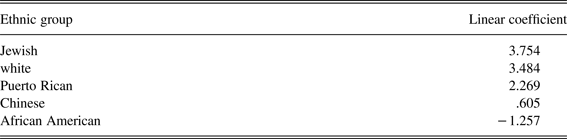
Figure 5 displays this result visually, plotting bought height as a function of Year of Birth separately for the five ethnic groups.
Height of bought by year of birth for five ethnic groups.
The correlations here correspond to the interaction coefficients in Table 4. The strongest correlations between Year of Birth and bought height are for Jewish (n = 15, p = .000) and white (n = 13, p = .000) speakers, followed by Puerto Rican speakers (n = 16, p = .02). These groups are all lowering bought in apparent time. African American and Chinese speakers, on the other hand, have nonsignificant correlations between bought height and Year of Birth. While Chinese speakers (n = 9, p = .17) show a visual trend of bought-lowering in apparent time, confirming the small positive coefficient from the interaction, African American speakers (n = 11, p = .36) show a small increase in bought height as speakers get younger.
The findings for ethnicity are important to the growing body of work demonstrating the intersections of regionality and ethnicity (Wolfram Reference Wolfram2007; Yaeger-Dror & Thomas Reference Yaeger-Dror and Thomas2010; Becker Reference Becker2014b; Wong & Hall-Lew Reference Wong and Hall-Lew2014). Figure 5 confirms that older speakers of all ethnic backgrounds produce raised bought. Further, Puerto Rican speakers are clearly participating in the reversal of raised bought in apparent time. For Chinese speakers the picture is less clear; these speakers have a positive but very small coefficient in the linear regression, and the correlation between Year of Birth and bought height is not significant. In another recent study, Wong & Hall-Lew (Reference Wong and Hall-Lew2014) found a clear change in apparent time away from raised bought for Chinese New Yorkers. Those findings in combination with the present results suggest that speakers of Chinese background in New York City in general are participating in bought's reversal.
In contrast, African American Lower East Siders are not participating in the reversal of raised bought. Instead, these speakers are maintaining and even slightly increasing use of raised bought in apparent time. This is particularly interesting given that Labov (Reference Labov1966) concluded that African Americans did not participate in the use of NYCE phonology, including use of raised bought. Now, as white and Jewish speakers move the most dramatically away from raised bought, African Americans are the only ethnic group to maintain its use. While this may appear on the surface to demonstrate ethnolectal behavior (as African Americans pattern differently than other ethnic groups), the picture is more complicated because this feature is regional, not ethnolectal. Use of raised bought is not considered part of a supra-regional African American English, but its use has been demonstrated for African Americans in Harlem (Coggshall & Becker Reference Coggshall, Becker, Yaeger-Dror and Thomas2010). Further work is needed to understand the use of raised bought by African American New Yorkers, whether to index ethnic, regional, or other aspects of identity, or more likely some intersection of these (Becker Reference Becker2014b).
In sum, ethnic differentiation remains an important factor in the sociolinguistic patterning for raised bought, including for the white and Jewish speakers whose precursors were profiled in Labov (Reference Labov1966). In that study, Jewish speakers led Italian speakers in bought-raising, and ethnic self-identification was suggested as the primary social motivation for the change in progress from below. Importantly, those white ethnic groups who were found to participate most strongly in bought-raising in 1966 are now moving the most dramatically away from raised bought today. Both Socioeconomic Status and Generation Status are significant predictors of bought height in the current data, with the upper-middle and lower-middle classes and speakers of Generations 2 and 2.5 producing the least raised boughts. The findings for socioeconomic status in particular are further confirmation of the change in apparent time away from raised bought.
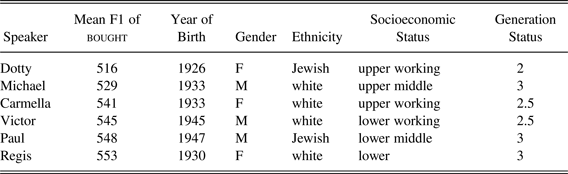
The production data confirm a reversal of the trajectory for bought outlined in Labov (Reference Labov1966) and document a change in apparent time away from raised bought led by the young, the middle classes, speakers of Generations 2 and 2.5, and white and Jewish speakers. The next section focuses on identifying the contemporary social meanings of raised bought as an important context for understanding this reversal. Because perceptions of raised bought, not lowered bought, are explored in the perception data, a final summary of the bought-raisers in the production data highlights the fact that raised bought is still produced on the Lower East Side, and that the users of raised bought cluster around certain macrodemographic characteristics. As seen in Table 5, which provides the demographic profiles of the top ten percent of speakers for bought height, the most extreme raisers are all older, and white and Jewish. They are generally from lower status class groups, although Michael is upper middle class and Paul is lower middle class. They are mixed with respect to gender and generation status, although half of them are third generation, meaning that both parents are local to New York City.
The top ten percent of bought-raisers.
Listener perceptions of what kind of New Yorker uses raised bought can be considered together with the characteristics of these Lower East Side bought-raisers. Together the two sources of data shed light on the social motivations that contribute to bought's reversal.
Raised bought in perception
Methods
The perception data come from a matched guise study administered online in 2011. The matched guise technique gathers listener reactions to speech samples that differ for one linguistic variable (Lambert Reference Lambert1967). The subjective reaction tests of Labov (Reference Labov1966) were an early instantiation of the matched guise approach. In those tests, listeners heard short passages taken from sociolinguistic interviews that contained multiple instances of the target variable and provided ratings of the speaker. More recently, scholars working in sociophonetic perception have used digital manipulation to maintain a high level of control in the creation of guises (Levon Reference Levon2007; Campbell-Kibler Reference Campbell-Kibler2009). Because listeners reliably participate in the assignment of social information to auditory samples, from broad socio-demographic categories to personality traits, sociolinguists use perceptual studies to probe listener behavior in order to see what it reveals about the social meaning of variables (Hay & Drager Reference Hay and Drager2007; Levon Reference Levon2007; Campbell-Kibler Reference Campbell-Kibler2009; Drager Reference Drager2010). Because guises differ for only the variable in question, significant differences in listener perceptions for the social attributes of speakers can be reliably attributed to the change in the variable, or the social indexes that listeners associate with the variable. A further benefit to this methodology is its ability to probe social meaning covertly: listeners hear only one version of a guise, surrounded by fillers, and so are normally not aware that they are reporting on the variable.
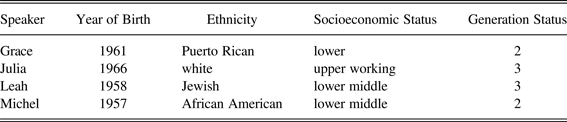
The guises for this experiment were created through synthesis using Praat (Boersma & Weenink Reference Boersma and Weenink2009) using four speakers from the Lower East Side corpus. In an attempt to control for gender, age, and ethnicity, these speakers were selected because they were judged by undergraduate students at Reed College to sound female, middle-aged, and white, although their demographic profiles are in fact quite different with respect to ethnicity, socioeconomic status, and generation status (see Table 6). This research design allows for a focus on identifying a baseline of indexical meanings for raised bought; further research is in order that investigates variation in perception according to these social categories.
Lower East Side speakers used for matched guise experiment, with their demographic profiles.
A number of short sections of speech were selected from each speaker's interview. Each excerpt contained one token of bought that was relatively close in height to the Atlas of North American English's cut-off for a raised bought of 700 Hz, meaning that the original boughts were neither very raised nor very lowered. The clips were also selected for being relatively neutral in terms of content, and for lacking any other marked use of NYCE features. The bought token in each clip was then digitally manipulated in F1 to produce pairs of resynthesized clips with either a very raised or very lowered bought. In most cases, this was achieved by adding or subtracting 100–150 Hz to each bought's full-vowel trajectory. In other words, the original clip was turned into two clips, one where the F1 of bought was well below the 700 Hz cut-off (in this clip, the bought sounds very raised), and one where the F1 was well above (in this clip, the bought sounds lowered or unraised). These samples were heard by undergraduates at Reed College, who judged them for naturalness. Less natural clips were thrown out, with a final set of stimuli composed of two clips from each speaker, each with a raised and lowered version. Because short, natural-sounding clips were targeted, lexical item could not be controlled for, so there is some repetition (an issue dealt with statistically by fitting a mixed-model with a random effect of clip).
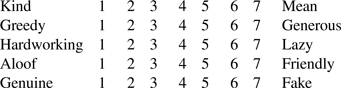
The survey was administered online. Listeners who were native New Yorkers were solicited. Anyone could take the survey, but only listeners who met the criteria for a native New YorkerFootnote 5 were included in the final sample. These exclusions cut the original responses from 150 to a final sample of 101. Listeners were instructed to take the survey in a quiet place and to use headphones. Each listener heard a total of eight resynthesized clips (either the raised or the lowered version of each, selected at random), as well as four fillers, all presented in a randomized order. In the first stage of the experiment, participants listened to all clips and provided open-ended responses to the prompt, ‘Tell us anything you can about your impression of the person in the recording. What do you think this person might be like? What kind of person do you think sheFootnote 6 is?’ In the second stage, participants listened to the same clips again and provided answers to three macrodemographic questions: (i) How old do you think this person is? (ii) What ethnicity do you think this person is? and (iii) Where do you think this person is from? They also rated speakers on five affective scales (Scherer Reference Scherer1972; Levon Reference Levon2007), which probe listener perceptions of personality characteristics or speaker attributes. The full survey instrument can be found in the appendix.
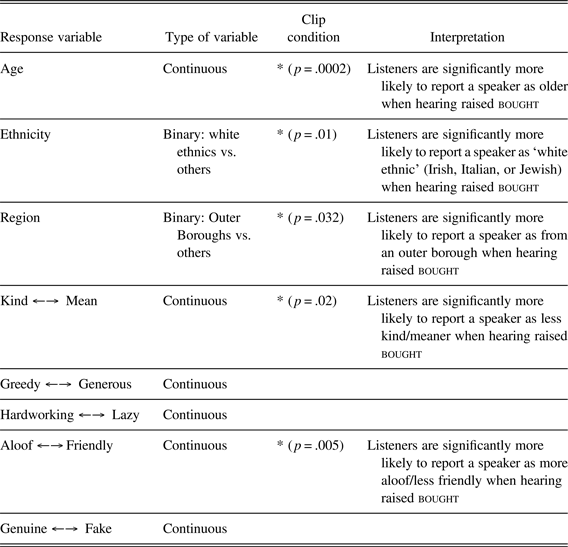
Mixed-effects models were fit for eight response variables, which are listed in the first column of Table 7. Speaker Age and the five affective scale ratings were run as continuous response variables. Because listeners provided many different responses to the open-ended questions on Speaker Region and Speaker Ethnicity, a number of application values were explored during statistical modeling for best fit. For Speaker Region, a model using a binary variable that opposed the outer boroughs (Brooklyn, Queens, The Bronx, and Staten Island) as the application value against other regional attributions produced a best fit. For Speaker Ethnicity, a model using a binary variable that opposed attributions of ‘white ethnic’ ethnicities (Irish, Italian, and Jewish) as the application value against all other ethnic attributions produced a best fit. All models were fit stepping down from a model that included the clip and listener as random effects, and speaker and clip condition (whether listeners heard a raised or lowered bought) as fixed effects. Demographics of the listener pool were also tested (listeners' reported age, gender, level of education, ethnicity, and generation status) but returned no significant results.
Summary of response variables for mixed models fit to the matched guise data, with the significance of the clip condition (whether listeners heard a raised or lowered bought) indicated with a * in the clip condition column.
Results
The responses of New York City listeners to tokens of raised bought demonstrate convincingly that New Yorkers associate raised bought with older, white ethnic residents of the outer boroughs who possess negative personality attributes. This section focuses on the significant results related to the clip condition—whether listeners heard a raised or lowered bought—and argues that these findings provide a range of linked social meanings that can be ascribed to bought's indexical field (Eckert Reference Eckert2008). Table 7 summarizes the results from the mixed-effects models that were fit to the eight response variables, and notes whether or not the condition of the clip significantly impacted the response variable.
First, listeners provided open-ended answers to three demographic questions that asked for attributions of Speaker Age, Ethnicity, and Region. All three response variables are significantly impacted by the clip condition. For Speaker Age, a continuous response variable, listeners are significantly more likely to judge a speaker as older when hearing raised bought. For Speaker Ethnicity, a model that used the six most dominant ethnic attributions (black/African American, Irish, Italian, Jewish, Latino, and white)Footnote 7 and used the combined white ethnic attributions (Irish, Italian, and Jewish) as the application value was the model best fit to the data. This means that listeners were significantly more likely to judge a speaker as white ethnic when hearing raised bought. For Speaker Region, a model that used a three-way distinction (outer boroughs, general New York City, and outside New York City) and used the outer borough group as the application value produced the best fit. This means that listeners were significantly more likely to judge a speaker as from an outer borough when hearing raised bought.
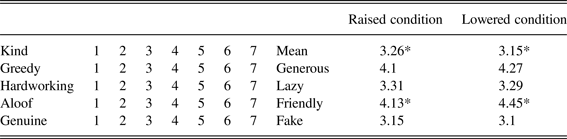
Table 8 presents the mean scores for each of the five rating scales (rated on a scale from 1 to 7): Kind to Mean, Greedy to Generous, Hardworking to Lazy, Aloof to Friendly, and Genuine to Fake. While there is always a difference between the raised and lowered conditions, with the raised bought condition favoring ratings towards the negative side of each affective scale, only two sets of ratings are significantly different for clip condition: listeners are significantly more likely to judge speakers as meaner/less kind and more aloof/less friendly when they hear a raised bought.
Mean ratings on five affective scales, raised and lowered clip conditions, with * indicating those affective ratings that were significantly different according to condition.
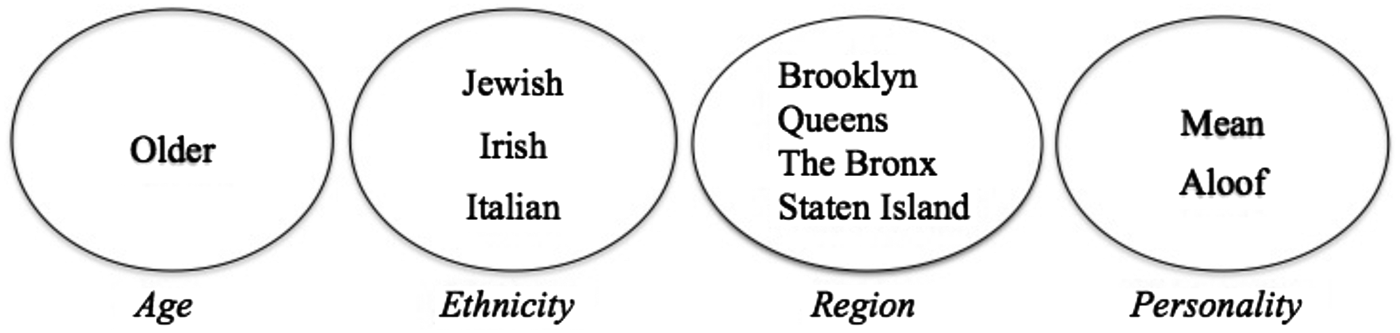
In sum, listeners are more likely to hear speakers as older, as white ethnic, as from an outer borough, and as meaner and more aloof when they hear raised bought. These characteristics are similar in type to those that comprise the indexical fields for other variables (Eckert Reference Eckert2008; Campbell-Kibler Reference Campbell-Kibler2009) and can be grouped into social types or macrodemographic information (age – older; region – outer borough of New York City; ethnicity – white ethnic) and personality attributes or qualities (mean and aloof), as seen in Figure 6.
Indexical field for raised bought.
Of particular interest are the negative personality characteristics. In Becker (Reference Becker2009), Lower East Side residents were found to significantly increase their use of nonrhoticity when discussing local neighborhood topics despite taking part in the change in progress towards rhoticity in NYCE. This was argued to be an instance of positive identity construction targeting attributes related to local authenticity. The potential for raised bought to similarly index positive, local attributes was explored here and an affective scale from Genuine to Fake was included to explore a potential index of authenticity. Listeners instead, however, associate raised bought with negative attributes only on these affective scales. Further, listeners zero in on specific demographic characteristics, specifying the kind of speaker who uses raised bought. A bought-raiser is not just a New Yorker, but one from Brooklyn, Queens, the Bronx, or Staten Island—those outer boroughs associated with working-class speech and ‘Brooklyn-ese’. Instead of white, the bought-raiser is specifically Jewish, Irish, or Italian—exactly those sub-groups that used to predominate in the ‘three-cornered’ structure of New York City's ethnic landscape. These demographic meanings, in combination with the negative personality characteristics, suggest that listeners link raised bought to a stereotypical ‘classic New Yorker’ persona, an icon of an earlier time. Also, no demographic characteristics of the listener pool were significant predictors of attributions made in the matched guise data, meaning that New York listeners as a whole share these indexical meanings for raised bought. The overall picture is one of listeners locating raised bought as a feature used by a certain kind of New Yorker—an older white ethnic from the outer boroughs who is mean and aloof.
Conclusion
Many NYCE features have receded or are currently in withdrawal. In 1966, Labov documented the loss of stereotypical NYCE features like the production of [oi] for stressed schwa in rhotic contexts (i.e. doity boid for dirty bird). More recent work has found that the NYCE short-a split of bad and bat is receding in favor of a more general American nasal system (Becker & Wong Reference Becker and Wong2009; Becker Reference Becker2010). The change in progress from nonrhoticity to rhoticity continues to advance (Labov et al. Reference Labov, Ash and Boberg2006; Becker Reference Becker2009; Mather Reference Mather2012); recent work has even found that some Lower East Sider speakers are fully rhotic in interview speech (Becker Reference Becker2014b).
An important context for the general withdrawal of classic NYCE features is the continued stigma attached to NYCE by other Americans (Niedzielski & Preston Reference Niedzielski and Preston2003) in combination with New Yorkers' own linguistic insecurity, first described in Labov (Reference Labov1966). Although at the time raised bought was lagging behind other NYCE variables in terms of social awareness, its stigma appears to have solidified and is evident in negative speaker attributes associated with the vowel. Yet the indexical field for raised bought reveals more than a general stigma; its use centers on a specific New York character type. Users of raised bought are older, white ethnic, and from the outer boroughs. Wong & Hall-Lew (Reference Wong and Hall-Lew2014) argue that both Chinese Americans from New York City and older white San Franciscans are aware of and index a stereotypical working class, white ethnic New Yorker through the use of raised bought. This stereotypical representation can also be seen in icons (Gal & Irvine Reference Gal, Irvine, Irvine, Gal and Kroskrity2000) from popular culture like the figure of Linda Richman, a character in the Saturday Night Live skit entitled ‘Coffee Talk’ (the title itself contains two environments for raised bought, signaling the importance of the feature in the styling of the character). Characters like Linda Richman, however, generally index positive or at least charmingly humorous characteristics, while listeners always rated speakers more negatively when hearing raised bought, and were significantly more likely to judge them as mean and aloof.
These negative aspects of the indexical field are crucial to understanding why Lower East Siders are distancing themselves from raised bought. They indicate that the persona that New Yorkers associate with raised bought is not just ‘classic’ but negative, something that speakers would like to distance themselves from. This is what the production data demonstrate. Lower East Siders have reversed the trajectory of change for bought and are lowering it in apparent time. While in-group ethnic identification was cited as the primary social motivation for bought-raising in 1966, in the production data it appears that in-group ethnic distancing is a primary social motivation for bought-lowering, as white and Jewish speakers show the most dramatic reversal of the change for bought. This finding is confirmed in raised bought's indexical field. Raised bought is not just generally stigmatized, but associated with a white ethnic New Yorker, and speakers connected to those ethnicities are the most heavily invested in distancing themselves from the vowel and its accompanying persona. In fact, the process of distancing on the part of white and Jewish speakers away from ‘white ethnic’ aligns with the broader social movement away from specific white ethnicities and towards a supra-white category.
The same connection can be drawn between the details of bought's reversal and the other demographic social meanings identified in the perception results. Raised bought is associated with an older New Yorker, and young Lower East Siders lead in bought-lowering. Raised bought is associated with the outer boroughs, suggesting the working-class stereotype of ‘Brooklyn-ese’, and lower middle and upper middle class Lower East Siders lead in bought-lowering.
The production and perception results, considered in tandem, centralize the role of social meaning in the reversal of the change, and support the perspective that social meaning and change should be considered co-constructed processes, such that social meaning has the potential to impact the trajectory of change. For the bought vowel, which is undergoing a change that has reversed its direction, the variable's complex social meanings are presented here as a motivation for this reversal.
Appendix: Survey
Part 1: Listen and describe
In these next few pages, please listen carefully to the recordings provided. After listening to the recording, in the space provided, tell us anything you can about your impression of the person in the recording. What do you think this person might be like? What kind of person do you think she is? You may write as much as you like, and listen to each recording as many times as you like.
Describe this person:
Part 2: Listen again
Now listen to the same recordings again. You may listen to the recordings as many times as you like. In this portion of the survey, please provide answers to some specific questions about the person in this recording. We ask that you try to provide an answer to each question, even if you are not entirely confident in its accuracy.
How old do you think this person is?
What do you think the ethnicity of this person is?
Where do you think this person is from? Be as specific as you can be.
Please rate this speaker according to the following characteristics.
This person is: