Over the last 30 years, musicologists have increasingly questioned the processes of canon formation and the assumed sanctity of the musical work. A significant outcome of this development within opera studies has included greater attention to the idea of musical drama as event, and this has had an important impact on which genres and composers are deemed worthy of attention. Accordingly, opera studies have begun to encompass a wide variety of popular theatrical genres, of which several important publications have established the performance practices and the role of music.Footnote 1 We are also starting to see new, rigorous and critical overviews of the development of certain genres focused on particular metropolitan centres. Melodrama, ballad opera and operetta have been at the forefront of this type of research.Footnote 2 These avenues of enquiry have encouraged scholars to unpick the rich relationships between popular theatrical genres, as well as those between popular and ‘elite’ genres, problematizing the distinction between the two. For example, the relationship of ballad opera to both vaudeville and English opera has been the subject of several studies, as have exchanges between melodrama, opera and film music.Footnote 3
The Victorian opera burlesque appears as a poor relation amid this wealth of scholarship. Although several stand-alone studies have been completed by musicologists, including Rachel Cowgill, Laura Tunbridge and Roberta Montemorra Marvin, a large-scale critical overview of the development of the genre is yet to appear.Footnote 4 Studies of opera burlesque have used the genre as a means of understanding broader issues, such as the reception of opera, including particular productions, and have considered the light it can shed on contemporary attitudes to cultural, political, gender-related and societal norms. While these studies are fascinating and illuminating, we have not yet established how opera burlesque was related to the broader theatrical landscape of the West End in London, or to other musical and theatrical genres. Nor have we considered how these relationships may have changed at different points in the genre's development, or how managers’ strategies and contemporary musical tastes may have influenced the music employed. Until these issues are recognized, we run the risk of misunderstanding what opera burlesque reveals about broader cultural and social issues, and of treating it as a static genre divorced from the broader developments taking place around it.
Richard Schoch argues that the specific, formal features of burlesque are less important to our understanding of the genre than the function it performed as a ‘sustained, self-conscious comic interpretation of a specific text’.Footnote 5 Nonetheless, we can point to some common characteristics: puns, music from a variety of genres, dance, topical references and the domestication and ‘lowering’ in status of settings and subjects. In addition, the ‘source’ texts most often came from classical mythology, Shakespeare and opera. Burlesque had a shifting relationship to other popular genres, combining ballad opera's use of satire with the spectacle of extravaganza and the humour and direct addresses to the audience of pantomime.Footnote 6 Eighteenth-century ballad opera is a particularly important precursor of burlesque because of the way in which music functions in both genres.Footnote 7 Like burlesques, ballad operas were structured as plays with interpolated music that was accessible and singable and had been appropriated from a variety of sources, namely opera and ballads (urban and rural).Footnote 8 In addition to these sources, burlesques also included minstrelsy and music hall. The pre-existing music was given new lyrics, creating comic intertextual references if audiences were aware of the original version.
Burlesques were popular throughout the nineteenth century, reaching their height in the 1860s and being gradually displaced by opéra bouffe and musical comedy from the 1870s.Footnote 9 They were, therefore, performed during a long period that saw considerable social, political and theatrical change. An important aspect of this change involved how theatres were licensed. Traditionally, the theatres royal in London – Covent Garden and Drury Lane – had operated under royal patents granted by Charles II in 1662. The patents had powerful implications because they granted monopoly over spoken, or ‘legitimate’, drama. The patents also ensured that the two theatres could perform any type of production all year round, as long as they received the approval of the Examiner of Plays at the Lord Chamberlain's Office, to whom all new plays were submitted for licensing, and who acted as censor.Footnote 10 Other minor theatres received licences annually and were prohibited from producing spoken drama.Footnote 11 Jane Moody has observed that in response the minor theatres produced ‘illegitimate’ theatrical pieces, such as burlesque, extravaganza and pantomime, which relied on visual and musical expression in order to circumvent the prohibition on the use of dialogue. In practice, however, the difference between the productions offered by patent and minor theatres was not clear-cut. The minor theatres found many ingenious ways around the Licensing Act, and the patent theatres, responding to competition, also staged a range of popular theatrical genres that showcased music and visual spectacle.Footnote 12 The licensing situation was debated in 1832 by a select committee. The patent theatres became the subject of scrutiny because of their financial difficulties and their seeming lack of support for native talent. They complained of the encroachment of the minor theatres onto the territory preserved by the patents and the ensuing competition this created. The minor theatres complained that, by putting on musical and spectacular entertainments at the expense of legitimate drama, the patent theatres were not fulfilling the obligations of their patents.Footnote 13 Eventually, the minor theatres gained the right to stage legitimate drama with the Theatre Regulation Act of 1843. This act consolidated the power of the Lord Chamberlain to license theatres and to read and censor texts of any pieces produced.Footnote 14
Burlesque's position as an ‘illegitimate’ genre being produced in minor theatres that sought ways around licensing acts and censorship has naturally coloured scholars’ readings of it. For Schoch, burlesque offered a means of articulating multiple and alternative political perspectives. He argues that burlesques often commented on contemporary political debates, particularly political emancipation, social class issues, republicanism and revolution. Schoch acknowledges that burlesques took a variety of political attitudes, but the examples he examines question the status quo and imagine alternatives.Footnote 15 Moody's ground-breaking research into illegitimate theatre characterized genres such as burlesque as challenging sites of ‘political, moral and generic transgression’,Footnote 16 which enjoyed relative freedom from the censorship mechanisms.Footnote 17 In consequence of this freedom, burlesques could critique contemporary political and social issues.Footnote 18 Subsequent research on burlesque, whether undertaken by musicologists or by theatre historians, has cemented its position as a subversive genre: a genre that unsettles cultural, social and even gender norms and hierarchies. Fiona Macintosh proposes that burlesque acted as ‘a relatively radical forum for serious debate’.Footnote 19 Laura Monrós-Gaspar argues that ‘the fact of burlesquing – or subverting – a classical text embodies an act of transgression which […] entails strong ideological concerns on the cultural division of the classes and a stagnant education system which was based on Classics as a status marker’.Footnote 20 Finally, Tunbridge emphasizes the role of burlesque in providing ‘social critique’ and ‘satire on contemporary social concerns’ and ‘theatrical hubris’.Footnote 21 Overwhelmingly, studies of burlesque produce an impression of a genre that questioned the status quo, that imagined new social and political alternatives, that participated in controversial debates and that traversed boundaries between classes and different cultural genres.
Following the 1843 Theatre Regulation Act, burlesque still proved popular and retained a regular position on the programme of most minor theatres because audiences continued to demand it,Footnote 22 but the nature of burlesque changed. Burlesques in the second half of the nineteenth century have received less attention than those in the first, probably because the genre began to lose its satirical bite.Footnote 23 Satire is often considered as challenging and critical, and this is largely how its role in opera burlesque has been understood until now. However, a significant school of literary theorists see satire as a conservative genre that upholds existing dominant norms.Footnote 24 We shall see that this conservative reading of satire is actually applicable to burlesques in the mid-Victorian period, which are less questioning of social norms and hierarchies than their predecessors. Tunbridge alludes to a change in the nature of the genre in her examination of two burlesques of Byron's Manfred from 1834 and 1863 respectively. She notices that the social satire of the earlier burlesque is much more challenging than that of the later one, which does not have the same ‘contemporary resonance’.Footnote 25 She links this difference to the change in theatre licensing, arguing that ‘fully licensed, burlesques lost their political potency, their ability to critique the establishment’.Footnote 26 Macintosh also alludes to a shift towards a ‘more socially homogeneous, more solidly bourgeois audience’ in the last two decades of the century,Footnote 27 but does not examine the implications of this change for burlesque. Finally, Schoch briefly mentions a change in burlesque towards the end of the century, when the genre took on a distanced relationship to Shakespeare and became more titillating and less satirical and critical. He associates this with audiences’ lack of familiarity with Shakespeare owing to their exposure to a restricted repertoire resulting from the fashion for long runs.Footnote 28 This reluctance to examine changes in the genre after mid-century has led to a rather one-sided understanding, which overwhelmingly depicts the genre as laden with social and political potency, even in its later guise.
Few researchers have dealt seriously with the issue of who actually attended burlesques, even though this is central to understanding the messages burlesque was intended to convey.Footnote 29 Schoch proposes that through the use of slang language and references to drinking and fighting, ‘burlesque constructed its audience as a collective of “fast” young men’.Footnote 30 He acknowledges that audiences may have been more diverse than this in reality, but argues that burlesque courted this particular bourgeois group. The reading seems to tell only part of a complicated story. Schoch's book spans burlesque across almost the whole of the nineteenth century, but does not acknowledge changes in audience make-up across this period, across different burlesque theatres or in response to developments in the West End more broadly. Tunbridge and Monrós-Gaspar agree that while burlesques were not exclusive, audiences were expected to be well informed about the burlesque's subject matter: music, theatre, current affairs and classical mythology.Footnote 31 It follows that burlesque producers and writers expected audiences to enjoy a considerable degree of education.
More often, researchers assert that burlesque audiences were diverse. Macintosh tells us that, along with melodrama, farce and pantomime, burlesque shared ‘a relatively broad-based audience’ (at least until around 1870).Footnote 32 Regarding classical burlesque, Monrós-Gaspar states that when touring burlesque productions were put on in small and provincial theatres to uneducated audiences much of the humour would have been produced by the performance, rather than by the parody of the original source subject.Footnote 33 This suggests that audience make-up was variable depending on location, and that different aspects of the production were enjoyed by different demographics. Similarly, Montemorra Marvin argues that mid-Victorian burlesques appealed to a broad sector of society, traversing class boundaries because the genre could communicate on different levels.Footnote 34 Opera-goers would understand intertextual references, and the ‘shared territory’ of ‘external associations, localized allusions and lampooning of social pretences and circumstances’ would have appealed to a wide variety of people.Footnote 35 Several researchers have understood the mixture of musical and theatrical genres that burlesque references and interpolates as an important aspect of the genre's apparent appeal to diverse audiences. At the same time, these mixtures have often been seen as evidence of burlesque's subversive, challenging nature. Moody sees the lampooning of elite genres through frequent ‘irreconcilable clashes’, ‘unresolved dissonances’ and ‘incongruous juxtapositions’ as one of burlesque's main strategies for disrupting and questioning cultural and, implicitly, social hierarchies.Footnote 36 Building on Moody's reading, Montemorra Marvin also highlights the juxtaposition of ‘seemingly incongruous well-known repertories’ and of ‘traditional lower- and upper-class entertainments’ in mid-Victorian opera burlesque.Footnote 37 She proposes that burlesque traversed cultural and social boundaries because it translated an ‘artificial high art genre into an “earthy” low art form’.Footnote 38
Divisions between ‘high art’ and ‘popular entertainment’ were developing in the second half of the nineteenth century, but at the same time the status and meanings of popular music were complex. Building on recent Victorian reception studies, I argue that we need to consider carefully the relationship of the bourgeoisie to the popular genres used in burlesque, and beware of assuming that musical juxtapositions were necessarily received as incongruous or dissonant (and consequently challenging and subversive).Footnote 39 The possible meanings created by placing a parlour ballad or a music-hall or minstrel song alongside an aria require closer scrutiny. Instead of reading juxtapositions as dissonant or as part of burlesque's broad appeal, I demonstrate that the musical choices in mid-Victorian opera burlesque were designed to appeal to a bourgeois audience. This is not to say that the audiences consisted solely of the middle classes; the tiered pricing system ensured that burlesques were accessible to working-class people, and members of the gentry would also have attended. But I propose that producers of mid-Victorian burlesques demonstrated little concern for the tastes or interests of the poorer or indeed the most elite members of the audience. However, I also argue that producers targeted different demographics within the middle classes, depending on the strategies of the theatre managements and the time at which the burlesques were performed. In examining the music in mid-Victorian burlesque, I shed new light on the ways in which West End theatre managers perceived middle-class cultural tastes and values and on the bourgeoisie's relationship to opera. At the same time, a safer, respectable and commercial image of burlesque begins to emerge.
Historians regularly examine the Victorian middle classes (their leisure pursuits, home life, gender roles and a whole range of other topics),Footnote 40 but there still exists considerable disagreement regarding the definition of exactly whom they comprised. Like William Weber, I see the middle classes as a ‘frequently self-conscious social group but neither monolithic nor unified’.Footnote 41 There would, of course, have been vast disparities in income, occupation, social circle and cultural tastes and knowledge. Historians have found a number of ways of dealing with this diverse and complicated group of people. In her study of Victorian middle-class art collecting, Dianne Sachko Macleod focuses on individuals before drawing conclusions about broader groups. This enables her to construct the Victorian middle-class art collector in more depth and detail than has previously been possible, and it allows her to refute some hackneyed stereotypes.Footnote 42 Unfortunately, there are no records of purchasers of burlesque tickets, so it is not possible to reproduce the detail of Macleod's focus on individuals in this study. However, I have tried to be as specific as possible about the group of people being discussed, referring to their occupations or where they fell on the income spectrum. More often, I have used an approach put forward by Elizabeth Langland in her study of Victorian etiquette manuals. Langland argues that we should not understand these manuals as a reflection of a ‘“real” historical subject’ but as documents deliberately intended to ‘construct’ and ‘consolidate’ a genteel middle class by distinguishing this group from the working classes and other factions of the middle classes.Footnote 43 Similarly, this article draws on advertising, newspaper reviews and the texts and music of the burlesques themselves in order to identify how burlesque audiences were constructed, rather than how they were constituted in reality.
Dror Wahrman argues that the middle class never was a tangible entity, but rather an imagined body that existed somewhere within the ‘space of possibilities between social reality and its representations’.Footnote 44 Its position within this space of possibilities would change according to the needs of the time (political in Wahrman's study). Wahrman examines the different ways in which the middle class was imagined in political language at important moments between 1780 and 1840, suggesting that the vagueness of the definition of the middle class was often useful. Similarly, I argue that different West End theatre managers imagined this heterogeneous, ambiguous and fluid body of people in different ways. I seek to nuance our understanding of burlesque, tracing the steady ‘bourgeoisification’ and commercialization of the genre by examining three opera burlesques across the 1860s, a key decade in the transition of the West End:Footnote 45 Leicester Silk Buckingham's Lucrezia Borgia! At Home and All Abroad, performed at the St James's Theatre on 16 April 1860; Henry James Byron's Little Don Giovanni, or Leporello and the Stone Statue, performed at the Prince of Wales's Theatre on 21 December 1865; and William Schwenck Gilbert's Robert the Devil; or, the Nun, the Dun, and the Son of a Gun, performed at the Gaiety Theatre on 21 December 1868. These burlesques were written by some of the best-known, most successful and most prolific burlesque writers of their time, and so are representative of trends in the genre. They are also illuminating because, as we shall see, they indicate that the musical choices for different burlesques could operate according to different models in order to appeal to different types of audiences within the fluid and heterogeneous Victorian middle class. Accordingly, I examine the particular circumstances of each theatre, demonstrating important differences at three theatres with seemingly similar clienteles and located in close proximity within the West End. In doing so, I demonstrate the importance of considering nuances in audiences, theatres and musical choices in understanding the genre of burlesque and the way it was received.
Examining burlesque presents significant philological issues. Burlesque writers and producers viewed the genre as something disposable, to be written and produced quickly and then replaced by the next burlesque. Accordingly, those involved in burlesque productions appear to have been little concerned with preserving their work. Fortunately, the texts of many burlesques did make it into print, usually to enable provincial theatre companies to stage the same burlesques produced in London.Footnote 46 The British Library also holds a large collection of burlesque manuscripts submitted to the Examiner of Plays. Many texts, therefore, are preserved in either manuscript or printed form, but the same unfortunately does not apply to the music. No scores or parts have yet emerged for the productions discussed here, and this seems to be the norm as regards burlesque.Footnote 47 Writers and arrangers evidently felt little need to preserve musical scores and parts, possibly because the music was usually pre-existing and so the original sources could be used if the burlesque were to be produced elsewhere. The titles of the music in burlesques are identified in the printed librettos and manuscripts. These provide a good indication of the tune to which the lyrics were to be sung, though titles are often incomplete or misspelt. In several cases the new lyrics provide the key to identifying the source. The Victoria and Albert Museum Theatre and Performance Archives hold some burlesque librettos alongside a wealth of other related material, including playbills, images of performers, productions and theatres, and newspaper clippings of reviews, which help to put flesh on our understanding of this fascinating genre.
Cleaning up burlesque
In the first half of the nineteenth century, the theatre had a tarnished reputation as a place of moral transgression and the public display of sexuality.Footnote 48 Dimly lit foyers and boxes offered prime locations for assignations with prostitutes and private drinking. However, by 1880 the theatres of the West End were considered impeccably respectable. This transformation has often been perceived as a middle-class reclamation of the theatre, but Jim Davis and Victor Emeljanow have argued that contemporary partisan writers such as Charles Dickens and Clement Scott, interested in promoting the theatre's redemptive powers, embellished such narratives. Instead, they argue that the transformation was more strongly influenced by capitalist than by moral factors: the West End's new-found respectability was intrinsically bound to its commercialization.Footnote 49 Of course, the West End and its theatres had long been associated with commercial entertainment, but historians have observed a change mid-century, which saw the area become ‘a site of mass consumption’.Footnote 50 Earlier in the century the City of London was the centre of commercial life, but by mid-century the West End contained the most sumptuous shops and the best entertainment. Developments in retailing, publishing, tourism, advertising, transportation and new institutions all contributed to the West End's development into a ‘shopping district, tourist site, [and] entertainment centre’ that was particularly attractive to bourgeois women.Footnote 51
These broader commercial changes are mirrored in the development of the West End's theatres. Financial depression from the 1830s and 1840s and the loss of a local audience as the West End's regular, affluent patrons moved out to the suburbs contributed to what Davis and Emeljanow have described as a period of uncertainty, resulting in a cessation in theatre building between 1843 and 1866. Consequently, theatre managers were forced to consider new ways of targeting new audiences. An important part of the strategy was to ‘offset’ the ‘decrease in regular playgoers by turning the West End itself into an elaborate theme park’ that appealed to tourists.Footnote 52 In order to do this, managers would try to recreate the ‘sense of occasion’, the ‘respectability’, the ‘sense of wonder’ and the ‘competitiveness’ of the Great Exhibition.Footnote 53 Tourism offered an important incentive to improve the respectability of the West End, as it was vital that visitors felt safe. Increased wages, better transport links and an outflow of Londoners to the suburbs meant that the typical West End tourist was middle class, and theatre managers began to target bourgeois consumers who had travelled to London from the provinces or suburbs, as did managers of West End department stores.Footnote 54
The development of mid-Victorian burlesque has not been examined against this context, but it too should be understood as part of this broader ‘bourgeoisification’ and commercialization of the West End, driven in part by tourism. In the new theatrical climate of increasing respectability it might have been expected that a subversive, transgressive, irreverent genre like burlesque might not survive, but as Montemorra Marvin has shown, burlesque continued to thrive and ‘by the 1880s, almost every truly popular opera had become the subject of a burlesque’.Footnote 55 Certainly there was an underlying anxiety that burlesque's past as a site of subversion and its future (which some feared was in a vulgarized version of the genre) meant that it was a potentially dangerous genre which could easily become disreputable. For example, a writer for The Examiner criticized the lowest-common-denominator humour found in some burlesques:
Mr F. Talfourd, Mr William Brough, and Mr Byron, the chiefs of the modern school of burlesque, are all capable of dispensing with the affectations of wit that are now practised for delusion of the ignorant […]. Is it not, then, worse than superfluous that they should spoil their sport with a mere strain after false wit, and aim also by the use of slang words that take the place of humour with the idle and stupid, to amuse the worse at the cost of annoyance to the better half of any but a taproom audience?Footnote 56
Implicit in the criticism is the idea that the slipping standards of burlesque made it vulnerable to appropriation by the vulgar society found in taverns. Peter Bailey has found that the middle classes feared that their social identity could be compromised during leisure hours, because leisure activities were not always clearly demarcated across social lines. Consequently, there was a risk that a middle-class person may inadvertently end up enjoying an entertainment similar to that enjoyed by someone from a lower social class.Footnote 57 If burlesque was to be demarcated as middle-class entertainment, its difference from working-class culture's vulgarity and lack of respectability must be highlighted. Differentiation from the working classes was important across the middle classes for various reasons. The lower middle classes were concerned with ‘separating themselves from their inferiors’ because they had emerged from the working classes and did not want to return.Footnote 58 Other sectors of the middle class were ‘susceptible to the desire to improve manners and morals’ and were, therefore, suspicious of the perceived vulgarity, violence and acceptance of drinking and licentiousness of working-class culture.Footnote 59 For others, their behaviour and tastes were converging with the aristocracy,Footnote 60 and they were also suspicious of the working classes as potentially ‘irresponsible agitators’ who might upset social stability, as had happened on the Continent.Footnote 61 For all of these reasons, differentiation from working-class culture and ‘bourgeoisification’ of the genre proved important strategies to ensure the continued commercial success of burlesque.
Reviews of burlesques throughout the 1860s showed sensitivity towards potential vulgarity and dissolution. A review of the performance of L'Africaine; or, The Queen of the Cannibal Islands at the Strand Theatre on 18 November 1865 contains an interesting example of how the audience apparently dealt with a potentially scandalous event:
In the stalls, which were occupied for the most part by ladies and gentlemen, manifestly of good social position, and all dressed in evening costume, there was seated, in company with a friend, a tall and remarkably pretty woman, the extraordinary lowness of whose dress was a general subject of observation, and obviously gave great scandal to the audience, among the female portion of whom a painful sensation was clearly perceptible. At last public indignation found expression in a brief emphatic form. No sooner had the curtain fallen on the first play than there was heard from the gallery a voice uttering in slow and well-measured accents an injunction which could be intended but for one person in the vast assembly. Pale with emotion, yet still retaining her gentle, placid look – for there was no taint of immodesty in her demeanour – she quietly drew her opera cloak over her shoulders, and then tied it tightly round her neck. In a few minutes afterwards she rose from her seat, and, leaving behind her friend, a modestly-dressed woman, walked out of the house, amid hisses from the gallery and stern silence, not less eloquent, in the stalls and boxes.Footnote 62
This account may have been imagined or at least embellished. Many critics, journalists and social commentators attended West End theatres and published reviews and comment pieces that were motivated by a desire for the theatre to be a place of moral and social improvement and education.Footnote 63 In general it is important to treat reviews with scepticism because most London newspapers of the time were indebted to political groups, and it was also standard practice for theatre managers to offer free tickets in exchange for positive reviews.Footnote 64 At the same time, reviews are often the only sources for gaining insight into the performance practices and reception of particular productions. This particular piece suggests that the question of respectability was of high importance to the reviewer, and probably also to burlesque producers and audiences during the 1860s. Past associations between the theatre and prostitution may also explain the description of the reassuringly strong reaction to the offence caused by the immodestly dressed woman. Even if the account was fictional, the fact that it was written at all suggests a shift in opinion about burlesque, especially when considered against other positive press notices.
It was precisely its bourgeois popularity that led commentators to defend burlesque and reclaim it for the middle classes. For example, an article in The Times on W. S. Gilbert's burlesque of Robert le diable was clear that ‘like the other extravaganzas from Mr Gilbert's pen, Robert the Devil shows an endeavour to avoid the ordinary vulgarities of grotesque drama, and bring its most elegant contingencies into the foreground’.Footnote 65 In fact, an article dedicated to Gilbert's achievements in The Illustrated Sporting and Dramatic News credited him with reforming burlesque by purging it of ‘music-hall melodies, stale puns, low comedians in women's clothes, and the incessant and unvarying breakdowns of old-fashioned burlesque’.Footnote 66 Clearly the elements associated with working-class culture were at issue here: the music, the vulgar humour and the unsightly physicality of the ‘breakdown’ dances associated with blackface minstrelsy. Similarly, a review of the 1860 St James's Theatre production of Lucrezia Borgia! was approving, finding that ‘the points of the opera are adroitly taken up, and applied without vulgarity’.Footnote 67 A genre once associated with ‘vulgarity, lowness, political radicalism and cultural subversion’Footnote 68 was now being praised for its taste, elegance and respectability.
Not only were references to working-class music and dance less tolerated during the mid-Victorian period, but also the subject matter and tone of opera burlesques changed. They contained innocuous language and little sexual innuendo (unlike music-hall performances). There was also minimal social satire. One brief reference can be found in Lucrezia Borgia!, in which criticism of high income taxes provided material for one of the songs sung to the tune of ‘The Glorious Vintage of Champagne’ (see Table 1 for full details of the music in Lucrezia Borgia!):
| Title | Origin |
|---|---|
| Song–Orsini. Air, ‘Billy Taylor’ | Popular ballad based on a traditional Scottish air |
| Dance music without, ‘La danza invitaci’ | Lucrezia Borgia (Donizetti) |
| Song–Lucrezia. Air, ‘Com’ e [sic] bello’ | Lucrezia Borgia |
| Air, ‘Come where my love lies dreaming’ | Parlour song by Stephen Foster |
| Song–Johnny. Air, ‘Di pescatore ignoble [sic]’ | Lucrezia Borgia |
| Concerted piece. Air from Martha | (Flotow); the particular number is not specified |
| Song–Lucrezia. Air, ‘Limerick Races’ | Comic Irish music-hall song sung by Irish entertainer and music-hall owner Sam Collins; composed by William GranthamFootnote a |
| Song–Johnny. Air, ‘Whar do you come from?’ | Minstrel song by Joel Sweeney |
| Concerted piece. Air, ‘Guerra, guerra!’ | Norma (Bellini) |
| Trio–Lucrezia, Alfonso and Johnny. Air, ‘Deh con te’ | Norma |
| [changes to] Air, ‘Skid-a-ma-link’ | Unidentified |
| Song–Lucrezia. Air, ‘Topsy's Song’ | Refers to ‘Oh! I'se so wicked’; written by George Howard for performance in his company's dramatization of Uncle Tom's Cabin |
| Trio–Lucrezia, Alfonso and Johnny. Air, ‘Take this cup of sparkling wine’ | From the opera Lurline by William Vincent Wallace; lyrics by Edward Fitzball |
| Duet–Lucrezia and Alfonso. Air from Fra Diavolo | (Auber); the particular number is not specified |
| [changes to] Air, ‘Diddle cum do’ | Unidentified |
| Song–Lucrezia. Original air, F. Kingsbury | F. Kingsbury was the arranger of music for the burlesque |
| Song–Johnny Raw. Air, ‘Beviamo’ | ‘Tocchiamo, beviamo’ from Rossini's La gazza ladra |
| Song–Orsini. Air, ‘The Glorious Vintage of Champagne’ | From Satanella, opera by M. W. Balfe |
| Chorus without sings ‘Doodle dam’ [sic] from ‘Ratcatchers [sic] Daughter’ | Music-hall song made famous by Sam CowellFootnote b |
| Song–Johnny. Air, ‘The Glorious Vintage of Champagne’ | From Satanella, opera by M. W. Balfe |
| Song–Johnny. Air, ‘Madre se ognor’ | Lucrezia Borgia |
| Finale. Air, ‘Medley from Lucrezia Borgia’ | Lucrezia Borgia |
a The lyrics may be found in the Bodleian's Broadside Ballads Online Collection: <http://ballads.bodleian.ox.ac.uk/view/sheet/9426> (accessed 23 February 2016).
b The lyrics may be found at <http://monologues.co.uk/musichall/Songs-R/Ratcatchers-Daughter.htm> (accessed 23 February 2016).
The high rate of income tax was an important issue for the middle classes, as they felt they were taxed unfairly.Footnote 70 Rising incomes meant that many of the lower middle classes were only just over the income-tax-paying threshold and ended up being over-taxed.Footnote 71 The working classes did not earn enough to pay income tax and so were unaffected.Footnote 72 Such references, therefore, were directed expressly at the middle classes as a criticism of policy that directly affected them. However, the political satire in this instance is rather light-hearted. It displays precisely the qualities that have led literary theorists to argue that satire is often conservative: it criticizes an individual concept, rather than the broader system, suggesting that particular aspects of it are fallible, but that the system itself is sound. It also functions as a ‘safety valve’, allowing writers and audiences a release for their frustrations without inciting concrete action.Footnote 73 Mid-Victorian burlesques certainly did not criticize the aristocracy or the political system in any serious way. Gentle mockery was in evidence rather than the ‘willingness to “smash the aristocracy”’ demonstrated by Gilbert Abbott à Beckett in earlier burlesques.Footnote 74 It could perhaps be argued that the song's reference to taking comfort in alcohol could be considered in a challengingly satirical light, especially considering the number of temperance movements in existence at the time. However, the fact that the alcohol is champagne rather than beer would have mitigated potential for controversy. The song goes on to sneer at the poor quality of this cheap champagne, suggesting that its purpose was to appeal to refined tastes:
The lowering of characters’ social status was another common means of introducing political satire in burlesque in the first half of the nineteenth century,Footnote 76 but this too is missing from the three burlesques under discussion here. Either the circumstances of the characters are unchanged in the burlesque, or the characters are given bourgeois social standing – making money in property or being interested in stocks and shares and financial speculations. Topical references were still included, but with the purpose of defining the middle-class audience rather than disrupting the status quo. For example, the Gaiety's Robert the Devil production contained references to appropriate and inappropriate holiday destinations, citing Boulogne sur Mer as appropriate to the ‘popular gentility’, while Margate is to be sneered at, and assuming that those who holiday in Boulogne will not ‘feel altogether up to Rome’.Footnote 77
Holiday destinations emphasized class difference, with different ‘social tones’ at each resort.Footnote 78 Margate was familiar to Londoners because it was close enough to go for the day. This seaside town mostly attracted working-class and lower-middle-class day trippers,Footnote 79 and it is likely that many in the audience would indeed have sneered at it. On the other hand, foreign holiday-making was an important indicator of social standing as such excursions allowed the middle classes to imitate aristocratic behaviours and tastes.Footnote 80 The first foreign package holidays pioneered by Thomas Cook were aimed at the upper middle classes; the working and lower middle classes were priced out.Footnote 81 The preference for Boulogne reflected Rome's closer association with the aristocracy as a key destination on the grand tour. It perhaps also mirrored the tastes of the Gaiety audience, who demanded entertainment rather than education, and may well have preferred a seaside holiday to a cultural experience.Footnote 82 Evidently, the Gaiety management constructed its audience in quite a specific way, encouraging them to identify with and enjoy the sentiments of snobbery and lack of stomach for an aristocratic cultural experience.
Misunderstanding the audience: Lucrezia Borgia! at the St James's Theatre
The new-found respectability of burlesque, its differentiation from working-class culture and its bourgeois appeal can be found most clearly in its music. This is certainly true of Lucrezia Borgia!, performed at the St James's Theatre in April 1860. We have already seen that in 1860 the theatres were beginning to benefit from the West End's growing reputation for propriety, but they were only just beginning to develop the mass consumerism and promotional strategies that would encourage middle-class and fashionable publics to flood there.Footnote 83 The Lucrezia Borgia! production also occurred at a difficult time in the history of the St James's Theatre.
The St James's Theatre was opened in December 1835 by the famous tenor John Braham as a potential home for English opera, and appealed to fashionable, upper-middle-class audiences. A major boon was the patronage of Queen Victoria, who regularly attended through the 1840s and 1850s. Braham did not last long as manager and was succeeded by John Mitchell, who introduced French plays and opera given in the original language. This was successful and through the 1840s the St James's became known as ‘the French theatre’.Footnote 84 However, the taste for French theatre waned. Mitchell reacted by bringing in German companies, but these performances failed to appeal and he eventually gave up on the St James's.Footnote 85 The theatre struggled to position itself from the mid-1850s and saw several managers come and go. At the beginning of 1859 the upper-tier ticket prices there were far higher than those at the Gaiety and the Prince of Wales's (see Table 2, columns 1, 3 and 4). The worst seats in the theatre would have been within the reach of the upper working classes, but generally ticket prices were not set in order to encourage the working classes to attend.Footnote 86
| St James's Theatre, Feb. 1859 Footnote a | St James's Theatre, Oct. 1859 Footnote b | Prince of Wales's Theatre, 1865 Footnote c | Gaiety Theatre, 1868 Footnote d | |
|---|---|---|---|---|
| private boxes | £3 3s. | £2 2s. | £2 2s. | £2 2s. |
| £2 2s. | £1 11s. 6d. | £1 11s. 6d. and 1 guinea | £1 11s. 6d. | |
| 10s. 6d. | ||||
| stalls | 10s. 6d. | 5s. | 6s. | 7s. |
| box seats | 4s. | 3s. | 3s. | 5s. |
| pit | 2s. 6d. | 2s. | 1s. 6d. | 4s. |
| amphitheatre/stalls | 1s. 6d. | 1s. | 1s. 6d. | 2s. |
| gallery | 1s. | 6d. | 6d. | 1s. |
a Based on prices on playbills from February 1859, ‘Theatre Box: St James's Theatre 1859’, V&A.
b Based on prices on playbills from October 1859, ‘Theatre Box: St James's Theatre 1859’, V&A.
c Based on prices on playbills at the Prince of Wales's Theatre 1865, ‘Theatre Box: Prince of Wales's Theatre 1865’, V&A.
d Based on prices on playbills for Robert the Devil, 21 December 1868, ‘Theatre Box: Gaiety 1868’, V&A.
However, in October 1859 a new manager, F. B. Chatterton, took over and slashed prices (see Table 2, column 2). October's playbills show that the best seats in the house were now priced at £2 2s. rather than £3 3s., and the gallery at 6d. instead of 1s. The gallery and pit prices were emphasized, advertised in bold at the top of the playbill. The reduced prices were commented on in the press, which noted that Chatterton did not ‘mean to depend on the aristocratic neighbourhood in which the house is situated. The choice of pieces also comes as proof.’Footnote 87 Theatre protectionists worried that the strategy of slashing prices boded ill for the theatre, fearing that a less affluent audience would spell decline in both behaviour and repertoire.Footnote 88 Indeed the St James's Theatre received criticism in the press for showing pieces of ‘folly’ and ‘ribald vulgarity’.Footnote 89 Chatterton did not manage to carve out a niche for the theatre. It was criticized for showing stale burlesques that were lacking in humour,Footnote 90 and a ‘miscellany of performances of little note’.Footnote 91 Prices gradually climbed back up and by the mid-1860s were similar to the other minor theatres under consideration here. The theatre now showed a better class of comedy than that programmed in the late 1850s. It regularly advertised ‘legitimate comedy’ alongside Shakespeare and other types of ‘legitimate drama’. However, at the time of the Lucrezia Borgia! performance the prices remained on Chatterton's reduced scale.
Nonetheless, the St James's Theatre could still rely on its past reputation as a fashionable favourite of Queen Victoria, and it offered a sumptuous setting with ‘a gorgeous chandelier’, ‘golden ornaments’ on the boxes and balconies and ‘deep crimson draperies’.Footnote 92 The theatre's audience in 1860 is therefore difficult to identify. Chatterton's prices were clearly aimed at a working-class and lower-middle-class audience, yet some of the older, more fashionable audience would probably still have attended. The audience at the St James's at this time was probably the most diverse among those of the three theatres considered here, and this is reflected in the reception of Lucrezia Borgia!
The structure of the burlesque, as a play with interpolated songs, is indebted to ballad opera. However, the music in Lucrezia Borgia! includes a greater proportion of operatic numbers than is traditionally found in ballad opera (see again Table 1). It also differs in this respect from that of the other two burlesques considered here. Five of the numbers drew on music from the original opera in equivalent places within the narrative, compared with three from Don Giovanni and one from Robert le diable (see Tables 3 and 4). Most of the other numbers were also taken from Continental opera – Norma, Martha and La gazza ladra. Members of the audience were assumed to be familiar with the plot, characters and music of the original opera. In presenting the opera in an English adaptation, the burlesque catered to the widely held, middle-class suspicion of Italian opera as a foreign art form. The adaptation would also have resonated with the common practice of presenting Continental opera in English and of providing Italian arias in sheet-music versions with new English lyrics, such as the arrangements made by Charles Jeffery of music from Norma and Il trovatore (incidentally, two operas drawn upon by the burlesques examined here).
The way in which operatic numbers were treated in the burlesque may be related to the method of presentation of Continental opera in London playhouses earlier in the century. Although the second half of the nineteenth century saw increased sensitivity to the composer's wishes and fidelity to the score,Footnote 93 in the first three decades of the century adaptations of Continental opera had routinely made significant cuts and simplifications and interpolated new numbers.Footnote 94 Italian opera was translated into English for performance at the playhouse at Covent Garden. This often involved a complete restructuring of the original opera, and alteration of the vocal parts to accommodate the new English lyrics. When operas were performed in Italian the transformation was less drastic, but there were still significant modifications of vocal parts to suit the capabilities of the singers and simplifications of complex numbers.Footnote 95 Simplicity and practicality were guiding principles: subplots were cut to simplify the action and reduce the running time, and new scenes or numbers were inserted, including arias that suited the capabilities of the singers.Footnote 96 It was also common to interpolate numbers from the same composer's back catalogue.Footnote 97 The use in the burlesque of interpolated music from other Italian operas may have been considered appropriate in retaining stylistic congruity, while the inclusion of English ballads also conformed to the standard pattern of opera adaptations earlier in the century.Footnote 98
In both English and Italian adaptations, recitative was often curtailed because it was deemed boring by audiences. Dialogue moved the action along, while musical numbers were used to reflect on events and emotions. Catchy choruses and simple melodies were retained, while complex harmony, music that was wedded to action, and complicated, lengthy and dramatic ensemble numbers were cut. Similarly, in Lucrezia Borgia! the operatic numbers retained in the burlesque were taken from lyrical arias or duets. Generally, choruses conveying action were removed: the burlesque opened not with the opening number of the opera (‘Nella fatal di Rimini e memorabil guerra’) but with a popular solo ballad for Orsini in which he narrates (to dramatic interjections by the chorus) how he was warned by an old man that Lucrezia Borgia would kill him and Gennaro. The chorus that closes the scene, in which Gennaro's friends recognize Lucrezia Borgia and accuse her of killing members of their families, was also removed. Instead, Lucrezia's crimes (of giving bad investment advice) were narrated in spoken dialogue.
The removal of music wedded to action and of dramatic ensembles created a separation of music and dramatic development that was typical of English opera in the first three decades of the nineteenth century. Solo numbers, reflecting on and embellishing the action, rather than driving it, dominated English opera, but even they were often ‘pruned to their briefest, most melodic moments’.Footnote 99 Similarly, the operatic numbers included in the burlesque had relatively simple and easily memorable melodies. They were also substantially curtailed, often to only a couple of phrases from the original number. For example, only the first two phrases of Lucrezia's aria ‘Com’è bello’ were used. The more complicated, virtuosic sections of the aria were not included. The same is true of the treatment of the interpolated ‘Guerra, guerra!’ from Norma. The introductory dialogue between the soloist and chorus and the recitative were excised, and only the most memorable part of the chorus (the eight-bar phrase from the Allegro feroce) was retained.
Lucrezia Borgia! also included some English opera. This strongly suggests that the imagined audience was middle class, even if in reality it may have been more diverse; English opera had never won the approval of the aristocracy, but its use of the English language and its simple, strophic songs were enjoyed by the bourgeoisie.Footnote 100 Indeed, George Biddlecombe has found that advertisements in opera librettos at theatres offering English opera and English adaptations of Continental opera were ‘aimed at a range of middle-class families, from those whose incomes might direct them towards ready-made clothes rather than the more expensive hand-made dresses and suits, to others who could enjoy more expensive luxuries, such as imported wines, and the services of eminent doctors’.Footnote 101 ‘Take this cup of sparkling wine’, from William Vincent Wallace's Lurline, would have been an apposite choice for a predominantly middle-class audience. Lurline was currently enjoying a successful first run at Covent Garden as part of an English Opera season and received much press attention across conservative and liberal newspapers, all of which attested to its popular and critical success.Footnote 102 ‘Take this cup of sparkling wine’ was one of the opera's most popular numbers and was encored in February performances.Footnote 103 Clearly the arranger intended to capitalize on current operatic hits.
Certainly, Lucrezia Borgia! did contain some numbers from popular genres, including some ballads (the great bourgeois drawing-room favourite Michael William Balfe was represented with his ‘Glorious Vintage of Champagne’ from Satanella), minstrel songs and music-hall songs. Importantly, the pairings of opera and popular music in Lucrezia Borgia!, rather than questioning cultural hierarchies, seem to have been made to reduce potential incongruity. For example, the burlesque included a clever transition from ‘Com’è bello’ from the original opera into Stephen Foster's parlour song ‘Come where my love lies dreaming’. This transition does not seem to have been effected in order to appeal to the lower orders of the audience. Indeed, the song's style has been compared to Italian opera.Footnote 104 Susan Key argues that Foster's sentimental songs ‘occupied a place defined by neither the “popular” nor [the] “elite” song’.Footnote 105 Such parlour ballads were performed by the middle classes, and their subject matter took a bourgeois stance.Footnote 106 As such, parlour ballads were intimately associated with bourgeois respectability. The discerning listener may have enjoyed the two numbers’ similarities: their melodic arch, lyrical style and mood of bitter-sweet sentimentality. The lyrics to ‘Come where my love lies dreaming’ also mirror the subject matter of ‘Com’è bello’: gazing at a loved one while they sleep. The two pieces juxtaposed in this instance maintained consistency of style and meaning.
It is also important to consider the influence of the arrangements on how popular music in burlesques would have been received. One reviewer found that the arranger, a Mr Kingsbury, had created stylistic consistency between the different types of music included:
The burlesque abounds with well-written parodies, the music to which has been arranged and composed by Mr. Kingsbury, and certainly few works of this class can boast of a better selection. Bearing in mind that the piece is a travestie upon an opera, Mr. Kingsbury has in the most artistic manner given an operatic complexion to the music, and the burlesque is full of concerted pieces and choruses which are attractive in themselves.Footnote 107
Unfortunately no score exists for this burlesque, but these comments suggest that Kingsbury's arrangements added refinement to the popular and minstrel tunes. The phrase ‘operatic complexion’ suggests that he may have smoothed out stylistic contrasts with the operatic numbers, perhaps through alterations of tempo and scoring, through writing orchestral rather than banjo or piano accompaniments, and through creating sustained, lyrical legato lines. Such arrangements were common in British minstrel performances at the time anyway. In Britain, minstrel troupes stressed the wholesomeness and respectability of their shows in order to court the bourgeoisie, in contrast to their American counterparts who were popular with the urban working classes.Footnote 108 Minstrel shows were associated with refinement, far more so than music hall, for example.Footnote 109 Studies of minstrelsy lack specificity in defining audiences. Nonetheless, Michael Pickering's work on British minstrelsy highlights the middle-class elements of minstrel shows. While Pickering acknowledges the cross-class appeal of the genre, he focuses on its development towards greater refinement. He also mentions the ‘bourgeois values’ evident in minstrel-song lyrics. He emphasizes that minstrelsy was accessible in a range of venues, which would suggest that the cross-class appeal was due to the flexibility of the shows.Footnote 110 Indeed, he argues that there were different ‘strains of minstrelsy’, which were socially distinct from one another and appealed to different sectors of society.Footnote 111
It is highly likely that the majority of the St James's Theatre audience would have attended the genteel, bourgeois variety of minstrel shows, as troupes performed regularly at the theatre in the 1840s and 1850s.Footnote 112 From the 1840s such minstrel shows offered musical accompaniments of harmonic complexity and a heterogeneous mixture of music, and often ended with an opera burlesque.Footnote 113 Troupes also put greater emphasis on sentimentalism and gained a reputation for ‘wholesome family entertainment’.Footnote 114 The minstrel shows at the St James's Theatre emphasized ‘elegance, refinement, and grand-scale display’.Footnote 115 It is unlikely, therefore, that the inclusion of minstrel songs in burlesque encouraged greater audience diversity, as there was actually an overlap between opera's audiences and those of minstrelsy. Indeed, expensive sheet-music prices suggest that minstrel songs were performed in middle- and upper-class homes.Footnote 116 The trends in minstrel performances in Britain at the time, and at the St James's Theatre in particular, provide further evidence that the minstrel songs (and any other popular songs) included in the production were given in a refined arrangement. Orchestral arrangements would reduce any sense of deliberate disjunction between opera and minstrelsy, but equally minstrelsy may not have been considered a ‘low’ genre in this context anyway.
Lucrezia Borgia! had been transformed into a play with a series of tunes popular with the bourgeoisie and memorable operatic excerpts. The treatment of Italian opera in the burlesque offered an accessible style of opera production that had been popular with the middle classes before the more recent interest in fidelity to the score. Burlesque remained free from the constraints of more ‘serious’ opera productions, retaining the ability to satisfy audiences’ tastes for Italian opera's ‘greatest hits’ without requiring the stamina needed to attend a sustained performance. Unfortunately, the gap between this imagined audience, who enjoyed refined minstrelsy and English and Italian opera (at least, its greatest hits in adaptation and translation), and the reality of the theatre's current audience was quite large. The writer and arranger had not responded to the theatre's current state of transition. A reviewer drew attention to this:
In selecting the opera of Lucrezia Borgia as a subject for burlesque, Mr. Leicester Buckingham has not been particularly happy, as the lyric work is not sufficiently well known to the habitués of those great supports of a theatre, the pit and gallery, to enable them to appreciate the travestie; consequently, much of the point and fun passes unappreciated.Footnote 117
The reviewer went on to suggest that with some revision the production would be ‘specially acceptable to the occupants of the stalls and boxes’.Footnote 118 Clearly, Buckingham and Kingsbury had not considered Chatterton's recent strategy of trying to attract a new audience with lower prices and accessible repertoire and had planned the production with only a small sector of the actual audience in mind. The stylistic uniformity of the music and the close relationship between the burlesque and the original opera prevented it from being a commercial success; its consumer market was too narrow. Burlesques later in the decade retained this focus on the bourgeois market, but they became more commercially savvy and relied less on the audience's prior knowledge of opera.
Commercial variety: Little Don Giovanni at the Prince of Wales's Theatre
Little Don Giovanni was performed at the Prince of Wales's Theatre on 21 December 1865. The date is significant because the theatre had recently reopened under the new management of Marie Wilton following extensive refurbishment. Before this time, the theatre had been called the Queen's Theatre. An examination of playbills shows that in the 1850s the Queen's Theatre tended to show pantomime and popular sensational melodrama about supernatural themes, exotic subjects and murder, such as Zarah the Gypsy Girl, performed on 20 June 1855.Footnote 119 The repertoire at the Queen's drew the attention of the Examiner of Plays, W. B. Donne, who objected to the sensational themes of crime and murder displayed in melodramas like Zarah and also criticized the poor ventilation of the theatre, calling it a ‘dust hole’.Footnote 120 Ticket prices around this time were low. In 1855 admittance to the pit cost 6d. and the most expensive seats were the boxes at 2s. 6d.Footnote 121 The theatre was catering for a local working-class and lower-middle-class audience.
Davis and Emeljanow have argued that the transformation of the Queen's Theatre did not occur overnight, and had actually begun before Wilton's involvement.Footnote 122 Either way, at the time of the Little Don Giovanni production the Prince of Wales's was known as a fashionable and respectable theatre. The reopening was commented on in the press, reviews noting the high ticket prices, the opulent décor and the fashionable audience:
The most stirring event of the season came off on Saturday. We allude to the opening, by Mr Byron and Miss Marie Wilton, of the little theatre in Tottenham street, under the appellation of ‘The Prince of Wales's’ […]. For the last twenty-six years it has been under the management of Mr C James, a scenic artist, who now has called in to his aid Mr Byron and Miss Wilton. The experiment is likely to answer well. The doors were literally besieged, and admission was scarcely possible. The prices are, however, on an aristocratic scale, and many carriages were among the crowd assembled at the doors. The interior of the house has been entirely reconstructed and richly decorated.Footnote 123
Reporters admired the new interior design, describing the white and gold trellis on the boxes, the gold stars on the ceiling, the white enamelled scroll and the Prince of Wales's feathers framing the proscenium arch, the ornamental stand of flowers on each side of the arch and the comfortable cushioned seating of the stalls and boxes.Footnote 124 Such attention to decoration was important in achieving middle-class respectability; Hugh Maguire has argued that the interior décor of West End theatres in the second half of the century mirrored the interior of middle-class homes, offering intimacy, comfort and respectability.Footnote 125
The new ornately decorated theatre attracted a new type of audience. Play-goers began to wear evening dress, and royalty, including the Prince of Wales himself, occasionally attended. The Little Don Giovanni première took place eight months after the reopening. The majority of the audience would have consisted of the professional middle class, including writers, surgeons, politicians and lawyers.Footnote 126 Some of the old Queen's audience would still have attended, but many of them dispersed across the West End.Footnote 127 Ticket prices, described as ‘aristocratic’ in the press, were now significantly higher than in the days of the Queen's Theatre, ranging from 6d. to £2 2s. (see Table 2, column 3).
We have seen that the timing of the Little Don Giovanni production also coincided with a period of renewed confidence in the theatre, with new theatres being built across the West End. The Prince of Wales's management capitalized on the growing reputation of the West End as a tourist destination, using a number of strategies to commercialize their burlesque productions. Wilton and her husband, Squire Bancroft, cultivated their celebrity and were the subjects of newspaper columns.Footnote 128 Wilton was a burlesque actress as well as manageress, and she cast herself in the title role of Little Don Giovanni.Footnote 129 Her involvement was noted in the press, helping to puff the performances.
West End retailers and theatre managers alike believed that shoppers and audiences had a heightened taste for the spectacular and the visual.Footnote 130 The Little Don Giovanni burlesque capitalized on this commercial demand for theatrical spectacle.Footnote 131 The production involved several complicated scene changes from exotic Spain to familiar London, using common strategies of commercial theatre of the time to attract tourists through ‘affirming the accessibility of a different world or celebrating the materiality of the familiar world’.Footnote 132 The spectacular scenery was frequently commented upon in press reviews, which admired how the audience was ‘suddenly brought before a charming picture of a Spanish Vineyard, by Sunset, which so delighted the audience that a general summons called the clever artist, Mr Charles S James, before them’.Footnote 133 The final scene was emphasized on the playbill and involved a transformation from Leicester Square to the ‘Winter Garden of the Christmas Fairies’. This was highly praised in reviews, which enthused that ‘the transformation scene of a most magnificent character takes place, brilliantly illuminated with the magnesium and other lights, producing a wonderful stage effect’.Footnote 134 The producer and scene painter paid particular attention to scenery, painting and effects, having learnt from the longstanding enthusiasm of tourists for exotica, technology and spectacle which had reached new heights at the 1851 Great Exhibition. The use of magnesium to create special effects would have been unusual at the time, further suggesting that James intended to provide his audience with novelties in technology.Footnote 135 The scene with the statue of the Commendatore was set in a square that put reviewers in mind of a Spanish square and London's own Leicester Square simultaneously. This mingling of Spain and London coupled with the transformation into the fairy garden gave audiences a spectacle that rendered the familiar exotic and magical, and that also gave the burlesque a pantomime feel that was appropriate for the festive season.
The Prince of Wales's burlesque producers were also mindful of making their musical choices commercially appealing. Given that Don Giovanni was a favourite of middle-class audiences,Footnote 136 we might expect the burlesque to retain a considerable amount of music from the original opera. Some of the original music was incorporated, but the overall programme suggests that the management was more interested in creating variety than in capitalizing on Mozart's popularity. This mirrored strategies of large department stores, such as William Whiteley's Universal Provider, which offered diverse commodities and services in order to cater to a new heterogeneous, mass public that was nonetheless essentially middle class.Footnote 137 Similarly, the music in Little Don Giovanni included a diverse mixture of operatic music, parlour songs, traditional songs, minstrel songs and music-hall songs (see again Table 3). The production was a great success, prompting many favourable reviews, a long run and even the patronage of the Prince of Wales at one of the performances.Footnote 138 The management understood that its middle-class audience consisted of a fluid, ambiguous, heterogeneous group of people. The emphasis on variety created a result closer to ballad opera than to the musical selections of Lucrezia Borgia!.
| Title | Origin |
|---|---|
| ‘Literary Dustman’ | Music-hall song based on a morris tune; original lyrics by Robert Glindon, c.1832 |
| ‘Operatic symphony’ (unidentified) leading to Song. Air, ‘Paddle your own canoe’ | Traditional; sung to the tune of Rosin the Bow |
| Duet, ‘My Pretty Page’ | Ballad, c.1828–9; author and composer unknown |
| Scena, ‘Di quilla [sic] pira’ | Il trovatore (Verdi) |
| Concerted piece. Air, ‘The Pullback’ | Minstrel songFootnote a |
| Chorus, ‘Giovanette [sic]’ | ‘Giovinette, che fate all'amore’ from Don Giovanni (Mozart) |
| Music, ‘Beauty of Brixton’ | Ballad; author and composer unknownFootnote b |
| Quintette, ‘Early in the Morning’ | Minstrel song, ‘So Early in de Morning’ |
| Quartette, ‘La [sic] ci darem’ | ‘Là ci darem la mano’ from Don Giovanni |
| Air, ‘Tapioca’ | Minstrel song by E. Warden |
| Trio, ‘The Telegraph’ | Music-hall song, ‘The Telegraph Girl’, written and composed by George Leybourne and Alfred Lee, performed by George Leybourne |
| Concerted piece, ‘Les deux Ajax’ from La belle Hélène | Refers to ‘Voici les rois de la Grèce’ from Offenbach's La belle Hélène |
| Finale, ‘Rally’ | Unidentified |
| Concerted piece. Air, ‘Tootle Tum Tay’ | The similarity of the lyrics suggests that this refers to Arthur Lloyd's ‘I vowed I never would leave her’ (music-hall song), originally by George Christy and sung by the Christy Minstrels |
| Music (part of ‘Aunt Sally’, unison) | Minstrel song, ‘My old aunt Sally’ |
| Concerted piece, ‘The Postman’ | Lyrics suggest that this refers to ‘The Postman's Knock’, lyrics by L. M. Thorton, music by W. T. Wrighton, c.1860; popular parlour ballad |
| Music, ‘Opera’ | Don Giovanni; the dialogue suggests the intended music was from the Commendatore scene |
| Finale, ‘Early in the morning’ | Minstrel song, ‘So Early in de Morning’ |
a Lyrics may be found in the Bodleian's Broadside Ballads Online Collection: <http://ballads.bodleian.ox.ac.uk/static/images/sheets/05000/04978.gif> (accessed 23 February 2016).
b Lyrics may be found in the Bodleian's Broadside Ballads Online Collection: <http://ballads.bodleian.ox.ac.uk/view/sheet/16009> (accessed 23 February 2016).
The bourgeois audience may have been heterogeneous, but some pastimes, particularly domestic music-making, were popular across the middle classes. The arranger of the burlesque's music capitalized on the bourgeois taste for commercial stand-alone ballads that could be bought and played at home. Drawing-room ballads were particularly popular with middle-class women who were wealthy enough to have servants to care for their houses and children. Consequently, they had leisure time to devote to singing and playing the piano.Footnote 139 The music in the burlesque drew on the expectation that its audiences would own a piano. Indeed, ownership of a piano cut across middle-class society, whether a family's income fell towards the lower or higher end of the spectrum, as virtually every respectable family owned a piano by the 1870s.Footnote 140 It symbolized ‘respectability, achievement and status’.Footnote 141 Piano ownership became increasingly possible across the middle classes as wages and living standards rose in the second half of the century and pianos in a range of prices became available. Some working-class people, such as respectable artisans, were able to hire pianos on credit, but the practice was disapproved by the higher orders out of snobbery and distrust of the system. The majority of the musical numbers listed in Tables 1, 3 and 4 could be purchased as sheet music. Don Giovanni offered the greatest mixture of genres. Tellingly, these genres represented the diverse sources from which bourgeois Victorian drawing-room and parlour ballads were drawn.Footnote 142 Reviews suggest that the Prince of Wales's management had found a commercially viable musical format (which they repeated in other burlesques); a reviewer for Bell's Life in London and Sporting Chronicle enthused about ‘the selected music of that pattern which is so popular now-a-days’.Footnote 143 The key was variety, but variety within bourgeois limits.
As in Lucrezia Borgia!, the popular genres were ‘bourgeoisified’. The minstrel songs chosen were already firm favourites which the bourgeoisie would sing in their own homes. For example, Little Don Giovanni included a ‘Quintette’ entitled ‘Early in the Morning’ – an adaptation of the minstrel song ‘So Early in de Morning’. This song was published in an expensive collection (priced 2s.) with the title Popular Plantation Songs, which was aimed at a wealthy, genteel market.Footnote 144 We know that the meanings and functions of minstrel songs, even the same song, could change quite considerably depending on the setting in which it was performed and the particular arrangement. (Indeed, ‘So Early in de Morning’ was also a favourite of working-class singers and labourers.) The meanings of the song in this case were contingent on its performance context alongside opera and drawing-room ballads, shorn of dialect, provided with new lyrics and performed in a bourgeois theatre, probably to an orchestral accompaniment. The middle-class familiarity with minstrel music probably meant that any interpolations had long lost their subversive effects.Footnote 145
Music hall was another question. Dagmar Höher has shown that before 1890 the vast majority of London music halls were frequented by working-class and lower-middle-class audiences.Footnote 146 The traditional narrative of music hall's development describes a transition towards greater respectability and a more middle-class audience. 1890 is given as a key date from which music-hall owners and managers directly targeted the middle classes by trying to clean up the halls. They offered respectable entertainment, policed audience behaviour and began to distance music hall from its traditional links to tavern culture, aligning it more closely with the theatre. However, Höher has argued that even then bourgeois attitudes were conflicted and there were still many anti-music-hall campaigns.Footnote 147 Middle-class audiences may have enjoyed blackface minstrelsy, but (certainly in the 1860s) they were far less accepting of music hall. They objected to its adverse effects on working-class morals, its lack of respect for middle-class values of temperance and hard work, and the apparent tolerance of prostitutes in the halls.Footnote 148
Mid-Victorian burlesques occasionally included music-hall songs in their programmes, but even then they were far outnumbered by other genres. Lucrezia Borgia! included only two music-hall songs, Little Don Giovanni three and Robert the Devil none. The songs are by some of the most famous performers in music-hall history: Sam Collins, Sam Cowell, George Leybourne and Arthur Lloyd. Their ubiquity meant that they would have been familiar even to those members of the audience who would not have wanted to be seen at a music hall. Interestingly, the music-hall songs in Little Don Giovanni were closely associated with the figure of the buffoon policeman who is set on catching Don Giovanni throughout the burlesque.Footnote 149 The sergeant first appears dancing to Robert Glindon's ‘Literary Dustman’, lamenting that Don Giovanni has eluded him. Lloyd's ‘I vowed I never would leave her’ was also sung by the sergeant along with the peasants Masetto and Zerlina and a chorus of peasant girls. In these cases music hall helped to characterize lower-class characters, highlighting difference rather than placing ‘high’ and ‘low’ culture on a similar level. On another occasion, Cowell's ‘Ratcatcher's Daughter’ was heard outside a tavern in Lucrezia Borgia!. The interpolation of a music-hall song here serves simply to set the scene. All of this further suggests that although burlesque did incorporate popular music, it drew mostly on popular music that was respectable and compatible with middle-class tastes.
The Prince of Wales's Theatre management also cleverly catered for differences within the bourgeois relationship to opera. Significant numbers of the middle classes were suspicious of opera's foreignness and would have felt uncomfortable attending an opera.Footnote 150 This suspicion is evident in the new lyrics provided for the minstrel song ‘The Pullback’, which was sung as an ensemble piece and ended with a roll call of operatic arias:
Anna: Oh, this behaviour is too bad!
Sergeant: Now, who am I to collar?
Giovan.: You lead on to the station house;
My man and I will follow.
Lepor.: Oh, isn't this a pullback!
All: Oh, yes, it was a pullback!
Oh – oh! heigho! O!
Lepor.: A most decided pullback!
All: Oh – oh – heigho!
Giovan.: Oh, what a pullback!
All: Oh, heigho! heigho! heigho!
Giovan.: Una voce poco fa!
Anna: True, and ah che la morte!
Luce di quest anima.
Sergeant: A grand piano-forte!
Giovan.: Di pecator [sic] ignobile.
Anna: Also vedrai carino!
Giovan.: Likewise La Donna Mobile [sic]!
Lepor.: And Signor Harri-Boleno.Footnote 151
The listing of famous arias in this way positions Italian, the language of opera, as a nonsense. The arias are divorced from meaning and listed among ‘A grand piano-forte’ and ‘Signor Harri-Boleno’, a famous Victorian clown, suggesting that these ‘foreign-sounding’ phrases are interchangeable with the aria titles. However, there were other members of the middle class who did attend opera and who saw knowledge of art traditionally associated with aristocratic tastes as a marker of respectability. Those of the audience who could recognize the titles of these arias and their origins in Il barbiere di Siviglia, Il trovatore, Linda di Chamounix, Lucrezia Borgia, Don Giovanni and Rigoletto would have felt self-congratulatory in their knowledge of a high-status cultural code, which they shared with others who also understood the references.Footnote 152 In this way, Little Don Giovanni appealed to different members of the heterogeneous middle-class audience, leaving the ambiguity of the middle-class self-definition unchallenged. Tellingly, only the higher-class characters, Don Giovanni and Donna Anna, participate in the roll call; the sergeant and the servant, Leporello, are unable to join in the game.
Creating a niche: Robert the Devil at the Gaiety Theatre
By the time of the production of Robert the Devil on the night of the opening of the new Gaiety Theatre on 21 December 1868, the boom in theatre building was well under way, as was a ‘process of commercialization and exclusiveness that would isolate the West End’.Footnote 153 The Gaiety drew a bourgeois audience that was similar to that of the St James's and the Prince of Wales's, but there were also important differences in its clientele. Here the watchword was fashion. The opening night was an important event that received much press attention. The Times described the theatre as
producing an exceptional effect, with its broad balcony and spacious private boxes […]. The gorgeous character of the decorations, the exquisite taste of scenery and costumes in three new pieces, all denoted a fresh spirit of luxury making its way into theatrical arrangements of the capital.Footnote 154
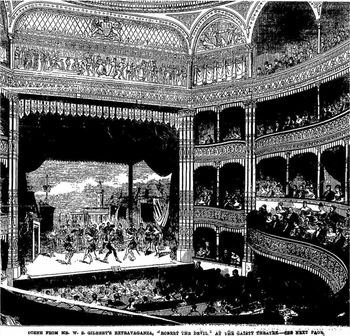
The spacious private boxes, the ornate interior decoration and the elegant dress of the audience can be seen in an image of the Robert the Devil production (see Figure 1).Footnote 155 The image published in the Penny Illustrated Paper highlights the spectacle of the occasion: the dancers on stage, the complicated set and the lavish surroundings of the theatre itself. The audience is depicted wearing evening dresses and dinner jackets, and even the audience members in the pit and gallery have ornate hairstyles and jewellery and are smartly dressed. The image positions the Gaiety audience as an important part of a fashionable theatrical spectacle, highlighting the visibility of the audience to itself.Footnote 156 Gaiety prices were on a similar scale to those at the Prince of Wales's, except that it charged considerably higher prices for the pit and gallery (4s. and 1s. at the Gaiety, compared with 1s. 6d. and 6d. at the Prince of Wales's), suggesting that they were trying to discourage the lower echelons of society (see Table 2, columns 3–4).
‘Robert the Devil’, The Penny Illustrated Paper, 4 September 1869. Reproduced with permission of Peter Joslin (image from the Peter Joslin Collection).

The manager of the Gaiety, John Hollingshead, apparently ‘laboured under no delusion that he was there to elevate public taste and to educate’.Footnote 157 A reporter from Fun noticed that the Gaiety ‘seems to secure the support of the tribe which represents, if not intelligence, at least wealth’.Footnote 158 The choices made for the Robert the Devil production suggest that the Gaiety management firmly understood that its fairly homogeneous, upper-middle-class audience wanted luxury, spectacle, fashion and frivolity rather than serious, educational drama.
The first full production of Robert le diable in London, which was advertised as ‘authentic’, took place in 1832 at the King's Theatre. French operas at the time were routinely translated into English or Italian. Adaptations were often modified along similar lines to Italian opera, cutting complex ensemble numbers, dramatic music and lengthy ballets.Footnote 159 To some extent, these trends can be seen in the way Robert the Devil was presented at the Gaiety Theatre (see Table 4). The only music from the original opera to be included was the opening drinking chorus (‘Versez à tasse pleine’). The most memorable melodic part of the chorus was adapted as a solo air. On the libretto and playbill the title of this number was given in Italian, confirming that members of the audience were most likely to be familiar with the piece in an Italian version. The opera's dramatic music, including the music to the famous ballet of the nuns, was cut. Instead, the simple, memorable and repetitive chorus ‘A fosco cielo’ from Bellini's La sonnambula took its place, perhaps reflecting the trend to translate grand opera into an accessible Italianate form.
| Title | Origin |
|---|---|
| Opening chorus, ‘Versiamo a tuzza [sic] piena’ | Opening chorus, Robert le diable (Meyerbeer) |
| Air changes to ‘Al sol piacer’ | Opening chorus, Robert le diable |
| Song–Raimbault. Air, ‘Les rendezvous de noble compagnie’ | Hérold, Le pré aux clercs |
| Concerted piece. Trio–Robert, Raimbault, Bertram and others. Air, ‘La tremenda ultrice spada’ | Bellini, I Capuleti e i Montecchi |
| Air changes to ‘Hunting the Hare’ | Welsh folk song |
| Quartette–Alice, Bertram, Robert, Raimbault and Gobetto. Air, ‘Bibi-Bamban’ | Composer listed on the programme as Arban; Arban's ‘Bibi-Bamban’ appears in the catalogues of the Bibliothèque Nationale de France as a quadrille on comic songs by Lhuillier, Offenbach and Marc ChautagneFootnote a |
| Air changes to ‘Ah qu'elles sont bonnes les pommes’ | From Offenbach's La belle Hélène; probably refers to ‘L'homme à la pomme’ |
| Quartette–Robert, Isabella, Alice, and Raimbault. Air, ‘Le Chateau [sic] de Kaoutchou’ | ‘Le Château de Ka-ou-tchou’ by Marc Chautagne, composer known for comic songs and operetta |
| Quintette–Robert, Bertram, Raimbault, Gobetto and Alice. Air, ‘Digue, digue, digue’ (L'ile [sic] de Tulipatan) | ‘Tu connais ce secret terrible’ from Offenbach's L’île de Tulipatan |
| (Air changes to finale of L'ile [sic] de Tulipatan) | |
| Chorus of Wax Figures. Air, ‘A fosco cielo’ | Bellini, La sonnambula |
| Trio–Robert, Bertram and Gobetto. Air, from Le dieu et la bayadère | (Auber); the particular number is not specified |
| (Air, ‘Allons gais chausseurs’) | Hervé, L'oeil crevé |
| Duet and chorus–Isabella and Prince of Grenada. Air, ‘Le trouvaille du P'tiot Ivon’ | Victor Robillard, French arranger and composer of comic songs |
| (Air changes to ‘Irish Washerwoman’) | Traditional jig dating from the late 16th/early 17th century |
| Duet–Bertram and Gobetto. (Air from Les deux bavards) | Les bavards is an operetta by Offenbach; the particular number is not specified. The lyrics suggest that they might have been set to the tune of ‘Quel bavard insupportable’, but it is not certain |
| Air changes to ‘Proclamation de Popolani’ (Barbe bleue) | From Offenbach's Barbe-bleue; probably refers to ‘J'apporte les volontés’, which is the only substantial solo for the character Popolani. The new lyrics also fit the melody |
| Quartette–Robert, Bertram, Isabella and Raimbault. Air, ‘Mon Oscar’ | Jules Javolet, composer of comic opera and writer of violin methods. ‘Mon Oscar’ was probably a number from one of his operettas, but its provenance is not specified in the libretto or playbill |
| Air changes to ‘Loup y es tu?’ (Bibi Bamban) | Probably also from Arban's quadrille on songs from operettas |
| Song–Robert and Bertram. Air, ‘My Father's Farm’ | Full title: ‘When I was a lad on me father's farm’; early version of ‘Old MacDonald had a farm’Footnote b |
| Finale–Bertram, Robert, Alice, Isabella, Gobetto, Raimbault and Chorus. Air, ‘Logeons le donc, et dès ce soir’ | Offenbach, La grande duchesse de Gérolstein |
a See <http://data.bnf.fr/14821066/marc_chautagne> (accessed 23 February 2016).
b At the première this song was not included. It was added in a revised and abridged version, in which all numbers from ‘Allons gais chasseurs’ to ‘Loup y es tu?’ were cut. The abridged version may be found at the British Library: W. S. Gilbert, Robert the Devil; or, the Nun, the Dun, and the Son of a Gun (London, n.d.). The Bodleian Library holds a copy of the original version.
Generally, however, Robert the Devil bore little resemblance to Italian opera or grand opera. The musical choices were fairly homogeneous: most of the music came from operetta and much of it from Offenbach. Unlike the management at the Prince of Wales's, that at the Gaiety did not try to appeal to a diverse range of tastes within a heterogeneous middle-class audience. The musical choices were part of a different commercial strategy: the theatre was carving out a particular niche for itself in cornering the popular French operetta market, regularly producing operetta throughout the year with Offenbach a regular fixture. Interestingly, Gilbert's other burlesques written around the same time for other theatres, including Dr. Dulcamara or the Little Duck and the Great Quack (on Donizetti's L'elisir d'amore) for the St James's Theatre in 1867 and La vivandière or True to the Corps (on Donizetti's La fille du régiment) for the Queen's Theatre in 1868, contained a far greater variety of ballads, operatic music, minstrel music and operetta on similar lines to the Prince of Wales's model. Gilbert altered his approach for the specific context of the Gaiety. In the manuscript of Robert the Devil submitted to the Examiner of Plays, many of the details of the music were missing, but suggestions have been pencilled in.Footnote 160 These included a chorus to open the second scene at the Princess's Palace. No chorus appears in the published version at this point, but the manuscript suggested choruses from either ‘Huguenots’ or ‘Grande Duchess’. A number from Offenbach's La grande duchesse de Gérolstein was eventually used as a finale to the burlesque. Other pencil markings suggested the use of ‘Chateau [sic] de Ko-chout’, ‘Ile [sic] de Tulipatan’ and ‘Le dieu et la bayadère’. These suggestions were included in the published version of the burlesque (see Table 4 for details). The suggested musical choices and the seeming interchangeability about where the chorus from La grande duchesse should occur suggest that the guiding principle in the musical choices was simply that the majority should come from French operetta.
The music was fresh: La belle Hélène had premièred in 1864 and had also recently appeared at the St James's Theatre in 1867, L'oeil crevé premièred in 1867 and La grande duchesse and L’île de Tulipatan were even more recent, having premièred in Paris only a couple of months before the Robert the Devil production.Footnote 161 Musical choices, therefore, were based on the desire to advertise new, fashionable products which the bourgeoisie might like to consume. Tellingly, the playbill advertising Robert the Devil provided details of the music used in the performance, including the composer, the original works the pieces were from and the publishers who had granted permission to perform the songs. This practice was unique to the Gaiety and appears to have been a marketing tool to make it easy for audiences to purchase the music.Footnote 162 Publishers probably saw the Gaiety's burlesque productions as an excellent means of advertising new music to an eager bourgeois market.Footnote 163
Hollingshead catered for the fashionable, commercial tastes of his audience in several other ways. One strategy was to sell programmes printed on scented fans, satisfying the upper-middle-class desire for luxury commodities as a symbol of social standing. Later Gaiety programmes were printed on silk.Footnote 164 The programmes for the opening night of Robert the Devil also included adverts for luxury items, including beauty products, horticultural decorations ‘for homes of taste’, perfume and ‘crests and initials embroidered or designed’, suggesting that the audience included some of the nouveau riche aspiring to acquire aristocratic lineage.Footnote 165
Erika Rappaport has argued that West End productions were comparable to shop windows, displaying richly decorated sets, costumes and props, and acting as an extension of the fashionable shopping district of which they were part.Footnote 166 This certainly seems to be true of the Gaiety's Robert the Devil production, in which not only musical selections but also desirable objects and settings were displayed for consumer-spectators. The musical choices, the way they were presented, the elegant programmes, the advertising and the spectacle of the ornate theatre itself all aligned the Gaiety with the commercial pleasures associated with the West End, making the Gaiety's burlesque a natural extension of the day's shopping.Footnote 167
The non-operetta choices in Robert the Devil were drawn from opera and traditional airs and folk songs (the traditional items were not advertised on the programme). Music hall was conspicuous by its absence. This was not appropriate for Gaiety audiences. A music-hall song did appear in a burlesque at the Gaiety in 1885, but it was sneered at in the press. A review of Frank Burnand's Mazeppa describes the vulgar response of those in the pit and gallery to the incorporation of the popular music-hall song ‘What cheer, Ria?’:
The object of the song was that delight of the lower orders – noise. The more the ‘profanum vulgus’ screams the merrier they become […] such a din is heard as never before echoed within the walls of this solemn place of mirth [The Gaiety].Footnote 168
The reviewer also expressed surprise that this ‘democratic ditty’ should be heard in the ‘aristocratic’ Gaiety. The reviewer finished the piece by speculating sarcastically that as ‘What cheer, Ria?’ had travelled as far as the Gaiety, it may continue climbing the social ladder and be introduced in aristocratic balls. The review suggests that members of the lower orders were in the audience, but it was not usually the Gaiety's policy to cater to their tastes. Music hall did not corroborate the Gaiety's identity, or indeed that of its audience. Overall, the musical choices at the Gaiety carefully constructed a fashionable, upper-middle-class audience. Any popular music programmed was not intended to disrupt the audience's sense of a cultural or social hierarchy. The fact that it did in the case of Mazeppa was precisely because music hall was so unusual at the Gaiety, strongly suggesting that cultural subversion was not typical of burlesque at this time and in this theatre. In the particular case of the Gaiety, the homogeneity of the music suggests that Hollingshead did not intend to expand his clientele, but rather was trying to attract a particular type of audience member: one who was wealthy and enjoyed luxury, fashion and frivolity.
This article has put forward an unfamiliar image of burlesque. It has argued that mid-Victorian burlesque was a different beast from its counterpart earlier in the century; gone were the days of cutting satire, cultural subversion and challenges to social hierarchies. In the second half of the century burlesque became respectable, safe and thoroughly bourgeois. Nonetheless, researchers have been slow to distinguish between early and late nineteenth-century burlesques; they tend to project the tendencies of late Georgian and early Victorian burlesque onto burlesques from the mid-Victorian period, assuming that they continued to question cultural and social norms. The result is that burlesque has been divorced from the wider context of the commercial development of the West End and of popular music more generally, which was driven by the appetites of the bourgeoisie. By placing mid-Victorian burlesque in its broader theatrical and musical context, we gain a greater understanding of the impulses driving many of the musical choices and of the audiences at whom this music was aimed. Indeed, if we examine the musical juxtapositions of ‘high’ and ‘low’ music through a mid-Victorian rather than a modern-day prism, we begin to understand just how commercial, and just how far from incongruous or dissonant, the respectable musical pairings were.
As the West End became a respectable site of mass consumerism and a fashionable centre of pleasure and entertainment through the 1860s, the minor theatres found new ways to appeal to their most important consumers: the bourgeoisie. This does not mean that burlesques were attended solely by the bourgeoisie, but this article has argued that writers, producers and musical arrangers imagined their audiences as middle class and deliberately courted this group. Nonetheless, the heterogeneity, ambiguity and fluidity of this group, combined with the separate histories and aims of the theatres themselves, and the time the performances were given, led the theatres to adopt different strategies. This article has deliberately examined burlesques performed at three theatres within a similar geographical area, with seemingly comparable clienteles and within a narrow chronological period in order to illustrate the considerable differences that can be found even within these relatively narrow parameters. Burlesque itself was a fluid, hybrid genre, which made it a perfect vehicle to attract this audience. Each theatre capitalized on a different aspect of burlesque: at the St James's, Lucrezia Borgia! was similar to early Continental opera adaptation; at the Prince of Wales's, variety was key, and here burlesque was similar to ballad opera; while the Gaiety's burlesque was almost an operetta, catering to the tastes of its particular share of the bourgeois consumer group and capitalizing on the developed commercial strategies of the broader West End area.
Overall, mid-Victorian burlesques can shed light on how a group of people who are often the subject of historical enquiry, but are notoriously difficult to define, were constructed by mid-Victorian theatre managers, and perhaps also how this group imagined themselves. The fact that burlesques were involved in consolidating identity and social boundaries in a time of flux shows that they did play an important social role, though not the one with which they have been associated. The image of the bourgeoisie that emerges from mid-Victorian burlesque is of a social group defined by broad commonalities, including respectability, commodity culture and domestic music-making, but with a conflicted relationship to opera, to which burlesque producers were sensitive. The ability of producers to understand and cater for consumer differences allowed mid-Victorian burlesque to become an extension of a fashionable shopping district and an important part of the West End ‘theatrical theme park’.Footnote 169