Introduction
Wisconsin has long been a leader in organic agriculture, ranking second in the USA with respect to number of organic farms, number of transitioning organic acres and number of organic vegetable farms [Bauer et al., Reference Bauer, Carusi, Gurda, McNair and Silva2017; USDA National Agricultural Statistics Service (NASS), 2019]. The development of Extension programming targeted at the specific needs of organic farmers is critical to minimize the risks associated with economically devastating diseases within organic systems (Van Bruggen et al., Reference Van Bruggen, Gamliel and Finckh2016; Burkhart-Kriesel et al., Reference Burkhart-Kriesel, Weigle and Hawkins2019; Rawat et al., Reference Rawat, Bisht, Naithani, Singh, Jahagirdar and Sarma2021; Shahi et al., Reference Shahi, Kachhap, Kumar, Agarwal and Singh2021). Disease management is a particular challenge for organic farmers, frequently ranking high as a barrier to successful organic vegetable production (Letourneau and van Bruggen, Reference Letourneau, van Bruggen, Kristiansen, Taji and Reganold2017; Shahi et al., Reference Shahi, Kachhap, Kumar, Agarwal and Singh2021). Within organic systems, farmers must implement pest management practices, including crop rotation; sanitation measures to remove disease vectors, weed seeds and habitat for pest organisms; cultural practices that enhance crop health, including selection of plant species and varieties with suitability to site-specific conditions and tolerance/resistance to insects, weeds and diseases (USDA, 2014; Van Bruggen et al., Reference Van Bruggen, Gamliel and Finckh2016; Letourneau and van Bruggen, Reference Letourneau, van Bruggen, Kristiansen, Taji and Reganold2017; USDA and NOP, 2018). While these integrated preventive management strategies can prove effective to minimize the risk of disease, circumstances arise where disease may still occur under organic management and necessitate input-based management approaches.
One example is late blight of potato and tomato, caused by the oomycete Phytophthora infestans. Late blight has been an annual challenge for growers in upper Midwestern US states for over a decade (Nowicki et al., Reference Nowicki, Foolad, Nowakowska and Kozik2012; Fry et al., Reference Fry, McGrath, Seaman, Zitter, McLeod, Danies, Small, Myers, Everts, Gevens, Gugino, Johnson, Judelson, Ristaino, Roberts, Secor, Seebold, Snover-Clift, Wyenandt, Grünwald and Smart2013). The aggressive nature of P. infestans in favorable environments often results in cultural management strategies that fall short in limiting disease impacts and spread (Bugiani and Bariselli, Reference Bugiani, Bariselli and Awasthi2021). Under these conditions, preventive input-based strategies are an important means for late blight management (van Bruggen, Reference Van Bruggen1995; Schumann and D'Arcy, Reference Schumann and D'Arcy2000). Included in these preventive strategies are naturally derived biopesticides, which can be viable options for crop protection in organic systems by providing an additional ‘hammer’ within ecologically based pest management programs (Butler and Rosskopf, Reference Butler, Rosskopf, Ownley and Trigiano2015; Dara, Reference Dara and Awasthi2021c; Organic Materials Review Institute, 2021). Understanding the most effective use of these tools within effective ecological, preventive disease management systems can positively influence the ability of organic farmers to successfully manage diseases on their farms while adhering to organic regulations and principles (Damalas and Koutroubas, Reference Damalas and Koutroubas2018; Dara, Reference Dara and Awasthi2021b; Reddy and Al-Rajab, Reference Reddy, Al-Rajab and Awasthi2021).
The wider adoption of biopesticides is constrained by the limited knowledge regarding product modes of action, field efficacy and optimal application strategy (Bugiani and Bariselli, Reference Bugiani, Bariselli and Awasthi2021; Dara, Reference Dara and Awasthi2021a). To advance production strategies that include the judicious use of biopesticides, we must not only increase our understanding of the aforementioned factors, but also better understand the frameworks within which organic farmers make their management decisions. Several studies highlight the complexity of farmer decision-making with respect to practice adoption, which is based on multiple and sometimes conflicting interests, including resources, knowledge sources, markets and personal beliefs (Ortiz et al., Reference Ortiz, Garrett, Heath, Orrego and Nelson2004; Jabbour et al., Reference Jabbour, Zwickle, Gallandt, McPhee, Wilson and Doohan2014; Bardenhagen et al., Reference Bardenhagen, Howard and Gray2020; Diemer et al., Reference Diemer, Staudacher, Atuhaire, Fuhrimann and Inauen2020; Mazhar et al., Reference Mazhar, Ghafoor, Xuehao and Wei2020).
A thorough body of literature underscores how the lack of understanding and recognition of these complexities have created an unstable bridge between the Extension and outreach offered by land grant universities and organic growers' needs (Beus and Dunlap, Reference Beus and Dunlap1992; Agunga and Igodan, Reference Agunga and Igodan2007; Middendorf, Reference Middendorf2007; Sarker and Itohara, Reference Sarker and Itohara2009; Crawford et al., Reference Crawford, Grossman, Warren and Cubbage2015; Marabesi and Kelsey, Reference Marabesi and Kelsey2019; Marabesi et al., Reference Marabesi, Kelsey, Anderson and Fuhrman2021). Strategies that could result in more effective outreach programming regarding organic production practices include the identification of the intersection of stakeholder interests with practice outcomes (e.g. improved soil health, increased worker safety), as well as increased training and education regarding the alignment of the impact of organic practices with the ecological and biological dynamics of pest management cycles. Enhancing regionally specific research and resources for organic production would provide the most appropriate tools to allow for preventive, ecologically based management through the consideration of site-specific conditions (Middendorf, Reference Middendorf2007; Marabesi and Kelsey, Reference Marabesi and Kelsey2019).
Our study evaluated organic farmers' perceptions and approaches of late blight management, including the use of biopesticides, within their disease management strategies. Additionally, we evaluated the sources of information accessed by organic vegetable growers that contribute to building those management frameworks. We assessed (1) grower concerns regarding tomato diseases in organic systems; (2) strategies and factors influencing the management of late blight; (3) the use and perception of risk regarding biopesticides and (4) sources of knowledge guiding the development of organic vegetable farmers' late blight management strategies. Each of these areas provides valuable information for future research and education efforts regarding late blight management in organic vegetable production, working with farmer priorities and using preferred knowledge-sharing mechanisms to facilitate the adoption of best practices.
Methods
A survey questionnaire (see Appendix 1) was developed and distributed electronically via Qualtrics (2019) to organic vegetable growers on the listservs of the Wisconsin Fresh Market Vegetable Growers Association (a non-profit grower association including both organic and conventional farmers); the University of Wisconsin-Madison Division of Extension Vegetable Crop Updates on-line newsletter and the FairShare Community Supported Agriculture Coalition (a non-profit organization supporting Community Supported Agriculture farms) listserv. Responses were collected from 20 March to 27 April 2018. Growers were contacted twice from 20 March 2018 to 20 April 2018 via email with a link to the Qualtrics survey. Paper surveys were sent by mail to gather representation of farmers who do not regularly use email, particularly Wisconsin's Amish and Mennonite communities. These responses (n = 3) were manually inputted via Qualtrics. The survey design was based upon from the tailored design method (Dillman et al., Reference Dillman, Smyth and Christian2014) and included 34 questions. It was estimated to take 15 min to complete, and questions ranged from open-ended to close-ended with multiple choice or scaled response options. The survey questions included three main parts:
(1) Respondent demographic including age, sex, ethnicity, farming experience and level of formal education
(2) Farm characteristics including location, type of farming system and motivation, tomato production information and resources used for farm management
(3) Late blight management including disease experience, types of management strategies emphasized, factors influencing management and attitudes and practice of copper and non-copper biopesticides
To add further context to the online-based survey and gain deeper insight from organic farmers, 13 survey questions were modified and integrated into a PowerPoint presentation and administered at a workshop about managing tomato diseases at the 2019 Midwest Organic and Sustainable Education Service (MOSES) Conference in LaCrosse, WI (see Appendix 1). The live audience response survey was administered using Poll Everywhere (www.polleverywhere.com), an audience response survey tool which allows users to answer questions using personal smartphones and laptops during live presentation (Sellar, Reference Sellar2011). Cross-tabulation analysis was applied to collected data to summarize data for both survey tools (White and Korotayev, Reference White and Korotayev2004). The total number of responses for each question is reported as ‘total N’.
Results and discussion
Respondent demographic
In total, 15 respondents producing certified organic vegetables completed the online survey. However, the total number of respondents varied between each question. All participants who responded to the survey actively farmed in Wisconsin. The average age of grower respondents was 43, with 64% of respondents identifying as female and 47% having more than 11 yr of operating their farm. The respondents of the survey had significant formal education, with 93% of respondents (n = 14) holding a 4-yr college degree or higher. Many growers had farming backgrounds or experience with agriculture. Forty-three percent of organic growers (n = 14) had direct experience either growing up on a farm or working on a farm and 21% of growers had taken classes focused on agricultural production and management. These demographics are similar to national averages for organic farmers reported in the United States Department of Agriculture Census [USDA National Agricultural Statistics Service (NASS), 2017, 2019; Cushman, Reference Cushman2019].
Late blight is an important disease concern
Respondents were asked to rank the importance of several diseases to their tomato production, including anthracnose (Colletotrichum spp.), bacterial leaf spot (Xanthomonas campestris pv. vesicatoria), early blight (Alternaria solani), Fusarium (Fusarium oxysporum) and Verticillium wilt (Verticillium dahliae), late blight (P. infestans), leaf mold (Passalora fulva), mosaic virus (Tobamovirus), nematodes (Meloidogyne spp.) and septoria leaf spot (Mycosphaerella populorum). The top three most important diseases rated by growers was early blight, followed by septoria and late blight (Table 1). In addition to late blight being among the top three important tomato diseases, some growers noted the presence of this disease on their farms. Five out of 14 growers indicated that late blight had been diagnosed and confirmed by an Extension agent or disease clinic over the past 10 yr on their farm. These data suggest that late blight is a disease concern for organic tomato producers in Wisconsin.
Topmost important tomato diseases

The number of organic growers that rated each disease as the most extremely important disease of their tomato production is indicated by ‘Count’. Total number of respondents for each disease is indicated by ‘Total N’. Percentages represent the percent of organic growers who rated each disease as extremely important.
Cultural strategies rank highly as a late blight management strategy
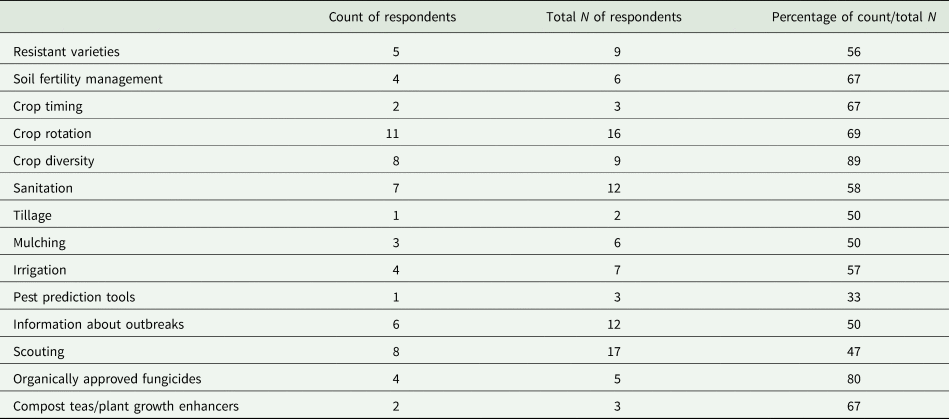
Growers were asked to rank the importance of several strategies for late blight management, from ‘not at all important’ to ‘extremely important’, on a five-part Likert scale (Table 2). The top two strategies ranked ‘extremely important’ based on percentage of organic respondents out of total respondents included crop diversity (eight out of nine, 89%) and organically approved fungicides (four out of five, 80%) (Table 2). The importance of crop diversity as a management approach reflects the systems-based management strategies promoted by the USDA National Organic Program Federal regulations, which emphasize practices such as crop rotation and diversity to increase biodiversity and conserve wetlands, woodlands and wildlife (USDA, 2014). Eleven growers ranked crop rotation as their most important management strategy (Table 2). The frequent identification of crop rotation and crop diversity among the responses to this question which specifically referenced their management strategies regarding late blight may indicate that organic growers correlate these approaches with successful mitigation of the late blight pathogen. However, this association may suggest a gap in knowledge about late blight pathogen biology, as P. infestans is not soilborne in the USA and thus its airborne spread cannot be effectively managed through crop rotation and diverse crop plantings (Finckh et al., Reference Finckh, Schulte-Geldermann and Bruns2006; Speiser et al., Reference Speiser, Tamm, Amsler, Lambion, Bertrand, Hermansen, Ruissen, Haaland, Zarb, Santos, Shotton, Wilcockson, Juntharathep, Ghorbani and Leifert2006; Islam et al., Reference Islam, Mondal, Hossain and Meah2013; Goutam et al., Reference Goutam, Thakur, Salaria and Kukreja2018; Haveri et al., Reference Haveri, Reddy and Thulasiram2018; Khan et al., Reference Khan, Ghazanfar and Raza2019). The ranking of ‘extremely important’ with respect to the use of organically approved fungicides suggests growers are aware of the limitations of cultural management strategies against late blight. Given this knowledge of late blight and the understanding that a key tenant of organic systems involves managing production using an ecological approach (Shahi et al., Reference Shahi, Kachhap, Kumar, Agarwal and Singh2021), growers may be broadly applying strategies that most align with systems-based management principles regardless of pathogen biology and etiology. Further information regarding grower decision-making and specificity toward different pathosystems is needed to better inform education efforts.
Extremely important late blight management strategies

The number of organic growers who rated each of the following late blight management strategies as ‘extremely important’: resistant varieties, soil fertility management, crop timing, crop rotation, crop diversity, sanitation, tillage, mulching, irrigation, pest prediction tools, information about outbreaks, scouting, organically approved fungicides and compost teas/plant growth enhancers is indicated by ‘Count’. The total number of respondents for each factor is indicated by ‘Total N’.
Factors influencing late blight management
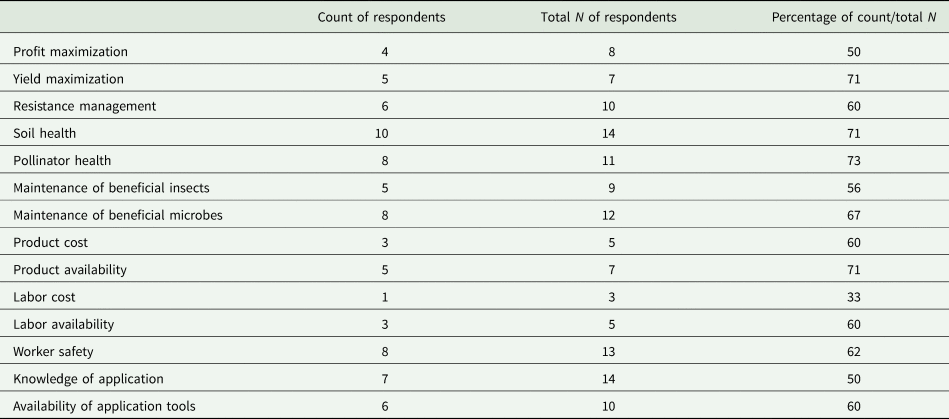
Growers also ranked the importance of several factors that influence their use of late blight management strategies from ‘not at all important’ to ‘extremely important’ (Table 3). Organic growers were highly influenced by yield maximization (five out of seven, 71%), soil health (10 out of 14, 71%) and product availability (five out of seven, 71%). While yield maximization and product availability were ranked highly, most growers highlighted the impacts on soil health as extremely important in influencing their disease management decisions. The importance of soil health aligns with the requirements and goals of the USDA National Organic Program regulations, which emphasize maintenance or enhancement of soil and water quality (Fernandez-Cornejo et al., Reference Fernandez-Cornejo, Greene, Penn and Newton1998; USDA, 2002, 2016; Burchard, Reference Burchard2005; Kuepper, Reference Kuepper, McDermott and Harris2013; Paull, Reference Paull2014). Other health-related factors emphasized by organic growers within their decision-making frameworks included pollinator health, maintenance of beneficial microbes and worker safety (Table 3). When asked about their motivations for farming organically, most responses included human and environmental health. For example, one grower said, ‘I am trying to protect my customers and the environment from chemicals that are harmful’ and another said, ‘Organic farming is an ethical choice’ and ‘Environmental health and people[‘s] health compel[s] me to farm organically’. Other responses listed ‘market demand’ and ‘to produce good tasting produce that delights when consumed’. The health of the environment, pollinators, microbes, workers and consumers have been identified as important drivers of organic and diversified farm management systems (Kelemen et al., Reference Kelemen, Nguyen, Gomiero, Kovács, Choisis, Choisis, Paoletti, Podmaniczky, Ryschawy, Sarthou, Herzog, Dennis and Balázs2013; Kuepper, Reference Kuepper, McDermott and Harris2013; Bhavsar, Reference Bhavsar2017) and should be considered when evaluating not only the suitability of new practices and products for use under certified organic management, but also in the communication of how these practices advance the ability of organic growers' to achieve their systems-based health goals.
Extremely important factors influencing late blight management strategies

The number of organic growers who rated the following factors as ‘extremely important’ in influencing late blight management: profit maximization, yield maximization, resistance management, soil health, pollinator health, maintenance of beneficial insects, maintenance of beneficial microbes, product cost, product availability, labor cost, labor availability, worker safety, knowledge of application and availability of application tools is indicated by ‘Count’. Total number of respondents for each factor is indicated by ‘Total N’.
Copper and reduced risk biopesticides with organic late blight management
In addition to cultural and variety selection strategies, reduced risk pesticides are especially salient within the discussion of managing high-risk tomato diseases, such as late blight. Growers were queried about their perceptions and usage of organically approved fungicides. These included copper products as well as biopesticides, which were defined as an oil, plant or naturally derived product that controls pests or pathogens by inhibiting or eliminating them.
Overall, use of copper fungicides was limited among survey respondents. Three out of nine growers used copper products (Table 4), with respondents citing concerns with copper's ‘off-target effects’, ‘worker safety’, ‘build-up’, ‘exposure’ and ‘residue’. These same concerns at the regulatory level have led to increasing restrictions on copper use in certified organic systems (INRA Science and Impact, 2019). Due to copper's adverse effects on soil and water quality, copper use for crop protection in both conventional and organic systems is completely banned in some northern European countries, leading to increasing need to identify copper-alternative biopesticide products (INRA Science and Impact, 2019; La Torre et al., Reference La Torre, Righi, Iovino and Battaglia2019; La Torre et al., Reference La Torre, Righi, Iovino and Battaglia2019).
Use of biopesticides

The number of organic growers who use non-copper and copper pesticides are indicated by ‘Count’. Total number of respondents for each type of product is indicated by ‘Total N’.
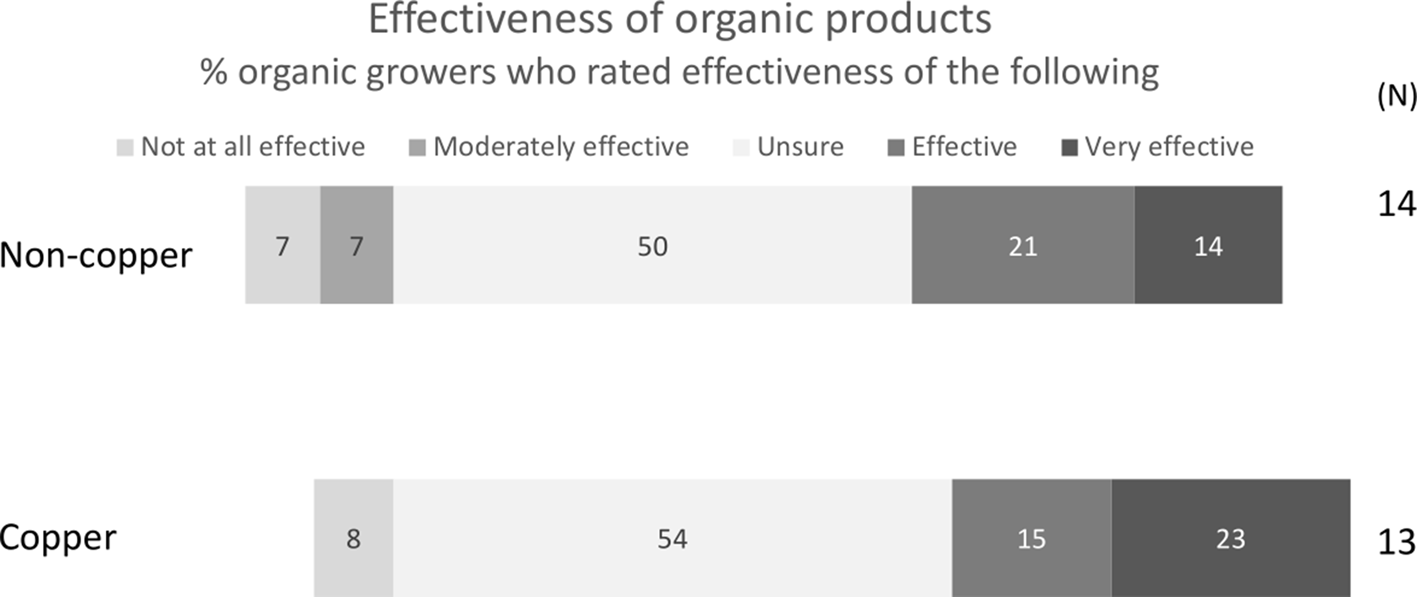
To further understand Wisconsin organic vegetable grower concerns of copper, respondents were asked to rank common statements about copper on a Likert scale from ‘not at all concerning’ to ‘extremely concerning’ (Fig. 1). Fifty percent (n = 14) of growers responding to the survey were extremely concerned regarding copper's harm to the environment and humans, with 43% (n = 15) of growers indicating concerns about residues on the harvested fruit, which can affect marketability due to consumer health concerns and negative cosmetic appearance (Baker et al., Reference Baker, Benbrook, Groth and Benbrook2002; Lamichhane et al., Reference Lamichhane, Osdaghi, Behlau, Köhl, Jones and Aubertot2018). Thirty-six percent (n = 14) of growers indicated that the difficulty of finding alternatives to copper was very concerning. Additionally, challenges with respect to lack of information regarding copper product alternatives, including the expense of these alternatives, were concerning for 15% (n = 14) and 23% (n = 15) of respondents, respectively. Regarding efficacy, copper was rated only slightly more effective than non-copper biopesticides with 38% (n = 13) of growers rating copper as ‘effective’ and ‘very effective’ compared to 35% (n = 14) rating non-copper biopesticides as ‘effective’ and ‘very effective’ (Fig. 1). This finding was surprising, as results of replicated research conducted in laboratory field, and growth chamber studies have consistently demonstrated copper as the most efficacious crop protectant in organic systems for tomato late blight (Dorn et al., Reference Dorn, Musa, Krebs, Fried and Forrer2007; Mizubuti et al., Reference Mizubuti, Lourenço and Gregory2007; Wang et al., Reference Wang, Hu, Zhang, Forrer and Cao2007; Hansen et al., Reference Hansen, Everts, Fry, Gevens, Grünwald, Gugino, Johnson, Johnson, Judelson, Knaus, McGrath, Myers, Ristaino, Roberts, Secor and Smart2016; Lamichhane et al., Reference Lamichhane, Osdaghi, Behlau, Köhl, Jones and Aubertot2018). However, a greater percentage of growers (54%, n = 13) was unsure about the effectiveness of copper, reflecting the broader lack of research regarding organic disease management, as well as a dearth of education materials specifically aimed toward the pest management needs of organic vegetable farmers. Concerns about environmental/human health impacts and product residues, coupled with issues identifying effective alternative products, strongly contribute to the risks and limitations associated with copper and may have influenced the low number of respondents who reported using copper in their disease management programs.
Grower concerns about copper products. Percentage of organic growers who ranked concern of statements about copper products from not at all concerning to extremely concerning. Total number of respondents that responded to each statement is indicated by N.

Usage and concerns of non-copper biopesticides
With the push toward reduction of copper use for disease management, non-copper biopesticides are becoming an increasingly attractive alternative in organic vegetable production. Interest in incorporating biopesticides into organic disease management programs has increased due, in part, to the products' biodegradability, low residual presence in the environment, low resistance risks, ability to specifically target pests and pathogens, little to no off-target effects and durability of disease management programs while protecting yield (Seiber et al., Reference Seiber, Coats, Duke and Gross2014; Tripathi et al., Reference Tripathi, Upadhyay, Bhuyan and Battacharya2009; Damalas and Koutroubas, Reference Damalas and Koutroubas2018; Marrone, Reference Marrone2019; Kalpana and Anil, Reference Kalpana and Anil2021). Furthermore, biopesticides can be used to reduce synthetic pesticide use and act as a pest resistance management strategy (Butu et al., Reference Butu, Stef, Grozea, Corneanu, Butnariu, Hakeem, Bhat and Qadri2020; Essiedu et al., Reference Essiedu, Adepoju and Ivantsova2020). We found that most organic growers responding to the survey (five out of six) have used non-copper biopesticides compared to copper products (Table 4). Despite this high degree of adoption of these productions, concerns regarding non-copper biopesticides included ‘uncertainty in mode of action and efficacy’, ‘high cost’ and ‘rainfastness’ (the degree to which the pesticide can be effective after rainfall or irrigation), with half of the growers responding to the survey uncertain about the efficacy of non-copper biopesticide products (50%, n = 14) (Fig. 2). These findings suggest that, with clearer information regarding the specific efficacy of biopesticide inputs, alternatives to copper could be more widely adopted into organic disease management programs. This further highlights the need for more replicated trials to determine modes of action and efficacy across greater ranges of environments and inoculum pressures to guide the development and communication of best management practices which would facilitate the successful integration of these products within disease management plans.
Perceived effectiveness of organic products. Percentage of organic growers who rated effectiveness of copper and non-copper biopesticides from not at all effective to very effective. Total number of respondents who rated each type of product is indicated by N.

Live audience response survey corroborated online survey results
Results from the live audience response survey corroborated findings from the online Qualtrics survey. Most respondents at the 2019 MOSES conference had experience working on a farm (44%, n = 78) and farmed in Wisconsin, Minnesota and Illinois. Farmers' experiences ranged from no organic experience to 40 yr, with an average of 7.6 yr. This group had similar variance in organic production experience as the online survey respondents, but had slightly lower average experience compared to the online survey averaged experience of 12.3 yr.
As with the online survey, growers reported fungal and fungal-like organisms as the most concerning pathogen group affecting organic tomato production (65%, n = 39). Once again, many growers noted concern regarding true fungal diseases such as septoria and early blight, which are caused by debris-borne pathogens and persist annually (Kemmitt, Reference Kemmitt2002; Zitter, Reference Zitter2020). In comparison, late blight, while occurring annually in the region, is not always guaranteed to occur annually on a given farm and thus growers prioritize their management efforts toward persistent and annually occurring diseases. Although late blight was not the primary concern for organic growers, most respondents from the audience indicated experiencing late blight on their organic farm (63%, n = 38), with 37% (n = 22) responding that they actively manage for late blight.
Respondents were asked to choose the three most important approaches emphasized when managing late blight. They were allowed to select up to three choices and the maximum allowed recorded responses was 100. Like the online survey results, crop rotation was the most important management approach, with 31% of respondents (n = 100) indicating this as their primary tool. This was followed by resistant varieties (20%) and organically approved fungicides (16%). Respondents' use of copper and non-copper products were less than 40% (n = 47). Nearly half of the respondents (43%, n = 20) indicated they do not use pesticides to manage late blight. For growers that use fungicides to manage late blight, a follow-up question about the greatest limitations to using these products was asked. Like the online survey results, product cost and knowledge of application (explained to the respondents as product mode of action or protocol for application) were the top two greatest limitations at 26 and 15%, respectively (n = 47). When asked if they had used biopesticides within their disease management programs, a majority (62%, n = 47) responded ‘no’, again reflecting the findings from the online survey. For those that used biopesticides, respondents listed specific products used, which included (1) copper products such as Champ (copper hydroxide) and Cueva (copper octanoate), (2) microbial products such as Serenade (Bacillus subtillis) and Actinovate (Streptomyces lydicus), (3) plant extracts such as Regalia (Reynoutria sachalinensis) and (4) essential oils such as EF400 (blend of clove, rosemary, peppermint oils) (n = 25). As a follow-up question, we asked about their satisfaction regarding efficacy and 50% (n = 21) indicated they were unsatisfied, unsure or experienced variable satisfaction with these products, corroborating the findings from the online survey. These responses indicate the potential for future research and education programs to address these concerns in efficacy and modes of action, which in turn could result in enhanced organic grower decision-making regarding biopesticide products. Furthermore, greater knowledge of biopesticides can reduce grower risk aversion of implementing these products into integrated disease management programs. This is especially critical in management programs targeting diseases that require preventive crop protections (Moser et al., Reference Moser, Pertot, Elad and Raffaelli2008; Chandler et al., Reference Chandler, Bailey, Tatchell, Davidson, Greaves and Grant2011; Islam et al., Reference Islam, Mondal, Hossain and Meah2013). The integration of biopesticides as a preventive tool in integrated disease management is particularly pertinent in high-risk disease situations, such as late blight, where any detection of symptoms on the plant indicates that crop loss and potential spread has already occurred (Gevens et al., Reference Gevens, Seidl and Hudelson2010; McGrath, Reference McGrath2010; Haveri et al., Reference Haveri, Reddy and Thulasiram2018). Moreover, biopesticides can have an important role in the effective management of diseases which are spread aerially, which may limit the effectiveness of crop rotation and crop diversity in disease mitigation and further necessitate preventive management strategies that include inputs (Van Bruggen and Termorshuizen, Reference Van Bruggen and Termorshuizen2003; Van Bruggen et al., Reference Van Bruggen, Gamliel and Finckh2016; Rawat et al., 2021).
Resources used by respondents
From a list of sources of information, including University of Wisconsin Extension, Midwest Organic and Sustainable Education Service (MOSES), other farmers, books/magazines, published scientific research, resources on the internet and workshops/field days/conferences, growers were asked to rank how often they used each resource from ‘never’, ‘1–2 times’, ‘3–5 times’ and ‘more than 5 times’ over the past 10 yr. The top two most cited resources used were resources on the internet and other farmers. It was not defined what was included in ‘resources on internet’, which may have included Extension sources as well as resources from other organic-focused non-profit education organizations. Resources specifically identified from UW Extension were accessed by the respondents, but those that used this resource tended to use them less frequently. This contrasts with the frequency of use of the resources provided by a non-profit organic-focused organization based in the upper Midwest, MOSES, whose resources were accessed by most farmers (88%) using this resource over five times in the last 10 yr. This suggests that the university Extension services have an opportunity to expand their engagement and impact within the organic vegetable farming community through provided resources that can be tailored to organic farmers' goals and systems. Furthermore, the identification of other farmers as primary resources indicates that integrating growers as co-educators into organic programming can enhance the impact of these programs by building trust, relevance and credibility (Wyckhuys and Oõneil, Reference Wyckhuys and Oõneil2007; Kuehne et al., Reference Kuehne, Llewellyn, Pannell, Wilkinson, Dolling, Ouzman and Ewing2017; Bardenhagen et al., Reference Bardenhagen, Howard and Gray2020). Increasing these bidirectional modes of engagement between Extension agents and organic growers as co-educators and co-creators of knowledge has been identified as a method to not only improve Extension resources for organic production, but also positively influence the communication and adoption of effective preventive pest management strategies within organic systems (Sarker and Itohara, Reference Sarker and Itohara2009; Bardenhagen et al., Reference Bardenhagen, Howard and Gray2020; Marabesi et al., Reference Marabesi, Kelsey, Anderson and Fuhrman2021). Thus, university Extension programs may be improved by developing research, workshops, conferences, and resources in close partnership with grower stakeholders (Table 5).
Resources used by growers for farm management

Percentage of organic growers who used the following resources for their farm management more than five times over the past 10 yr (2007–2017): University of Wisconsin-Madison Extension (UW-Madison Extension), Midwest Organic and Sustainable Education Service (MOSES), other farmers, books/magazines, published scientific research, resources on the internet and workshops/field days/conferences. The number of organic growers who used listed resources is indicated as ‘Count’. Total number of respondents who rated each type of resource is indicated by N.
Conclusions
The integration of two questionnaires allowed us to identify several considerations in managing late blight in organic systems. Though this study was primarily qualitative in nature, several conclusions can be derived from this work. These conclusions should be placed in the context of our work representing a relatively small subset of farmers in Wisconsin and the surrounding upper Midwestern states, as the survey and audience response questionnaires were not based on a random selection of all organic tomato growers in this region.
Managing late blight has specific challenges in organic tomato production
Organic vegetable growers in Wisconsin and the upper Midwest reported to have had experience with late blight as a disease on their farms and considered it among the top three most important diseases of tomato production. The regulation and standards for organic production require an emphasis on soil health, promotion of biodiversity and adoption of systems-based management strategies (Melovic et al., Reference Melovic, Cirovic, Dudic, Vulic and Gregus2020). Both questionnaires affirmed that the late blight management strategies most widely adopted by organic farmers adhere to the National Organic Program regulations and organic management principles, with responses emphasizing the importance of crop diversity, soil health and pollinator/microbial health in late blight management regimes. These factors should be considered when evaluating the potential for organic grower adoption of new management strategies, including integration of biopesticide products. Our findings suggest that biopesticide implementation within organic systems must conform to organic principles and contribute to, or at least not hinder, crop and microbial biodiversity and soil health, not only allowing adherence to the NOP regulation but also aligning with organic grower priorities and motivations. These factors and their implications often vary by location, thus the incorporation of biopesticides in management programs will require site-specific considerations (Gardener and Laudick, Reference Gardener and Laudickn.d.; Samada and Tambunan, Reference Samada and Tambunan2020).
Expanding the use of organic biopesticides for late blight management
Overall, biopesticide use is limited in organic vegetable production in Wisconsin and the upper Midwestern states. A small number of respondents reported using copper and non-copper biopesticide products allowed under National Organic Program regulation. This limited use may be due, in part, to the concerns that growers had about these products, particularly with respect to health and efficacy-related risks, including concerns regarding product residues (both on the plant and in the soil), application safety and non-target effects on human and environmental health. For non-copper biopesticides, growers were concerned about high cost, especially in relation to variable results and the uncertainty about the efficacy of these products.
Reducing grower risk aversion is important to advancing the implementation for biopesticide products (Moser et al., Reference Moser, Pertot, Elad and Raffaelli2008; Chandler et al., Reference Chandler, Bailey, Tatchell, Davidson, Greaves and Grant2011; Samada and Tambunan, Reference Samada and Tambunan2020). Yield and cosmetic appearance are especially important for the marketability of organic fruit and vegetable crops and the risk of producing unmarketable products is high. This has resulted in grower reluctance to adopt new, and seemingly risky, technologies (Chandler et al., Reference Chandler, Bailey, Tatchell, Davidson, Greaves and Grant2011). Limitations of biopesticides include its lack of standardized commercialization and formulation, poor storage stability, application and variable performance in field (Moser et al., Reference Moser, Pertot, Elad and Raffaelli2008; Chandler et al., Reference Chandler, Bailey, Tatchell, Davidson, Greaves and Grant2011; Tripathi et al., Reference Tripathi, Upadhyay, Bhuyan and Battacharya2009; Damalas and Koutroubas, Reference Damalas and Koutroubas2018; Essiedu et al., Reference Essiedu, Adepoju and Ivantsova2020; Samada and Tambunan, Reference Samada and Tambunan2020; Kalpana and Anil, Reference Kalpana and Anil2021; Rawat et al., 2021). These limitations and concerns are reflected in our findings and suggest that increasing knowledge of the application, efficacy and modes of actions of biopesticides may enhance decision-making regarding the implementation and adoption of these products into organic integrated disease management programs. Given the importance of late blight management in organic systems, biopesticides may be a strong addition to a systems-based ecological pest management approach; however, the development of effective management recommendations centered on improved formulation, delivery and application timing/frequency are needed (Samada and Tambunan, Reference Samada and Tambunan2020; Rawat et al., 2021).
Emphasizing pathogen biology and risk in late blight management education
Results from both questionnaires revealed that organic growers more regularly and proactively consider the management of fungal diseases such as septoria and early blight over the oomycete disease of late blight. The finding that growers are emphasizing crop rotation to manage late blight suggests growers place a greater emphasis on broad holistic practices over input-based strategies that may be more effective for specific pathogens, but less aligned with organic principles. However, with certain diseases such as late blight, where strong disease resistance lacks in many desirable crop cultivars, consistent management cannot be achieved solely with cultural strategies; in these situations, a greater need exists for preventive management that includes inputs such as such as biopesticide products. The need to optimize disease management to support both consistently occurring fungal diseases in addition to more variable, high-risk diseases such as late blight is increasing under the evolving landscape of climate change and fungicide resistance (INRA Science and Impact, 2019; Kettles and Luna, Reference Kettles G and Luna2019). Region- and disease-specific information regarding product efficacy and best practices for integration into a systems-based disease management program, including impacts of quality and profitability, must be determined to ensure growers will utilize this additional tool into their crop management strategies as necessary. As this knowledge is generated, effectively communicating the ‘how’ and ‘why’ this information impacts management decisions—in this case, knowledge of how biopesticides work under specific pathosystems—is critical for grower adoption (Dara, Reference Dara and Awasthi2021c). Through our survey findings and conversations facilitated by the live poll, one recommendation for education regarding late blight management in organic systems may include the clearer distinction of the life cycles and transmission modes of fungal pathogens such as early blight and septoria as compared to oomycete pathogens such as late blight, and how this impacts the design of effective disease management programs. Emphasizing the unique characteristics of late blight as a high-risk community disease may further facilitate the adoption of more strategic integrated disease management of tomatoes in Wisconsin and the upper Midwest.
Building more effective Extension approaches to engage organic farmers
Many studies have found that growers emphasize learning from their own experiences and those of other farmers rather than Extension agents and scientific research, which are often viewed as grounded in conventional management approaches (Eckert and Bell, Reference Eckert and Bell2005; Agunga and Igodan, Reference Agunga and Igodan2007; Middendorf, Reference Middendorf2007; Parker and Lillard, Reference Parker and Lillard2013; Jabbour et al., Reference Jabbour, Zwickle, Gallandt, McPhee, Wilson and Doohan2014; Crawford et al., Reference Crawford, Grossman, Warren and Cubbage2015; Marabesi et al., Reference Marabesi, Kelsey, Anderson and Fuhrman2021). Growers responding to our surveys also placed less emphasis on Extension resources as compared to other knowledge and training opportunities regarding the development of their disease management strategies. However, other studies have demonstrated that organic farmers have strong interests in Extension programs addressing the needs of organic farmers, if they align with their values and goals (Delate et al., Reference Delate and DeWitt2004; Bardenhagen et al., Reference Bardenhagen, Howard and Gray2020; Marabesi et al., Reference Marabesi, Kelsey, Anderson and Fuhrman2021). Organic-specific educational resources, like MOSES, workshops/field days/conferences and research that are specifically tailored to serve organic needs, will continue to rise in demand as the organic market expands. Respondents also demonstrated a preference for learning opportunities which foster interactions with other growers and sharing of diverse experiences on working organic farms. Integrating more interactive methods into future research and outreach efforts can allow for greater collaboration and two-way learning, which are key factors for improving Extension support for organic growers (Marabesi and Kelsey, Reference Marabesi and Kelsey2019; Marabesi et al., Reference Marabesi, Kelsey, Anderson and Fuhrman2021). In this study, the information gained through surveys and live polling helped to identify needs and preferences for the future generation of organic-relevant materials for specific pathosystems to further enhance education programming and resources for the organic community in Wisconsin and the upper Midwest.
Appendix 1: Wisconsin Tomato Late Blight Management Survey
Farm characteristics –
1. Do you farm in Wisconsin?
□ Yes – Continue survey
□ No – End survey
2. How many years have you been operating this farm?
□ 0–5
□ 6–10
□ More than 11
3. In what Wisconsin county is your farm located?
4. How large is your farm in acreage?
□ Less than 1
□ 1–5
□ 6–10
□ 11–25
□ 26–50
□ More than 50
5. In 2017, how many acres of tomato did you plant and/or how much row feet of tomato did you plant?
Acre: Row Feet:
6. In 2017, what percent of tomatoes planted were grown under high tunnels?
7. In 2017, what percent of tomatoes produced went into processing and fresh market?
Processing: Fresh Market:
8. Over the past 10 years, what specific tomato varieties do you generally grow and why?
9. Do you use heirloom tomato varieties?
□ Yes
□ No
10. Do you use late blight resistant tomato varieties?
□ Yes
□ No
11. Is your farm certified organic?
□ Yes, currently certified organic
□ Currently transitioning from conventional to organic
□ No
If yes to #8:
12. How many years have you been farming organically?
13. Do you use organic tomato seed?
□ Yes
□ No
Rank the importance of the following diseases 1–3 with 1 being most important and 3 being third most important.
14. Rank the top 3 most important diseases on tomato production?
___ Anthracnose
___ Bacterial leaf spot
___ Early blight
___ Fusarium and Verticillium wilt
___ Late blight
___ Leaf mold
___ Mosaic virus
___ Nematodes
___ Septoria leaf spot
___ Other: __________________
Chemical, mechanical, cultural management—
1. For the past 10 years, how many times have you used the following individuals, organizations, or sources for information or assistance?


The following questions are specific to late blight on your farm. All responses are confidential and will be kept anonymous. Please answer openly and truthfully.
2. Do you manage for tomato late blight during each growing season?
□ Yes
□ No
3. Over the last 10 years on your farm, has late blight been diagnosed and confirmed by an extension agent or disease clinic?
□ Yes
□ No
4. In which year(s) was late blight confirmed on your farm?
5. In the years that late blight was confirmed, when do disease problems seem most troublesome during the growing season?
□ Early season
□ Mid-season
□ Late season
6. How important are the following approaches to late blight disease management on your farm?
7. How important are the following factors in influencing your late blight disease management strategies?


For the following questions, plant growth or health enhancers are defined as products that work to promote the health of the crop. Bio-pesticides are defined as an oil, plant or biologically based product that control pests by inhibiting or eliminating them. Copper-based fungicides control pests by inhibiting or eliminating them. Alternatives may include but are not limited to compost teas, molasses, sugar, milk, etc.
Specify the product you use, the number of applications on tomato crop, and describe any concerns you have with each product.
8. In 2017, did you make foliar spray applications to manage tomato late blight on your farm?
9. Rank the following products you prefer with 1 being most preferred and 3 being least preferred?
___ Plant growth or health enhancer
___ Bio-pesticide
___ Copper- based fungicides
___ Other: ________________
10. Rate the effectiveness of each product in ability to reduce late blight disease?


The following questions relate to copper-based fungicides.
11. How much do you agree or disagree with the following statements?
12. How concerning are the following statements for using copper products in your vegetable systems?


Give examples. Describe x product over y and provide reasoning.
13. What is your reason for choosing one product over another?
14. Do you manage your tomato crops differently under high tunnels or open field? How?
15. What are your overall motivations for farming organically?
Respondent demographic –
1. Fill out the following chart.

Thank you for taking the time to complete and submit this survey. Your information and insights are valuable to us in making informed decisions about researching ways to enhance disease management for Wisconsin vegetable growers. Use the space below to provide additional comments on how we might improve our resources:
Please contact Tina Wu at kwu55@wisc.edu or write to the following address if you have any further questions or concerns about this survey.
Please return completed survey to:
Russell Labs 875B
1630 Linden Dr.
Madison WI 53706
Workshop Session: Ecological Management of Tomato Diseases
Presenters: Tina Wu, Erin Silva, Julie Dawson, Amanda Gevens
Poll Everywhere Questionnaire
1. What is your farming education
a. Grew up on a farm
b. Worked on a farm
c. Classes in agriculture
d. All of the above
e. No farming background
2. Where do you farm? Respond with state or country abbreviation
3. How many years have you been farming organically
4. Which pathogen group are you most concerned with?
a. Virus
b. Bacteria
c. Nematode
d. Fungi/Fungi-like
5. Have you experienced late blight on your farm?
a. Yes
b. No
6. Are you actively managing for late blight?
a. Yes
b. No
7. Which top 3 management approaches do you emphasize when managing late blight? Respond in separate texts
a. Resistant varieties
b. Crop timing
c. Crop rotation
d. Sanitation
e. Tillage
f. Irrigation
g. Outreach information
h. Scouting
i. Organically approved fungicides
8. What is your biggest limitation to managing late blight with fungicides?
a. Product cost
b. Product efficacy
c. Knowledge of application
d. Time and cost associated with labor
e. Worker and consumer safety
f. I don't manage for late blight with fungicides
9. Have you tried using biopesticide products?
a. Yes
b. No
10. If yes, what product(s) did you use?
11. If yes, were you satisfied with the results?