In 2013, President Obama referred to Kamala Harris, then California’s attorney general, as our “best-looking attorney general in the country” at a Democratic National Committee fundraiser. After the crowd erupted with laughter, Obama responded in jest, saying, “It’s true. Come on.” Harris would later be elected to the US Senate in 2016—the second Black woman and one of three Asian American women senators to serve in the country’s highest legislative chamber—and was a former candidate for president in 2019. The daughter of immigrants from India and Jamaica, Harris is honey-hued with straight, shoulder-length brown hair. Phenotypically, Harris is less African looking and consequently is seen as an attractive woman of color (Kutz Reference Kutz2017; Matthews Reference Matthews2013). Although Obama’s comment was an attempt to be humorous, it struck a nerve with critics who lambasted the president for judging women on their looks rather than their credentials.
Colorism, a form of discrimination based on a person’s skin tone, favors light-skinned people of color over their darker-skinned peers. Bonilla-Silva (Reference Bonilla-Silva2010) argued that colorism is part and parcel of institutional racism and White privilege that operate on two interrelated levels: race and skin color. Colorism is a legacy of slavery and racism that has contributed to Black Americans’ racial identities (Russell-Cole, Wilson, and Hall Reference Russell-Cole, Wilson and Hall1992). Perceptual dimensions of skin color are on a contingency for people of African descent; therefore, what may be considered lighter-skinned in one context may be darker-skinned in another (Russell-Cole, Wilson, and Hall Reference Russell-Cole, Wilson and Hall1992). A person’s skin color (among other identifying features, such as hair) continues to shape Black Americans’ socioeconomic status, professional lives, romantic choices, and family relationships. For example, Hunter (Reference Hunter2007) found that whereas Black Americans make less money than Whites, darker-skinned African Americans earn less money than their lighter-skinned counterparts. Here, race and color work in tandem to marginalize dark-skinned Black people.
Black women political elites in particular have markedly different experiences on the campaign trail and in the statehouse based on their skin color (Brown Reference Brown2014). A recent study found that millennial voters believe that darker-skinned Black women candidates have more Afrocentric and progressive policy preferences than their lighter-skinned counterparts (Orey and Zhang Reference Orey and Zhang2019). Therefore, colorism also may impact candidate recruitment or viability (see also Dowe Reference Dowe2020).
We argue that for Black women, colorism is a salient part of everyday life. Black women are bombarded with colorism in interpersonal interactions (e.g., degraded or celebrated for their skin tone), when shopping for products (e.g., makeup), when exposed to celebrities (Sims Reference Sims2016b), and when experiencing the world as a Black woman. Skin tone is a defining characteristic for determining beauty. Beauty is culturally normative and its characteristics are more stringently applied to women than to men (Collins Reference Collins1990). Lighter-skinned Black women are more likely to marry a partner who has higher socioeconomic status (Hughes and Hertel Reference Hughes and Hertel1990). Indeed, Udry, Bauman, and Chase (Reference Udry, Bauman and Chase1971) found that “traditional status advantages of light-skinned women hold for all cohorts.” Black women are more impacted by colorism than Black men (Fears Reference Fears1998). Intragroup analysis of Black men and women reveals that there often are minor differences that do not rise to significant levels of political dissension (Gershon et al. Reference Gershon, Montoya, Bejarano and Brown2019; Simien Reference Simien2006). Gender, in tandem with skin color, may combine to create a different orientation toward other Black Americans in the form of linked fate.
We argue that for Black women, colorism is a salient part of everyday life.
Gender, in tandem with skin color, may combine to create a different orientation toward other Black Americans in the form of linked fate.
We contend that skin color may be associated with feelings of linked fate differently among Black men and women. We explored internal politics among Black Americans of differing skin tones to advance the idea that skin tone is related to linked fate differently for Black men and women. Using data from the 2016 Collaborative Multiracial Post-Election Survey (CMPS), we found that (1) colorism is gendered, and (2) the gendered component of colorism has ramifications for linked fate.
COLORISM AND POLITICS
Several political scientists have examined the effects of colorism on politics (e.g., Carew Reference Carew and Nadia2016; Cassese Reference Cassese2019; Hochschild and Weaver Reference Hochschild and Weaver2007; Hutchings et al. n.d.; Russell-Cole, Wilson, and Hall Reference Russell-Cole, Wilson and Hall1992; Yadon Reference Yadon2019). Hochschild and Weaver (Reference Hochschild and Weaver2007) purported a “skin color paradox” in which there are few political differences among light- and dark-skinned Blacks. They found that darker-skinned Blacks are not more inclined to have a sense of linked fate with other Blacks. This led them to conclude that political attitudes among Blacks were not dependent on skin tone. Similarly, Seltzer and Smith (Reference Seltzer and Smith1991) found that skin color bore little influence on Blacks’ political beliefs or values. As such, race-based oppression, not colorism, seemed to be the motivating factor in Blacks’ political behavior rather than skin tone.
Previous studies investigated skin color and political attitudes among Blacks without giving significant attention to the role of gender differences. We challenged this using an intersectional framework that considers varied lived experiences (Collins and Bilge Reference Collins and Bilge2016), as well as an intra-categorical view that focuses on the heterogeneity of the Black experience. We argue that gender is instrumental in fully understanding how colorism may impact political beliefs. Much of our scholarly knowledge on colorism in electoral contests is based on Black candidates without disaggregating by gender. These studies demonstrated that dark-skinned candidates are believed to have a stronger tie to racialized communities, whereas light-skinned candidates are rated closer to Whites on trait measures. However, Carew (Reference Carew and Nadia2016) found that Black women are seen more positively on specific trait measures when they are darker-skinned. This research indicates that stereotypes based on skin color may be conditional on gender.
We argue that feelings of group attachment also may be conditional on gender. One of the most important concepts to understanding Black political behavior is linked fate (Dawson Reference Dawson1994): the belief that a person’s life chances are highly determined by group status. Scholars have sought to expand the limits of linked fate to test the theory among other racial, ethnic, and gendered groups (Frasure-Yokley, Masuoka, and Barreto Reference Frasure-Yokley, Masuoka and Barreto2019). We propose a deeper delve into Dawson’s (Reference Dawson1994) theorization of Blacks by examining the impact of colorism within African American communities and its differing effects between men and women. Rather than assuming homogeneity based on a shared racialized experience, we contend that colorism produces varied lived realties for Black men and women in America. Therefore, attachments to Black group identity may be different between genders. Colorism, we argue, impacts the psychological attachment within the group.
DATA AND METHOD
We tested our hypotheses using the 2016 CMPS (Barreto et al. Reference Barreto, Frasure-Yokley, Vargas and Wong2018), a nationwide internet survey with large samples of people of color. The strength of this dataset lies in the richness of its content and sample sizes. The survey consists of samples randomly selected from registered-voter and third-party lists.Footnote 1 Although respondents were not randomly selected from the general population,Footnote 2 these analyses are weighted to be nationally representative.
We treated respondents as “Black” if they self-identified as Black or African American in the CMPS screener. In the 2016 CMPS, there were 3,154 self-identified Black respondents (i.e., 69.28% self-identified women, 30.72% self-identified men).Footnote 3 Of the 3,102 Black respondents who self-identified as Black or African American and who answered a follow-up question about country of origin, about 74% stated that they had “roots in America for many generations,” indicating that nearly 25% of the sample may have had immigrant ancestry. About 94% of the people in the sample were born in the United States.
We asked two questions: linked fate and self-reported skin tone. The CMPS asked all respondents, “Do you think what happens generally to [race] people in this country will have something to do with what happens in your life?” About 67% of all Black respondents said yes; about 67% of Black women and about 69% of Black men said yes. The CMPS also asked all respondents to rate themselves on the Massey and Martin (Reference Massey and Martin2003) “scale of skin color darkness” (i.e., a visual scale of hands that vary in skin shade), in which 1 is lightest and 10 is darkest. We included variables for experience with discrimination (Sanchez and Masuoka 2006Reference Sanchez and Masuoka Reference Sanchez and Masuoka); educational attainment, income, and age (Sanchez and Masuoka Reference Sanchez and Masuoka2006); partisanship (White, Laird, and Allen Reference White, Laird and Allen2014); and respondents’ approximation of the percentage of Black people in their neighborhood (Wilcox-Archuleta Reference Wilcox-Archuleta2018).Footnote 4
FINDINGS
We assessed whether gender is related to self-reported skin tone. A Pearson chi-squared test suggested that gender and self-reported skin tone are significantly correlated (Pr=0.000). Figure 1 shows men’s and women’s self-reported skin tone from a linear regression model. On average, women in the CMPS self-rated at 4.82 and men self-rated at 5.33; this difference is statistically significant (p=0.000). This suggests that either men and women see their skin tone differently on the Massey and Martin (Reference Massey and Martin2003) scale (Freeman et al. Reference Freeman, Penner, Saperstein, Scheutz and Ambady2011; Penner and Saperstein Reference Penner and Saperstein2013) or that women are reluctant to self-rate darker, possibly to communicate social or beauty status (Hunter Reference Hunter2007). Another possibility is that Black men in this sample actually do have a darker skin tone than Black women. Given the sampling process, we expected there to be no statistical difference in skin tone between men and women. As such, we believe this difference is a function of differences in self-reporting behavior rather than actual skin tone.
Self-Reported Skin Tone (Women Compared to Men)

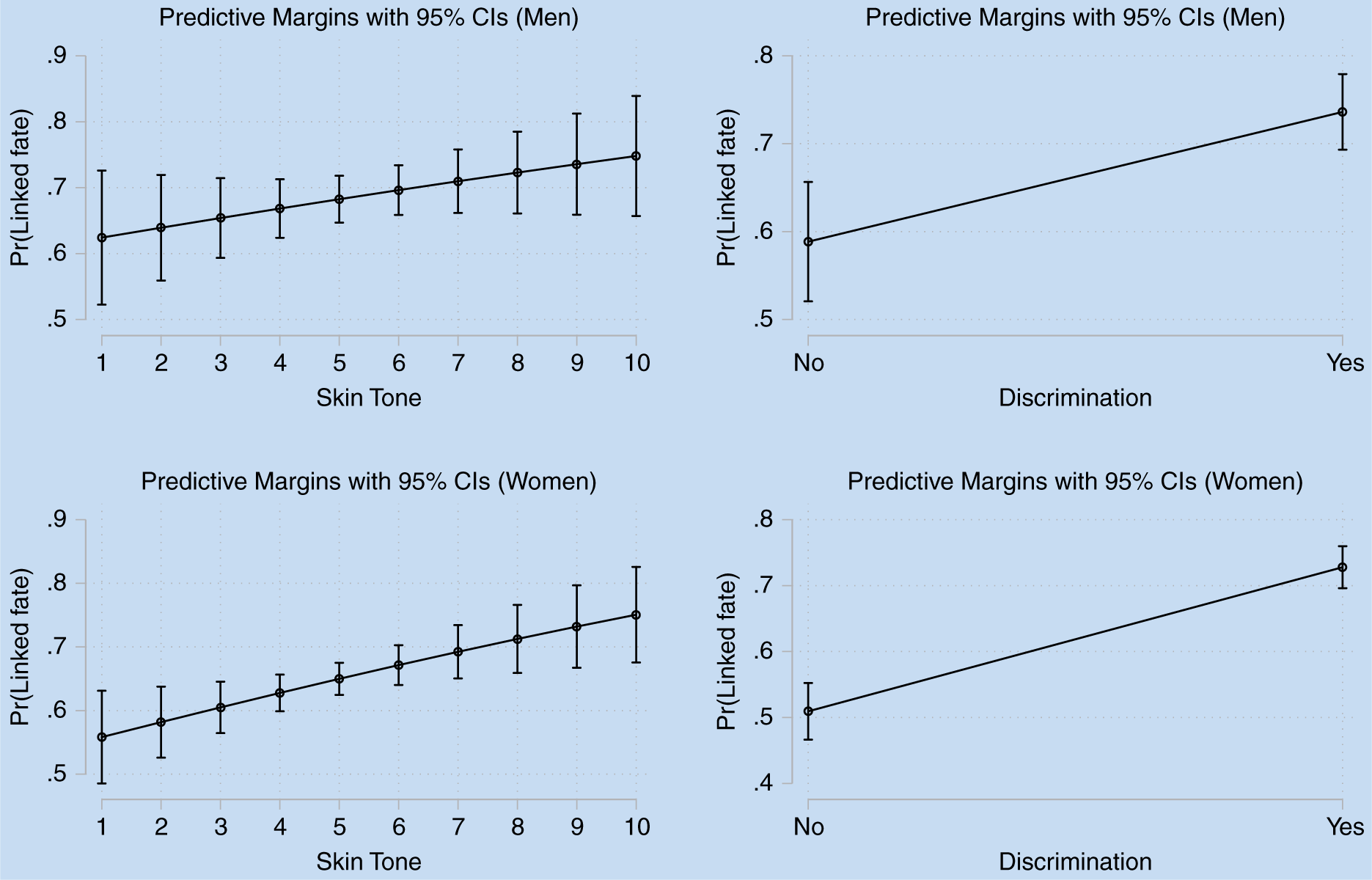
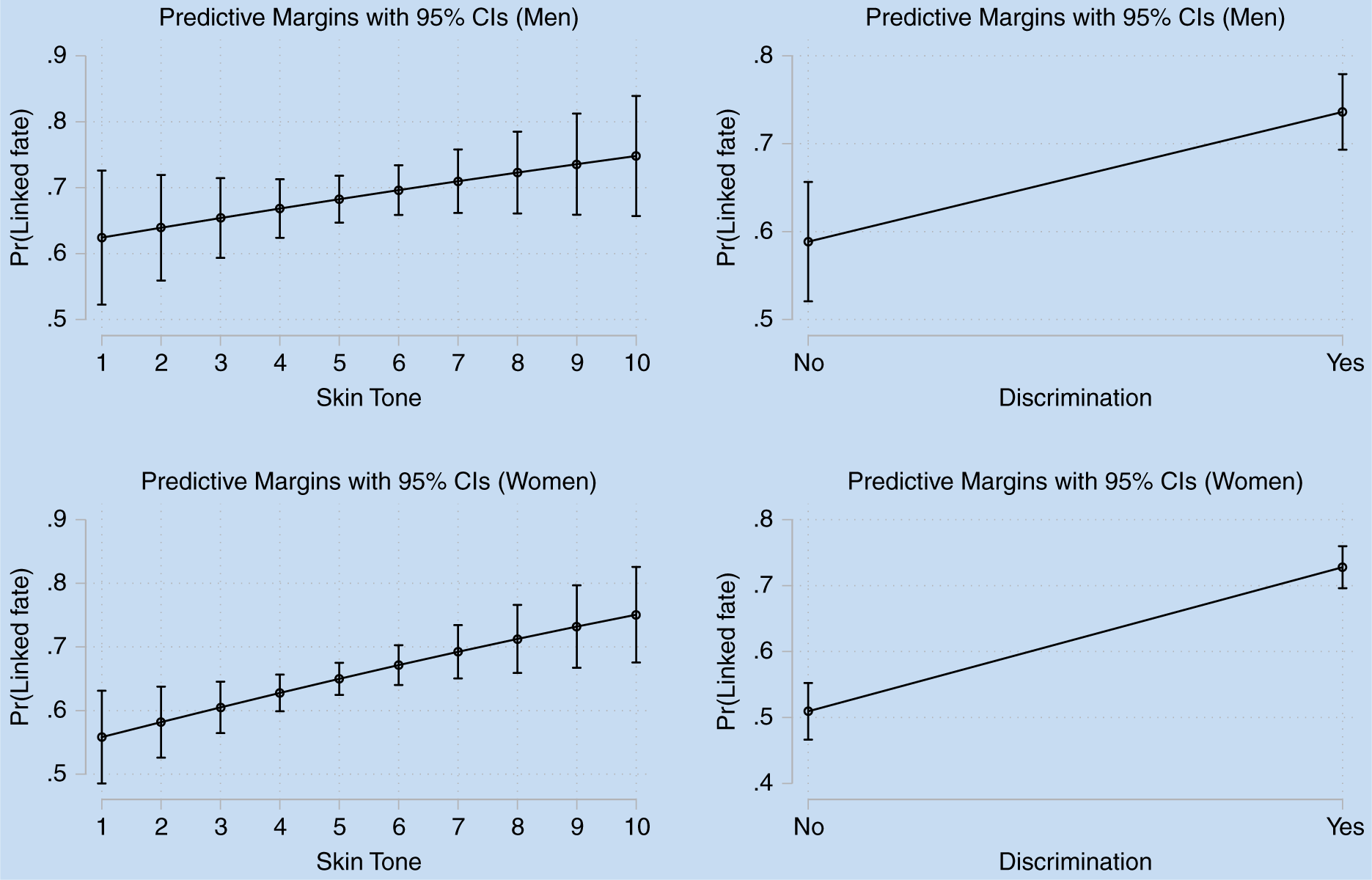
Turning to linked fate, predicted probabilities from a logistic regression indicate that Black respondents were about 2 percentage points more likely to report linked fate as their self-rated skin tone darkens (p=0.005). Those who experience discrimination were about 20 percentage points more likely to report linked fate (p=0.000). Figure 2 shows differences in the predicted probability of reporting linked fate among men and women separately by skin tone and experience with discrimination. There is a general upward trend: as self-reported skin tone darkens and respondents report discrimination, so does the tendency to report linked fate. However, on average, the relationship between increasingly darker self-reported skin tone and the probability of reporting linked fate is statistically significant only among women. For women, as self-rated skin tone darkens, the probability of reporting linked fate increases by about 2 percentage points (p=0.009). The probability of reporting linked fate also is about 21 percentage points greater for women who experience discrimination (p=0.000). In other words, both discrimination and skin tone shape women’s feelings of linked fate. For men, experience with discrimination is statistically significant (p=0.000) and associated with an approximate 14-percentage-point increase in the probability of reporting linked fate.
Predicted Probability of Linked Fate Among Men and Women by Skin Tone
DISCUSSION AND CONCLUSION
These findings illustrate that race and gender are inextricably linked (Collins Reference Collins1990). We contend that the link between skin tone and linked fate differs for Black men and women because society may see the heterogeneity among Black women but not among Black men (Penner and Saperstein Reference Penner and Saperstein2013). This may be because Black women’s status as “women” allows them to be depicted as objects of beauty—or not—and Black men experience discrimination that is distinct to their race–gender classification, regardless of skin tone. Footnote 5 For instance, consider Senator Kamala Harris and Stacey Abrams, a former candidate for the governor of Georgia. In 2017, The Hill listed Harris as one of its “50 Most Beautiful.”Footnote 6 By contrast, in 2019, Abrams shared that she was discouraged from pursuing office because “[she] was just too dark.”Footnote 7 In a similar list for male leaders,Footnote 8 only two African American male politicians appeared—Obama and Congressman Cedric Richmond—and eight White American male politicians. The paucity of African American male politicians on that list suggests that they are not necessarily viewed as sex symbols the way that Black women politicians might be. As such, Black men may not be assessed by their “beauty” and may experience a different form of colorism than Black women.
For Black women, skin tone and discrimination shape perceptions of linked fate. We suggest two explanations at the individual and the societal levels (Felson Reference Felson1985; Sims Reference Sims2016a). First, there is something about darker skin that shapes how connected Black women feel to Black people. Social-identity theory (Tajfel and Turner Reference Tajfel, Turner, Austin and Worchel1986) suggests that this may be related to how Black women see themselves. Among Black women, darker skin may make race a more salient identity than it is for those lighter-skinned, resulting in those with darker skin feeling greater attachment to the group. Black women with darker skin may feel closer psychological ties to other Black people, which is not necessarily driven by racial discrimination but perhaps is due to a positive psychological orientation toward the group.
Second, skin tone may shape Black women’s linked fate because their racial experiences may be more pliable than men’s, resulting in how society sees and treats Black women. Lighter skin may result in a Black woman being perceived as in multiple non-Black categories (Brown Reference Brown2014), and darker skin may result in a Black woman being perceived as solely Black (Sims Reference Sims2016a). Skin tone may combine with other features, such as hairstyle, to alter the racial experiences of Black women (Brown Reference Brown2014; Lemi and Brown Reference Lemi and Brown2019; Sims, Pirtle, and Johnson-Arnold Reference Sims, Pirtle and Johnson-Arnold2019) in ways that are not perceived by CMPS survey respondents as discriminatory. Another possibility is that lighter skin may be associated with a higher social status in the mind of survey respondents (Hunter Reference Hunter2007); thus, selecting a lighter shade on a skin-tone question reflects how people think of themselves socially. Because the particular skin-tone measure in the CMPS used a gradated scale of visual colors rather than the terms “light” and “dark,” we were unable to address whether the survey respondents drew distinctions among nominal categories. Whereas discrimination explained Black men’s sense of linked fate, both discrimination and skin tone explained Black women’s sense of linked fate. How others see Black women may alter how connected they feel with other Black Americans. In summary, colorism is gendered, and the relationship between skin tone and group politics is gendered. Ignoring gender occludes the role of colorism in Black Americans’ feelings of linked fate: these data suggest that skin tone matters differently among women.
Ignoring gender occludes the role of colorism in Black Americans’ feelings of linked fate: these data suggest that skin tone matters differently among women.
Supplementary Materials
To view supplementary material for this article, please visit http://dx.doi.org/10.1017/S1049096520000761.