Is racial fluidity a barrier to blackFootnote 1 group consciousness in Latin America? Several studies contend that the valorization of racial mixture and denigration of black people have hampered the formation of group consciousness for afro-descendants (Costa Vargas Reference Costa Vargas2004; Hanchard Reference Hanchard1994; Twine Reference Twine1998; Wade Reference Wade1993). Phenotypic fluidity within Latin American racial discourse(s) permits some members of marginalized identity groups to claim mixed-race identity. Still, people of African descent face similar realities of marginalization and exclusion, regardless of mixed or black self-identification (Costa Vargas Reference Costa Vargas2004; Telles Reference Telles2004; Wade Reference Wade1993; Reference Wade2004). This paper sets out to explicitly test the relationship between racial fluidity—understood as the uncertain link between phenotype and racial self-identification—and black group consciousness in Latin America.
This paper uses an original survey experiment of Panamanians to unpack the relationship between phenotype, fluid racial identification, and five dimensions of group consciousness. The first key finding in the paper is that racial fluidity has a significant effect on who identifies as black, but surprisingly little impact on the standard measures of group consciousness. This finding nuances the relationship between identity fluidity and identity strength in Latin America. While race mixture encourages some people to reject black identity, it is concordant with politicized black identity for others.
The second key finding is that differences in Afro-Panamanian phenotype predict the differential salience of group consciousness measures. Afro-Panamanians with physical traits that stably predict black self-identification (fixed phenotype) express stronger perceptions of systemic racial inequality, while Afro-Panamanians with (very) mixed phenotype express stronger belief in black linked fate and the potential efficacy of collective black mobilization. The evidence from this study suggests that these two sets of group consciousness measures tap into separate dimensions of politicized group identity for black Panamanians with fixed and (very) mixed phenotype.
In the next section of the paper, I discuss the existing literature on African-American and minority group consciousness in the U.S. to unpack its content and contingency. In the section that follows, I review the existing arguments that have dismissed Afro-Latin American group consciousness in light of the mounting evidence that the hegemony of mestizaje is contested. This section presents two hypotheses that address the relationship between racial fluidity and dimensions of group consciousness. The next section explains why Panama is a useful case to unpack the relationship between phenotype and politicized black identity in Latin America by situating Panamanian race-making within race-making projects in the rest of the region. I present the data and methods and the results in the subsequent sections. In the final two sections, I weigh the evidence for Afro-Panamanian group consciousness against the paper's hypotheses and conclude with a discussion of the significance of the findings to our understanding of the link between racial fluidity and group consciousness.
Group Consciousness in American Politics
Group consciousness is a form of group identity. A person identifies with her group when she perceives her membership in the group and feels attached to her group based on shared beliefs and interests (Jackman and Jackman Reference Jackman and Jackman1973; McClain et al. Reference McClain, Carew, Walton and Watts2009). Moving down the ladder of abstraction, group consciousness is politicized in-group identification based on a recognition of the group's marginal social standing and that collective political action is the best way to improve the group's social standing (Jackman and Jackman Reference Jackman and Jackman1973; McClain et al. Reference McClain, Carew, Walton and Watts2009; Miller et al. Reference Miller, Gurin, Gurin and Malanchuk1981; Sanchez Reference Sanchez2006). The distinction between these two concepts is important because the individual and collective dimensions of identification are often conflated (Brubaker Reference Brubaker2009; Lee Reference Lee2008). Parsing the two concepts helps to separate the social importance of identification from its political relevance.
African American group consciousness was first theorized in an effort to explain their relatively high levels of civic participation at the height of the Civil Rights Movement (Shingles Reference Shingles1981; Verba and Nie Reference Verba and Nie1972). McClain et al. (Reference McClain, Carew, Walton and Watts2009) argue that the “specific history” of group-based exclusion and oppression created the conditions for African-American group consciousness (p. 477–8). African-American group consciousness is still a strong predictor of black partisanship and vote choice, over and above their social class, and strongly drives black attitudes on policies specific to race (Austin et al. Reference Austin, Middleton and Yon2012; Dawson Reference Dawson1994; Tate Reference Tate1994).
Identity scholars typically measure group consciousness using a mix of survey items that capture the following concepts: polar affect, polar power, perceived discrimination, linked fate, and collective efficacy (McClain et al. Reference McClain, Carew, Walton and Watts2009; Miller et al. Reference Miller, Gurin, Gurin and Malanchuk1981; Sanchez Reference Sanchez2006; Sanchez and Vargas Reference Sanchez and Vargas2016). Polar affect captures the degree to which the person likes ingroup members and dislikes outgroup members. The polar power dimension measures their degree of (dis)satisfaction with the groups relative social/material status. Perceived discrimination measures the level of discrimination that the individual perceives toward their group. Linked fate, often used as a summary measure of group consciousness, measures the degree of support for the idea that what happens to the group in general, affects the individual personally. Finally, collective efficacy is a measure of their belief in the efficacy of the collective mobilization of their group as a solution to their group's marginal position.
While the multiple measures of group consciousness are theorized as a single component of group identity for African Americans, recent evidence shows that the degree of cohesion across these measures varies by group. Sanchez and Vargas (Reference Sanchez and Vargas2016) show that perceived discrimination is a central dimension of group consciousness for African Americans and Latinxs in the U.S. but a weaker dimension of Asian American group identity. Collective efficacy is the central dimension of group consciousness for Asian Americans. Consequently, the salience of one dimension is neither necessary nor sufficient for the salience of the other dimensions (Lien Reference Lien1994; Miller et al. Reference Miller, Gurin, Gurin and Malanchuk1981). A person may express a high degree of affinity for their in-group and culture but attribute between-group inequality to individual shortcomings, as Lien (Reference Lien1994) finds with some Asian Americans and Mexican Americans.
The group consciousness literature contends that politicized racial identities emerge where historical marginalization has laid the foundation for collective solidarity and the demand for group uplift. However, the content of group consciousness is contingent on the particular history of groups’ formation and marginalization. This study follows the example of Miller et al. (Reference Miller, Gurin, Gurin and Malanchuk1981), Lien (Reference Lien1994), Sanchez and Vargas (Reference Sanchez and Vargas2016), and Clealand (Reference Clealand2017) to disaggregate the dimensions of group consciousness. The disaggregated approach to measurement allows for a nuanced examination of politicized black identity in Latin America, because it does not presuppose that they coalesce into a unitary group consciousness like they do for African Americans.
Barriers to Afro-Latin Group Consciousness
Compared to African-Americans in the U.S. and Coloreds and Blacks in South Africa, Afro-Latin Americans are believed to have limited group consciousness, despite similar legacies of slavery and racial stratification (Hanchard Reference Hanchard1994; Marx Reference Marx1998). Latin American nationalisms are rooted in mestizaje—the myth that centuries of racial mixture produced harmonious and egalitarian relations across racial lines (Telles and Bailey Reference Telles and Bailey2013). Despite the reality of the social, economic, and political marginalization of Afro-Latin Americans, the hegemonic narrative of mestizaje delegitimizes claims of racial inequality and discrimination (Costa Vargas Reference Costa Vargas2004; Hanchard Reference Hanchard1994; Hooker Reference Hooker2005; Johnson Reference Johnson, Kingstone and Yashar2012; Paschel Reference Paschel2010; Priestley and Barrow Reference Priestley and Barrow2008; Twine Reference Twine1998). Decades of elite projects, like the omission of racial categories from censuses and national surveys, have created a social consensus around the myth that everyone can make equal claims to mestizo (mixed race) identity. As a result, racial boundaries are believed to be socially and politically inconsequential (Loveman Reference Loveman2014). Scholars such as Hanchard (Reference Hanchard1994), Nobles (Reference Nobles2000), Sansone (Reference Sansone2003), and Twine (Reference Twine1998) used the Brazilian case to thoroughly unpack the project of racial hegemony embedded in mestizaje. Hanchard, for example, argued that the Brazilian mestizaje project promoted racial exclusion while simultaneously denying the existence of racial discrimination. As a result, the majority of Afro-Brazilians developed a “faint resemblance,” a recognition of shared culture with people of similar phenotype that nevertheless remained apolitical.Footnote 2 The elite imposition of mestizaje in Latin America is one of the predominant explanations for limited black group consciousness.
Individual racial classification and identification in most Latin American countries are shaped by phenotype and context together (Gravlee Reference Gravlee2005; Harris Reference Harris1970; Roth Reference Roth2012; Telles Reference Telles2014; Telles and Paschel Reference Telles and Paschel2014). In a multi-country study of the predictors of racial identification in Latin America, Telles and Paschel (Reference Telles and Paschel2014) find that skin color is one of the strongest predictors of self-identification, especially for individuals on the extremes of the skin color spectrum, but a much weaker predictor of self-identification for individuals in the middle of the color distribution. While some individuals with mixed traits consistently self-identify as black, others switch in and out of black identity, and still others self-identify as mestizo, and white (Bailey Reference Bailey2009; Mitchell-Walthour and Darity Reference Mitchell-Walthour and Darity2014; Telles and Flores Reference Telles, Flores and Urrea-Giraldo2015). Particularly for lighter skinned afro-descendants, self-identification as mixed-race instead of black provides a mythical route to social mobility that obviates the need for black group consciousness (Contreras Reference Contreras2016; Degler Reference Degler1971; Mitchell-Walthour et al. Reference Mitchell-Walthour and Darity2014; Sansone Reference Sansone2003; Telles Reference Telles2004; Twine Reference Twine1998). As a consequence, identity scholars posit fluid racial categorization and identification as additional barriers to Afro-Latin group consciousness.
This argument, while extremely influential for theorizing the micro-level dynamics that prop up mestizaje, flattens the heterogeneity of meanings and interpretations within mixed-race self-identification. The belief in mestizaje and the recognition of systematic black marginalization are not mutually exclusive. The reality is more nuanced. Recent evidence from Brazil shows that black counter-narratives to mestizaje exist. While the premise of mestizaje is that racial boundaries and categories are socially, politically, and economically inconsequential, dark-skinned Afro-Brazilians with higher levels of education are more likely to self-identify as black over mixed-race and are more likely to express a since of linked fate with the larger community of Afro-Brazilians (Mitchell-Walthour Reference Mitchell-Walthour2011; Mitchell-Walthour et al. Reference Mitchell-Walthour and Darity2014; Telles and Paschel Reference Telles and Paschel2014). Joseph (Reference Joseph2013) found that all of her interviewees in Minas Gerais believe that racism exists in Brazil. The subset of her interviewees that celebrated Brazilian mestizaje did not claim that Brazil had achieved racial equality. They believed that the high levels of racial mixture in the country provide an opportunity that race relations will become more egalitarian in the future.
Moraes Silva and de Souza Leão (Reference Moraes Silva and de Souza Leão2012) argue that some Afro-Brazilians are “[mixed-race] in fact, [but] blacks in classification” (128). These individuals primarily identify themselves as a mixed race due to objective factors, like their skin color, their parents’ race, or their official response on the census. These same individuals shift their identification to negro when discussing their personal experiences of discrimination. Rather than pushing ascriptively mixed individuals away from black self-recognition, “[t]he personal experience of racial discrimination causes [some pardos and negros] to converge in their feelings of stigmatization in opposition to white [identity]” (Moraes Silva and de Souza Leão Reference Mitchell-Walthour and Darity2012, 129).
Latin American mestizaje(s) is a contested political ideology through which some blacks recognize the reality of race mixture alongside the objective reality of racial stratification. This is not to say that mestizaje has no effect on black group consciousness. Some people that identify as mestizo do so as a means to distance themselves from blackness (Degler Reference Degler1971; Twine Reference Twine1998; Wade Reference Wade1993). The color-blind discourse of mestizaje also limits some people's recognition of discrimination and in some cases encourages them to reject its existence (Costa Vargas Reference Costa Vargas2004; Hanchard Reference Hanchard1994). Rather than reject the moderating effects of mestizaje on Afro-Latin group consciousness, this study emphasizes that additional interpretations for race mixture exist within this hegemonic racial discourse.
This review of the group consciousness and racial identity literature in the U.S. and Latin American contexts suggests three amendments to our understanding of the strength and content of politicized Afro-Latin identity. First, fluid racial schemas allow Afro-Latin Americans with mixed features to self-identify in multiple racial categories depending on the context, but these identities are not zero-sum. When a person self-identifies as mestiza she might also identify as black. Moreover, her ability to acknowledge her racial mixture does not negate her ability to recognize the racial bias at the root of the marginalization that she and others like her may face. In addition, the fluidity of individual self-identification is constrained by phenotype and as a result, everyone cannot claim equal access to identity fluidity. The concordance between blackness and race mixture and the continued recognition of discrimination for some individuals, in addition to the fact that fluidity only affects black self-identification for a subset of the black population, means that on average changes in the fluidity of racial schema should have little impact on the central dimensions of group consciousness.
Hypotheses 1 The average effect of an increase (decrease) in the fluidity of the racial schema on the five dimensions of black group consciousness will be zero.
Second, both self-identified blacks with fixed ascriptive features—physical traits that stably predict black self-identification—and those with more mixed ascriptive features should express constituent elements of group consciousness. The existing literature finds that people with darker skin report significantly more instances of discrimination (Canache et al. Reference Canache, Hayes, Mondak and Seligson2014; Cawvey et al. Reference Cawvey, Hayes, Canache and Mondak2018; Telles Reference Telles2014) and thus are more able to recognize the racism underlying mestizaje. If Afro-Latin Americans with more mixed phenotype perceive less discrimination on average, do they feel weaker attachment across all dimensions of group consciousness? It is likely that blacks with more mixed phenotype will still feel elements of group consciousness, because the very act of claiming black self-identification has become a symbolic form of anti-racism (Moraes Silva and Sousa Leão Reference Moraes Silva and de Souza Leão2012; Mitchell-Walthour et al. Reference Mitchell-Walthour and Darity2014; Telles and Paschel Reference Telles and Paschel2014). Furthermore, group consciousness is multi-dimensional and thus not limited to perceived discrimination. As a result, it is likely that blacks with more mixed phenotype will also feel politicized group identity.
Hypotheses 2 Blacks across phenotype—from very mixed to fixed black phenotype—will express dimensions of group consciousness.
Hypothesis 2 is agnostic to how many dimensions of group consciousness will be salient and which dimensions will predominate.
Third (and relatedly), phenotype should predict varying levels of salience for different dimensions of group consciousness because phenotype structures black socialization so strongly in Latin America. The interaction of racial fluidity and phenotype should raise the salience of certain dimensions relative to others based on one's personal experiences as a black person. A priori, it is difficult to predict which dimensions of group consciousness will predominate based on phenotype. It is likely that perceptions of discrimination and limited group influence will predominate for blacks with fixed phenotypic features, because of the centrality of colorism in Afro-Latin racial schemas. It is also possible that these same dimensions will predominate for blacks with more mixed-phenotype, as personal experiences of discrimination in some circumstances can trigger a shift from mixed-race to black self-identification (Moraes Silva and de Souza Leão Reference Moraes Silva and de Souza Leão2012). The paper's empirical approach permits an exploratory analysis of the relationship between phenotypic fluidity and the predominant dimensions of group consciousness.
Case Selection
The content and stability of mestizaje ideologies is rooted in country context, but common elements of mestizaje generalize across most of the region. Mestizaje is an institutional project rooted in historical nation-building that persists within Latin America's multiculturalist states in the 21st Century. Within the color-blind ideology of mestizaje, blackness is stigmatized and racial categories are fluid. The following analysis examines the relationship between fluidity and dimensions of black group consciousness in Panama, a frequently overlooked case of regional black politics.
Mestizaje is a national discourse that blurs ethnic and racial boundaries to construct a homogeneous national identity. Mestizaje Footnote 3 in Panama is embedded within historical and contemporary projects of nation building, as it is in the rest of the Americas (Andrews Reference Andrews2004; Conniff Reference Conniff1985; Marx Reference Marx1998). Panama declared independence from Colombia in 1903 and in 1904 signed the Hay-Bunau-Varilla Treaty, which gave the U.S. exclusive rights to the construction and management of the Canal Zone. While Panama already had a sizeable black and brown population at independence, the U.S.-owned Panama Canal Company encouraged the flow of tens of thousands of black West Indian migrant workers (Conniff Reference Conniff1985). By 1940, Afro-Panamanians were the second largest ethnic group in the country (48,967 persons), outnumbered only by the majority mestizo population (191,938 persons) and a few hundred persons larger than the country's white population (48,328 persons) (Grimaldo Reference Grimaldo1945, 94–95).
During the first half of the 20th century, the rising political force of nativist populism crystalized a bright boundary between blackness and mestizaje. The 1941 Constitution stripped Black West Indians of their citizenship rights and racism and xenophobia were political fodder for populist demagogues (Conniff Reference Conniff1985). But the status quo of racial exclusion began to change as economic stagnation and a growing regional wave of anti-imperialism shifted the nationalist question from one of citizenship to territorial sovereignty. Domestic pressures to repatriate the Canal created political incentives to expand the boundaries of the Panamanian racial state to incorporate black West Indians into citizenship—and consequently into mestizaje—during the latter half of the 20th century (Conniff Reference Conniff1985; Maloney Reference Maloney2010).
Panama has increased the socio-political visibility of the black population significantly in the 21st century, due in large part to demands from black social movement leaders (Priestley and Barrow Reference Priestley and Barrow2008). In the 2010 round of censuses, every Latin American country except for Chile and the Dominican Republic enumerated afro-descendants, constituting a historic challenge to mestizaje.Footnote 4 Nevertheless, the ideology and discourse of mestizaje still feature prominently in the Panamanian racial schema (PNUD 2013).
Racial discrimination and black marginality underlie mestizaje's color-blind racial discourse. Mestizaje privileges European phenotypic features (straighter hair, lighter skin, etc.). There is a consistent relationship between darker skin tone and higher perceptions of racial discrimination in the region (Canache et al. Reference Canache, Hayes, Mondak and Seligson2014; Cawvey et al. Reference Cawvey, Hayes, Canache and Mondak2018; Telles Reference Telles2014). Like afro-descendants in the rest of the region, Afro-Panamanians face a significant degree of racial marginalization and exclusion. Despite a relatively large black-middle class in Panama's urban centers, black people are denigrated by racial stereotypes that depict them as deviant, criminal, members of the underclass (PNUD 2013; Priestley and Barrow Reference Priestley and Barrow2008).
Mestizaje provides fluid racial schemas so that in theory people of varying skin colors and phenotypes can equally claim to be mestizo. The relationship between skin color and self-identification in Panama is less fluid than that of the rest of the region. Telles and Paschel (Reference Telles and Paschel2014) find that nearly 100% of Panamanians with very dark skin tone self-identify as black over mestizo, compared to significantly more variability between black and mixed-race categories in Colombia, Brazil, and the Dominican Republic. Still, Afro-Panamanian activists point to the mismatch between the 9.2% of Panamanians that self-identified as black (negro) on the 2010 Census and scholarly estimates that place the black population share between 30–50% as evidence that many Panamanians continue to “lighten” their self-identification (Andrews Reference Andrews2004; PNUD 2013).
While Panama's racial schema is less fluid compared to the rest of the region, data from an original survey experiment that I will describe in more detail in the following section shows that the share of Panamanians that identify as black and white varies substantially based on how they are asked their race. Roughly 13% of Panamanians identify as black when presented with six racial categories (white, mixed, indigenous, black, mulatto, or other). Likewise, 16% of Panamanians identify as black when asked how they racially identify without prompting them with any racial categories. In comparison, when people are asked how they racially identify using only the terms black, white or neither, over 37% of Panamanians self-identify as black. Given the random assignment of the question wording, we can generalize that 37% of Panamanians can categorize themselves as black. When they had more options, however, Panamanians (in my sample) dispersed across 5–6 categories. The majority of respondents self-categorized as mestizo over black or white: 159 (48%) in the open treatment and 189 (56%) in the six-category treatment respectively. Because of the random assignment of the question-wording treatments we can infer that nearly 21% of Panamanians can self-categorize as either black or mestizo, given that 37% of respondents in the bi-polar treatment self-categorized as black and 16% self-categorized as black in the open treatment (13% in the six-category treatment).Footnote 5
The survey also included a measure of the respondents’ skin color (light, medium, or dark) and hair type (straight and thin, straight and thick, wavy, and tightly curled/braided) as measured by the survey enumerator. Moving from light to dark skin color is associated with moving from whiter to blacker phenotype and moving from straight and thin hair to tightly curled/braided hair is associated with moving from whiter to blacker phenotype. I constructed a continuous measure, Phenotype, by combining these two variables such that values 1 through 4 include light-skinned individuals with hair type that varies from straight and thin (1) to tightly curled/braided (4), values 5–8 include medium-skinned individuals with hair type that varies from straight and thin (5) to tightly curled/braided (8), and values 9–12 include dark-skinned individuals with hair type that varies from straight and thin (9) to tightly curled/braided (12). The most extreme phenotypes on the spectrum are at the polls—1 representing a person that is phenotypically very white and 12 representing a person that is phenotypically very black.Footnote 6
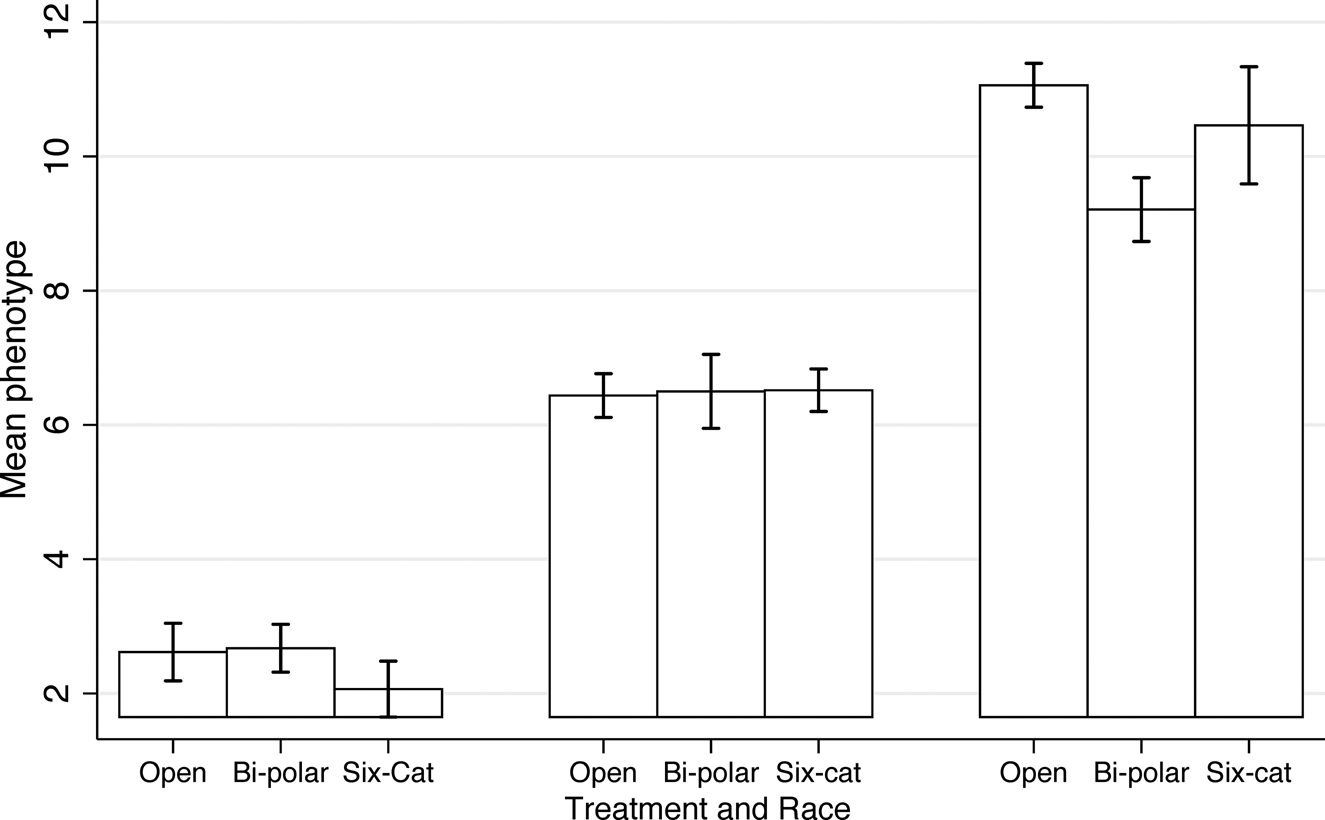
The question wording treatment had the greatest effect on the racial identification of individuals on the ascriptive boundary between black and mestizo. The first three bars in Figure 1 show that the mean of Phenotype is lowest for whites in the six-category treatment and is highest for whites in the bi-polar treatment. The differences between the three treatments are significant which suggests that there were significantly more individuals with higher values of Phenotype (meaning darker skin, curlier hair type) that identified as white in the bi-polar treatment. Similarly, the last three bars in Figure 1 show that mean Phenotype is highest for blacks in the open treatment and lowest for blacks in the bi-polar treatment, meaning some individuals with traits on the ascriptive margins of black identity were more likely to identify as black in the bi-polar treatment compared to the open and six-category treatments. The middle three bars in Figure 1 show that Phenotype for mestizos is significantly higher than that of the average self-categorized white person and significantly lower than that of the average self-categorized black person. Most important for this study, Figure 1 shows that the boundary between the black and mestizo racial categories is particularly fluid. Panamanians with more mixed phenotypic characteristics are the principal movers across racial categories, with the majority of movement between the mestizo and black categories.
Mean phenotype by race and treatment category. The figure presents the average score of Phenotype by race and treatment group. The first set of three bars present the mean phenotype for white in all three treatment groups. The second set of three bars presents the mean phenotype for mestizos in all three treatment groups. The bi-polar treatment did not include an option for respondents to self-categorize as mestizo so individuals that classified as neither black nor white are scored as mestizo. The last set of three bars presents the mean phenotype for blacks in all three treatment groups.

The standard elements of mestizaje are all accounted for in the Panamanian case. Mestizaje is institutionalized (although contested), black self-identification and dark skin are stigmatized, and racial categories are fluid. This analysis of a typical Afro-Latin AmericanFootnote 7 case should push us to reevaluate the relationship between group consciousness and fluidity and stigmatization, central components of mestizaje.
Methods
I test the hypotheses in this study using data from an original survey experimentFootnote 8 of voting eligible Panamanians in August of 2014, three months after the country's national and local elections. The experiment was part of an omnibus survey conducted by Borges y Asociados, a Central American public opinion research firm. The survey began with questions about the national election and general political attitudes about partisanship and approval ratings of elected officials. My experimental module came afterward. At the end of the battery, the interviewer rated each respondent's skin color as “light,” “medium,” or “dark”. They also rated each respondent's hair type from tightly curled/braided to straight. The experiment randomly assigned all respondents (independent of their race and skin color) to three different question formats for reporting their racial identification: (1) Open (What is your race?), (2) Bi-Polar (Using the terms black and white, which term best identifies you?), and (3) Six-category (Using the terms white, mixed, indigenous, black, mulatto, and other, which term best identifies you?).Footnote 9 After the question-wording experiment, all respondents answered several questions that measured five separate dimensions of group consciousness—polar affect, polar power, linked fate, collective efficacy, and perceived discrimination—the dependent variables of this study. I limit the analysis to the sub-sample of black self-identifiers—respondents that self-reported as black in one of the three question-wording treatments. By limiting the analysis to black self-identifiers this study cannot speak to the effects of fluidity and phenotype on people who identified as mestizo on the survey, but might also identify as black. Despite this limitation, the sizeable sub-sample of respondents that self-identified as black across treatments and phenotype provides important insight into the fluidity-to-consciousness link in Latin America.
I operationalize polar affect with the measure Pride, the degree of pride that the respondent feels in being black. Pride is measured on a scale from 0–4, “4” being very proud and “0” being not at all proud. I use Pride as a proxy for polar affect because in-group pride is a form of in-group affect. Perceived Discrimination takes values from 0–4, “4” meaning strong agreement with the statement that discrimination against dark skinned people is a problem in Panama. Polar power takes values from 0–2, “0” meaning the respondent believes that black people in Panama have a lot of influence and “2” meaning the respondent believes they have very little influence. Linked Fate, measures the degree to which the respondent believes that what happens to Afro-Panamanians in general affects what happens in their life. Linked Fate is measured using a scale from 0 to 4, “4” indicating a strong belief in linked fate. Finally, Collective Efficacy takes values from 0 to 4, “4” meaning a strong belief that a collective Afro-Panamanian voting block would have a decisive impact on elections.
The first part of the analysis examines the effect of identity fluidity on the five dimensions of group consciousness for Afro-Panamanians. I use the number of racial categories in the question wording to proxy for identity fluidity. The open question wording treatment provided the greatest potential for identity fluidity because it did not place constraints on self-identification. The six-category treatment provided an intermediate degree of identity fluidity, and the bi-polar treatment provided the least fluidity because it only provided two specific choices (black or white) and the option to elect “neither.” I evaluate the differences in the mean values of each dimension of group consciousness across the three treatment groups to test the effect of identity fluidity on each dimension of group consciousness. Appendix Table 1.2 shows that there are more black women in the six-category treatment group, but the sub-sample of self-identified black respondents is balanced on party identification, educational attainment, age, and household income across the question-wording treatment groups. As a result, I am able to estimate the average treatment effect (ATE) of identity fluidity on the group consciousness dimensions for black respondents.
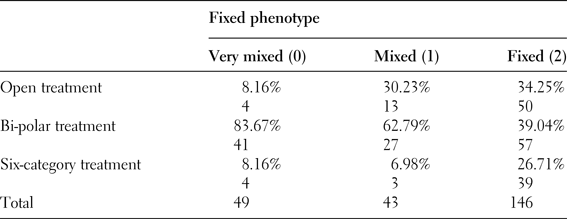
The second part of the analysis examines the relationship between phenotype and the measures of group consciousness. I leverage the randomized question-wording treatment alongside respondents’ phenotype (as measured by the interviewer) to categorize black phenotype into three levels that are associated with different degrees of stability in black self-identification. Table 1 shows the relationship between question wording and black self-identification at three levels of phenotype—very mixed, mixed, and fixed black phenotype. The table shows that black self-identification is volatile for people with very mixed phenotype (medium skin tone or lighter, all hair types). The bi-polar treatment raised black identification substantially for people with very mixed phenotype, from eight people in the open and six-category treatments to 41 people in the bi-polar treatment. Volatility in black self-identification is lower for people with mixed phenotype (dark skin tone and straight and thick hair type)—27 respondents self-identified as black in the bi-polar treatment compared to 13 and 3 in the open and six-category treatments respectively—and for people with fixed phenotype (dark skin tone and wavy or tightly curled hair)—57 respondents self-identified as black in the bi-polar treatment compared to 50 and 39 in the open and six-category treatments respectively. I use this insight to construct Fixed Phenotype for self-identified Afro-Panamanians, the primary explanatory variable in this study. Fixed Phenotype takes values from 0 to 2. Black respondents with very-mixed phenotype are coded as “0”; those with mixed-phenotype are coded as “1”; those with fixed-phenotype are coded as “2.”Footnote 10
Share and number of self-identified black respondents in each treatment category by the level of Fixed Phenotype

The table reports the share and number of self-identified black respondents at each level of Fixed Phenotype and each question wording treatment group. In my sample, 238 (of 896 total) respondents self-identified as black. At higher values of fixed phenotype, the treatment effect decreased, as shown by the proportional share of self-identified blacks across question-wording treatments at level 2 of Fixed-Phenotype.
Each model includes the variable Treatment Group, which controls for the format that the respondent was asked to report their race. This variable is important as a control for the possibility that the Bi-Polar and Six-Category treatments may have primed stronger group consciousness by mentioning out-groups. I use linear regression models of each dimension of group consciousness on Fixed Phenotype to test Hypothesis 2 and to explore the variation in the strength of the different group consciousness dimensions at varying levels of phenotype. All of the regression models control for Gender, Party ID, Educational Attainment, Age, and Household Income. Gender is coded as “1” for respondents that identify as women. Party ID is a categorical variable that captures whether the respondent is a member of one of the three major parties: Partido Revolucionario Democrático (PRD) (1), Panameñista (2), and the Cambio Democrático (3). Party ID takes a value of “0” for voters that are not a member of any party. Educational Attainment, Age, and Household Income are all ordinal variables. Their ranges are reported in Appendix Table 1.1. I draw on insights from original focus groups that I conducted in Panama City in the fall of 2015 to supplement the interpretation of the statistical results.Footnote 11 I conducted four focus groups, stratified by race and class. Two of my focus groups were composed of self-identified Afro-descendant Panamanians, one middle class group, and one working class group. The other two focus groups were composed of self-identified non-Afro-descendant Panamanians, also stratified by class.
Findings
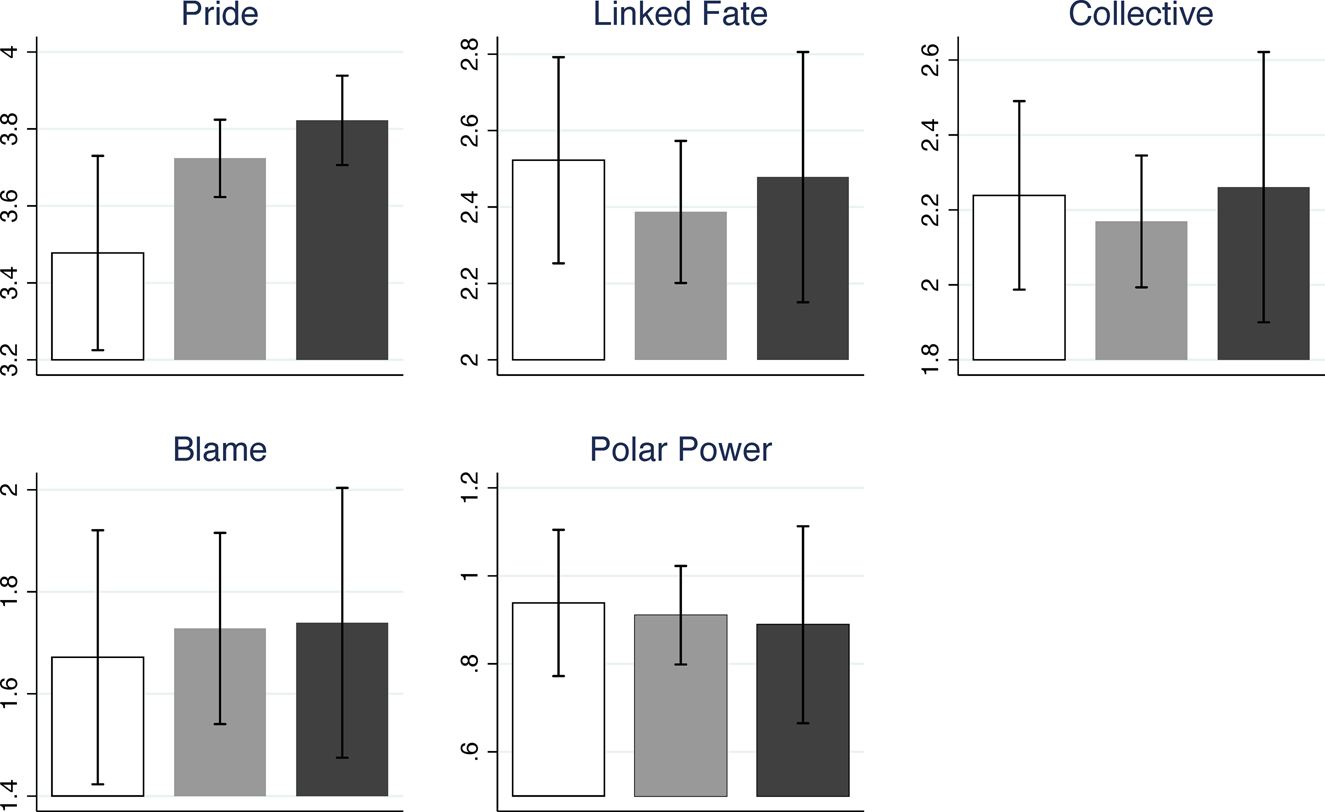
Figure 2 shows that the strength of black group consciousness is relatively stable across the different levels of identity fluidity (openness of question wording). There are no significant differences across treatments in the strength of Polar Power, Perceived Discrimination, Linked Fate and Collective Efficacy. The figure also shows that blacks across treatments express moderate levels of Linked Fate and Collective Efficacy, while they tend to express weaker levels of Perceived Discrimination and Polar Power. Self-identified blacks in the open treatment do express significantly lower levels of Pride, although Afro-Panamanians on average express a strong sense of Pride across all three treatments.
ATEs of question wording on group consciousness dimensions. This figure plots the ATEs of the three question wording treatments: (1) Open, (2) Bi-Polar, and (3) Six-Category—on the five dimensions of black group consciousness—Polar Power (0–2), Perceived Discrimination (0–4), Pride (0–4), Linked Fate (0–4), and Collective Efficacy (0–4). The only significant differences in ATEs are on the Pride dimension. Blacks in the Bi-Polar Treatment have .24 points stronger Pride than blacks in the Open Treatment (p = .19). Blacks in the Six-Category Treatment have .34 points stronger Pride than blacks in the Open Treatment (p = .04).

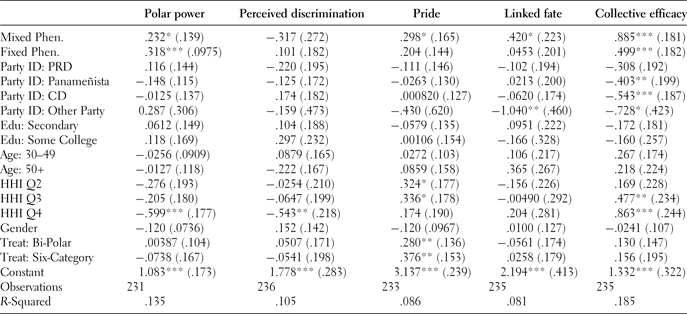
Table 2 presents the results of a regression of the five dimensions of group consciousness on Fixed Phenotype. The significant and high magnitude of the intercepts for Pride (Column 3)—the level of pride in one's black self-identification—and Linked Fate (Column 4)—the belief that what happens to black Panamanians in general affects one's personal life—demonstrate that Afro-Panamanians with very mixed phenotype (Fixed Phenotype = 0) feel these dimensions of group consciousness quite strongly. The same pattern holds for people with mixed phenotype (Fixed Phenotype = 1) and fixed phenotype (Fixed Phenotype = 2) as shown by the positive coefficients on both group consciousness dimensions.
OLS regression of black group consciousness on Fixed Phenotype

This table reports the results of OLS regressions of group consciousness on phenotype for self-identified Afro-Panamanians. Very mixed phenotype (Fixed Phenotype = 0) is the reference category. OLS, Ordinary Least Squares. Standard errors in parentheses ***p < .01, **p < .05, *p < .1.
In contrast to the strong evidence for Pride and Linked Fate, the low magnitude of the intercept for Perceived Discrimination—a general belief that discrimination is not a problem in Panama—taken in conjunction with the insignificant coefficients at all levels of Fixed Phenotype shows general disagreement with this dimension (Column 2). Column 1 shows that Afro-Panamanians of varying phenotypes express middling levels of Polar Power—a general belief that Afro-Panamanians have normal influence, as opposed to very little influence. Column 5 also shows relatively limited belief in black Collective Efficacy—a general perception that a collective Afro-Panamanian voting block would have little impact on election outcomes. However, the results show important variation in Polar Power and Collective Efficacy across Fixed Phenotype that I explore in the next section.
Discussion
The null-effect of the question wording treatment on 4 of the 5 group consciousness dimensions challenges us to revisit the political significance of fuzzy racial boundaries. The results in Figure 2 show that fluidity did not have a substantive effect on measures of black group consciousness. The foundational literature on Afro-Latin American group identity treated fluidity as evidence that blacks exit their marginal group identity when possible, stunting the development of black group consciousness. It is somewhat surprising then that the strength of most dimensions of black group consciousness is stable across the question wording treatments. In the context of my survey-experiment and consistent with Hypothesis 1, identity fluidity does not reduce Polar Power, Perceived Discrimination, Linked Fate, or Collective Efficacy, and has little substantive impact on Pride.
The discourse of mestizaje allows many Panamanians to move between mestizo (mixed race) and black self-identification without much conflict. During my focus group sessions, 8 of 20 participants in the Afro focus groups referenced their mixed racial heritage. One of the participants in a non-Afro focus group, a dark-skinned woman, self-identified as mestiza during the recruitment phone call. When she was asked her racial identification during the focus group—this time in a room of seven light skinned mestizos—she proudly claimed, “I am Afro-Panamanian.”Footnote 12 Many Afro-Panamanians recognize that they are both mixed and black. Their ability to claim race-mixture does not necessarily negate black self-recognition.
Hypothesis 2 posited that Afro-Panamanians across the phenotypic spectrum would express dimensions of group consciousness. The evidence in Table 2 provides cautious support for this hypothesis. I find that Afro-Panamanians with mixed phenotype express a greater sense of pride in their racial identity. The slightly higher levels of Pride for people with mixed phenotype is notable because it runs contrary to expectations but it is not a distinguishing feature of group consciousness for mixed-phenotype blacks. Mean levels of Pride are quite strong across all three levels of phenotype. Afro-Panamanians with fixed phenotype also express stronger Pride than Afro-Panamanians with mixed phenotype but this difference is not significant (p = .144).
Group pride was one of the dimensions of black identity that participants in the Afro-Panamanian focus groups expressed. When asked to consider what Panama would be like without black people, respondents in the Afro working-class group replied, “There would be no more excitement… no more joy… no more spice.” Respondents in the middle-class group echoed these sentiments, “The spice and the flavor would be gone… The party would be over… The joy would be gone.” As the comments suggest, pride appears to have more of a social significance than a political significance.
Column 4 of Table 2 shows that Afro-Panamanians with mixed phenotype express significantly higher levels of Linked Fate than blacks with fixed and very mixed phenotype. The model predicts that blacks with mixed phenotype on average express nearly .5 points higher Linked Fate on the 0–4 scale than blacks with fixed and very mixed phenotype.Footnote 13 In contrast, levels of Linked Fate are statistically indistinguishable for blacks of very mixed and fixed phenotype. This runs counter to recent studies in Brazil that find that darker skin color is associated with stronger linked fate (Mitchell-Walthour Reference Mitchell-Walthour2011; Mitchell-Walthour et al. Reference Mitchell-Walthour and Darity2014). In addition, Column 5 of Table 2 shows that Afro-Panamanians with mixed and fixed phenotype believe more strongly in the collective efficacy of black electoral mobilization compared to people with very mixed phenotype. Comparing Afro-Panamanians with mixed and fixed phenotype, I find that the former expresses the strongest belief in Collective Efficacy (p = .029).
The relationship between the group consciousness measures and phenotype is non-linear. This is demonstrated most clearly in the relationship between Fixed Phenotype and Collective Efficacy, Pride, and Linked Fate. On each of these dimensions, afro-descendants with mixed phenotype have stronger group consciousness than do people with fixed phenotype and very mixed phenotype. This is partially an artifact of the survey experiment. The Bi-polar question-wording treatment coerced people with very mixed phenotype (meaning medium skin tone, inclusive of all hair types) to identify as black. The majority of respondents at this level of phenotype for the full sample self-identified as mestizo in the Open treatment (59.7%) and Six Category treatment (63%). Table 1 shows that 41 of 49 self-identified black respondents with very mixed phenotype self-identified as black because of the Bi-polar question-wording. It is not surprising then that these same respondents would express the lowest levels of group consciousness on most dimensions. Yet, the above analysis of the high magnitude of the constant terms for Linked Fate and Pride, shows that some very mixed blacks still express dimensions of group consciousness.
The regression analysis in Table 2 shows that Perceived Discrimination and Polar Power are positively associated with fixed phenotype. Column 2 shows that black people with fixed phenotype believe more strongly that racial discrimination is a problem in Panama compared to people with mixed and very mixed phenotype. The difference between people with fixed phenotype and very mixed phenotype is not significant, which is surprising given the direct relationship between perceptions of discrimination and darker skin color (Canache et al. Reference Canache, Hayes, Mondak and Seligson2014; Cawvey et al. Reference Cawvey, Hayes, Canache and Mondak2018). The positive difference between Perceived Discrimination for blacks with fixed and mixed phenotype is marginally significant (p = .064) as we might expect. Column 1 shows that blacks with fixed phenotype believe more strongly that blacks as a group lack influence in the country (Polar Power) than do black people with mixed and very mixed phenotype (Column 1 of Table 2). The .09-point difference between blacks with mixed and fixed phenotype is not significant (p = .45), but the direction and magnitude of the difference are consistent with the expected relationship between discrimination and consciousness. Black people with mixed phenotype (Fixed Phenotype = 1) also express stronger Polar Power than do black people with very mixed phenotype (p = .099).
In my own focus groups with Afro-Panamanians in Panama City I observed a duality between the perception of frequent social experiences of discrimination and a consistent tenor of respectability politics—in group blame for between group inequality and black marginalization. As one black, middle-class respondent explained, “We live in a society where [black people are] stigmatized. There are negative perceptions about black people. It is not because [society] has targeted us. The majority of the time we have placed the target on ourselves.” Likewise, respondents in the Afro-Panamanian focus groups acknowledged the relative lack of black representation and influence in Panama's powerful business class and elite political strata (limited perceived polar power) but their responses centered on internal shortcomings rather than institutional racism as root causes. One black working-class participant explained: “We (Afro-Panamanians) are the employees. We are the labor force. We are the ones that produce for them.” And in response another participant added, “they are more prepared than us. They have more education… Black people, we're also lazy.” This is an especially important finding because it runs counter to more recent findings that show a general recognition of systemic roots to racial inequality across the region (Clealand Reference Clealand2017; Mitchell-Walthour Reference Mitchell-Walthour2011; Telles and Bailey Reference Telles and Bailey2013).
Perceived Discrimination and Polar Power appear to be less central to black identity in Panama compared to Linked Fate and Collective Efficacy. The constant terms for both measures are low and the models produce low-to-moderate predicted values on both dimensions (Table 2).Footnote 14 But a subset of Afro-Panamanians expresses clear agreement on these measures. Approximately 18 and 25% of black respondents in my sample express a positive belief in Polar Power and Perceived Discrimination, respectively. The regression results for both dimensions show that these dimensions are predominately, but not exclusively, perceived by blacks with fixed phenotype. Likewise, Collective Efficacy and Linked Fate are predominately, but not exclusively, perceived by blacks with mixed phenotype. Appendix Figures 2.2–2.5 plot the mean strength of Polar Power and Perceived Discrimination at each level of Collective Efficacy and Linked Fate. High levels of Polar Power and Perceived Discrimination are associated with lower levels of Collective Efficacy and Linked Fate. These measures thus appear to tap into contrasting dimensions of black identity for Afro-Panamanians in this sample.
Exploratory factor analysis further confirms the existence of two contrasting dimensions of black group consciousness that differs across (very) mixed and fixed phenotype. The unrotated factor loadings for the first factorFootnote 15 show that Collective Efficacy and Linked Fate are the central items that tap into black identity for (very) mixed Afro-Panamanians. Importantly, weak Polar Power—a belief that blacks have a lot of influence in Panama—and weak Perceived Discrimination—a belief that discrimination is not a problem in Panama—are also central to this latent measure of Afro-Panamanian identity for blacks with (very) mixed phenotype. In contrast, Perceived Discrimination and Polar Power are the central components of the first factor for Afro-Panamanians with fixed phenotype along with weak Linked Fate and Collective Efficacy. I find a very strong negative correlation between these two factors. The correlation coefficient for the first factor for blacks with fixed phenotype and blacks with mixed phenotype is −.9152 (p = .000) and −.9827 (p = .000) for blacks with very mixed phenotype.Footnote 16
Does the evidence above aggregate to a black group consciousness in Panama, as this concept is understood in the broader identity politics literature? I posit a cautious yes. Group consciousness is defined as politicized in-group identification based on a recognition of the group's marginal social standing combined with the belief that collective political action is the best way to improve the group's social standing (McClain et al. Reference McClain, Carew, Walton and Watts2009). It is clear that both the recognition of marginal group standing and the efficacy of black collective political action exist within the Afro-Panamanian consciousness, albeit in an unconventional way. The evidence from the focus groups and survey both show that blacks are aware of their group's marginal status in Panama's racial schema. The survey evidence shows that this awareness is particularly keen for people with fixed, black phenotypic features but also among a non-trivial share of blacks with (very) mixed phenotype. Perceived collective efficacy and black linked fate are also generally common attitudes for Afro-Panamanians across phenotype, although attitudes on these dimensions are stronger and more central for black people with (very) mixed phenotype.
The challenge to the group consciousness interpretation is that the two components of the concept—recognition of marginal social standing and a belief in the efficacy of collective mobilization—do not cohere into a singular, collective black politicized identity. The strong negative correlation between these two components of group consciousness, especially the limited recognition of oppression and marginality by people with very mixed phenotype, may actually suggest that the measures of collective efficacy and linked fate are tapping into motivations to gain distance from the most stigmatized blacks, those with fixed phenotype. In Appendix Figure 2.7 I present predicted values from a logistic regression of attitudes toward intra-racial marriage on the interaction of phenotype and these divergent factors of group consciousness and I find no evidence that either factor is significantly associated with negative in-group affect—proxied by cooler attitudes toward intra-racial marriage.Footnote 17 There is a notable difference between predicted support for intra-racial marriage for blacks with (very) mixed phenotype and low levels of perceived discrimination and polar power (and thus higher levels of linked fate and collective efficacy) compared to blacks with fixed phenotype and strong perceived discrimination and polar power. This gap in attitudes toward intra-group marriage across phenotype and dimensions of consciousness might suggest lower in-group affect among (very) mixed blacks low on perceived discrimination and polar power. This difference is not significant which should assuage the concern that collective efficacy and linked fate are tapping into the desire among those of (very) mixed phenotype to distance themselves from the group. Moreover, blacks across phenotype that express strong perceived discrimination and polar power are strongly and equally supportive of intra-marriage. On balance, the evidence suggests that there exist counter-narratives to mestizaje among Afro-Panamanians despite fluid boundaries between black and mestizo identity. Blacks with fixed phenotype and more mixed phenotype express key dimensions of group consciousness in line with Hypothesis 2.
Conclusion
The results from this study contribute to our knowledge of Afro-Latin group consciousness in several ways. This study builds on recent identity politics scholarship that documents Afro-Latin American group consciousness (Clealand Reference Clealand2017; Mitchell-Walthour Reference Mitchell-Walthour2011; Mitchell-Walthour et al. Reference Mitchell-Walthour and Darity2014). Alongside these studies, this study demonstrates that counter-narratives to mestizaje exist in response to the racial marginalization that underlies this ideology. While racial fluidity provides a means for some Latin Americans to reject black identity, for others fluidity itself is concordant with black group consciousness. Black group consciousness has formed in response to hegemonic color-blind racial discourse and this study shows that within this context it takes on distinctive content and significance.
This study leverages a multidimensional conceptualization of group consciousness to nuance our understanding of the relationship between fluidity, phenotype, and black group consciousness in the region. Levels of black pride, linked fate, and collective efficacy are strong for blacks of varying phenotypes. In contrast, perceived discrimination and limited polar power are relatively weaker dimensions of Afro-Panamanian group consciousness. The evidence from this study shows that these measures, which are assumed to be cohesive components of singular group consciousness, tap into distinctive forms of black identity in the Panamanian context and that their strength is conditional on phenotype. Black people with more mixed phenotype express stronger linked fate and collective efficacy, while blacks with fixed black phenotype express stronger polar power and perceived discrimination. A conclusive answer for why this difference emerges is beyond the scope of this study, but one hypothesis that follows is that differential forms of socialization into Afro-Panamanian identity for people with mixed and fixed phenotype, have raised the salience of some dimensions of group consciousness over others. Further research should explore the mechanisms that produce these distinct dimensions of Afro-Panamanian group consciousness and the implications of this heterogeneity for collective political mobilization.
There are still important reasons to be cautious in how we interpret the results from this study. While Afro-Panamanians express strong, positive attitudes on central dimensions of black group consciousness, further research is needed to probe the content of these measures in the Latin American context. Recent findings in the group consciousness literature suggest that identity scholars in American and Comparative Politics need to revisit the common measures we have used to measure the latent concept of group consciousness (Gay et al. Reference Gay, Hochschild and White2016; McClain et al. Reference McClain, Carew, Walton and Watts2009; Sanchez and Masuoka Reference Sanchez and Masuoka2010; Sanchez and Vargas Reference Sanchez and Vargas2016). Gay et al. (Reference Gay, Hochschild and White2016) find that people across racial groups in the U.S. express similar degrees of linked fate to African-Americans. They also find that black respondents’ linked fate to their racial group is very similar to their linked fate to non-racial categories, like social class. It is possible that the strong evidence for linked fate may actually be evidence of a general psychological preference for group attachment rather than politicized group identity. That linked fate in this sample is correlated with a belief in the collective efficacy of black political behavior might assuage this concern somewhat.
Panama fits within the Latin American paradigm of racialization. Afro-Panamanians are victims of racial stigmatization and marginalization. Also, the boundaries between black and mestizo identity are fluid, especially for people with more mixed phenotype. Still, it is important to note that each of these factors, typically considered as barriers to black group consciousness, vary substantially in strength and content across Latin America. Racial identity is less fluid in Panama than in other countries in the region (Telles and Paschel Reference Telles and Paschel2014). Consequently, these results provide a baseline expectation of Afro-Latin group consciousness, situated between the rigid, descent-based model of racialization in the U.S. and the more fluid, phenotype-based model common throughout Afro-Latin America. More research that directly examines individual attitudes and belief in mestizaje alongside their group consciousness is necessary to determine the actual effect of this color-blind ideology on levels of consciousness. Hochschild and Weaver (Reference Hochschild and Weaver2007) show that there are no meaningful differences in the strength and dimensions of politicized black identity for blacks in the U.S. As a result, we should expect that in a less fluid racial schema than Panama (tending towards a highly fixed model like the U.S.) more dimensions of group consciousness will converge across phenotype and we will see a more homogenous model of black racial attitudes. In contrast, in a more fluid racial schema than Panama, we might expect multiple dimensions of group consciousness to emerge more starkly based on phenotypic differences within the black population. This working hypothesis bridges the study of racial attitudes and political behavior across the Americas, with a more nuanced understanding of the role of fluidity on the formation of group consciousness.
ACKNOWLDGEMENTS
I would like to thank Deborah Yashar, Amaney Jamal, Ernesto Calvo, Ali Valenzuela, Christopher Achen, Vladimir Medenica, Danilo Contreras, Elizabeth Nugent, Bethany Park, and the three anonymous reviewers for their input on this manuscript. Grants from the Bobst Center for Peace and Justice at Princeton University supported the field research and data collection for this project.
SUPPLEMENTARY MATERIAL
The supplementary material for this article can be found at https://doi.org/10.1017/rep.2019.49