Introduction
Numerous studies on the prevalence and incidence of dementia have shown that the prevalence of dementia doubles every five years (from approximately 1.5% in persons aged 60–69 years to 40.0% in nonagenarians), and that the incidence grows exponentially – from approximately 1/1,000 person-years in people aged 60–64 years to more than 70/1,000 person-years in persons aged 90 years and over (Qiu et al., Reference Qiu, Ronchi and Fratiglioni2007; Fratiglioni et al., Reference Fratiglioni, von Strauss, Qiu, Jacoby, Dening, Thomas and Oppenheimer2008). Besides, mortality studies reported a population-attributable risk of death from dementia between 11% (Llinàs-Reglà et al., Reference Llinàs-Reglà, López-Pousa, Vilalta-Franch, Garre-Olmo and Román2008) and 15% (Agüero-Torres et al., Reference Agüero-Torres, Fratiglioni and Guo1999).
Regardless of the incidence rates of dementia, it is plausible to hypothesize that the rate of dementia diagnoses in a specific geographical area may be determined by two main factors: the cost and accessibility to the healthcare system, and the degree of aging of the population. Thus, on one hand, countries or regions without memory clinics or specific outpatient consultation offices for dementia and/or with private or mixed healthcare providers would be expected to have fewer diagnoses of dementia, and, on the other hand, aged populations would be expected to have more diagnoses of dementia.
Traditionally, research on healthcare services accessibility has focused attention on the differences between rural and urban areas, although it is difficult to find in the literature a comparable definition of rurality across studies (Russ et al., Reference Russ, Batty, Hearnshaw, Fenton and Starr2012). In this sense, most studies have concluded that the access and utilization of the healthcare systems by elderly people is lower and more difficult in rural areas due to a combination of different factors, such as accessibility to appropriate care services, distance, transportation difficulties, and different lifestyles and beliefs (Blazer et al., Reference Blazer, Landerman, Fillenbaum and Horner1995; McDonald and Conde, Reference McDonald and Conde2010; Sibley and Weiner, Reference Sibley and Weiner2011). Regarding dementia detection and diagnosis by healthcare professionals, several barriers have been identified both in rural and urban settings. Current research reports the influence of other external factors in the low rate of detection of dementia, such as visit time constraints, clinical interest, diagnostic uncertainty, lack of effective treatments, stigmatization consequences, and denial of symptoms by patients and families (Turner et al., Reference Turner2004; Forbes et al., Reference Forbes, Morgan and Janzen2006; Iliffe et al., Reference Iliffe, Wilcock and Haworth2006; De Lepeleire et al., Reference De Lepeleire2008; Vernooij-Dassen et al., Reference Vernooij-Dassen2005; Morgan et al., Reference Morgan2009; Koller et al., Reference Koller2010; Innes et al., Reference Innes, Morgan and Kosteniuk2011; Greenway-Crombie et al., Reference Greenway-Crombie, Snow, Disler, Davis and Pond2012; Bail et al., Reference Bail2013).
A recent meta-analysis has reported evidences of geographical variation rates of dementia in a variety of geographical scales (Russ et al., Reference Russ, Batty, Hearnshaw, Fenton and Starr2012), however methodological differences between studies limit definitive conclusions. The objectives of this study were to perform an exploratory analysis of the rate of dementia diagnoses performed in a defined geographical territory, and to compare the dementia subtypes and the clinical characteristics of the patients based on the degree of aging of the municipalities. Our hypotheses were that, given that access and availability of healthcare services is the same for any municipality within the area of study, a higher rate of dementia diagnoses would be detected in aged municipalities, and that the subtypes of dementia, and characteristics of the patients would be similar between aged and young municipalities.
Methods
Design, geographical area of reference and study population
This study was performed in the Health Region of Girona (HRG), which is located in the northeast region of Catalonia (Spain), and includes 204 municipalities. It has an area of 5,517 km2, a population of 690,207 inhabitants (according to the Citizens Municipal Registry 2007), and a population density of 125.1 inhabitants/km2. In the HRG there are 246 centers of primary health care and 7 hospitals for public use. The Catalan Health Care system is a mixed health model that integrates all available resources into one network, and offers universal medical assistance. Patients with dementia can be referred to the memory clinics of the HRG (located in the hospitals, where the diagnosis is made) from primary care, by internal hospital request, from the mental health services, from psychogeriatric units, or from nursing homes. This study used data from the cases of dementia registered by the ReDeGi during 2007–2012, and data of the population of the municipalities included in the ReDeGi surveillance area. The ReDeGi is an epidemiological surveillance system of dementia, and registers demographic and clinical data on all the new dementia cases diagnosed in the seven hospitals of the public health care system of the HRG.
Registry procedure and registered variables
The methodological principles and the functional structure of the ReDeGi have been described in detail elsewhere (Garre-Olmo et al., Reference Garre-Olmo2009; Reference Garre-Olmo2010). Briefly, the ReDeGi registers all new cases of dementia diagnosed in the hospitals within the HRG. Diagnoses are made in the neurology or geriatrics outpatient consultation offices or in the memory clinics of each hospital. Case identification and notification to the ReDeGi is performed by the consultants of each HRG hospital that conducted dementia diagnosis. The validity of the diagnosis is based on the premise of the validity of the diagnostic process on the part of the consultants collaborating with the ReDeGi. Consultants from each hospital examined and diagnosed the patients. The diagnosis is established on the basis of the medical history, an interview the patient and a family member or caregiver, a general medical examination, results from laboratory tests, and diagnostic neuroimaging when needed. A technician from the ReDeGi regularly visits the HRG hospitals, reviews the medical records of the dementia cases, and collects information regarding the hospital (name of the hospital, date of admission and medical record number), the sociodemographic characteristics (date of birth, sex, nationality, place of residence, schooling level, marital status, type of housing and healthcare referral device), the diagnosis characteristics (approximate date of the onset of symptoms, date of the diagnosis, DSM-IV-TR diagnostic criteria (APA; 1994), additional diagnostic criteria for the subtype of dementia), and clinical information (score and date of administration of the Mini-Mental State Examination (MMSE) (Folstein et al., Reference Folstein, Folstein and McHugh1975), score and date of administration of the Blessed Dementia Rating Scale (BDRS) (Blessed et al., Reference Blessed, Tomilson and Roth1968), score of the Clinical Dementia Rating (CDR) (Morris, Reference Morris1993), a past family history of dementia, present diagnosis of hypertension, diabetes mellitus, dislipidemia, stroke, thyroid disease and a past history of depressive disorder). The collection of this information meets the confidentiality requirements for personal data protection in compliance with Spanish legislation.
Population data of the municipalities under surveillance
The population data of the 204 municipalities in the HRG were extracted from the INEbase, the system in which the Spanish National Institute of Statistics stores statistical information. The INEbase allows access to data for each municipality, and the municipal register revises population estimates annually. We retrieved data stratified by five-year age groups for each municipality of the HRG corresponding to the period 2007–2012. For each municipality we estimated the distance and the expected time needed to arrive by car to the HRG reference hospital using the Google Maps application (via web browser). We registered the number of kilometers (km) and minutes (min) of the first suggested route between the centre of each municipality and the exact address of the HRG reference hospital.
Data analysis
To achieve the study objectives, we used a double analytic strategy combining an ecological analysis using aggregate data and an individual analysis using data of each case of dementia registered by the ReDeGi. The municipalities were classified according to the degree of aging of their population using a cluster analysis. These results were then used in a second step in the individual analysis.
For the ecological analysis, a database was first created that combined the population of each municipality stratified by age, the total number of dementia cases registered by the ReDeGi for each municipality and the number of cases stratified by dementia severity (CDR score: 1 mild, 2 moderate, 3 severe). The crude and age-adjusted incidence density rates of dementia diagnoses for each municipality were calculated. The person-years method of estimating incidence density rates was used (Breslow and Day, Reference Breslow and Day1994). The coverage of the ReDeGi was calculated using the report by Ferri et al. (Reference Ferri2005), who reported an incidence rate of dementia of 8.8 cases/1,000 inhabitants for the Western Europe zone. We estimated the number of expected cases of dementia for the area under surveillance using the overall person-years of the study period.
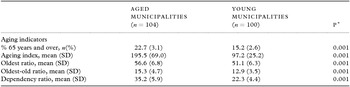
In the first step, we stratified the municipalities according to the number of inhabitants (up to 1,000, between 1,001 to 5,000, and 5,001 or more). The HRG also includes 27 small municipalities in the coastal area of Girona province named the Costa Brava and other touristic municipalities in the interior that are characterized by second residences and young inhabitants. To overcome this problem, we calculated the relative frequency of inhabitants aged 65 years and over (%65+), the ageing index (AI), the oldest ratio (ORa), the oldest-old ratio (O-ORa) and the dependency ratio (DRa). The AI was calculated as the number of persons 65 years old or older per hundred persons under the age of 15. The ORa was calculated as the number of persons aged 75 or older per one hundred persons over the age of 65. The O-ORa was calculated as the number of persons aged 85 or older per one hundred persons over the age of 65. The DRa was calculated as the number of persons aged 65 or older per one hundred persons 15 to 64. To classify the municipalities according to the most robust aging criteria of its population, we performed a two-step cluster analysis using the population aging indicators and the size of each municipality. Cluster distances were calculated according to the log-likelihood function, and cluster membership was selected according to the decrease in log-likelihood (Kaufman and Rousseeuw, Reference Kaufman and Rousseeuw1990). The number of clusters was determined with the Bayesian Information Criterion (BIC) (Schwartz, Reference Schwartz1978). The two-step cluster analysis grouped the HRG municipalities into two clusters (Figure 1). This cluster solution had the minimum cluster selection criterion (BIC = 710.9) and had the maximum value of ratio of distance measure (3.1 vs. values that ranged from 1.7 to 1.0 for 3 to 15 cluster solutions); one cluster included 104 municipalities with high values in the ageing indicators, and the other cluster included 100 municipalities with low values in the ageing indicators (Table 1). Aged municipalities had lower number of inhabitants than young municipalities (78.6% vs. 33.0% of municipalities up to 1,000 inhabitants [χ2 test = 49.7; df = 2; p < 0.001]). The density incidence rates of dementia diagnoses were compared to according the municipalities’ size and cluster membership using the Mann-Whitney's U and the Kruskall-Wallis tests.
Population aging indicators (mean, SD) according to the degree of aging of the municipalities

*Mann-Whitney's U test.
Area under surveillance according to the type of municipality (aged vs. young).

For the individual analysis, a second database was created by combining the ReDeGi patient database with a new variable called municipality typology, which classified the municipalities in two clusters: one with a high frequency of elder people (aged municipalities), and the other with a low frequency of elders (young municipalities). The distance and time to the reference hospital, dementia subtype, clinical characteristics and demographic characteristics of the patients according to their municipality of residence were compared using the χ2 test for categorical variables, and the Mann-Whitney's U or the Kruskall-Wallis tests for continuous variables.
Results are expressed as absolute numbers and percentages, means and standard deviation, odds ratios, and 95% confidence intervals (95% CI). Bonferroni's adjustment was used for multiple comparisons, and differences were considered statistically significant using p < 0.002. Data processing and analysis was conducted using SPSS Version 19.0 for Windows.
Results
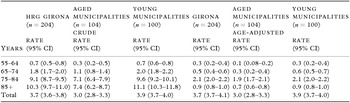
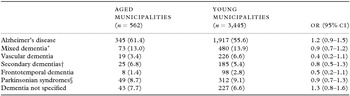
The study population consisted of a follow-up time of 1,147,254 person-years in individuals aged 55 and over. During the period 2007–2012, the ReDeGi registered 4,314 cases of dementia diagnosed in hospitals of the HRG, of which 4,288 cases (99.3%) were living in municipalities under surveillance and 4,007 cases were 65 years or over (92.9%). In accordance with the incidence rate of dementia (8.8/1,000), the estimated number of new dementia cases for the area under surveillance during 2007–2012 was 5,680. Taking into account the number of cases living in municipalities under surveillance (n = 4,288), the registry's coverage embraced 75.4% of the expected cases of dementia in the area under surveillance (CI 95% = 74.3–76.6). According to the CDR score, the severity of dementia was mild in 60.2% of the cases, moderate in the 29.7%, and severe in the 10.1%. The overall incidence rate of dementia diagnoses in the HRG was 3.7 diagnoses of dementia per 1,000 person-years aged 55 and over (95% CI = 3.6–3.8). In the Table 2 there are shown the crude and age-adjusted incidence rates of dementia diagnoses stratified by age-groups and type of municipality. Aged municipalities had lower values of the incidence rate of dementia diagnoses than young municipalities, regardless of the age range. For the group of individuals aged 65 years and over, the incidence of dementia diagnoses was 4.5 per 1,000 person-years in aged municipalities, and it was 6.1 cases per 1,000 person-years in young municipalities. There were no differences in the dementia subtypes diagnosed according to the degree of aging of the municipalities (Table 3).
Incidence rates of registered dementia cases per 1,000 person-years aged 65 and over (95% confidence interval) according to degree of aging of the municipalities

Dementia subtypes (cases [n (%)]) according to the type of municipality of residence

*Alzheimer's disease with cerebrovascular disease.
†Includes Traumatic brain injury dementia, alcohol-related dementia, Creutzfeldt-Jacob Disease, Huntington Disease, and dementia due to other medical conditions such as normal pressure hydrocephalus, anoxic encephalopathy, brain tumor, mental illness, multiple sclerosis, central nervous system infection, and multiple etiologies.
§Includes Dementia-Parkinson Complex, Diffuse Lewy Body disease, progressive supranuclear palsy, and corticobasal degeneration.
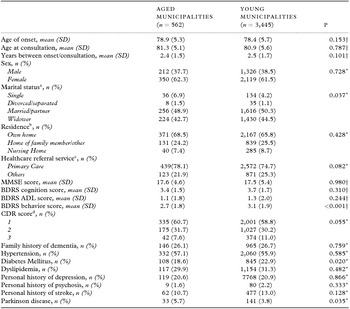
There were no significant differences in the distance or the time to arrive to the hospitals between the two types of municipalities: 19.7 km. (SD = 9.1) and 23.8 min. (SD = 9.5) for aged municipalities, and 17.9 km. (SD = 10.9) and 21 min. (SD = 9.4) for young municipalities (Distance: Mann-Whitney U = 4,453.5; Z = −1.6; p = 0.096; Time to arrive: Mann-Whitney U = 4,382.0; Z = −1.837; p = 0.066). Table 4 reports sociodemographic and clinical characteristics of the cases according to the degree of aging of the municipalities. The only significant difference was related to psychological and behavioral symptomatology, being higher in the cases from young municipalities (Mann-Whitney U = 339,752; Z = −4.7; p < 0.001) (Table 4).
Sociodemographic and clinical characteristics of patients (cases [n (%)]) according to the type of municipality of residence

*χ2 test.
†Mann-whitney U test; MMSE: mini-mental state examination; BDRS: blessed dementia rating scale; CDR: clinical dementia rating.
aMissing values = 268 (6.7%).
bMissing values = 174 (4.3%).
cMissing values = 2 (0.0%).
dMissing values = 53 (1.3%).
Discussion
To the best of our knowledge, this is the first report comparing the incidence rate of dementia diagnosis according to the degree of aging of the municipalities in general population in a defined geographical area; thus, comparisons with previous literature are limited. The study results do not confirm our hypothesis that there would be higher rates of dementia diagnoses in aged municipalities; instead, our results show that young municipalities have the highest rates of dementia diagnoses. The lowest incidence rates were detected in aged municipalities, which are smaller, and have a traditional agrarian lifestyle. In these municipalities we could calculate a rate of under diagnosis of 45.4% of the expected cases of dementia (vs. 25.9% in young municipalities, which are bigger and urban.
Given the fact that the incidence of dementia increases with age (Qiu et al., Reference Qiu, Ronchi and Fratiglioni2007), one would think that our results may be due to an under-registration of the cases in aged municipalities, but since the registry procedures are standard and harmonized for all the hospitals within the HRG, this explanation was ruled out. Previous research reported barriers hampering the diagnoses of dementia in rural general practice (Koller et al., Reference Koller2010; Greenway-Crombie et al., Reference Greenway-Crombie, Snow, Disler, Davis and Pond2012), such as a lack of specialists in these areas. Nevertheless, the general practitioners in the HRG can refer the patients with suspected dementia to the seven hospitals in the area, which all have memory clinics or specialized dementia support services. The access to the initial diagnostic evaluation by primary care physicians is another important factor to take into account when interpreting our results. Regarding this issue, in the HRG there are 246 centers of primary health care that guarantee a minimum of one center per municipality. All the centers of primary health care offer universal medical assistance to the whole population and the potential bias due to the accessibility economic difficulties could be ruled out. Moreover, the geographical area covered in our study is relatively small, has proper public transportation services, and there are no differences between municipalities regarding the distance or the time required to get to a hospital, which excludes another possible explanation for our results based on distance, and accessibility to healthcare services (Blazer et al., Reference Blazer, Landerman, Fillenbaum and Horner1995; Mc Donald and Conde, Reference McDonald and Conde2010; Sibley and Weiner, Reference Sibley and Weiner2011).
Hence, our results may be explained on the basis of an epidemiological adaptation of the environmental docility hypothesis (Lawton, Reference Lawton1974): according to Lawton's environmental docility hypothesis, as personal competence diminishes environmental pressure accounts for a greater proportion of behavioral outcomes. That is, the lower the level of competence, the greater the influence of environment on behavior (Lawton, Reference Lawton1974). From an epidemiological point of view, we may hypothesize that residents of aged municipalities, which are also smaller, with less inhabitants, and mostly rural, have less pressure in terms of cognitive and functional requirements to perform the activities of daily living (ADL). For instance, the cognitive skills required for finding the way to the grocery store and buy the products to prepare a meal are not the same in a city than in a small town/village. In the first case, a person with cognitive impairment must deal with vehicle traffic, with more visual and auditory stimuli, and has to interact with unknown people. In contrast, in a village, the same activity is cognitively less demanding because of the proximity of the shop and familiarity with the people. So, the impact of the dementia in rural settings may be lower regarding the ability to perform the ADL, or the need for surveillance, causing that the family and/or the patient never consult primary care services because of cognitive impairment. There were no differences in the dementia subtypes diagnosed in aged or in young municipalities, but cases from aged municipalities had a lower score in the Blessed Dementia Rating Scale behavior subscale. Thus cases from young municipalities had increased behavioral and psychological symptoms, suggesting that the environment could play a role in the clinical manifestations of dementia. The presence of behavioral and psychological symptoms may be the first cause to consult the doctor and start a dementia diagnostic procedure, and has been associated with negative outcomes both for the patient and the caregiver (Cerejeira et al., Reference Cerejeira, Lagarto and Mukaetova-Ladinska2012). So, the adaptation of the environmental docility hypothesis to the epidemiology of dementia may state that the lower the level of cognitive and functional requirements to perform the ADL in an environment, the lower the rate of behavioral and psychological symptoms of dementia, and the lower the rate of dementia diagnosis in this environment.
Some limitations must be acknowledged when interpreting the study results. First, there are several specific barriers related to dementia diagnosis, such as factors related to the healthcare professionals or to the patients and their families and caregivers that we did not control. Second, although this study is based on an epidemiological surveillance system of dementia in a defined geographic catchment area, we cannot exclude a selection bias because 24.6% of the expected cases in this area were not registered. Regarding the external validity of the study, the absence of comparable studies makes the validity of our study difficult to assess.
In summary, this is the first study to compare the rate of dementia diagnoses and the characteristics of the cases according to the degree of aging of municipalities in a specific geographic territory. We identified a lower rate of dementia diagnoses in aged municipalities than in young municipalities. We propose an adaptation of the environment docility hypothesis to explain this phenomenon, based on the fact that the environment, in terms of the place of residence, may condition the clinical manifestations of dementia that predispose an individual to look for help, and to obtain a diagnosis that explains the symptoms, which opens possibilities for new treatments and social support services.
Conflicts of interest
None.
Description of author's roles
LCP had full access to the data, and contributed to the interpretation of results and writing of the paper. JGO contributed to the study concept and design, analysis of the data and contributed to the interpretation of results and writing of thepaper. SLP contributed to the study concept, design, and critically revised thepaper. MA, IC, MF, MH, ML, YS and MV substantially contributed to critically revising the paper.
Acknowledgments
The ReDeGi was founded by the Health Region of Girona from the Department of Health of the Generalitat de Catalunya (Spain). The ReDeGi funder was not involved in the study design, interpretation of the results or in the decision to submit the paper for publication.
The ReDeGi Group consists of the following co-investigators:
-
1. Department of Neurology, Hospital Universi- tari Josep Trueta: Mar Castellanos, PhD; David Genís, MD; Jordi Gich, BPsych; Rosa Meléndez, MD; Albert Molins, MD; Lluís Ramió, MD; Joaquín Serena, PhD; Yolanda Silva, PhD
-
2. Dementia Unit, Hospital Santa Caterina : Calvó-Perxas L, PhD; Marta Hernández, BPsych; Saioa Lejarreta, MD; Jordi Llinàs, BPsych; Secundino López-Pousa, PhD; Manuela Lozano, BPsych; Immaculada Pericot, PhD; Joan Vilalta-Franch, PhD; Josefa Turbau, MD; Antoni Turon, PhD; Oriol Turró-Garriga, BPsych
-
3. Dementia Unit, Hospital de Palamós : Elisabet Alsina, Rosa de Eugenio, MD; Margarita Flaqué, BPsych; Erélido Hernández, MD
-
4. Neurology Department, Hospital de Figueres : María Aguirregomozcorta, MD; Olga Carmona, MD; Marta Cullell, BPsych; Teresa Osuna, MD; María del Mar Fernández, MD
-
5. Neurology and Geriatrics Departments, Hos- pital d’Olot: Josep Bisbe, MD; Marta Linares, BPsych; Favià Marquez, MD; Natalia Vallmajó, MD
-
6. Neurology and Geriatrics Departments, Hos- pital de Blanes : Fernando Espada, MD; Teresa Casadevall, MD; Héctor Perkal, MD; Marta Viñas, MD
-
7. Neurology Department; Hospital de Camp- devànol : Isabel Casas, BPsych; Anna Manzano, MD; Josep Ma Cuy, MD, Josefa Turbau, MD