


Assertive outreach teams have been introduced in most parts of England to assist in the management of severe mental illness. To improve their effectiveness, we need to know what factors are associated with favourable outcome. The Pan-London Assertive Outreach Study (PLAO) investigated the routine practice of assertive outreach teams in London. It established how teams are organised and operate (Reference Wright, Burns and JamesWright et al, 2003), assessed staff burn-out and satisfaction (Reference Billings, Johnson and BebbingtonBillings et al, 2003), identified socio-demographic and clinical characteristics of patients and recorded rates of hospitalisation and compulsory admissions within a 9-month follow-up period (Reference Priebe, Fakhoury and WattsPriebe et al, 2003). The present paper explores the baseline characteristics of teams, staff and patients that predict outcomes over the 9-month follow-up.
METHOD
Characteristics of 24 designated assertive outreach teams, 187 staff members and 580 patients were assessed. A census of all team patients on the case-load was taken on 18 June 2001. The case-load for each team was divided into patients who had been with the team for 3 months or longer (established patients) and those who had joined the case-load in the previous 3 months (new patients). Newly accepted patients were oversampled because the initial stage of assertive outreach provision may be a ‘stabilisation’ period with a relatively poor outcome (Reference McGrew, Bond and DietzenMcGrew et al, 1995). To increase the proportion of new patients in the sample, another census was taken on 18 September 2001, whereby all patients who joined the team in the previous 3 months were added to the sample. The total sample consisted of 391 established patients and 189 new patients (for more details see Reference Priebe, Fakhoury and WattsPriebe et al, 2003).
Voluntary hospital admission and compulsory admission rates in the 9-month follow-up period were obtained for 487 patients. Details of the approach, the instruments used and the study organisation have been described in previous papers (Reference Billings, Johnson and BebbingtonBillings et al, 2003; Reference Priebe, Fakhoury and WattsPriebe et al, 2003; Reference Wright, Burns and JamesWright et al, 2003).
For this analysis, a total of 25 variables were selected as potential predictor variables of outcome. The variables were chosen to cover a wide range of features of the teams and patients without introducing multi-collinearity, which would make the multiple regression results hard to interpret, and also to provide good predictive discrimination (Reference Harrell, Lee and MarkHarrell et al, 1996). The selection of the variables took into account the importance of the content covered by these variables, as ascribed by the authors of the three previous PLAO papers from the baseline results.
In preference to composite measures such as fidelity scores, we selected nine characteristics of teams that reflected separate attributes of team organisation and policy. In this way we intended to identify independent features of teams that might be relevant for outcome. The team predictor variables were: team size (the total number of clinical full-time equivalent staff); designated psychiatrist input (full-time equivalent psychiatrist per 100 patients); integration of health and social care (integration v. non-integration); multi-disciplinarity (number of clinical disciplines represented in the team); the proportion of face-to-face contacts that were located in the community; ratio of full-time to part-time staff; weekend working (whether the team did or did not operate at weekends); out-of-hours work (whether the team from Mondays to Fridays operated out of hours or normal office hours only); and case-load (the average individual case-load per staff member in the team).
As potential predictors reflecting the views and work experience of staff, we selected the three sub-scales of the Maslach Burnout Inventory (Reference Maslach and JacksonMaslach & Jackson, 1981): emotional exhaustion (depletion of emotional resources); depersonalisation (negative attitudes and feelings about patients); and personal accomplishment (negative evaluation of one's self, especially regarding dealing with patients). A high level of burn-out is reflected by a low score on personal accomplishment, a high score on emotional exhaustion and a high score on depersonalisation. We also selected two sub-scales of the Minnesota Satisfaction Scale (Reference Weiss, Davis and EnglandWeiss et al, 1967): intrinsic (extent to which they feel that their work fits their skills) and extrinsic (satisfaction with working conditions and rewards). A high level of satisfaction is reflected by a high intrinsic and a high extrinsic satisfaction score.
Finally, 11 patient characteristics were considered as potential predictors: age; gender (male v. female); ethnicity (non-White v. White); living status (living alone v. living with others); the total number of previous hospital admissions in four categories (no hospitalisation and 1–3, 4–9 and 10 or more hospitalisations); hospitalisation in the 2 years prior to the interview (yes/no); compulsory admission in the 2 years prior to the interview (yes/no); alcohol or drug misuse or dependency in the last 2 years (yes/no); occurrence of physical violence in the last 2 years (yes/no); arrest in the last 2 years (yes/no); and whether or not the patient was in contact with services other than the assertive outreach team.
The two outcome variables assessed at the 9-month follow-up were whether or not patients had been admitted to hospital and whether or not they had been admitted involuntarily within the follow-up period.
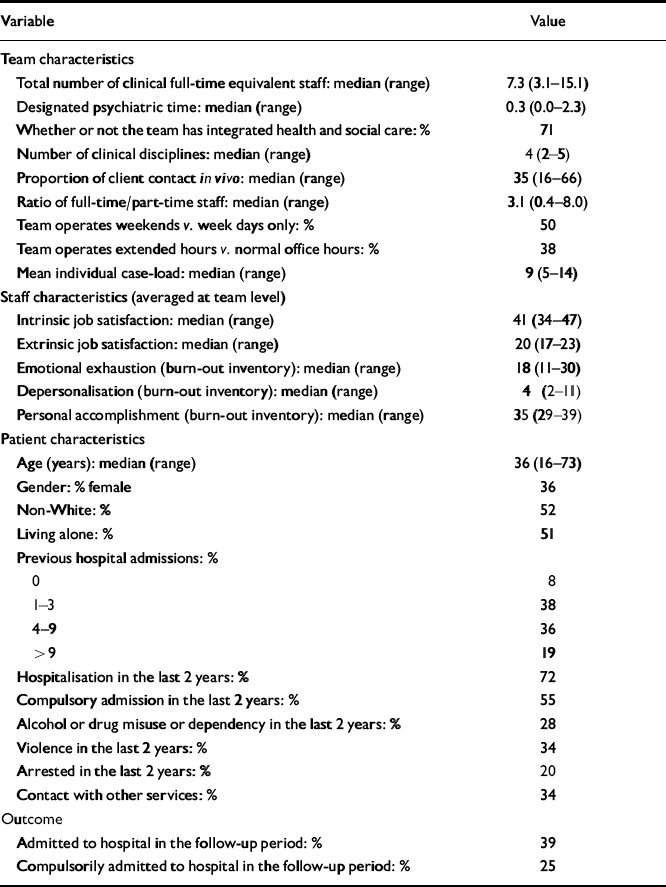
Table 1 lists the 25 variables that were tested as predictors, and the outcome criteria, in terms of number count and percentage, or mean and range, where appropriate.
Characteristics of 24 assertive outreach teams and 487 patients with observed outcome
| Variable | Value |
|---|---|
| Team characteristics | |
| Total number of clinical full-time equivalent staff: median (range) | 7.3 (3.1-15.1) |
| Designated psychiatric time: median (range) | 0.3 (0.0-2.3) |
| Whether or not the team has integrated health and social care: % | 71 |
| Number of clinical disciplines: median (range) | 4 (2-5) |
| Proportion of client contact in vivo: median (range) | 35 (16-66) |
| Ratio of full-time/part-time staff: median (range) | 3.1 (0.4-8.0) |
| Team operates weekends v. week days only: % | 50 |
| Team operates extended hours v. normal office hours: % | 38 |
| Mean individual case-load: median (range) | 9 (5-14) |
| Staff characteristics (averaged at team level) | |
| Intrinsic job satisfaction: median (range) | 41 (34-47) |
| Extrinsic job satisfaction: median (range) | 20 (17-23) |
| Emotional exhaustion (burn-out inventory): median (range) | 18 (11-30) |
| Depersonalisation (burn-out inventory): median (range) | 4 (2-11) |
| Personal accomplishment (burn-out inventory): median (range) | 35 (29-39) |
| Patient characteristics | |
| Age (years): median (range) | 36 (16-73) |
| Gender: % female | 36 |
| Non-White: % | 52 |
| Living alone: % | 51 |
| Previous hospital admissions: % | |
| 0 | 8 |
| 1-3 | 38 |
| 4-9 | 36 |
| > 9 | 19 |
| Hospitalisation in the last 2 years: % | 72 |
| Compulsory admission in the last 2 years: % | 55 |
| Alcohol or drug misuse or dependency in the last 2 years: % | 28 |
| Violence in the last 2 years: % | 34 |
| Arrested in the last 2 years: % | 20 |
| Contact with other services: % | 34 |
| Outcome | |
| Admitted to hospital in the follow-up period: % | 39 |
| Compulsorily admitted to hospital in the follow-up period: % | 25 |
Statistical analysis
Patients were the unit of analysis, so patients in the same team shared the same team characteristics. They were also allocated the same staff characteristics, following the team approach of assertive outreach whereby patients are cared for by the whole team and not by one individual staff member.
Data were analysed using STATA 7.0 for Windows (StataCorp, 1999). Ten patient variables had up to 9% missing values, and 24% of patients had missing values on at least one variable. To avoid loss of precision, we imputed the missing baseline values using multiple imputation (Reference Clark and AltmanClark & Altman, 2003), so that all analyses were based on all subjects with the outcome observed. Because patients in the same team may not be independent, standard statistical techniques would produce incorrect standard errors. We therefore computed all standard errors by the robust method, allowing for clustering within teams (Reference RogersRogers, 1993). All analyses allowed for the sampling fraction (i.e. 0.37 for established patients and 1 for new patients; Reference Priebe, Fakhoury and WattsPriebe et al, 2003) by weighting by its inverse (Reference Horvitz and ThompsonHorvitz & Thompson, 1952). This tended to increase the standard errors by about 15%.
To predict the two dichotomous outcome variables, both univariate and multiple logistic regression was used. Univariate analyses related each outcome via logistic regression to each predictor. Quantitative variables were entered as such, and ordered categorical variables were entered as continuous. The multivariate model was selected from the team, staff and patient variables, starting with all variables that were univariately significant and using stepwise selection to include all variables that were significant independent predictors of either of the two outcomes, controlling for the effects of the other variables in the model. For variable selection, we used a liberal significance level of P<0.15. However, the statistical significance of associations was taken as P<0.05. Results were expressed as odds ratios for the presence v. absence of a characteristic, for a 10% increase in the percentage of contacts in the community, for a 10-year increase in age, for a one standard deviation increase in scores of staff burn-out and satisfaction and for a one unit increase in other variables.
RESULTS
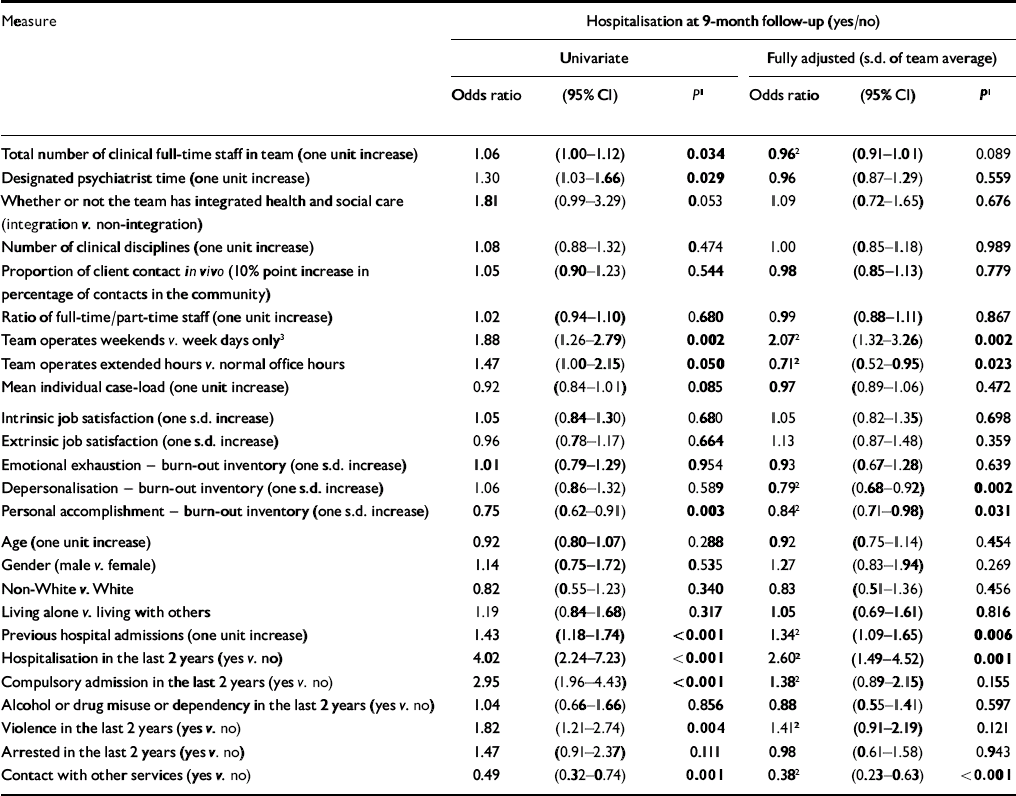
Table 2 shows results of the univariate and multivariate prediction of hospital admissions of any type in the follow-up period. Out of the nine tested team characteristics, four were associated significantly with outcome in the univariate analysis. Having more clinical staff and more designated psychiatrist input, working at weekends and working out of office hours each predicted a higher probability of admission. In a multivariate adjusted model, only weekend working remained a significant predictor of higher admission rates.
Predictors of patient hospitalisations (all) at 9-month follow-up
| Measure | Hospitalisation at 9-month follow-up (yes/no) | |||||
|---|---|---|---|---|---|---|
| Univariate | Fully adjusted (s.d. of team average) | |||||
| Odds ratio | (95% CI) | P 1 | Odds ratio | (95% CI) | P 1 | |
| Total number of clinical full-time staff in team (one unit increase) | 1.06 | (1.00-1.12) | 0.034 | 0.962 | (0.91-1.01) | 0.089 |
| Designated psychiatrist time (one unit increase) | 1.30 | (1.03-1.66) | 0.029 | 0.96 | (0.87-1.29) | 0.559 |
| Whether or not the team has integrated health and social care (integration v. non-integration) | 1.81 | (0.99-3.29) | 0.053 | 1.09 | (0.72-1.65) | 0.676 |
| Number of clinical disciplines (one unit increase) | 1.08 | (0.88-1.32) | 0.474 | 1.00 | (0.85-1.18) | 0.989 |
| Proportion of client contact in vivo (10% point increase in percentage of contacts in the community) | 1.05 | (0.90-1.23) | 0.544 | 0.98 | (0.85-1.13) | 0.779 |
| Ratio of full-time/part-time staff (one unit increase) | 1.02 | (0.94-1.10) | 0.680 | 0.99 | (0.88-1.11) | 0.867 |
| Team operates weekends v. week days only3 | 1.88 | (1.26-2.79) | 0.002 | 2.072 | (1.32-3.26) | 0.002 |
| Team operates extended hours v. normal office hours | 1.47 | (1.00-2.15) | 0.050 | 0.712 | (0.52-0.95) | 0.023 |
| Mean individual case-load (one unit increase) | 0.92 | (0.84-1.01) | 0.085 | 0.97 | (0.89-1.06) | 0.472 |
| Intrinsic job satisfaction (one s.d. increase) | 1.05 | (0.84-1.30) | 0.680 | 1.05 | (0.82-1.35) | 0.698 |
| Extrinsic job satisfaction (one s.d. increase) | 0.96 | (0.78-1.17) | 0.664 | 1.13 | (0.87-1.48) | 0.359 |
| Emotional exhaustion - burn-out inventory (one s.d. increase) | 1.01 | (0.79-1.29) | 0.954 | 0.93 | (0.67-1.28) | 0.639 |
| Depersonalisation - burn-out inventory (one s.d. increase) | 1.06 | (0.86-1.32) | 0.589 | 0.792 | (0.68-0.92) | 0.002 |
| Personal accomplishment - burn-out inventory (one s.d. increase) | 0.75 | (0.62-0.91) | 0.003 | 0.842 | (0.71-0.98) | 0.031 |
| Age (one unit increase) | 0.92 | (0.80-1.07) | 0.288 | 0.92 | (0.75-1.14) | 0.454 |
| Gender (male v. female) | 1.14 | (0.75-1.72) | 0.535 | 1.27 | (0.83-1.94) | 0.269 |
| Non-White v. White | 0.82 | (0.55-1.23) | 0.340 | 0.83 | (0.51-1.36) | 0.456 |
| Living alone v. living with others | 1.19 | (0.84-1.68) | 0.317 | 1.05 | (0.69-1.61) | 0.816 |
| Previous hospital admissions (one unit increase) | 1.43 | (1.18-1.74) | <0.001 | 1.342 | (1.09-1.65) | 0.006 |
| Hospitalisation in the last 2 years (yes v. no) | 4.02 | (2.24-7.23) | <0.001 | 2.602 | (1.49-4.52) | 0.001 |
| Compulsory admission in the last 2 years (yes v. no) | 2.95 | (1.96-4.43) | <0.001 | 1.382 | (0.89-2.15) | 0.155 |
| Alcohol or drug misuse or dependency in the last 2 years (yes v. no) | 1.04 | (0.66-1.66) | 0.856 | 0.88 | (0.55-1.41) | 0.597 |
| Violence in the last 2 years (yes v. no) | 1.82 | (1.21-2.74) | 0.004 | 1.412 | (0.91-2.19) | 0.121 |
| Arrested in the last 2 years (yes v. no) | 1.47 | (0.91-2.37) | 0.111 | 0.98 | (0.61-1.58) | 0.943 |
| Contact with other services (yes v. no) | 0.49 | (0.32-0.74) | 0.001 | 0.382 | (0.23-0.63) | <0.001 |
Higher scores of staff on personal accomplishment predicted lower admission rates in both univariate and multivariate analysis. In the multivariate analysis, higher scores of depersonalisation also were associated with lower admission rates, although there was no significant association at the univariate level. It is to be noted that high personal accomplishment correlated significantly with low depersonalisation.
Five patient characteristics were correlated with admissions at the univariate level, three of which remained significant in the multivariate model. Patients with more admissions in their history and, independently, more admissions within the last 2 years were more likely to be admitted again, whereas contact with other services was associated with lower admission rates.
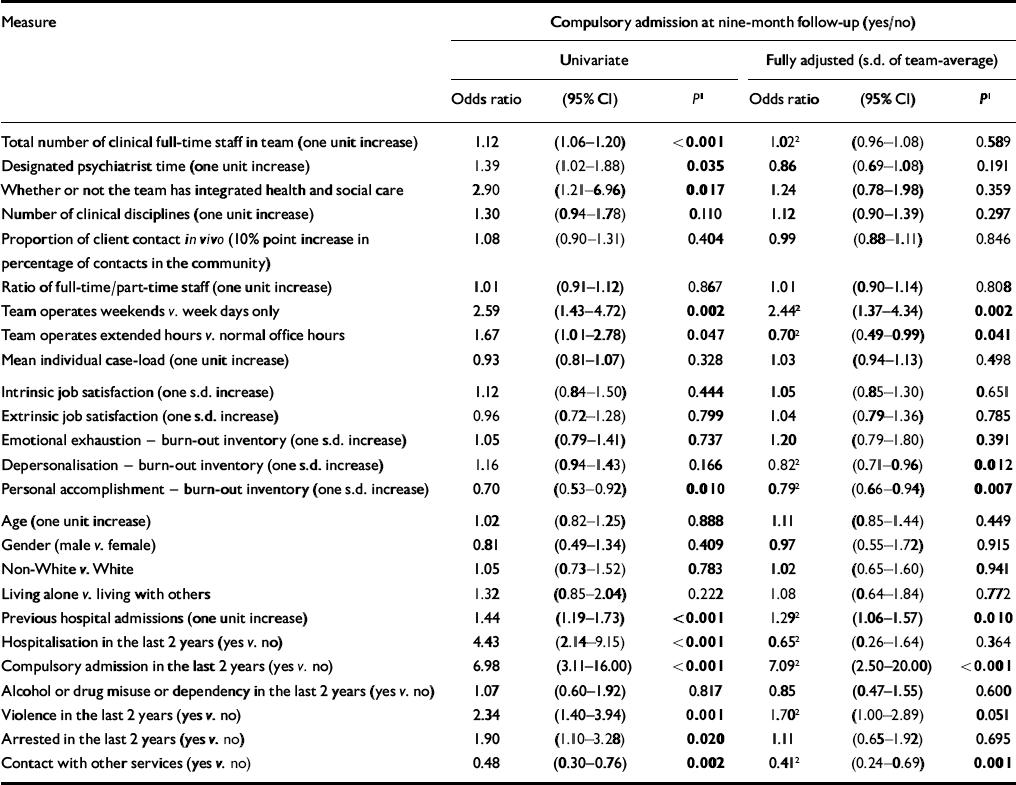
The univariate and multivariate prediction of compulsory admission in the follow-up period is summarised in Table 3. In the univariate analysis, five team characteristics were associated with outcome: more clinical staff, more psychiatrist input, integration of health and social care, weekend working and working out of office hours each predicted a higher probability of compulsory admission to hospital within the follow-up period. In the multivariate model, only working on weekends and out of office hours remained significant predictors. In this model, however, the direction of effect of out-of-hours working was reversed compared with the univariate analysis. When the influence of all other variables had been adjusted for, out-of-hours working was associated with lower – not higher – compulsory admission rates, whereas weekend working continued to predict a higher probability of compulsory admissions. Staff scores on depersonalisation and personal accomplishment predicted compulsory admissions in the same way as they did for admission of all types. With respect to patient characteristics, the total number of admissions in the patient's history as well as admissions, compulsory admissions, violence and arrests in the last 2 years each predicted higher compulsory admission rates, whereas contact with other services was associated with a lower probability of being sectioned. In the multivariate model only two variables remained significant predictors (i.e. compulsory admissions in the last 2 years and contact with other services) and physical violence in the last 2 years approached statistical significance.
Predictors of patient compulsory admissions at 9-month follow-up
| Measure | Compulsory admission at nine-month follow-up (yes/no) | |||||
|---|---|---|---|---|---|---|
| Univariate | Fully adjusted (s.d. of team-average) | |||||
| Odds ratio | (95% CI) | P 1 | Odds ratio | (95% CI) | P 1 | |
| Total number of clinical full-time staff in team (one unit increase) | 1.12 | (1.06-1.20) | <0.001 | 1.022 | (0.96-1.08) | 0.589 |
| Designated psychiatrist time (one unit increase) | 1.39 | (1.02-1.88) | 0.035 | 0.86 | (0.69-1.08) | 0.191 |
| Whether or not the team has integrated health and social care | 2.90 | (1.21-6.96) | 0.017 | 1.24 | (0.78-1.98) | 0.359 |
| Number of clinical disciplines (one unit increase) | 1.30 | (0.94-1.78) | 0.110 | 1.12 | (0.90-1.39) | 0.297 |
| Proportion of client contact in vivo (10% point increase in percentage of contacts in the community) | 1.08 | (0.90-1.31) | 0.404 | 0.99 | (0.88-1.11) | 0.846 |
| Ratio of full-time/part-time staff (one unit increase) | 1.01 | (0.91-1.12) | 0.867 | 1.01 | (0.90-1.14) | 0.808 |
| Team operates weekends v. week days only | 2.59 | (1.43-4.72) | 0.002 | 2.442 | (1.37-4.34) | 0.002 |
| Team operates extended hours v. normal office hours | 1.67 | (1.01-2.78) | 0.047 | 0.702 | (0.49-0.99) | 0.041 |
| Mean individual case-load (one unit increase) | 0.93 | (0.81-1.07) | 0.328 | 1.03 | (0.94-1.13) | 0.498 |
| Intrinsic job satisfaction (one s.d. increase) | 1.12 | (0.84-1.50) | 0.444 | 1.05 | (0.85-1.30) | 0.651 |
| Extrinsic job satisfaction (one s.d. increase) | 0.96 | (0.72-1.28) | 0.799 | 1.04 | (0.79-1.36) | 0.785 |
| Emotional exhaustion - burn-out inventory (one s.d. increase) | 1.05 | (0.79-1.41) | 0.737 | 1.20 | (0.79-1.80) | 0.391 |
| Depersonalisation - burn-out inventory (one s.d. increase) | 1.16 | (0.94-1.43) | 0.166 | 0.822 | (0.71-0.96) | 0.012 |
| Personal accomplishment - burn-out inventory (one s.d. increase) | 0.70 | (0.53-0.92) | 0.010 | 0.792 | (0.66-0.94) | 0.007 |
| Age (one unit increase) | 1.02 | (0.82-1.25) | 0.888 | 1.11 | (0.85-1.44) | 0.449 |
| Gender (male v. female) | 0.81 | (0.49-1.34) | 0.409 | 0.97 | (0.55-1.72) | 0.915 |
| Non-White v. White | 1.05 | (0.73-1.52) | 0.783 | 1.02 | (0.65-1.60) | 0.941 |
| Living alone v. living with others | 1.32 | (0.85-2.04) | 0.222 | 1.08 | (0.64-1.84) | 0.772 |
| Previous hospital admissions (one unit increase) | 1.44 | (1.19-1.73) | <0.001 | 1.292 | (1.06-1.57) | 0.010 |
| Hospitalisation in the last 2 years (yes v. no) | 4.43 | (2.14-9.15) | <0.001 | 0.652 | (0.26-1.64) | 0.364 |
| Compulsory admission in the last 2 years (yes v. no) | 6.98 | (3.11-16.00) | <0.001 | 7.092 | (2.50-20.00) | <0.001 |
| Alcohol or drug misuse or dependency in the last 2 years (yes v. no) | 1.07 | (0.60-1.92) | 0.817 | 0.85 | (0.47-1.55) | 0.600 |
| Violence in the last 2 years (yes v. no) | 2.34 | (1.40-3.94) | 0.001 | 1.702 | (1.00-2.89) | 0.051 |
| Arrested in the last 2 years (yes v. no) | 1.90 | (1.10-3.28) | 0.020 | 1.11 | (0.65-1.92) | 0.695 |
| Contact with other services (yes v. no) | 0.48 | (0.30-0.76) | 0.002 | 0.412 | (0.24-0.69) | 0.001 |
Pairwise interactions were tested between those variables that are significant predictors in the final model. Altogether 68 interactions were tested, 34 for each outcome. Four of them are significant at P<0.05; 3.4 such results are to be expected by chance and none of the interactions was significant at P<0.01.
DISCUSSION
What predicts outcome?
This naturalistic prospective study investigated assertive outreach practice under routine conditions in London. Other studies have suggested that community-focused services can be effective and reduce the number of days that patients spend in hospital (Reference Merson, Tyrer and OnyettMerson et al, 1992; Tyrer et al, Reference Tyrer, Merson and Onyett1994, Reference Tyrer, Evans and Gandhi1998, Reference Tyrer, Manley and Van Horn2000; Reference Tyrer and SimmondsTyrer & Simmonds, 2003) and contacts with the police (Reference Tyrer, Evans and GandhiTyrer et al, 1998; Reference Gandhi, Tyrer and EvansGandhi et al, 2001), but this study does not address the overall effectiveness of assertive outreach teams. Rather, it utilises the existing variation between teams, staff and patients to assess whether (and, if so, in what way) such characteristics predict outcome. Only two simple outcome criteria were used: whether patients were admitted and whether they were admitted compulsorily within a 9-month follow-up period. Other outcome criteria, such as patients’ psychopathology, quality of life and treatment satisfaction, may be equally or even more important targets of assertive outreach than preventing admissions. In some cases, voluntary hospitalisation might even be regarded as a positive outcome if it indicates a degree of engagement with services, although compulsory admission is an adverse outcome that services try to avoid. The advantage of these outcome criteria is that they are clearly operationalised and can be established on the basis of records alone, thus avoiding selection bias through non-response to research interviews.
The most important result is that certain characteristics of teams, staff and patients were all found to be predictive of outcome. This held true in multivariate analyses when the influence of all other variables was controlled for. Before concluding that these effects are causal, we must contemplate the idea that they may be due to confounding by unmeasured variables.
Team characteristics
With respect to team characteristics, weekend working was a strong predictor both of more voluntary admissions in general and of compulsory admissions in particular. The positive association between weekend working and admissions may reflect a greater illness severity of patients referred to teams with weekend working that has not been captured fully by the measured variables. However, there are also other possible explanations: teams that do not work at weekends, by definition, cannot admit any patients on two out of seven days of the week; and staff covering weekends will have to take time off during normal office hours. This might be disruptive to relationships with fellow staff and patients and have an adverse effect on patient outcome. Furthermore, a policy of weekend working may reflect a team philosophy with a stronger focus on risk containment than in teams that do not provide care on weekends. Such emphasis on risk containment may affect clinical decisions to admit patients voluntarily or involuntarily (Reference Tyrer, Morgan and Van HornTyrer et al, 1995). Similar explanations may apply to out-of-hours working, which in univariate analyses, also predicted higher admission and compulsory admission rates. When the influence of all other predictors, including weekend working, is controlled for, however, the effect was reversed (i.e. in addition to the impact of all other variables, extended working hours predicted lower compulsory admission rates), which reflects that the predictive values of some of the tested variables still overlap.
Other team variables often regarded as relevant in the assertive outreach literature, such as multi-disciplinary working, high percentage of contacts in the community and integration of health and social care, do not predict outcome when the influence of other factors is controlled for. These factors therefore may be less important for the effectiveness of teams than has been suggested on the basis of reviews (Reference Mueser, Bond and DrakeMueser et al, 1998; Reference Catty, Burns and KnappCatty et al, 2002). The findings might encourage service providers to be more flexible over these aspects of assertive outreach, and not necessarily adhere to detailed prescriptions lacking research evidence.
Staff characteristics
Staff satisfaction and burn-out was averaged at a team level reflecting the team approach of assertive outreach. Although job satisfaction did not have an impact on outcome, staff burn-out did. It is interesting to note that in the multivariate model two components of burn-out – depersonalisation and high personal accomplishment – were associated with reduced hospitalisation and compulsory admission at 9-month follow-up. This meant that those with more negative views of their patients, and those who viewed themselves more positively regarding their work with their patients, were less likely to have these patients admitted to hospitals. This is surprising given that, univariately, high depersonalisation and low personal accomplishment were associated with admissions, and that high depersonalisation correlated significantly with low personal accomplishment. Thus, the results at the multivariate level could be due to the confounding masking effect of personal accomplishment on depersonalisation.
The impact of staff burn-out is independent of the way the team is organised and of the characteristics of the clients as far as both aspects have been captured by the variables used in this study. How to improve staff morale in assertive outreach teams and maintain it at a level that is as high as possible remains an open question and is an appropriate subject for further research. The findings also suggest that staff burn-out might affect the results of randomised controlled trials comparing assertive outreach with other forms of treatment, particularly when the experimental service is new and has a more charismatic leadership than the service in the control condition.
Patient characteristics
The patient characteristics identified in the univariate analyses as predictors of the two outcome criteria were very similar. This was expected because the two criteria are not independent: hospital admission included compulsory admissions. A higher total number of previous admissions, voluntary or compulsory admissions in the last 2 years, physical violence in the last 2 years and no contact with other services predicted poorer outcome on both criteria. In multivariate analyses, however, different and specific events in the past seem to be the best predictors of similar events in the follow-up period (i.e. hospital admissions in the past predict further admissions, and a history of compulsory hospital admissions is the best predictor of compulsory admissions in the future). One might conclude that where treatment has failed in the past it is more likely to fail in the future, and those patients for whose care the assertive outreach teams have been specifically set up (i.e. those with a history of voluntary and compulsory admissions), still have the poorest outcome. Assertive outreach teams face the same problems with these patients as generic community mental health teams, despite their superior resources and targeted approach. This implies that teams with a high percentage of this core group of patients managed by assertive outreach on their case-load inevitably tend to achieve a less favourable average outcome, and what teams can realistically accomplish will depend on the history of their patients.
Contact with other services emerged as a very powerful, independent predictor of favourable outcome. To some degree, patients’ contact with other services might simply reflect a higher level of engagement, a greater willingness to accept support and better skills to seek and receive it. Thus, patients’ attitudes and skills may explain the predictive association. Nevertheless, the fact that contact with other services alone reduces the risk for voluntary and compulsory admissions by around 50% may be seen as evidence for the importance for multi-agency working with this group.
Implications and future research
The findings of the study point at the complexities of predicting outcome under routine conditions. Aspects of how the team is organised, staff burn-out, patients’ history and their contact with other services have been identified as independent significant predictors and should be considered in research as well as clinical practice. In the UK, the decision on whether assertive outreach should be implemented has been taken, and assertive outreach teams will be part of established services for some time to come. The challenge now is to evaluate how the teams work and to improve their effectiveness. This study provides some indication about what factors may have to be targeted in the processes of clinical governance and service development.
APPENDIX
The Pan-London Assertive Outreach Study Group
Tom Burns, Christine Wright, Peter James, Adele Greaves, Christine Benfell, Nan Greenwood (St George's Hospital Medical School, London); Paul Bebbington, Sonia Johnson, Joanne Billings (University College London and Camden and Islington Mental Health and Social Care Trust); Stefan Priebe, Walid Fakhoury, Joanna Watts (Unit for Social and Community Psychiatry, Barts’ and The London School of Medicine); Matt Muijen, Ian Ryrie, Rebecca Walwyn (Sainsbury Centre for Mental Health); Ian White (Medical Research Council Biostatistics Unit, Cambridge).
Clinical Implications and Limitations
CLINICAL IMPLICATIONS
-
▪ Aspects of how assertive outreach teams work, staff burn-out and patient characteristics are associated independently with outcome.
-
▪ Weekend working predicts higher admission/compulsory admission rates.
-
▪ Patients who are in contact with services other than assertive outreach have a much lower risk of voluntary and compulsory admission.
LIMITATIONS
-
▪ Only voluntary and compulsory admissions within a 9-month follow-up period were taken as outcome criteria. Other criteria such as patients’ views and quality of life were not considered.
-
▪ Only 25 predictor variables were tested.
-
▪ This is a naturalistic observational study, and the associations found may reflect confounding rather than causal relationships.
Acknowledgements
We thank those who were involved in the development of the study: Peter Tyrer, Kevin Gournay, Graham Thornicroft, Tom Craig and Angela Greatley. This study was developed and carried out partly under the auspices of The London Mental Health Virtual Institute for Research and Development.




eLetters
No eLetters have been published for this article.