Introduction
Owing to significant advantages of multi-input and multi-output (MIMO) technologies because of their exceptional properties in improvement of signal quality, system reliability, channel capacity, and to achieve higher data rate [Reference Yan and Bernhard1], a plethora of wearable applications in the fields of medical, defense, and sports have emerged requiring the use of wearable MIMO antennas to meet the desirable radiation requirements [Reference Yan and Vandenbosch2]. Since MIMO systems involve the use of multiple-radiating elements, it is therefore desirable to develop a very compact wearable MIMO antenna with wideband, high gain, and minimum coupling of electromagnetic (EM) waves among the nearly coexisting radiating elements along with a negligible impact of EM wave radiation over the human body [Reference Wen, Hao, Munoz, Wang and Zhou3].
Several MIMO antennas have been proposed by researchers. For instance, a compact four-element MIMO slot antenna [Reference Pandit, Mohan and Ray4] of size 26 × 26 × 0.8 mm3 with four slots in the ground plane achieved narrow 10 dB return loss (RL) bandwidth (BW) of 3.5% (5.6–5.8 GHz) along with 15.4 dB isolation and envelope correlation coefficient (ECC) <0.01, whereas a coplanar waveguide (CPW)-fed monopole MIMO antenna [Reference Ullah, Mabrouk and Koziel5] of size 13.7 × 36.2 × 15.2 mm3 using parasitic patches has been proposed to enhance the 10 dB RL BW of 19.13% (5.2–6.3 GHz) with 22 dB isolation and ECC <0.004. Furthermore, a three-element MIMO antenna [Reference Sharma, Sarkar, Saurav and Srivastava6] of size 48 × 29 × 1.6 mm3 using a printed dipole antenna with common ground, radiates with 10 dB RL BW of 16.28% (5.5–6.2 GHz) with 15 dB isolation and ECC <0.003, and a slotted patch MIMO antenna [Reference Roy, Ghosh and Chakarborty7] of size 52 × 50 × 1.6 mm3 using an L-shaped slotted patch, backed with a rectangular patch on truncated ground, radiates with 10 dB RL BW of 22% (4.9–6.1 GHz) with 15 dB isolation and degraded ECC <0.1. Meanwhile, a textile-based four-port L-shaped slotted MIMO patch antenna [Reference Roy, Ghosh, Pattanayak and Chakarborty8] of size 110 × 97 × 1.4 mm3 has been proposed using spring type isolation strips to achieve 10 dB RL BW of 39.2% (4.1–6.1 GHz) with 27 dB isolation and ECC <0.1. Therefore, it is desirable to develop a simple, compact, and wideband wearable MIMO antenna with good radiation performance with minimum coupling among closely located radiating elements and a low specific absorption rate (SAR) to cover ISM band applications.
This paper illustrates a simple and compact design of wideband CPW-fed quad co-located inverted-L element-based wearable MIMO radiator with a square split ring structure in the center of a wide square slot. In order to minimize the coupling among the four co-existing proposed inverted-L-shaped quad antennas, four diagonal strips are bent to form a square-shaped split ring structure. Thus, a higher degree of isolation has been achieved as compared with antennas reported in the literature [Reference Pandit, Mohan and Ray4–Reference Roy, Ghosh, Pattanayak and Chakarborty8] for WBAN applications. The proposed antenna has been designed and simulated by Ansys HFSS (Version 16.2) 3D-Electromagnetic simulator and measured using an Agilent E5071C network analyzer. In Section “Antenna design and radiation mechanism,” the design of the proposed inverted-L-shaped radiating elements based wideband (ILW) wearable MIMO antenna and its radiation mechanism is discussed. Section “Results and discussion” compares the simulated and measured radiation characteristics of the proposed ILW wearable MIMO antenna. Section “Performance on human body” discusses the study of radiation performance of fabricated prototype of the proposed ILW wearable MIMO antenna on human body. Finally, conclusion is provided in the last section.
Antenna design and radiation mechanism
Antenna design
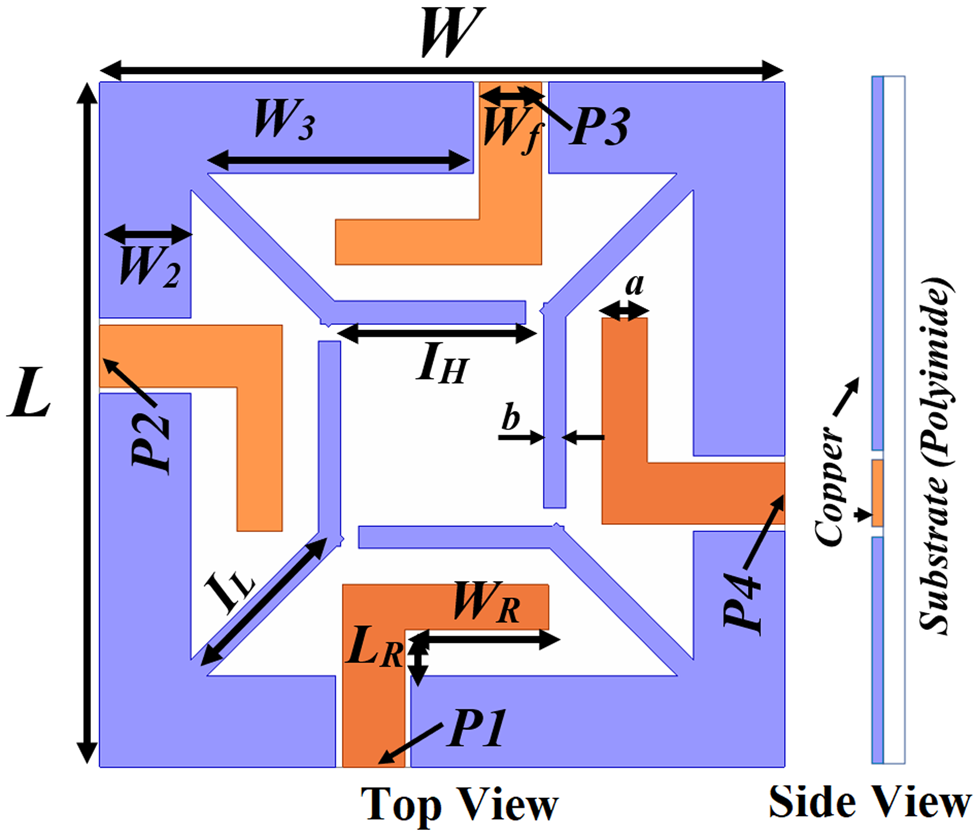
The proposed ILW wearable MIMO antenna of size 30 × 30 × 1 mm3 has been designed on a foldable polyimide substrate (ɛr = 3.5 and tan δ = 0.027). The 50 Ω CPWs with inverted-L-shaped feed stubs are used to excite the four-port MIMO wearable antenna. The design geometry of the proposed ILW wearable MIMO antenna with its optimized parameters is shown in Fig. 1.
Design geometry of ILW wearable MIMO antenna with top and side views (L = 30, W = 30, LR = 2, Wf = 2.7, g = 0.3, IH = 8.5, IL = 8.5, WR = 6.3, W 3 = 11.6, W 2 = 4, a = 2, b = 1) (unit: mm).

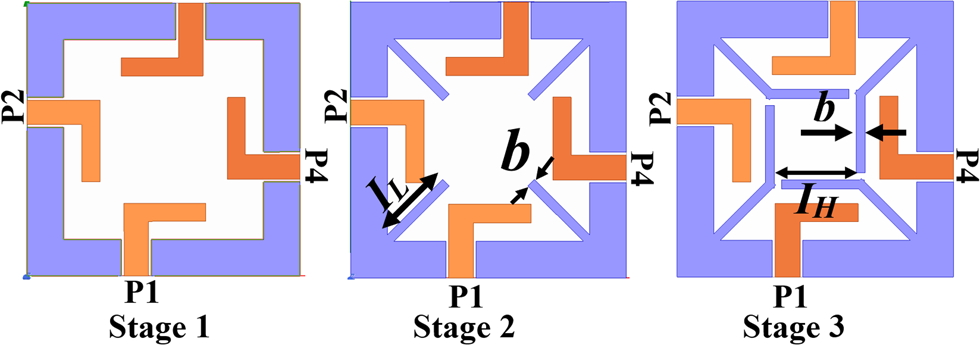
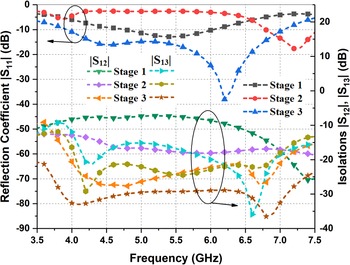
The evolution process of the proposed ILW wearable MIMO antenna has been illustrated through three stages namely, stage 1, stage 2, and stage 3, as indicated in Fig. 2 and its simulated magnitude of S-parameters of four-port MIMO antenna system are depicted in Fig. 3. Initially, a wide square slot is excited by four CPW-fed inverted-L-shaped feed stubs in stage 1 as indicated in Fig. 2. The antenna designed in stage 1 radiates in the 6.8–7.5 GHz band for simulated RL ≥10 dB and isolation >8 dB as shown in Fig. 3. Next, in stage 2, thin rectangular strips are diagonally extended from the vertices of the square slot to decouple EM waves among quad inverted-L-shaped radiating elements as shown in Fig. 2.
Evolution stages of the proposed ILW wearable MIMO antenna.

Comparison of simulated S-parameters (magnitude) of evolution stages of the proposed ILW wearable MIMO antenna.

In stage 2, the designed antenna radiates in the 4.8–6.0 GHz band for simulated RL ≥10 dB and isolation >17 dB as shown in Fig. 3. In stage 3, a thin rectangular strip is folded and modified in the form of a square split ring structure in the center of wide square slot as shown in Fig. 2. The diagonal rectangular strips and folded thin rectangular strip have been optimized to strip length IL = IH = 8.5 mm to achieve the high degree of isolation among the four ports. The antenna in stage 3 radiates in the 3.9–7.1 GHz band for simulated reflection coefficient |S 11| ≤ −10 dB and transmission coefficients |S 12| ≤ −22 dB and |S 13| ≤ −30 dB as shown in Fig. 3.
The length of inverted-L-shaped radiator (Leff) which is used to feed wide square slot is calculated using equation (1) as follows:

where ɛr,eff ≈ ((ɛr + 1)/2), fc = 5.5 GHz is a center frequency of operational band (3.9–7.1 GHz), Lr and Wr are specified dimensions as indicated in the caption of Fig. 1.
Radiation mechanism
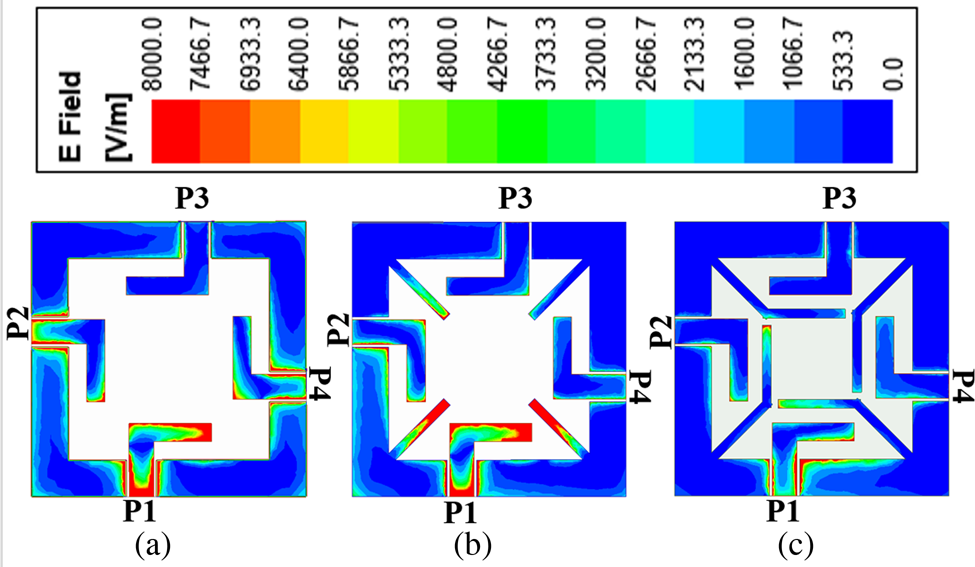
The isolation improvement among radiating elements of can be explained using electric-field distributions of the four-port ILW wearable MIMO antenna by excitation at port P1, as shown in Figs 4(a)–4(c). It can be observed from Fig. 4(a) that strong EM wave coupling between port P1 and ports P2, P3, and P4 has been reduced by extending four diagonal metallic strips from vertices of the square slot as shown in Fig. 4(b).
Simulated electric-field distributions of the proposed ILW wearable MIMO antenna at frequency 5.8 GHz: (a) stage 1, (b) stage 2, and (c) stage 3.

The isolation is further enhanced by modifying the diagonal metallic strips of stage 2 into a square split ring structure in the center of square slot as shown in Fig. 4(c). The electric-field distribution of Fig. 4(c) shows that the coupling between port P1 and other ports P2, P3, and P4 is greatly reduced and thus improves isolation significantly.
Results and discussion
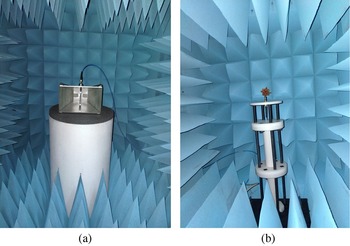
The Ansys HFSS (Version 16.2) simulation tool is used to design and simulate the proposed four-port ILW wearable MIMO antenna The Agilent E5071C network analyzer is used to measure the radiation performance of fabricated ILW wearable MIMO antenna as shown in Fig. 5.
Measurement setup for testing of the proposed ILW wearable MIMO antenna: (a) transmitting antenna (horn antenna) and (b) receiving antenna (fabricated prototype of the proposed ILW wearable MIMO antenna).

S-parameters and radiation pattern
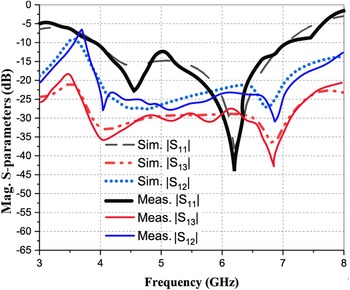
The reflection coefficient of an excited port of the proposed four-port ILW wearable MIMO antenna is measured while keeping other ports terminated with matched loads. The measured and simulated magnitude S-parameters (reflection/transmission coefficients) of the proposed four-port ILW wearable MIMO antenna are compared in Fig. 6. It is observed from Fig. 6 that the proposed ILW wearable MIMO antenna achieves simulated 10 dB RL BW of 58.18% (3.9–7.1 GHz) with excess of 30 dB isolation in the whole frequency band whereas measured 10 dB RL BW of 54.54% (4–7 GHz) with excess of 30 dB isolation in the entire frequency bands. It has been also observed from Fig. 6 that there are some variations among measured results and simulated ones at certain frequencies which may be due to fabrication inaccuracies and material uncertainties.
Comparison of measured and simulated magnitude S-parameters of the proposed ILW wearable MIMO antenna.

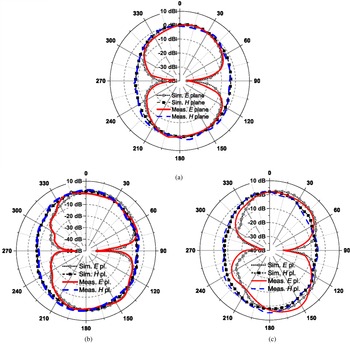
Figures 7(a)–7(c) illustrate the comparison of the simulated and measured radiation patterns (E and H planes) for radiating element 1 of the proposed ILW wearable MIMO antenna at different frequencies 4.5, 5.8, and 6.5 GHz, respectively. It can be observed from Fig. 7 that the copolar radiation of ILW wearable MIMO antenna excited by port P1 in the E-plane is bidirectional whereas its copolar radiation in the H-plane is nearly omnidirectional at all specified frequencies.
Comparison between measured and simulated radiation patterns of the proposed ILW wearable MIMO antenna at different frequencies: (a) 4.5 GHz, (b) 5.8 GHz, and (c) 6.5 GHz.

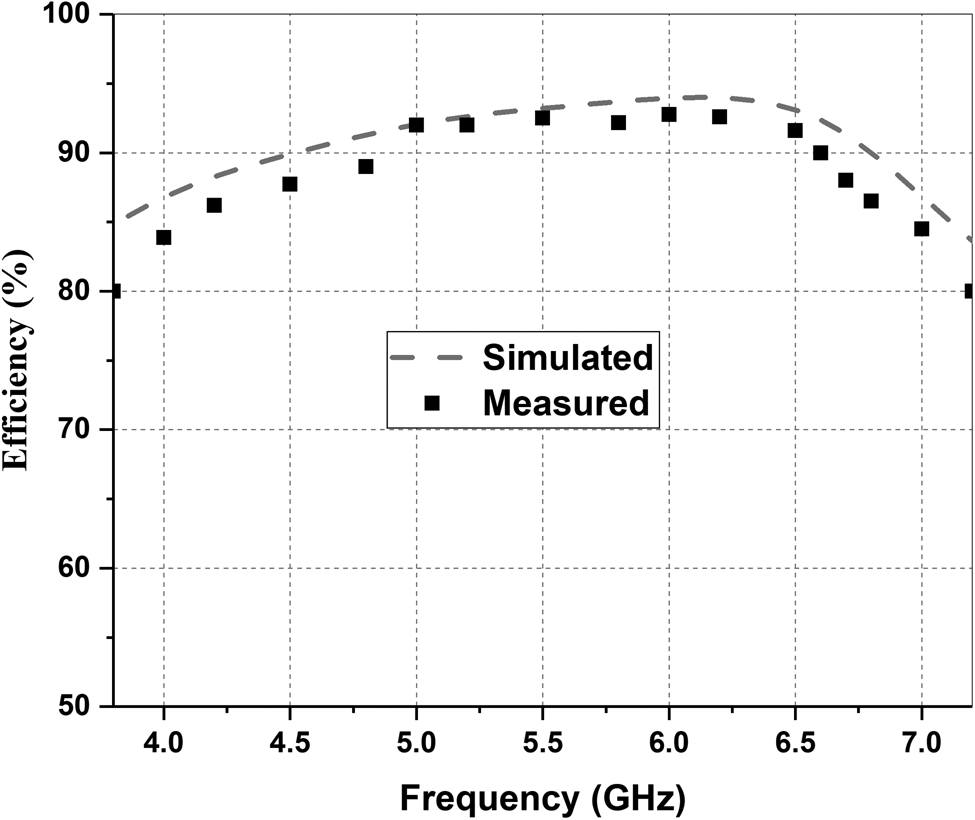
The peak absolute gain of the proposed antenna is 4.4 dBi and peak realized gain is 4 dBi and radiation efficiency of 93% at the frequency 5.8 GHz. Figure 8 shows the comparison of measured and simulated efficiency of the proposed ILW wearable MIMO antenna. It is observed from Fig. 8 that the measured and simulated radiation efficiencies of the proposed ILW wearable MIMO antenna are in excess of 85% in the entire operational band.
Comparison of measured and simulated efficiency of the proposed ILW wearable MIMO antenna.

The proposed ILW wearable MIMO antenna can also be used for high beam efficiency transmission requirements in which it is essential to enhance the power radiation to the maximum over an arbitrary zone of visible space in the presence of production conditions and constraint on the beam efficiency as discussed in [Reference Morabito, Lagana and Isernia9].
MIMO diversity performance
The study of the diversity performances in wearable MIMO antenna is critically important apart from its previously discussed radiation characteristics. The diversity performance of the proposed four-port ILW wearable MIMO antenna has been studied using two key parameters such as ECC and diversity gain (DG). The ECC estimates the amount of signal fading in view of correlation among different wireless communication channels.
The ECC is determined by equation (2) [Reference Sharma, Sarkar, Saurav and Srivastava6] using radiation method as mentioned below:

where FM(θ, ϕ) = radiation field of the proposed ILW wearable MIMO antenna at excited port M;
M = 1, 2, 3, 4, ….
The DG of wearable MIMO antenna is calculated using ECC by equation (3) [Reference Biswas and Chakraborty10] as given below:

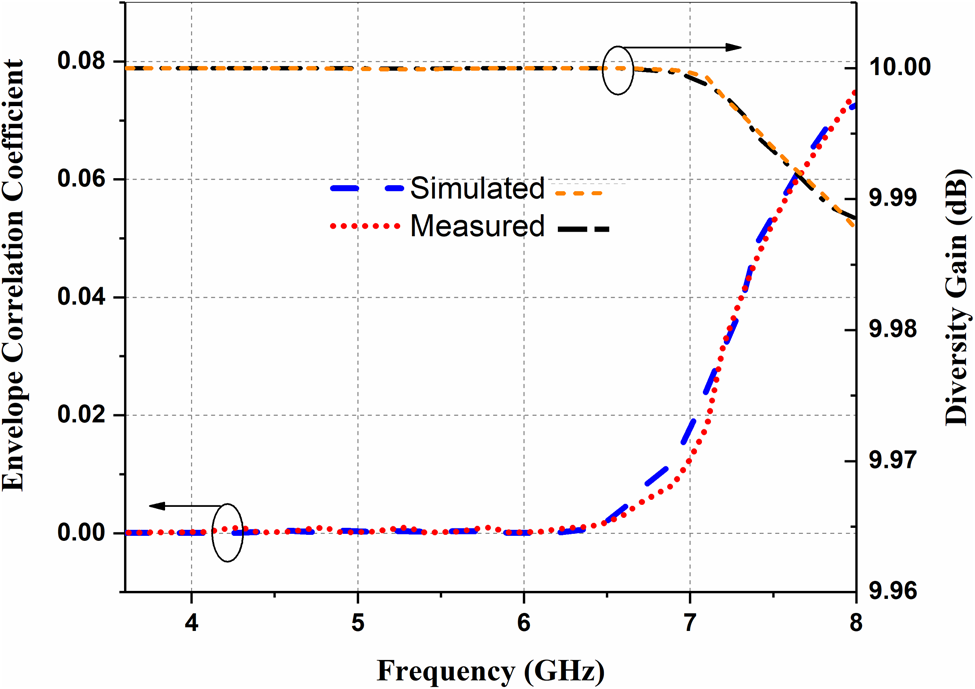
Figure 9 shows the good match between the measured and simulated ECC and DG parameters of the proposed ILW wearable MIMO antenna. It is clear from Fig. 9 that the value of ECC is significantly small (ECC <0.0002), whereas the DG is sufficiently high (DG >9.9) for the proposed ILW wearable MIMO antenna in the entire operational frequency band. This shows that the proposed ILW wearable antenna has good MIMO performance in the whole frequency band of operation.
Comparison of measured and simulated ECC and DG of the proposed ILW wearable MIMO antenna.

Table 1 illustrates the comparison of radiation characteristics of the proposed four-port ILW wearable MIMO antenna with other reference antennas. It is clear from Table 1 that the designed and fabricated ILW wearable MIMO antenna has compact and simple structure with wider BW, higher isolation, very low ECC, and better radiation performance for WBAN applications.
Comparison of radiation performance of the proposed ILW wearable MIMO antenna with reference antennas

Performance on human body
Human body loading
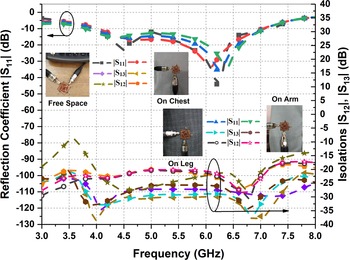
This section illustrates the performance of wearable MIMO antenna with human body WBAN applications. Therefore, the radiation characteristics of the fabricated four-port ILW wearable MIMO antenna have been measured and validated through experiments by placing the fabricated wearable MIMO antenna on various body parts such as arm, chest, and leg as depicted in the inset of Fig. 10.
Measured magnitude S-parameters of the proposed ILW wearable MIMO antenna on various portions of human body.

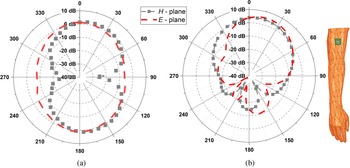
The measured magnitude S-parameters of the proposed ILW wearable MIMO antenna at different portions of human body are depicted in Fig. 10. While the proposed wearable MIMO antenna placed on chest, leg, and arm, it is observed from Fig. 10 that the RL BW remained unchanged as 54.54% (4–7 GHz) and the isolation was also in excess of 20 dB throughout the entire operational frequency band under all conditions. Figure 11 shows the radiation pattern of the proposed ILW wearable MIMO antenna in the presence and in the absence of the human body model. It seems from Fig. 11 that the radiation pattern of the proposed antenna is more directive in the presence of human body model.
Simulated radiation patterns of the proposed ILW wearable MIMO antenna at frequency 5.8 GHz: (a) without human body model and (b) with human body model.

SAR evaluation
The SAR evaluation for ISM band application is very useful to protect human body from harmful EM radiations. So, it is necessary to maintain low SAR throughout its operational band. The SAR is dependent on ρ (mass density in kg/m3), σ (conductivity in S/m), and E (electric-field intensity in V/m), given as below [Reference Mao, Vital, Werner, Wu and Bhardwaj14]:

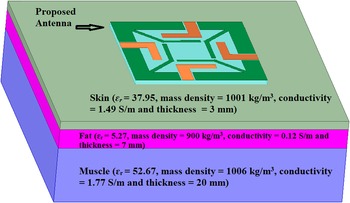
The proposed antenna with three-layer human tissue models [Reference Mao, Vital, Werner, Wu and Bhardwaj14] are shown in Fig. 12 for analyzing the SAR performance. The simulated SAR of the proposed ILW wearable MIMO antenna is 0.95 W/kg, which is significantly less than 1.6 W/kg (permissible SAR as per the FCC guideline). Therefore, the ILW wearable MIMO antenna is suitable for WBAN applications.
Proposed four-port ILW wearable MIMO antenna with a three-layered human tissue cubic model.

Conclusion
The compact wideband CPW-fed inverted-L-shaped wearable wide slot MIMO antenna has been designed, fabricated, tested, and presented. A square split ring structure with diagonal copper strips is employed for providing high degree of isolation between four ports. The proposed ILW MIMO antenna achieved a measured − 0 dB impedance BW of 54.54% (4–7 GHz) with more than 30 dB isolation along with a very small ECC <0.0002, high DG >9.9, and SAR <1.6 W/kg in the entire operational frequency band. This confirms that the proposed ILW wearable MIMO antenna is a good candidate for C-band/ISM band applications.
 Saurabh Singh received his B.Tech. degree in electronics & communication engineering from UPTU in 2009, his M.Tech. degree in digital communication from the AKTU in 2017, and his Ph.D. degree in electronics & communication engineering in 2022 from Madan Mohan Malaviya University of Technology, Gorakhpur, Uttar Pradesh, India. In 2017, he was a guest faculty in ECE Department of Ambedkar Institute of Technology for Handicapped College, Kanpur. He is the author of three book chapter, nine international conference papers, and five articles published in peer reviewed journals. His research interest is to design a simple and compact antenna for WBAN applications with good radiation characteristics such as wide bandwidth, wide ARBW, high gain, and suitable for human body.
 Sudhanshu Verma received his M.E. degree in electronics & communication engineering in 2009 from the Birla Institute of Technology, Ranchi, India and his Ph.D. degree in electrical engineering in 2014 from the Indian Institute of Technology, Patna, India. He is currently an assistant professor with Department of Electronics and Communication Engineering, Madan Mohan Malaviya University of Technology, Gorakhpur, India. He has published more than 50 research papers in international conferences and 11 research articles in peer reviewed journals. His main interests include analysis and design of microstrip filters, reconfigurable antennas and small antennas for mobile communications, analysis of the interaction between electromagnetic fields and the human body by use of numerical and experimental phantoms and development of conformable and flexible antennas for medical applications such as for cancer treatment.