Introduction
Triple negative breast cancer (TNBC) lacks oestrogen receptors (ER), progesterone receptors (PR) and human epidermal growth factor receptor (HER-2/neu).Reference Dent, Trudeau and Pritchard1–Reference Livasy, Karaca and Nanda3 Of the global breast cancer burden, it has been estimated that ∼170,000 are TNBC and risk of death is twice compared with non-TNBC patients.Reference Foulkes, Smith and Reis-Filho4 TNBC have distinct and aggressive clinical and pathological features such as onset at early age, advanced stage at diagnosis, higher frequency of unfavourable histopathology, higher nucleic grade, higher mitotic index, lack of tubule formation and increased incidence of distant reccurences.Reference Cleator, Heller and Coombes5–Reference Diaz, Cryns, Symmans and Sneige9 It also has higher rate of local relapse; higher reccurrence rate between the first and third year after treatmentReference Diaz, Cryns, Symmans and Sneige9 and a higher rate of 5-year mortality.Reference Patil, Singhai and Patil11 TNBC patients have significantly shorter survival period following first metastasis as compared with the non-TNBC patients.Reference Longacre and Bartow12, Reference Rodriguez-Pinilla, Sarrio and Honrado13 Therefore despite its small proportion among all breast cancer patients, it accounts for a disproportionate number of deaths due to its aggressiveness. It is a serious clinical problem because of its aggressive behaviour and its relatively poor prognosis. In TNBC, no benefit can be derived from endocrine therapy and targeted therapies like trastuzumab thus leaving cytotoxic chemotherapy as the sole treatment option.Reference Liedtke, Mazouni and Hess14–Reference Garber, Richardson and Harris19 So there is a need to find new markers which can be targeted for treatment of TNBC.
TNBC in itself is a highly diverse group of breast cancer and according to a recent studyReference Perou, Sørlie and Eisen10 it has been further subclassified into six subgroups based upon the gene expression profiling and genetic ontologies. These are BL-1 (basal like)—is a highly proliferative type, BL-2 associated with higher expression of epidermal growth factor receptor; IM subtype (Immunomodulatory): enriched with immune cell responses and have good prognosis; M and MSL subtype (Mesenchymal and Mesenchymal stem like)—enriched in growth factor receptor pathways and LAR subtype (Luminal Androgen Receptor): characterised by androgen receptor (AR) signalling associated with early relapse.
Cancer antigen (CA 15.3) is a glycoprotein, which has long been investigated in breast cancer is a prognostic marker. Many studies have correlated these two markers with disease characteristics and prognosis in breast cancer.Reference Duffy, Duggan and Keane20 Vascular endothelial growth factor (VEGF-A) is an important mitogen that plays a significant role in angiogenesis. It is a prognostic marker for metastases and is a target for bevacizumab in treatment of TNBC.Reference Taha, Zeeneldin and Amani21 So the justification of their inclusion in the study was on the basis of easily measurable serum expression and their proven role in breast cancer. TNBC patients have higher rates of locoregional recurrence after adjuvant radiation as compared with similar stages of ER-positive patients. The interest was to see whether their serum levels correlates with disease characteristics in two subtypes of breast cancer patients. Therefore the present study investigated the serum expression of VEGF-A and CA 15.3 in TNBC and non-TNBC patients and their correlation with age of patient, tumour size and stage of the disease.
Materials and methods
A prospective pilot study was conducted in the Department of Radiotherapy and Oncology, in association with the Department of Biochemistry, Government Medical College and Hospital, Chandigarh and Department of Pharmaceutical Sciences and Drug Research, Punjabi University, Patiala. The inclusion of patients in the study was done from radiotherapy and surgery outpatient department. Clinical assessment of eligible patients was carried out at the time of diagnosis. The study was performed in accordance with the declaration of Helsinki and the code of Good Clinical Practice. Written informed consent was taken from all patients who agreed to participate after a full explanation of the study.
All the recruited patients were assessed for eligibility of inclusion/exclusion criteria. Inclusion criteria were, newly diagnosed and histologically confirmed breast cancer patients aged 18 years or more, normal blood counts with normal liver and kidney functions and no prior chemotherapy or hormonal therapy. Exclusion criteria were exposure to any chemotherapy or hormone therapy, carcinoma in situ (stage 0), pregnant/lactating females, severe or uncontrollable comorbid disease and second malignancy.
The study was conducted on 70 newly diagnosed breast cancer patients from May 2010 to July 2011 divided into two groups—all the patients who were confirmed to be ER, PR and HER-2/neu negative from histopathological reports and thus said to have TNBC were taken in the study arm. Patients who were confirmed with the positivity of either of ER, PR or HER-2/neu receptors and thus said to have non-TNBC were taken as the control arm.
Evaluation of markers
Once the patient was ascertained to fit into the inclusion criteria, a blood sample of 5 ml was collected under sterile conditions, centrifuged and the resulting serum was stored at −20°C till sample collection of all patients was done. Once the serum collection was over the samples were subjected to evaluation of both the biomarkers, CA 15.3 and VEGF, which was enzyme-linked immunosorbent assay (ELISA) based. The marker evaluation was only done at the baseline levels (at diagnosis, before any treatment) and the immunoassays were performed in duplicate.
CA 15.3
The detection and evaluation of the biomarker in serum was done by the use of ADVIA Centaur CP system (Seimens Healthcare, Erlangen, Germany), a fully automatic chemiluminiscent immunoassay reader based on two-step sandwich immunoassay method, using direct chemiluminiscent technology.
It utilised ADVIA Centaur calibration and reagent packs containing monoclonal antibody DF3; specific for CA 15.3, labelled with acridinium ester and monoclonal antibody 115D8 specific for CA 15.3 labelled with flouroscein. The serum levels of CA 15.3 > 30 U/ml were considered to be higher.Reference Garber, Richardson and Harris19
VEGF
Evaluation was done by using serum ELISA kit from Ray Biotech Inc., USA (Cat# ELH-VEGF-001) for estimation of the tumour marker by sandwich Elisa method, which is in vitro ELISA for the quantitative analysis of VEGF in human serum. VEGF present in the samples was bound to the wells by immobilised antibody. The wells were washed and the biotinylated antibody, HRP-conjugated streptavidin was pipette to the wells. The wells were again washed, TMB substrate solution was added to the wells and colour developed in proportion to the VEGF present. The stop solution changes the colour from blue to yellow and the intensity is measured at 450 nm. Only the baseline values of the tumour markers were taken. In this study as the control group was also a cancer subtype; so this group too would be associated with elevated marker levels, therefore in correspondence to 180 pg/mlReference Duffy, Duggan and Keane20 (the value for VEGF in normal individuals) the VEGF levels >400 pg/mlReference Duffy, Duggan and Keane20 were considered to be higher.
Statistical analysis
The marker levels were correlated to the clinical characteristics of the disease, i.e. age of the patient, tumour size and stage of the disease as well as a comparison was done between TNBC and non-TNBC patients. Spearman's test was used to find the correlation. p-Value of ≤0.05 was taken as significant.
Results
Patient characteristics
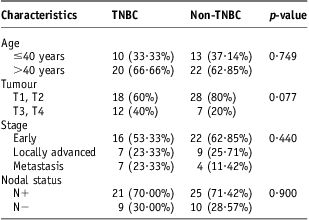
The patient clinical and pathological characteristics for both the TNBC and non-TNBC groups were as shown in Table 1. Total 65 patients met the inclusion criteria, 30 in TNBC and 35 in non-TNBC group. Five patients were excluded because they had received prior chemotherapy. In all, roughly 2/3rd of the patients were aged >40 years, had early stage disease with tumour size 2–5 cm and positive nodal status. TNBC patients had double the chances of higher tumour stage (T3, T4) and distant metastasis rate as compared with non-TNBC group.
Clinical and pathological characteristics of the patients
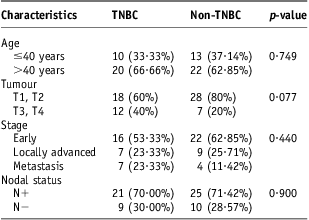
Notes: The p-value < 0.05 would have been considered significant. But none of the disease characteristic shows significance.
Abbreviation: TNBC, triple negative breast cancer.
Expression of VEGF in TNBC and non-TNBC subgroups
There was a marked difference in expression of marker VEGF between the two arms of patients. TNBC group had a higher number of patients with elevated values of VEGF marker as compared with the non-TNBC group. VEGF levels were found to be higher than 400 pg/ml in 27 patients, 19 (54·33%) of them were TNBC and only 8 (22·87%) non-TNBC. Mean values of the marker in the two groups were 784·34 pg/ml in TNBC versus 334·60 pg/ml in non-TNBC patients, respectively.
Expression of CA 15.3 in TNBC and non-TNBC subgroups
The CA 15.3 levels were higher in non-TNBC group rather than in TNBC patients (60·720 U/ml versus 45·243 U/ml), though the difference was not as marked as the VEGF levels.
Correlation between marker levels and variables:
Correlation irrespective of the group (TNBC and non-TNBC)
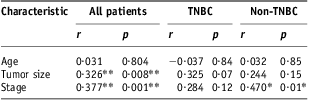
Bivariate correlation analysis was used to find correlation between serum marker values (CA 15.3 and VEGF) and variables such as and patient's age, tumour size and stage of the disease. Significant correlation was found between serum CA 15.3 levels and tumour size (r = 0·326, p = 0·008) and stage of the disease (r = 0·377, p = 0·001), but not with age of the patient (Table 2). The correlation was irrespective of two groups TNBC or non-TNBC. While no significant correlation could be established between serum VEGF levels and clinical characteristics.
Correlation between CA 15.3 levels and the clinical characteristics
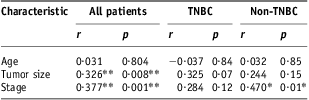
Notes: Where r is the Spearman's coefficient, p is significance value, * and ** refers to significant correlation at p < 0·05 and p < 0·01 level, respectively.
Abbreviation: TNBC, triple negative breast cancer.
Correlation with respect to TNBC and non-TNBC subgroups
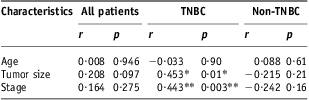
Correlation in non-TNBC subgroup: as shown in Table 2, significant correlation was seen between CA 15.3 biomarker values and stage of the disease, (r = 0·470, p = 0·01) but not with tumour size (r = 0·244, p = 0·15) and patient's age (r = 0·032, p = 0·85). However, in case of VEGF no correlation with the clinical characteristics was seen (Table 3).
Correlation between VEGF levels and the clinical characteristics
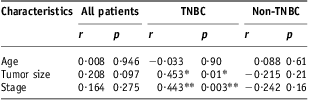
Notes: Where r is the Spearman's coefficient, p is significance value, * and ** refers to significant correlation at p < 0·05 and p < 0·01 level, respectively.
Abbreviation: TNBC, triple negative breast cancer.
Correlation values in TNBC subgroup: there was no correlation between CA 15.3 marker levels and any of the clinical characteristics in TNBC patients. VEGF marker showed significant correlation with both tumour size (r = 0·453, p = 0·01) and stage of the disease (r = 0·443, p = 0·003) but not with age in TNBC patients (Tables 2 and 3).
Discussion
Tumour markers have long been used for the characterisation of breast cancer, as predictive parameters for response to chemotherapy and also as prognostic factors. VEGF and CA 15.3 have also been used for the same in many of the previous studiesReference Duffy, Duggan and Keane20–Reference Heer, Kumar and Speirs23 and proven that serum VEGF levels were found to be higher in breast cancer patients as compared with the controls. But when the levels of VEGF were studied in patients with early breast cancer as compared with the controlsReference Derya, Hakan, Hilal, Duygu and Vidan24 the results signified a newer finding, mean serum VEGF concentration in patients compared with the controls was not significantly different. In a similar study by Linderholm et al.Reference Linderholm, Helborg and Johansson25 that compared tumour levels of VEGF in TNBC versus non-TNBC, a marked difference in the levels in terms of median values (8·2 pg/μg of DNA in TNBC versus 2·8 pg/μg of DNA in non-TNBC) was reported. Our study also serum levels of VEGF were higher in TNBC versus non-TNBC patients (784·340 pg/ml versus 334·360 pg/ml). The same trend was shown in terms of patient number (54·33% of the TNBC patients showed elevated VEGF levels as compared with 22·87% of non-TNBC). In a study by Fatma et al.,Reference Taha, Zeeneldin and Amani21 the value of serum VEGF in patients with metastatic TNBC in response to chemotherapy was explored and it was seen that patients whose disease progressed despite therapy had a significantly higher baseline VEGF levels.
VEGF is secreted by the tumour cells as well as activated platelets. In the present study, VEGF was measured from the serum. The debate is still going on whether serum or plasma VEGF should be used as a marker of tumour progression and prognosis.Reference Linderholm, Helborg and Johansson25 Some studies showed that platelet-poor plasma reflects more accurate tumour progressionReference Verheul and Pinedo26 whereas others found that serum VEGF gives a better indication of tumour progression.Reference Wynendaele, Derua and Hoylaerts27
CA 15.3 is a specific biomarker for breast cancer proven in many studies. This prompted its inclusion in the current study to see whether it will hold true for TNBC subgroup also. It has been seen that high pre/post operative concentration of CA 15.3 is associated with worst outcome in terms of disease-free survival (DFS) and overall survival (OS).Reference Duffy, Duggan and Keane20 CA 15.3 levels >30 U/L were associated with significantly shorter OS. The marker levels have been well related to the tumour size and stage of the disease. Higher pre-operative levels of the marker are associated with larger tumour size, nodal involvement and higher stage.Reference Duffy, Duggan and Keane20, Reference Park, Oh and Kim29, Reference Martin, Corte and Alvarez30 As the stage of the disease increased, CA 15.3 also increased.Reference Velaiutham, Taib, Ng, Yoong and Yip31, Reference Agrawal, Jelen and Rudnicki32 In our study also CA 15.3 levels showed a direct correlation with both tumour size (p = 0·008) and stage of the disease (p = 0·001) in all patients.
In a study, Berruti et al.Reference Berruti, Tampelllini and Torta33 reported that patients with CA 15.3 values <30 kU/L at the time of first recurrence survived significantly longer than those with higher concentrations. It was seen that 67% of patients showed elevated CA 15.3 levels either before or at time of recurrence. Higher values of CA 15.3 are also associated with metastatic disease. Further a study confirmed that higher marker levels were associated with decreased probability of DFS.Reference Laessig, Nagel and Heinemann34 In a study by Park et al.,Reference Park, Oh and Kim29 it was evident that at first point of metastasis CA 15.3 levels were found to be above 95th percentile of healthy individuals in 71·8% of the patients. Similar trend was seen in the current study, marker level elevation was directly related to the metastatic status of the disease. This results holds valid for the presence and absence of metastasis and not the nature of metastasis (whether visceral or bone). Therefore CA 15.3 can be used a marker of metastatic burden in breast cancer.
Only few studies have evaluated the serum VEGF levels in TNBC patient,Reference Ferrero, Nicoletti and Ragni35 but this is the only study that estimated simultaneously serum VEGF and CA 15.3 levels together in TNBC and non-TNBC patients. Our study also suggests that CA 15.3 may be of little relevance in TNBC. In addition, it also explored the correlation of the markers with the disease variables like tumour size, stage and metastasis. It was observed that when the markers were evaluated for correlation irrespective of the receptor status; CA15.3 showed a direct correlation with both the tumour size and stage of the disease (p = 0·001 and 0·008, respectively) while VEGF showed correlation with none (Table 2). However, when the correlation was studied with respect to two subgroups, i.e. TNBC and non-TNBC; there was no positive correlation between CA 15.3 marker levels and clinical characteristics in TNBC patients but VEGF had significant correlation with both tumour size (p = 0·003, Figure 1) and stage of the disease (p = 0·01, Figure 2) respectively (Table 3).
Correlation between VEGF levels and tumour size in case of TNBC patients.
Abbreviations: VEGF, vascular endothelial growth factor; TNBC, triple negative breast cancer.

Correlation between VEGF levels and stage of the disease in case of TNBC patients.
Abbreviations: VEGF, vascular endothelial growth factor; TNBC, triple negative breast cancer.
The uniqueness of this study lies in the finding that VEGF may be a good marker for tumour size and metastasis in TNBC as compared with CA 15.3. It will need further research to see whether VEGF levels can be linked to specific metastatic sites in TNBC patients. Also, the increased VEGF levels were present in double the number of TNBC than non-TNBC patients; hence, it may support the hypothesis that VEGF may be responsible for aggressiveness of TNBC and thus needs further evaluation. This has also suggested that anti VEGF agents can be used for TNBC treatment. The VEGF pathway can be targeted therapeutically at various molecular levels. Currently two major concepts are studied in the clinical setting: blocking VEGF from binding to its extracellular receptors with VEGF antagonists (antibodies, VEGF-Trap) or inhibiting VEGF signalling with tyrosine kinase inhibitors.Reference Inai, Mancuso and Hashizume36 An important agent bevacizumab is a recombinant humanised monoclonal antibody targeted against VEGF.Reference Berruti, Tampelllini and Torta33, Reference Diaz, Cryns, Symmans and Sneige38 A study by Miller et al.,Reference Miller, Wang and Gralow39 revealed an increase response rates and OS with the addition of bevacizumab to conventional paclitaxel therapy in TNBC patients.
There are some limitations of this study. Limited the sample size; especially when subgroups were considered individually limited follow-up of the study. This may have led to false negative results as in case of comparison of tumour size between the two groups (Table 1) (p = 0·07) and also in case of correlation of CA 15.3 levels with tumour size in TNBC patients (Table 2) (p = 0·07). Here a slight increase in the sample size would have led to significant results in both cases. Therefore some of the non-significant results may be attributed to type II error. Also women in this study are only from one geographical location, it has been seen that incidence of TNBC varies with ethnicity. However, there is no reason to believe that these results would not apply to other patients with breast cancer. Despite the limitations this study has several strengths. It has focused on the characterisation of TNBC patients as compared with non-TNBC ones in terms of their difference in clinical characteristics, and their correlation with marker levels. Further our study also lacks information on impact of various treatments such as radiation and chemotherapy on DFS and OS due to baseline nature of the study.
Future directions
Breast cancer is a heterogeneous disease. Molecular studies are going on to further characterise this disease to find out new targets for its treatment. A recent approach to anti-VEGF therapy currently in its initial stage of evaluation is genetically engineered fusion proteins that function as molecular ‘traps’ for VEGF. Aflibercept (VEGF-Trap, Regeneron Pharmaceuticals Inc., New York, USA) is a recombinant fusion protein that binds both VEGF and placental growth factor with high affinity. It is composed of the extracellular domains of VEGFR1 and VEGFR2 that are fused to the Fc region of human IgG (VEGF-Trap—regeneron). VEGF levels are somehow linked to aggressiveness of TNBC, VEGF traps may prove as one of the targeted therapies for TNBC. Currently, there are more than 40 ongoing trials (http://clinicaltrials.gov/) that explore this therapy in solid and haematologic malignancies. Further research is needed to see whether VEGF levels can be linked to specific metastatic sites in TNBC patients.
Conclusion
The present study reveals that VEGF may be a better biomarker as compared with CA 15.3 in TNBC, as a direct correlation was seen between VEGF levels and tumour size as well as stage of the disease, but no such correlation was seen in case of CA 15.3 levels with these clinical characteristics. Also the expression profile of VEGF was high in TNBC rather than non-TNBC patients.
Acknowledgements
This study was supported by staff and management members of Government Medical college and hospital, Chandigarh and Post Graduate Institute of Medical Sciences and Research, Chandigarh, India.
Conflict of interest
None.