Introduction
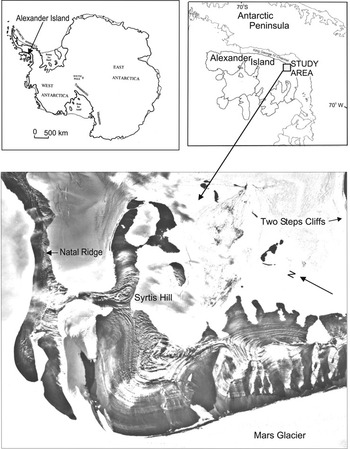
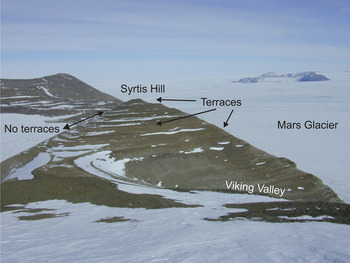
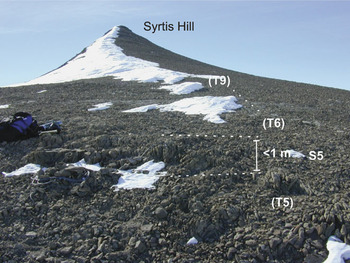
Landforms with the characteristics of cryoplanation terraces (or any of the other terms used for these same forms - see Hall Reference Hall1998, p. 5) abound on the nunataks of Alexander Island in the area of Two Steps Cliffs–Natal Ridge (Fig. 1). The forms observed on Alexander Island appear to be typical of what Reger (Reference Reger1975, p. 11) refers to as “hillside type” cryoplanation terraces. The term ‘cryoplanation’ was first introduced by Bryan (Reference Bryan1946) and was “…centred upon conceptual clarification embracing etymological niceties” (Thorn & Hall Reference Thorn and Hall2002, p. 542), but has, in reality, served more to confuse than enlighten. In essence, the term is used to describe bedrock benches, usually in sequence one above another upon a mountain (Fig. 2), found within cold (or previously cold) environments associated with permafrost and deemed to be formed by freeze-thaw weathering on the risers and various forms of mass movement on the treads (see definition by Van Everdingen Reference van Everdingen1998). The key to the ‘confusion’ alluded to above is the almost complete absence of actual data from active cryoplanation terraces. Rather, the concept is based almost entirely on unequivocal field observation of the existence of such “forms” coupled with unsubstantiated conjecture (see Priesnitz Reference Priesnitz1988). To further add to this confusion, in much of the literature cryoplanation is inexorably linked with the concept of nivation (Thorn & Hall Reference Thorn and Hall1980). Since it is difficult to know where one process group ends and the other begins, Hall (Reference Hall1998) has suggested that nivation and cryoplanation may be two ‘end points’ of the same process-landform suite. A broad-based discussion regarding both nivation and cryoplanation can be found in Thorn & Hall (Reference Thorn and Hall2002). As noted in Hall (Reference Hall1997a), there are few references to cryoplanation in Antarctica which is surprising considering the apparent climatic suitability of the region. Antarctica may provide one of the few contemporary regions where cryoplanation is active, and thus it becomes an important study area with respect to better understanding what processes are (and are not) associated with this enigmatic landform. This consideration of process is considered by some (e.g. Nelson Reference Nelson1998, p. 149) as one of the approaches required to better understand cryoplanation terraces. The information presented here builds upon that described by Hall (Reference Hall1997a) in which the terraces of Alexander Island were first described and some data regarding weathering processes presented.
Location of the study area (from an aerial photograph).

General view across to Syrtis Hill showing the spatial distribution of terraces.

Study area
As in the earlier study (Hall Reference Hall1997a), the investigations were carried out along the north-eastern side of the Mars Glacier at the southern end of Alexander Island (71°50′S, 68°21′W) in the Natal Ridge to Two Steps Cliff area (Fig. 1). This is a region that experiences a cold, dry continental-type climate, with continuous permafrost and an active layer thickness of 0.3–0.4 m (Hall Reference Hall1997a) in the ice free areas. Available data indicate summer and winter mean air temperatures in the order of -2°C and -11°C respectively, with a winter minimum around -35°C and a summer high of +6°C (Hall Reference Hall1997a, Reference Hall1997b). Rock temperatures (Hall Reference Hall1997a, Reference Hall1997b) show significantly higher summer values but winter temperatures are comparable to those of the air, remaining sub-zero for the whole winter period. The geology of the study area consists of argillaceous sedimentary rocks, sandstones, mudstones, and conglomerates that are near-horizontally bedded (Taylor et al. Reference Taylor, Thomson and Willey1979), there being a 7° dip to the north over much of the area (Fox, personal communication 1999). Two sandstones dominate the terraces in this region - a light-coloured sandstone that weathers to rounded forms and a dark-coloured sandstone that weathers to angular forms (Hall Reference Hall1997b). Earlier weathering studies (Hall Reference Hall1997b) indicated that there was evidence for extensive weathering activity on the northern and western aspects of nunataks but that the weathering on east and south aspects was more limited. This weathering difference was also reflected in the cross-profile of the valleys, as they exhibit a marked asymmetry (Siegmund & Hall Reference Siegmund and Hall2000), with south-facing slopes being much steeper (58°) than the north-facing (30°). The benches observed in this area (Fig. 2) show a distinct aspect preference (Hall Reference Hall1997a, Fig. 3) with none occurring in the north-east through east and south to the south-west sector, while benches occur from south-west through west and north to the north-east; the greatest bench extent is in the north to north-west sector. The nunataks here were ice covered during the last glacial maximum by ice that was centred on Alexander Island (Sugden & Clapperton Reference Sugden and Clapperton1978). More detail on this area, its history, landforms and the glacial impact can be found in Hall (Reference Hall1997a, Reference Hall1997b), Siegmund & Hall (Reference Siegmund and Hall2000), Hall & André (Reference Hall and André2001), and André & Hall (Reference André and Hall2005).
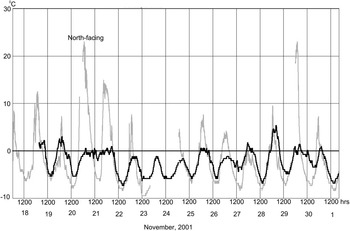
Rock surface temperatures for dark sandstone risers. The darker line is from a south-facing riser and the lighter line from a north-facing riser.

Methods
Thermal data were collected from a number of points on several terraces from November–December 2001 and build on previous data for the same rocks over longer time periods (Hall Reference Hall1997b). All data were collected at high-frequency (1 min or 20 sec intervals) and with a wide spatial distribution in order to extract as much information from the available time as possible for the north and south aspects for both the light and dark sandstones, plus for both sandstones on a sub-horizontal surface. The data were collected from within the ‘weathering active’ window of the year - late spring to early autumn - when any weathering, particularly water-based weathering, should be at its optimum and rock temperatures follow daily radiation patterns (r2 = +0.84: Hall Reference Hall1997a). The aim here was to monitor thermal conditions on the aspect that exhibited terrace development (north) and that (south) that did not (Hall Reference Hall1997a, Fig. 3). Data were also obtained from a sub-horizontal exposure of bedrock (on the top of a nunatak) with thermal contraction polygons, and from a nunatak top sub-horizontal exposure of the two main sandstone types. All thermal data were collected using type-T thermocouples connected to ACR 12-bit data loggers giving a resolution of 0.4°C. To facilitate comparison, the thermal data presented here are all from the surface of the rock and, on the risers, at a height of c. 10 cm above the base of the riser. Thermocouples were attached to the rock surface, in firm contact with the rock, and then covered with a layer of sandstone grains from that rock to ensure albedo was the same as the host rock. Relative humidity data were collected at 10 min intervals from the nunatak top with a resolution of ± 0.4%, an accuracy of +/- 4%, and a response time of 5 min; an internal thermistor is used by the logger for air temperature correction. X-ray diffraction (XRD) and porosimetry analyses were undertaken on two samples from each of the two dominant sandstone types. Field measurements were also made of maximum terrace widths and riser heights, as well as of joint spacing, and bedding plane spacing on the terraces, and how these varied with lithology.
Observations
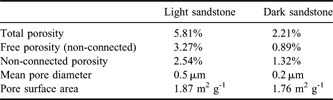
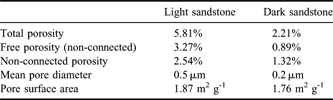
Porosimetry data for the two sandstones (based on two samples from each sandstone) are shown in Table I, where it can be seen that the lighter sandstone has a higher porosity (5.81% compared to 2.21%) and larger pore sizes (0.5 μm compared to 0.2 μm) as compared to the dark sandstone. XRD analyses failed to show any evidence of chemical weathering of the sandstone. Salt efflorescences, found on some of the sandstones, were composed of gypsum. Petrographic analyses of the sandstones indicate the light-coloured variety is comprised of quartz, plagioclase, microline and biotite. The dark sandstone is very rich in quartz and biotite, and more rich in biotite than the light-coloured sandstone, but with limited plagioclase and muscovite.
Porosimetry data for the two sandstones.
Perhaps one of the most significant observations from the record period is that none of the data indicate the occurrence of either an exotherm or a zero curtain, which would be indicative of water freezing within the rock despite rock temperatures frequently being within the range (-4° to -7°C) where freezing of interstitial water might be expected to occur. Thus for the record period, the height of summer when snowmelt could be expected (and thus water made available), there is no data-based indication of freeze-thaw, or indeed any water-based weathering process, taking place. Data for the north- and south-facing risers of the dark sandstone (Fig. 3) show the marked difference in temperatures for this period, with the south-facing barely rising above 0°C, with a maximum around +5°C, while that for the north reaches the mid-20°C’s and is commonly above +5°C. Interestingly, and argued to be as a result the latitude and time of year, the south-facing terraces are warmer than the north at ‘night’ (this being a period of 24 hrs of daylight) thereby giving the north-facing terraces the larger diurnal thermal variation during this record period. Thus, were water present, then it would have been the equatorward terraces that would have experienced the lowest, and thus most effective, freeze temperatures. In a number of instances (Fig. 3), the north-facing terraces were noticeably colder than the south-facing (e.g. -8°C compared to -4°C on 27 November). So, although the data are indeed time-limited, they were collected from a period when climatic evidence indicates freeze-thaw weathering should be active.
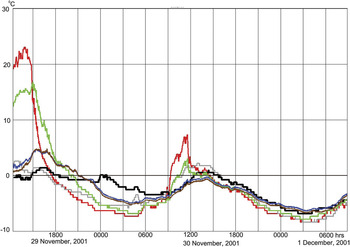
Thermal data from the rock surfaces (Fig. 4) show the north-facing dark sandstone to have the highest temperatures (up to +23°C; air maximum = +2.5°C) while the north-facing light-coloured sandstone reaches +17°C, indicating the influence of albedo. The south-facing dark sandstone was -1°C at the same time as the peaks (+23°C/+17°C) cited above for the north-facing exposures. The sub-horizontal surface has both the light and dark sandstones within 1°C of each other and, at the time of the north-facing peaks, attaining temperatures of ∼4°C indicating the influence of slope on radiation receipt. Air temperatures through this period (29 November) were between +3°C and +0.5°C. Data for 30 November (Fig. 4), when there were decreased radiation receipts due to cloud cover, show that the north-facing dark sandstone still is the warmest (+7°C) while the light-coloured sandstone and the air are in close agreement (c. +2 to +3°C) and the sub-horizontal and the south-facing exposures remain sub-zero (c. -2°C). The overcast ‘night-time’ temperatures (1 December) show all of the exposures within a 2°C range (-8°C to -6°C: air = -8.4°C) of each other and thus in close agreement. While there must be some degree of site-to-site variability that is the product of experimental error relating to sensor contact, orientation, etc. not being absolutely identical at each point, nevertheless the broad picture remains and any error must be within the 2°C window measured for the overcast ‘night’ during which there would have been a close proximity of rock surface values. Three thermal conditions not identified from the data shown are: 1) exotherms (the release of latent heat as water turns to ice), or 2) zero curtains (both indicative of water freezing), and 3) ΔT/Δt events of ⩾2°C min-1 indicative of thermal shock on the sunny day. What the north-facing data do show, though, are multiple replications of thermal variability in the range of ±1°C min-1 that would be conducive to thermal stress at the grain scale leading to granular disintegration.
Rock surface thermal data to show the variability as a function of aspect, slope and rock type. Red line is a north-facing dark sandstone riser, green line is a north-facing light sandstone riser, grey is a south-facing dark sandstone riser, blue is a horizontal dark sandstone surface, brown is a horizontal light sand stone surface, and black is the air temperature.

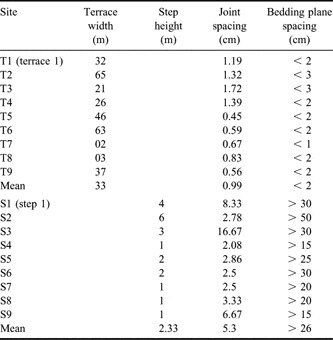
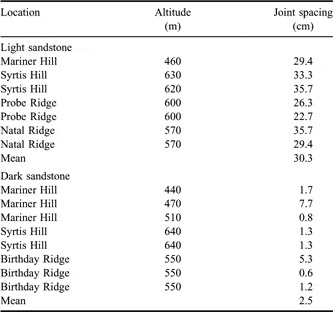
Data were collected regarding terrace width and terrace riser height (as measured at the maximum development), together with joint and bedding plane spacing (measured along the whole width of the terrace) associated with each terrace (Table II). In addition, more general (i.e. not specific to a terrace) information on bedrock jointing for the light and dark sandstones was collected from various sites in the area (Table III). The joint spacing measurements (100 per sample) were immediately transferred to mean values in the field and so the standard deviations are not available; visual observation suggested little variation. The most noticeable overall difference between the dark and light sandstones (Table III) is the significantly larger number of joints per metre for the dark sandstone (mean = 77 m-1) and the closeness of the average joint spacing (mean = 30.37 cm) when compared to the light-coloured sandstone (3.4 m-1 and 2.49 cm respectively). The terraces themselves have the same basic joints m-1 and joint spacing differentials where the two types of sandstone outcrop and these attributes may be significant with respect to terrace development.
Terrace dimensions (maximum step height and width) and details of spacing for jointing and bedding on each terrace.

Joint spacing for the light and dark sandstones.

Discussion
Coupled with the previous observations regarding the distribution of terraces (Hall Reference Hall1997a), the resulting data and observations presented here show that weathering on the southern aspect must be highly limited (as evidenced by the absence of terrace development and limited debris production) and that weathering and transport must be active on the north-facing slopes where terraces are found. Contemporary weathering and transport processes appear to be water limited and the available thermal data provide no evidence for freeze-thaw weathering or thermal shock. The most enigmatic question remaining is that of the timing and mechanism(s) for debris removal.
Given the sub-horizontal nature and 360° exposure of the bedrock the very specific orientational preference observed here (Hall Reference Hall1997a) is thought to be significant. Terrace orientation is considered an important parameter and suggestions as to how the orientation should be defined (and measured) have been presented (Nelson Reference Nelson1998). As the terraces on Alexander Island are what Nelson (Reference Nelson1998, p. 148) terms the “plan curvature” type, so the data presented in fig. 3 of Hall (1997a) represent the orientation of maximum development. However, as noted by Hall (Reference Hall1997a, p. 183), because it is possible to follow the lithological junction along which any given terrace has developed through the full 360° exposure around the nunataks, the observation that the terraces “are less well developed or….phase out towards the south and southeast” remains, it is believed, valuable information. Thus, whatever the processes of weathering and/or transport, as expressed by the development of the terraces, they are at their optimum in the north to west sector and become more limited towards the east and south. Indeed, at the local scale, the availability of such circular information would seem more valuable than the (more appropriate to larger scale evaluations) vector means used by Nelson (Reference Nelson1998, p. 138) as it provides a valuable insight into processes.
The available thermal data clearly indicate that there is, at least for the record period, limited facility for weathering on the southern aspect - as is also self-evident by the absence of any terrace development or significant debris production for that sector (Fig. 5). This absence of terrace development also indicates that weathering activity on this aspect cannot be greater at other times in the year or the landform differential would not be as large as it is. This preferential equator-facing distribution is important as Reger (Reference Reger1975, p. 109) and Reger & Péwé, (Reference Reger and Péwé1976, p. 103) suggest that in interior Alaska, “where clear to partly cloudy days are common” the terraces face towards to pole (i.e. north) “away from the summer afternoon sun”. In the west of Alaska, where there is more cloud cover, so Reger (Reference Reger1975, p. 109) found the orientation to be more equatorward (south). Nelson (Reference Nelson1989) also refers to cryoplanation terraces in interior Alaska as being preferentially on north-facing slopes and argues their distribution is similar to that of glacial cirques, for which he sees the terraces as non-glacial analogues whilst Nelson (Reference Nelson1998) shows that, at a regional scale, there is a wider distribution of orientations but with, broadly speaking, the more continental terraces favouring a poleward orientation.
An example of the limited amplitude and extent of a south-facing dark sandstone riser.

In respect to the weathering of the cryoplanation riser, a consistent argument has been that “congelifraction” (freeze-thaw weathering) is the (only) weathering process acting (e.g. Reger Reference Reger1975, p. 142, Reger & Péwé Reference Reger and Péwé1976, p. 107, Priesnitz Reference Priesnitz1988, p. 60, Grosso & Corté Reference Grosso and Corté1991, pp. 54 & 57, and Czudek Reference Czudek1995, pp. 98 & 100). The role of the snowbank (the nivation component within cryoplanantion - see Reger & Péwé (Reference Reger and Péwé1976)) is to provide a source of moisture needed for the action of freeze-thaw while air-temperature fluctuations across 0°C are used (Reger Reference Reger1975, pp. 143 & 145) as indicators of weathering activity (given the assumed presence of water). Further, the resulting debris are said (Reger Reference Reger1975, p. 143, Czudek Reference Czudek1995, p. 99) to be sharply or highly angular; a ‘form denoting process’ connotation that underpins so many periglacial arguments and texts (e.g. French Reference French2007, p. 60) that seem oblivious to the same ‘angular rocks’ in other climatic environments (Hall & Thorn in press). These arguments appear to be based on a great number of assumptions, not the least that the terraces are indeed “cryoplanation” in origin. With the assumption of this origin, so, on this presumed role of freeze-thaw (‘congelifraction’), with such as Grosso & Corté (Reference Grosso and Corté1991, p. 57) going as far as to say “Cryoplanation is a process related to the frost susceptibility of the rocks involved”, a structure is built to validate this role of frost action.
Here, available data (Fig. 4) show that thermally-driven weathering processes appear largely limited on the southern aspect. Equally, water-based processes are also constrained due to the limited snow accumulation (and hence ‘nivation’) on that aspect, coupled with long periods of temperatures conducive to any potentially available water remaining in a frozen state. Indeed, weathering processes (and presumably transport processes as well) are, as noted by Balke et al. (Reference Balke, Haendel and Krüger1991), primarily water limited within the Antarctic context. Were this not so then thermal conditions, even on the southern aspect, would otherwise be conducive to some form of weathering taking place. The clear absence here of weathering and terrace development on the southern (pole-facing) aspect is in contrast to the findings of others (e.g. Reger Reference Reger1975, Nelson Reference Nelson1989) where well developed cryoplanation terraces within continental Alaska often exhibit a stronger poleward orientation.
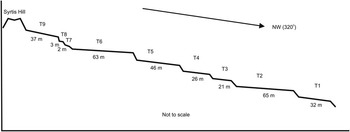
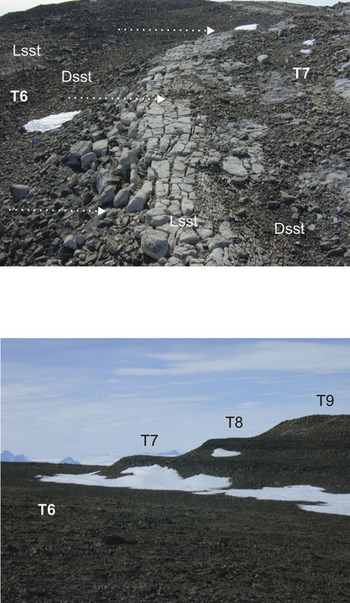
In respect of weathering and transport the north aspect must experience the greatest activity as exhibited by terrace development (Figs 2 & 6), in which tread widths increase with altitude - although in the upper section there is a coalescing of sections (T7–T9) within a singular evolving tread (Fig. 7). Field observation indicates that the sections T7 & T8 are indeed parts of an evolving T9; with growth of T6 into T9 (Figs 7 & 8).
An example of the large amplitude and extent of the north-facing terraces.

Cross section to show the upper series of terraces facing to the north-west on Syrtis Hill (not to scale).

The T6–T9 series of terraces wherein T7 and T8 are suggested to be part of the development of T6 into T9: a. detail of the rock riser along a dark sandstone exposure at the T6–T7 break, and b. view across the T6 to T9 series of terraces.

Any model of cryoplanation terrace formation and development must encompass initiation and growth, as well as weathering, transport and erosion. The models of Reger (Reference Reger1975) and Nelson (Reference Nelson1989) fail to explain the developmental sequence of the terrace forms observed on Alexander Island as (terrace) side slopes are absent (on which solifluction can occur to remove weathering debris in a lateral fashion (e.g. Nelson Reference Nelson1989, Figs 2 & 3)). Explaining debris removal where, with a series of terraces one above another, transported debris should move from one tread over the riser of the tread of the terrace below and so on down (see Hall Reference Hall1998), and the absence of such a debris accumulation downslope has never been satisfactorily explained.
Visual observation indicates that terraces are initiated along the lithological boundaries between the sandstones. That the highest (on the nunatak) terraces are the ‘oldest’, and those lower down the slope ‘more recent’ seems justifiable insofar as those at the top are the largest while those at the lowest elevation are but incipient (Fig. 9). The large T1 and T2 terraces (Fig. 7) are not in disagreement with this as there are further (smaller) terraces below T1 which are not shown (see Fig. 9) and, in reality, T7 and T8 are part of the coalescing of T6 and T9 into the large uppermost terrace; T7 and T8 have more limited lateral extension than that implied in Fig. 8. The increase of terrace size with elevation accords with nunatak exposure from ice cover and thus longevity of weathering and transport. The spatial distribution of terrace occurrence and the available weathering data consistently show a preferential aspect component irrespective of altitude. Transport processes, not just weathering, must also have been highly efficient in the north-east sector as there is a conspicuous lack of debris at the base of the risers or on the treads.
View downslope of the T1–T2 terraces to show the beginning of small terraces lower down the slope and the absence of any terrace formation at the slope base.

Since the dark- and the light-coloured sandstones have quite different joint spacing (Table III) it might be expected that the darker sandstone would weather faster than the light-coloured such that terraces, with time, were composed of a light-coloured tread and that breaks of slope might be at the light-dark sandstone junctions. However, visual observation indicates that in several instances (e.g. Fig. 8a) the dark sandstone appears to be the more resistant whilst the greater porosity of the light coloured sandstone may have an influence on water-based weathering (e.g. freeze-thaw) when water is available.
Little debris on the bedrock tread indicates the efficient removal, whilst the absence of debris at the base of the riser indicates slow current production. Blocks at the base of the riser appear to be undergoing granular disintegration and there is an accumulation of sand-sized debris near the risers. Although aeolian processes would seem likely to remove fine-grained debris the absence of ventifacts and any aeolian depositional forms as well as a lack of fine debris on surrounding glacier surfaces, suggest this may be uncommon.
Conclusions
Terraces in the Syrtis Hill - Two Steps area of Alexander Island have a preferential equatorward orientation but with no evidence of freeze-thaw activity and limited weathering processes and transport. For this site at the present time, it is hard to accept the cryoplanation-based theory (as it stands) regarding the role of freeze-thaw weathering. Equally, other water-based weathering processes are seemingly absent and thermal stresses appear limited. The restricted contemporary weathering seems validated by the minimal debris evident in the field. Water-based and aeolian transport processes would appear to be temporally limited at the present time in the absence of any clear evidence to the contrary. Thus, despite a climate suitable for cryoplanation development, cryoplanation does not appear to be particularly active at this time. It is suggested that the terraces may owe their development to previous snowier, and thus wetter, conditions. If that is the case, then the lines between ‘nivation’ and ‘cryoplanation’ become more and more blurred, with increased uncertainty over palaeoenvironmental implications. The spatial distribution, primarily equator-facing, is at odds with the general theory for both nivation and cryoplanation but this may be a function of latitude. If that is the case, again the climatic and process attributes of both concepts may need revisiting. Ultimately, these landforms of Alexander Island are ideal for more in-depth study and may be valuable for a better, more critical, evaluation of the cryoplanation concept.
Acknowledgements
We would like to thank the British Antarctic Survey for providing the opportunity to undertake this work, and Professor David Walton in particular for his on-going help and support in pursuit of geomorphological studies in Antarctica. The Trans-Antarctic Fund generously provided support for KH. Two anonymous referees kindly provided much input and useful criticism on the first draft of this paper, especially in suggesting relevant literature.