INTRODUCTION
Despite recent developments in drug and behavioural treatments of obsessive compulsive disorder (OCD), about 30% of cases (Piccinelli et al. Reference Piccinelli, Pini, Bellantuono and Wilkinson1995) remain refractory to treatment. Novel treatment strategies are therefore of considerable interest, one of which is repetitive transcranial magnetic stimulation (rTMS). Greenberg et al. (Reference Greenberg, George, Martin, Benjamin, Schlaepfer, Altemus, Wassermann, Post and Murphy1997) found positive effects of rTMS in OCD in a single-session experimental design, and Sachdev et al. (Reference Sachdev, McBride, Loo, Mitchell, Malhi and Croker2001) found promising results in a pilot study, as did Mantovani et al. (Reference Mantovani, Lisanby, Pieraccini, Ulivelli, Castrogiovanni and Rossi2005). The rationale for this is based on the neuroimaging studies of OCD, which have demonstrated abnormalities in the fronto-subcortical circuits, and in particular increased metabolism in the orbital frontal gyri and medial caudate nuclei, both key components of the orbitofrontal circuit (Baxter et al. Reference Baxter, Phelps, Mazziotta, Guze, Schwartz and Selin1987). This activity can arguably be diminished by increasing the activity in the indirect pathway by stimulating the dorsolateral prefrontal cortex (DLPFC) by fast-frequency rTMS (George et al. Reference George, Stallings, Speer, Nahas, Spicer, Vincent, Bohning, Cheng, Molloy, Teneback and Risch1999).
METHOD
Subjects
The study sample comprised 18 adult subjects with a DSM-IV diagnosis of OCD, as judged by two psychiatrists independently, who had failed adequate trials of at least two anti-obsessional drugs and cognitive behaviour therapy. The presence of concurrent major depressive episode, or a history of other major psychiatric disorder, drug dependence, Tourette disorder or neurological illness, and rTMS or electroconvulsive treatment in the previous 6 months were the exclusionary criteria. Subjects were recruited from the neuropsychiatry clinic that they attended for a second opinion, or through advertisement in the newsletters of the OCD Foundation of Australia and the Royal Australian and New Zealand College of Psychiatrists. The study was approved by the South-eastern Sydney Illawarra Area Health Service ethics committee and all subjects gave written informed consent.
Study design
Subjects were randomly assigned to either rTMS (n=10) or sham rTMS (n=8) for 2 weeks (10 treatment sessions). Subjects and clinician raters were blind to the treatment status. Randomization was based on a random number generator, and blinding was achieved by only the research assistant (T.F.M.) and rTMS administrator (C.K.L.) being aware of the group allocation. At the end of 2 weeks, subjects were informed about the treatment status and given the option of a further 2 weeks (10 sessions) of rTMS if they had received real treatment or 4 weeks (20 sessions) of rTMS if they had received sham treatment. The clinician rater continued to be blind for the first half of this open phase (4 weeks into the study). Subjects were asked at the end of the blind phase whether they believed they were in the rTMS or sham treatment group, and their guess was no better than chance. Treatment response was assessed by self- and clinician-rated scales weekly throughout the study and after 1 and 6 months of the last treatment, with the same rater following a subject through the study. The subject's medication status was unchanged at least 2 weeks prior to and during the 4–6 weeks of stimulation, and no new medication had been commenced in the 4 weeks prior to study entry.
Stimulation procedure
rTMS was administered using a Magstim Super Rapid device (Magstim Co. Ltd, Dyfed, Wales, UK) with a focal 8-shaped 70 mm coil, with 30 trains of 5 s each, at 10 Hz and 110% motor threshold, with 25-s inter-train intervals (1500 stimuli per session). Motor threshold was determined by ‘method of limits’ using electromyographic equipment (Loo et al. Reference Loo, Taylor, Gandevia, McDarmont, Mitchell and Sachdev2000). The coil was centred over the left DLPFC cortex, defined as 5 cm anterior to the optimal site for activating the right first dorsal interosseus muscle (Loo et al. Reference Loo, Mitchell, Sachdev, McDarmont, Parker and Gandevia1999). For sham stimulation, an inactive coil was placed on the subject's head and an active coil was discharged at the same parameters at least 1 m away, and out of the patient's line of sight. In previous rTMS trials, we found this method resulted in effective subject blinding (Loo et al. 2003, Reference Loo, Mitchell, McFarquhar, Malhi and Sachdev2007). rTMS was administered by a research nurse under the supervision of a psychiatrist, and subjects and experimenters wore earplugs during the session.
Ratings
Subjects were rated by a psychiatrist blind to the treatment group, at baseline and weekly thereafter until completion, and 1 month after completion, using the following instruments: the Yale–Brown Obsessive Compulsive Scale (YBOCS; Goodman et al. Reference Goodman, Price, Rasmussen, Mazure, Fleischmann, Hill, Heninger and Charney1989), the Maudsley Obsessive-Compulsive Inventory (Hodgson & Rachman, Reference Hodgson and Rachman1977), the Montgomery–Asberg Depression Rating Scale (MADRS; Montgomery & Asberg, Reference Montgomery and Asberg1979), the Beck Depression Inventory (BDI; Beck et al. Reference Beck, Ward, Mendelson, Mock and Erbaugh1961) and the Spielberger State Trait Anxiety Inventory-I (STAI-I; Spielberger, Reference Spielberger and Spielberger1972). A brief cognitive battery was administered at baseline and at the end of every 2 weeks until study exit.
Analysis of data
The primary outcome variable was the total YBOCS score. All analyses were performed using SPSS version 14 (SPSS Inc., Chicago, IL, USA).
RESULTS
Subjects
The male to female ratio was 3:7 in the rTMS and 5:3 in the sham rTMS group (χ2=1·9, df=1, p=0·168), and the mean (s.d.) ages were 29·5 (9·9) and 35·8 (8·2) years respectively (t=1·43, df=16, p=0·173). The duration of illness was a mean 12·6 (7·5) years in the rTMS group and 12·3 (5·4) in the sham rTMS group (t=–0·08, df=15, p=0·937), and the subjects had received a mean 4·6 (1·6) trials of anti-obsessional drugs in the rTMS group and 4·1 (2·0) in the sham rTMS group (t=–0·5, df=15, p=0·624). Thirteen subjects (nine in the rTMS and four in the sham rTMS group) were currently on medication. The total YBOCS scores in the rTMS and sham rTMS groups were 25·8 (5·7) and 23·9 (9·9), the obsession subscale scores 14·2 (3·4) and 12·9 (4·4) and compulsion subscale scores 11·6 (2·8) and 11·0 (6·3) respectively, all non-significant. The scores on the MADRS [16·1 (8·6) and 16·3 (11·4)], BDI [23·4 (14·4) and 15·9 (11·5)], Maudsley Inventory [17·6 (6·4) and 16·4 (6·0)] and STAI-I [54·2 (13·5) and 53·3 (16·7)] were not significantly different between the groups.
Between-group effects for the 2-week blind phase
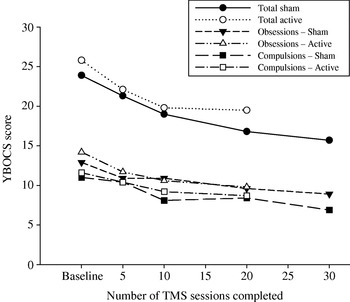
When baseline, 1-week and 2-week total YBOCS scores were analysed in a repeated measures design, with or without MADRS or BDI scores as covariates, there were no significant differences between the two groups (without covariate, F=0·10, df=1, p=0·76) (Fig. 1). This result was unchanged for YBOCS obsession (F=0·75, df=1, p=0·40) and compulsion (F=0·07, df=1, p=0·08) subscale scores, and the Maudsley Inventory scores (F=0·31, df=1, p=0·59). The interaction was not significant between sham and active MADRS scores over the 2 weeks (F=0·218, df=1, p=0·647), with both groups improving over time (F=47·686, df=1, p=0·041). Using the criterion of >40% reduction in YBOCS score, three individuals in the rTMS and two in the sham rTMS group showed improvement.
Comparison of repetitive transcranial magnetic stimulation (rTMS) and sham rTMS in obsessive compulsive disorder (OCD). The top two lines are total Yale–Brown Obsessive Compulsive Scale (YBOCS) scores for the two groups, while the bottom four lines are obsession and compulsion subscores on the YBOCS. The first 10 sessions (2 weeks) represent the double-blind phase, after which open treatment continued for a total of 20 sessions of rTMS.

Within-subject effects over 4 weeks of rTMS
In a repeated measures analysis on all subjects, using baseline, 2 weeks and 4 weeks data, there was a significant overall reduction in total YBOCS scores (F=4·98, df=2, p=0·013), which was due to a fall in YBOCS obsession (F=10·28, df=2, p<0·001) but not compulsion (F=1·50, df=2, p=0·24) scores. However, correcting for depression using MADRS made this non-significant (F=1·038, df=2, p=0·366). The Maudsley Inventory scores were not significantly reduced (F=1·34, df=2, p=0·28), nor were the STAI-I scores (F=0·14, df=2, p=0·87), but scores on MADRS showed a significant reduction (F=8·68, df=2, p=0·001). Overall, six patients had a >40% reduction in total YBOCS scores over 4 weeks.
Adverse effects
Significant adverse effects were transient headache (rTMS n=7, sham=1), localized scalp pain during the session (rTMS n=12), facial nerve stimulation during the session (rTMS n=3), feeling dizzy/faint (rTMS n=3, sham=1), and weepiness (rTMS n=2). There was no significant deterioration over 4 weeks of stimulation on any cognitive measure, using repeated measures analysis of variance (ANOVA).
DISCUSSION
This study did not support the efficacy of high-frequency left DLPFC rTMS given over 2 weeks in OCD. While the subjects did improve in their YBOCS scores, in particular the obsession scores, over 4 weeks, the improvement in the first 2 weeks was not different in the rTMS and sham rTMS groups. The improvement is possibly attributable to placebo and antidepressant effects of rTMS. This result is not inconsistent with the previous literature. The study by Greenberg et al. (Reference Greenberg, George, Martin, Benjamin, Schlaepfer, Altemus, Wassermann, Post and Murphy1997) included only one session of stimulation, and considering the variability in obsessive-compulsive symptoms, the results of such an intervention can be difficult to interpret. It should therefore be regarded as an experimental rather than a treatment study. The previous study from our group was a non-sham-controlled study comparing left and right prefrontal high-frequency rTMS (Sachdev et al. Reference Sachdev, McBride, Loo, Mitchell, Malhi and Croker2001) that showed some promise and led us to conduct this controlled investigation. Mantovani et al. (Reference Mantovani, Lisanby, Pieraccini, Ulivelli, Castrogiovanni and Rossi2005) stimulated the supplementary motor area bilaterally with 1 Hz stimulation in seven patients with OCD, using an open design, and reported significant improvement that persisted at the 3-month follow-up. The only other controlled treatment studies used low-frequency (1 Hz) right DLPFC rTMS (Alonso et al. Reference Alonso, Pujol, Cardoner, Benlloch, Deus, Menchon, Capdevila and Vallejo2001) or left DLPFC rTMS (Prasko et al. Reference Prasko, Paskova, Zalesky, Novak, Kopecek, Bares and Horacek2006) and sham stimulation, and found no beneficial effect. There is some evidence in the literature, based on the theory of cerebral lateralization of emotions, to suggest that right DLPFC low-frequency stimulation may produce a result very similar to a left DLPFC high-frequency stimulation, at least in its anti-depressant effect (Loo & Mitchell, Reference Loo and Mitchell2005). Therefore, the study by Alonso et al. (Reference Alonso, Pujol, Cardoner, Benlloch, Deus, Menchon, Capdevila and Vallejo2001) could be compared with our own, and the results are not dissimilar.
In the few subjects who did improve in our study, the effect could not be dissociated from a reduction in depression. Co-morbid depression is a common finding in OCD, and the success of putative antidepressant medication in OCD has made the dissociation of the two effects difficult. In an attempt to activate relevant fronto-subcortical circuits in OCD, the form of rTMS used in OCD trials has been similar to those used in depression trials (Loo & Mitchell, Reference Loo and Mitchell2005). Thus it is important to consider the contribution of antidepressant effects to any apparent improvement in OCD symptoms. This is the first study to do so and we failed to find specific effects on OCD symptoms that were independent of mood changes. We can, however, defend the choice of left DLPFC stimulation as this has been shown to be antidepressant and our earlier study (Sachdev et al. Reference Sachdev, McBride, Loo, Mitchell, Malhi and Croker2001) found it to be useful in OCD. Moreover, right prefrontal high-frequency rTMS theoretically runs the risk of worsening depression, as does left prefrontal low-frequency rTMS (Loo & Mitchell, Reference Loo and Mitchell2005), which would adversely affect patients with OCD. The latter was used by Prasko et al. (Reference Prasko, Paskova, Zalesky, Novak, Kopecek, Bares and Horacek2006) in their study.
The small sample size of our study is a limitation but we estimate that given the effect size seen in our study, a very large sample would have been needed to demonstrate a group difference. It is true that our subjects had a chronic and resistant illness, and the results may be different in drug naïve patients early in the course of the disorder. However, it is unlikely that such patients will come forth for rTMS, which, even though without significant adverse effects, can be uncomfortable and warrants daily attendance at a hospital or clinic. We have used one set of stimulation parameters in this study, and cannot exclude the possibility that a different set, given over a more extended period, will produce a different result, as is suggested for depression (Loo & Mitchell, Reference Loo and Mitchell2005). The orbito-frontal cortex, the region of greatest interest in OCD, cannot be directly targeted by current rTMS technology.
If further studies of rTMS are conducted for OCD, they should include larger samples, possibly non-resistant cases, and longer courses of stimulation. While different stimulation parameters should be tried, this might, to some extent, have to await a better understanding of the pathophysiology of OCD and newer advances in the technology.
ACKNOWLEDGEMENTS
We acknowledge the assistance of many psychiatrists and the Obsessive-Compulsive Foundation of Australia. Richard McBride and Vanessa Croker helped in data collection and Angie Russell in manuscript preparation. The study was supported by the National Health and Medical Research Council of Australia (Program Grant ID No. 993208).
NOTE
Supplementary information accompanies this paper on the Journal's website (http://journals.cambridge.org).
DECLARATION OF INTEREST
None.