


Introduction
Spodoptera litura (Fabricius) is widespread throughout tropical and subtropical Asia and Pacific Islands. Larvae of S. litura feed on a variety of crop plants (Okamoto & Okada, Reference Okamoto and Okada1968). Spodoptera litura inflicts serious attacks on soybean, sweet potato, taro and cabbage in Japan. The occurrence of this insect is sporadic and difficult to predict. Control has generally relied on chemical pesticides. Insecticides are effective against young larvae but some fail to control grown larvae or have become ineffective after the development of larval resistance (Hirose, Reference Hirose1995).
Usually S. litura does not survive winter in outdoor conditions except in a limited area of southwestern Japan (Naito, Reference Naito1987; Matsuura et al., Reference Matsuura, Naito and Kikuchi1991; Matsuura & Naito, Reference Matsuura and Naito1997). The S. litura populations that are present in the early season may also originate from populations that overwinter in greenhouses and disperse northwards every year in Japan (Naito, Reference Naito1987). Populations may also contain migrants from overseas (Murata et al., Reference Murata, Etoh, Itoyama and Tojo1998). The density increase of this insect is gradual from spring to early summer and then accelerates from mid-summer to autumn in southwestern Japan (Wakamura et al., Reference Wakamura, Kozai, Kegasawa and Inoue1992). Severe damage is frequent. Life table research suggested that outbreaks of S. litura may be induced by the reduction of natural pressures from natural enemies, which include the egg parasitoid, Telenomus sp. (Yamanaka et al., Reference Yamanaka, Nakasuji and Kiritani1972).
The efficiency of egg parasitoids as control agents against lepidopterous pests is widely recognized (Wajnberg & Hassan, Reference Wajnberg and Hassan1994). In a preliminary survey conducted in a cabbage field of Ibusuki, Kagoshima, Japan in 2001, the author (T.F.) and co-workers found that Trichogramma sp. (Hymenoptera: Trichogrammatidae) emerged from more than 40% of S. litura egg masses but from less than 10% of the eggs within those egg masses. This suggested that Trichogramma is not very effective in controlling S. litura. We found another egg parasitoid, Telenomus nawai Ashmead, on S. litura egg masses in taro fields at Tsukuba, Japan in 2002. This parasitoid has been known as an egg parasitoid of Spodoptera depravata (Butler) (Arakaki et al., Reference Arakaki, Noda and Yamagishi2000). Telenomus nawai is considered an important natural enemy of the Spodoptera moths in Japan (Arakaki et al., Reference Arakaki, Noda and Yamagishi2000), but information about this wasp is limited.
In general, eggs that are left without any protection and are exposed to natural enemies will not persist. Various types of materials are used for protection (Gross, Reference Gross1993). Egg masses of S. litura are usually covered with scale-hair, which protect them from a generalist parasitoid Trichogramma chilonis Ishii (Ohta et al., Reference Ohta, Miura and Kobayashi1994). We found that T. nawai emerged from many eggs of S. litura egg masses despite this protective layer of scale-hair.
In this paper, we report the effective parasitism on egg masses of Spodoptera litura by Telenomus nawai in comparison with that by Trichogramma ostriniae Pang & Chen, which was collected at Ibusuki and successively reared in the laboratory of the KPIAD as a possible control agent for various lepidopterous pests including S. litura. Developmental time and adult longevity of the parasitoid at five constant temperatures in the laboratory was also investigated. This provides fundamental information for assessment of the feasibility of T. nawai as a biological control agent of S. litura.
Materials and methods
Insects
Spodoptera litura larvae were collected from a wild population that fed on the leaves of cabbage, Brassica oleracea L., in Ibusuki, Kagoshima Prefecture, in late May 2002. Larvae were successively reared in the laboratory and fed an artificial diet (Insecta LFS, Nihon Nousan Kogyo Co., Yokohama) in a plastic case (30 cm long×23 cm wide×8.5 cm high, c. 20 larvae per case) at 25°C and 14L:10D until pupation. Pupae were removed from the rearing case and kept in glass cylinders (9 cm internal diameter×6 cm high, c. 5 pupae per cylinder) until emergence. Two pairs of females and males of S. litura were confined in another glass cylinder, the inside walls of which were covered with a filter paper (6 cm×30 cm, Toyo No. 2). They were provided with a small piece of absorbent cotton that had been immersed in 5% honey solution. Egg masses laid on the paper were removed by cutting the paper around them with scissors. Hatching rate of the eggs was generally more than 99% in the laboratory culture.
Telenomus nawai were obtained from S. litura egg masses laid on taro leaves at Tsukuba in early September 2002. They were successively reared on S. litura egg masses at 25°C and 14L:10D. Males emerged slightly earlier than females, waited for female emergence on the egg mass, and mated immediately when a female emerged. For the experiments, mated females and males were used. Adult wasps were kept in a glass tube (15 mm internal diameter×18 cm long) at 15°C and 14L:10D until use in experiments. They were fed honey that was streaked on the tube wall.
Trichogramma ostriniae used in this experiment were provided by Dr H. Inoue of the Kagoshima Prefectural Sericultural Experiment Station (currently, KPIAD). The laboratory culture originated from individuals that had emerged from Plutella xylostella (Linnaeus) (Lepidoptera: Yponomeutidae) eggs collected in cabbage fields at Ibusuki, Kagoshima, in October 1994, and was successively maintained on Ephestia kuehniella (Zeller) (Lepidoptera: Pyralidae) eggs. In the present study, T. ostriniae were kept on the S. litura eggs for more than three generations. Egg masses or isolated eggs of S. litura were provided to T. ostriniae after most scale-hair that covered the egg masses was removed to expose the eggs. Scale-hair was removed by scrubbing the surface of intact egg masses with a fine soft brush. Trichogramma ostriniae adults emerged from 50–60% of the eggs of those egg masses. Mated females were used for the experiments.
Emergence of T. nawai and T. ostriniae from S. litura egg masses
Single egg masses of S. litura collected within 12 h after oviposition were mounted on filter paper sheets (c. 1.2 cm×3 cm) and offered to two female adults of T. nawai in a glass tube (15 mm internal diameter×18 cm long). Mean number of eggs per egg mass was 328 (range 219–542). The tubes were plugged with a silicon sponge (Silicosen®, Shin-Etsu Polymer Co., Ltd, Tokyo), and kept at 25°C and 14L:10D. The parasitoids were removed 24 h after the introduction. A S. litura egg mass with or without scale-hair layer was also presented to two T. ostriniae females in the glass tube. The egg masses were otherwise kept in their initial condition, and emerged parasitoids and/or hatched larvae of S. litura were counted and removed every day until the emergence or hatching ceased. Treatments had five replications. Hatching rates (X) of S. litura were transformed to arcsin(X 1/2) and submitted to one-way-layout ANOVA and subsequent Tukey's ranking.
Optimum host age for T. nawai
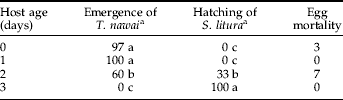
To determine the optimum host age for the parasitoid, 0-day-old S. litura eggs were separated from egg masses after the scale-hair was removed. Twenty eggs were pasted on a paper sheet (1.2 cm×3 cm) with water-soluble glue. The paper sheet with eggs was placed in a glass tube and single 1-day-old T. nawai females were introduced on day 0, 1, 2 or 3. The tubes were plugged and kept at 25°C and 14L:10D. The parasitoids were removed 24 h after introduction. Eggs were then kept under the same conditions, and the emergence of parasitoids and/or hatching of S. litura larvae were checked every day. Treatments were replicated three times and the data were pooled for the three replications. For the comparisons of rate values, when the 4×2 chi-square test was significant, paired chi-square test at Bonferroni's corrected P value were subsequently applied. The values accompanied with the same letter in table 1 are not significantly different at the P=0.05 level.
Effect of age of Spodoptera litura eggs on emergence rate (%) of Telenomus nawai (n=60).
a Values accompanied with the different letters in the same column are significantly different by 4×2 chi-square test and subsequent paired chi-square test (P<0.001).
Effect of temperature on development of T. nawai
Twenty separated and naked 0-day-old S. litura eggs were pasted on a paper sheet (1.2 cm×3 cm) and placed together with a single 1-day-old T. nawai female in a glass tube. The parasitoids and host eggs were kept at 25°C for 24 h, and then the parasitoids were removed. The exposed eggs were held in the tube at a constant temperature of 15°C, 20°C, 25°C, 30°C or 35°C and 14L:10D. The emergence of parasitoids and/or S. litura larvae was checked every day. The treatments had three replications and subsequently each of the 60 eggs were examined for each temperature.
Adult longevity of T. nawai
To evaluate longevity of the parasitoid adults in the absence of hosts, 15 female and male parasitoids were individually held in glass tubes at a constant temperature of 15°C, 20°C, 25°C, 30°C or 35°C and 14L:10D. They were provided with undiluted honey streaked on the tube wall. Mortality was checked every day.
Results
Emergence of T. nawai from S. litura egg masses
When intact egg masses of S. litura were exposed to T. nawai females (day 0), S. litura larvae hatched from only 2.3% of the eggs in the egg masses on day 4 and the parasitoids emerged from 75.5% of the egg masses on days 12–14. The remaining 22.2% of the eggs were broken (fig. 1, Tel./Intact). In those egg masses, host larvae were observed to hatch from the lower layer of the egg masses earlier than the parasitoids. After the host larvae emerged, broken eggs were observed around the exit holes in the upper layers of the egg masses. We considered these eggs to have been parasitized by T. nawai, although they had also been broken by feeding and/or crawling by the host larvae.
Parasitism of eggs in intact and naked egg masses of Spodoptera litura by Telenomus nawai (Tel.) and Trichogramma ostriniae (Tri.) (n=5). Means of the hatching rates of the host eggs were significantly different between Tel./Intact and Tri./Naked, and Tri./Naked and Tri./Intact (P<0.01). Egg mass size; Tel./Intact: 230, 273, 280, 376, and 382, Tri./Intact: 219, 258, 385, 519 and 542, Tri./Naked: 258, 260, 296, 323, and 326 (■, Tel.;  , Tri.; , Dead; □, Spodoptera).

Telenomus nawai female adults were observed to crawl into the hair layer to parasitize eggs of S. litura. The hair layers of all the egg masses from which T. nawai emerged were disturbed by the parasitoids. In contrast, when an intact egg mass was exposed to T. ostriniae females on day 0, the offspring parasitoid emerged from only 2.9% of eggs in the egg masses on days 9–11 (fig. 1, Tri./Intact) and the rate increased only to 21%, even when the hair layer had been removed (Tri./Naked). The means of the hatching rates of the host eggs were significantly different between Tel./Intact and Tri./Naked, and Tri./Naked and Tri./Intact (P<0.01).
Optimum host age for T. nawai
Emergence of T. nawai was observed in 97–100% of 0- to 1-day-old host eggs. The rate significantly decreased to 60% for 2-day-old eggs, and the 3-day-old eggs yielded no parasitoids and gave rise to S. litura hatchings (table 1). Emergence rates were significantly different between 0-day or 1-day-old and 2-day-old eggs and 2-day-old and 3-day-old eggs. Hatching rates of S. litura eggs were 33% and 100% for 2- and 3-day-old eggs, respectively.
Effect of temperature on development of T. nawai
Table 2 shows the emergence rates and the developmental periods from egg to adult in T. nawai. Adult emergence occurred at all temperatures tested except for 15°C. The rates of adult emergence were 95% for a temperature range from 25°C to 35°C, and 80% at 20°C. No wasps emerged at 15°C during the 5-month observation period; all the eggs collapsed or mildewed and died.
Emergence rates and developmental periods of Telenomus nawai on Spodoptera litura eggs at five constant temperatures.
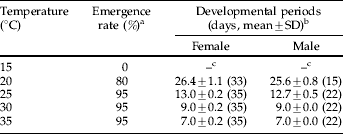
Regressions of developmental rate (Y d−1) on temperature (X°C) were: Y=0.067X−0.0915 (r 2=0.996) for females and Y=0.068X−0.0943 (r 2=0.998) for males.
a Sixty S. litura eggs were used at each temperature.
b Values in parentheses show the numbers of emerged parasitoids.
c No insect emergence.
Developmental periods decreased as temperature increased from 20°C to 35°C (table 2). The regressions of developmental rate (Y d−1) on temperature (X °C) from egg to adult emergence were significant at the P=0.001 level in both sexes; female: Y=0.0067X−0.0915 (r 2=0.996), male: Y=0.0068X−0.0943 (r 2=0.998). The lower development threshold for the females and males occurred at 13.7°C and 13.9°C, and effective accumulative temperature from egg to adult emergence for females and males were 149.3 and 147.1 degree-days, respectively. The developmental period was not significantly different between sexes at all temperatures tested, while males were observed to emerge earlier than females to wait for female emergence on the egg masses.
Adult longevity
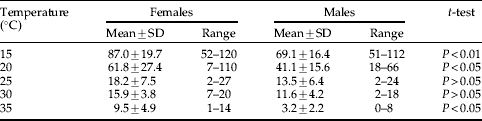
Adult longevity of T. nawai was significantly increased at lower temperatures in both sexes (table 3). The regressions of reciprocals of longevity (Y d−1) on temperature (X°C) were Y=0.00469X−0.0670 (r 2=0.935, P<0.01) for females and Y=0.0132X−0.227 (r 2=0.733, P=0.064) for males. In males, the value at 35°C was much shorter than that in females. When this value was excluded, the regression became significant: Y=0.00530X−0.0695 (r 2=0.921, P=0.040). Females lived significantly longer than males at temperatures of 15, 20 and 35°C.
Mean adult longevity (d) of Telenomus nawai at five constant temperatures (n=15).
Discussion
We collected T. nawai from the S. litura egg masses laid on taro leaves in Tsukuba, Japan. This is probably the first record of T. nawai as an egg parasitoid of S. litura, although it has been collected from egg masses of S. depravata in Tsukuba (Arakaki et al., Reference Arakaki, Noda and Yamagishi2000). Arakaki et al. (Reference Arakaki, Noda and Yamagishi2000) also collected Telenomus sp. from S. litura egg masses in Okinawa. This parasitoid was thelytokous, but seemed to be a conspecific population of T. nawai infected by Wolbachia (Arakaki et al., Reference Arakaki, Noda and Yamagishi2000). Yamanaka et al. (Reference Yamanaka, Nakasuji and Kiritani1972) found high parasitism of S. litura egg masses on taro leaves by Telenomus sp., and Hamada (Reference Hamada1992) obtained one species of Telenomus from S. litura egg masses on taro and soybean leaves in the fields at Tsukuba, Ibaraki, between August and September, 1984. No further species identification or investigations have been conducted by these authors.
Telenomus nawai emerged from 76% of host eggs in the intact egg masses covered with scale-hair. The mean hatching rate of S. litura eggs was greatly reduced to 3% (fig. 1). This suggests the high potential of T. nawai as a control agent of S. litura population in the field. In contrast, T. ostriniae emerged from only 3% of host eggs in the intact egg masses. This rate increased for T. ostriniae to 21% when most of the scale-hair had been removed from the egg masses to expose the eggs (fig. 1). This rate was considerably lower than the values for the same species in our successive rearing (55–60%, T. Fukuda, unpublished data) in which S. litura eggs were completely separated from the egg masses and scale-hair. Residual scale-hair on the egg masses probably disturbed oviposition of T. ostriniae in the above experiment.
The differences between T. nawai and T. ostriniae in parasitism of intact egg masses may be due to differences in oviposition behaviour. We observed that T. nawai crept into the hair layer covering the S. litura egg masses, while T. ostriniae did not. A congeneric species, Telenomus euproctidis Wilcox, was also found to creep into the dense hair layer of Euproctis taiwana (Shiraki) (Lepidoptera: Lymantriidae) egg masses (Arakaki, Reference Arakaki1990). Hamada (Reference Hamada1992) recorded, Trichogramma dendrolimi Matsumura, T. chilonis, Trichogramma sp. and Telenomus sp. as egg parasitoids of S. litura in Tsukuba, Japan. However, T. chilonis seldom attacked S. litura egg masses covered with a hair layer (Ohta et al., Reference Ohta, Miura and Kobayashi1994). As noted in the present paper, this was also true for T. ostriniae. This appears to be the reason why Trichogramma sp. parasitized less than 10% of the eggs in S. litura egg masses in the field (T. Fukuda, unpublished data).
The emergence rate of T. nawai from the intact egg masses of S. litura, shown in fig. 1, was lower than that expected from the isolated and naked eggs in table 1. At least two explanations for this are possible. Firstly, S. litura larvae hatch from the eggs within four days at 25°C (Miyashita, Reference Miyashita1971), but T. nawai require a longer time to complete the development on S. litura eggs at the same temperature (table 2). Therefore, host larvae that hatched might have fed on eggs parasitized by T. nawai, resulting in a decrease of emergence of the parasitoids. Secondly, S. litura females usually lay egg masses with two or three layers, and thus the eggs on the lower layers can escape from attack by T. nawai. Layered egg masses have been also found in the peacock butterfly, Inachis io geisha (Stichel) (Lepidoptera: Nymphalidae) (Hondô et al., Reference Hondô, Onodera and Morimoto1995) and the gypsy moth, Lymantria dispar (Linnaeus) (Lepidoptera: Lymantriidae) (Hitchcock, Reference Hitchcock1959). These females are considered to stack their eggs to guard the lower layers from parasitoids.
Maximum mid-summer temperatures in southwestern Japan exceed 30°C, and the field density of S. litura increases rapidly from mid-summer to autumn. This population increase is probably caused by an escape from natural enemies in this season as Yamanaka et al. (Reference Yamanaka, Nakasuji and Kiritani1972) suggested. Adult emergence of T. nawai was 95% at 30°C and 35°C (table 2), indicating that high temperature has little influence on the emergence of T. nawai. This heat hardiness may be adaptive in the high temperature zones of south-western Japan. However, S. litura eggs hatched within three days at temperatures of 30°C and 35°C (Miyashita, Reference Miyashita1971), and were susceptible to parasitism by T. nawai for only two days after oviposition even at 25°C (table 1). This means that the effectiveness of T. nawai as a biological control agent against S. litura is limited to within only one or two days after the oviposition by the host. Successive mass releases of this parasitoid may be necessary for successful control of S. litura. Males have a short adult span at a higher temperature of 35°C (table 3), but this may not affect reproduction since we observed in our experiment that males emerged as adults earlier than females and then waited for females to copulate soon after emergence. Early emergence of males has also been observed in several Telenomus species (Schwarts & Gerling, Reference Schwarts and Gerling1974; Chabi Olaye et al., Reference Chabi Olaye, Schulthess, Shanower and Bosque-Pérez1997; Fantinou et al., Reference Fantinou, Alexandri and Tsitsipis1998).
Adult females of Telenomus alsophilae Viereck and Telenomus californicus Ashmead are known to survive for four months or more (Fedde et al., Reference Fedde, Fedde and Drootz1979; temperature data were not presented). Such long-lived species of Trichogramma are not known. Adults of Telenomus busseolae Gahan survive up to 12 weeks at 8 and 12°C (Bayram et al., Reference Bayram, Ozcan and Kornosor2005). In the present study, the longevity of T. nawai females was significantly prolonged as temperature decreased, while the regression for this effect was marginally significant in males (table 3). The longer adult span of T. nawai females at lower temperature (>2 months at 20°C and 15°C; table 3) indicates that long-term preservation of this species is possible for long periods. If techniques of mass production and low temperature management of T. nawai are established, this species could serve as a powerful biological control agent of S. litura. The effectiveness of T. nawai against the field population of S. litura should be a subject of future research.
Acknowledgements
This research was mainly accomplished during the work of Takeshi Fukuda with the Laboratory of Insect Behaviour, NIAS. The authors sincerely thank V.N. Fursov for identification of T. ostriniae, and Seiji Tanaka and Toshiharu Akino of NIAS for critical reading of the manuscript. The authors also thank Tetsuya Yasuda, Toshiharu Akino, Hiroe Yasui and Midori Fukaya of the NIAS laboratory for their helpful discussions and encouragement. Thanks are also due to Tatsuro Muta, Takuhiro Yamaguchi and the other staff of the Kagoshima Prefectural Experiment Station, who gave Takeshi Fukuda a leave opportunity to work at NIAS, and encouragement throughout this study.


