Biographical accounts of the castrato Francesco Bernardi, known as Senesino, are dotted with anecdotes about his haughty, arrogant behaviour. A singer with a strong awareness of his worth, he had outspoken, conflicting relationships with his patrons throughout his career. Most famously, during his fifteen-year sojourn in London, relations with Handel proved difficult. John Mainwaring, Handel's first biographer, charges to Senesino's unruly behaviour the collapse of the first Royal Academy of Music (the Italian opera company) in 1728,Footnote 1 and evidence suggests that Senesino's hostility to Handel played a fundamental role in his dismissal (by the composer himself) and the formation of the Opera of the Nobility in 1733.Footnote 2 As a matter of fact, Senesino's desire to establish an artistically influential position in London was evident from the early stages of his negotiations with the Academy, and began to take concrete form in the production of Arsace (1721).Footnote 3 As this article will reveal, Senesino's troublesome reputation had preceded him to London, and his aspiration to shape a distinct artistic identity upon his arrival there may have combined with the need to smooth his public reputation. In fact, the singer's self-fashioning, playing, as it were, between his on-stage and off-stage personas, unfolded in surprising ways.
Senesino's problems started early: when only twenty years old, on his first important professional engagement outside his home town of Siena, he did not hesitate to press charges against Francesco Santurini, the impresario of the Sant'Angelo theatre, for the failure to allocate a theatre box as part-payment of his fee.Footnote 4 (He may have been supported by a patron in this endeavour.) It is ironic that the sole evidence of Senesino's first engagement in Venice at the Teatro Sant'Angelo during the 1706/1707 season (one season earlier than previously thought) comes from the pages of the magistrate's registry for small claims.Footnote 5 On the other hand, another hitherto unknown source from 1707, a sonnet to the young singer praising his performance as Narciso in Carlo Francesco Pollarolo's pastoral La vendetta d'amore in Rovigo (near Venice),Footnote 6 focuses exclusively on his beauty, the sweetness of his singing and the power of his song over the listener's senses. The sonnet quotes from the aria ‘Tu sei pur bello’ (You are so beautiful), sung by Narcissus (Senesino) when falling in love with his own image reflected in the water, and offers a fitting (possibly involuntary) allegory for Senesino's troublesome self-importance.
To Signor Francesco Bernardi from Siena, who in the Teatro Manfredini in the role of Narcissus sings with great skill the following canzonetta:
Sources such as this one and the earlier registry claim emerge as independent, isolated moments, but they initiate a narrative in which anecdotes about Senesino's self-important and troublesome personality (off stage) entwine with praise for the exquisite quality of the voice and artistry of the singer (on stage). That one could have an impact on the other, however, is shown by other testimonials, which reveal a correlation between Senesino's arrogance and the appreciation of his artistic qualities. One such example is a letter by theatrical agent Count Francesco Maria Zambeccari to his brother Alessandro on Senesino's performance and attitude at the beginning of his engagement in Naples in 1715. Zambeccari criticizes Senesino's static and flawed acting, his recitatives and the mistakes he made in an aria, comparing him negatively with the famed castrato Nicolini (Nicola Grimaldi), before giving vent to his pique for Senesino's (and fellow castrato Pietro Casati's) lack of reverence:
non stimano nessuno, perciò nessun li può vedere, e quasi tutta Napoli non li considera se non per due castroni b[astardi] f[ottuti] superbissimi. Da me non è mai stato, al contrario di quanti musici d'opera sono stati in Napoli; solo questi due non sono stati da me. Però ho la consolazione di vederli mal visti da tutti.Footnote 8
they have no respect for anyone. So no one can [bear to] see them, and almost all Naples considers them, if at all, to be a couple of [fucking bastard] conceited eunuchs. He has never been to my house, unlike so many opera musici who have been in Naples; only these two have never been to my house. And so I have the consolation of seeing them ill considered by everyone.
Since Zambeccari's first impression of Senesino as an artist (as of Casati and the rest of the company) upon his arrival in Septemlber 1715 had been generally positive,Footnote 9 this letter reveals that antipathy for the singer's behaviour off stage had disposed him poorly towards the singer on stage, sharpening significantly his critical stance.
Documents such as these provide a glimpse into the complexity of the perception of a singer's persona. Eighteenth-century theatre and opera scholars have demonstrated how off-stage behaviour affected the audience's perception of stage performance.Footnote 10 Star performers’ personality and temperament conditioned how eighteenth-century audiences understood the fictional character, so that a David Garrick's ‘violence’ or a Spranger Barry's ‘tenderness’, for example, would bring out different facets of the character they were portraying, but both portrayals would be held to be believable.Footnote 11 The much-cited episode of Anastasia Robinson's complaint that her role in Handel's Ottone did not suit her nature, which was more akin to that of a ‘Patient Grisell’,Footnote 12 suggests that considerations about the relationship between a performer's identity and stage role were relevant to the opera stage too. This awareness explains why singers may have wanted to control the way their persona was perceived through autobiographical writings, portraiture, operatic roles and musico-dramatic self-fashioning.Footnote 13 Eighteenth-century theatrical practice certainly encouraged the transfer and overlap between stage roles and a performer's real-life personality. The association between particular actors or singers and particular roles is confirmed by the practice of using stage roles as nicknames for actors (Lelio, Flaminia) and singers (Siface), while criticism of the widespread practice of singers and actors abandoning their stage role momentarily to address the audience confirms that the actor never stopped being the actor and the singer never stopped being the singer.Footnote 14 Theatre scholars have also remarked on eighteenth-century audiences’ competence in matters of repertoire and the traditions of acting technique, and their discernment in evaluating drama against their knowledge of contemporary theatrical practices – in particular, the ‘lines of business’, the type of parts which actors and actresses specialized in and for which were hired.Footnote 15 Singers too were judged against their parts, as shown by the request made by the castrato Benedetto Baldassari. He asked for his part in Handel's Radamisto (1720) to be changed because ‘he had never acted any thing, in any other opera, below the character of a sovereign’.Footnote 16 This despite the fact that opera audiences in London, one could argue, may have had a more limited knowledge of operatic practices from which to build up comparable powers of discrimination.Footnote 17
The act of singing itself points to the physicality of the individual singer and his/her voice; it strengthens the singer's presence, identity, and ability to capture and hold the attention of the audience. Ornamentation, in particular, distinguished singers from each other, established hierarchies, separated lesser singers from star singers and lent the better ones the status of almost superhuman, wondrous creatures.Footnote 18 At the same time, it is through singing, and especially the singing of arias, that the stage role unfolds before the audience.Footnote 19 There is no doubt therefore that it is through singing (rather than through acting) that the stage character and the singer's persona can overlap. The anonymous poet of the sonnet quoted at the beginning of this study knew this well and skilfully wove together Narciso's and Senesino's attributes by incorporating poetic text from the aria into the sonnet (highlighted through the use of capital fonts). The sonnet also praises the power of Senesino's voice, and its ability to soften the heart of his audiences: ‘Poiche con miglior arte di Cupido / RUBBI col Volto, e colla voce i CORI’ (As with the best art of Cupid / you steal the hearts with look and voice).
Senesino may have greatly needed to capitalize on these attributes in London, for the ‘difficult’ element in his character had filtered through to London before he even set foot on the island in September 1720. That this preoccupied the singer is shown in a letter he sent to Giuseppe Riva (through whom he negotiated his contract with the Royal Academy of Music) on the eve of his departure from Siena for England. Senesino expresses gratitude to Riva for the advice already received, and will rely on his help in London
per dissipare quelle calunnie che mi danno da temere assai quantunque le mie procedure sieno state finadora molto differenti, e se per caso qualche cosa mi possa essere accaduto, non sarà se non che con tutte le ragioni che m'assistevano, ma non per altro provenienti ne da superiorità ne da Capriccio ne dà malignità alcuna. tutte codeste impressioni ingiustam[en]te fattemi doverebbero essermi vantaggiose nella diversità Del mio procedere quando non fossero inoltrate negl'animi di quegli a segno di non potersi mai estinguere particolarmente a quelli che ne sono l'impostori. Iddio difenda la mia innocenza ch'io dal mio canto operarò secondo soglio nel passato, e molto più costà per appigliarmi ai suoi amorosi consigli che sò non esser altro che per mio maggior bene.Footnote 20
to dissipate those slanders which cause me considerable distress, although my behaviour until now has been very different, and if anything has happened to me, it has been with all good reason and not in any way deriving from a sense of superiority, nor from wilfulness or any maliciousness. All these unjust impressions would play to my advantage because my behaviour is actually very different, if it were not for the fact that they [the slanders] are so ingrained in people's hearts, especially of those who initiated them, that they cannot be extinguished. God may defend my innocence, while for my part I will continue to act as I always have in the past, especially over there, in order to follow your loving advice, which I know is nothing other than for my own good.
He then assures Riva that he will pay whatever visits he recommends, and that he shall do all he can ‘to win over Monsieur Handel’, implying that Handel, too, was ill disposed towards the singer:
Non lasciarò sub[it]o di fare quelle visite che da lei mi vengano insinuate, et altresì farò il possibile per vincere l'animo di M[onsieu]r Hendel, quantunque il gran piacere possa avere nel sentire la venuta del S[igno]r Gio[vanni] Bononcino da me tanto stimato virtuosis[si]mo [et] a Seconda di tutta la Nazione farne a Gara con chi si sia nell[’] ammirarlo come hò fatto altre volte.
I will not fail to pay those calls that you suggest, and I shall also do all I can to win over Monsieur Handel, although I may have the great pleasure of hearing of the arrival of Signor Giovanni Bononcini, a great artist whom I much admire, as does the whole nation, and I would challenge anyone to admire him more than I do and have done in the past.
One naturally wonders what these accusations were, why Senesino would have needed to charm Handel beyond the need to have him on his side as the main composer for the Italian opera, and how he may have tried to gain his favour. Senesino's delight at the news of Bononcini's imminent arrival in London, placed immediately after the expression of his worries, suggests (through the use of ‘quantunque’ (although)) not only that with Bononcini in London, he would have had less need to have Handel on his side, but also that Senesino saw his off-stage and on-stage reputations as being, if not directly related, then at least able to affect one another.
Although it was not Handel who chose to hire Senesino in the first place, there is no evidence to suggest that he was opposed to the choice. Presumably the composer had had a good opportunity to assess the qualities of the singer when he visited Dresden in 1719, a year before Senesino's contract was finally signed. When he wrote to the Earl of Burlington in July 1719, he seemed confident that he could conclude business with Senesino (as well as with Matteo Berselli and Francesco Guicciardi); in fact, he returned to London empty-handed. Once the sumptuous celebrations for the wedding of Friedrich August and Maria Josepha were finally over, in September 1719, Senesino, who could have easily freed himself to sign a contract with the Royal Academy of Music, renewed his engagement with Dresden for another year. Presumably he continued to find Handel's offer on behalf of the Royal Academy unsatisfactory, and this may have led to an uneasy relationship with Handel.
The process of securing Senesino for the Royal Academy of Music was drawn out: negotiations with the singer had started by November 1717 (if not earlier) and did not conclude until the spring/summer of 1720.Footnote 21 After much to-ing and fro-ing, his excuse for further delay may well have been thought to be just that, an excuse, and interpreted as yet another attempt to play hard to get, or at best a pretext to travel to Italy first and invest his earnings from Dresden in a property in Siena, the nucleus of what became, thanks to his income in London, the Palazzo della Lizza – still owned today by the Bernardi-Avanzati family.Footnote 22
Rumours about the circumstances leading to the dismissal of the Italian company from Dresden (and of Senesino in particular) may also have reached London before Senesino did and given cause for concern. While the singer referred to financial reasons for the disbandment of the company in his communication with Riva, a well-known report from Quantz (although published only in 1752) blames Senesino's defiant and manipulative behaviour for the ending of Italian opera in the city:
Nach dem Beylager componirte Heinchen noch eine Oper, welche nach der Zurückkunft des Königs aus Pohlen aufgeführet werden solte. Bey der Probe aber, die auf dem königlichen Schlosse, in Gegenwart des Musikdirectors Baron von Mortar gehalten wurde, machten die beyden Sänger, Senesino und Berselli einen ungeschliffenen Virtuosen-Streich. Sie zankten sich mit dem Capellmeister Heinchen über eine Arie, wo sie ihm, einem Manne von Gelehrsamkeit, der sieben Jahre sich in Wälschland aufgehalten hatte, Schuld gaben, daß er wider die Worte einen Fehler begangen hätte. Senesino, welcher seine Absichten schon nach England gerichtet haben mochte, zerriss die Rolle des Berselli, und warf sie dem Capellmeister vor die Füße. Dieses wurde nach Pohlen an den König berichtet. Inzwischen hatte zwar der damalige Graf von Wackerbart, der sonst ein großer Gönner der Wälschen war, den Capellmeister und die Castraten zu des Capellmeisters völliger Gnugthuung, in Gegenwart einiger der vornehmsten vom königlichen Orchester, als Lotti, Schmidt, Pisendel, Weiß, u.s.w. wieder miteinander verglichen. Es kam aber ein königlicher Befehl zurück, daß alle wälschen Sänger abgedanket seyn solten. Hiermit hatten die Opern für diesmal ein Ende.
After the nuptials Heinchen composed still another opera[,] which was to be performed after the King's return from Poland. At the rehearsal, however, which took place at the Royal Palace in the presence of the music director, Baron von Mortax, the two singers, Senesino and Berselli, behaved like rude virtuosos. They quarrelled with Heinchen over an aria and charged this scholarly man[,] who had spent 7 years in Italy[,] with making an error in the libretto. Senesino, who may have already had intentions of going to England, tore up Berselli's score and threw it at Heinchen's feet. This was reported to the King of Poland. In the meantime, Count von Wackerbart, who usually was a great patron of the Italians, had reconciled the Kapellmeister and the castrati to Heinchen's complete satisfaction in the presence of some of the most important members of the Royal orchestra, such as Lotti, Schmidt, Pisendel, Weiss, etc. However, a Royal order came back demanding the dismissal of all the Italian singers. With this, opera was at an end for the present.Footnote 23
While it is highly unlikely that Senesino's behaviour could have been the sole cause of this termination, any gossip about his insubordination – whether or not it was staged in order to free himself, so as to be able to accept an offer from London – would have caused a certain degree of apprehension over his imminent arrival in London.
Senesino's demands over pay were, as one might have expected, at the heart of his negotiations and likely to have been the reason the process was so lengthy. His demand for the right to influence repertory, included from the earliest exchanges with Riva, may have been an additional stumbling-block:
Passarò adunque alle mie pretenzioni, e sono di mille Ghinee effettive o sua valuta per mio Onorario diviso in tre rate, il mio giorno di benefizio prima di qualsivogl[ia] altro di qualunque genere in tempo buono, et a prezzo giusto, cioè di 67 Lire, sapendo che tanto Importa la spesa del Teatro in d[ett]a sera; cauzione per la paga, o pure sopra la sottoscrizione, e la scielta di qualche Opera.Footnote 24
I will now set out my demands, and they are for a thousand guineas in cash or equivalent value for my fee, divided into three instalments, my benefit night before any other of whatever kind at a good time, and at a fair cost, namely 67 pounds [sterling], since I know that that is the amount for the expenses of the theatre that night; a guarantee for my fee or else [for it to be] based on the subscription [income]; and the choice of some operas.
No matter how unusual Senesino's final request may appear, it was not exceptional, at least not in London. Before him, the castratos Valentino Urbani (Valentini) and Nicola Grimaldi (Nicolini) had provided scores, assembled casts and probably then directed several pasticcio operas between 1708 and 1717.Footnote 25 Their prominent roles in London no doubt reflected respect for Italian singers; these may also have been encouraged by the need for opera managers and directors to have access to Italian scores, librettos and expertise. These circumstances may have made Senesino's request a viable option, albeit one that may have caused friction with John Jacob Heidegger, unlikely to welcome any interference with the programming at the newly founded Royal Academy of Music. We do not possess Senesino's contract, but the production of Arsace in February 1721, an opera proposed to the Academy Board by Senesino himself immediately upon his arrival in London, indicates that this latter demand had been granted.
Roman poet Paolo Rolli is our sole witness of the Arsace affair, as he recalls the events in two letters to his long-term friend Giuseppe Riva, one dated 23 September 1720, the other 18 October 1720.Footnote 26 Rolli, who had not met Senesino before his arrival, was to become a close friend. When away from London, the two exchanged irreverent and sardonic commentaries on private and theatrical affairs in verse rich in sexual innuendo, which provide not only information on specific theatrical matters, but also a glimpse into both Rolli and Senesino's perspectives, and their personalities and temperaments (as well as Senesino's skill as a poet). Rolli draws a humorous vignette of these new Italian arrivals in London, Matteo Berselli and Maddalena Salvai as well as Senesino, and his first impression of Senesino, written to Riva a day or two after the singer's arrival, seems, in hindsight, wonderfully perceptive in his catching at once Senesino's well-mannered and educated air, and his troublesome temperament:
Lunedì passato arrivò il Sig.r Senesino col Berselli e la Salvai. N'ebbi la nuova martedì in Richmond, stando a pranzo, et immediatam.te col buon Casimiro venni alla città. Mi consolo infinitamente di trovar questo celebre virtuoso sì ben costumato, amatore delle lettere, gentilissimo e d'onorati sentimenti. Caro Riva se dal buon mattino siegue buona giornata credimi ch’è veramente una grand'eccezzione della regola. Non passa buona corrispondenza tra lui e la Salvai. Di lei non so ancora dirvene alcuna cosa perché solo una volta l'ho vista, ma posso dirvi che rumoroso, faccendone, e non inventor di prudenza e polvere l'uomo è[.] i vostri occhiali lo squadreranno a prima vista.Footnote 27
Last Monday [19 September] Signor Senesino arrived with Berselli and Salvai: I received the news of it on Tuesday in Richmond while I was at dinner, and immediately came into town with the good Casimiro. I am most gratified to find this famous virtuoso so well mannered, a lover of literature, most charming and with honourable sentiments. Dear Riva, if after a fine morning there follows a fine day, believe me there is a great exception to the rule. There is not a good relationship between him and la Salvai: I cannot tell you anything about her because I have seen her only once, but I can tell you that the man is boisterous, a hustler and no master of tact and polish. Your spectacles will sum him up at first sight.
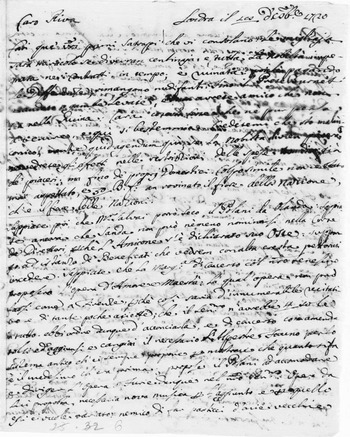
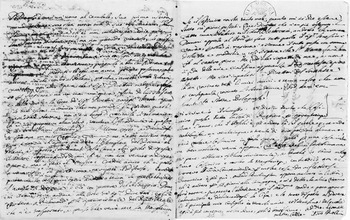
Rolli continues by mentioning that, only three days after Senesino's arrival, he had been commissioned to revise the libretto of Amore e maestà (to be known as Arsace), a libretto by Antonio Salvi originally set to music by Giuseppe Maria Orlandini and staged in Florence in 1715, with Senesino, Margherita Durastanti and Berselli in the cast.Footnote 28 But it is in his following letter to Riva (see Figure 1; transcribed and translated in the Appendix) that he explains the extent of Senesino's involvement and the production's bumpy ride. The whole project did not run very smoothly, and it generated a series of conflicts that may have delayed production until 1 February (after Bononcini's Astarto and Handel's Radamisto). Senesino fiercely objected to Heidegger's intention to turn Amore e maestà/Arsace into a ‘pasticcio’ of old arias, fighting for the insertion of a number of newly composed numbers to complement parts of Orlandini's original setting. He also strongly rejected Heidegger's choice of Girolamo Polani (according to Rolli, Senesino had referred to Polani as a ‘coglione’, an idiot)Footnote 29 to assemble the score and revise the music of Amore e maestà, and eventually settled for composer and Royal Academy cellist Filippo Amadei.
Letter from Paolo Rolli to Giuseppe Riva, 18 October 1720 (I-MOe, Autografoteca Campori), transcribed and translated in the Appendix. Reproduced with permission of the Biblioteca Estense Universitaria and of the Ministero dei beni e delle attività culturali e del turismo, Modena


Why did Senesino reject Polani's collaboration so strongly? After all, Polani's skill as a composer seems to have been adequate, and his music may have been well received in his own time; Michael Talbot has described the cantatas (the composer's only surviving music) as excellent works, ‘full of character and attractive musical gestures’.Footnote 30 However, Polani's name was associated mainly with pastoral operas produced between 1704 and 1717 at the small theatre of San Fantin in Venice, and he had had little to no experience with the more serious kind of dramma per musica that he might have been able to call on in the revision of Amore e maestà. Furthermore, if Polani acted as Salvai's manager, as Lowell Lindgren has suggested, the existing tensions between Senesino and Salvai may have contributed to Senesino's hostility towards Polani.Footnote 31 On the other hand, Amadei, a composer and a cellist in the opera orchestra brought over to London in 1715 from Rome by the Earl of Burlington, was certainly more experienced in that genre. He was also a member of the Italian circle in London and an old acquaintance, perhaps even a friend, of Senesino (Senesino had sent his greetings to him a few times via Riva). They had known each other since at least 1711, when the singer had sung in Amadei's dramma per musica Teodosio il giovane in Rome.Footnote 32 All these reasons may have made Amadei a more suitable candidate in Senesino's eyes.
The haste with which Senesino put his proposal forward – just three days after his arrival in London – and Rolli's reference to Senesino's ‘first appearance [on the London stage]’ in this ‘fine first opera’ (my italics) in his letter to Riva quoted above clearly indicate that Senesino had hoped Arsace could be produced swiftly to mark his debut (which instead took place in Bononcini's Astarto).Footnote 33 Senesino's desire to control his debut and his commitment to this particular production signal that perhaps there was more at stake than the need to make a good impression in London (not that this should be underestimated), and that discrete concerns combined, in the reworking of Amore e maestà as Arsace, into a single effort to reconcile his on- and off-stage personas.
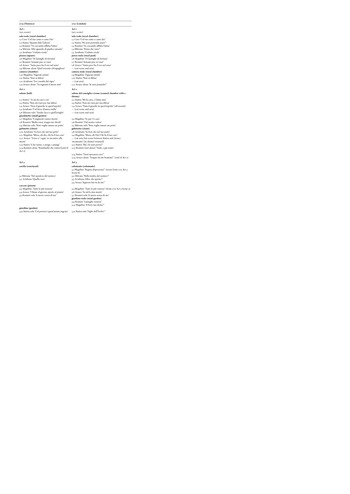
Arsace was finally staged in London on 1 February 1721 by the newly assembled Italian cast, with Senesino in the title role (Essex, in the original drama), Durastanti as Queen Statira (Elizabeth I) and Salvai as Rosmiri (refer to Table 1). It was no ordinary opera. The libretto, originally modelled by Salvi on Thomas Corneille's tragedy Le Comte d'Essex (1678), concluded with the death of the hero. Although set in ancient Persia, the subject was drawn from a period of national greatness in British history, making it particularly suitable for Senesino's English debut. Its political resonance had already been recognized and exploited in Rome a few months earlier, during the carnival season of 1720, when Amore e maestà was produced at the Teatro Alibert and dedicated to James III, son of the deposed James II and ‘Re della Gran Bretagna’.
Arsace, comparison between the 1715 and the 1721 librettos

* arias by Amadei
Arsace, or Amore e maestà, was, in Salvi's words, a true tragedia per musica. Tightly centred on Elizabeth I's (Durastanti) inner struggle between her passions (her love for Essex/Arsace) and her ethos (her status as queen), the opera unfolds through the continuous alternation between her desire to save her beloved Arsace, whom she believes guilty of treason (he is in fact a victim of a conspiracy and slander), and her duty as a queen to condemn him to death. As Arsace stubbornly refuses either to explain his actions (he cannot do that in order to protect his beloved Rosmiri) or to ask for forgiveness (he is innocent, and strong in the belief that his past actions should speak for his loyalty), the queen eventually signs his death sentence. Salvi even manages to strengthen the tragic quality of the drama laid out by Corneille by adding Rosmiri's suicide and by concluding the opera in a way that was, for that time, unconventional: with a dramatic solo scene in which the queen foretells her own death.
Corneille's tragedy was a successful dramatization of the events leading to the execution in 1601 of Robert Devereux, Second Earl of Essex, Queen Elizabeth I's favourite. The figure of Devereux enjoyed wide public interest after his death, undergoing many transformations through a body of literature, ballads and poems that emphasized ‘his love for his queen, his gentleness and concern for others, and his willingness to die humbly and penitently’.Footnote 34 These writings, which included Devereux's own Apologie of the earle of Essex,Footnote 35 had considerable influence on later literary treatments of Essex's story and of his relationship with Queen Elizabeth I, shifting the interest from the political, public plane to an affective, personal one.Footnote 36 Corneille's Le Comte d'Essex, John Banks's Unhappy Favourite (1682), and ultimately Senesino's Arsace (1721) reflect this shift to the sentimental.Footnote 37 Senesino's Italian (although French-inspired) operatic rendition of the Elizabeth–Essex story in 1721 may have provided an intriguing alternative to Banks's tragedy, which was being revived yet again by two different companies in 1720 and 1721 (and was reprinted in 1721).Footnote 38 All three companies were capitalizing on audiences’ interest in the story.
Rolli openly declares the English connection in his note to the reader in the libretto, although it is highly unlikely that the London audience would have missed the obvious Elizabeth–Essex subject clothed in Persian garb:
The subject of this present drama is the same that is treated of in the tragedy written by the French tragedian Tommaso Cornelio, on the death of the famous Earl of Essex, whose story is well known in this his native country. He that wrote this drama, as he has varied very much from the method of the first author, he has also changed the names as well of the persons as of the place. ’Tis sufficient, at present, that the spectators be informed, that Statira is Queen Elizabeth, and Arsaces the Earl of Essex.Footnote 39
In the dedication to the Duke of Montague (not translated into English) he takes this point further, progressing from praise for the Duke to a eulogy to the English nation. He assigns to the very choice of this subject an innovative role in dramma per musica (already highlighted by Salvi), namely the creation of the tragedia per musica.Footnote 40 He refers to the success of Orlandini's original opera in Florence (performed by Senesino and Durastanti), as well as to the Venetian and Neapolitan performances – both given by Senesino's illustrious predecessor in London, Nicolini, and his stage partner, Marianna Benti Bulgarelli, La RomaninaFootnote 41 – and forestalls failure by praising the taste of an English audience which, Montague included, is able to appreciate tragedy and the musical expression of the passions. And indeed, Senesino's production of Arsace, more than that of his predecessor Nicolini, further strengthened the tragic character of Amore e maestà – in ways perhaps that those who had seen the Venetian or Neapolitan productions of the opera with Nicolini may have been able to appreciate.
Both tragedy and praise for the English nation and aristocratic good taste were implicit in the choice and development of the narrative. Salvi's Amore e maestà, like his other librettos based on French classical tragedies, follows its model closely. Yet it also deviates from it in significant ways.Footnote 42 As argued by Reinhard Strohm, these changes were part of a more general process of differentiation between opera libretto and spoken drama that took place in the eighteenth century under the formative influence of French drama. The assimilation of the techniques and principles of French classicism, with its emphasis on the pathetic and the expression of sorrowful emotions, helped librettists develop tighter dramaturgical structures centred on the aria, which expands and becomes the climax of a rhetorical framework, the conduit channelling affective communication between the singer and the audience.Footnote 43 In her anthropological study of opera seria as ritualistic performance, Martha Feldman identifies in the aria the container (‘frame’) in which fixed elements of opera seria (such as the poetic text, for example, but also ideology, narrative structures, poetic and musical forms, the ‘rules’ of gesture, and stage deportment and decorum) combine with musical improvisation to regulate exchanges between singers and audience.Footnote 44 Foregrounding the singer's unique, novel, often dazzling performance, the singing of the aria becomes the element in the opera that most affects the audience's experience (and thus understanding) of the drama. While reflecting the newest reformist trends emerging outside Florence that led to these important transformations in opera, Amore e maestà also reflected the sophisticated interests and taste of Prince Ferdinando de’ Medici in Florence – it was a true aristocratic product. Because of its roots in the history of the British monarchy and in French tragedy (seen as the highest form of theatre), and its presentation through the most elevated and novel strand of Italian opera (tragedia per musica), Arsace is introduced, through Rolli's unusually elaborate presentation, as the quintessence of sophistication and good taste. Rolli's address to an elite of connoisseurs, who possess the discernment to appreciate it, thus acts as a captatio benevolentie directed at Senesino's new English audience.Footnote 45
Furthermore, the Elizabeth–Essex subject lent itself to the favourable representation of Senesino's own predicament: like Essex/Arsace, Senesino claimed he had been the victim of slander and false accusations. While the operatic representation of the victimized hero was not unique to Essex/Arsace, the emphasis that this opera places on the condition is more unusual. Although it is likely that only a small section of the audience would have been cognizant of the singer's difficulties, identification of singer with character in this instance strikes us as being particularly advantageous to Senesino on his (first) appearance on the London stage; he could capitalize on the parallel with a fêted figure of British history from a period seen as a time of national greatness, and therefore the identification may have been actively sought through Rolli's revisions and Amadei's new arias.
These revisions range from minor spelling variants between Roman and Florentine forms (‘vidde’ for ‘vide’, for example, or ‘egli'l’ for ‘egli il’), the modernization of seventeenth-century idioms (such as from ‘d'Occo nipote’ to ‘nipote d'Occo’) and the elimination of cruder images (as when ‘teschio’ (skull) is changed to ‘collo’ (neck) in Megabise's aria ‘Figurati estinti’), to the shortening of recitative and elimination of entire scenes (see Table 1) – something that will become common practice in Rolli's adaptations in London. Significantly though, Rolli maintains Salvi's original ‘funesto fine’ (woeful ending) of 1715, only substituting Statira's final aria ‘Figlie dell'Erebo’ for Salvi's ‘Col portarvi quest'anima ingrata’. This is unlike all the productions that preceded his own, which moderated the tragic ending or replaced it altogether with a happy one.Footnote 46 In Salvi's original libretto, as well as in Rolli's revision, the queen's advisor (Megabise/Berselli), like everybody else in the opera, abandons her to face the devastating consequences of her choice, which is emphasized by her presence on stage alone at the end of the opera. In Venice and Naples – where it was produced as Arsace in 1718 by the established partnership of Nicolini and Romanina – as well as in Modena in 1719 – which was based on the Venetian production – the tragic ending is moderated by the addition of a final scene in which Megabise (and the people) remain faithfully at the queen's side to support her in her deep affliction. When produced in Rome during the Carnival of 1720 (and dedicated to James III), it was more drastically revised in order to achieve the more traditional happy ending, in which neither Rosmiri nor Arsace dies.Footnote 47
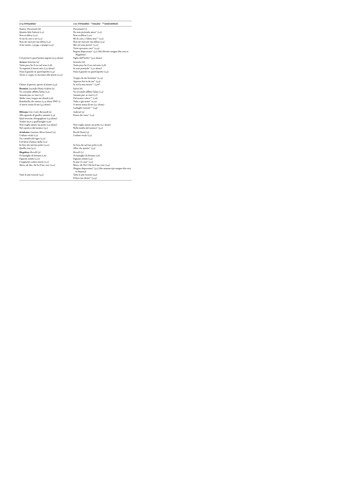
Rolli's version introduces eighteen new arias alongside fourteen arias retained from Orlandini's original setting (see Table 2). Of these, fourteen were set to music by Amadei (the libretto clearly indicates these by means of an asterisk), while four may have been inserted from other operas and may derive from other composers.Footnote 48 Durastanti and Senesino, as well as Rosmiri's role, gain one aria in 1721, while Berselli gains two arias. In comparison with Salvi's, the new aria texts often show Rolli's customary preference for shorter lines, more regular metres and a more incisive and regular accentuation. Apart from modernizing the text, these changes often coincide with dramaturgical modifications either through a change of emphasis in the poetic text or through the often more fluid and cantabile musical setting that they can encourage.Footnote 49 See, for example, the faster, more fluid senari of the popular lament ‘Sì sol la mia morte / può farvi tranquille / amate pupille, / io vado a morir’ (If only my death, beloved eyes, can make you happy, I willingly go to die) in Senesino's last aria, which replace Salvi's longer original ottonari: ‘Chiuse al giorno, aperte al pianto / io vi lascio o luci care / spente in braccio del martir’ (Shut to the day, open to tears, I leave you, oh dear lights, extinguished in the arms of torment). This change diminishes the focus on Rosmiri's affliction and shifts the attention to the hero's active choice to die, clearly expressed at the end of the first stanza (‘Io vado a morir’ / ‘I willingly go to die’).
Arsace, cast and aria incipits for 1715 (Florence) and 1721 (London) productions

a GB-Lbl R.M.23.g.4 has Orlandini's name added in pencil and Bononcini's name crossed out, while an aria collection in Cambridge (GB-Cfm MU MUS 54) attributes it to Lotti.
The replacement of Salvi's original aria for Arsace/Senesino concluding the first act, ‘Tu segnasti il morir mio’ (Act 1 Scene 13 – also in ottonari), with Rolli's shorter, faster quinari of ‘Se non possiedo’ (Act 1 Scene 12), leads to similar results. In this scene Arsace, who has surrendered his dagger to Artabano after his failed raid on the court (to stop Rosmiri's wedding), is alone on stage and considers death to be better than life without his beloved Rosmiri:
You signed my death [sentence,] / beautiful hand, by giving yourself to another / and I now will learn / So I want to show you / that if I was faithful in life / such I will be in death.
If I mayn't enjoy the object of my love, / I only intreat you, adverse fate, / to end my life, that so my pains may cease. / You pleasing hopes of sweetest love / are vanisht now, and so is all my joy. / Loving too much, has brought / me to despair.Footnote 50
While similar in content and affect, these aria texts differ significantly in that Arsace/Senesino's plea ceases to be directed to Rosmiri and her ‘bella man’ (beautiful hand) and turns to the more abstract ‘fato’ (fate, in the first stanza) and ‘speme’ (hope, in the second), thus allowing Senesino to sing his arias directly to his audience and to strengthen his rhetorical plea.Footnote 51
The revisions, more wide-ranging than those Rolli carried out on Astarto (for a production first in Rome in 1715 and then in London in 1720),Footnote 52 sometimes suggest that Rolli was taking a complex array of issues into account: not only Senesino's status and representation, but also that of the other singers, questions of aesthetic focus for London taste, and the niceties of political representation in this Italian opera on an English story for an English audience. The most extensive transformations concern the end of Act 2 – with the clear aim of allocating the conclusion of the second act to Senesino/Arsace (a prime spot that Salvi had originally assigned to the character of Rosmiri) – and the beginning of Act 3, in order to reinforce the presence of Durastanti/Statira on stage (see Table 1). Rolli moves part of Salvi's Act 3 Scene 6 (in which Megabise continues to plead with the queen for Arsace) to the beginning of his Act 3. While this increases the presence of the queen on stage, who now dominates the act (and who of course also concludes the opera with a highly affecting solo scene), it also increases focus on Arsace, who is the subject of the exchange between Statira and Megabise right at the beginning of the act. While to some extent Durastanti does gain from these revisions, the increased focus on Senesino, together with cuts in a number of the queen's lines elsewhere in the opera, cause Durastanti's character to lose depth and complexity. It de-emphasizes the ‘maestà’ (majesty) component of the queen's dilemma between ‘amore’ (love) and ‘maestà’ in favour of ‘sdegno’ (anger), and thus determines a shift in emphasis from ethos (her status as queen) to pathos (her emotions). This shift is symbolically sanctioned in Artabano's aria in Act 2 Scene 8, addressed to the queen, in which Rolli changes Salvi's original ‘maestà’ to ‘sdegno’ (italicized here): ‘So ben che nel tuo petto / combatte un doppio affetto / amor e sdegno’ (I know the contrary passions / of love and anger, at once are / fighting furiously in your breast). This process matches a general weakening of the political drive behind the conspiracy plotted by Mitrane and Artabano against Arsace. This is achieved mainly through cuts to passages in the recitative that focus on political motives, making the villains less evil (at least one of them, Mitrane, who is beset by doubts and driven more by love for his wife Rosmiri than political ambition) and reducing their number of arias altogether (they receive three arias in 1721 against five in 1715; see Table 2).
In fact, the success of Orlandini's Amore e maestà may have resided precisely in the focus on the queen and her dilemma, as well as on Rosmiri, as this dual focus provided an ample display of contrasting emotions and, as a consequence, musical variety. Salvi's invention of Rosmiri's suicide had lent yet more weight to a character that Strohm has characterized as ‘typically operatic’.Footnote 53 Rolli generally preserved Rosmiri's ethos and the prominence of Salvai's role in the drama; however, by taking away her solo scene at the end of Act 2 and assigning it to Senesino, he not only deprived her of her prime spot at that point, but also transferred some of her ‘operatic’ quality to him. The affective response of the audience, originally elicited by Rosmiri's aria ‘Rondinella’ (little sparrow), which used the imagery of a vulnerable and sympathetic bird, was now redirected towards Arsace/Senesino, who, in his new end-of-act aria ‘Troppo da me bramata’, invokes the consolatory relief of death. The more successful expressive elements of the opera are thus not downplayed but rather transferred, in part, to Senesino.
Rosmiri gained one extra aria in the 1721 production, bringing Salvai's total number of arias to six (like the primo uomo). This, however, may have been in part the result of a compromise between Heidegger and Senesino. Her new arias ‘Dal nostro volere’ (Act 2 Scene 6) and ‘Lusinghe vezzose’ (Act 3 Scene 9), like Durastanti's ‘Mi fu caro, e l'alma mia’ (Act 2 Scene 2) and Senesino's ‘Se sol la mia morte’ (Act 3 Scene 6), belong to a group of arias that were neither retained from Orlandini's original 1715 setting nor composed anew by Amadei. One of Salvai's arias, ‘Lusinghe vezzose’, can be linked to both Senesino and Heidegger. The poetic text goes back to Domenico David's La forza della virtù (Venice, 1693) and its numerous adaptations, but the aria as we know it in Arsace is found, in virtually identical form, in the incomplete manuscript score of the pasticcio opera Eumene, produced in Naples in 1715,Footnote 54 now held at the British Library. ‘Lusinghe vezzose’ was sung then by Durastanti in the role of Laodicea, with Senesino in the title role. The aria may have found its way into Eumene from Orlandini's Carlo re d'Alemagna, produced first in Bologna in 1713 and then in Naples 1716, via Senesino or Durastanti, who also starred in these productions. The same aria, albeit in modified form, had also been heard in London in Arminius, a pasticcio arranged by Heidegger in 1714. It is possible, therefore, that the insertion of Orlandini's ‘Lusinghe vezzose’ (and perhaps of other arias too) was the result of a compromise between Heidegger and Senesino, between Heidegger's wish to use some older and successful arias already at hand and Senesino's (and the other singers’) choice of which arias were going to be used and where.
All considered, it is Senesino and Durastanti who gain the most from Rolli's revisions. That Senesino would be cast more prominently in Arsace than other singers was to be expected. However, when Senesino's arias are compared with those for Durastanti and Salvai, they strike us as being fairly homogeneous, even if highly expressive: their use of slow or moderate tempos and preference for triple metre lend them a sorrowful character. They are generally characterized by stable intervals, regular phrasing, natural accentuation and, surprisingly for the debut role of a star primo uomo, lack of truly virtuosic colorature.
Senesino's first aria in the opera is from Orlandini's original setting, ‘Tanta pace ha il reo nel seno’ (in the English libretto, ‘The guilty is so easy in his mind’); potentially, this could have been Senesino's first aria on the London stage. It arrives after a tantalizing wait, all other characters having sung their first arias. It was not unusual in the dramma per musica of the time (1700–1730) to hear the hero sing his first aria last in the ensemble. It was also not unusual for him to make his first appearance at the beginning of the second scenic unit – although there seems to be no particular pattern in this respect other than a gradual regularization in the succession of the arias, avoiding a second aria for a particular character until all the main characters had sung their first, as we observe in Metastasio's librettos.Footnote 55 Senesino, once he had graduated to primo uomo roles, seems often to have had the task of opening the opera, as in Teodosio (Rome, 1711), Irene Augusta (Venice, 1713), Furio Camillo (Reggio, 1714) and Eumene (Naples, 1715), either alone or together with the prima donna. From Teofane (Dresden, 1717) onwards, however, we notice instead that Senesino frequently opened the second scenic unit (which often shifts the action to an outdoor setting). This occurred in Astarto (London, 1720), Radamisto (London, 1720), Mutio Scevola (London, 1721), Rodelinda (London, 1725) and Adelaide (Venice, 1729).
No doubt it is this second scheme that places the hero in the more favourable position. The first scenic unit then functions as an introduction, in which the hero finds himself at the centre of the other characters’ thoughts and words, and expectation gradually builds up towards his eventual appearance, which is now greatly emphasized.Footnote 56 Here in Arsace, this dramaturgical structure is stretched further: Arsace does indeed appear at the beginning of the second scenic unit in Act 1 Scene 6, but does not sing his first aria until Scene 8. He appears in the royal park followed by his soldiers, not leading but led by the hand, by his friend Megabise. In Scene 6 Arsace explains to his bewildered friend the reasons for the action he has just taken: he has raided the court in a desperate attempt to stop the wedding between his beloved Rosmiri and Mitrane. After Megabise's first aria, ‘Di lusinghe di fortuna’, Rosmiri enters. The scene between the two temporarily reunited lovers leads to a rather elaborate aria, not for Arsace, as one would perhaps expect, but for Rosmiri (her second in the opera), ‘Amami pur se vuoi’. It is only after a dialogue with Mitrane, in which Arsace declares his belief that his proven loyalty to the queen will get him out of trouble, that he finally sings his first aria (‘Tanta pace ha il reo nel seno’). Given the nature of the recitative, one would have expected a fully fledged heroic aria. Compare, for example, Senesino's first aria (opening the second scenic unit) in Antonio Lotti's Teofane, ‘Cervo altier’, the heroic and virtuosic character of which is strengthened in Handel's setting of the same text (clearly based on Lotti's) in the 1726 revival of Ottone.Footnote 57 Salvi, however, introduces here a more ambiguous and metrically irregular text, which speaks of peace and struggle at the same time (peace for Arsace and inner struggle for the queen):
The guilty is so easy in his mind, / that he is under less apprehension / of fear than his judge himself. / He that condemns me is more troubled, / more disturb'd, and more afraid than I am.
Orlandini takes the opportunity to express a more intimate, sensitive side to the hero, focusing on the direct reference to the queen's inner turmoil by means of an almost lament-like aria in E minor. Senesino retained this aria for his London production – all the more significant considering that in 1718 Nicolini had replaced it with one of heroic character in the production of Arsace for Venice and Naples.Footnote 58 As the opera was produced at the San Giovanni Grisostomo theatre in Venice, often visited by British travellers, and dedicated to Charles Douglas, Duke of Queensbury and Dover (who was travelling with Lord Peterborough),Footnote 59 it is likely that at least some in the audience at the King's Theatre may have been able to appreciate this and the other differences (already highlighted in this article) between Nicolino's and Senesino's productions.
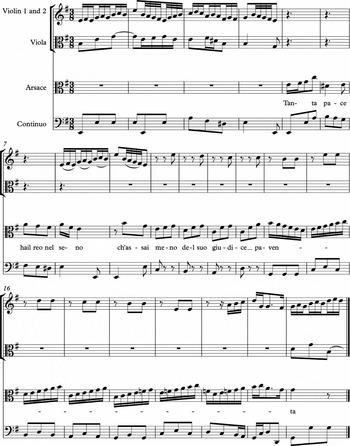
A glance at the musical construction of the aria (see Example 1) suggests why Senesino might have preferred it to a new and more virtuosic setting. After a brief instrumental ritornello of a gentle, almost playful character, the singing voice plunges the listener into a different expressive world. An initial rising line suddenly leaps down by a diminished seventh in bar 6, conveying not so much a sense of ‘pace’ (peace), but a distinct lack thereof. Gradually widening intervals in bars 10–13, including the use of tritones, increase the level of intensity. The coloratura semiquaver runs at bars 14–20 on ‘paventa’ (and later accompanying such words as ‘s'affanna’ and ‘spaventa’) are organized largely in downward sequence; these inject some fluidity into the vocal line while retaining the characteristic wide consonant and dissonant intervals. These would have provided a challenge to the seamless legato that was, alongside perfect intonation and sweetness of tone, one of the most praised qualities of Senesino's voice.Footnote 60 Orlandini's aria could therefore have successfully fulfilled the double task of introducing to the audience of the Haymarket both Arsace, the hero of the opera, and Senesino, the newly arrived castrato, had this opera been the first he sang in London.
Giuseppe Maria Orlandini,‘Tanta pace ha il reo nel seno’, Arsace, Act 1 Scene 8, bars 1–22. Transcribed from D-B Mus.ms 16371

The presentation of the hero as a sensitive and unjustly accused victim is emphasized further by the prison sequence in Act 3, which climaxes with his final farewell before he is taken away to be executed. The prison scene was a popular topos in the dramma per musica. Generally revolving around a male prisoner (often the hero) and extending over two or three scenes, it was a privileged dramatic locus for expressing a range of emotions and masculine virtues.Footnote 61 The prison sequence in Arsace does not, in its general characteristics, differ from several examples in other operas of the period, but it does present some unusual features which further the focus not only on the hero/Senesino, but also on his pathetic representation. Although Arsace had been confined in the royal apartments under ‘house arrest’ since Act 1 Scene 11 (which in fact allows most of the opera to function as an extended prison sequence), the prison scene proper takes place in an actual prison, and may have relied on the visual representation of those elements such as chains, stones and darkness that generally characterized these scenes and amplified their expressive power.Footnote 62
As expected, the prison sequence begins with an accompanied recitative (‘Un palco infame a me?’, Act 3 Scene 4), which lends gravity, and climaxes with the hero's farewell aria (Scene 6). A sequence of scenes unfolds in a series of dialogues first between Arsace and his friend Megabise (ending with Arsace's aria ‘Appreso hai tu da me’, in Scene 4), then between Megabise and Rosmiri (ending with Megabise's aria ‘Tutte le più vezzose’, Scene 5), then Arsace and Rosmiri (concluding with Arsace's aria ‘Se sol la mia morte’ / If only my death, Scene 6), and finally Rosmiri alone (concluding with Rosmiri's aria ‘A morir senza di me’ / To die without me, Scene 7) – all ending with arias of varied character. What is unusual here is the order in which the different affections are expressed. Normally the prison sequence opens with a sombre monologue or a lament (a ‘prison aria’), which reflects on present conditions and exposes the hero's vulnerability, before concluding on a more positive note with a heroic aria. Here, though, the opposite is true, with an opening monologue in accompanied recitative expressing disbelief and rage (‘Un palco infame a me?’), which then progresses to a more heroic, solemn aria (‘Appreso hai tu da me’) and concludes with an aria almost in lament style (‘Se sol la mia morte’), which was to become a ‘hit’.Footnote 63 Rosmiri's attempted suicide is also changed into a less dramatic fainting episode that does not steal the show from Senesino, who simply lays her on a couch and sings his farewell aria practically alone on stage, before Rosmiri revives in the next scene.
What is even more atypical, if not unique to Arsace, is the fact that the hero actually dies, making these scenes, and especially his last aria, exceptionally poignant. ‘Se sol la mia morte’ is an aria of extraordinary beauty that Senesino himself is likely to have inserted to replace Salvi's ‘Chiuse al giorno, aperte al pianto’. Both arias, while referring to Rosmiri's eyes (pupille), dwell on looming death; but while Salvi's text was a direct response to Rosmiri's collapse and possessed a stronger funereal character, with direct reference made to the ‘meste esequie’ (sad funeral), the more fluid senari of ‘Se sol la mia morte’ introduce the concept of the peace that death can bring:
If only my death, / beloved eyes, / can make you happy, / I willingly go to die. / For the peace of our minds / let us jointly agree / that you put an end to your cruelty, / and I'll do the same to my sufferings.
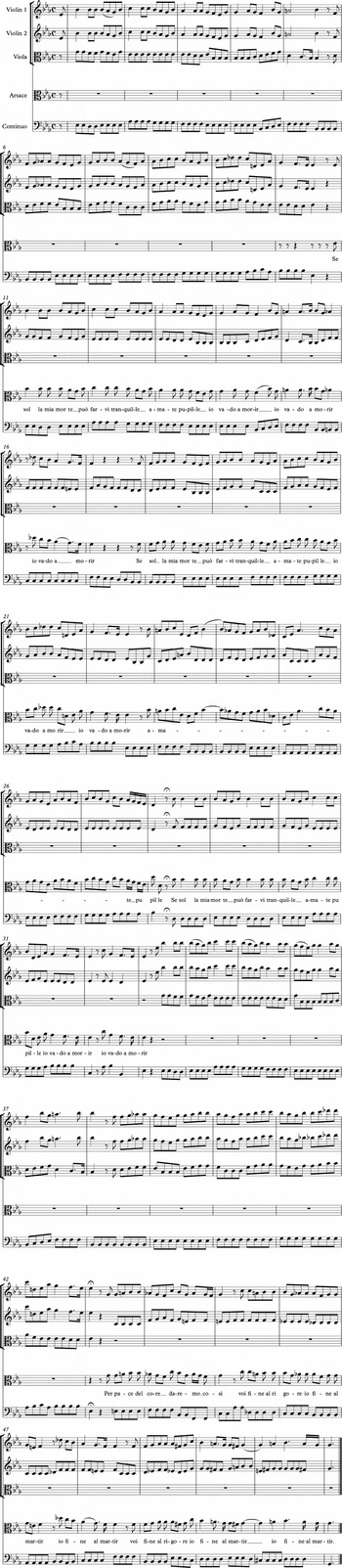
Peace is indeed what the musical setting expresses, in contrast to Arsace's first aria in the opera, which seemed to signal a lack of it; see Example 2. This sense of peace is especially present in the A section, with its fluid cantabile, regular stepwise motion and ascending progressions (as found, for instance at bars 6–9 and 18–21), while the brief B section is more chromatic and dissonant. Elements of the seventeenth-century lament aria are retained, such as the use of repeated ostinato quavers and sparse indications of ornamentation.
Giuseppe Maria Orlandini?,‘Se sol la mia morte’, Arsace, Act 3 Scene 6. Transcribed from D-B Mus.ms 16371

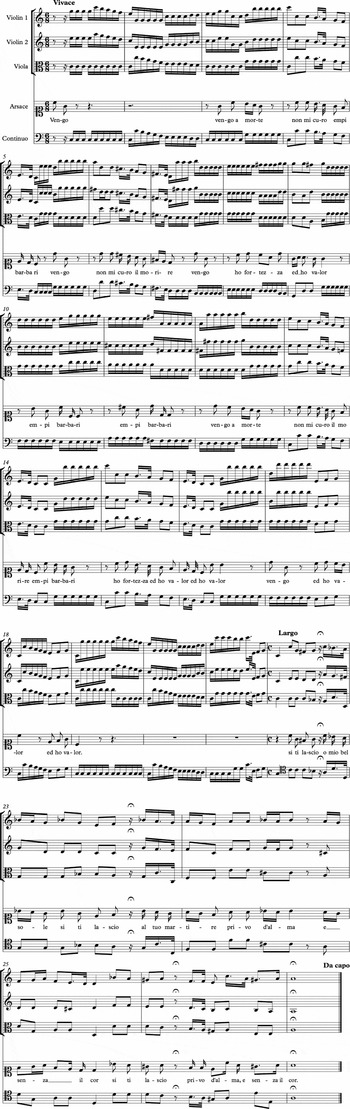
In order to appreciate the atypical features of this prison sequence, one may look to Sarro's setting of Arsace for Nicolini in Naples in 1718 (a few months after the setting by Michelangelo Gasparini in Venice, also for Nicolini).Footnote 64 The sequence opens with a short arioso (‘Cieca sorte’) framed by a section in accompanied recitative (‘Morte sì vile a me?’), which, according to Angela Romagnoli's extensive study of prison scenes of this period, can be defined as a classic ‘prison aria’, its solemn character created by the use of repeated notes in dotted rhythm (in the French style) interrupted by rapid broken chords.Footnote 65 The scene then unfolds in a succession of secco and accompanied recitatives, all sung by Arsace/Nicolini, and climaxes with Arsace/Nicolini's heroic ‘motto’ aria ‘Vengo a morte’ (I come to death) (Example 3). The abrupt opening (marked Vivace), followed by incisive vocal motives sung against the rapid hammering semiquavers of the strings, frames Arsace's farewell to Rosmiri in the B section of the aria. In this tender Largo, where Arsace ceases to address the ‘empi barbari’ (pitiless and cruel ones) and turns to Rosmiri, the strings abandon the pressing concitato of the A section and support the voice more or less in rhythmic unison throughout. The complete textural breaks after each statement of ‘Si ti lascio’ (Yes, I leave you) lend emphasis to Arsace's expressive farewell, which contrasts greatly with the sudden firm reprise of ‘vengo’ in the da capo. It is Rosmiri then, and not Arsace, who, left alone on stage after Arsace's heroic exit, concludes the prison sequence with a lament aria (‘Idol mio se tu morrai’).Footnote 66
Domenico Sarri, ‘Vengo a morte’, Arsace, Act 3 Scene 4 (Arsace, facsimile edition, Garland Opera Series: Italian Opera, 1640–1770 (New York: Garland, 1978))

No doubt prison scenes were a favourite of Senesino's celebrated predecessor in London, Nicolini, whose universally recognized acting skills would have been shown to great advantage in such scenes. He had starred in more than twenty of them prior to 1718, and had revised Mancini's opera Gli amanti generosi for his production in London (as Idaspe fedele in 1710 and 1712) so as to add a second prison scene to the existing one.Footnote 67 On the other hand, Senesino, while still a good actor, does not appear to have privileged them in any special way; in fact, he seems to appear more frequently in prison scenes once in London, perhaps owing to the audience's expectations after Nicolini's success.Footnote 68
Senesino had specifically chosen Arsace for his debut in London: to introduce himself to the London audience, to the Royal Academy of Music and to Handel. His aim was to convey an image of himself as a man of letters (which he was) and of refined taste (worthy of the elite he was addressing), a capable musician and a singer with an extraordinary quality of voice that compared favourably with his illustrious predecessor, but with an artistic identity of his own.Footnote 69 His six arias throughout the opera together reinforce the image of the sincere, unjustly accused victim – a victim in love (not of love), always in control of his passions. Significantly, Arsace does not attempt to move anyone within the diegesis: both narrative and dramaturgy (as modified by Rolli) allow him to direct his persuasive action unmediated to the listener, thus maximizing the opportunity to engage directly with his new audience. As already noted, his highly expressive arias are devoid of ostentatious coloratura, so transforming the listener's appreciation of the character: while the text defines the character as stubbornly fixed in his heroic stance, the musical setting lends him an expressive, pathetic, truly likeable voice, which would naturally have been augmented by Senesino's particular brand of performance. They also begin to construct a consistent image of his artistic persona – similar to those ‘star's trademarks’ that, as Berta Joncus argues, allow the star singer to function as ‘signifier’.Footnote 70
For all that, the lack of (written) virtuosic coloratura in Senesino's arias in this opera is surprising. While we would look in vain in Senesino's repertoire for the impressive vocal acrobatics of a Farinelli, Orlandini's preserved arias from 1715 and Amadei's new arias for 1721 appear rather modest, in terms of proportions and virtuosity, in comparison with some of the arias written previously for the singer, especially in Naples by Francesco Feo, Leonardo Leo and Alessandro Scarlatti, and even more with those written by Lotti in Dresden, which are clearly characterized by virtuosic qualities.Footnote 71 Johann Joachim Quantz, who observed Senesino in Dresden (1717 and 1719) and in London (in 1727), describes how he could sing ‘an allegro with fire, and he knew how to thrust out the running passages with his chest with some speed’. He also commented that ‘the role of a hero suited him better than that of a lover’. (‘Das Allegro sang er mit vielem Feuer, und wußte er die laufenden Passagien, mit der Brust, in einer ziemlichen Beschwindigkeit, auf eine angenehme Art heraus zu stoßen . . . Die Rolle eines Helden kleidete ihn besser, als die von einem Liebhaber’.)Footnote 72 This observation, which at first reads as a commentary on Senesino's tall and elegant physique, may refer instead to his flair in singing bravura arias, as the ‘lover’ and the ‘hero’ often combined in the primo uomo part in opera seria. It therefore remains surprising that a prominent virtuoso such as Senesino, on his debut in a major European capital which was soon to become one of the most important operatic centres outside Italy, did not capitalize on such a tool for establishing his artistic primacy and identity.Footnote 73
While it was a mark of identity and stardom, highly ornamented singing was also the target of much criticism directed at opera during the eighteenth century: it destroyed verisimilitude and made words unintelligible. Ludovico Antonio Muratori, among the severest of critics, condemned, among other things, the ‘soverchio uso delle crome, e semicrome, e delle minutissime note, dalle quali si rompe la gravità del canto’ (excessive use of quavers, semiquavers and the most minute notes, which break the gravity of the singing), and charged ornamented singing with being one of the main elements that lent opera its effeminate character.Footnote 74 While the association between ornamentation and effeminacy does not appear to have preoccupied Senesino – his ‘woman-like’ voice and extraordinarily sweet pathetic singing would have equally qualified as effeminate, according to Muratori – he may have taken contemporary charges against naturalness more seriously. Senesino was often praised for the simplicity of his singing. Quantz noted that ‘he did not overload the slow movements with arbitrary ornamentation, but brought out the essential ornaments with the greatest finesse’ (‘Das Adagio überhäufte er eben nicht zu viel mit willkührlichen Auszierungen: Dagegen brachte er die wesentlichen Manieren mit der größten Feinigkeit heraus’).Footnote 75 Actor Luigi Riccoboni, who also had the chance to hear Senesino in London, in 1727, praised him as an ‘excellent Musicien, & qui ne s'est jamais laissé entraîner par le goût de la nouvelle Musique’ (excellent musician, who never suffered himself to be carried away by the taste for the new music).Footnote 76 He placed Senesino among the exponents of the older pathetic style, a style of singing and, more generally, of performing that was associated with the ‘golden age’ of Italian music, the age of composers such as Giovanni Bononcini and of singers such as Vittoria Tesi and Francesca Cuzzoni. This tradition came to be opposed to the technical virtuosity of younger composers, such as Nicola Porpora, and virtuosos such as Faustina Bordoni and, above all, Farinelli, all of whom also starred on the London stage.Footnote 77
It is clear from Tosi's and other writings of the time that the main charge against technical virtuosity and extended coloratura was artificiality and the lack of naturalness. Bononcini often exploited such connotations in his London operas. Compare, for example, his two arias for Senesino, ‘Dolce sogno’ and ‘Si già sento l'ardor che m'accende’, in Griselda (1722). ‘Dolce sogno’ is a delightful aria in a lulling 3/8 time, marked Lento e piano sempre. The limited compass and the relatively low register (b–c♯2) are perfectly suited to Senesino's range, with short and contained passages of coloratura. This aria was singled out by Rolli (who revised the libretto of Griselda) for its mimetic and pathetic effect.Footnote 78 But while exemplifying Bononcini's typical musical style (and writing for Senesino), this aria also gives voice to the real feelings of the character of Gualtiero, in clear contrast to ‘Si già sento’, in which he instead fakes passion for Almirena. This aria, an Allegro assai, is characterized by a bold and accentuated virtuosity with trills, long and fast colorature, and a wide compass that forces Senesino up to g2 (which was very high for him). Senesino/Gualtiero's deception unfolds through musical means; the music enacts the metaphorical association between artifice and gratuitous virtuosity, and tells the audience that he is deceiving both Griselda and Almirena. Similar strategies are at play in Astarto, where Senesino's most virtuosic aria (the added ‘L'onor severo’) is inserted into a scene that plays with the confusion between Clearco's and Astarto's identities. It should now be clear that Senesino's avoidance of extensive coloratura in his arias in Arsace was key to the portrayal of Arsace as an honest, sincere and reliable character. By the same token, the charming and sensitive on-stage persona emerging through this dramatic role, and especially through his singing, may have moderated the perception of the singer's disagreeable off-stage persona.
As we know, Arsace did not reach the stage until 1 February 1721. It may well have been the quarrel with Heidegger that caused the production of Arsace to be delayed until then, meaning that Senesino's London debut instead took place in Bononcini's Astarto (which opened on 19 November 1720). However, the arrival of Bononcini, who had already had a smash hit in London with his Trionfo di Camilla regina de’ Volsci,Footnote 79 was eagerly awaited by the London audience and Senesino alike, and may have been seen by the singer as offering an even better chance to be cast in a favourable light. Bononcini's London operas were to be highly successful, and his characteristic style perfectly suited Senesino's quality of voice. Astarto, like Arsace, casts the hero as the innocent victim of a conspiracy, and while it features considerably more virtuosic arias, it lent itself to the expression of the sorrowful affects that Senesino wanted to convey in his strategy of vocal self-fashioning. Like other singers, Senesino strove to control his public image, and he understood the importance of presenting himself in the best possible light to new audiences. This was achieved through the synergy of narrative, rhetoric and dramaturgy that led to the enhancement of Senesino's most valuable asset: his voice.
APPENDIX
Letter from Paolo Rolli to Giuseppe Riva of 18 October 1720
Londra il 18 d’8bre 1720
Caro Riva
. . . Sappiate che la Marg[herit]a di concerto col n[ost]ro Senesino proposero l'opera d'Amore e Maestà, la qual'opera non può farsi come a Firenze, perchè così saria d'innumerabile recitativo e di tante poche ariette; che il Sen[esi]no n'avrebbe 4 sole in tutto. ebbi ordine dunque d'acconciarla, e di concerto con amendue tolsi ed aggiunsi e cangiai il necessario. L'Alpeste Fauno per lo sistema antico ch'ei sempre propone per mostrare che quanto si fa è il medesimo ch'era prima, propose il Polani ad accomodare e diriger l'Opera. Furie dunque nel n[ostr]o Sen[esin]o. Opera da lui proposta, necessaria nova musica per l'aggiunto e per quello egli ci vuole variato, nemico di far pasticci d'arie vecchie, Desideroso d'aver un'uomo al Cembalo, Sua prima uscita con un coglione: sono stati motivi tutti di suo risentimento. Il Fauno mi gli fece dire ch'ei non contraddicesse: ed io passai la silvestre ambasciata: ma non potendo ritenerlo, lo consigliai d'andare egli stesso a parlargli con dolce risolutezza che dicesse voler'aver tutta la Deferenza a’ suoi consigli: ma in cio’ che riguarda la propria stimazione, pregarlo a ben considerare tutti li sopraccennati motivi. Ch'egli non avea privata passione contro alcuno non che contro al Polani; mentre avrebbe sotto di lui recitata ogn'altra Opera che i Sig[nor]i Direttori medesimi fossero per scegliere, ma non mai un'opera offerta da lui stesso e della quale la Corte de’ Sig[nor]i Direttori naveagli chiesto ragione per lo buon'esito. in somma che non potendosi già recitar quest'Opera come stava; non v'era Luogo di recitarla in tal maniera. ch'ei non proponeva alcun'altro, mentre l'Accademia à presso di se bravissimi Maestri. L'Uomo restò, e domandogli se qu[est]o era un mio raggiro = Za˗˗˗˗˗ ma n'ebbe assertiva negativa, e notizia ch'avevo già dato l'Esemplare del Drama al Polani, ed esposto solamente i sentimenti della Corte a lui perchè dirigesse il Polani: soggiungendo di più ch'ei non era venuto a dirigere Opere, ma a fare il Musico. Credete amico ch'ei parlò a meraviglia, se parlò come ne ripetè il Discorso. E credete pure che la bella prim'opera andrebbe a terra se quello stupido l'avesse a dirigere: e ciò con piacere del Selvaggio. Domani il Sen[esin]o deve andare alla Corte de’ Sig[nor]i Direttori: egli è questa sera a Richmond per le ripetite istanze del Pri[nci]pe Reale che n’è trasportato, e penso che verrà seco la Margherita Se il Casimiro non sta tanto male; quanto mi si dice essere stato ne’ giorni passati. Quei Direttori che n'an già risaputo il Fatto come Arbuthnot e il Colon[ello] Blethwait, an detto che saran Domani apposta al Bord per fare tutto quello il Sig[no]r Senesino vorrà, perchè à ragione: e siccome il tutto passa con somma dolcezza e modestia; cosi’ si spera che l'Uomo farà buon viso al cattivo gioco . . . .
Il v[ost]ro Rolli
Dear Riva
. . . I must tell you that Margherita, together with Senesino, proposed the opera of Amore e Maestà, which cannot be given as it was in Florence because there would be interminable recitative and so few arias: Senesino would have only four in all. So I was instructed to adapt it, and working with the two of them I made the necessary cuts, additions and alterations. The Alpine Faun [Heidegger], following the old system which he always proposes, to prove that what is being done is the same as before, suggested that Polani should adapt and direct the opera. So fury on Senesino's part: the opera had been proposed by him, new music is necessary for the additions, and for these he wants something new: he objects to having pasticcios of old arias, and wants to have a man at the harpsichord, his first appearance with an idiot: all these have been the reasons for his resentment. The Faun got me to tell him not to argue; and I conveyed the rustic message; but being unable to restrain him, I advised him to go himself and talk to him gently but firmly, and he might say that he was willing to show all deference towards his advice, but as regards his own estimation, to beg him to consider all the above reasons; that he had no secret resentment against anyone, including Polani; while he would sing under him any other opera that the Directors themselves might choose, but never one suggested by himself, for the success of which the Directors had made him responsible; in short that, it not being possible to give the opera as it was, there was no way of performing it in such a manner: that he would not propose any other, since the Academy has excellent musicians at its disposal. The Man bridled, and asked him if this was a trick of mine, but received a negative reply, and the information that I had already given a copy of the opera to Polani, and merely explained to him the Board's opinion that Polani should direct it, further adding that he [Senesino] had not come to direct operas but to sing. You must believe, my friend, that he spoke wonderfully well, if it was as he told me. And you can indeed believe that the fine first opera would be a disaster if that idiot were to direct it, and that would please the Wild One [Handel?]. Tomorrow Senesino is to go to the Court of Directors; this evening he is at Richmond because of the repeated requests of the Prince of Wales, who is thrilled, and I think that Margerita will come with him if Casimiro is not as ill, as I have been told in the last few days. Those Directors who have already been told about the matter, like Arbuthnot and Colonel Blathwayt, have said that tomorrow they will be sure to be at the Board, to do everything that Signor Senesino wishes, because he is right; and since everything is done with the utmost gentleness and courtesy, it is hoped that the Man will put a good face on a bad game . . . .
Your Rolli