Relocation of dairy cattle to a new facility offers many benefits. But, initially there is the potential for adverse effects. New flooring surfaces may be more textured than older flooring that is worn from years of scraping and cow traffic. This may lead to increased incidence of lameness due to friction and wear (Phillips & Morris, Reference Phillips and Morris2001). In addition, new concrete is alkaline (pH 12; Heng & Murata, Reference Heng and Murata2004) and caustic, which may lead to increased lameness compared with more neutral, older concrete previously exposed to slightly acidic faeces (Misselbrook et al. Reference Misselbrook, Powell, Broderick and Grabber2005). A benefit to locomotion in a new facility includes a more coarse surface that could reduce slippage (Phillips & Morris, Reference Phillips and Morris2001) compared with an older facility. A milking parlour with increased capacity leads to greater throughput and, in turn, less time standing in the holding area. While increased texture can be an irritant, worn alleys can cause increased slippage and lameness (van der Tol et al. Reference van der Tol, Metz, Noordhuizen-Stassen, Back, Braam and Weijs2005) and lead to thin soles. Thin soles in cows are the result of imbalance of wear and growth and abrasive floors are more likely to lead to thin soles than smooth ones; affected cows usually suffer from painful gait, arched back, and specific leg lameness and are associated with higher moisture content of claws than normal cows (van Amstel et al. Reference van Amstel, Shearer and Palin2004). Going from an open feed bunk to a headlock feed line may have advantages as cows using the post-and-rail barrier had lower feeding times relative to cow using a headlock barrier, suggesting that using a headlock barrier reduces aggression at the feed bunk (Endres et al. Reference Endres, DeVries, von Keyserlingk and Weary2005).
Cleanliness can be used as an indicator of the quality of farm management. Cleaner cows have a reduced the risk of contamination with pathogens, which can lead to improved milk quality (Sanaa et al. Reference Sanaa, Pourel, Menard and Serieys1993; Schreiner & Ruegg, Reference Schreiner and Ruegg2003). The objectives of this study were to determine the effects of relocation on locomotion and cleanliness of two breeds of dairy cows after introduction to a new free stall barn.
Materials and Methods
Animals and treatments
This study was conducted at the Virginia Tech Dairy Cattle Center from March 2004 to October 2004. Before relocation (19 July), Jersey (n=22; 102±63 days in milk, DIM; 22·2±1·0 kg milk/d) and Holstein (n=22; 107±56 DIM, 32·9±1·0 kg milk/d) cows were combined to acclimatize them to a new social structure. The numbers of cows of each breed were balanced for stage of lactation and lactation number.
Before relocation, cows at the old facility were housed in an 8-row free stall barn with diamond-shaped grooved (10·2×10·2 cm; 1·27 cm deep) concrete alleys. Stalls (1·1 m×2·1 m) were bedded with sawdust and partitioned by wooden dividers. A farm employee scraped alleys daily at 3·00. Feeding occurred at 9·00; feed bunks were located centrally to the free stall pens, and were raised 0·68 m from the ground. Automatic watering troughs were located next to feed bunks and at the end of free stall pens. On the morning of relocation, farm employees led cows to the new facility, a distance of approximately 131 m. The new facility was free stall housing with diamond-shaped grooved (11·4×11·4 cm; 1·27 cm deep) concrete alleys (2·74 m). Stalls (1·2 m×2·3 m) were bedded with canvas mattresses above the concrete floor covered lightly with sawdust and partitioned by pipe-loop dividers. Cows had access to about 12·0 v. 4·6 m2/cow space in the new and old facilities, respectively. Each alley (3·67 m) in the new facility was flushed twice daily by an automatic alley flush system. Feeding occurred at 10·00 and 14·00. Feed was pushed up prior to 17·00. Feed areas were located in the center of the free stall area and were directly on the ground in front of head lock gates.
The milking parlour at the old facility was a single side-opening parlour with 6 milking stalls. Milking began at 1·00 and 13·00. The milking parlour at the new facility was a double-eight herringbone design. Milking began at 1·00 and 13·00.
Locomotion scoring
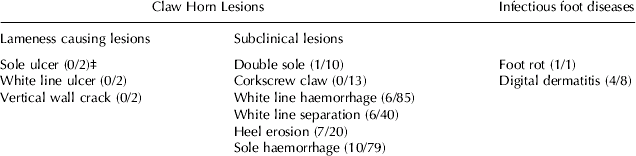
Data collection began in March 2004 with hoof trimming for all cows in the herd (Table 1). The feet trimming and diagnoses were performed by an experienced hoof trimmer who is also a veterinarian; claw disorders were recorded and treatment applied if necessary. Foot disorders were divided into two categories, claw horn lesions and infectious foot diseases, in order to provide a statistical adjustment for prior foot conditions. The disorders of each subcategory were given a numerical value of 1 for each cow and were summed to create a covariate (lesion score or disease score) used to determine the effect of pre-relocation hoof scores on milk yields. Distribution of lesion scores of Holsteins and Jersey was 54·5% for score 0, 22·7% for score 1, 18·2% for score 2, and 4·5% for score 3. Multiple foot disorders were present in 9·1% of cows. Locomotion scoring observations were made as each cow exited the milking parlour walking in a straight line for a distance of 10 m on concrete and while stationary on concrete by a single observer in the afternoon. Locomotion scores were recorded at −29, −13, −7, and −1 d before relocation and scores were collected on d 14, 21, 30, 35, 45, 58, 74 and 86 following relocation. Locomotion scores were on a 1–5 scale with a lower score denoting a more normal locomotion (Sprecher et al. Reference Sprecher, Hostetler and Kaneene1997; Berry, Reference Berry2001); however, there were no cows that scored 5.
Incidence of claw horn lesions and infectious foot diseases for study cows and all cows in the herd at the time of hoof trimmingFootnote †
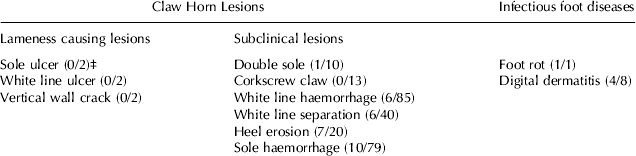
† The disorders of each subcategory were given a numerical value of 1 and were summed to create a covariate (lesion score or disease score) used to determine the effect of pre-relocation hoof scores on milk yields
‡ (n/n)=Number of incidences observed in the study cows (44) from 98 herd cows
Some cows had more than one of the afflictions listed
Cleanliness scoring
Data collection began on 5 July 2004, 2 weeks prior to relocation. Scoring was conducted twice-monthly by two individual observers in the free stall areas. Cleanliness scores were based on a system devised by Cook (Reference Cook2002). Cows were scored on a 1–4 scale on three regions of their bodies: lower leg; udder; and flank and upper leg. Lower scores were indicative of cleaner body regions. A score of 1 signified little flecks or no manure in the region. A score of 2 meant there was minor splashing of manure in the region. A score of 3 indicated distinct plaques of manure with some hair visible, and a score of 4 denoted confluent plaques of manure covering the area. The observer examined the left side of the animal when making cleanliness scores because it is the preferred side for resting on a level surface (Albright et al. Reference Albright, Youngblut, Arave and Wilson1975). The exception to this was udder scoring. The udder was observed from both behind and the left side, to account for manure splashing by the tail. Cows were completely washed 2 weeks prior to data collection to determine individual baselines.
Statistical analysis
Main effects of breed, lactation number, date, and their interactions were tested with the MIXED procedure of SAS (SAS Institute, Inc., Version 8.2, 1999, Cary NC, USA) with cow (treatment by breed by lactation number) as subjects. Dependent variables were locomotion score, udder cleanliness score, lower leg cleanliness score, and flank and upper leg cleanliness score. All scores recorded at −29, −13, −7, and −1 d were used a covariate observations beginning 19 June 2004 (−1 month, relocation) for locomotion. Cleanliness scores for 2 weeks prior to relocation were the covariate for cleanliness measures. The covariate was created by averaging all scores collected 1 month before relocation to allow for a single score in the pre-treatment period for locomotion and the 2-week period of measures was used for cleanliness scores; they adjusted scores by 0·53 and 0·55 points increase in locomotion and cleanliness scores for every 1·0 point increase in the preliminary average (covariate), respectively. Results are presented as least squares means±sem. Differences were considered significant at P<0·05 and trends at P<0·10.
Results
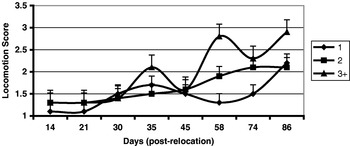
Breed and lactation number did not affect locomotion score (1·6 v. 1·7±0·12 for Holsteins and Jerseys, respectively, and 1·5 v. 1·6 v. 2·0±0·13 for first, second and third and greater lactations, respectively). Moreover, date (P<0·01) and the interaction of date and lactation number (P<0·05; Fig. 1) had an impact on locomotion score. Locomotion scores increased from 1·2 on day 14 to 2·4 on day 86. The lactation number by date interaction showed cows in third and greater lactations had significantly (P<0·05) higher locomotion scores (more lameness) by day 86 (Fig. 1).
Effect of lactation number by day of relocation interaction on locomotion score for Holsteins and Jerseys (P<0·05).

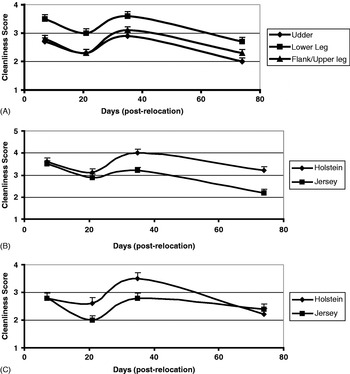
Generally, breed and lactation number did not affect cleanliness. Date and its interactions with breed and lactation number had an effect on cleanliness scores. Overall, cleanliness scores decreased by the end of observation (day 74; Fig. 2A). Breed by date interaction had an effect (P<0·05) on lower leg (Fig. 2B) and flank/upper leg cleanliness scores (Fig. 2C). There were breed differences with respect to lower leg cleanliness, with Jerseys (2·9 v. 3·5±0·10) having significantly lower scores (cleaner) than Holsteins (P<0·01). Lactation number affected lower leg cleanliness, with scores decreasing as lactation number increased (3·4 v. 3·3 v. 2·9±0·10 for first, second and third and greater lactations, respectively; P<0·01).
(A) Effect of day of relocation on cleanliness score (P<0·01), (B) effect of breed by day of relocation interaction on lower leg cleanliness (P<0·05) and (C) effect of breed by day of relocation interaction on flank/upper leg cleanliness (P<0·05) for Holsteins and Jerseys.

Discussion
At the time of hoof trimming the most prevalent claw horn lesions were sole haemorrhage (n=10) and heel erosion (n=7) based on individual hoof observations. Prevalence of clinical lameness in herds in Wisconsin, USA is 11·1% v. 24·0% for herds using sand v. mat surfaces in free stalls (Cook et al. Reference Cook, Bennett and Nordlund2004) which may be due to location and differences in stall and alley materials. Locomotion scores appeared to decline for the month before the relocation event and improved to about 21 d after relocation (data not shown). Locomotion deteriorated subsequently, i.e. higher scores. The initial decline in locomotion agrees with the findings of de Passille & Rushen (Reference De Passille and Rushen2006) who found gait scores on non-lame cows were worsened for at least 6 weeks after hoof trimming.
There was no effect of breed on locomotion. Peterse (Reference Peterse1985) suggests that Jerseys are less susceptible to lameness problems than Holsteins; however, relocation did not result in significant changes in locomotion score between the breeds. Date had the same effect across both breeds, with locomotion scores increasing as time progressed. The lactation number by date interaction revealed that third and greater lactation cows had more severe and sporadic locomotion scores (Fig. 1). First lactation cows had relatively stable scores until the increase at day 86, supporting previous findings with respect to multiparous cows and lameness due to metabolic stress from high milk yield (Barkema et al. Reference Barkema, Westrik, van Keulen, Schukken and Brand1994) and increased age (Eddy & Scott, Reference Eddy and Scott1980).
The reason for the higher locomotion scores after relocation may be multi-faceted: cow hooves could be irritated owing to the increased aggregate effect of the new flooring (Phillips & Morris, Reference Phillips and Morris2001; Vokey et al. Reference Vokey, Guard, Erb and Galton2001); the increased alkalinity of new concrete may slowly erode hoof health (Bray et al. Reference Bray, Beede and DeLorenzo1992); or cows could spend more time exploring their surroundings, degrading the hoof over time. Van Amstel et al. (Reference van Amstel, Shearer and Palin2004) finds that thin-soled cows have clinical signs of painful gait, arched back, and specific leg lameness. Increased locomotion scores were not evident until after day 58. Van der Tol et al. (Reference van der Tol, Metz, Noordhuizen-Stassen, Back, Braam and Weijs2005) reports that concrete floors do not provide enough friction to allow natural gait behaviour and slips occur from an inability to adjust walking to the frictional properties of a floor. Altered gait results in less confidence when floors are slippery, suggesting that adjustment in behaviour due to concrete might be detrimental to the welfare of the cow when she endures a prolonged confinement. Holstein and Jersey locomotion scores were affected similarly, suggesting that neither breed is more or less susceptible to lameness issues as a result of relocation to a new facility.
Jerseys (mean=2·9±0·1) had lower cleanliness scores for the lower leg region than Holsteins (mean=3·5±0·1) which suggests that the larger free stalls in the new facility allowed them to fully move themselves closer to the neck rail away from the alley while lying. Older cows were also cleaner in the lower leg region, possibly due to more time spent lying down. The effect of date on cleanliness showed that cows across breeds benefitted from relocation; scores for the three body regions improved from pre-relocation scores. Another explanation for improved lower leg cleanliness may be that cows stood in the alleys during flushing or that the new facility was flushed twice daily compared with one scraping daily for the older facility. Differences in stall base, which affects drainage, and free stall design could impact cleanliness. Tucker et al. (Reference Tucker, Weary and Fraser2005) find that the neck rail design is important in controlling stall cleanliness. Stall dimensions impact cleanliness of cows (Tucker et al. Reference Tucker, Weary and Fraser2004). It should be noted that there was a decrease across all cleanliness scores over time; the increase in cleanliness score at day 26 can be attributed to a defective water recycling pump that did not allow for normal alley flushing the previous week (Fig. 2).
Overall, cow cleanliness benefitted from relocation. All regions of the body that were examined had improved cleanliness scores at the end of observation. The most likely cause of this is the improved and more frequent cleaning of alleys, the use of larger free stalls (Nordlund & Cook, Reference Nordlund and Cook2003; Tucker et al. Reference Tucker, Weary, de Passille, Campbell and Rushen2006) and reduced aggression at the feed bunk (Endres et al. Reference Endres, DeVries, von Keyserlingk and Weary2005). Jerseys benefitted more from relocation, showing greater improvement in flank/upper leg and lower leg cleanliness than Holsteins.
In conclusion, all cows were cleaner (lower scores) on all body regions after relocation, suggesting that the new facility improved hygiene. Locomotion scores increased as time passed, which suggests that changes in locomotion scores in the new facility were gradual.