Introduction
Research in the field of Developmental Origins of Health and Disease (DOHaD) overwhelmingly demonstrates that the environment in which the embryo, fetus and young child grow and develop influences short- and longer-term health and well-being. Pregnant women and children under the age of 2 years have thus become an important target of interventions under the rubric of the first thousand days of life. However, this model may inadvertently place responsibility for health outcomes on pregnant women and mothers, and deflect attention from other windows for intervention.
This commentary identifies these as framing problems in DOHaD interventions and we argue for integrated and inclusive interventions that encompass broader social contexts. Drawing on our research in African settings, we offer two examples. First, future interventions should retain a strong focus on girls, women and mothers (with a view to supporting and empowering them), but should also expand to include a range of actors, including but not limited to masculine roleplayers and other family members, while being cognizant of the gender and other social roles inherent in these framings. Second, broader action frameworks should encompass life-course approaches that identify multiple windows of opportunity for intervention. We consider current evidence on interventions in different stages of the life course, such as adolescence, and discuss the importance and challenges of intervention design when these are placed within a broader social context. With these two examples we suggest how a wider conceptualization of relations may offer a useful framing.
Framing the problem, framing the solution
Criticisms levelled at DOHaD interventions have often centred on two problems: (1) causal inference without adequate evidence and (2) discourses of blame. As Winett et al. suggest, these result from the particular frames in which DOHaD research is communicated: ‘Frames tell us which features are within a problem’s parameters, and which are outside of it. Because they characterize a problem as being of a particular type (and thus not another), frames also tell us literally and by abstraction what the problem is, why it matters, what can be done about it, and who is responsible’.Reference Winett, Wallack and Richardson 1
The cultural naturalization of females as primary caregivers often places the DOHaD focus squarely on mothers, with the potential to invoke maternal blame.Reference Richardson 2 Although significant research demonstrates the importance of paternal epigenetic effects,Reference Murphy, Jenkins and Carrell 3 early interventions have often been framed around maternal behaviour or the dyad, based on the assumption that, of the parents, it is the mother whose role is most pivotal in impacting the multiple factors that may compromise the nutrition and well-being of the fetus or young child.
Another question about the framing of DOHaD interventions arises from the intense focus on the first thousand days between conception and 24 months. There is increasing recognition that, although this period is central to DOHaD as an important period of plasticity and site for intervention for generational well-being, the first thousand days may be too narrow a time frame and other points of intervention should not be overlooked. Falconi et al.Reference Falconi, Gemmill, Dahl and Catalano 4 analysis of cohort mortality data from France, England, Wales and Sweden points to adolescence as an important plastic developmental window. Prentice et al.Reference Prentice, Ward and Goldberg 5 argue that adolescence warrants particular attention in their call for a return to more comprehensive approaches to nutrition interventions. On the basis of their data from the Gambia and longitudinal data from a consortium of studies in Brazil, Guatemala, India, the Philippines and South Africa, they have demonstrated that height recovery can occur throughout childhood and especially during adolescence. As Viner emphasizes, because the knowledge adolescents acquire and the health behaviours they adopt are largely carried forward into adult life, such learning has a profound impact.Reference Viner, Ozer and Denny 6 Hence, the effective engagement of adolescents in the context of DOHaD provides a significant opportunity to frame constructive roles and responsibilities across genders at a formative time, although doing so requires recognition of the complex interplay during this developmental phase of family, peer, school, societal and cultural influences.
Anthropological work has shown how narrow time frames for interventions may have inadvertent side effects. For example, in the South African context, TruytsReference Truyts 7 has shown that although pregnant women may be well supported, their access to food diminishes after birth, and particularly in the weaning period, jeopardizing their own health. She demonstrates that in conditions of impoverishment, maternal access to nutrition is shaped, in part, by networks of support and belonging, and, in part, by ideas about priorities. Still other researchers are attempting to circumvent the problems of evidence and blame we have highlighted by thinking with an ecological framework. Prescott and Logan’s ‘ecological justice perspective’Reference Prescott and Logan 8 attempts to account for ‘the upstream drivers of place-based health’, considering parenting, nutrition, mental health and health inequities in an ecosystems context, which is one way to decentre the focus on the mother–child dyad and design interventions across multiple scales.
These different ways in which DOHaD interventions are framed are important given that they are generative of perceptions of responsibility and can contribute to the perpetuation of gender, race and class biases in how scientific research is conducted and reported, and who is included or excluded in policy frameworks.
Beyond the dyad: current evidence
This brief report suggests that initial steps towards more inclusive DOHaD frameworks require the effective engagement of a broad range of actors in intervention design, the expansion from singular ‘windows of opportunity’ to multiple interventions along stages of the life course, and the development of interventions with reference to wider social context. Looking at two examples – the involvement of men and the engagement of adolescents – it is clear that although there is general recognition of relevance and potential benefit, DOHaD-related research has not sufficiently taken questions of framing and multiple interventions into account.
Involvement of men
Although health-promoting agencies have long recognized that men should be targeted when addressing sexual and reproductive health promotion, few studies have evaluated its effect or how this is best done.Reference Sternberg and Hubley 9 Sternberg and HubleyReference Sternberg and Hubley 9 reviewed 24 studies reporting interventions that targeted heterosexual men and contained evaluation data and concluded that positive change would be very difficult or impossible without the inclusion of men. This review’s principal finding was that active male involvement was crucial to both the successful provision of knowledge and the empowerment of women targeted by the programmes, and we would argue that male involvement in the context of promoting the DOHaD agenda is equally important. There was also evidence relevant to current trends in communication that the use of social media is an effective strategy; however, no studies comprehensively evaluated the impact of the intervention on the lives of the men themselves or on their partners and families.
A recent global systematic review of 92 parenting intervention programmes from 20 countries showed that evidence relating to inclusion of fathers, where present, is commonly secondary to the evidence pertaining to mothers, and that evidence relating to couple v. individual participants is generally missing, despite the stance that including fathers is ‘good science and good practice’.Reference Panter-Brick, Burgess and Eggerman 10 In addition, the review shows that current research on fathers as caregivers is largely confined to the global North, with little work done thus far in settings of the global South. As engaging with fathers is one of the least well-explored and articulated aspects of parenting interventions, we suggest this represents an important area for future research linked to the DOHaD agenda.
In the South African context, anthropological research on fathers points to the need for interventions that are sensitive to local configurations of parenting and gender roles. For example, Mayekiso’s researchReference Mayekiso 11 with men who had fathered children with HIV positive women in South Africa demonstrates that men’s identities as fathers are strongly shaped by cultural models of ‘provider masculinity’.Reference Connell 12 – Reference Mavungu 14 Although male roles can include support of women and children, even in the absence of recognized or formalized marriages and material household infrastructures,Reference Richter and Morrell 15 men’s abilities to offer support are shaped by multiple factors that include their structural positions, cultural ideas about rights over children (legitimated through legal or customary marriage and impregnation fines), normative gendered ideas within public hospitals about whether men should accompany their partners and what roles they can play, the diverse roles and responsibilities of the broader family in relation to individual children at different ages, and the roles of other significant women in households, particularly mothers and mothers-in-law.Reference Moses 16
Engagement of adolescents
Similarly, there is little work on the engagement of youth in the DOHaD agenda thus far, all of which utilizes school-based health promotion models. Promoting integration of DOHaD-linked knowledge and health practices into school curricula is one approach; the WHO Health Promoting School model offers an effective starting pointReference Macnab 17 ; however, there are concerns about whether teachers are prepared to take on this role. In South Africa, for example, calls for school-based health promotion have not translated into practice because of current dysfunctions in the education sector and resistance to progressive health messaging around reproductive rights.Reference Vergnani, Flisher, Lazarus, Reddy and James 18 School-based behaviour change interventions with adolescents show some promise,Reference Bay, Mora and Sloboda 19 , Reference Bay, Yaqona and Tairea 20 but, importantly, such interventions require careful design to avoid frames that again inadvertently place responsibility too squarely in one corner.
Discussion: towards inclusive DOHaD frameworks
The International DOHaD call to action in the Cape Town manifesto 21 calls for DOHaD to be presented as a new and exciting way to achieve a healthier life, and not as just another approach to health promotion that provides population-level instruments. Our commentary adds that such interventions should be framed with inclusivity, and incorporate a comprehensive approach.Reference Winett, Wallack and Richardson 1 In public health, the cornerstone for prevention is the promotion of awareness, and, in this regard, the DOHaD agenda is no different, but to achieve effective change, how, when and among whom this awareness is generated has to be established, and the opportunities and challenges of doing so considered. For example, the shift to include the pre-conception period in DOHaD frameworks is an important move to expand the DOHaD focus, but, unless carefully executed, risks increasing attention on reproductive women as the agents responsible for future health. Likewise, shifts in attention to focus on fathers or other groups need framing in a constructive and inclusive context to avoid generating new DOHaD-related stigma.
Seeking a more comprehensive framework, RossReference Ross 22 and MayekisoReference Mayekiso 11 have developed a concept of ‘social attachment’ that seeks to locate new life in a broad social framing to understand how human well-being is envisaged and enacted in specific contexts. The concept expands the traditional psychoanalytic concern with maternal relations to take into account the range of people who are constellated around reproductive events and children’s lives and whose influence may be determinative in well-being at different times in the life cycle. Although mothers and other female caregivers may be central, particularly in the early years, and although it is vital to support women as they bear and rear children, we need also to identify the range of resources and possibilities that are available and how they shape both physical and mental health. Different players are likely to have different impact at different times in the life cycle. Fathers and others can also be guided to assume a significant role in shaping feeding and rearing practices after birth. Mothers-in-law and grandmothers appear to play critical roles in early years, whereas schools (i.e. the state) and peers are more significant for teenagers. In the Southern African context with which we are most familiar, where apartheid and HIV have devastated traditional familial relations, roles and hierarchies, carers other than mothers are in the foreground. Grandmothers and maternal uncles (important given high rates of father absence), for example, might be two other categories that have wide cultural salience for directed intervention.
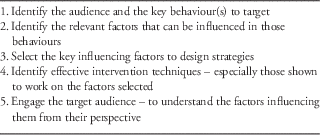
Starting with this broader social framing in mind, it becomes clear that a number of groups form part of the target audience for DOHaD interventions. Working with Darnton’s principles for developing behaviour change interventionsReference Darnton 23 (Table 1), the first five (Table 1) are particularly relevant to DOHaD. Although these principles underscore the need to identify the audience and select key behaviours that form useful targets for intervention, they propose that, in addition to defining the demographics of a target group, attention must be paid to what information to promote, and how and when these messages are best delivered.
Darnton’s principles for behaviour change interventionReference Darnton 23

Returning to our two examples, men and adolescents, what are strategies for producing more inclusive interventions in these cases?
First, more inclusive health promotion strategies would engage across the gender continuum and across a variety of roleplayers. Intervention design should be attentive to gender inclusivity and avoid frames that inadvertently stigmatize or blame. Valuable lessons can be learned from successes in gender-transformative work in other domains. Frameworks designed to involve men in reducing gender-based violence, for example, include engagement at the individual level (e.g. responsible fatherhood programmes), community level (e.g. social media strategies), provider level (e.g. workplace-based programmes) and policy level (ensuring men are included in policy frameworks).Reference Viitanen and Colvin 24 Intervention design needs to account for wide cultural variation in notions of fatherhood and parenting styles.Reference Cabrera and Tamis-Lemomda 25 Reifying men or masculinity can be counterproductive and decrease men’s receptivity to gender equity and health messages.Reference Viitanen and Colvin 24
Second, interventions focussed on adolescents require involvement of a host of other players, including schools and peers. Collaborative strategies are needed to identify the issues, choose appropriate languages and design the interventions so that they are adolescent-centred. Collaborative inter-generational strategies are likely to prove crucial for DOHaD health promotion to generate any sustained behavioural change; an incentive for educators is that novel adolescent-centred avenues for engagement will almost certainly result. It seems sensible to incorporate DOHaD in parallel to issues that have found effective avenues in health promotion, including advocacy for safe and supportive families, creative school environments and interaction with positive and supportive peers. Finally, collaboration needs to be generated between sectors and disciplines that traditionally do not interact (e.g. education, public health, medicine, psychology, social work, epidemiology and anthropology) to facilitate effective DOHaD programme delivery (e.g. government, non-government, school, and community). The process and dialogue necessary for broad societal engagement over DOHaD needs to be established, so that adopting desirable health practices is a feasible, lifelong process.
Acknowledgements
M.P. thanks Abdallah Daar for the invitation to the exploratory workshop on DOHaD at Stellenbosch Institute for Advanced Study (STIAS) in 2016. M.P. and F.C.R. thank the First Thousand Days research team at the University of Cape Town (www.thousanddays.uct.ac.za). A.M. thanks the STIAS for their invitation to work at the Wallenberg Research Centre as a Fellow and to contribute to the exploratory workshop on DOHaD at STIAS in 2016 sponsored by the Wallenberg Endowment Fund.
Financial Support
M.P. thanks the Commonwealth Scholarship Commission for the United Kingdom, and the Institute for Social and Cultural Anthropology at the University of Oxford. F.C.R. thanks the AW Mellon Foundation for enabling research in the broad area of the first thousand days of life and the South African National Research Foundation and the University of Cape Town’s Research Committee for support of some of the work cited herein. The opinions expressed in the article do not necessarily reflect those of funders.
Conflicts of Interest
None.