Introduction
The World Association for Disaster and Emergency Medicine (WADEM; Madison, Wisconsin USA) is a multidisciplinary professional association whose mission is the global improvement of prehospital and emergency health care, public health, and disaster health and preparedness.Reference Fitzgerald, Tarrant and Aitken1 WADEM recognizes its responsibility as a multidisciplinary leader in health to provide guidance and engage in disaster risk reduction. The development of this WADEM Oceania Special Report on the Health Impacts of Volcanic Activity was undertaken by the WADEM Oceania Chapter who are cognizant of the threat that active volcanism poses to population health and livelihood in the Asia-Pacific region.
Following a structured session dedicated to investigation of health impacts of volcanic activity in Oceania at the WADEM Congress on Disaster and Emergency Medicine (WCDEM) Brisbane 2019, the WADEM Oceania Chapter developed this Special Report. The target audience for this Special Report includes WADEM members, readers of Prehospital and Disaster Medicine, and the global disaster health community.
Volcanoes of Oceania
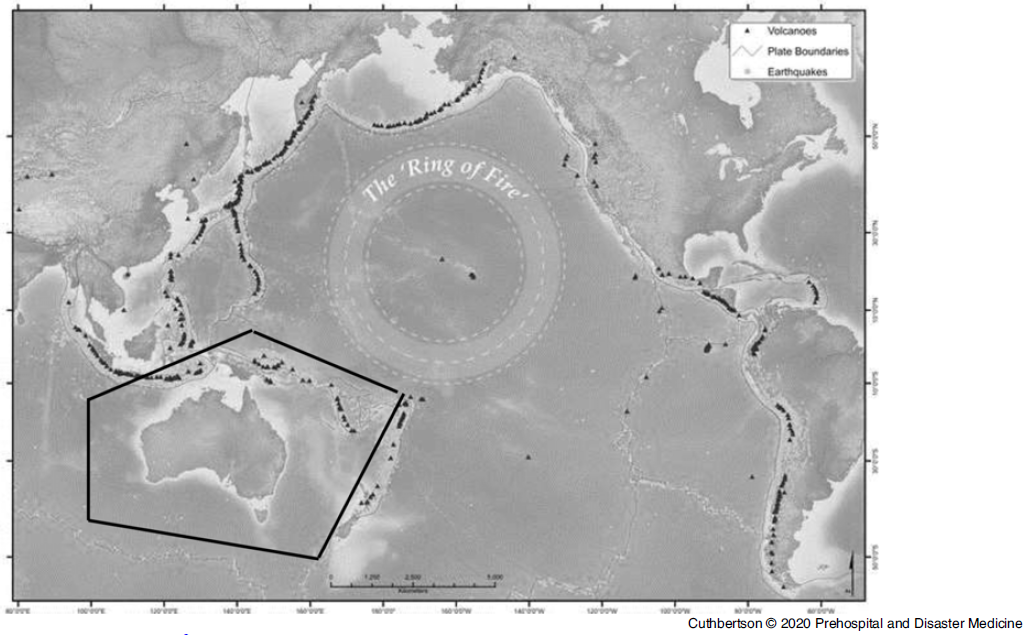
The Pacific “Ring of Fire” is a horseshoe-shaped zone surrounding the Pacific Ocean where a concentration of volcanic and earthquake activity occurs (Figure 1).2 Much of the volcanic activity is associated with subduction zones, which are convergent boundaries between tectonic plates. Subduction zones form when continental and oceanic crust collide. Thinner, denser oceanic crust is less buoyant than continental crust, so it sinks (subducts) beneath the continental crust. At depths of approximately 80km-160km, partial melting occurs to generate magma, which migrates upwards and may reach the Earth’s surface to produce volcanic landforms. Subduction zones generally produce volcanic arcs.
The Pacific Ring of Fire2 with Oceania Region Outlined.

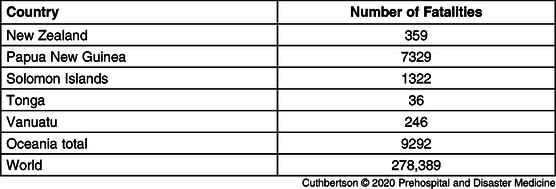
In the Oceania region, the island arc countries of Papua New Guinea (PNG), the Solomon Islands, Vanuatu, Tonga, and New Zealand (Figure 1) are most at-risk from active volcanism.3 These countries contain active, explosive-type volcanoes that have produced major eruption crises in modern times. Recent examples are the 1951 eruption of Lamington volcano, PNG where pyroclastic flows swept down all sides of the volcano, killing an estimated 2,942 people; and the 1937 eruption of Rabaul volcano, PNG where 507 people were killed by pyroclastic surges and ashfall. Overall, since 1500ad, there have been ~9,300 volcanic fatalities recorded in Oceania due to volcanic activity (Table 1).Reference Brown, Jenkins, Sparks, Odbert and Auker4
Volcanic Fatalities in Oceania since 1500AD, by Country3

Near-Vent Volcanic Hazards
Volcanoes are unique among natural hazards in that they can cause a wide range of hazardous phenomena. Close to volcanic vents, hazards can be highly dangerous and/or destructive to property and include pyroclastic flows and surges, ballistic projectiles, lava flows, lahars, thick ashfalls, debris avalanches, and gas and aerosol emissions.
A range of approaches is used to reduce volcanic risks to life safety. These include volcano monitoring and surveillance, land-use planning, warning systems, hazard maps, and public education campaigns. Following the 1937 eruption of Rabaul volcano, which was unmonitored at the time, a permanent observatory was established in 1940. It was destroyed during WWII and re-established in 1950. An unrest crisis during 1983-1985 was valuable in spurring preparedness efforts, particularly the development of a contingency plan that identified evacuation routes out of the area and safe refuges, as well as public education on the volcanic hazard.3 The value of these efforts became apparent in 1994/1995 when a powerful explosive eruption forced the temporary abandonment of Rabaul City: approximately 100,000 residents evacuated their homes, but only five lives were lost.3
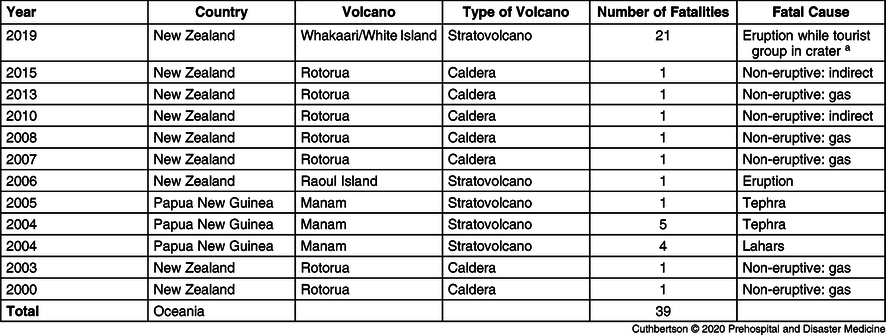
While volcano monitoring and surveillance (and associated measures) have demonstrably saved lives, residual risks remain, particularly from small, sudden, unheralded eruptions which may be deadly at close range. Since 2000, 39 lives have been lost due to volcanic activity in Oceania (Table 2). This catalogue is dominated by the December 9, 2019 eruption at Whakaari volcano, New Zealand, with the death toll at 21 at the time of writing.5
Fatal Incidents in Oceania since 20003,Reference Brown, Jenkins, Sparks, Odbert and Auker4

a This event is under active investigation. Likely fatal cause is a base surge. Number of fatalities is at time of writing.5
Far-Reaching Volcanic Hazards
Volcanic ashfall is generated by all explosive eruptions, dispersed by prevailing winds, and may be deposited on communities and farmland hundreds or even thousands of kilometers away.Reference Stewart, Wilson and Sword-Daniels6 The wide geographic reach of ashfalls, and sometimes also volcanic gases and aerosols, make them the volcanic hazard most likely to affect the greatest numbers of people.Reference Loughlin, Vye-Brown, Sparks, FitzGerald, Tarrant and Aitken7 Lahars (volcanic mudflows) can also affect areas further away (typically tens of kilometers) from volcanoes, as they travel down river systems.
Ashfalls are generally disruptive rather than damaging, but occasionally they can cause fatalities. Following the eruption of Manam volcano, PNG in late 2004, five people (two elderly people and three children) died from respiratory complications following ash inhalation (Table 2).Reference Brown, Jenkins, Sparks, Odbert and Auker4,8 A further four people died and one was injured by a lahar in the valley on the north side of the island.Reference Brown, Jenkins, Sparks, Odbert and Auker4 The following year, 14 people were injured and one killed by heavy ashfalls in Warisi village on the eastern side of Manam island, reportedly due to buildings collapsing under the weight of the debris,Reference Brown, Jenkins, Sparks, Odbert and Auker4,9 as well as burning down due to the hot debris.
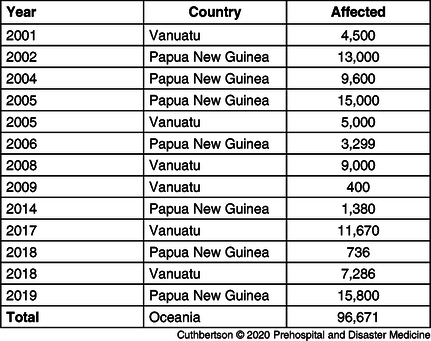
More commonly, ashfalls can affect the habitability of downwind communities, including aspects such as contamination of drinking-water supplies, degradation of outdoor and indoor air quality, damage to buildings, crop damage, and food security. These aspects of environmental health can be important drivers of evacuation decisions, particularly if impacts are sustained. As shown in Table 3, since 2000, nearly 100,000 people across Oceania have been displaced by volcanic ashfall, with approximately two-thirds in PNG and one-third in Vanuatu.10 Forced migrations and protracted displacements bring insecurity, the potential for politicization of the population, and can be drivers of instability in the region. This applies to both the community that has to relocate as well as the host community. Internally-displaced persons (IDPs) place pressure on resources, job opportunities, food, health access, and civil and political rights.
Numbers of People Displaced by Volcanic Ashfall in Oceania, 2000-2020

In the following section, the recent 2017-2018 Ambae eruption, which caused the entire population of the island to be evacuated twice, is discussed.
Case Study: The 2017-2018 Ambae Eruption, Vanuatu
The island of Ambae is a massive basaltic shield volcano that is the largest by volume in the Vanuatu archipelago. The volcano is also known locally at Manaro or Manaro Voui. The 2017-2018 explosive, multi-phase Ambae eruption occurred in four main phases. The first of these (September-November 2017) triggered a mandatory evacuation of the entire population of the island’s 11,670 residents, primarily due to fears of eruption escalation, with the island repatriated by the start of November 2017. Phase 2 (December 2017-February 2018) and Phase 3 (March-April 2018) produced thick ashfalls and acid rain to the west and south of the island. However, these were able to be managed within-island, by evacuating people from the most-affected zones to evacuation centers at the relatively-unaffected eastern end of the island. Information was also provided to residents in less-affected areas on volcanic ash, gas and acid rain hazards, and how to minimize their impacts. Phase 4, from July-November 2018, brought further thick ashfalls to the west, east, and southeast, causing major damage to crops, water supplies, and traditional buildings, and prompting another mandatory whole-island evacuation from the end of July until the end of October 2018 when volcanic activity ceased.
A government-sponsored “second home” scheme for evacuees was set up on the neighboring island of Maewo, whereby Ambae residents were provided with access to land, shelter and building supplies, food, and water, while still keeping their land on Ambae. Approximately 3,000 Ambae residents evacuated to Maewo under this scheme, with other Ambae residents self-evacuating to other islands in Vanuatu, primarily to the neighboring island of Santo. As of March 2019, 4,178 people had returned to Ambae,11 and by February 2020, the Ambae Council of Chiefs estimated that 80% of the population had returned home.Reference Ligo12
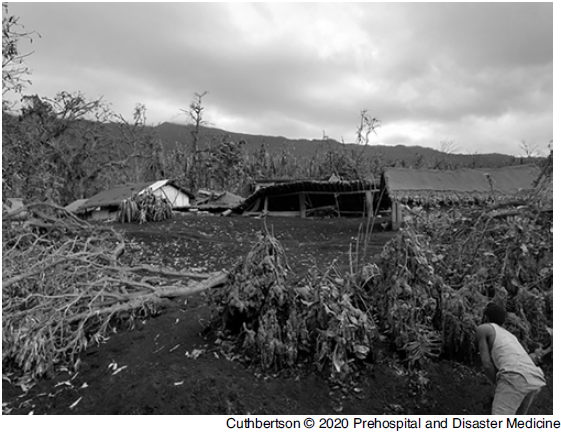
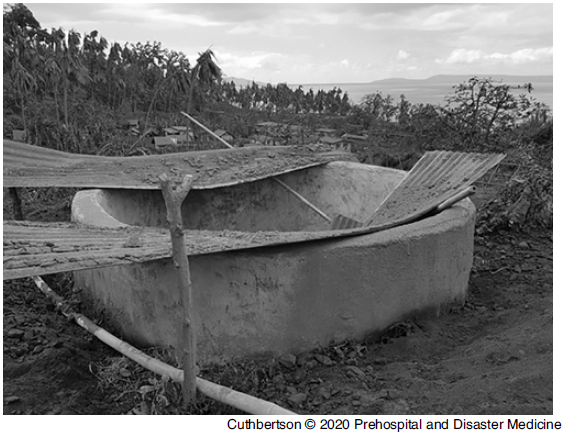
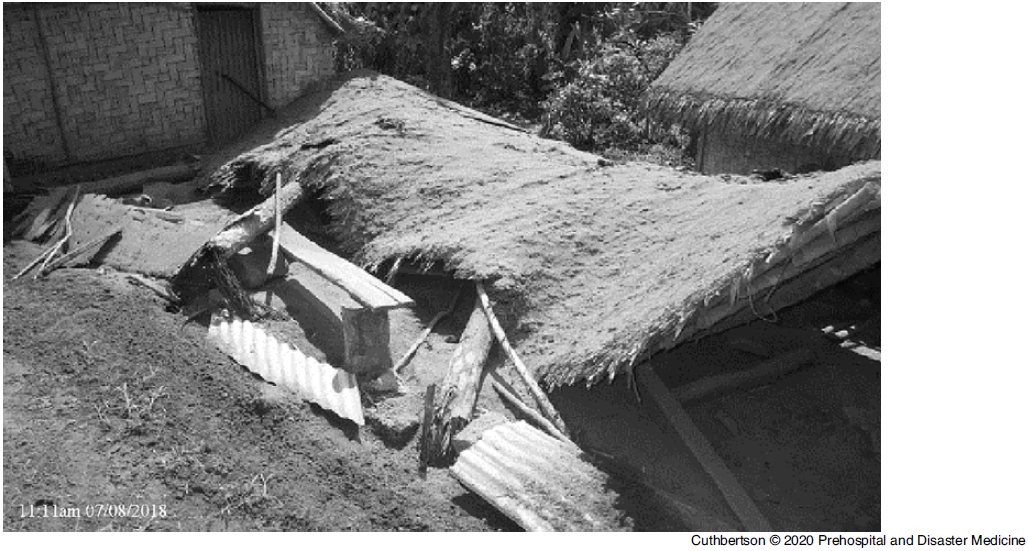
Environmental health consequences of the ashfalls were assessed through visits from multi-agency field teams from Vanuatu, New Zealand, and Singapore, and assistance from local agency staff and community members. Ash contamination of water supplies was a major problem for Ambae, along with severe damage to food crops (Figure 2) and traditional buildings by thick ashfalls. Across the whole island, 22% of traditional buildings completely collapsed (Figure 3) at ash thicknesses as low at 4cm depth.Reference McSporran13 In some villages, up to 50% of traditional buildings collapsed.Reference McSporran13 No modern buildings, typically constructed of reinforced breeze blocks with metal roofs, collapsed, although sagging and collapse of rain gutters was common.Reference McSporran13 Ashfall also contaminated roof catchment rainwater tanks and other open-air tanks (Figure 4) with 26 out of a total of 33 drinking-water samples analyzed exceeding drinking-water guidelines for fluoride, aluminum, copper, manganese, and zinc.Reference Stewart14
Heavy Ashfall Damage to Crops, South Ambae (~150mm ashfall depth).

Complete Collapse of an Open-Sided Traditional Building (55mm ashfall depth).

Village Well Contaminated with Ashfall after Protective Metal Sheets Collapsed, South Ambae.

Approximately 6,000 Ambae residents voluntarily evacuated to Santo,15 where a health disaster response was coordinated by the local government. This involved recruiting health care workers from a nongovernmental organization (NGO) primary care clinic to provide acute care on-arrival to the island and on-going care in the community. An NGO primary care team comprised of a General Practitioner, Nurse Practitioner, and two health care assistants undertook initial assessment of a group of newly arrived evacuees. This allowed identification and management of urgent care needs.
Over the subsequent weeks, the primary care clinic provided care to the evacuees. A prospective database of anonymized case files was undertaken to monitor evolving primary health care needs of the evacuee community. Twenty-five patients were assessed by the initial team. Two patients required urgent transfer to emergency department for acute management. There were six diabetic patients who required medication supplies. There were eight hypertensive patients, of which two required urgent blood pressure reduction and four required medication supplies. Over the following two weeks, 104 patients were reviewed at the clinic. During this time, 45 patients were treated for respiratory tract infections. Medication supplies were replenished for antihypertensives and diabetic medications for seven patients. Opportunistic cardiovascular and diabetes risk reviews were performed and follow-up arranged for nine patients.
Involving local primary care clinicians in this setting enhanced local capacity for health care provision. Patients were able to receive continuity of care for their acute and on-going medical problems. Involving primary care clinicians in disaster management allows opportunity to evaluate evolving care needs and gain an improved understanding of the impact of displacement on the community.Reference Burns, Douglas and Hu16
Conclusion
This report summarizes the WADEM 2019 Brisbane conference Oceania chapter session focusing on the health impacts of volcanic activity. Since 2000, 39 lives have been lost in Oceania due to volcanic activity (in PNG and New Zealand), but a far larger number (~100,000) have been displaced by volcanic ashfall (in PNG and Vanuatu). Managing large numbers of IDPs is challenging for these developing countries. The priority for health response is restoration of safe, accessible health services for the affected population. This can be affected by local health workers also being affected and losing homes. Disasters occur against a background of variable low vaccination coverage rates, high prevalence of infectious diseases, and poor nutritional status of under-fives, which creates a higher risk of infectious disease outbreaks. Effective responses may include prioritization of routine vaccination with nutritional support for children; support of women of childbearing age, including those pregnant and lactating; re-establishment of health care centers, subcenters, and hospitals; provision of medical kits and supplies; and additional mental health care trained workers. Such efforts align with Priority 2 of The Sendai Framework for Disaster Risk Reduction, “Strengthening disaster risk governance to manage disaster risk.”17
Conflicts of interest
none