INTRODUCTION
The global rate of biodiversity loss over the last 50 years has been greater than at any other time in human history, and these rates are expected to continue, or accelerate in the future. Population and economic growth are major drivers of impacts on biodiversity (State of the Environment Committee 2011; Millennium Ecosystem Assessment 2005). The decoupling of desirable economic development from its undesirable environmental impacts is therefore a central policy challenge for the 21st century.
Given the implausibility of divorcing development from environmental impact, an increasingly popular approach to avoiding net environmental losses is to use environmental offsets. Also termed biodiversity or development offsets (BBOP [Business and Biodiversity Offsets Programme] 2012; Coggan et al. Reference Coggan, Buitelaar, Bennett and Whitten2013), environmental offsets are those measures that compensate for the residual adverse impacts of an action on the environment, such as enhancing or protecting similar environmental values elsewhere. Compensating for environmental impacts, in the form of offsets, is an important component of an environmentally sustainable development framework.
The overarching objective of environmental offsets is to deliver a ‘no net loss’ or ‘net gain’ of a particular component of the environment. This objective is typically enabled through policy statements and the use of metrics, which quantify the amount and type of environmental impacts to be incurred through a development on one or more components of the environment, and also what an equivalent offset would be to compensate for that impact.
However, environmental offsetting policy still faces numerous theoretical and practical challenges (Bull et al. Reference Bull, Suttle, Gordon, Singh and Milner-Gulland2013a ). There is no ‘standard’ approach to offsetting, and many different approaches have been developed in multiple jurisdictions. Many of these approaches are flawed (Maron et al. Reference Maron, Rhodes and Gibbons2013) and still result in considerable uncertainty around offset requirements with elements of policies open to different interpretations. Evaluation of the outcomes from environmental offsetting programmes is rare; however, available evidence suggests that offset delivery is inconsistent, and frequently inadequate (Brown & Lant Reference Brown and Lant1999; Turner et al. Reference Turner, Redmond and Zedler2001; Brownlie et al. Reference Brownlie, King and Treweek2013). Therefore, the challenge for policy makers is to create a decision making framework that provides both greater transparency and certainty for business, while also delivering measurable environmental outcomes.
This paper outlines the Australian Government's environmental offset policy development process in 2011–2012, and describes the approach developed for evaluating the suitability of proposed offsets in meeting the policy goals. We describe the stakeholder consultation process undertaken with representatives from industry, environmental groups and the academic research community, and outline the subsequent collaborative process between policy makers and academics in developing the current offsets assessment approach. We discuss key policy shifts from the environmental offsets policy previously in use (Department of Environment and Water Resources 2007) to the currently active framework (Department of Sustainability, Environment, Water, Population and Communities 2012). Finally, we discuss implementation issues and early feedback on the policy and assessment approach.
ENVIRONMENTAL OFFSET POLICY IN AUSTRALIA
Australia is one of the most enthusiastic adopters of environmental offsetting, with policies in place or development in all states, territories and at the federal level. Requirements vary among jurisdictions, and policies target various elements of the environment (Productivity Commission 2013). Environmental offsets are only considered following avoidance and mitigation measures, and generally aim to deliver a no net loss outcome for the environmental matter which is protected.
Australia has a federal system, with an Australian Government and eight state and territory governments. The Australian Government, through the Commonwealth Environment Protection and Biodiversity Conservation Act 1999 (hereafter the EPBC Act; Australian Government 1999), has responsibility for the regulation of impacts on a specific set of environmental values (known as ‘protected matters’). This is distinct from state and territory jurisdictions, which have a broader remit for the regulation of the whole of the environment under the Intergovernmental Agreement on the Environment (Australian Government 1992).
Environmental offsets have been used as conditions of approval in specific circumstances under the EPBC Act since 2001. From 2007, a draft offset policy guided decision making about what constitutes a suitable offset for impacts on federally protected matters (Department of Environment and Water Resources 2007). Application of this policy relied on expert judgement and negotiation with proponents based on precedents. It resulted in offsets being primarily delivered through protection of existing habitat, calculated using an area-based ratio of a protected area offset site to the impact site (Trust for Nature [Victoria] 2008). Where there was high uncertainty relating to the protected matter, offset packages often included funding for research. Over time, stakeholder dissatisfaction with the approach provided impetus for a review of the Australian Government's environmental offset policy and practice and, ultimately, development of a new policy and offset calculation approach.
In October 2012, the Australian Government released the EPBC Act Environmental Offsets Policy (hereafter the Policy), which outlines how the suitability of an offset is determined through the environmental impact assessment and approval process under the EPBC Act (Department of Sustainability, Environment, Water, Population and Communities 2012). The Policy applies to any proposed action that would have a significant impact on a matter protected under the EPBC Act, where offsets are possible and appropriate. It specifies that an offset must contribute to the ongoing viability of the protected matter being impacted by a proposed action, and deliver an overall conservation outcome that improves or maintains the viability for that matter as compared to what is likely to have occurred under the status quo: that is, if neither the action nor the offset had taken place (Maron et al. Reference Maron, Rhodes and Gibbons2013). The Policy is accompanied by the Offsets Assessment Guide (hereafter the Guide), which calculates the equivalence of offset trades that are specifically related to threatened species and ecological communities. Below, we describe the process of developing and refining the Policy and the Guide, and the outcomes of that process.
DEVELOPMENT OF THE OFFSETS ASSESSMENT GUIDE
Initial policy development and stakeholder consultation (early 2011)
Prior to the release of the Policy and the Guide in late 2012, an extensive stakeholder consultation process was undertaken over 2011–2012, involving five workshops with 22 representatives from national industry and environment groups, and academia.
International approaches and Australian state and territory offset policies and metrics were first considered for suitability for use under the EPBC Act framework. It was desirable to align the Australian Government's approach as much as possible with state and territory approaches, particularly with those states with fully functioning metrics, so as to provide consistency in approach for proponents. However, this is challenging given there is a high degree of variation between state and territory jurisdictions’ offset requirements. Further, environmental offsets under the EPBC Act relate to >2000 different protected matters, including more than 1800 threatened species and ecological communities. Thus, any offset metric for application under the EPBC Act would need to be sufficiently generic to deal with the different data inputs that relate to the range of threatened species and ecological communities, and also accommodate the range of ecological currencies used in different Australian states.
In recognition of the high level of interest in environmental offsets, a stakeholder engagement process was undertaken, which included consultation on the development of the policy principles, as well as the draft Guide used for determining suitable offsets for a given impact. Stakeholders who participated in the consultation process included state and territory government agencies, representatives of national industry and environment groups, and academics (Department of Sustainability, Environment, Water, Population and Communities 2012).
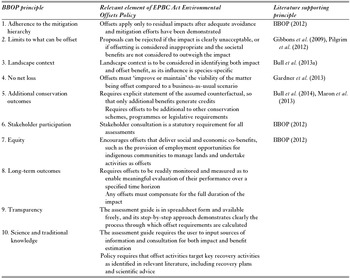
Initially, consultations with stakeholders focused on finding common ground between industry groups and environment groups, through developing a set of policy principles that would address stakeholders’ primary concerns with offsets (Table 1). The starting point in developing these principles was the Business and Biodiversity Offsets Programme (BBOP 2012).
Business and Biodiversity Offsets Programme (BBOP) principles on biodiversity offsets and description of how each is reflected in the EPBC Act Environmental Offsets Policy.

Public release of consultation draft environmental offsets policy and offsets assessment guide (late 2011)
A draft policy, which provided detail around the principles developed through consultation, was released for public comment in August 2011 (Department of Sustainability, Environment, Water, Population and Communities 2011). The draft policy also included an early draft framework of a metric to give effect to the Policy, the Offsets Assessment Guide. This early Guide framework was developed further via a workshop with stakeholders during the consultation period. Public comment was invited and 54 submissions were collected in response to the draft policy and Guide.
Submissions from industry stakeholders revealed that the lack of certainty around offset requirements was industry's primary concern (Association of Mining and Exploration Companies 2011; National Farmers’ Federation 2011; Rio Tinto 2011; Urban Development Institute of Australia 2011). Uncertainty in offset requirements results in uncertainty in the cost of a proposed development, which can affect a project's viability (Productivity Commission 2013).
Environmental groups were primarily concerned with the limited extent to which offsets to date could be demonstrated as achieving their basic ‘no net loss’ (or similar) objective (Invasive Species Council 2011; World Wide Fund for Nature Australia 2011; BirdLife Australia 2012; Environmental Defenders Office [Victoria] 2013).
Submissions were analysed for key issues, and following internal consideration, the Policy was revised. There was little revision undertaken of the policy principles, given the consultative manner in which they were developed. However, it was clear from submissions that further work was needed on the framework for the Guide in order to adequately give effect to the policy principles. There was also a clear desire from stakeholders for a robust offset calculation approach that would improve certainty in offset requirements and measurability in the success of offsets in compensating for loss.
Further development of the Guide through research collaboration, and release of the final policy (2012)
The Australian Government Department of the Environment invited university academics, Philip Gibbons, Martine Maron, Hugh Possingham and Megan Evans to develop a new framework (our own unpublished data) that allowed direct calculation of environmental losses and potential gains, including mechanisms to explicitly incorporate the policy principles. During the development of the metric, each significant iteration produced by the academic team was tested by assessment officers at the Department of the Environment for its application to a range of project types, for ease of use, and to ensure that the policy principles were met in each case. This collaborative arrangement allowed testing theoretical approaches in the context of real constraints such as complex environmental impacts and high levels of uncertainty.
Key shifts between the 2007 and 2012 environmental offset policies
The 2007 and 2012 policies both guide the decision maker to consider the following key issues when determining what constitutes an appropriate offset:
-
• the nature of the impact;
-
• the scale and intensity of impacts;
-
• the level of certainty that the offset will deliver the intended conservation gain;
-
• the time frame in which the offset will be delivered;
-
• that offsets should deliver a conservation benefit for the impacted protected matter; and
-
• that offsets should be enforceable, monitored and audited.
The key differences in the two policy approaches relate to requirements for and definitions of direct offsets, benchmarking for measurement of conservation losses and gains, incorporating the level of statutory protection applying to the protected matter, and consideration of time lags between an impact and when a conservation gain is delivered. The first two issues are discussed below, while the others are covered in the next section.
Direct offsets
The 2007 draft policy recognized both ‘direct’ and ‘indirect’ offset measures as appropriate means of compensating for the impacts of an action. Direct offsets were defined as those ‘aimed at on-ground maintenance and improvement of habitat or landscape values’ and may include long-term protection of existing habitat, restoration or rehabilitation of existing degraded habitat, and re-establishing habitat (Department of Environment and Water Resources 2007). The definition of indirect offsets in the 2007 draft policy included removal of threatening processes, implementation of recovery plan actions, and ongoing management activities, as well as contributions to appropriate trust funds or banking schemes that can deliver direct offsets, and contributions to relevant research or education programmes.
The definition of direct offsets in the 2012 policy is broader than that in the 2007 draft policy, encompassing any action that provides a measurable benefit for an impacted protected matter. Under this broader definition, a direct offset may include a range of management activities that provide a direct benefit to a protected matter. For example, the improvement and creation of new habitat across a landscape, implementing feral animal control programmes that reduce predation of a threatened species, or increasing the population of a threatened species through captive breeding and release programmes, all fall within the expanded definition of a direct offset. This policy approach supports flexible delivery arrangements for offsets (such as through a third-party provider), which enables them to better target relevant recovery actions and may be more suitable for highly mobile or transient species that occur across differing tenure types (Bull et al. Reference Bull, Suttle, Singh and Milner-Gulland2013b ; Coggan & Whitten Reference Coggan and Whitten2013).
The 2012 policy introduces the term ‘other compensatory measures’ in place of ‘indirect offsets’. The shift in language is in recognition that ‘other compensatory measures’ are not true offsets; rather, they are actions for which there is likely to be some indirect benefit to the impacted matter, but that benefit cannot be quantified. Other compensatory measures can include environmental education campaigns or research on the protected matter that is impacted.
The 2007 draft policy states that direct offsets are more desirable than indirect offsets, but does not place specific limits on the magnitude of impact that must be offset directly, nor explicitly builds in incentives for direct offsetting. The 2012 policy stipulates a minimum of 90% of the offset requirement for any given impact is met through direct offsets. This requirement is designed to provide some flexibility in cases where 100% direct offsets may be difficult to obtain, or where there is a desire to promote investment in priority research or educational programmes.
Benchmarking
The expected benefit of an environmental offset action must be quantified correctly, such that the overarching test of an offset policy (such as ‘improve or maintain’, or ‘no net loss’) can be measured, and additionality can be ensured. This requires the selection of a baseline scenario, against which the benefit from an offset action is measured (Gordon et al. Reference Gordon, Langford, Todd, White, Mullerworth and Bekessy2011; Maron et al. Reference Maron, Rhodes and Gibbons2013). ‘Conservation benefit’ is defined by Maron et al. (Reference Maron, Rhodes and Gibbons2013) as the difference between the outcomes of two scenarios: (1) the scenario in which the conservation action occurs, and (2) the scenario in which it does not (the ‘alternative scenario’; also referred to as the baseline or counterfactual). The conservation benefit is therefore additional to what would have occurred without the offset.
The 2007 draft policy uses an ‘improve or enhance’ test, but the benchmark against which this improvement or enhancement is measured is not specified. The 2012 policy states that offsets must deliver an overall conservation outcome that improves or maintains the viability of the protected matter ‘as compared to what is likely to have occurred under the status quo, that is if neither the action nor the offset had taken place’ (Department of Sustainability, Environment, Water, Population and Communities 2012).
THE POLICY FRAMEWORK
The principles of the EPBC Environmental Offsets Policy (Department of Sustainability, Environment, Water, Population and Communities 2012) are given effect by the accompanying Guide, which provides a clear and consistent support tool for those assessing the appropriateness of offsets under the EPBC Act, while providing greater guidance and transparency to external stakeholders.
The Guide adopts a balance sheet layout, comparing the amount of an impact on a protected matter with the amount of benefit conferred by the proposed offset action for that same protected matter, and delivering a final percentage score indicating the degree to which the impact has been offset. The Guide calculates the net present value (NPV) of an offset proposal by discounting the gain delivered by the offset over the relevant time horizon (time lag between the time of impact and until ecological benefit). NPV is used to reflect the fact that a given benefit (such as improving habitat quality or averting loss) today holds more value for a protected matter than the same benefit realised in the future. Discounting is an important component, as it allows impacts and benefits at different times to be compared using equivalent units (Moilanen et al. Reference Moilanen, van Teeffelen, Ben-Haim and Ferrier2009; Overton et al. Reference Overton, Stephens and Ferrier2013).
The diversity of potential impacts and offset actions for the range of threatened species and ecological communities listed under the EPBC Act required a flexible yet rigorous approach. The key principles built into the operation of the Guide (Table 1) were adapted from recent academic literature on offsetting methodology and impact assessment (Dunford et al. Reference Dunford, Ginn and Desvousges2004; Gibbons et al. Reference Gibbons, Briggs, Ayers, Seddon, Doyle, Cosier, McElhinny, Pelly and Roberts2009; Joseph et al. Reference Joseph, Maloney and Possingham2009; Maron et al. Reference Maron, Rhodes and Gibbons2013). Below we describe the main steps in using the Guide to evaluate a proposed offset for a given impact.
Choice of currency
In order to measure the suitability of an offset to compensate for a specific impact, both the offset (gain) and impact (loss) must be in equivalent units, or currency. The most appropriate currency in which to work varies depending on the matter impacted, the type of impact, and the quality and quantity of information about threats to the protected matter. Loss-gain comparisons can be made according to any of seven possible currencies in the Guide:
-
(1) Area of community. This applies to threatened ecological communities listed under the EPBC Act. Area of the potential offset site is measured in hectares, and the quality of the ecological community is defined on a scale of 0 to 10. The area of the community is then adjusted according to quality (see supplementary material).
-
(2) Area of habitat. This applies to threatened species listed under the EPBC Act. Area is measured in hectares, and the quality of habitat from the perspective of the species of concern is defined on a scale of 0 to 10. The area of the habitat is then adjusted according to quality (see supplementary material).
-
(3) Number of features. For use where the impact is on a discrete number of features which are required to sustain a threatened species, such as nest hollows or habitat trees.
-
(4) Condition of habitat. For use where the impact results only in a reduction of threatened species habitat quality, but not its area.
-
(5) Birth rate. Impacts may result in a reduction in the birth rate or recruitment to a threatened species’ population; where it is possible to quantify, this currency may be used in the Guide.
-
(6) Mortality rate. Impacts may result in an increase in the mortality rate of a threatened species’ population; where it is possible to quantify, this currency may be used in the Guide.
-
(7) Number of individuals. For impacts which result in a loss of a discrete number of individuals; for example, removal of a certain number of threatened plants or animals.
Quantifying losses
Quantifying the losses from a development is done as part of the environmental impact assessment process. The residual impacts that remain following all potential avoidance and mitigation measures are quantified using the most relevant currency to enable appropriate loss-gain comparisons.
Quantifying gains
Calculation of the conservation benefit of a proposed offset action requires specification not only of a scenario representing a future with the offset action, but also a counterfactual scenario representing a future without the offset (Maron et al. Reference Maron, Rhodes and Gibbons2013). All decisions about the adequacy of offset actions incorporate assumptions about counterfactual scenarios, but these assumptions are usually implicit, and often implausible (Maron et al. Reference Maron, Rhodes and Gibbons2013). The approach used in the Guide was to require explicit statement of assumptions about the two scenarios, and to adjust the difference between them to account for uncertainty and time lags. This approach to calculating gains has several steps.
-
(1) State the proposed offset action. This may be an area-based action, such as protection or restoration of habitat, or may involve instalment of nest boxes, control of introduced predators, or patrolling of beaches used for shorebird nesting. The currency used must be the same as that used for quantification of the impact.
-
(2) Set the relevant time horizon. The time horizon is determined by the proposed management interventions. For example, if a land manager proposed to replant flowering Proteaceae species as habitat for a woodland bird, the time horizon over which the quality improvement would be assessed would be the time it takes for the replanting to provide viable foraging resources for the target bird species, perhaps 15 years (Wooller et al. Reference Wooller, Wooller and Brown2002). In contrast, if the proposed offset requirement was to replant large Eucalyptus trees for the re-establishment of hollow-bearing trees as breeding habitat for the same species, the time horizon would likely be much longer, as it takes many decades for such trees to develop suitable hollows (Gibbons et al. Reference Gibbons, Lindenmayer, Fischer, Manning, Weinberg, Seddon, Ryan and Barrett2008).
-
(3) Estimate the offset action scenario. For the appropriate time horizon, the ecological value (in the appropriate units of currency; for example number of individuals, area and quality of habitat) of the offset site or population affected by the offset action is estimated, on the basis that the proposed offset action was successful.
-
(4) Estimate the counterfactual scenario. The ‘without offset’ scenario describes the expected ecological value of the site or population targeted by the proposed offset at the appropriate time horizon if the offset action did not take place, namely it describes the ‘business as usual’ scenario for the relevant protected matter. Proposed offset benefits are measured against this counterfactual scenario. Where replanting and recreating habitat is proposed, there may be substantial differences between the quality scores of the two future scenarios, as new habitat would not have been created in the absence of the offset. However, where an offset action comprises protection of existing vegetation, the counterfactual scenario may be that only a small proportion of the vegetation would be lost in the absence of the protection. Where relevant it is also possible to incorporate the impact of degradation of habitat over time by forecasting a reduction in quality for the ‘without offset’. For example, if known invasive species are present, a slow reduction in the quality of habitat without management intervention may be a realistic forecast (see supplementary material for further details).
-
(5) Adjust for uncertainty. A major goal in regulatory decision-making is to manage levels of uncertainty (Moilanen et al. Reference Moilanen, van Teeffelen, Ben-Haim and Ferrier2009). In the Guide, the ‘confidence in result’ is a percentage figure that describes the level of certainty about the success of a proposed offset action. There are two main considerations in determining this score: the likelihood that the proposed conservation outcome can be achieved based on existing evidence, and overall likelihood of the performance of the offset in its implementation.
Dealing with biological systems can be complex and unpredictable with poor historical data to inform decisions. Managing uncertainty is a critical part of dealing with such systems, especially in forecasting outcomes of conservation actions into the future. As such, proposed offset actions that are designed to have a lower risk of failure have a higher confidence in result score; for example, implementing known or tested management interventions for ecosystem restoration.
One of the key challenges in assessing the value that an offset action delivers is accounting for the time it takes for a species or ecological community to benefit from the offset. In many cases there is a substantial delay in the delivery of a conservation benefit through the offset action, and so this time lag between impact and offset (Bekessy et al. Reference Bekessy, Wintle, Lindenmayer, McCarthy, Colyvan, Burgman and Possingham2010) may compound the impacts of an ecological deficit on threatened species. For example, where the removal of mature fruiting trees on which a species relies for food is removed and a like-for-like offset involves the planting of new young trees, many years or decades may elapse before the new habitat is similarly productive to the removed habitat, and this temporal deficit is of particular concern for threatened species (Maron et al. Reference Maron, Dunn, McAlpine and Apan2010). The importance of accounting for the time gap between the ecological damage of an impact and the ecological benefit of an offset has been highlighted in the literature (Dunford et al. Reference Dunford, Ginn and Desvousges2004; Moilanen et al. Reference Moilanen, van Teeffelen, Ben-Haim and Ferrier2009; Overton et al. Reference Overton, Stephens and Ferrier2013).
Where an action impacts on a protected matter, the effect of any ecological deficit in the time between the impact and delivery of an offset outcome is influenced by the threat status of a threatened species or ecological community. A critically endangered species has a high risk of extinction in the near future, and so is unlikely to enjoy benefits from offset outcomes that are only realized in the distant future. One way of accounting for such time lags is to use an annual discount rate based on a threatened species’ annual probability of extinction, and to discount the estimated benefit of an offset for each year an ecological deficit exists. The approach for selecting an appropriate discount rate to estimate the NPV of an offset proposal was, therefore, to adapt the estimated annual probabilities of extinction for listing criteria developed by the International Union for Conservation of Nature (IUCN) for each threatened status grouping under the EPBC Act (Table 2; see also supplementary material). This approach gives effect to the Environmental Offsets Policy principle that requires offsets to be ‘in proportion to the level of statutory protection that applies to the protected matter’ (Department of Sustainability, Environment, Water, Population and Communities 2012).
Derivation of the discount rate (r) used to determine the net present value (NPV) of offset proposals for threatened species and ecological communities under the EPBC Act (Australian Government 1999). P is the minimum probability of extinction in T years according to IUCN (2001) criteria.

Net present value
The final step in the Guide is to calculate the NPV of a proposed offset (see supplementary material). The NPV of a future offset benefit is calculated through adjusting the raw offset gain for both confidence and time lags:
 \begin{equation*}
NPV = \frac{{Gain \times Confidence}}{{(1 + r)^T }},
\end{equation*}
where gain is the difference in the value of the offset between the offset scenario and the counterfactual scenario, steps 3 and 4 above), Confidence is the per cent ‘confidence in result’ (step 5), r is the annual discount rate and T is the time horizon (step 2).
DISCUSSION
Under the approach to environmental offsets described herein, the impact and offset are quantified according to attributes that are relevant to the type of offset action and the protected matter that is affected, rather than a simple ‘offset area to impact area’ ratio. The approach explicitly estimates the extent to which an offset will improve the target biota and/or avert future losses, the degree of confidence that the offset will be implemented successfully, and the time it will take to deliver a conservation benefit. For threatened species and ecological communities, the policy approach and Guide explicitly account for the relevant listing category of a protected matter, such that offset requirements where time lags are involved are greater for matters with a higher risk of extinction.
The Guide was developed through a collaboration between policy makers within the Department of the Environment and researchers within a Commonwealth-funded network of university-based researchers, the Environmental Decisions Hub of the National Environmental Research Program. This engagement enabled scientific input to steer the policy development process alongside public consultation. It is our view that this collaboration led to increased scientific rigour and greater stakeholder confidence in the policy development process.
The Guide was designed to be easy to use, whilst also addressing the complexities associated with evaluating proposals to compensate for impacts to elements of biological systems. However, the nature of robust offsetting means that the information requirements for determining an appropriate offset are considerable. This can limit application of the approach where there is high uncertainty associated with the efficacy of the proposed offsets. The Guide responds to this by scaling the offset requirement to the estimate of confidence in offset success. This incentivizes research that reduces the uncertainty around offset outcomes. Nevertheless, development of an adequate information base to inform offset decision making for cryptic protected matters, and/or those in poorly-known areas, remains an ongoing challenge.
Since implementation of the Guide, the focus of discussions regarding environmental offsets between the regulator and a proponent have shifted from simplistic area ratios, toward directly evaluating the components of an offset action that determine its environmental performance. Similarly, a broader definition of direct offsets has provided the opportunity for an array of threat-abatement activities to generate offset benefits. For example, as part of the offsets package for a bauxite mine to the south of Embley in Queensland, the project proponent was required to develop and fund a feral pig control programme that would improve recruitment for nesting migratory and threatened sea turtle species (Department of Sustainability, Environment, Water, Population and Communities 2010). This component of the offsets package was developed to counterbalance impacts on turtle recruitment that arose through light pollution and habitat disturbance elsewhere.
Although the compensation of unavoidable ecological damage is central to achieving sustainable development, existing approaches to biodiversity offsetting are not, and cannot be, complete solutions to the challenge of biodiversity decline. Averted loss offsetting is valid only where biodiversity declines are expected to continue (Gordon et al. Reference Gordon, Langford, Todd, White, Mullerworth and Bekessy2011; Maron et al. Reference Maron, Rhodes and Gibbons2013). The EPBC Act Environmental Offsets Policy explicitly aims to achieve no net loss compared to a ‘business as usual’ baseline from offset trades, and often that baseline is one of decline. Although few other offset policies in Australia and globally are similarly explicit about the benchmark against which no net loss is to be achieved (Maron et al. Reference Maron, Rhodes and Gibbons2013), where averted loss offsetting is implicit, a similar goal to that of the EPBC Act policy is intended. Progressively less emphasis on averted loss offsetting could be facilitated through integrating offset policies with broader environmental and land use policies, so that an overarching goal to achieve overall environmental improvements can be achieved through targeted and strategic management interventions and planning decisions.
Environmental offsetting remains an evolving field for policy makers, environmental managers and businesses globally. Some of the future challenges for policy makers include investigating efficient ways to ensure offsets deliver on stated environmental gains and facilitating market mechanisms for the delivery of offsets. Other challenges relate to improving the efficiency of offsets as a regulatory tool, harmonizing offset requirements across jurisdictions and reducing regulatory overlap (Productivity Commission 2013).
ACKNOWLEDGEMENTS
The EPBC Act Environmental Offsets Policy and Guide were developed through a consultative process with environmental and industry groups, as well as with expertise from representatives of the academic community. The Department of the Environment would like to particularly acknowledge those individuals and organizations that made submissions to draft policy documents and participated in workshops. Over the two-year policy development process, a number of staff from Department of the Environment made a significant contribution to the policy, including Peter Burnett, Vicki Middleton, Feach Moyle, Kelly Pearce, and Rebecca Sagoe-Crentsil. This research was conducted with funding from the Australian Government's National Environmental Research Program. Megan Evans was supported by an Australian Postgraduate Award and a CSIRO Climate Adaptation Flagship scholarship. Hugh Possingham was supported by ARC fellowships.
Supplementary material
To view supplementary material for this article, please visit http://dx.doi.org/10.1017/S037689291400040X.