1 INTRODUCTION
The acquisition of sentential negation by English-speaking children has puzzled researchers for almost half a century. Simply put, the puzzle has been to understand why children's early negative utterances differ so much from those used by adults. One of the main findings is that English-speaking children initially use not (and, to a lesser degree, no) to express sentential negation (Klima & Bellugi Reference Klima, Bellugi, Lyons and Wales1966, Bellugi Reference Bellugi1967). Adult English speakers, by contrast, typically convey the same messages using negative auxiliary verbs such as doesn't and can't. Despite a number of investigations of the form and function of different aspects of negation across developmental periods (e.g. Bloom Reference Bloom1970, Wode Reference Wode1977, Choi Reference Choi1988, Déprez & Pierce Reference Déprez and Pierce1993, Drozd Reference Drozd1995, Harris & Wexler Reference Harris, Wexler and Clahsen1996, Hamann Reference Hamann, Powers and Hamann2000, Gilkerson, Hyams & Curtiss 2004, Cameron-Faulkner, Lieven & Theakston 2007, Dimroth Reference Dimroth, Klein and Levinson2010, Schütze Reference Schütze2010), no adequate theoretically-driven account of the mismatches between child and adult grammars has been forthcoming. The present paper presents a novel solution to the old puzzle by invoking the Negative Concord Parameter proposed by Zeijlstra (see Zeijlstra Reference Zeijlstra2004, Reference Zeijlstra, Cate and Zeevat2007, Reference Zeijlstra and Biberauer2008a, Reference Zeijlstrab, Reference Zeijlstra2010). Before we introduce the parameter, we will review the main acquisition facts at issue, and previous attempts that have been made to explain children's non-adult negative utterances.
More than forty years on, Bellugi's (Reference Bellugi1967) Ph.D. dissertation still contains the most detailed observations to date about the development of sentential negation by English-speaking children. The Bellugi thesis describes the longitudinal development of negation by the three Harvard children, Adam, Eve and Sarah (Brown Reference Brown1973). The first three stages of children's development have become standard fare in the child language literature, but the Bellugi thesis introduces further facts about children's use of negation, and discusses a number of issues that have gone unmentioned in the literature. The additional facts include observations about children's command of negative polarity expressions, negative concord structures and sentences with negative tags. Although these data are not routinely reported in the literature, they make important contributions to the theory developed in the present study.
1.1 Three stages in the acquisition of sentential negation
Let us briefly review the three familiar stages in children's development of sentential negation. The first stage (stage 1) was labelled ‘primitive’ by Bellugi (Reference Bellugi1967). In children's earliest utterances, negation is expressed by the negative markers not or no which appear either at the end of a word or at the end of a phrase, the ‘nucleus’ of the sentence in Bellugi's terms. Frequently, the subject NP is omitted in these early utterances. Examples include utterances such as No sit there, Not a teddy bear, No fall!, Wear mitten no (Bellugi Reference Bellugi1967). These utterances are reported to fulfill a variety of functions in children's communicative repertoire.
On the basis of (a few) examples in which the subject NP is present (e.g. No the sun shining), the first stage in the acquisition of negation is often characterized as one at which negation appears external to the sentence (de Villiers & de Villiers 1985, Déprez & Pierce Reference Déprez and Pierce1993, Drozd Reference Drozd1995). This proposal remains controversial, however. Bloom (Reference Bloom1970), for example, argued that children's earliest utterances with ‘external’ negation are, in fact, instances of anaphoric negation.Footnote 2 The ongoing debate over the data and whether or not negation is initially external to the sentence is not directly relevant to our purposes. Our evaluation of children's knowledge of negation focuses, instead, on the syntactic category of negation in children's grammars at different stages of development, an issue for which the second stage of development is more relevant.
At the second stage (stage 2) in the acquisition of negation, Bellugi claims that negation is positioned sentence-internally. At this stage, children use not or no in combination with some kind of predicate, including main verbs (e.g. He no bite you, I no want envelope). Utterances with negative auxiliary verbs also begin to appear in children's productions at the second stage (e.g. I can't catch you, I don't sit on Cromer coffee). It is important to note, however, that Bellugi claims that children's early use of negative auxiliary verbs is confined to don't and can't. She states that the rest of the auxiliary system was ‘largely absent’ at this second stage (Bellugi Reference Bellugi1967: 64) in the three children's grammars. Hence, these particular negative auxiliary verbs were analysed as forms of negation, not as auxiliary verb forms.
The rapid emergence of the auxiliary system marked these children's passage into the third stage (stage 3). Once the children had entered the third stage, they used an array of both positive and negative auxiliary verbs. This was demonstrated, for example, by children's use of the auxiliary verb will in various syntactic contexts, as well as their command of the irregular forms of be, and their ability to ask yes/no questions with do-support. Children reached this third stage at varying ages, by Bellugi's calculations: Eve reached this stage at 2;2 (i.e. the age of two years and two months), Adam was 3;2, and Sarah was 3;8.Footnote 3
1.2 Previous accounts of the acquisition of sentential negation
The present paper focuses on the changes that take place in children's grammars as they make the transition from the second to the third stage in the development of negation, and the consequences of these grammatical changes throughout children's grammars. Children's absence of productive use of negative auxiliary verbs in the second stage of development is particularly noteworthy, in view of the overwhelming preference by adults to produce negative auxiliary verbs rather than utterances with not. The observed preferences by adults are documented in our investigation by surveying the primary linguistic data provided by the mothers of two young children (Lily and Naima), using the CHILDES Providence corpus (Demuth, Culbertson & Alter 2006).Footnote 4
Here are a few findings from the survey we conducted. Analysis of the child-directed speech from five transcript files for each parent reveals that Naima's mother used negative auxiliary verbs for sentential negation 78.9% (183/232 tokens) of the time, while they were used 72.2% of the time by Lily's mother (104/144 tokens). These calculations are actually quite conservative, given that the copula be was included in these counts, and it co-occurs quite naturally with not. The survey findings suggest that the absence of negative auxiliary verbs in children's speech is not easily explained by invoking the frequency of negative expressions in the parental input. Further details appear in Appendix A.Footnote 5
In the child language literature, various ways have been offered to explain discrepancies between child and adult grammars. In the earliest days of generative linguistics, Klima & Bellugi (Reference Klima, Bellugi, Lyons and Wales1966) attempted to explain the transition from child to adult grammar as the consequence of the gradual accrual of rules. Such an explanation is no longer tenable within the current generative framework, which has forsaken rule-based accounts of children's transition to the adult grammar, in favor of parameters. In addition to parameters, some UG-based accounts of children's early non-adult grammars appeal to maturation (see e.g. Borer & Wexler Reference Borer and Wexler1987; Wexler Reference Wexler, Lightfoot and Hornstein1994, Reference Wexler1998; Schütze & Wexler Reference Schütze and Wexler1996).
Much of the recent literature on the acquisition of sentential negation has pursued an approach that ties young children's non-adult negative utterances to the fact that they are in the optional infinitive stage of grammatical development (e.g. Harris & Wexler Reference Harris, Wexler and Clahsen1996, Guasti & Rizzi Reference Guasti, Rizzi and Cinque2002, Schütze Reference Schütze2010). In the optional infinitive stage, children frequently omit tense and agreement markers, a fact that can be used to explain why children express negation with not in sentences like It not fit in here (see Harris & Wexler Reference Harris, Wexler and Clahsen1996). In a recent paper, Schütze (Reference Schütze2010) explicitly proposes that, at the second of Bellugi's stages in the acquisition of negation, children produce utterances such as It don't fit in here instead of It doesn't fit in here because they do not yet have mature use of tense and agreement. On his proposal, children prefer the negative marker n't over not but, because n't requires a host, children are forced to apply do-support in order to avoid a violation of Lasnik's Stray Affix constraint (Lasnik Reference Lasnik, Hornstein and Lightfoot1981). Since children are in the optional infinitive stage of development, however, the idea is that children often fail to realize the agreement morpheme and, consequently, sometimes produce don't instead of doesn't. In contrast to this argument, we will contend that, at this stage of development, children have not yet identified n't as a separate negative marker.Footnote 6 We maintain Bellugi's view that don't is a transitional form of negation in young children's grammars at the second stage of the development of negation.
There is little doubt that children's non-adult productions of sentential negation are intertwined with their acquisition of the auxiliary verb system; clearly children cannot use doesn't, for example, until they have mastered do-support. In this sense, we agree with researchers such as Schütze (Reference Schütze2010), who align children's negative utterances with the optional infinitive stage of development. However, we have chosen to pursue the idea that there is a ‘strong’ continuity between child and adult grammars (Pinker Reference Pinker1984, Crain & Pietroski Reference Crain and Pietroski2002). As Crain & Pietroski (Reference Crain and Pietroski2002: 177) state the continuity hypothesis, the claim is that ‘child language can differ from the local adult language only in ways that adult languages can differ from each other’. In the present study, we follow the continuity hypothesis. In our view, children's grammars fail to align with those of adults primarily due to a parameter that implicates children's knowledge of negation.
1.3 A parametric account of the acquisition of sentential negation
According to parameter theory, children are not expected to accrue individual rules governing the local language, as had been supposed using earlier theories of syntax. Instead, the theory known as the Principles and Parameters theory (Chomsky Reference Chomsky1981, Reference Chomsky1995) supposes that children are biologically fitted, as part of the human genome, with a Universal Grammar that contains both the core principles of language, i.e. principles that are manifested in all human languages, as well as a program for spelling out ways in which human languages can vary. These points of variation are parameters. Once parameters entered the theory of Universal Grammar, many cross-linguistic differences that had been assumed to be learned previously, were reconceived as innately specified properties of human languages. The move to the Principles and Parameters theory enabled researchers in child language to formulate and evaluate far-reaching predictions about the course of language acquisition, including predictions that were not consistent with experience-based accounts.
The introduction of parameters was designed to advance the theory of Universal Grammar along its stated goal of explaining children's rapid mastery of human language. Parameters were seen to reduce the role of experience in children's acquisition of human languages. In the 1980s, parameter setting was seen to initiate radical changes in child language. Instead of piecemeal acquisition of specific constructions, as advocated by usage-based accounts of language development, acquisition within the generative framework was seen to involve the mastery of clusters of linguistic phenomena, all in one fell swoop. The metaphor that was often coupled with descriptions of parameter setting was that of a switch, as in a circuit box. The child language learner was seen to set the switch one way or the other in response to ‘triggering’ experience. If the switch was set one way, then the child's grammar assumed one format; if the switch was set the other way, the child's grammar assumed a different format.
The minimalist program has seen a move to reduce the ‘machinery’ for parameters in the innate language faculty. Parametric options are generally viewed as following from lexical learning (Borer Reference Borer1984, Chomsky Reference Chomsky1995). Once a child acquires a lexical item with particular features, its consequences will be implemented in the sentence derivation. We will assume the minimalist version of parameters in this paper; children have to learn the lexical items for negation and their associated features, and this in turn has ramifications throughout the grammar.
The present proposal is that children's developmental path in the acquisition of sentential negation can be explained by invoking Zeijlstra's Negative Concord Parameter (Zeijlstra Reference Zeijlstra2004, Reference Zeijlstra, Cate and Zeevat2007, Reference Zeijlstra and Biberauer2008a, Reference Zeijlstrab). According to this parameter, children acquiring any human language must settle on the syntactic status of negation in the local language. We will outline the technical details of Zeijlstra's Negative Concord Parameter shortly. Suffice it to say for now that the parameter comes down to a choice in the language between a form of negation which is an adverb, and one in which it is a head. The default is to begin with an adverb, since this option does not require language learners to build extra structure into their sentence representation. Children can revise their hypothesis to analyse negation as a head later, at which time they posit a functional projection for negation, a NegP. Applying Zeijlstra's analysis to children acquiring English, we can say that children at Bellugi's first and second stages of acquisition hypothesize that negation is adverbial, which turns out not to align with use of negation in adult English speakers. Once children add a head form of negation to their grammar, they transition to Bellugi's third stage in the acquisition of negation.
The fact that English-speaking children must acquire both a lexical item for negation that is an adverb and one that is a head is not without complications. Although there is nothing to prevent children from acquiring more than one negative marker, there are certain properties associated with each cross-linguistic parametric option, so we will investigate how this cashes out in the adult English grammatical system.
1.4 Where we are headed
The structure of the remainder of the paper is as follows. The theoretical details of the parameter and its relation to negative concord are described in Section 2. There we outline Zeijlstra's (Reference Zeijlstra2004, Reference Zeijlstra and Biberauer2008a, Reference Zeijlstrab, Reference Zeijlstra2010) account of the typology of negation, presenting some of the cross-linguistic variation in negative markers. We describe the corresponding typological properties that are associated with each parametric option, and offer a sketch of the relevant syntax of sentential negation in English. Section 3 applies Zeijlstra's learnability theory to child language (see Zeijlstra Reference Zeijlstra, Cate and Zeevat2007). In that section, we establish various predictions about the consequences for children's grammars of positing adverbial negation at the initial stage. We also derive various consequences of incorporating negation as a head. Section 4 reports our investigation into the predictions of Zeijlstra's theory for child language acquisition, focusing in particular on the forms of children's negative sentences throughout development. We include details about children's use of negative imperatives, their use of double negation versus negative concord, and the related presence or absence of negative polarity items in children's productions. We also explore the prediction that, until children categorize n't as a head, they should not be able to produce structures requiring movement of a negative auxiliary verb, such as negative questions (e.g. What don't you like?) and negative tags (You like linguistics don't you?). The emergence of these structures over time is examined to determine whether or not these sentence structures coincide with adding a negative head to the grammar. Finally, Section 5 contains a summary of the conclusions we have reached as a result of these investigations.
2. ZEIJLSTRA'S THEORY OF NEGATION
Within the minimalist framework there has been a strand of research that has pursued the ‘cartographic’ approach to sentence representations, in which it is assumed that there is a hierarchy of universally specified functional projections available (e.g. Rizzi Reference Rizzi and Haegeman1997, Cinque Reference Cinque1999). Another group of researchers has pursued the idea that languages do not all share the same universal ‘list’ of functional projections, and that only those functional projections that are motivated by properties of the positive input need be projected (e.g. Iatridou Reference Iatridou1990, Thráinsson Reference Thráinsson, Abraham, Epstein, Thráinsson and Zwart1996, Bobaljik & Thráinsson Reference Bobaljik and Thráinsson1998, Neelman & van de Koot Reference Neelman and Koot2002). Footnote 7 This alternative ‘building block grammars’ view is endorsed by Zeijlstra (Reference Zeijlstra2004, Reference Zeijlstra, Cate and Zeevat2007, Reference Zeijlstra and Biberauer2008a). Applying the ‘building blocks’ view to negation, it follows that a language will only project a NegP functional projection if it is motivated by the input.
While all languages express negation, Zeijlstra's proposal is that languages may or may not require a NegP. Only those languages with a lexical item for negation that is a head need a NegP phrase to represent sentential negation (Zeijlstra Reference Zeijlstra2004, Reference Zeijlstra, Cate and Zeevat2007, Reference Zeijlstra and Biberauer2008a, Reference Zeijlstrab). In some languages, such as Dutch and German, the negative marker is always a negative adverb. Because the negative adverb serves as a negative operator, it can be interpreted in the semantics without any computation in the syntactic component, and so no NegP is necessary. Zeijlstra terms this semantic negation. In another set of the world's languages, negative markers do not correspond one-to-one with a negative operator; these are the negative concord languages. Negative concord languages include Czech, French, Italian, and dialects of English among others. These languages may contain additional negative markers (i.e. n-words) that do not carry the force of a negative operator.Footnote 8 There is only one negative operator per clause, and the other negative elements in the clause mark the fact that such a negative operator is present in the sentence representation. In negative concord languages, the negative markers must be licensed in the syntactic component, and so a NegP functional projection is motivated. Because negative concord must be licensed in the syntactic component, Zeijlstra terms this syntactic negation. The two ways negation is realized cross-linguistically can be viewed as a parameter, which Zeijlstra terms the Negative Concord Parameter.
There are two types of negative concord languages, strict and non-strict. In strict negative concord languages like Czech, n-words (marked n in example glosses) always appear together with a negative marker, as shown in (1). The same is true in non-strict negative concord languages like Italian, except when the n-word is in subject position, in which case a negative marker (non in Italian; marked neg in glosses) is not permitted, as shown in (2a, b).
- (1)
(a) Milan nikomunevolá. Czech
Milan n.body neg.call
‘Milan doesn't call anybody.’
- (2)
(a) Gianni *(non) ha telefonato a nessuno. Italian
Gianni neg has called to n.body
‘Gianni didn't call anybody.’
(b) Nessuno (*non) ha telefonato (a nessuno).
n.body neg has called to n.body
‘Nobody called (anybody).’
The difference between the two types of negative concord will not be important for present proposal, but it is worth drawing attention to the distinction in so far as it is relevant to child grammars. It turns out that some English-speaking children take up negative concord and these children use the strict type of negative concord. Next we turn to the typology of negation, where we return to adult English, which does not fit cleanly into the options we have considered; it has a negative adverb like Dutch and German, but is not a negative concord language, despite having a negative head.
2.1 A typology of negation
Zeijlstra (Reference Zeijlstra2004) lays out a typology of negation based on the following detailed version of Jespersen's Cycle, which documents the diachronic change in negative forms across languages.Footnote 9 The phases in Jespersen's Cycle are shown to correlate with other syntactic properties including (i) whether the language exhibits double negation or negative concord, (ii) whether or not ‘true’ negative imperatives are permitted, and (iii) the interpretations that arise when the universal quantifier in subject position precedes negation. Our investigation of child data will not consider (iii), the interpretation of sentences with a universal quantifier and negation (e.g. Every boy didn't leave) and how they correlate with semantic or syntactic negation, since appropriate data from two-year-old children are not available. The important generalization that emerges from the typological study is that languages with a head form of negation are negative concord languages but not vice versa.
- (3)
Phase I: Negation is only expressed by a single negative marker that is attached to the finite verb.
Phase II: The negative marker that is attached to the finite verb becomes phonologically too weak to express negation by itself and a second negative adverb becomes optionally available.
Phase III: Sentential negation is obligatorily expressed by the negative marker that is attached to the finite verb and the adverbial negative marker.
Phase IV: The negative adverb is the obligatory maker for negation and the use of the negative marker that is attached to the finite verb becomes optional.
Phase V: The negative adverb is the only available negative marker. The negative marker that is attached to the finite verb is no longer available.
Phase VI: The negative marker is available in two forms: it can appear either as a negative adverb or as a negative marker that is attached on the finite verb, though sometimes simultaneously.
The phases of Jespersen's Cycle that are most relevant to English and our investigation of child language are Phases V and VI. Adult standard English is a Phase VI language: it incorporates the negative adverb not as well as the head form of negation n't (which is taken to be equivalent to a negative marker attached to a finite verb). We will see that child development mirrors the change from Phase V to Phase VI in Jespersen's Cycle as children move from a grammar in which only a negative adverb is available to one which also incorporates a negative head.
2.2 Properties of Phase V and VI languages
Languages in which there is only one form of negation, a negative adverb, are Phase V languages. These languages include German, Dutch, Swedish, and Norwegian, which are V2 (or verb-second) languages, as well as Quebecois, Bavarian, and Yiddish, which are negative concord languages. The discussion here is limited to the V2 Phase V languages that are double negation languages.
In Phase V languages with double negation, the two forms of negation each carry negative force, and therefore cancel each other out. The example below from Dutch illustrates that double negation ends up being a positive statement (from Zeijlstra Reference Zeijlstra2004: 3).
(4) Jan heeft nietniemand gebeld. Dutch
Jan has negn.body called
‘Jan didn't call nobody.’ = ‘Jan called somebody.’
Phase V languages all allow ‘true’ negative imperatives, as illustrated with German in (5) (Zeijlstra Reference Zeijlstra2004: 140–141). In languages with true negative imperatives, the imperative form is exactly the same in both affirmative and negative versions in (5). In those languages that do not allow true negative imperatives, the negative imperative cannot be formed by simply adding negation to the affirmative form but must be expressed using a different type of syntactic structure.
- (5)
(a) Mache es! German
do it
‘Do it!’
(b) Mache es nicht!
do it neg
‘Don't do it!’
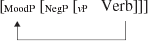
True negative imperatives are formed by verb movement to a Mood projection, as shown in (6) below. In later work (Zeijlstra, personal communication) suggests movement is to C rather than Mood (see also Zeijlstra Reference Zeijlstra2010). Either way, in languages in which negation is an adverb, the verb can freely raise across negation to the appropriate functional projection, since the negative adverb will not block movement (Travis Reference Travis1984).
(6)

Phase VI languages have different properties. The set of Phase VI languages comprises only varieties of English, both standard English and non-standard varieties with negative concord. Standard English stands as the exception to Zeijlstra's generalization that any language with a negative head will exhibit negative concord. As van Gelderen (Reference Gelderen2008) notes, however, there has long been a prescriptive tide against the use of negative concord, and this may have arrested any ‘natural’ move in this direction for standard English varieties. Nevertheless, there are varieties of both British English and African American dialects in which negative concord is the norm, or at least optional (see Poplack Reference Poplack2000, Green Reference Green2002, Iyeiri Reference Iyeiri2005).
In standard English, sentential negation is expressed either by the negative marker n't, a head that is attached to a finite auxiliary verb, or by the negative adverb not. In fact, the literature has debated whether not should be analysed as a negative adverb or as a head (see Zanuttini Reference Zanuttini1991, Reference Zanuttini, Baltin and Collins2001; Haegeman Reference Haegeman1995; Lindstad Reference Lindstad2006). One test used by Zeijlstra (Reference Zeijlstra2004) to determine its syntactic status is Merchant's why not test (Merchant Reference Merchant2001). On Merchant's analysis, the phrase why not is formed by phrasal adjunction, and therefore is only licit with negative adverbs. As one might expect, the why not construction is fine for Phase V languages like German, Dutch, Swedish, and it is also fine for English, suggesting that not is indeed an adverb. We follow Zeijlstra in taking not to be an adverb or an XP.
Turning to imperatives, Zeijlstra's generalization is that languages with a head form of negation ban true negative imperatives. If imperatives with do-support are considered to illustrate a different syntactic structure, then true to the generalization, modern-day English in all its dialectal varieties bans true negative imperatives, but whether the addition of do-support constitutes a different syntactic structure is debatable; it may be that do-support is an independent requirement.Footnote 10 In 15th century English, however, before the introduction of do-support and the negative marker n't, true negative imperatives of the form in (7) clearly did occur (Zeijlstra Reference Zeijlstra2004: 146). At this time, English still exhibited verb movement, so we can assume that the verb moved out of the vP across negation.
(7) Fear not! 15th century English
‘Don't fear!’
In later work, Zeijlstra (Reference Zeijlstra and Biberauer2008a) raises the possibility that English is actually a Phase V language with only a negative adverb. This is because standard English goes against the generalization that languages with a negative head are negative concord languages. The argument would be that all negative auxiliary verbs like don't, can't, etc. are unanalysed whole lexical items and therefore n't is not analysed as a separate head (Pullum & Wilson Reference Pullum and Wilson1977). It is difficult to make this argument for the lexical item doesn't, however, since this particular negative auxiliary verb realizes the agreement morpheme-internally to the word, splitting the word don't.Footnote 11 It seems unlikely that this form, too, is simply learned as an unanalysed whole. We will therefore continue to assume that English is a Phase VI language with both a negative adverb and a head form of negation, n't, as in the earlier proposal.
2.3 The syntax of negation
The theory of negation proposed by Zeijlstra (Reference Zeijlstra2004, Reference Zeijlstra, Cate and Zeevat2007, Reference Zeijlstra and Biberauer2008a) is couched in the minimalist program (Chomsky Reference Chomsky1995, Reference Chomsky, Martin, Michaels and Uriagereka2000). Within minimalism, semantic features are distinguished from formal features. Semantic features have semantic content and do not trigger syntactic operations while formal features may or may not have semantic content. If they have semantic content, they are interpretable and can be interpreted at LF, but if they are without semantic content, they are uninterpretable and must be deleted during the derivation before reaching LF. The deletion takes place in the syntactic component once a checking relation with a corresponding interpretable feature is established, through the mechanism of Agree (Chomsky Reference Chomsky, Martin, Michaels and Uriagereka2000). Working within this framework, Zeijlstra assumes that negative markers can carry either semantic features or uninterpretable formal features.
In Dutch and German and other V2 languages with semantic negation, the negative adverb is adjoined as a vP adjunct, as illustrated in (8a) (but see also Lindstad Reference Lindstad2006 for Norwegian). The negative adverb carries a semantic feature [NEG], as shown in (8b), that is directly interpreted at LF.
- (8)
(a) [vP niet [vP ]] Dutch
(b) Jan loopt niet[NEG].
Jan walks not
‘Jan doesn't walk.’
English also has a negative adverb, not, so one possibility is that this is adjoined to vP, just as in Dutch. However, since adult English also has a head form of negation that motivates a NegP projection, not could also be positioned in the specifier of the NegP projection. Either way, it can be assumed that not carries a semantic [NEG] feature.
Negation implicates formal features in English because English has the head form of negation n't in addition to its adverbial form. In a sentence like (9a), negation is licensed in the syntactic component.
- (9)
(a) John doesn't walk to school.
(b) [TP John does [NegPOp⌝[iNEG] [Neg0n't[uNEG]] [vP walk to school]]]
As shown in (9b), the negative marker n't is positioned in the head of NegP and carries an uninterpretable negation feature [uNEG] that must be deleted before LF. This uninterpretable negation feature is checked off by a covert operator in SpecNegP that carries an interpretable negation feature ([iNEG]).
In negative concord varieties of English, there are two negative markers in the sentence representation, both carrying an uninterpretable negative feature ([uNEG]). These uninterpretable features are checked against the negative operator with the interpretable negation feature by multiple Agree (Ura Reference Ura1996; Hiraiwa Reference Hiraiwa2001, Reference Hiraiwa2005). Both uninterpretable negative features are thus eliminated before the derivation reaches the interface, yielding one semantic negation, and the interpretation that John did not do anything (but see Haegeman & Lohndal Reference Haegeman and Londahl2010). This is illustrated in (10).
- (10)
(a) John didn't do nothing.
(b) [TP John did [NegPOp⌝[iNEG] [Neg0n't[uNEG]] [vP do nothing[uNEG]]]
To summarize, cross-linguistic data reveal two types of languages. One set of languages has semantic negation, and sentential negation is expressed with a negative adverb. Another set of languages has a head form of negation. These languages have a NegP and negation is licensed in the syntactic component of the grammar. The two cross-linguistic options form the options realized by the Negative Concord Parameter (Zeijlstra Reference Zeijlstra2004, Reference Zeijlstra, Cate and Zeevat2007, Reference Zeijlstra and Biberauer2008a). The generalization is that a language with a negative head is always a negative concord language, but not vice versa. Finally, standard English is exceptional in that it has both semantic negation as well as syntactic negation, and, despite having a negative head, does not have negative concord.
In the next section, we turn to the predictions that Zeijlstra's theory makes for child English.
3. LEARNABILITY AND PREDICTIONS FOR CHILD ENGLISH
Our proposal is that children acquiring standard English begin with the semantic negation value of the Negative Concord Parameter – that is, negation is exclusively adverbial in the early grammar and only considerably later in the course of acquisition do children add the head form of negation to their grammar.
There are a number of reasons why children might initially begin with a parametric option that does not align with the target grammar. In the earlier Principles and Parameters conception of parameters (Chomsky Reference Chomsky1981), in the absence of definitive evidence for one or other binary setting, children could simply pick one parameter value. In some cases, it has been proposed that children may be forced to pick the subset value for learnability reasons and this may not be the target value (see e.g. Berwick & Weinberg Reference Berwick and Weinberg1984, Roeper & Williams Reference Roeper and Williams1987, Wexler & Manzini Reference Wexler and Manzini1987, Crain, Ni & Conway Reference Crain, Ni, Conway, Clifton, Frazier and Rayner1994, Fodor & Sakas Reference Fodor and Sakas2005). A further proposal is that children will initially hypothesize the more economical parameter value. For example, Rizzi argues that a parameter value that requires less articulatory effort at PF will be favored initially, even when it does not match the input from the target language (Rizzi Reference Rizzi, Cinque and Kayne2005).
Alternative notions of computational efficiency or economy could also give rise to parametric differences.Footnote 12Thráinsson (Reference Thráinsson, Abraham, Epstein, Thráinsson and Zwart1996) argues that Chomsky's (Reference Chomsky and Freiden1991) general principle of economy of representation guides the child to follow the ‘Real Minimalist Principle’, that is, to ‘[a]ssume only those functional categories that you have evidence for’ (Thráinsson Reference Thráinsson, Abraham, Epstein, Thráinsson and Zwart1996: 261). Zeijlstra (Reference Zeijlstra, Cate and Zeevat2007, Reference Zeijlstra and Biberauer2008a) also uses a version of economy to argue for a default option for the Negative Concord Parameter. The idea is that the most economical or simple way to express negation is with a negative adverb, because this does not require the learner to build the structure for a NegP; the adverb can simply be adjoined in the verb phrase. The grammar is hypothesized to be simpler because it does not require formal features. The consequence is that language learners will initially take this option. If there is linguistic evidence available, the learner can posit a NegP functional category in their sentence representation, in which case their grammar takes the alternate value for the Negative Concord Parameter. In Zeijlstra's work, this idea extends beyond negation and is formalized more generally as the Flexible Formal Feature Hypothesis (FFFH).
3.1 The Flexible Formal Feature Hypothesis
The Flexible Formal Feature Hypothesis (FFFH) is stated in Zeijlstra (Reference Zeijlstra, Cate and Zeevat2007) as follows:
- (11)
(a) Every feature [F] is first analysed as a semantic feature ([F]).
(b) Only if there are doubling effects with respect to F in the language input, [F] has to be reanalyzed as a formal feature [i/uF].
The FFFH assumes that rich morphological structure in the positive input is what drives children to posit functional projections in their sentence representations. Returning to negation, the FFFH requires children to first assume that the language has semantic negation ([NEG)] and, only if there are doubling effects for negation in the input, will they reanalyze or add (in the case of English) negation as formal features ([iNEG] and [uNEG]) to their grammar. In the case of negation, the ‘doubling effects’ are sentences with negative concord since there are two negative markers that add up to one semantic negation. Negative concord sentences thus constitute the input that informs children that (at least) one of the negative markers carries an uninterpretable negation feature that must be checked in the syntactic component. This is what motivates a NegP functional projection. It is important for Zeijlstra's proposal that parameter values are not innately specified. Rather, they arise out of learnability requirements for simplicity.
Let us consider how the FFFH plays out in the grammars of children in different language communities. Children acquiring Phase V languages like Dutch or German, like all other children, initially hypothesize that their language has semantic negation. Since this is the correct option, and there is an appropriate lexical item in the positive input, these children converge speedily on the target grammar. What of children learning French or Italian? In principle, they too hypothesize semantic negation, but exposure to negative concord will soon cause them to reanalyze the local language as having formal features for negation, leading them to add a NegP projection to the grammar. Assuming that negative concord is abundant in the local language, adoption of formal features for negation could be very rapid, to the extent that the earlier, adverbial stage is never realized or detectable in the child's output (see Wexler's Reference Wexler1998 Very Early Parameter Setting).
Now consider children learning English. Once again, the FFFH should guide children to initially hypothesize semantic negation. The lexical items not (and/or no) are negative markers in the positive input that children can recruit for this purpose.Footnote 13 Children learning negative concord varieties of English can switch to formal features for negation once they recognize the ‘doubling’ evidence they need to converge on the adult grammar. Children learning standard English, however, lack exposure to the negative concord data that motivates formal features for negation. In our view, this means that children acquiring standard English refrain from projecting a NegP until alternative sources of linguistic data are forthcoming. This accounts for the protracted development of sentential negation observed in many children. Let us lay out the learning path for children acquiring standard English in more detail.
3.2 Early adverbial negation
The Flexible Formal Feature Hypothesis entreats children to initially posit semantic negation. Children therefore scout the adult input for sentences that contain one semantic negation and identify not and/or no as potential negative adverbs. The items not (and/or no) are assigned a semantic feature for negation [NEG], requiring negation to be interpreted in the semantic component. These items will be used in situations when an adult would use a negative auxiliary verb. Thus, children are predicted to produce sentences like This not fit or possibly This no fit instead of This doesn't fit.Footnote 14 The derivation would be as shown in (12). The verb and subject merge, the negative adverb takes vP as its complement, negating the proposition, after which the subject moves out to SpecTP (see Zeijlstra Reference Zeijlstra2004: 262).
(12) [TP thisi [T [vPnot/no[NEG] [vP ti fit]]]]
The fact that English-speaking children initially hypothesize only semantic negation means that their early English is a Phase V language, similar to many of the Germanic languages. This gives rise to some predictions about further properties of children's grammars at this stage of development.
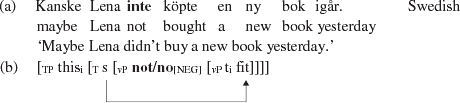
The first prediction is that, in principle, a negative adverb does not block agreement/movement between the tense/agreement morpheme in T and the main verb. This can be illustrated in Phase V V2 languages like Swedish, in which the negative marker is a negative adverb. In V2 contexts, the verb moves over negation to V2 position, but in non-V2 contexts, such as when there is an initial adverb, inflection shows up on the main verb, as shown in (13a) (Vikner Reference Vikner1995). In English, this means that children could produce utterances like This not fits, in which the tense/agreement marker is realized on the main verb (see Bobaljik Reference Bobaljik1994).Footnote 15 This is illustrated in (13b).
(13)
Furthermore, if Bellugi's claim (see Section 1.1 above) that children's early uses of don't and can't at stage 2 are forms of negation rather than auxiliary verbs, these transitional forms can also be analysed as negative adverbs adjoined to vP, just like not. Quite possibly, children suspect that forms like don't and can't differ from not in their distribution (see Schütze Reference Schütze2010), but given that NegP has not yet been adopted into the grammar, they temporarily utilize these forms as vP adjuncts.Footnote 16 Children who take this path potentially could produce utterances like This don't fits, in which inflection associates with the main verb over the negative adverb don't. As a caveat, it has to be recognized, however, that adults do not permit utterances like It not fits, even though not is an adverb for adults also, so if such utterances occur in child grammars, we will need to consider how they are eliminated from the adult grammar.
A second prediction that follows from analyzing early English as a Phase V language is that children should take every negative marker as a form of semantic negation. Thus, early child language should permit double negation, as in sentences like John didn't tell nobody, where the intended meaning is that John told somebody. In practice, this may be difficult to test, as sentences with double negation are likely to be absent from two-year-old children's spontaneous speech for independent reasons. For one thing, double negation is infrequent even in adult languages that allow it (Zeijlstra Reference Zeijlstra2004). Conversely, English-speaking children should not use negative concord at this stage of development. There is nothing to prevent children from producing negative polarity items (henceforth NPIs) such as any in the adverbial stage, however, since the negative adverb can license the NPI.
A third prediction is that children will produce true negative imperatives. Affirmative imperatives such as Walk! will be produced by all children at all stages, but in the early development of negation, at the stage before do-support is acquired, the true negative imperative correlate Not run! is also predicted to occur, at least in some children's output. Given that there is no verb movement in English, and children know this early (see Wexler Reference Wexler, Lightfoot and Hornstein1994, Reference Wexler1998), the representation for a true negative imperative would be as in (14). An uninterpretable mood feature on the verb checks off its feature with an interpretable feature on the MoodP.Footnote 17
(14) [MoodP[iMOOD] [vPnot [vP run[uMOOD]]]]
It is worth considering what triggers the transition from the early adverbial negation stage of negation to the adult grammar. As we noted, for children learning standard English, there is no doubling evidence in the input to trigger addition of a NegP projection into the functional hierarchy, so some source of linguistic evidence must become available. Following Haegeman (Reference Haegeman1995), Zeijlstra (Reference Zeijlstra2004) observes that questions with raised negative auxiliaries are a potential catalyst to instigate change. Questions with raised negative auxiliaries must be formed by head movement of the negative auxiliary from I to C, which confirms the status of don't, can't, etc. as heads, and not as vP adjuncts. If children recognize these data in the positive input, they will potentially trigger reanalysis of the features on these lexical items.Footnote 18 Negative tags are another potential source of evidence, since these are analysed as reduced questions (e.g. Sailor Reference Sailor2009) and likely to be frequent in the input.Footnote 19
There may be more accessible sources of evidence to trigger adding the ‘negation as a head’ value for the Negative Concord Parameter. Negative auxiliary verbs, which are formed by adjunction of one head to another, should prove an abundant source of evidence. However, decomposing the morphology of negative auxiliary verbs may be problematic for children, since empirical evidence suggests that, at least for a while, don't seems to be treated as a negative adverb, rather than a negative auxiliary verb, at least by some children. The negative auxiliary doesn't may be more informative than most other auxiliary verb forms because the agreement morpheme is internal to the word. This provides overt evidence that the word is formed compositionally from several parts, including n't. We contend that doesn't, in particular, may be an important source of evidence for children to trigger change to the adult grammar.
Once children use negative auxiliary verbs productively (and doesn't, in particular) we can infer that negation is no longer just semantic negation in children's grammars. We can assume that they have added formal features for negation and incorporated a NegP phrase into their sentence representations.
3.3 Negation as a head
Once children have added n't as a lexical item into their lexicon, they require a NegP projection to license it in the syntactic component of the grammar. The head form of negation, n't, generates an uninterpretable [uNEG] feature in the head position of NegP. In order for the uninterpretable feature on n't to be checked off, the child needs to posit a covert negative operator with an interpretable [iNEG] feature in the SpecNeg position. The negation and auxiliary verb can then merge (Bobaljik Reference Bobaljik1994). The now adult-like representation for the sentence This doesn't fit is shown in (15).
(15) [TP thisi [T does [NegPOp⌝[iNEG] [Neg0n't[uNEG]] [vP ti fit]]]]
Once children adopt the second value of the Negative Concord Parameter, they have moved through one phase of Jespersen's Cycle, from a Phase V to a Phase VI grammar.
The consequence of adding another lexical entry for negation is that children should now be able to produce adult-like sentential negation, sentences like It doesn't fit. The question is whether they retain the form It not fits (if it was used in their earlier Phase V grammar) alongside It doesn't fit. The same question could be asked of negative imperatives. If children produce Not run! at the adverbial stage, do they simply add Don't run! once the head form of negation is in the lexicon, or do they eliminate the earlier form? Clearly the forms It not fits and Not run! are not grammatical in adult English, even though a negative adverb continues to be part of the adult grammar, so they must be eliminated from the grammar at some point. The question for acquisition, though, is when these forms are purged, and on what grounds.
One possibility is that a learnability principle, such as the Uniqueness Principle, kicks in to exclude the possibility that is not supported by the input (Wexler & Culicover Reference Wexler and Culicover1980, Pinker Reference Pinker1984). The Uniqueness Principle does not tolerate two syntactic forms being used for the same meaning, so it could force the non-adult optional form from children's grammar. Another possibility is that the acquisition of do-support has the effect of eliminating the non-adult form. This seems likely, although the mechanism that causes inflection to be blocked from appearing on the main verb is not clear. All we know is that sentences with the adverb not require do-support in the adult grammar (i.e. It does not fit).
The third prediction that follows from Zeijlstra's parameter is that once n't is added to the lexicon and a NegP functional projection is added to the grammar, negative concord is licensed, suggesting that children could, in principle, produce it. Of course, negative concord is not witnessed in the environmental input of children learning standard English, so this prediction may just be an ‘in principle’ prediction that fails to eventuate due to lack of linguistic evidence. At the same time, NPIs such as any are present in the input for children acquiring standard English, so nothing precludes children from producing them, either at the adverbial stage, or once they have adopted a head form of negation, since NPIs are licensed by either type of negative marker in adult English.
It is interesting to speculate about the timing of children's progression to adult-like sentential negation across dialects of English. Children acquiring negative concord dialects are exposed to the doubling of negative markers in the input, so, all things being equal, these children should adopt the ‘negation as a head’ value of the Negative Concord Parameter early. The caveat is that children acquiring any variety of English still have to acquire do-support before they can use the head form of negation to its full extent, so early use of negative concord could be hampered by this fact.
The fourth prediction is that a number of structures should become available to children as part of their syntactic repertoire once they have incorporated the head form of negation. The presence of negative questions with a raised negative auxiliary verb offers uncontroversial evidence that children have adopted n't as a negative head. In adult English, negative questions can be formed with a negative auxiliary verb or with not, but the unmarked way is to use a negative auxiliary verb. As noted, children can only produce this structure once they can move the negative auxiliary verb to the left periphery via head movement, as illustrated in (16).
- (16)
(a) What don't you like?
(b) [CP whatj [C don'ti [TP you [T ti [vP like tj]]]]]
Tag questions are another construction that should not be present at the earlier stage, when negation is restricted to an adverb. Tags can be of two types; invariant, as in (17a), or a form of the auxiliary verb that is dependent on the main clause, as in (17b). The dependent type has long been considered to be some kind of reduced question. An analysis by Sailor (Reference Sailor2009) proposes that dependent tags are derived by I-to-C movement with subsequent ellipsis of the VP. The movement of the negative auxiliary verb to C should mean that children are not able to produce negative tag questions until negation has been analysed as a head. The structure is illustrated in (17c).
- (17)
(a) You like linguistics, eh/huh/right?
(b) You like linguistics, don't you?
(c) You like linguistics [CP [C don'ti [TP you ti [VPlike linguistics]]]]?
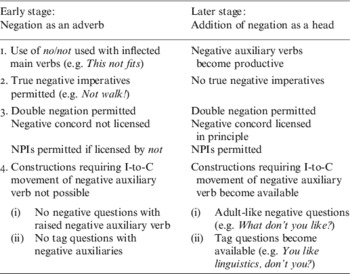
The predictions that follow from Zeijlstra's theory are summarized in Table 1.
Summary of predictions.

4. CHILD DATA
This section investigates our predictions for child language (outlined in Sections 3.2 and 3.3 above) based on Zeijlstra's (Reference Zeijlstra2004, Reference Zeijlstra, Cate and Zeevat2007, Reference Zeijlstra and Biberauer2008a) theory. We have identified a cluster of linguistic properties that may be identifiable in children's output when they have a Phase V grammar, and a different constellation of properties that should be present in the Phase VI grammar. In order to test the proposal, however, a criterion needs to be identified for deciding the age or stage at which children add the ‘negation as a head’ option to their grammars. For the Harvard children, the turning point can be the age at which Bellugi (Reference Bellugi1967) claims the children enter stage 3 in the acquisition of negation, since this is when they are reported to use negative auxiliary verbs productively. A more conservative measure proposed in Thornton & Tesan (Reference Thornton and Tesan2007) is to take productive use of the auxiliary verb doesn't as indication that children have added n't as a head; we will use this criterion for our investigation of the first prediction.
In order to test the predictions we will draw on a variety of sources of child data from the literature, including data from children's spontaneous productions as well as experimental data. The spontaneous production data include diary data from one child, Laura (Thornton, unpublished data), as well as data culled from the transcripts of the Harvard children (Brown Reference Brown1973) and the Belfast corpus (Henry Reference Henry1995, Wilson & Henry Reference Wilson and Henry1998) in the CHILDES database (MacWhinney Reference MacWhinney2000). Because children acquiring English produce comparatively few negative sentences in their spontaneous speech at stages 1 and 2, we also present longitudinal data from four children that were gathered using elicited production methodology. This methodology allowed us to probe two-year-old children's use of negation and inflection in 3rd person singular contexts (see Thornton & Tesan Reference Thornton and Tesan2007).Footnote 20 This richer data set allows us to test the first prediction that follows from Zeijlstra's proposal. To further put our proposal to the test, we also discuss an experiment eliciting negative questions conducted by Guasti, Thornton & Wexler (Reference Guasti Maria, Thornton and Wexler1996).
4.1 Prediction 1
At the adverbial negation stage, children should, in principle, be able to produce negative sentences in which the main verb is inflected, such as This not fits or This don't fits.
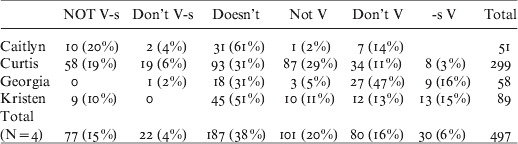
The interaction of inflection and negation was studied longitudinally in four two-year-old children (Tesan Reference Tesan2005, Thornton & Tesan Reference Thornton and Tesan2007). The children visited our language acquisition laboratory every two weeks for about a year. Details of the children's participation are listed in Appendix B. The elicited production study targeted sentences with third person singular subjects, since these sentences provide the most information about children's knowledge of negation as it interacts with inflection.
As is usual for children in the optional infinitive stage of development, the four children all frequently omitted the morphology in their utterances with 3rd person subjects (see Rizzi Reference Rizzi1994; Wexler Reference Wexler, Lightfoot and Hornstein1994, Reference Wexler1998). Our focus, however, is those productions in which inflection was present in children's negative sentences. The important finding is that among those utterances with overt inflection were ones that conformed to Prediction 1. That is, three of the four children produced some number of utterances in which inflection was positioned on the main verb, such as He not fits in there. Utterances of this kind have been previously mentioned only in passing, and have usually been interpreted as performance errors due to their infrequent appearance.Footnote 21 The fourth child from the group produced fewer negative sentences, but nevertheless did produce one utterance of the form This don't fits in here.
The children's data also revealed another type of utterance that has not been well documented in the literature. The children produced some utterances with what we term ‘misplaced’ morphology, ones like He -s fit in there or negative ones like He -s not fit in there.Footnote 22 The utterances with ‘misplaced morphology’ are not informative for the present inquiry and are therefore excluded from the data we present, but for completeness, they are included in the summary of the data in Appendix C.Footnote 23
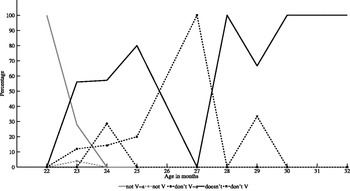
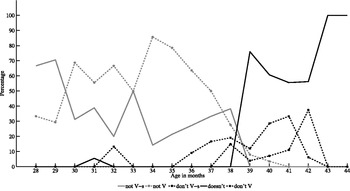
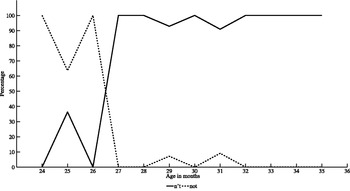
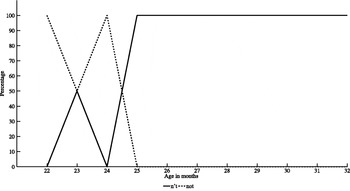
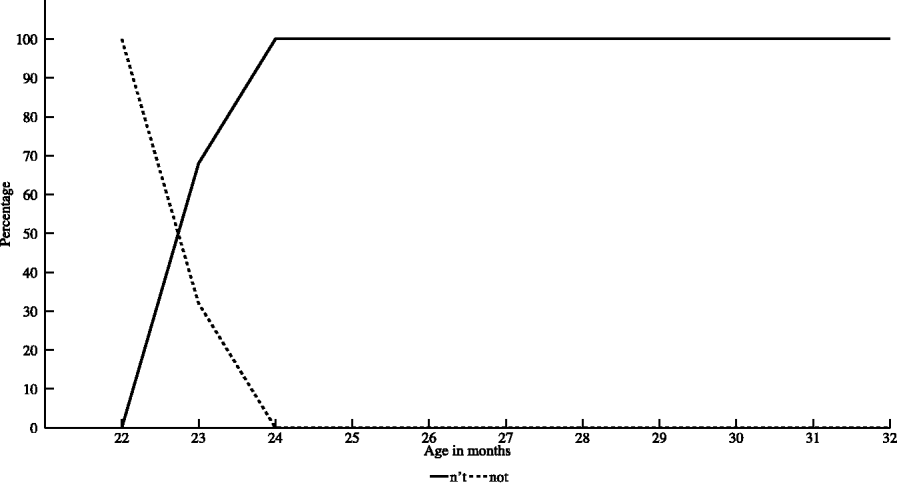
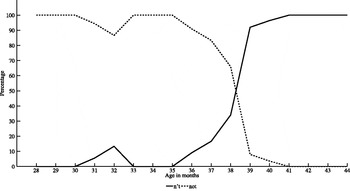
The four children's data that are represented in the graphs in this paper include only sentences with 3rd person singular subjects, since these data reveal the position of the tense/agreement morpheme, if present. The first graph for each child shows the variety of utterances that express sentential negation in combination with a lexical verb, excluding the copula.Footnote 24 Following this, we present a second graph for each child that collapses the data according to whether their negative sentences incorporate the lexical item not or n't. These graphs all show a sharp transition between use of not being exchanged for n't. The data show that when children add the head value of the Negative Concord Parameter, they cease to use the adverb, at least for their productions of lexical verbs with third person subjects.
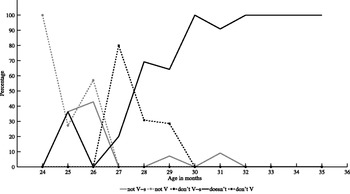
Turning to the first of the four children, this child, Kristen, produced a variety of negative structures, among them sentences with negation and an inflected main verb. The utterances of the form This not fits were soon replaced by don't and then doesn't, as shown in Figure 1.
Kristen's negative sentences with 3rd person subjects by age in months.

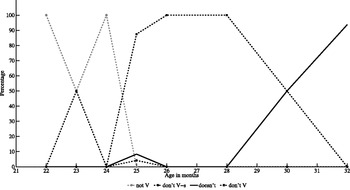
The next child, Georgia, was a conservative learner and produced few negative sentences. This child did not produce not with inflected main verbs, but she produced one instance of don't used with an inflected main verb among her utterances. Therefore, although the support is limited for Prediction 1, her data are compatible with the prediction. Georgia's data are shown in Figure 2.
Georgia's negative sentences with 3rd person subjects by age in months.

The data for Caitlyn are shown in Figure 3. Caitlyn was the fastest to develop linguistically, rapidly becoming adult-like at just over two-and-a-half years of age, a good year earlier than Curtis, the child whose data follow, and considerably earlier than the majority of the children whose data are recorded in the CHILDES database. Caitlyn began using sentential negation by using not plus an inflected main verb, so her data support the proposal that children begin with a negative adverb.
Caitlyn's negative sentences with 3rd person subjects by age in months.

The final child, Curtis, exhibited the most chaotic path of development. There were many cases of utterances with not and an inflected main verb in his early productions. He vacillated between alternative structures for negative sentences for many months. When he finally acquired the form doesn't at age 3;2, adult-like negative sentences dominated the other forms of negation, which gradually disappeared, but not before he was about three-and-a-half years old. Curtis's development of negation is shown in Figure 4.
Curtis's negative sentences with 3rd person subjects by age in months.

Although each child showed a different profile when their negative sentences were charted, the following graphs from each of the children show that once the data are organized by negative marker, not or n't, each child's pattern of development looks remarkably similar, with not being prominent at first, and gradually being replaced by the much more frequent n't marker. The data for the four children are shown in Figures 5–8.
Negative markers n't versus not in Kirsten's grammar.

Negative markers n't versus not in Georgia's grammar.

Negative markers n't versus not in Caitlyn's grammar.
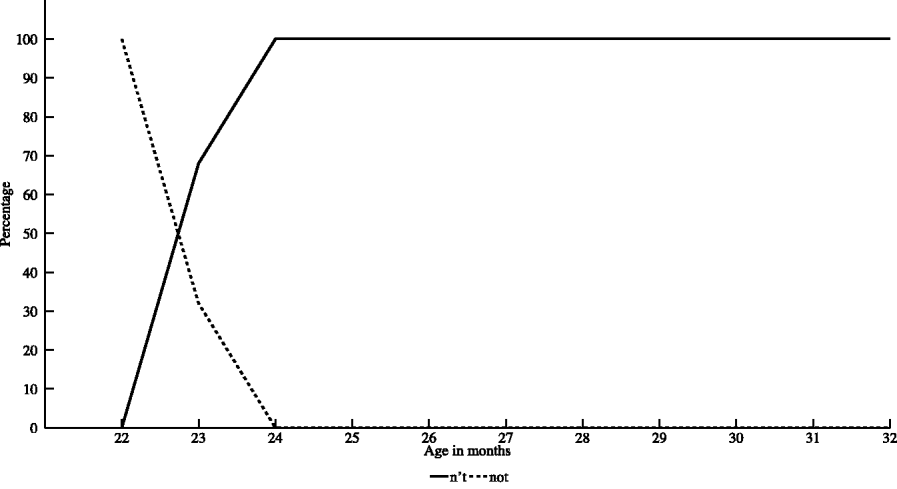
Negative markers n't versus not in Curtis's grammar.

As the graphs illustrate, once children adopted n't as a head and were using the negative auxiliary doesn't productively, utterances like This not fits in here disappeared from children's productions.Footnote 25 There is considerable variation in the age that this takes place, but once it occurs, it is quite rapid. At this point, children have incorporated syntactic negation into their grammar, and added a NegP. The empirical data suggest that acquisition of do-support causes utterances with an inflected main verb to be eliminated, but exactly why this is so is not clear. We simply note here that the ungrammaticality of utterances with negation and an inflected main verb in adult English is also not well understood, especially given that such utterances are perfectly grammatical with the negative adverb never, as in It never fits.
Another potential reason why children might hesitate to use not once doesn't enters the grammar is because they are uncertain about its status as a negative adverb or a head. The positive evidence showing do-support in lieu of sentences with inflected main verbs such as He not fits may lead them to question their former analysis of not as a negative adverb. Consequently they may refrain from its use while they reevaluate its status. Although Zeijlstra (Reference Zeijlstra2004, Reference Zeijlstra and Biberauer2008a) assumes that not is an adverb in the adult grammar, and this is the assumption we follow in this paper, its status as adverb or head has been debated by theoretical linguists (e.g. Chomsky Reference Chomsky1995; Lindstad Reference Lindstad2006; van Gelderen Reference Gelderen2008, Reference Gelderen2011), so its status in child grammar is also worthy of consideration.
Although these issues cannot be resolved, the child data are nevertheless compatible with Prediction 1. The children's data show a rapid change from semantic negation as linguistic evidence causes children to adopt the syntactic negation value of the Negative Concord Parameter. Once children start to use doesn't productively, utterances like This not fits disappear rapidly from the grammar.
4.2 Prediction 2
Children in the adverbial negation stage should produce true negative imperatives. Recall Zeijlstra's (Reference Zeijlstra2004) proposal that Phase V languages, in which negation is a negative adverb, have true negative imperatives, whereas Phase VI languages do not. While there is some uncertainty as to whether negative imperatives with do-support such as Don't run! are true negative imperatives or not, it is clear that imperatives of the form Not run! fit the criterion – such examples show negation simply preceding the affirmative imperative form with no syntactic alternative required for the negative imperative. Evidence that children produce such forms would lend further support for the proposal that children's early grammars are limited to a negative adverb.
Prediction 2 is investigated in diary data from one child, Laura (Thornton, unpublished corpus). Diary data are the source of data here because there are a sizeable number of imperatives, including negative ones, produced at an early age in this corpus. The diary data are comprised of about 4500 utterances, collected from age 1;6 to 2;6.Footnote 26 The first step is to illustrate that this child was in the early semantic negation stage under discussion. Her negative utterances with inflected main verbs at around age 2 shown in (18) confirm she was using not as a negative adverb (age format is shown in years; months.days).
- (18)
(a) Daddy, this is not works. (2;0.4)
(b) This pencil not works. (2;0.4)
(c) This is not goes here. (2;0.6)
(d) This not goes here. (2;0.23)
(e) This not fits. (2;0.25)
(f) But he don't fits. (2;3.8)
About a month earlier, Laura produced negative imperatives, with the form Not + V, as illustrated in (19). The examples in (19d, h) are particularly clear examples of negative imperatives since they are followed directly by a non-negative imperative. Imperatives of this form were frequent at around age two, but then came to an abrupt halt, presumably replaced by Don't + V imperatives (in which don't could still be a transitional adverb, but we cannot tell from its surface form).
- (19)
(a) Not come in, Boomer! (1;11.0) [Boomer is the dog]
(b) Not go here! (1;11.0)
(c) Not sing in the car! (1;11.12)
(d) Not do that! Walk! (1;11.12)
(e) Not sing that song! (1;11.13)
(f) Not play your flower pot! (1;11.27)
(g) Not walk! Dance! (2;0.15)
These data support Prediction 2. True negative imperatives appear in the early grammar when the Negative Concord Parameter defaults to semantic negation. The true negative imperatives are short-lived, however, disappearing well before negation in its head form is added to the grammar. Bellugi (Reference Bellugi1967), for example, gives examples of Don't V imperatives in the Brown (Reference Brown1973) children's grammars at stage 2, so these forms with do-support are documented before children have acquired negation as a head. As we have noted, there is no way to tell whether children use don't in these imperatives as a transitional negative adverb, or whether it is being analysed as a negative auxiliary verb with the negative head n't. Our theory favors the former option, since children are not expected to analyse n't as a head until considerably later in the course of acquisition.
4.3 Prediction 3
In the semantic negation stage, children should permit double negation, and negative concord should not be licensed. Negative polarity items such as any occur in children's input data and children are expected to use them, as long as they are licensed by a negative adverb (i.e. not). Once children have syntactic negation, children's grammars should, in principle, license negative concord. In practice, children may not take up this option but either way, use of NPIs is expected to continue. Children learning negative concord dialects should adopt negative concord early, unless acquiring do-support is a complicating factor.
The first part of Prediction 3 states that at the early semantic negation stage, double negation should be permitted in the grammar. In such Phase V grammars, each instance of negation is semantic negation. Given the cognitive complexity of sentences with double negation, it is unlikely examples will show up in toddlers' speech, and indeed, no such examples have been discussed or observed in the literature. Bellugi (Reference Bellugi1967) explicitly notes that children do not use double negation in their spontaneous production and that it is a late development in English. Experiments will be required to test when children are able to interpret double negation.
Second, at the semantic negation stage, NPIs should be possible, if licensed by a negative adverb. To assess this, Laura's diary data, and Adam and Sarah's transcript data (Brown Reference Brown1973) were searched for NPI any (as well as anymore and anything). In Laura's diary data, the finding is that NPIs emerge early, simultaneously with inflected main verbs and true negative imperatives (as discussed for Prediction 1). As expected, in all of the examples below other than the imperative utterance in (20b), the NPI is licensed by no or not.Footnote 27
- (20)
(a) Boomer's not hungry anymore. (2;0.3)
(b) Don't touch anything! (2;0.7)
(c) I not a dog anymore. (2;0.15)
(d) I'm not scared anymore. (2;0.18)
(e) There's no anymore. (2;0.24) [=no cookies left]
(f) Girl's not sad anymore. (2;0.25)
According to Bellugi (Reference Bellugi1967), Adam and Sarah entered stage 3 and started to use a range of positive and negative auxiliaries productively at quite different ages: Adam was 3;2, and Sarah was 3;8. If we take the children's productive use of negative auxiliary verbs to mean that they have adopted syntactic negation, then we could expect that the children might use NPI any/anymore/anything before this age. Adam has a couple of examples at age 3, but Sarah does not use these items as NPIs in the early period. This is somewhat surprising, given Laura's early uses. Adam's examples are given in (21).
- (21)
(a) I can't wear that anymore. (3;0.2) file 24
(b) He won't have anything to… (3;4.01) file 28
It follows from Zeijlstra's theory of negation that once children have added syntactic negation, sentences with negative concord can be licensed, at least ‘in principle’. The intriguing fact is that Bellugi (Reference Bellugi1967) reported that both Adam and Sarah used negative concord, despite the fact that their parents were not speakers of negative concord dialects.Footnote 28 Crucially, the sentences with negative concord only occurred late in acquisition, after the children had made the transition to stage 3. Some examples from the children are given from Adam in (22) and Sarah in (23).
- (22)
(a) She is not having no picnic. (3;11) file 40
(b) I just don't want nothing in there. (4;0) file 42
(c) I don't want to share none of my books. (4;6) file 49
(d) I'm not scared of nothing. (4;7) file 51
- (23)
(a) I didn't do nothing. (3;5) file 63
(b) I didn't call him nothing. (3;8) file 72
(c) Because nobody didn't broke it. (4;5) file 107
(d) I don't think I can do this no more. (4;8) file 121
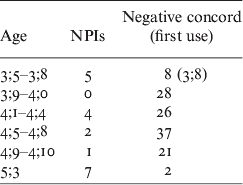
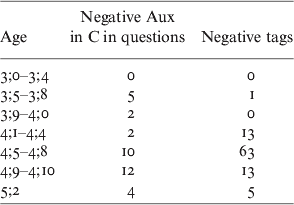
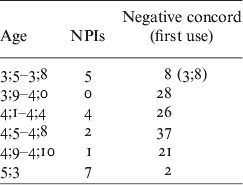
A closer look at Adam and Sarah's data shows that the children both used NPIs and negative concord after syntactic negation has been adopted, but their profiles differed. Recall, Bellugi (Reference Bellugi1967) identified Adam as moving to stage 3 at 3;2. A search of the children's transcripts (Brown Reference Brown1973) revealed that Adam began by using NPIs, but once he started to use negative concord, the NPIs temporarily dropped out of his grammar, appearing again at 4;4. Adam's data, arranged in three-monthly periods, are illustrated in Table 2.
Adam's use of negative polarity items and negative concord by age.
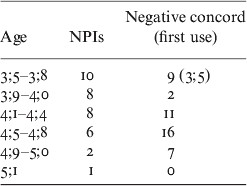
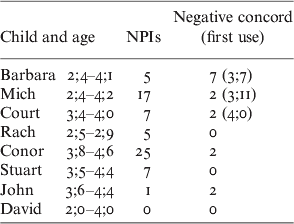
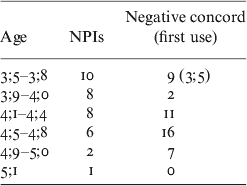
Sarah, on the other hand, used both NPIs and negative concord alongside each other from age 3;5 through to 5;0, so these two structures appeared to be optional in her grammar. As shown in Table 3, Sarah's first use of negative concord is at 3;5 (file 63), so this is three months before it is predicted, according to Bellugi's (Reference Bellugi1967) criterion for moving into stage 3. In this context, it is worth noting that Clark & Clark (Reference Clark and Clark1977) estimate Sarah's transition to stage 3 to be at 3;5, rather than 3;8. If true, this would bring her data in line with the prediction. Notice that Sarah appears to have a strict negative concord dialect, like Czech (recall (1) above), as (23c) above shows that she allows an n-word in subject position in negative concord sentences. Sarah's data are shown in Table 3.
Sarah's use of negative polarity items and negative concord by age.
Although Adam and Sarah take up the negative concord option made available once the grammar has instantiated a NegP functional projection, presumably other children choose not to. The child whose diary data we examined, Laura, for example, did not use negative concord productively. The key point is that Universal Grammar does not prohibit children acquiring any dialect of English from using it once they have added a NegP. This raises the question of how children acquiring standard English get rid of the unwanted negative concord utterances. Since the grammar licenses negative concord, it is quite likely that it does not dissipate until it is stamped out by prescriptive grammar in the school years.
All things being equal, the expectation is that children learning negative concord varieties of English should use negative concord earlier than Adam and Sarah, since they are exposed to the relevant doubling input with two negative markers. There are no sources of African American English available on the CHILDES database that can be used to investigate this prediction. Although there is a limited literature on negative concord in African American English (e.g. Green Reference Green2011), it does not address the age of emergence. There are data from children acquiring Belfast English (Henry Reference Henry1995, Wilson & Henry Reference Wilson and Henry1998) and Bristol English (Wells Reference Wells1981) in the CHILDES database, both of which are varieties of English in which negative concord is optional. Here, the Belfast corpus is used to investigate age of emergence.
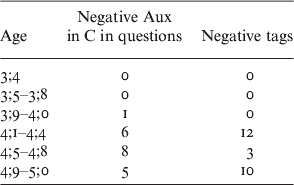
According to Henry et al. (Reference Henry, McLaren, Wilson and Finlay1997), negative concord first appears very late in Belfast English children, with the first instance not appearing until 4;6. This late use is compared with children acquiring Bristol English, who reportedly have command of negative concord by 3;3. Henry et al. (Reference Henry, McLaren, Wilson and Finlay1997) propose that this difference cannot be attributed to frequency of input or to sociolinguistic variables, and suggest that it has its source in distributional facts about negative concord in the two languages. Our own searches of the Belfast English transcripts on CHILDES show earlier use of negative concord than reported by Henry et al. (Reference Henry, McLaren, Wilson and Finlay1997), with one child's first use of negative concord at 3;7, bringing it closer to the reports of children acquiring Bristol English.Footnote 29 The Belfast corpus transcripts reveal that the children do not use negative concord very frequently, with uses of NPIs outnumbering instances of negative concord. These data from the Belfast children are summarized in Table 4.
Negative polarity items and negative concord in the Belfast corpus.
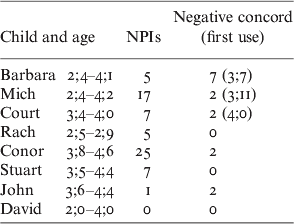
The data from the Belfast children suggest that exposure to negative concord in the input does not speed acquisition of syntactic negation. Both the Brown children and the children in the Belfast corpus start to use negative concord at three-and-a-half years of age or later. It would be useful to see production data from an English variety in which negative concord is the norm, and not optional, as it is in Belfast English, to see whether this has any effect on the emergence of negative concord and the use of NPIs.
There is another interacting variable that may delay use of negative concord no matter what the dialect, or the frequency of its use. It is possible that even if children were to adopt a NegP phrase early due an abundance of negative concord input, in practice, its use could be severely curtailed until do-support has been acquired, typically a fairly late acquisition for English-speaking children. This issue remains for future research.
4.4 Prediction 4
At the semantic negation stage, children cannot produce constructions that require head movement of the negative auxiliary verb. As a consequence, children will not be able to form adult-like negative questions with an auxiliary verb raised to C such as What don't you like? or (dependent) negative tags such as You like linguistics, don't you?. These structures should become available once the child has added a head form of negation to their grammar.
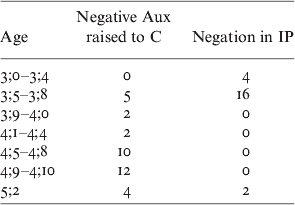
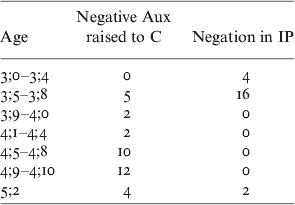
To test Prediction 4, Adam and Sarah's transcripts (Brown Reference Brown1973) were searched to see when these structures emerge. We have seen that Adam entered stage 3 at age 3;2, so his negative questions with raised n't and tags should emerge after this point. The data for his negative questions are summarized in Table 5. The column labeled ‘Negative Aux raised to C’ shows Adam's adult-like questions, and the column showing ‘Negation in IP’ shows any alternative form of negative question in which the negation remained in the IP.
Adam's negative question forms by age.

The transcript data show Adam's first negative questions at 3;4, after he entered Bellugi's stage 3. These first four questions are all why-questions, which, for some children, are optionally formed with an unraised Aux for a considerable period of time, even when other wh-words always appear with a raised Aux (see Thornton Reference Thornton2008). By age 3;5, Adam was producing some yes/no questions with a raised Aux, as well as some with negation remaining in the IP. The main point is that, as predicted, adult-like questions with the negative auxiliary verb raised to C only appear after he has adopted a head form of negation.
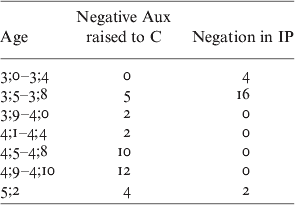
Turning to Sarah, there are no negative questions with a raised Aux before 3;8, the age Bellugi states that she entered stage 3. The first negative question with the Aux raised to C is at 4;0. Overall, Sarah asks few negative questions, however. Sarah's data are shown in Table 6.
Sarah's negative question forms by age.
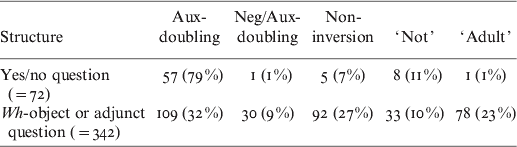
As Sarah's data illustrate, children acquiring English tend to ask few negative questions in their spontaneous speech (see Harris & Wexler Reference Harris, Wexler and Clahsen1996). When the situation calls for a negative question, however, children can oblige. An elicited production experiment by Guasti et al. (Reference Guasti Maria, Thornton and Wexler1996) elicited positive and negative questions from 10 four- and five-year-old children. In their positive questions, children raised the Aux to C 96% of the time in yes/no questions and in 88% of their wh-questions. The children's negative questions took a wide range of forms, however, as illustrated in (24). A raised negative auxiliary verb was used in only 1% of yes/no questions and in 23% of wh-questions (see Stromswold Reference Stromswold1990).
- (24)
(a) What don't you like? Adult form
(b) What do you don't like? Aux-doubling structure
(c) What don't you don't like? Neg/Aux-doubling structure
(d) What you don't like? Noninverted structure
(e) What do you not like? Not-structure
The most common alternative to the adult negative question structure for both wh-questions and yes/no questions was the Aux-doubling structure, shown in (24b) above. A few such Aux-doubling structures were also noted by Stromswold (Reference Stromswold1990) in Adam's questions. Occasionally the negative Aux doubled was doubled, as in (24c). The other structures used by the children in Guasti et al.'s (Reference Guasti Maria, Thornton and Wexler1996) experiment included questions with an unraised auxiliary verb (in contrast to their positive questions) and use of not rather than n't. The figures taken from Guasti et al. (Reference Guasti Maria, Thornton and Wexler1996) are shown in Table 7.
Number and percentage of different negative question structures used by question type for children (N = 10).
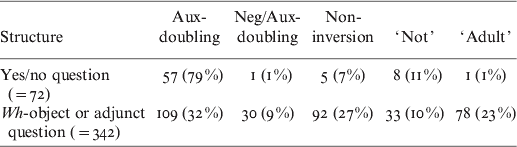
The children's non-adult question structures all have in common the fact that negation remains in the IP domain, and is not raised by head movement to C. In all of these alternative structures that children produce, negation could be analysed as an adverb. In Aux-doubling structures such as What do you don't like? and in non-inversion questions such as What you don't like?, don't could be a transitional negative adverb, as discussed earlier. Children's questions with not are, of course, grammatical in the adult grammar, but they are not adults' preferred form, so they can be interpreted as a strategy to avoid raising a negative Aux to C. In sum, all of children's non-adult question structures with negation in the IP are expected before children add the new value of the Negative Concord Parameter.
There is one fact that does not line up with our predictions. Our investigation suggests that English-speaking children add a head negative marker to their grammar, somewhere between age three and age four, so by age four, children should produce adult-like negative questions. The children in the Guasti et al. (Reference Guasti Maria, Thornton and Wexler1996) experiment were aged four and five, so it is surprising that they are producing this assortment of non-adult structures considerably after syntactic negation should have been incorporated into their grammars. The children are apparently quite conservative, reluctant to implement the consequences of syntactic negation until they are certain.
Tag questions, too, are late in acquisition, as noted originally by Bellugi (Reference Bellugi1967) and predicted by our theory. Recent linguistic theory analyses negative tags as negative questions ‘reduced’ to the tag by VP ellipsis, so the prediction is that the timing should be very similar to negative questions, all things being equal. This is confirmed in Adam and Sarah's data in Tables 8 and 9.
Number of negative questions and negative tags by age for Adam.
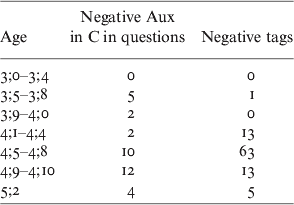
Number of negative questions and negative tags by age for Sarah.
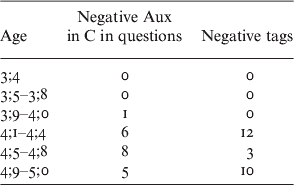
Other than two suspect examples well before age three, Adam's first negative dependent tag in the transcripts is at 3;5, exactly the same age that he starts to use negative questions with a raised negative Aux. Before he started to use dependent tags, according to Bellugi (Reference Bellugi1967), he often formed tags with ‘huh?’ Some examples at 4;0 are given in (25).
- (25)
(a) It's turned on red [?] # huh? (4;0) file 42
(b) That's like you doing thread # huh? (4;0) file 42
(c) I have to get black color # huh? (4;0) file 42
As Table 8 shows, neither negative questions nor negative tags appear often before about 4;5 so productivity of these two structures lags considerably after adoption of the head form of negation into the grammar.
Sarah also produced tags at about the same time as she produced negative questions, again confirming our prediction that these structures follow incorporating the syntactic negation value of the Negative Concord Parameter. Sarah adopts the head form of negation at around 3;8, and the data in the table suggest the two structures become productive between 4;1 and 4;4.
We can conclude that Prediction 4 is supported by Adam and Sarah's data. Syntactic structures that require movement of the negative auxiliary to C are not produced before the grammar has incorporated a head form of negation.
5. CONCLUSION
Textbooks on child language recapitulate the developmental stages that children pass through as they acquire sentential negation, mainly based on the detailed observations of the three Harvard children (Brown Reference Brown1973) recorded in Klima & Bellugi (Reference Klima, Bellugi, Lyons and Wales1966) and Bellugi (Reference Bellugi1967). But exactly why children pass through these stages is not well understood. Children appear to ignore the frequent negative auxiliary verbs in the input and, instead, proceed through a protracted stage of development during which they use not (and to a lesser extent no). Recent literature has attempted to tie children's non-adult forms of sentential negation to the optional infinitive stage of language development, a stage at which tense and agreement are compromised in children's grammars. Although we agree that children's use of tense and/or agreement is not adult-like at this age, we have proposed that there is an additional factor at play. Our proposal is that knowledge of negation is non-adult-like in the early grammar because children's first hypothesis limits them to a negative marker that is an adverb, in keeping with the default value of the Negative Concord Parameter (Zeijlstra Reference Zeijlstra2004, Reference Zeijlstra, Cate and Zeevat2007, Reference Zeijlstra and Biberauer2008a).
Adopting Zeijlstra's Flexible Formal Features Hypothesis (FFFH), we suppose that children initially posit semantic features for negation. Children begin with semantic negation because it does not entail structure building in the form of positing a unique functional projection for negation. Children add syntactic negation to their grammar in response to positive input revealing that there is a negative head in the target language. At this point, they posit a NegP functional projection and can check formal features for negation in the syntax.
According to Zeijlstra's proposal, the triggering input that compels children to add syntactic negation is negative concord. Structures with negative concord have two negative markers, signaling to children that both negative markers must be checked off in the syntactic component of the grammar (Zeijlstra Reference Zeijlstra2004). The problem with this learnability scenario is that it does not accommodate children acquiring standard English who do not encounter negative concord structures, but nevertheless still need to add a negative marker that is a head (i.e. n't) to their grammar. Negative concord, then, cannot be necessary for adopting syntactic negation (though it should be sufficient to engage this parameter value for other languages). We propose that children learning standard English must find another source of evidence to motivate the NegP projection. Negative auxiliary verbs such as don't, can't, isn't are an abundant source of evidence, but children appear to have some difficulty identifying the negative morpheme. We attribute this to a difficulty in decomposing negative auxiliaries into Aux+n't. This difficulty in decomposition, in turn, explains why English-speaking children remain limited to semantic negation for an extended time period.
Taking Zeijlstra's theory of negation as the backdrop, we predicted a number of properties that children's grammars may exhibit at the earlier stage, when they are confined to semantic negation, and then at the later stage when they have taken the available evidence on board and added syntactic negation, adopting the head value of the Negative Concord Parameter. At the early stages, when negation is an adverb, children potentially allow utterances like It not fits with an inflected main verb, they tolerate true negative imperatives, and they (at least potentially) permit double negation. On the flipside, children at this stage must exclude negative concord, and should be unable to ask adult-like questions with the negative auxiliary verb raised to C, or use negative tags. On the other hand, once children have established the fact that English has a head form of negation, utterances like It not fits rapidly cease, non-adult negative imperatives such as Not walk! disappear, negative concord is (at least in principle) licensed, and constructions requiring movement of the negative auxiliary verb to C become available to children. These predictions have been investigated in a range of empirical data, which has given solid support for our proposed account of the development of sentential negation by English-speaking children.
More generally, usage-based explanations of children's development of negation have more difficulty explaining the mismatch between child and adult grammars. For example, Cameron-Faulkner et al. (Reference Cameron-Faulkner, Lieven and Theakston2007) lay the blame on the child's attentional mechanisms, claiming that the child in their study used the most salient form of negation in the input (i.e. no) as the form to express sentential negation, although this form is typically the form of negation associated with anaphoric negation. This is used in a ‘creative’ way, in combination with verbal predicates, and only later do children become sensitive to the frequency and distribution of negative forms. This kind of explanation for children's non-adult productions seems to go against the spirit of usage-based theories, in that children are apparently not learning the form/function mapping of negative sentences in tandem (see Tomasello Reference Tomasello2000, Reference Tomasello2003; Lieven & Tomasello Reference Lieven, Tomasello, Robinson and Ellis2008). Another challenge for the usage-based approach is to explain why the earlier and later stages of negation are associated with other properties. On the usage-based approach, each property or construction has to be learned separately on the basis of the input. To take one example, it is a challenge for the usage-based account to explain why Adam and Sarah use negative concord late in the course of acquisition, despite the fact that it is missing in the parental input, and why negative questions and tags also emerge late, despite the fact that they are probably more frequent in children's input data.
Our UG-based theory anticipates a mismatch between English-speaking children and adults, based on the fact that children hypothesize semantic negation until they sort out the evidence for syntactic negation. Although children may take some time to analyse the local input, the interim grammar they adopt is UG-compatible, in line with the continuity hypothesis (e.g. Crain & Pietroski Reference Crain and Pietroski2002). Once children adopt syntactic negation, they can converge on the adult grammar. However, syntactic negation permits negative concord, and at least some children acquiring standard English take up this possibility (Bellugi Reference Bellugi1967). These children eventually have to override this option. At present, little is known about the developmental path of children acquiring negative concord dialects, and how this compares with children acquiring non-negative concord dialects. These issues, and many others, represent a rich empirical area for future research in the acquisition of negation in child language.
APPENDIX A
Some auxiliary verbs and modals are collapsed. The adverb never is also included in the counts.

APPENDIX B
Participants' ages and duration of participation in the study
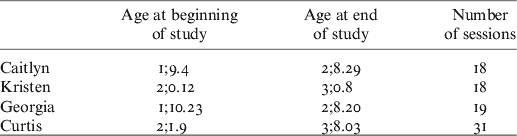
APPENDIX C
Summary of negative sentences with 3rd person subjects and a lexical main verb (excluding BE) for four children (Thornton–Tesan corpus)