Introduction
Aluminum foam with an open-cell structure has high specific strength, damping, temperature resistance, and recovery [Reference Soni and Biswas1, Reference Gibson and Ashby2, Reference Banhart3, Reference Banhart4, Reference Wang, Yang, He and He5]. Open-cell aluminum foam has a particularly strong sound absorption ability for noise in frequencies greater than 800 Hz and is suitable for use in the fields such as noise control for air compressors and generators, viaduct and highway sound-absorbing walls, high-speed rail and subways, mechanical devices, recording studios, and swimming pools [Reference Liu, Li, Fu and Lv6, Reference Kim, Park, Um and Hur7, Reference Han, Seiffert, Zhao and Gibbs8, Reference Arenas and Crocker9].
In recent years, Lu [Reference Lu and Wang10, Reference Lu, Chen and He11], Dupere [Reference Dupere, Dowling and Lu12], Han [Reference Han, Zhu and Liu13], Zhang [Reference Zhang and Chen14], and Chen et al. [Reference Chen, Chen, Xin, Wang, Du and Lu15] have studied the relationship between the sound absorption coefficient and the pore structure of porous metals. Results show that improved sound absorption property of the foam metal can be achieved when the pore size is smaller, porosity is higher, and the material is thicker. Moreover, the sound absorption property of the aluminum foam can be improved by controlling the pore structure [Reference Zheng, Chen and He16, Reference Wang, Li, Chen and Ying17, Reference Han, Seiffert, Zhao and Gibbs18, Reference Byakova, Gnyloskurenko, Bezim’yanny and Nakamura19, Reference Ao, Wang, Tang, Zhi, Ma and Bao20, Reference Wang, Wang, Wu and You21, Reference Li, Wang, Wang, Ren, Han and Wen22, Reference Chen, Liu, Tong and Li23, Reference Xie, Zuo, Wang, Zhong and Dong24, Reference Zhu, Sun, Tang, Wang, Ao, Bao and Song25]. For example, when the porosity is constant, reducing the pore size or increasing the number of holes in the cell wall can improve the sound absorption performance of the foam metal [Reference Chen, Liu, Tong and Li23]. Also, the sound absorption coefficient of foam metal in the medium and high frequency range can be improved via the pore size range that can be widened, gradient, and periodicity [Reference Ao, Wang, Tang, Zhi, Ma and Bao20, Reference Chen, Liu, Tong and Li23, Reference Xie, Zuo, Wang, Zhong and Dong24, Reference Zhu, Sun, Tang, Wang, Ao, Bao and Song25].
Infiltration casting is a common method for preparing open-cell sound absorbing aluminum foam [Reference Han, Seiffert, Zhao and Gibbs18, Reference Wang, Wang, Wu and You21]. But, the sound absorption property of conventional infiltration casting aluminum foam is lower, its average sound absorption coefficient in the 1000–5800 Hz frequency range is usually no more than 0.7, because of its low porosity (60–70%). To improve the sound absorption performance of the aluminum foam, it is necessary to increase the porosity of the infiltration aluminum foam. However, the mechanical properties of infiltration aluminum foam are significantly reduced when porosity is increased [Reference Degischer and Kriszt26]. This significantly affects the potential engineering applications of high-porosity infiltration aluminum foam.
The strength of high-porosity percolation aluminum foam can be improved, however, by a fiber compounding method. When the fiber composite foam is subjected to external force, it can resist external force through interface debonding and pulling out and breaking of the fibers, which can greatly improve its mechanical properties [Reference Tevatia and Srivastava27, Reference Olbricht, Yawny, Young and Eggeler28, Reference McWilliams, Yu, Klier and Yen29]. For example, the yield strength of the aluminum fiber/aluminum alloy composite foam with 86% porosity, 0.1 mm fiber diameter, and a fiber content of 5 vol%, prepared by us in the previous stage, can reach 0.85 MPa, which generates a yield strength 57.41% higher than that of aluminum alloy foam with the same porosity.
At present, numerous research on the sound absorption properties of porous metals is mainly focused on conventional infiltration cast aluminum foams and fiber-sintered porous metal [Reference Zhang and Chen14, Reference Ao, Wang, Tang, Zhi, Ma and Bao20, Reference Navacerrada, Fernández, Díaz and Pedrero30, Reference Li, Li and Han31, Reference Liu, Qing and Hou32]. There is no research on the preparation and sound absorption properties of infiltration fiber/aluminum alloy composite foam with high-porosity. It is unclear what, if any, influence the fiber compounding has on the sound absorption properties of high-porosity infiltration aluminum foam and its sound absorption mechanism. For this reason, we chose to prepare high-porosity ZL104 alloy foam and ZL104 alloy/aluminum fiber composite foams using the infiltration casting method [Reference Zuo, Zhang, Kong, Zhou, Luo, Lu and Liu33]. The pore structure, sound absorption performance, and sound absorption mechanism were studied to provide a useful reference for further research and the development of infiltration aluminum foam with high strength and good sound absorption properties.
Results
Pore structure of ZL104 alloy foams and ZL104 alloy/aluminum fiber composite foams
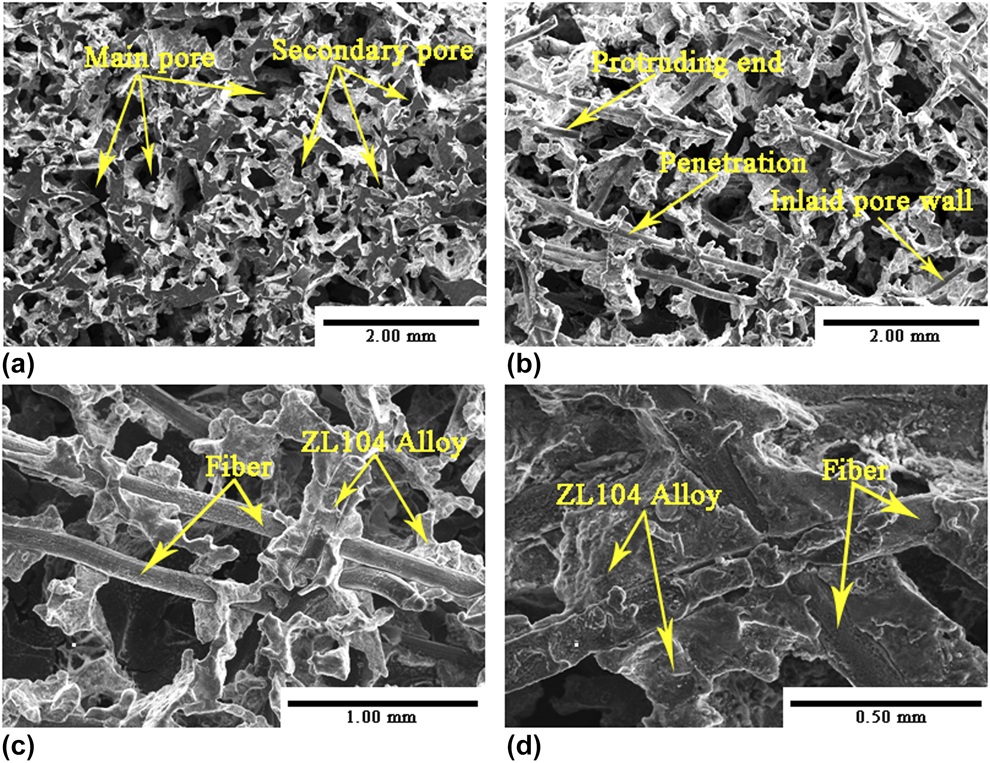
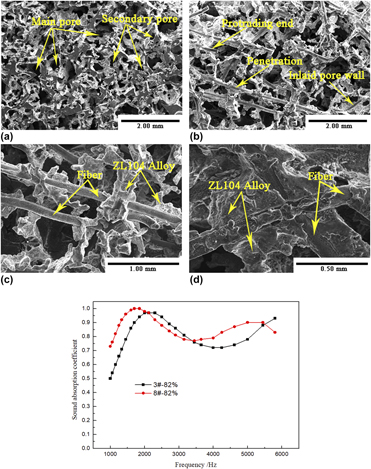
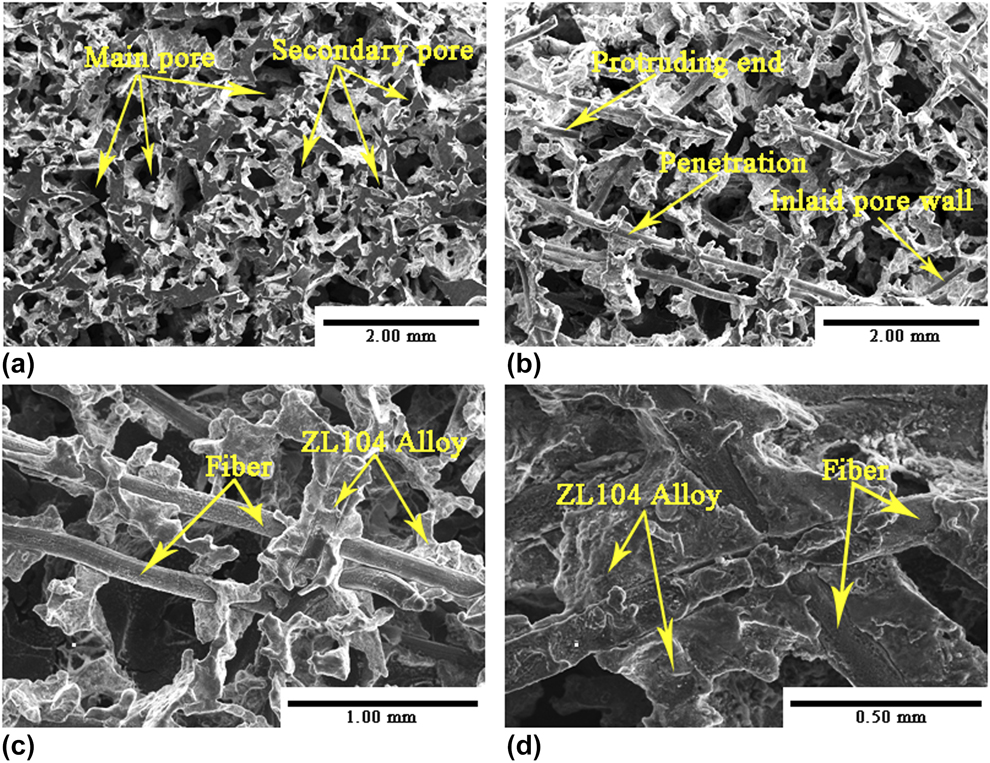
Figure 1 shows the pore structure of the foam samples. Figure 1(a) suggests that the fiber-free alloy foam had a pore structure of secondary pores distributed on the main pore wall, forming a porous pore wall. The pore structure is a mixed-size pores structure consisting of big pores and small pores. The reason is that after mixing the regulating salt (small-size salt particles) and the main salt (big-size salt particles), the regulating salt is distributed in the main salt gaps. These gaps then divide into many smaller gaps, leading to the appearance of secondary pores on the main pore wall after infiltration. This increases the foam sample’s porosity as the bulk density of the salt particles increases. Figures 1(b) and 1(c) are pore structures of 12# fiber composite foam sample. It can be seen that fibers are irregularly interlaced, but are evenly distributed in the fiber composite foam matrix. The fibers exist in three states: (i) as embedded in pore walls, (ii) as penetration pores, and (iii) as partially embedded in the pore wall with the remaining part extending out of the pore. Figure 1(d) shows the morphology of the alloy/fiber composite pore wall of 16# fiber composite foam. It can be seen that the fiber is partially embedded in the pore wall, wrapped by the matrix alloy, and tightly bonded to the matrix alloy which enhances the mechanical properties of composite foam. After the fiber compounding, the complexity of foam pore structure, surface roughness, the specific surface area of fibers, and the specific surface area of pores wall increase because of (i) high-temperature oxidation during pretreatment and infiltration casting and (ii) some fibers being exposed in the pore and a small amount of aluminum alloy adhering to them [Fig. 1(d)].
Pore structures of ZL104 alloy foam and ZL104 alloy/aluminum fiber composite foam: (a) 3# ZL104 alloy foam, (b) 12# fiber composite foam, (c) 12# fiber composite foam, and (d) 16# fiber composite foam.
Sound absorption properties of fiber composite foam
Effect of porosity on sound absorption properties of fiber composite foam
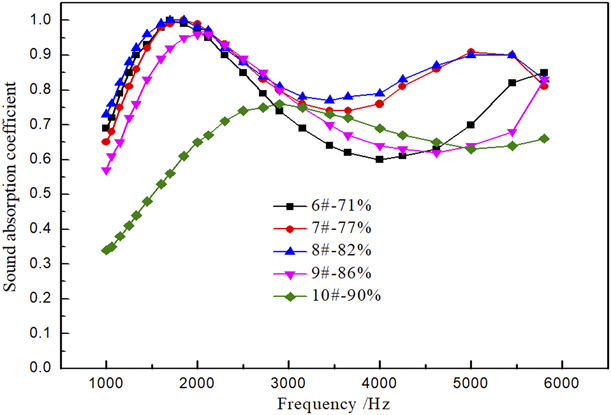
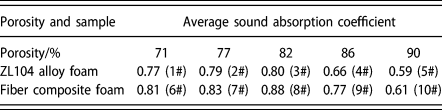
Figure 2 shows the relationship between the sound absorption coefficient of ZL104 alloy/aluminum fiber composite foams and different porosity levels with a fiber (Φ 0.10 × 5 mm) content of 5 vol%, and the corresponding average sound absorption coefficient of the composite foams and ZL104 alloy foams in the range of 1000–5800 Hz is listed in Table I. It can be seen from Fig. 2 that the absorption coefficient of fiber composite foam has a peak and a trough in the sound frequency range of 1000–5800 Hz. The absorption coefficient peak of fiber composite foam moves into the high frequency region as porosity levels increase. The sound frequency corresponding to the peak absorption coefficient of fiber composite foam moves from 1600 to 3000 Hz when the porosity increases from 71 to 90%. It can be seen from Table I that the average sound absorption coefficient of the fiber composite foam is higher than that of the ZL104 alloy foam with the same porosity. The average sound absorption coefficient of these two types of samples increases first and then decreases as porosity increases, with the maximum sound absorption coefficient obtained when the porosity is 82%. The fiber composite foam (8#) with a porosity of 82% has the best sound absorption performance in the frequency range of 1000–5800 Hz, and its average coefficient is 0.88. The main reason is that as porosity increases, the pore number and the pore wall surface area, the friction between acoustic waves and the pores wall, and the number of inelastic collisions all increase, which will consume more acoustic energy. However, when porosity levels are too high, the connection channel between the pore and the pore will enlarge, the specific surface area of the foams will decrease, and the friction and reflection effects on the acoustic waves will be weakened, reducing the sound absorption performance.
Sound absorption coefficient of ZL104 alloy/aluminum fiber composite foams with different porosity in the sound frequency range of 1000–5800 Hz.

Average sound absorption coefficient of the two kinds of foams with different porosity in sound frequency range of 1000–5800 Hz.

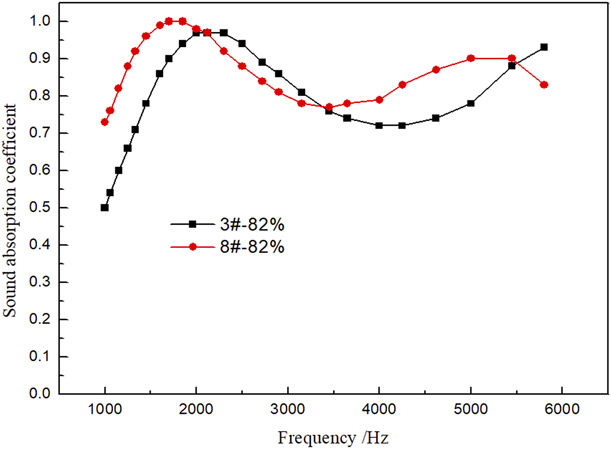
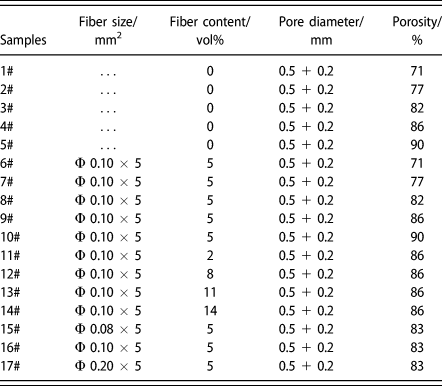
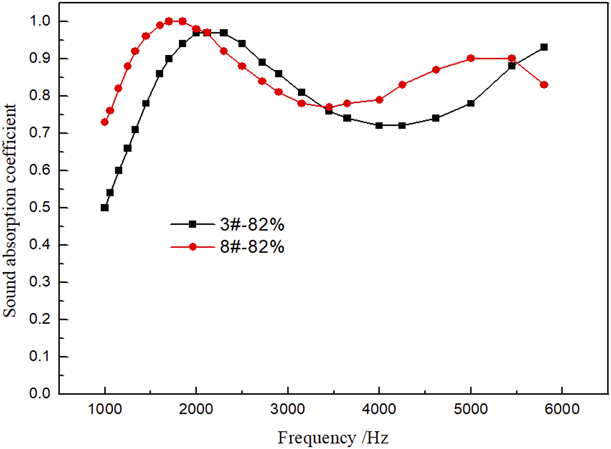
Figure 3 compares the sound absorption coefficient of ZL104 alloy foam (3#) and that of ZL104 alloy/aluminum fiber composite foam (8#), both with the same porosity level of 82% in the 1000–5800 Hz frequency range. It can be seen that the average sound absorption coefficient of the fiber composite foam (0.88) with a porosity of 82% is 10% higher than that of the ZL104 alloy foam (0.80). The fiber compounding effectively improves the sound absorption performance of aluminum foam in low frequency ranges (≤2000 Hz) and in high frequency range (3500–5500 Hz), however, the sound absorption property of composite foam is lower than that of alloy foam in medium frequency range (2000–3500 Hz), so that the corresponding sound absorption peak and sound absorption valley increase and move into the low frequency ranges. The sound absorption coefficient peak value is raised from 0.97 (2300 Hz) to 1 (1700 Hz), and the absorption coefficient trough value increases from 0.72 (4250 Hz) to 0.77 (3450 Hz). Improved sound absorption performance of composite foam is because the fibers are not completely enclosed within the pore wall [Fig. 1(d)]; the surface roughness and specific surface area of the fiber composite foam are significantly enlarged, which increases the collision intensity and friction between the acoustic wave and the pore wall surface and the sound energy consumption increases. At the same time, the sound wave causes the vibrating air to in turn vibrate the fibers in the pore themselves. This consumes the sound energy and further improves its sound absorption performance.
Comparison of sound absorption coefficient between ZL104 alloy foam and ZL104 alloy/aluminum fiber composite foam with porosity of 82% in the 1000–5800 Hz sound frequency range.
Effect of fiber content on the sound absorption properties of fiber composite foam
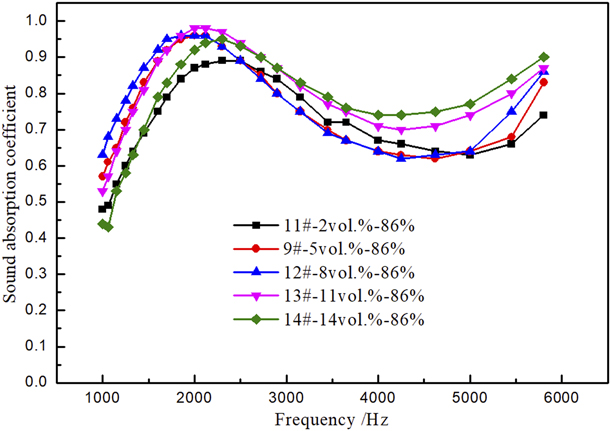
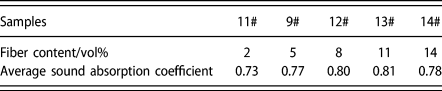
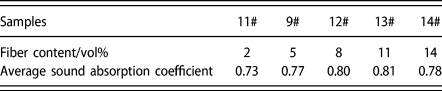
Figure 4 shows the sound absorption coefficient of ZL104 alloy/aluminum fiber composite foams with 86% porosity, a fiber specification Φ 0.10 × 5 mm, and different fiber contents in the 1000–5800 Hz frequency range. It can be seen that in the low frequency zone (<2000 Hz), the composite foam with 8 vol% fiber content has the best sound absorption properties. In the middle and high frequency range (>2500 Hz), the composite foam with a fiber content of 14 vol% has the best sound absorption property. And when the sound frequency is above 5000 Hz, the sound absorption coefficient of the fiber composite foam increases with an increase in the aluminum fiber content. It can be seen from Table II that the average sound absorption coefficient of fiber composite foam first increases and then decreases with increased fiber content. This is due to the pore wall surface roughness and specific surface area of the composite foam increase with increasing the fiber content, resulting in improving sound absorption performance. However, when the fiber content was too high, the fibers tended to cluster and lead to decrease volume fraction of fibers partially wrapped in matrix alloy and the specific surface area of foam, resulting in decreasing the sound absorption property. The coefficient reaches its highest value of 0.81 when the fiber content is 11 vol%.
Sound absorption coefficient of ZL104 alloy/aluminum fiber composite foams with porosity of 86% and different fiber content in the 1000–5800 Hz sound frequency range.

Average sound absorption coefficient of ZL104 alloy/aluminum fiber composite foams with porosity of 86% and different fiber content in 1000–5800 Hz sound frequency range.
Effect of fiber diameter on sound absorption properties of fiber composite foam
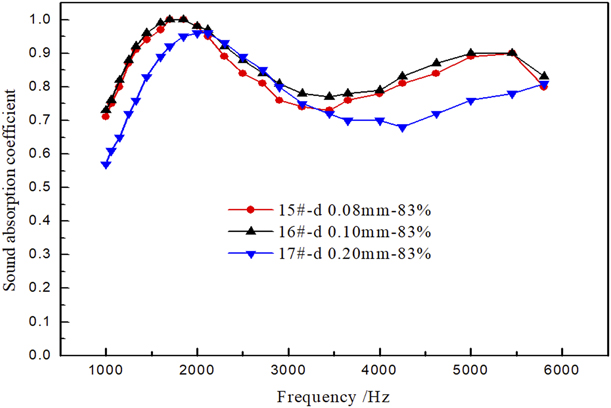
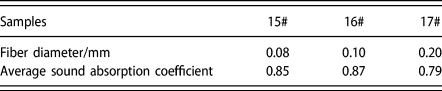
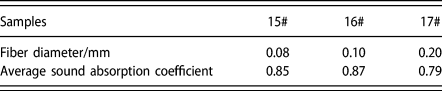
Figure 5 shows the relationship between the sound frequency and sound absorption coefficient of ZL104 alloy/aluminum fiber composite foam with 83% porosity, 5 vol% fiber content, and different fiber diameters. The corresponding average sound absorption coefficient is shown in Table III. The results indicated that the average sound absorption coefficient of the fiber composite foam first increases and then decreases as the fiber diameter increases. The fiber composite foam with 83% porosity has the best sound absorption properties, with an average sound absorption coefficient 0.87, when the fiber diameter is 0.1 mm. The finer the fibers, the smaller the flow resistance to sound waves. With the increase of the fiber diameter, the flow resistance to sound wave increases which improves the sound absorption performance. But when the fiber diameter is too big, the fiber is stronger. Although the flow resistance is increased, the fiber vibration amplitude created by sound waves is weakened, which reduces the enhancement effect of fiber on sound absorption performance.
Sound absorption properties of ZL104 alloy/aluminum fiber composite foams with porosity of 83% and different fiber diameters in the 1000–5800 Hz sound frequency range.

Average sound absorption coefficient of ZL104 alloy/aluminum fiber composite foams with 83% porosity and different fiber diameters in 1000–5800 Hz sound frequency range.
Discussion
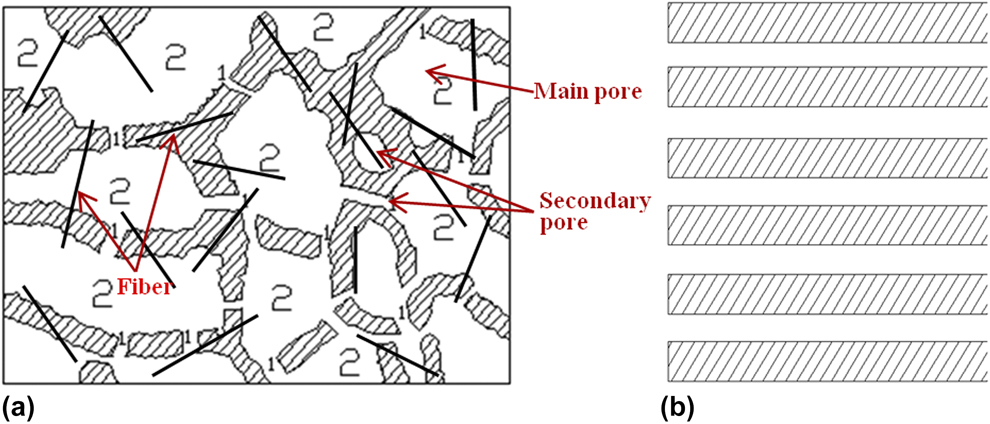
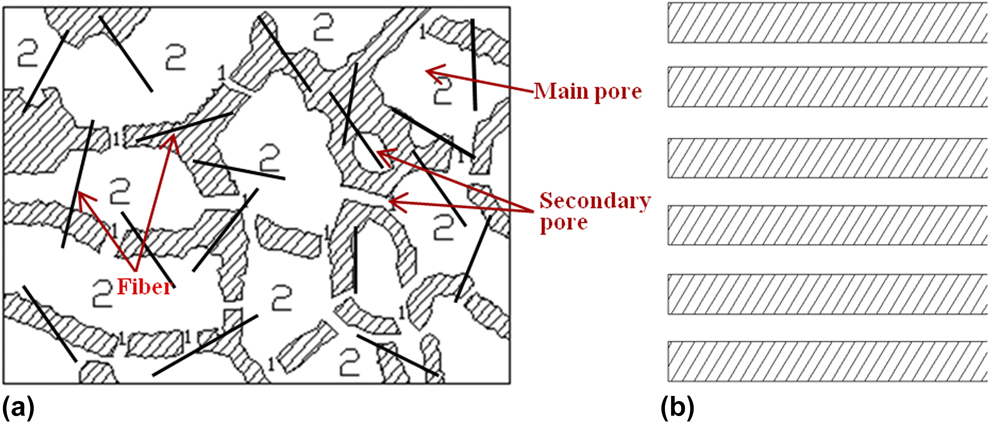
Figure 6 is a circular tube model schematic diagram of foam metal. Figure 6(a) shows that the main pore (big hole) and the secondary pore (small hole) in the fiber composite foam are connected to each other, and the pore wall structure is a composite structure of aluminum alloy and fibers. In the schematic diagram, Position 2 is obtained by removing the filler salt particles, whereas Position 1 is the channel between the filler salt particles. This is a similar structure to that of an expansion and contraction pipe and an expansion chamber muffler model [Reference Ma34]. When the sound waves enter and extrude from pore channels with different diameters, the air is compressed and expanded in the hole to create a heat exchange, and this drives the fibers in the cavity of the fiber composite foams to vibrate and consume sound energy.
Round pipe model with the same pipe diameter of metal foam pore: (a) the pore structure and fiber distribution in fiber composite foam and (b) the round pipe model.
The sound absorption properties of fiber composite foams are significantly affected by pore structure parameters such as porosity, pore size, and static flow resistivity. The method of estimating the sound absorption coefficient is [formula (1)] [Reference Ma34, Reference Xi and Tang35, Reference Allard36, Reference Allard and Atalla37]:
 $$a = 1 - {\left| {{{Z - {\rho _0}{C_0}} \over {Z + {\rho _0}{C_0}}}} \right|^2}\quad ,$$
where a is the sound absorption coefficient of porous material, Z is the surface impedance of porous material, ρ0 is the air density, and C 0 is the propagation speed of sound waves in the air.
If the change in pore size is ignored, the pore structure of fiber composite foam [Fig. 6(a)] is approximate to a circular tube structure [Fig. 6(b)]. When the sound waves propagate in the pipe, the air vibrates and produces the relative displacement velocity to the pore wall surface, which leads to friction and viscosity effect between the air and the pore wall. According to the J–A model [Reference Allard36, Reference Allard and Atalla37], the surface impedance Z of foam metal can be expressed by its characteristic impedance Z c and the sound wave propagation constant k in foam metal [Eq. (2)].
 $$Z = - j{{{Z_{\rm{c}}}} \over \phi }\cot \left( {kt} \right)\quad ,$$
where Z c is the characteristic impedance of foam metal and k is the sound propagation constant of foam metal, ϕ is the porosity of foam metal material, and t is the thickness of foam metal.
Z c and k can be calculated by the effective elastic modulus K of the equivalent fluid and effective density ρ of the equivalent fluid, as shown in expressions (3), (4), (5), and (6).
 $${Z_{\rm{c}}} = \sqrt {K \cdot \rho } \quad ,$$
 $$k = \omega \sqrt {{\rho / K}} \quad ,$$
 $$\rho = {\rho _0}{\alpha _\infty }\left[ {1 + {{\sigma \phi } \over {j\omega {\rho _0}{\alpha _\infty }}}{{\left( {1 + {{4j{\alpha _\infty }^2\eta \omega {\rho _0}} \over {{\sigma ^2}{\Lambda ^2}{\phi ^2}}}} \right)}^{1/2}}} \right]\quad ,$$
 $$K = {{\gamma {P_0}} / {\left\{ {\gamma - \left( {\gamma - 1} \right){{\left[ {1 + {{\sigma '\phi } \over {j{B^2}\omega {\rho _0}{\alpha _\infty }}}{{\left( {1 + {{4j{\alpha _\infty }^2\eta \omega {\rho _0}} \over {{{\sigma '}^2}{{\Lambda '}^2}{\phi ^2}}}} \right)}^{{1 / 2}}}} \right]}^{ - 1}}} \right\}}}\quad ,$$
where α∞ is the tortuosity factor, ρ0 is the air density, σ is the static flow resistivity, ϕ is the porosity, ω is the acoustic angular frequency, γ is the adiabatic constant, P 0 is the air pressure, B 2 is the Prandtl number, η is the air viscous coefficient, Λ is the viscous characteristic scale, and Λ′ is the thermal characteristic scale, as shown in expressions (7) and (8).
 $$\Lambda = {1 \over c}{\left( {{{8{\alpha _\infty }\eta } \over {\sigma \phi }}} \right)^{{1 / 2}}}\quad ,$$
 $$\Lambda ' = {1 \over {c'}}{\left( {{{8{\alpha _\infty }\eta } \over {\sigma \phi }}} \right)^{{1 / 2}}} = {\left( {{{8{\alpha _\infty }\eta } \over {\sigma '\phi }}} \right)^{{1 / 2}}}\quad .$$
Static flow resistivity is an important variable parameter for the influence effect of porous materials on air viscous capacity. It can be calculated approximately by Eq. (9) [Reference Raymond Chu, Naguib and Atalla38]:
 $$\sigma = {{8\mu } \over {\phi {d^2}}}\quad ,$$
where d is the pore diameter and μ is the constant representing the roughness of the pore wall surface.
The sound absorption coefficient of the fiber composite foam can be explained by the J–A model [Eqs. (1)–(9)] [Reference Xi and Tang35, Reference Bies and Hansen39]. According to Eq. (1), the smaller the difference between the surface impedance of the foam material and characteristic impedance (415.33 Pa s/m) of the surrounding air, the better is the sound absorption performance. According to the J–A sound absorption model, the sound absorption coefficient of fiber composite foam primarily depends on the viscosity characteristic scale of the material Λ, the thermal characteristic scale Λ′, the porosity, the tortuosity factor, and the static flow resistivity. Among them, Λ and Λ′ are determined by the porosity, the tortuosity factor, and the static flow resistivity. The static flow resistivity is determined by the pore size, porosity, tortuosity factor, and the surface roughness of the foam pore wall. Therefore, when the pore diameter, porosity, sound frequency, and material thickness are constant, the sound absorption coefficient of foam metal is mostly affected by the roughness and tortuosity factor of the pore wall. After the fiber compounding, the surface roughness and the specific surface area of the pore wall, the friction between the acoustic wave and pore wall, the viscous loss of acoustic waves, and the flow resistivity of fiber composite foam are increased. This is attributed to the influence of these fibers not being completely wrapped, being penetration pores, or extending from one end to the hole [Eq. (9)]. If one ignores the change of material tortuosity factor, the viscosity characteristic scale Λ, the thermal characteristic scale Λ′, the effective elastic modulus K, the effective density ρ, the characteristic impedance Z c, and the surface impedance Z of the fiber composite foam all consistently decrease and the sound absorption coefficient increases.
Thus, compared with 3# ZL104 alloy foam with the same porosity, the 8# fiber composite foam has greater viscosity and a higher reflection effect on the acoustic wave because of the increase in the pore wall surface roughness, its specific surface area, and the static flow resistivity of the composite foam. At the same time, sound waves drive air compression and expansion in the pore which generates a heat exchange and in turn causes fiber vibration in the pore to consume sound energy. Therefore, 8# sample has better sound absorption performance than that of 3# sample (Fig. 3). For the fiber composite foam, when the porosity and fiber specification parameters are constant, the pore wall surface roughness and specific surface area of the composite foam increase with an increase in fiber content, resulting in an improved sound absorption performance. However, when the fiber content was too high, the fibers tended to cluster, which resulted in volume fraction of fiber partially wrapped in matrix alloy and the specific surface area of foam to decrease, leading to a decrease of the sound absorption property. Hence the fiber composite foam with 86% porosity and a fiber diameter of 0.1 mm has the best sound absorption performance when the fiber content is 11 vol%. Adding too many or too few fibers will reduce the sound absorption performance of fiber composite foam (Table II). When the porosity level and fiber content are constant, the over-fine and over-thick fibers will be overwrapped or underwrapped, respectively, by composite foam matrix alloy, which cause the surface roughness and specific surface area of the composite foam to decrease, leading to a decrease in sound absorption performance. The sound absorption performance of fiber composite foam with 83% porosity, a fiber content of 5 vol%, and a fiber diameter of 0.1 mm is better than that of the fiber composite foams whose fiber diameters are too thick (0.2 mm) or too fine (0.08 mm) (Table III).
Conclusions
(1) ZL104 alloy foam and ZL104 alloy/aluminum fiber composite foam have a porosity of 71–90%, a mixed pore structure with main pores of 0.5 mm and secondary pores of 0.2 mm, and a porous pore wall caused by secondary pores distributed randomly on the main pore wall of the composite foam. And the fibers of the ZL104 alloy/aluminum fiber composite foam exist in three states: embedded in the pore wall, penetrating the pores, and those that are partially embedded and extending out from the pore wall.
(2) The sound absorption performance of ZL104 alloy/aluminum fiber composite foams is significantly better than that of ZL104 alloy foams with the same porosity. The former’s average sound absorption coefficient first increases and then decreases with increased porosity levels, fiber content, and fiber diameter. Compared with the alloy foam with the same porosity, the sound absorption coefficient peaks and troughs of fiber composite foams improve and move to the low frequency range, where their sound absorption properties are significantly better compared with those of the alloy foam. The average sound absorption coefficient of the fiber reinforced composite foam with a fiber diameter of Φ 0.1 × 5 mm, a content of 5 vol%, and porosity level of 82% reaches 0.88 in the sound frequency range of 1000–5800 Hz, which is a 10% improvement on ZL104 alloy foam with the same porosity.
(3) According to the J–A sound absorption model, when the porosity, pore size, and tortuosity factor are constant, the sound absorption coefficient of metal foam primarily depends on the surface roughness of the pore wall. After fiber compounding, the surface roughness and specific surface area of the pore walls increase, leading to increase in friction levels between the acoustic wave and the foam pore wall and viscosity losses of acoustic waves in the pores. As a result, the sound absorption performance of the ZL104 alloy/aluminum fiber composite foam improved significantly. In addition, the expansion and compression of the air in the pore hole caused by acoustic waves generates a heat exchange and creates fiber vibration in the pore. This further improve the sound absorption performance of the ZL104 alloy/aluminum fiber composite foam.
Experimental
Materials preparation
High-porosity ZL104 alloy/aluminum fiber composite foam was prepared using an infiltration casting method. ZL104 alloy (9.3% Si, 0.25% Mg, and 0.32% Mn) was used as the substrate material. Aluminum fibers (Φ 0.08 mm × 5 mm, Φ 0.1 mm × 5 mm, and Φ 0.2 mm × 5 mm) were pretreated at 600 °C for 24 h to serve as reinforcement. NaCl particles (diameters of 0.5 and 0.2 mm) and aluminum fibers were evenly mixed and pressed to form a precursor, followed by infiltrating (the infiltration pressure and the infiltration height are 2–4 atm and 60 mm, respectively), cooling, and water desalting. High-porosity ZL104 alloy foams and ZL104 alloy/aluminum fiber composites, each with different pore structures, were prepared by adjusting the process parameters. The fiber and pore structure parameters of these fabricated foam samples are presented in Table IV.
Fiber and pore structure parameters of infiltration foam samples.

Pore structure characterization and sound absorption coefficient test
The pore structure of the aluminum alloy foam and composite foam were affected by different variables. Alloy foam pore structure was affected by its porosity levels and pore size. But the aluminum alloy composite foam was also affected by the additional variables of fiber content, fiber diameter and length, fiber distribution state, and fiber–matrix bonding interface morphology. The porosity of the two kinds of foam was calculated using Eq. (10).
 $$\lambda = \left( {1 - {{{\rho _{{\rm{foam}}}}} \over {{\rho _{{\rm{matrix}}}}}}} \right) \times 100\% \quad .$$
Here, λ is the porosity of the foam, ρfoam is the foam density, and ρmatrix is the ZL104 alloy or the composite foam matrix density.
The pore size of the two kinds of foams were characterized by the NaCl particle size. The fiber content was characterized by volume ratio of the fiber to the composite foam matrix. The pore structure morphology, the fiber distribution pattern, and the fiber–matrix bonding interface of the foam samples were analyzed using an S-3400N (Hitachi High-Technologies Corporation, Tokyo, Japan) scanning electron microscope. According to the GB/T 18696.2-2002 Chinese National Standard, the sound absorption coefficient of Φ 30 × 30 mm foam sample in the frequency range of 1000–5800 Hz was tested by a SW-477 impedance tube (Beijing Prestige Acoustic Electric Company, Beijing, China), and the photograph of the “Φ 30 × 30 mm foam” sample is shown in Fig. S1. The average sound absorption coefficient in this frequency range was calculated using the average value of the sound absorption coefficient corresponding to each test frequency.
Supplementary material
To view supplementary material for this article, please visit https://doi.org/10.1557/jmr.2019.263.
Acknowledgments
This work was supported financially by the National Natural Science Foundation of China (Nos. 51164019, 51741103, and 51861020) and Applied Basic Research Programs of Yunnan Province, China (No. 2010CC004).