Introduction
Brassica rapa L. (n = 10, AA genome) is grown for edible and industrial oil, as a vegetable and for fodder. It has been domesticated over a long period of time in both Europe and Asia. Key crops include: vegetable or fodder turnip (subsp. rapa, formerly subsp. rapifera); oilseed turnip rape (subsp. oleifera); brown sarson or toria (subsp. dichotoma) and yellow sarson (subsp. trilocularis); broccoletto (B. ruvo), a European vegetable with an enlarged, compact inflorescence; Chinese cabbage (subsp. pekinensis), an Asian heading vegetable with winged petioles; pak choi (subsp. chinensis), a Chinese non-heading leaf vegetable with fleshy but non-winged petioles; mizuna (subsp. nipposinica), an Asian non-heading leafy vegetable with many tillers and either pinnate or entire leaves (see Table 1 for scientific authorities not given in the text).
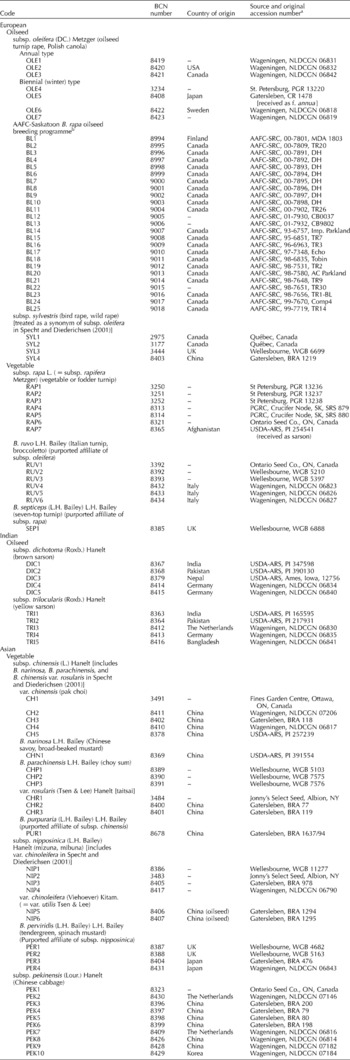
Source of seed and BCN collection number (code used on herbarium specimens deposited in the Agriculture and Agri-Food Canada Vascular Plant Herbarium – DAO) for material of the Brassica rapa cytodeme (B. rapa, B. perviridis, B. purpuraria, B. ruvo and B. septiceps) included in this study

a Sources: Gatersleben, BRA; PGRC, Plant Gene Resources of Canada; VIR, The N.I. Vavilov Institute of Plant Industry, St Petersburg, Russia; USDA-ARS, United States Department of Agriculture, North Central Regional Plant Introduction Station, Ames, Iowa, USA; NLDCGN, Centre for Genetic Resources, Wageningen, The Netherlands; Wellesbourne, WGB, Genetic Resources Unit, Horticulture Research International, Wellesbourne, UK.
b AAFC-SRC, Agriculture and Agri-Food Canada, Saskatoon Research Centre; DH, dihaploid.
Such varied use and corresponding morphological variability has led to the recognition of a large number of both specific and infraspecific taxa (subspecies, varieties and/or cultivars) and varying taxonomic treatments (reviewed in Hanelt, Reference Hanelt and Schultze-Motel1986; Specht and Diederichsen, Reference Specht, Diederichsen and Hanelt2001). Bailey (Reference Bailey1922, Reference Bailey1930, Reference Bailey1940) published extensively on the morphologically based classification of cultivated B. rapa and related species. Hybridization studies by Olsson (Reference Olsson1954) showed that B. rapa, B. campestris and Asian n = 10 taxa corresponding to B. chinensis L., B. narinosa L.H. Bailey, B. nipposinica L.H. Bailey, B. pekinensis (Lour.) Rupr., B. trilocularis (Roxb.) Hook f. & Thoms. and Sinapis dichotoma Roxb. were fully interfertile and, therefore, consistent with their assignment to a single species. Hanelt (Reference Hanelt and Schultze-Motel1986) recognized eight subspecies of B. rapa (reduced to seven in Specht and Diederichsen, Reference Specht, Diederichsen and Hanelt2001) on the basis of morphology, use and area of cultivation. Specht and Diederichsen (Reference Specht, Diederichsen and Hanelt2001) also proposed subspecies affiliations for five n = 10 cultivated taxa – B. dubiosa L.H. Bailey, B. perviridis, B. purpuraria, B. ruvo and B. septiceps – but did not formally place them in synonymy. Although members of the B. rapa cytodeme or Brassica AA genome (Harberd, Reference Harberd, Vaughan, MacLeod and Jones1976; reviewed in Warwick et al., Reference Warwick, Francis and La Fleche2000) are generally fully interfertile, differences in fertility levels vary with different subspecific crosses (Olsson, Reference Olsson1954; McGrath and Quiros, Reference McGrath and Quiros1991).
A number of genetic or phylogenetic relationships have been proposed for taxa within B. rapa, based on morphology, geographical distribution, isozymes and nuclear restriction fragment length polymorphism (RFLP) data (reviewed in Hanelt, Reference Hanelt and Schultze-Motel1986; Song et al., Reference Song, Osborn and Williams1988; Specht and Diederichsen, Reference Specht, Diederichsen and Hanelt2001). Various data have indicated a division of B. rapa into ‘western’ and ‘eastern’ groups, perhaps corresponding to two independent centres of origin (McNaughton, Reference McNaughton and Simmonds1976; Denford and Vaughan, Reference Denford and Vaughan1977; Prakash and Hinata, Reference Prakash and Hinata1980; Song et al., Reference Song, Osborn and Williams1988; McGrath and Quiros, Reference McGrath and Quiros1992). The western, or European, group includes vegetable turnip and oilseed turnip rape; India–Asian oilseed types are putatively derived from the latter. The eastern, or Asian, group contains the various Asian vegetables indicated above.
Molecular markers, including amplified fragment length polymorphisms (AFLP), have been utilized extensively as tools for assessing genetic diversity and genetic relationships in Brassica crop species (reviewed in Snowdon and Friedt, Reference Snowdon and Friedt2004). The AFLP technique produces highly reproducible, dominant markers, well suited for estimating levels of genetic diversity (Vos et al., Reference Vos, Hogers, Bleeker, Reijans, van de Lee, Hornes, Frijters, Pot, Peleman, Kuiper and Zabeau1995). AFLP-based genetic diversity studies have been reported for B. carinata (Warwick et al., Reference Warwick, Gugel, McDonald and Falk2006), B. juncea (Srivastava et al., Reference Srivastava, Gupta, Pental and Pradhan2001; Burton et al., Reference Burton, Ripley, Potts and Salisbury2004), B. napus (Lombard et al., Reference Lombard, Baril, Dubreuil, Blouet and Zhang2000; Seyis et al., Reference Seyis, Snowdon, Lühs and Friedt2003; Sobotka et al., Reference Sobotka, Dolanska, Curn and Ovesna2004), B. nigra (Negi et al., Reference Negi, Sabharwal, Bhat and Lakshmikumaran2004) and B. rapa (Das et al., Reference Das, Rajagopal, Bhatia, Srivastava and Lakshmikumaran1999; Huh and Huh, Reference Huh and Huh2001; Guo et al., Reference Guo, Zhou, Ma and Cao2002; Zhao et al., Reference Zhao, Wang, Deng, Lou, Wu, Sun, Xu, Vromans, Koorneef and Bonnema2005). The purpose of the present study was to evaluate patterns and levels of genetic diversity in Asian, European and Indian accessions of B. rapa based on AFLP polymorphisms, in order to test the separateness of currently recognized subspecific taxa and the purported affiliation of four previously unassigned AA genome species (B. perviridis, B. purpuraria, B. ruvo and B. septiceps), and to compare levels of diversity in breeding lines within a major B. rapa oilseed breeding programme at Agriculture and Agri-Food Canada (AAFC)-Saskatoon.
Materials and methods
Plant material
Accessions, sources of seed and the taxonomic framework of the B. rapa cytodeme examined in this study are listed in Table 1. Specht and Diederichsen's (Reference Specht, Diederichsen and Hanelt2001) taxonomic treatment of B. rapa is followed in Table 1, with the exception of the retention of subsp. sylvestris (Lam.) Janchen as separate from subsp. oleifera, for a total of eight subspecies: subsp. chinensis (includes B. parachinensis, B. narinosa and var. rosularis), subsp. dichotoma, subsp. nipposinica, subsp. oleifera, subsp. pekinensis, subsp. rapa, subsp. sylvestris and subsp. trilocularis, and four affiliated species: B. perviridis, B. purpuraria, B. ruvo and B. septiceps. In addition, 25 breeding lines (BL), which were either a breeding population or dihaploid line, from the AAFC-Saskatoon B. rapa oilseed breeding programme were included in the AFLP analysis. The Canadian AAFC breeding lines were developed from European oilseed rape (subsp. oleifera). The correct identification of all accessions was verified by the senior author.
Amplified fragment length polymorphism (AFLP) protocols
Plants were grown in a controlled environment. Young leaves were collected from each of five individuals per accession and stored at − 80°C. Three DNA samples were prepared for each accession, i.e. from two individuals and one bulked sample was prepared with equal amounts of leaf tissue from three individuals. In total, 279 samples representing 465 individuals were screened for AFLP markers. Genomic DNA was extracted from lyophilized material ground in a Fast Prep FP120 (BIO 101) grinder using the Rapid isopropanol-based DNA extraction method (Edwards et al., Reference Edwards, Johnstone and Thompson1991). AFLPs were generated based on a modified protocol of Vos et al. (Reference Vos, Hogers, Bleeker, Reijans, van de Lee, Hornes, Frijters, Pot, Peleman, Kuiper and Zabeau1995), as detailed in Warwick et al. (Reference Warwick, Gugel, McDonald and Falk2006). Seven selective primer pair combinations were used (Table 2). The amplified products were separated by polyacrylamide gel electrophoresis (PAGE) in an automated sequencer (LI-COR, Lincoln, Nebraska, USA) and infrared gel images were analysed using a geneIR program in LI-COR.
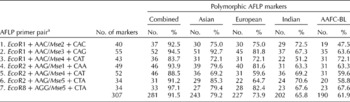
Number (No.) and frequency (%) of polymorphic AFLP markers detected for each of seven AFLP primer pairs for all 93 Brassica rapa accessions (Combined), for Asian, European and Indian subspecies/taxa and AAFC breeding lines (BL), based on 33, 21 and 10 accessions, and 25 breeding lines, respectively

a The core sequences of primers for the selective amplification were as follows: 5′GACTGCGTACCAATTC3′ for the EcoR1 primer and 5′GATGAGTCCTGAGTAA3′ for the Mse1 primer. Each primer contained three selective nucleotides at the 3′ end (e.g. EcoR1+AAC contained the core sequence plus AAC at the end).
Data analysis
AFLP markers were scored as either present (1) or absent (0) for all samples. Fragments showing the same electrophoretic mobility were treated as identical. For each accession, the data from the two individuals and the bulked sample were combined to give a single score of marker presence/absence in a given accession. Pairwise genetic similarity measurements between each accession were obtained from the binary matrix with the Numerical Taxonomy and Multivariate Analysis package in NTSYSpc version 2.1 (Rohlf, Reference Rohlf1997) using the SIMQUAL option. The Sokal and Michener's simple matching (SM) coefficient and the Jaccard ( J) coefficient were computed. Dendrograms were generated from each similarity matrix using the unweighted pair-group method arithmetic average (UPGMA) clustering procedure in a sequential agglomerative hierarchical combinatorial (SAHN) strategy. The degree of relationship between the two similarity matrices (SM and J) was measured using the product–moment correlation r [ = normalized Mantel statistic Z (Mantel, Reference Mantel1967)] between the two similarity matrices calculated using the MXCOMP function in NTSYS. A cophenetic correlation procedure was also used to compare the matrix of ultrametric distances (generated from the tree matrix) with the pairwise SM coefficient similarity matrix.
Results
AFLP data
Approximately 95% of the bands that were present in individual plants were present in bulked samples of the same accession (data not shown). The use of bulked leaf samples from individual plants for AFLP analysis and assessment of genetic diversity was documented for B. carinata (Warwick et al., Reference Warwick, Gugel, McDonald and Falk2006). In previous unpublished results on B. rapa we observed that the resolution of markers observed in bulk samples, i.e. either bulked leaves or bulked DNA samples, beyond 3–5 individuals per sample resulted in reduced resolution. Rare AFLP bands were amplified only faintly and were harder and unlikely to be scored compared to bands that were common to all individuals or at a high frequency in the accession. Although a sample size of five individuals is adequate to represent the diversity in dihaploid breeding lines, greater sampling per accession would be required in order to estimate diversity within genebank accessions or breeding populations. In addition, one can expect differences among accessions received from the various germplasm institutions in this study. The amount of variation in such accessions is dependent on several factors, including sample size of the original seed source, numbers and degree of isolation of plants included in seed increase programmes, as well as the procedures in place at each institution to maintain seed purity and prevent cross-pollination in this self-incompatible species. In this study we have, therefore, focused our comparisons on a broad range of accessions rather than estimating diversity levels within a given accession.
A total of 307 polymorphic AFLP fragments were generated with the seven primer pair combinations [Table 2, Supplementary Table 1 (available online only at http://journals.cambridge.org)]. Fragment size ranged from 56 to 353 bp (Supplementary Table 1). A comparable number of markers (34–55) was generated per primer pair.
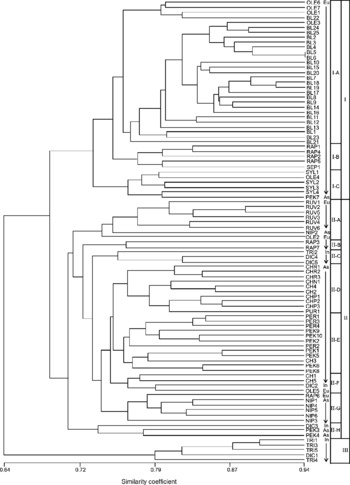
The distance matrices based on the SM and J similarity coefficients were highly correlated (r = 0.94). The high correlation between the SM- and J-based distance matrices showed that the allelic relationship between the absence and presence of a given band can be assumed (Lombard et al., Reference Lombard, Baril, Dubreuil, Blouet and Zhang2000). Since the correlation value for the similarity matrices generated for the SM and J coefficient was so high, only the SM data were used to generate the dendrogram presented here. The dendrogram obtained using the SM coefficient for pairwise distance calculations between accessions is illustrated in Fig. 1. The same dendrogram was also obtained with the J coefficient (available upon request from the senior author). The cophenetic correlation was also high (r = 0.81) for the SM matrix and the cluster matrix, indicating a good fit of the cluster analysis to the SM similarity matrix. Both analyses revealed three main clusters (designated I, II and III) (Fig. 1) and 11 subclusters (I-A, I-B, I-C; II-A, II-B, II-C, II-D, II-E, II-F, II-G and II-H). Clusters I and III were primarily European and Indian in origin, whereas Cluster II contained accessions corresponding to taxa of Asian, European and Indian origins (Fig. 1).
Genetic similarity among 93 accessions of Brassica rapa based on 307 amplified fragment length polymorphism (AFLP) characters, including 25 breeding lines (BL) from the Agriculture and Agri-Food Canada (AAFC)-Saskatoon Research Centre breeding programme. The dendrogram was produced using unweighted pair-group method arithmetic average (UPGMA) clustering of pairwise similarities based on the simple matching (SM) coefficient. Taxon codes and accession numbers are given in Table 1. Purported subspecies/taxa origins are indicated to the right of the accession code, as either Asian (As), European (Eu) or Indian (In). Three main clusters (I, II and III) and 11 subclusters I-A, I-B, I-C, II-A, II-B, II-C, II-D, II-E, II-F, II-G, and II-H are indicated on the right.

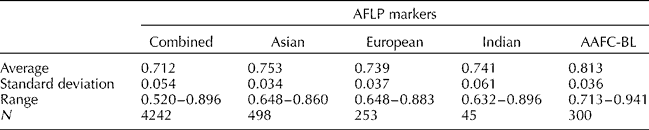
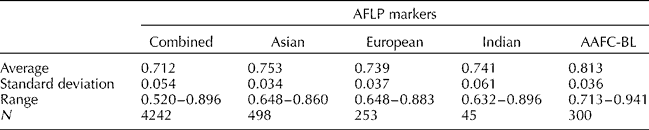
Regional differences in diversity levels, as measured by the proportion of polymorphic loci within groups, were evident, with 79, 74, 66 and 62% polymorphism for Asian, European, Indian subspecies/taxa and AAFC-BL lines, respectively (Table 2). Mean pairwise similarity indices are summarized for all accessions (Combined, Asian, European and Indian accessions) (Table 3). Pairwise similarity measures ranged from 0.520 to 0.941 and were comparable in the European, Asian and Indian groups. However, they were notably less divergent for the AAFC-BL lines (Table 3).
Among accession pairwise similarity values: average, standard deviation, range and number of pairwise comparisons (N) based on 307 AFLP markers for all 93 B. rapa accessions (Combined), for Asian, European and Indian subspecies/taxa and AAFC breeding lines (BL), based on 33, 21 and 10 accessions, and 25 breeding lines, respectively
The discriminating power of each primer pair for fingerprinting cultivars was estimated by computing the number of groups into which the 25 breeding lines from the AAFC-Saskatoon oilseed breeding programme could be separated. The number of unique classes ranged from 22 to 25. Individual primer pairs 2, 3 and 4 uniquely identified all the 25 breeding lines, while primer pairs 1, 5, 6 and 7 identified 22, 24, 23 and 24 of the breeding lines, respectively.
Genetic affiliation
The accessions did not separate clearly into European, Indian and Asian groups (Fig. 1). Only one of the taxa (B. ruvo accessions) formed a separate terminal cluster. Cluster I, the largest European cluster, included most of the accessions of subspp. oleifera, rapa and sylvestris and the AAFC breeding lines (Fig. 1). Subsp. oleifera accession OLE5 (Japanese source) and subsp. rapa accessions RAP3, 6 and 7, and the purportedly European B. ruvo, however, clustered with Asian and Indian accessions in Cluster II. Within Cluster I, the 25 AAFC breeding lines formed a subcluster (I-A) with the subsp. oleifera accessions OLE1, 3, 6 and 7, while B. septiceps formed subcluster (I-B) with subsp. rapa (RAP1, 2, 4 and 5). The four purported wild accessions, subsp. sylvestris, were included in a single subcluster (I-C) along with OLE4 and PEK7. The two Canadian (SYL1 and SYL2) and one European (SYL3) accession clustered with accession OLE4, while the Chinese accession SYL4 clustered with the Asian accession PEK7. With respect to the Indian oilseeds, four of five accessions of subsp. trilocularis formed a distinct cluster with subsp. dichotoma DIC1 (Cluster III), while the other accessions of subsp. dichotoma clustered with an Asian accession of subsp. oleifera (OLE5 with DIC2 in Cluster II-F), subsp. pekinensis (PEK3 and 4 with DIC3 in Cluster II-H), and one accession of subsp. trilocularis (TRI2 with DIC4 and 5 in Cluster II-C). The Asian vegetable groups showed the greatest diversity compared to European accessions, with no clear separation of subspecies in Cluster II. Subspecies chinensis was the most variable, with accessions scattered in several clusters. The accessions CHN1, CHP1–3, CHR1–3 and B. purpuraria formed Cluster II-D with subsp. chinensis accessions CH2 and CH4. Accessions of subsp. pekinensis were also highly variable, and scattered among several clusters. Three of the four accessions of B. perviridis clustered with several PEK accessions in Cluster II-E. Five of the six accessions of subsp. nipposinica (NIP1, 3, 4–6) formed a separate cluster, II-G.
Discussion
Genetic affiliation
A number of putative relationships have been proposed in the literature for members of the B. rapa AA cytodeme (Specht and Diederichsen, Reference Specht, Diederichsen and Hanelt2001) and an assessment of molecular data support for each of these will be discussed separately below. The accessions did not separate clearly into the European, Asian and Indian groups, as suggested by various researchers (e.g. Song et al., Reference Song, Osborn and Williams1988). Instead, several European, Asian and Indian groups were observed, thereby supporting polyphyletic origins for several subspecific taxa.
European
The main European AFLP-based cluster included subspp. oleifera, rapa and sylvestris. Our results were similar to those of the isozyme and RFLP-based study by McGrath and Quiros (Reference McGrath and Quiros1992) and the AFLP-based study by Zhao et al. (Reference Zhao, Wang, Deng, Lou, Wu, Sun, Xu, Vromans, Koorneef and Bonnema2005) where, in general, European accessions grouped more closely with each other than with Asian accessions. The AFLP data set supported the close relationship of subspp. rapa and oleifera, as suggested by Song et al. (Reference Song, Osborn and Williams1988) and McGrath and Quiros (Reference McGrath and Quiros1992). B. ruvo, the purported European vegetable broccoletto, did not cluster with the main European oleifera/rapa group, and thus the data do not support its purported affiliation to subsp. oleifera (Specht and Diederichsen, Reference Specht, Diederichsen and Hanelt2001). B. septiceps, seven-top turnip or Italian kale (a vegetable grown in the eastern United States), clustered with subsp. rapa, supporting its purported affiliation with subsp. rapa (Specht and Diederichsen, Reference Specht, Diederichsen and Hanelt2001). As expected, since derived from European oilseed lines, the 25 AAFC breeding lines clustered with subsp. oleifera. The four purported wild accessions of B. rapa, subsp. sylvestris, were included in the main European cluster. The two Canadian, SYL1 and SYL2, and one European SYL3 accession clustered with accession OLE4, supporting their European origins. The accession SYL4 (Chinese source), however, clustered with the Asian accession PEK7, suggesting a separate origin for this wild accession. These data suggest that the wild type likely has multiple geographic origins, representing escapes from both oilseed and vegetable B. rapa crops, and that its taxonomic placement as a synonym of subsp. oleifera (Specht and Diederichsen, Reference Specht, Diederichsen and Hanelt2001) may not always be the case. It is difficult to locate areas in Europe and Asia where B. rapa has not been previously cultivated and, therefore, it is difficult to separate wild and naturalized populations from recent escapes from cultivation. Accessions SYL1 and SYL2, however, are naturalized weed populations from eastern Canada that do not represent recent crop escapes. Both oilseed and vegetable crop types of B. rapa are also considered to be naturalized in China (Zhou et al., Reference Zhou, Lu, Yang, Al-Shehbaz, ZY and Raven2001).
Indian
The distinctness of the Indian oilseed subsp. trilocularis in our data (Cluster III) was consistent with findings from isozyme-based genetic studies (Simonsen and Heneen, Reference Simonsen and Heneen1995) and crossing studies (McGrath and Quiros, Reference McGrath and Quiros1991) that showed reduced pollen and seed fertility when subspp. trilocularis and dichotoma were crossed with other subspecies of B. rapa. McGrath and Quiros (Reference McGrath and Quiros1992) reported that subsp. trilocularis, the only self-compatible subspecies, showed reduced isozyme variability and had an allelic subset of that found in subsp. dichotoma, suggesting its derivation from the latter. In contrast to an earlier RFLP study (Song et al., Reference Song, Osborn and Williams1988) and an isozyme and RFLP-based study (McGrath and Quiros, Reference McGrath and Quiros1992), the proposed European derivation of either Indian subspecies was not confirmed with our AFLP data.
Asian groups
The Asian vegetable groups showed greater diversity compared to European accessions, with no clear separation of subspecies. This was similar to the findings of the McGrath and Quiros (Reference McGrath and Quiros1992) isozyme and RFLP-based study and the Zhao et al. (Reference Zhao, Wang, Deng, Lou, Wu, Sun, Xu, Vromans, Koorneef and Bonnema2005) AFLP-based study. Subspecies chinensis was the most variable, with accessions in several clusters. This is consistent with the tremendous morphological diversity described for this group (Tsen and Lee, Reference Tsen and Lee1942; McNaughton, Reference McNaughton and Simmonds1976; Nishi, Reference Nishi, Tsunoda, Hinata and Gómez-Campo1980; Lee, Reference Lee1982; Yamagishi et al., Reference Yamagishi, Yui and Ashizawa1985; Toxopeus et al., Reference Toxopeus, Tamagishi and Oost1987; Gladis and Hammer, Reference Gladis and Hammer1992). Subspecies chinensis is recognized as the most ancient type or primary group of Asian vegetables (Hanelt, Reference Hanelt and Schultze-Motel1986), with subspp. pekinensis and nipposinica thought to be derived from subsp. chinensis (Specht and Diederichsen, Reference Specht, Diederichsen and Hanelt2001). The relationships of three morphologically distinct variants, that were previously treated taxonomically as B. narinosa (CHN1), B. parachinensis (CHP1–3) and var. rosularis (CHR1–3), but are all currently placed in the synonymy of subsp. chinensis (Specht and Diederichsen, Reference Specht, Diederichsen and Hanelt2001), were examined. All three taxa, CHN1, CHP1–3 and CHR1–3, clustered with accessions CH2 and CH4, supporting their inclusion within subsp. chinensis and their proposed derivation from subsp. chinensis, as suggested by Song et al. (Reference Song, Osborn and Williams1988) for var. parachinensis. B. purpuraria, described by Bailey (Reference Bailey1940) as a Chinese vegetable with limited cultivation near Nanjing and Beijing, clustered with accessions of subsp. chinensis, supporting Specht and Diederichsen's (Reference Specht, Diederichsen and Hanelt2001) suggested affiliation with subsp. chinensis.
Accessions of subsp. pekinensis were also highly variable, forming several AFLP-based clusters, consistent with multiple and/or hybrid origins for this subspecies. Song et al. (Reference Song, Osborn and Williams1988) also showed the separation of subsp. pekinensis into two groups. Alternative origins of subsp. pekinensis have been proposed, including its origin in central China by hybridization between subspp. rapa and chinensis (Li, Reference Li, Talakar and Griggs1981), from a wild or cultivated plant through differentiation of, and selection from, subsp. chinensis alone (Ten, Reference Ten1980), or derivation from subsp. rapa alone (Ren et al., Reference Ren, McFerson, Li, Kresovich and Lamboy1995). However, none of the above hypotheses could be rejected statistically in a random amplified polymorphic DNA (RAPD)-based study by Ren et al. (Reference Ren, McFerson, Li, Kresovich and Lamboy1995). Our AFLP data set did not support a derivation from subsp. rapa alone, but the clustering of some PEK accessions with subsp. chinensis (in two of the three clusters) is consistent with a common origin with subsp. chinensis, as is evidence from a wild type, with PEK7 and SYL4 forming an AFLP cluster.
Five of the six accessions of subsp. nipposinica (NIP1, 3, 4–6) formed a cluster in the present study. The typical variety, var. nipposinica (NIP1–4) is cultivated as a leaf vegetable in Japan and China, whereas var. chinoleifera ( = var. utilis) (NIP5 and 6), is apparently grown for oilseed production in China. The data, therefore, do not support Specht and Diederichsen's (Reference Specht, Diederichsen and Hanelt2001) suggestion that var. chinoleifera is better placed with the Indian oilseed, subsp. trilocularis. Three of the four accessions of B. perviridis, purported to be originally from Japan and cultivated for 60 years in the south-eastern United States as tendergreen or spinach mustard, clustered with several PEK accessions. The AFLP data, therefore, did not support its purported affiliation with subsp. nipposinica, as suggested by Specht and Diederichsen (Reference Specht, Diederichsen and Hanelt2001) and Song et al. (Reference Song, Osborn and Williams1988).
Diversity levels
The seven AFLP primer pairs used in this study showed similar amounts of polymorphisms (i.e. 84–97%) among the B. rapa accessions. Similar AFLP polymorphism frequencies among EcoR1 or Mse1 primer pairs have been reported in other Brassica studies, including a B. napus study using 17 primer pairs (Lombard et al., Reference Lombard, Baril, Dubreuil, Blouet and Zhang2000), a B. juncea study with ten primer pairs (Burton et al., Reference Burton, Ripley, Potts and Salisbury2004) and a B. carinata study with four primer pairs (Warwick et al., Reference Warwick, Gugel, McDonald and Falk2006).
The present study indicated quite high diversity levels (62–79%) among the B. rapa accessions examined, and although the AAFC-BL lines were notably less divergent, they are still almost double that observed for AAFC breeding lines of B. juncea (see below). Other molecular-based studies have also indicated high levels of genetic diversity in B. rapa. Das et al. (Reference Das, Rajagopal, Bhatia, Srivastava and Lakshmikumaran1999) reported that 69% of 319 AFLP markers and 80% of 125 RAPD markers were polymorphic in nine accessions of B. rapa. In a study of 107 B. rapa oilseed accessions from Tibet, Wang et al. (Reference Wang, Dan, Hu, Tu, Luan, Meng, Zhou, Nimazhuoma and Tan2002) found 89% polymorphism in 236 RAPD bands. Levels were even higher (i.e. 91% of 524 markers were polymorphic) in a larger study of 161 B. rapa accessions (Zhao et al., Reference Zhao, Wang, Deng, Lou, Wu, Sun, Xu, Vromans, Koorneef and Bonnema2005). Similarly high levels of AFLP polymorphism have been reported for two other highly variable Brassica crops, B. napus (Lombard et al., Reference Lombard, Baril, Dubreuil, Blouet and Zhang2000; Seyis et al., Reference Seyis, Snowdon, Lühs and Friedt2003; Sobotka et al., Reference Sobotka, Dolanska, Curn and Ovesna2004) and B. juncea (Srivastava et al., Reference Srivastava, Gupta, Pental and Pradhan2001; Burton et al., Reference Burton, Ripley, Potts and Salisbury2004). Srivastava et al. (Reference Srivastava, Gupta, Pental and Pradhan2001), for example, reported 62% polymorphism in 1251 AFLP markers in a diverse collection of 30 genotypes of B. juncea, while reduced polymorphism levels (i.e. 35% of 751 AFLP bands) were observed for 77 B. juncea oilseed breeding lines from two Canadian and one Australian breeding programmes (Burton et al., Reference Burton, Ripley, Potts and Salisbury2004). High polymorphism levels (79% of 426 AFLP markers) were also found in a study of 18 B. nigra accessions (Negi et al., Reference Negi, Sabharwal, Bhat and Lakshmikumaran2004). In contrast, much lower levels were observed for B. carinata, with only 23% of the 296 AFLP markers polymorphic in a study of 66 accessions (Warwick et al., Reference Warwick, Gugel, McDonald and Falk2006).
AFLPs are important markers for assessing genetic relationships among cultivars and for fingerprinting cultivars. For example, Lombard et al. (Reference Lombard, Baril, Dubreuil, Blouet and Zhang2000) showed that AFLP markers had high discriminating power to easily identify cultivars of B. napus for plant registration and protection purposes, as did the AFLP studies on B. carinata (Warwick et al., Reference Warwick, Gugel, McDonald and Falk2006). The discriminating power of the AFLP primer pairs was also high for the 25 B. rapa breeding lines from the AAFC-Saskatoon oilseed breeding programme examined in the present study. AFLP markers, therefore, exhibit a high level of efficiency for detecting DNA polymorphisms among B. rapa accessions and could serve as a valuable tool for breeders. AFLP-based genetic distance information can be used to make informed decisions regarding the choice of genotypes to cross for developing populations, or to facilitate the identification of diverse parents to cross in hybrid combinations in order to maximize heterosis (Charcosset and Moreau, Reference Charcosset and Moreau2004).
Acknowledgements
This work was funded in part by the Canada-Saskatchewan Agri-Food Innovation Fund under the project ‘Development of novel plant hosts for molecular farming applicable to Saskatchewan’ in collaboration with Dr W. Keller, Plant Biotechnology Institute, NRC, Saskatoon. We wish to acknowledge the support of genebank managers at Wellesbourne, Gatersleben and Wageningen for supplying us with seed samples and thank Dr E. Small and C. Sauder, AAFC-ECORC, and R.K. Gugel, AAFC-SRC, for providing helpful comments on an earlier draft of this manuscript.